Performance Analysis of DSR and OLSR Routing
Protocols in WSN
Archana Chauhan 1 Praveen Sharma2
M-Tech Student1, Assit. Prof. 2 & Department of CSE & NGF College of Engineering &Technology Palwal, Haryana, India
Abstract—Wireless Sensor Network (WSN) has been considered as a distinguished Ad Hoc Network that can be employed to satisfy multiple applications and tasks. Since a WSN contains hundreds of small size, low cost and battery powered sensor nodes. These nodes have the data processing capabilities and event sensing capabilities. Number of routing protocols has been carried out to perform routing in these networks. In this paper, an effort have been made to measure the performance of DSR and OLSR routing protocol employing Random Waypoint model, and also examine how well these chosen protocols performs on WSNs, in fixed environments, employing OPNET 16.0 Simulation tool. The performance measurements of these protocols will concentrate on the effect of the number of nodes and network size. The performance metrics utilized in this work are average end-to-end delay, throughput and network load.
Keywords: Ad-hoc network, OLSR, DSR, MANET, OPNET Simulation, WSN.
I. INTRODUCTION
Wireless sensors network (WSN) is the set of self configured and homogenous nodes called as sensor nodes. These nodes have the data processing capabilities and event sensing capabilities.
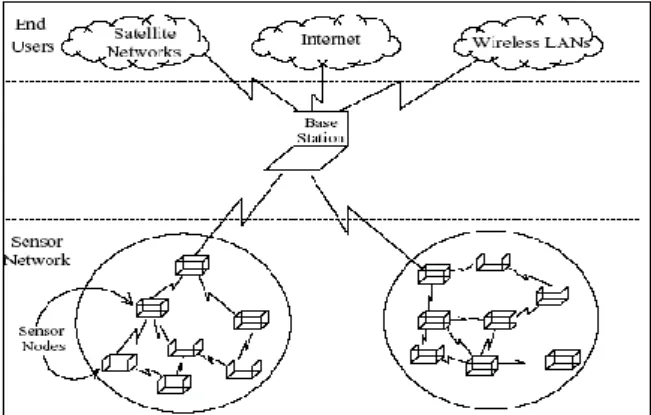
Figure 1 Wireless Sensor Network
The constituents of sensor node are assembled on a single or multiple boards, and bundled in a few cubic inches. A wireless sensor network contains of few to thousands of nodes which interact through wireless mediums for co-operative processing and information sharing. A user can fetch information of his/her interest from the wireless sensor network by placing queries and collecting results from the sink nodes or base stations. The base stations in wireless sensor networks act as an interface between the network and users. Wireless sensor networks can also be taken as a disseminated database as the sensor networks can be linked to the Internet, by which global information sharing becomes viable. Wireless Sensor Networks is composed of number of individual nodes that are capable to communicate with the environment by observing physical parameter or checking the physical parameters, these nodes have to cooperate in order to satisfy their tasks as normally, a single node is not capable of doing so and they utilize wireless communication to enable this cooperation.
II. WSN COMMUNICATION ARCHITECTURE
The protocol stack contains the physical layer, data link layer, network layer, transport layer and application layer. And also contains power management plane, mobility management plane and task management plane. The primary use of protocol stack are combining data with networking protocols, interacts power effectively by the wireless medium. The physical layer is needed for frequency selection, carrier frequency generation, modulation and data encryption, signal detection, transmission and receiving mechanisms. The Data Link Layer is needed for error control, medium access, data frame detection, multiplexing and de- multiplexing of data streams. It also assures reliable point to point and point to multi-hop connections in the network. The MAC layer of data link layer offers the service of collision detection and utilizes minimum power. The network layer is needed for propagating the information obtained from the transport layer i.e. discovering the most effective route for the packet to transport on its way to a destination node. The Transport Layer is required when the sensor network aims to be accessed across the internet. It also supports in keeping the flow of data whenever the application needs it. The application layer is
responsible for representing all needed information to the application and application users and routing requests from the application layer down to the lower layer.
Figure 2: Protocol Stack
III. SIMULATION STATISTICS
In OPNET there are two types of statistics, one is Object statistics and the other is Global statistics. Object statistics can be referred as the statistics that can be gathered from the individual nodes. On the other side Global statistics can be gathered from the whole network. When someone selects the needed statistics then run the simulation to record the statistics.
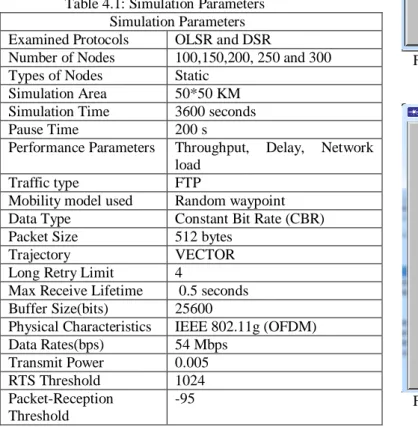
Table 4.1: Simulation Parameters Simulation Parameters Examined Protocols OLSR and DSR
Number of Nodes 100,150,200, 250 and 300
Types of Nodes Static
Simulation Area 50*50 KM
Simulation Time 3600 seconds
Pause Time 200 s
Performance Parameters Throughput, Delay, Network load
Traffic type FTP
Mobility model used Random waypoint
Data Type Constant Bit Rate (CBR)
Packet Size 512 bytes
Trajectory VECTOR
Long Retry Limit 4 Max Receive Lifetime 0.5 seconds Buffer Size(bits) 25600 Physical Characteristics IEEE 802.11g (OFDM) Data Rates(bps) 54 Mbps Transmit Power 0.005 RTS Threshold 1024 Packet-Reception Threshold -95
These gathered results are seen and examined. To see the results right click in the project editor workspace and select view results or click on DES, results then see results.
IV. RESULTS AND ANALYSIS
This chapter represents and examined the results of DSR and OLSR simulations. We have represented our results according to the scenario we select in network having fixed nodes. Fixed node network presents data collecting applications in WSN while mobile nodes shows object tracking applications.
4.1 Network Load
In figure 4.1-4.4, the graphs present the network load in bits per second, wherein the horizontal line indicates the simulation time in seconds and the vertical line shows the network load in bits per second.
Figure 4.1: Network load of OLSR and DSR for 100 Static nodes.
Figure 4.2: Network load of OLSR and DSR for 150 Static nodes.
Figure 4.3: Network load of OLSR and DSR for 200 Static nodes
Figure 4.4: Network load of OLSR and DSR for 250 Static
nodes 4.2 End-to-End Delay
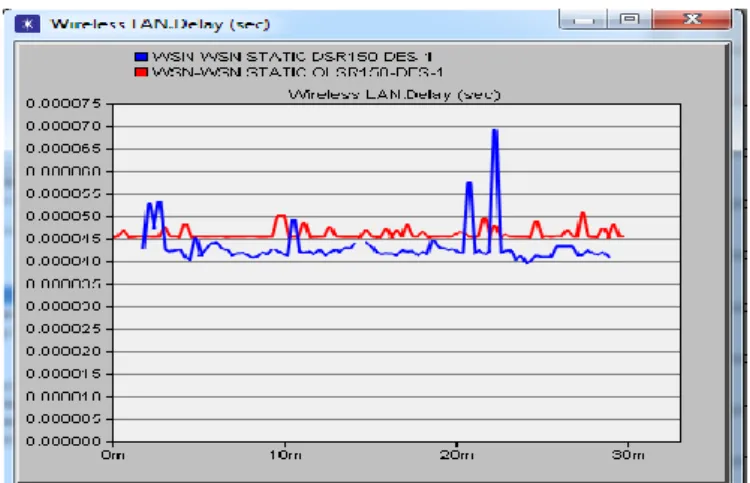
In figure 4.5-4.8, we can view the behavior of DSR and OLSR for 100,150,200 and 250 fixed nodes scenario with and without random node failure. If we view at the scenario without node failure, it is clear from the graph that, OLSR provides the lowest and consistent delay in comparison of DSR in both small and large network.
Figure 4.5: End to End Delay of OLSR and DSR for 100 Static nodes
Figure 4.6: End to End Delay of OLSR and DSR for 150 Static nodes
Figure 4.7: End to End Delay of OLSR and DSR for 200 Static nodes
Figure 4.8: End to End Delay of OLSR and DSR for 250 Static nodes
4.3 Throughput
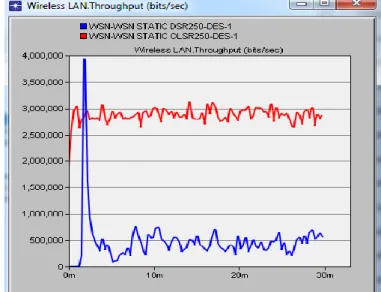
The results of throughput are depicted in figure 4.9-4.12. Throughput is the ratio of total amounts of data that arrives at the receiver end in the specified period of time. The X-axis shows the time in second and Y-Axis shows the throughput in bits per second. With increasing in number of node, the
throughput also increase and thus the performance will be high.
Figure 4.9: Throughput of OLSR and DSR for 100 Static nodes.
Figure 4.10: Throughput of OLSR and DSR for 150 Static nodes
Figure 4.11: Throughput of OLSR and DSR for 200 Static nodes.
Figure 4.12: Throughput of OLSR and DSR for 250 Static nodes.
CONCLUSION
In this study, we have measured two routing protocols for their responses to network scalability and node failure in terms of packet end-to-end delay, throughput, and routing overhead as a performance metrics. The chosen performance metrics were used to identify protocols suitability and effectiveness with respect to reliability and effective utilization of network resources for one kind of network i.e. fixed nodes. Because the requirement for protocol effectiveness and reliability is critical in any network. DSR and OLSR were evaluated in two different scenarios having both small and large number of executing nodes with and without random failure of nodes for fixed node networks. All the nodes in each scenario were utilized as source nodes routing the data to a common base station (destination node). This study examined and proved that OLSR is more reliable protocol with respect to throughput and delay and somewhere an efficient protocol in term of routing overhead based on the network size and type. Although; DSR has its own efficiency regarding network overhead but total performance of OLSR is better as compared to DSR.
REFERENCES
[1] ChenY. S., Y. W. Lin, and S. L. Lee, “A mobicast routing protocol forWireless Sensor Networks(WSN)” in Proceedings of ACM/Springer Mobile Networks and Applications, Vol. 15, 2010, pp.20-35.
[2] SkordylisA. and TrigoniN., “Delay-bounded routing inWireless Sensor Networks(WSN),”in Proceedings of ACM International Symposium on Mobile Ad hoc Networking and Computing, 2008, pp. 3020-3026.
[3] Saha A. K. and Johnson D.B., “Modelling the mobility for Wireless Sensor Networks(WSN),”in Proceedings of ACM International Workshop on Ad Hoc Networks,2004, pp. 91-96.
[4] Vidhale, B.; Dorle, S.S., "Performance Analysis of Routing Protocols in Realistic Environment forWireless Sensor Networks(WSN)," in Proceedings of Systems Engineering (ICSEng), 2011 21st International Conference on , vol.2,Aug. 2011, pp.267-272.
[5]Ait Ali, K.; Baala, O.; Caminada, A., "Routing Mechanisms Analysis inWireless Sensor Networks(WSN),"in Proceedings of Ad hoc Networks Technology Conference , 2011 IEEE 73rd ,May 2011,pp.15-18.
[6] T. Taleb, E. Sakhaee, K. Hashimoto, N. Kato, and Y. Nemoto, “A stablerouting protocol to support ITS services inWireless Sensor Networks(WSN),” in Proceedings of IEEE Transactions on, Vol. 56, 2007, pp. 3337-3347.
[7] YamaguchiH., K. Yukimasa, and S. Kusumoto, “QoS routing Protocol forWireless Sensor Networks(WSN),” in Proceedings of IEEE International Workshopon Quality of Service, 2006, pp. 132-139.
[8] Ding Y,Borcea C. , Xiao L “A static-node assisted adaptive routing protocol inWireless Sensor Networks(WSN)” In Proceedings of the ACM international Workshop onWireless Sensor Networks(WSN), 2007, pp 59–68.
[9] Manvi S., Kakkasageri M.S., Mahapurush , “Performance Analysis of AODV, DSR, Routing Protocols In Wireless Sensor Networks(WSN)” InProceedings ofInternational conference on future Computer and Communication., April. 2009. pp. 21-26.
[10] Bernsen, J. Manivannan, “Routing Protocols for Wireless Sensor Networks(WSN) That Ensure Quality of Service” InProceedings of the fourth internationalconference on Wireless and Mobile Communications., Aug. 2008, pp.1-6. [11] TalebT., E. Sakhaee, A. Jamalipour, K. Hashimoto, N. Kato, and Y. Nemoto, “A stable routing protocol to support its services inWireless Sensor Networks(WSN)” in Proceedings of IEEE Transactions on Wireless and Mobile Communications, vol. 56, no. 6,November 2007, pp.3337– 3347.
[12] GoelA., RamakrishnanK. G., D. Kataria, and D. Logothetis, “Efficient computationof delay-sensitive routes from one source to all destinations,” in Proceedings of IEEEConference on Computer Communications, 2001, pp. 854-858.
[13] BlumJ., EskandarianA., and HoffmanL.. "Performance Characteristics of Wireless Sensor Networks(WSN)". in
Proceedings of IEEE 6th International Conference onComputer Communications, Shanghai, China,2004, Pp. 115-119.
[14] H. Wu, Fujimoto, R., Guensler, R., and Hunter, M, “MDDV: a mobility-centric data dissemination algorithm for Wireless Sensor Networks(WSN),” in Proceedings of the 1st ACM international Workshop onWireless Sensor Networks ,October, 2004,pp. 47-56.
[15] BalonN., and J. Guo, “Increasing Broadcast Reliability inWireless Sensor Networks,”In Proceeding of the 3rd ACM International Workshop on Ad Hoc Networks, NY, USA, 2006, pp. 104-105.