bstract: Constitutions enshrine the fundamental values of a people and build a framework for a state’s public policy. With regard to intergenerational justice, their endurance gives rise to two concerns: the (forgone) welfare concern and the sov ereignty concern. In this paper, I outline a procedure for constitu tionamending that is intergenerationally just. In its line of reason ing, the paper debates ideas such as perpetual constitutions, sunset constitutions, constitutional reform commissions and constitutional conventions both historically and analytically. It arrives at the con clusion that recurrent constitutional reform commissions in fixed time intervals strike the best balance between the necessary rigidity and the necessary flexibility of constitutions.
Introduction1
From the perspective of the reproduction of political orders, con-stitutions are an interesting case. Arguably, they are the most im-portant intergenerational contract in modern society. This raises the question of how binding this contract should be: flexible or fixed?
A “constitution” is usually2 defined as a system of fundamental
principles according to which a state is to be governed. Consti-tutions build a framework for a state’s public policy. They enjoy normative priority over ordinary statutes and regulate the manner in which ordinary laws are made.Constitutions also enshrine the fundamental values of a people, often in their preambles or in their first part. They can (but need not) contain a catalogue of basic human rights and liberties. Constitutions are distinguished from ordinary legislation by their rigidity. Written constitutions usually require legislative supermajorities, concurrent majorities of different houses of the legislature, and/or popular referenda in order to be changed.3 By their very nature, constitutions are
intergenerational documents because they are intended to place certain questions beyond the reach of simple majorities. With few exceptions, they are meant to endure for many generations. This paper proceeds as follows. The next section outlines the inter-generational challenge to “difficult to change” constitutions, start-ing with employstart-ing a thought experiment. After clarifystart-ing my key concepts, and paying tribute to the beginning of the debate, I put forth my proposal for a procedure of constitution-amending that is intergenerationally just. I test this proposal against two main concerns: the (forgone) welfare concern and the sovereignty concern. The conclusion summarises why recurrent constitutional reform commissions in fixed time intervals strike the best balance between the necessary rigidity and the necessary flexibility of con-stitutions, thereby fulfilling the requirements of intergenerational justice. Some questions regarding the possible design for these commissions are outlined for further research.
A thought experiment4
As a thought experiment, let us imagine that the founding fathers (no women are involved) of a newlyformed nation adopt a con stitution. In this constitution, the very last provision stipulates
that no single clause of the constitution be changed or abolished for a time period of 300 years. After that time period, consti tutional changes are possible by a supermajority of 75% of the members of parliament.
This thought experiment is intended to illustrate the challenge that the idea of intergenerational justice poses to “very difficult to change” constitutions. In it, the framers of a constitution impose their will on subsequent generations. Those born in the next three centuries are expected to acquiesce to the norms of this constitu-tion without their consent. But in a democracy, the legitimacy of governance is founded on the consent of the governed. All those who are subject to the rule of a constitution should be able to exert influence over the basic laws that regulate their lives.
“Sovereignty” means the ability of a people, of each generation5 of
citizens, to live under rules of their own choosing. After all, whose is a constitution? If the answer is “the citizens of country X”, this means nothing else than it is the constitution of the citizens current
ly alive. This is the appropriate state of affairs since dead people can
neither be benefited by possessing something, nor harmed by losing a property, including the capacity to rule after their death. But if a constitution is too difficult to change, the dead citizens of country X wield power over the living,6 and the past rules over the present.
It might well not make a difference if those succeeding genera-tions share the values and views of their ancestors, but what if they happen not to? What if succeeding generations see some provi-sions of the constitution as a threat to their long-term well-being, or even as morally wrong? This problem is exacerbated when a sta-ble majority of the citizenry would like to reform the constitution but falls short of the required supermajority of 66% or even 75%. Can we call it “the rule of the people” or “popular sovereignty” if stable majorities (let’s say from 50% + 1 vote up to a three-fifths supermajority) of the present demos cannot change certain consti-tutional clauses for the simple reason that their forefathers put the bar for changing the constitution extremely high? “Generational sovereignty”7 is closely linked to the concept of “legitimacy” for
two reasons, namely that
a) “the people” is considered the only legitimate source of govern-mental power in democracies;
b) as a matter of fact, “the people” does not consist of the same
people over time as generations come and go when time passes.8
Terminology
In his otherwise well-formulated paper The Problem of a Perpetual
Constitution, Victor Muñiz-Fraticelli writes: “A perpetual
consti-tution has no ‘sunset clause’, no date of expiration; it may [my emphasis] contemplate for its amendment and even specify a procedure for its modification, but it does not consider its own
Constitutions as Intergenerational Contracts: Flexible or fixed?
by Jörg Tremmel
A
abolition. When adopted, it is intended to govern a society for as long as that society exists, and to be accepted by the present and future members of that society as a valid charter of political association.”9 The problem with this definition is that the
mod-al verb “may” renders it inadequate. Its extension encompasses both constitutions that cannot be changed for an indefinite future (even longer than in the hypothetical construct at the beginning)
and constitutions that can be amended by (super)majority vote at
any time. Muñiz-Fraticelli’s terminology forces him to speak of “a constitution sufficiently perpetual”10 which is a contradiction
in terms since “perpetuity” is not a gradual concept. It is more adequate, therefore, to distinguish terminologically:
a) Sunset constitution: A constitution that lapses automatically after a fixed time span, e.g. 19 years. (The analogue of this on the level of a single clause would be a “sunset clause”).
b) Perpetual constitution: A constitution that does not allow for amendment, repeal or replacement. (The analogue of this on the level of a single clause would be an “irrevocable clause”).
c) Endurance by default constitution: A constitution that endures by default in the sense that unless objection to it receives a certain level of political support, the constitution will endure. (The ana-logue of this on the level of a single clause would be an “endurance by default clause”).
Muñiz-Fraticelli does not distinguish between b and c. In his ter-minology, every constitution that is not a sunset constitution is by definition a perpetual constitution. But, as this paper will show, it is important to be able to distinguish terminologically a “per-petual constitution” from an “endurance by default constitution” that is “difficult to change”. In comparison to ordinary laws, all constitutions are difficult to change, but this does not make them “perpetual” in the usual sense of the word (“eternal”, “everlast-ing” or “perennial”). The constitution in the thought experiment could be called a temporarily unchangeable constitution. Despite its blatant rigidity, it is still less strict than a permanently un-changeable (a “perpetual”) constitution.
The beginning of the debate about perpetual constitutions
At the end of the 18th century, the incipient constitutionalism in the United States of America and France spurred an intensive and high-level debate. Perpetual constitutions and sunset consti-tutions feature very prominently in the political theory literature due to the pro and con arguments of Jefferson’s famous propos-al that a constitution should lapse automaticpropos-ally after 19 years in order to be intergenerationally legitimate. In a letter to James
Madison from 6 September 1789,11 Thomas Jefferson pondered
the problem of intergenerational domination. From a discussion of public debt, he switched to laws and constitutions: “On similar ground it may be proved that no society can make a perpetual constitution, or even a perpetual law. The earth belongs always to the living generation. (...) The constitution and the laws of their predecessors extinguished them, in their natural course, with those whose will gave them being. (...) Every constitution, then, and every law, naturally expires at the end of 19 years. If it be en-forced longer, it is an act of force and not of right.”12 Should laws
remain valid until the succeeding generation repeals them? Jeffer-son answered negatively and counselled an explicit opt-in deci-sion: “It may be said that the succeeding generation exercising in fact the power of repeal, this leaves them as free as if the constitu-tion or law had been expressly limited to 19 years only. In the first
place, this objection admits the right, in proposing an equivalent. But the power of repeal is not an equivalent. It might be indeed if every form of government were so perfectly contrived that the will of the majority could always be obtained fairly and without impediment. But this is true of no form. The people cannot as-semble themselves; their representation is unequal and vicious. Various checks are opposed to every legislative proposition. Fac-tions get possession of the public councils. Bribery corrupts them. Personal interests lead them astray from the general interests of their constituents; and other impediments arise so as to prove to every practical man that a law of limited duration is much more manageable than one which needs a repeal.”13
In his reply, Madison dissented and pointed at the instability that would ensue. Madison’s reply is often unduly shortened in the contemporary discussion,14 but it is worthy to be cited at some
length. First, he acknowledged: “The idea which the latter evolves is a great one; and suggests many interesting reflections to Leg-islators; particularly when contracting and providing for public debts. (...) My first thoughts lead me to view the doctrine as not
in all respects [Madison’s emphasis] compatible with the course of
human affairs.” Madison’s objections were mainly of a practical
nature.15 “Would not a Government ceasing of necessity at the
end of a given term, unless prolonged by some Constitutional Act, previous to its expiration, be too subject to the casualty and consequences of an interregnum? (...) Would not such a periodi-cal revision engender pernicious factions that might not otherwise come into existence; and agitate the public mind more frequently and more violently than might be expedient? (...) I can find no re-lief from such embarrassments but in the received doctrine that a tacit assent may be given to established Governments & laws, and that this assent is to be inferred from the omission of an express revocation.”16 In the locus classicus, Madison already points at the
necessary distinction between constitutions that are beneficial and those that are harmful to future generations: “[My observations] are not meant however to impeach either the utility of the prin-ciple as applied to the cases you have particularly in view, or the general importance of it in the eye of the Philosophical Legislator. On the contrary it would give me singular pleasure to see it first announced to the world in a law of the U. States, and always kept in view as a salutary restraint on living generations from unjust &
unnecessary [Madison’s emphasis] burdens on their successors.”17
The US Constitution that came into force in 1789/1791 did not become a sunset constitution; it became a constitution that is notoriously difficult to change. Today we live in a world with-out sunset constitutions. In contrast to the situation in 1789, to defend the idea of a “constitution without a set expiration date” nowadays does not seem very challenging. It is a bit like beating a straw man.
As there is a need to strike a balance between the excesses of con-stant change and inflexibility, both extremes, sunset constitutions and perpetual constitutions, can be regarded as indefensible.18
Roznai concludes from a study of unamendable content in 734 historic and current constitutions: “Treating the entire [my
phasis] constitution as unamendable derives either from ascrib-ing it to a superhuman source, or from the constitution-maker being afflicted with exceptional arrogance and belief that he has achieved the apex of perfection.”19 The constitutions we find in all
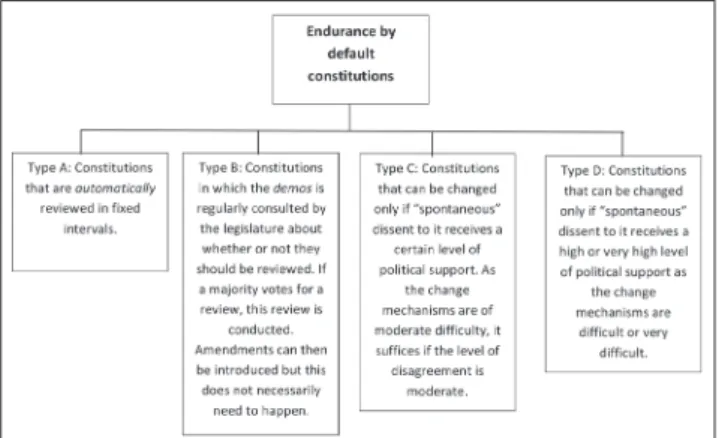
countries of the world are endurance by default constitutions, so this is the material to be dealt with, at least from the perspective of
applied political philosophy. Figure 2 shows what types of
endur-ance by default constitutions can be distinguished.
Irrevocable provisions protected by eternity clauses
Isn’t there a type E-constitution? As mentioned, there is no such thing as a perpetual constitution anywhere in the world. Howev-er, there are irrevocable provisions within endurance by default constitutions. I will call those provisions that are sheltered from alteration or repeal “irrevocable provisions”. I will call those provi-sions that guarantee that some proviprovi-sions are irrevocable “eternity clauses”.20
Eternity clauses present the intergenerational challenge in its ex-treme. They are the little brother of perpetual constitutions. In the 735 past and present constitutions that Roznai examined, 28% include or included eternity clauses.21 If one believed that first
and foremost basic rights and liberties (as far as they are part of constitutions) are candidates for irrevocable clauses, one is mis-taken. In the constitutions that are or were in effect after World War II, less than 30% of the clauses referred to basic rights.22
Around the globe, the form and system of government are more often the content of irrevocable clauses than anything else. While more than 100 constitutions protect the republican form of a
gov-ernment, some protect a monarchy.23 The second notable group
is protecting the state’s political or governmental structure, such as federal or unitary, for instance, or presidential or parliamen-tarian.24
To get a better understanding for eternity clauses and irrevocable content, here are a few examples from the US, Turkey, Germany and France. There are two provisions in the US Constitution that are irrevocable by the methods specified in Article 5. The first is that no amendment to the constitution may abolish the African slave trade prior to the year 1808,25 and the second is that “no
state, without its consent, shall be deprived of its equal suffrage in the Senate.” The Turkish Constitution has a high number of irrevocable clauses: Article 1 declares the form of the state as a republic. Article 2 establishes the following: “The Republic of Turkey is a democratic, laic and social state governed by the rule of law; bearing in mind the concepts of public peace, national solidarity and justice; respecting human rights; loyal to the
na-tionalism of Atatürk, and based on the fundamental tenets set forth in the Preamble.” Article 3 declares: “The Turkish state, with its territory and nation, is an indivisible entity.” It then decides upon the official language, the national flag, the national anthem and the national capital. Article 4, the eternity clause, declares the immovability of the founding principles of the Republic defined in the first three Articles and bans any proposals for their modifi-cation. In the German “Basic Law”, the eternity clause in Article 79 (3) shields the contents of article 1 and article 20 from being changed, as well as the division of the Federation into Länder and their participation in the legislative process.26 Article 20 enshrines
some constitutional principles;27 article 1 protects human
digni-ty.28 In France, altering the “republican form of government”
(ar-ticle 89) is out of reach for the politicians.
Most of the world’s eternity clauses are not irrevocable provi-sions.29 In theory, this would allow a two-step process by which,
firstly, the eternity clause could be abolished, and then, second-ly, the previously entrenched content can be altered by normal constitutional change procedure. But some eternity clauses are declared irrevocable themselves30 – in this case of “second-order
unamendability”, no legal recourse can be taken by successor generations to change the content that was entrenched by their predecessors.
“Institutions are sticky, and constitutions are the stickiest of them.”31 If this is true, eternity clauses are the stickiest of the
stickiest of all institutions. Nevertheless, in the literature, the sig-nificance of this stickiness is sometimes played down. It is some-times light-heartedly asserted that succeeding generations are al-ways free to abandon the constitutional order they inherited – by means of a revolution. From this, the conclusion is drawn that there is no intergenerational injustice in including irrevocable (or almost irrevocable) content in constitutions. But this is the most cynical argument of all, since it devalues human lives. Historical-ly, revolutions were often followed by periods of unrest and civil war, and they usually brought about a plethora of casualties and a massive loss of well-being for a large share of the population. There should be easier ways for succeeding generations to get rid of an outdated constitutional legacy.
The proposal: recurrent constitutional reform commissions
More often than not, the reason outdated provisions are not changed is not that the people still support them, but that re-formers lack windows of opportunity to mobilise the silent (su-per)majority.32 In type A and B constitutions, a time for reflection
about the constitution is incorporated in the text of the constitu-tion. In fixed intervals, a review has to be conducted either auto-matically (type A), or the demos has to be asked if such a review should be taking place (type B). I will argue in the remainder of this article that constitutions that are automatically reviewed in fixed intervals (type A constitutions) rank first from the point of view of intergenerational justice. Type B constitutions come second as they also create a review situation (of a second order), even though such a review of the constitution is not mandato-ry. In type C and D constitutions, inertia plays into the hands
Constitutional amendment procedures should be designed with the aim of making the voices of succeed ing generations heard from time to time by opening a window of opportunity.
of the existing system despite the fact that time goes on and the world changes constantly. Constitutional amendment procedures should be designed with the aim of making the voices of succeed-ing generations heard from time to time by opensucceed-ing a window of opportunity.
A constitution should prescribe a time for its own revision. But, of course, the revision of constitutional provisions remains possi-ble in the midst of such an interval (i.e. “spontaneously”) by the established amendment procedure as well.33
Assuming the demographic data are available, one can calcu-late the point in time at which the post-framers’ generation has become as numerous as the framers’ generation (“generational change point”) for each country and each base year. Based on the variables “number of eligible citizens in a base year x (framers’ generation)”, “citizens reaching the voting age in the years x+1, x+2, ..., x+n”, “deaths of framers’ generation members in the years x+1, x+2, ..., x+n”, one arrives at different time periods until the next generational change point for each country, depending on its population structure. An entire article could be devoted to such a model.34 To cut a long story short, I take 25 years as a good length
of time between two constitutional reform commissions. A constitutional reform commission at fixed time intervals strikes the right balance between the two legitimate goals of flexibility and rigidity. A constitutional reform commission at fixed time intervals strikes the right balance between the two legitimate goals of flexibility and rigidity. To be very clear: a constitutional reform commission is not a constitutional convention. The mandate of the latter would be to draft a new constitution of a piece, a mono-lithic and integral new document. By contrast, the mandate of a reform commission is to make proposals for the adoption/change/ abolition of single clauses of endurance by default constitutions. There is no danger that a generation could end up without any constitution at all when a reform commission is at work. My pro-posal substantiates Condorcet’s ideas, not Jefferson’s. While Jeffer-son counselled that constitutions should be adopted anew by each generation, Condorcet argued that each generation should have a window of opportunity for a revision.35
It is very likely that the implication of such a window of opportu-nity is not that the constitution be rewritten from scratch, quite the contrary. Zachary Elkins, Tom Ginsburg and James Melton have analysed each and every constitution written since 1789.36
One of their key findings is that flexibility (defined as the con-stitution’s ability to adjust to changing circumstances captured in the empirical analysis by the ease of formal and informal amend-ment, either informally via constitutional construction by the courts or via formal amendment procedures by the legislature) is positively correlated with the endurance of a constitution.37
Like-wise, the inclusiveness of a constitution (defined as the degree to which the constitution includes relevant social and political actors taking into account that time will change which societal groups will have a stake in the endurance of the constitution) is positively correlated with its stability over time. The life expectancy of the least inclusive constitution is a full 55 years less than the most inclusive constitution (14 years vs. 69 years).
The finding that flexibility increases endurance makes sense in-tuitively. Here is a second, slightly changed version of the initial thought experiment to illustrate this point:
In another state, the framers of a newlyformed constitution (women are involved now) install a review provision which stipu
lates that, instead of leaving all constitutional clauses unchanged for 300 years, each generation can have a reform commission and revise the constitution.
Which constitution is more threatened to be repealed entirely after 300 years: the one with the 300 year-old content due to the entrenched embargo by the framers’ generation, or the one that has been updated by each generation (who wanted to do this) in the last 300 years? In the first scenario, the citizens have been hin-dered to exercise the pouvoir constituant for a long time, whereas in the second scenario no generation was shut out of their project of constitutionalism. Even if not all installed review commissions actually did lead to amendments, all generations have had their say. In this second version of the thought experiment, 300 years after the initial formulation of the constitution a revolution will be unnecessary, given that an evolutionary process (in the form of amendments) has taken place.
In what follows, I will try to defend my proposal in the light of two concerns: the (forgone) welfare concern and the sovereignty concern.
The (forgone) welfare concern
The proclaimed benefits of constitutions for future generations – and the danger of parochialism
Since Madison, the benefits of constitutions for succeeding gen-erations have often been highlighted. There are indeed good ar-guments to aver a positive impact of constitutions on the quality of life of succeeding generations, compared to a world without constitutions. But constitutions are so commonplace in our real world nowadays that the danger of a people of being “constitu-tionless” for a relevant time period is virtually non-existent. No doubt: constitutions are great inventions in the history of hu-mankind. But this in itself does not defend “difficult to change” or even perpetual constitutions. Are they defendable at all? Here are some arguments that have been brought forward on their behalf:
1) Constitutions as defenders of human rights and liberties: When constitutions entrench democratic rules and fundamental rights against their abolition, they make it more likely for succeeding gener ations to live under those rules and to enjoy these rights and liberties. Constitutions are thus devices to ensure intergenerational justice.38 It is certainly true that fundamental rights and liberties are a boon for present and future individuals. Fundamental rights are not only enshrined in international documents such as the United
Nations Declaration of Human Rights or the European Convention for the Protection of Human Rights and Fundamental Freedoms but,
selectively, also in national constitutions.39 One of these
less generalised to all constitutions of the world. Based on some single-case studies of Western constitutions, general conclusions about the merits of rigid constitutions are drawn. It should not go unnoticed that only 4% of national states today lack a con-stitution.40 But of all states, only 11.4% (home to 4.5% of the
world population) can be classified as “full democracies”.41 Taking
a global view, one cannot ignore the fact that almost all authori-tarian states are constitutionalised states. It is thus quite surprising that only recently some political and legal theorists have discov-ered the rest of the world.
It is high time for the mainstream to debate the intergeneration-al chintergeneration-allenge to constitutionintergeneration-alism in the context of authoritari-an constitutions, too. Until now, only a few studies argue that constitutions in authoritarian regimes matter, and that they even have a causal effect in regime endurance.42 Several constitutions in
Islamic countries enshrine the primacy of Islam.43 By fusing
reli-gion into the branches of government, these constitutional clauses defy the principle of religious freedom and are thus in contrast to one basic human right. Yet these examples are constantly ignored when legal scholars assert that constitutions are defenders of hu-man rights and liberties.
The case of Iran deserves a closer look. Starting in 2009, Iran was repeatedly the site of vigorous youth revolts. Millions of young people took to the streets when waging the so-called Green Rev-olution against the rigged election of Ahmadinejad and soon against the whole illiberal theocratic political system that is pro-tected by the present constitution. They sought basic liberties. When “their” constitution was enacted 38 years ago (in 1979), the majority of the people living in this country today were not even born. The subsequent youth revolutions were repressed with sheer brutality, and failed to change the political system. The irre-vocableness of some key provisions44 makes it very difficult for the
succeeding generations in Iran to adapt their constitution to their values as the framers have sought to leave an immovable imprint. Now the youth has the choice between the devil and the deep blue sea. A revolution would give them the opportunity to replace the Iranian constitution, but during a revolution many (more) Irani-ans would be imprisoned, tortured and killed.
As in Iran, constitutions in many countries of the world protect the political order without protecting human rights and liberties. The claim that future generations are the beneficiaries, not the victims, of constitutions enacted by their predecessors is wrong when looking at constitutions in authoritarian regimes. There is a paradox here: those states that would need the valve of mandatory constitutional reform commissions the most are also those least inclined to put it in their constitutions.
Harm and forgone welfare are two distinct concepts. While some provisions of the Iranian constitution are harmful, other consti-tutions, even in Western Europe and North America, can be held responsible for forgone welfare. Who would aver that all con-stitutional clauses in established Western democracies foster the welfare of the citizens living under the jurisdiction of these
con-stitutions? Take the US constitution. The Second Amendment45
to the United States Constitution protects the right of the people
to keep and bear arms and was adopted on 15 December 1791, as part of the first ten amendments contained in the Bill of Rights. People who are forced to live under the Second Amendment forgo welfare. Comparative studies have shown that the percentage of people killed in gun incidents is much higher in the USA than in similar countries where citizens do not have a constitutional right to bear arms, such as Canada. If the Second Amendment were abolished, the welfare of all succeeding generations of US citizens would be higher.
The example of this amendment is suggestive in even more respects. If the hunch is correct that the provisions of the Second Amend-ment ought not to have been protected in the Bill of Rights, then we must ask what the fact of its protection says in general about the decisions of framers of the US Constitution. Two possibilities stand out as the most obvious. The first is that it speaks to the falli-bility of the authors of constitutions. The second is that the mean-ing and impact of the Second Amendment changed over time with population growth and with changing technology (a muzzle-load-ed musket is not the same as an AK-47 assault rifle, after all).46
Either explanation is the basis of a powerful argument for a regular review of constitutions at fixed time intervals.47
To sum up: it is not overstated to say that the majority of pres-ent people worldwide forgo welfare due to certain constitutional clauses in their respective constitutions.48
2) It is a good thing that constitutions shield certain matters from capricious everyday politics. Contentious issues must be silenced at some point in order to secure peaceful cooperation and fellowship among all citizens.49
Usually, democratic societies don’t avoid debate and deliberation. To use constitutions as “gag devices” is a risky strategy since “what-ever is silenced might explode in the future”.50 In such cases,
Roz-nai counsels rather “a temporal unamendability, which allows the removal of the contentious issue from the public agenda for a while without long-term restraints.”51 The fear of agitating public passions
too strongly could indeed be justified if constitutional reform com-missions were established at very short intervals (every five years or so). But the “risk” of stirring up political interest and engagement once within the course of a generational cycle – every 25 years or so – seems bearable. Moreover, as long as the debated question is not “this constitution, or an alternative” but just single provisions of the constitution in place, the conflict will be manageable.
Veneration for constitution-making events should not obscure the fact that each constitution is man-made. Drawing on the com-mon division between polity, policy and politics, constitutions are usually regarded as part of polity. This view neglects that constitu-tions (and all other instituconstitu-tions) are “clotted” politics. Before they came into existence, politicking happened. Although politicking is never very harmonious, it is necessary from time to time.
3) No longterm private investment of time and capital will occur if there is no reasonable certainty of reaping its reward. Constitutions may reduce uncertainty – assuring for instance, the performance of contracts
If the hunch is correct that the provisions of the Second Amendment ought not to have been protected in the Bill of Rights, then we must ask what the fact of its protect ion says in general about the decisions of framers of the US Constitution.
and securing the rights to property – or increase it. A system in which the constitution and the laws are selfexpiring increases uncertainty about the future and undercuts most longterm private investments.52 The endurance of a constitution must not be equated with the en-durance of ordinary laws. Even though laws have a more modest claim than constitutions, their longevity (at least in some areas) is often greater. France, for instance, has seen no less than 15 con-stitutions come and go, yet the French Code Civil of 1805 has endured unaltered “[w]hether the French government has been imperial, republican, or fascist.”53 The same is true, by analogy, of
the Bürgerliches Gesetzbuch in Germany, which came into effect on 1 January 1900.54
4) The citizens of yesterday know best what is right, better than the citizens of today themselves.
The core argument of paternalistic thinking – that the framers of a constitution are in a position to identify and represent the general interest – does not hold. Scepticism is justified on a num-ber of grounds. Firstly, it is extremely unlikely that the interests and preferences of a group of adults55 can be better identified by
a third-party than by the affected group itself. The paternalis-tic conception that men understand women’s needs better than women themselves was successfully rejected by women during their long battle for the right to vote. By the same token, we reject the idea that the interests of Afro-Americans could have been ad-equately represented by their white masters during the era of the Declaration of Independence, which was neither demanded by – nor beneficial for – the represented. That citizens themselves best understand their own interests is a generally accepted principle in contemporary political theory for sound reasons.
It is nothing less than hubris for a generation to pretend to be able to determine which institutions will be the most appropriate ones over several decades, even centuries. Let’s change the thought experiment in the introduction and replace 300 years by 3,000 years. It is difficult to even conceive that a constitution written 3,000 years ago would function at all, let alone do so perfectly. The conditions in which people live now, the size of the population, the types of problems we face and the values we consider important, are all, in fact, very different to those of civilisations that existed 3,000 years ago. Now, this being said, 300 years are likewise a con-siderable time span in a world that changes at a rapid pace. A fram-ers’ generation should be modest enough to acknowledge that their decreed rules of government might display some deficiencies in the future. If one generation entrenches irrevocably rules and systems
of government,56 they mistrust their successors. But why should a
father mistrust his adult son? Why a mother her adult daughter? A framers’ generation should offer a constitutional content to its successors, not try to force it upon its children and grandchildren.
5) There is more rationality – that is, more checks and balances against shortterm passions – in older constitutions.
Since Madison, the defenders of very rigid constitutions have been arguing that their content must be protected against changes by successor generations that are motived by irrationality and
pre-sentism. The resounding assertion that later generations will pan-der to their “passions” and short-term interests can be countered by pointing at an interesting development in constitution-amend-ing worldwide. The growconstitution-amend-ing acceptance of our responsibility for posterity has resulted in the fact that constitutions, especially the ones which were adopted in the last few decades, refer verbatim to long-term thinking and speak of the obligations of today’s cit-izenry towards future generations.57 These newly inserted clauses
may be termed “posterity protection provisions” (PPPs).58
The-matically, most of these clauses fall into one of the following three categories: general PPPs, ecological PPPs and financial PPPs.59
An example for the ecological PPPs is Art. 24 of South Africa’s Constitution of 1994.60 Examples for financial PPPs are the “debt
brakes” recently adopted by several European countries. The Con-stitution of Poland, for instance, limits the level of national public debt to three-fifths of GDP.61
Some of the PPPs are enshrined as fundamental rights; some others are enshrined as statements of public policy, often in preambles, and hence function rather as a guide than a restriction for pub-lic popub-licy-making. Individual basic right PPPs aimed at environ-mental protection can be found, inter alia, in the constitutions of Argentina, Brazil, Finland, Hungary, Latvia, Portugal and South Africa. Often they do not explicitly mention future generations, but give every inhabitant of the country the right to a healthy and well-balanced environment. This follows the rationale that protect-ing the environment for today’s generations is also good for future generations. Public policy PPPs are based on the assumption that there is a potential conflict of interests between present and future generations with regard to many environmental issues, for instance nuclear waste and global warming. Today’s generations can benefit by burdening future generations. These provisions usually men-tion future generamen-tions explicitly and underline our responsibility to them. Article 20a in the German Grundgesetz is based on this approach (likewise, provisions in the constitutions of the Czech Republic, France, Greece, the Netherlands, Lithuania, Spain, Swe-den, and Switzerland).
Yet another distinction is their abstractness v. concreteness: while intergenerational provisions are often formulated in abstract terms, they sometimes adopt very specific formulations – e.g. when they set a specific debt ceiling or declare specific areas as national parks.62
The literature on PPPs, especially those that constitutionalise “green rights”, is abundant. The important point for our context is that most of these clauses have been adopted just recently. Cho and Pedersen mention a time span of 25 to 30 years,63 which is
roughly equivalent to the time span in which the vulnerability of the environment came to the fore in public and scientific debate. This contradicts the hypothesis that there is more rationality and more foresight in older constitutions. It refutes the claim of the proponents of perpetual or “difficult to change” constitutions that the succeeding generations could give more room for passion than for wisdom in “their” rounds of constitutionalism.
While there is no consensus as to whether or not mankind has progressed morally since ancient times, some theorists do see some kind of moral progress at work.64 One would expect this to
materialise in constitutional evolvement, unless stunted by oner-ous constitution-amending mechanisms. The insertion of PPPs in constitutions, however, can be regarded as a sign of moral pro-gress, since these provisions are guided by an impartial concern for the common good in the long term.
The sovereignty concern Definitions of sovereignty
A definition of sovereignty has already been used in the introduc-tion but will now be carved out more thoroughly. Axel Gosseries presents three concepts of generational sovereignty of which the first one, termed “jurisdictional generational sovereignty”, reads as follows: “A generation is jurisdictionally sovereign during its period of existence to the extent that it is free from enforceable extra-generational jurisdictional claims made by other generations willing to impose their own rules.”65 With regard to
constitution-alism, a shorter, yet sufficiently broad definition would be: “A generation within a state can be called sovereign if it has the abili-ty to live under constitutional provisions of their own choosing.”66
The sovereignty concern and the (forgone) quality concern are interconnected. Imagine the following cases:
1) A people lives under the jurisdiction of a “very difficult to change” constitution67 that was established long ago. All of the
constitution’s provisions in fact foster their welfare/guarantee their liberties but the citizens are under the false impression that they do not. The citizens thus want to change/repeal/add one or several provisions. But the rigidity of the constitution does not allow for them to do so.
2) A people lives under the jurisdiction of a “very difficult to change” constitution that was established long ago. The citizens are under the impression that all of their constitution’s provisions foster their welfare and guarantee their liberties, which in fact they do. The citizens don’t want to change/repeal/add any sin-gle provision. The rigidity of this constitution would not have allowed for them to do so anyway.
3) A people lives under the jurisdiction of a “very difficult to change” constitution that was established long ago. One or more of the constitution’s provisions do in fact impair their potential welfare/infringe on their liberties, and the citizens recognise this fact. The citizens thus want to change/repeal/add one or several provisions. But the rigidity of the constitution does not allow for them to do so.
4) A people lives under the jurisdiction of a “very difficult to change” constitution that was established long ago. One or more of the constitution’s provisions in fact impair their potential wel-fare/infringe on their liberties but the citizens don’t recognise this fact. The citizens don’t want to change/repeal/add any single pro-vision. The rigidity of this constitution would not have allowed for them to do so anyway.
The sovereignty concern applies to all four cases, but to a different extent. The least problematic is case 2. Is generational sovereignty impaired here at all? Take the individual counterpart to this ques-tion: Is your freedom restrained if you are not free to do what you don’t want to do – and should not be doing anyway? One may conclude that there is at most a theoretical, if any, sovereignty concern here.
In case 3, there are good reasons to reform constitutional provi-sions since they clearly impair welfare, but the people are incapa-ble of doing so because a previous generation decided otherwise over their head. This is the situation which Jefferson, Paine and Condorcet had in mind when they demanded flexible constitu-tions.
To evaluate case 1, it makes sense to draw on the distinction be-tween autonomy and freedom as is familiar on the level of an individual. The Greek etymology of the word “autonomy” means
“one’s own law”. On the level of a demos, autonomy refers to self-governance, i.e. a country’s ability to determine its own affairs and to make decisions according to reasonable principles. “Free-dom”, on the other hand, includes the capacity to override these reasoned decisions, by following one’s passions. It seems to me that “sovereignty” is, semantically speaking, more closely connect-ed to “autonomy” than to freconnect-edom.68 Thus, in case 1 it is primarily
a people’s freedom that is restrained by the constitution, not their sovereignty/autonomy. This state of affairs, if true, would justify paternalistic arguments.69 It is necessary to distinguish the inter-
from the intragenerational context here. In an intragenerational context, a generation can commit itself in a “sober” state to cer-tain rules. The aim is to prevent itself from actions in a “drunken” state that it will regret when “sober” again. The story of Ulysses and the Sirens is seen as the archetype of such practice. He has his companions tie him to the ship’s mast in order to be able to listen to the Sirens without falling for their call. Now, as long as each generation decides intragenerationally that it wants to be tied to the ship’s mast, there is no intergenerational sovereignty concern. But the autonomy of an earlier generation must not turn into het-eronomy of the latter. Unlike in Ulysses’s case, the constitutional hand-cuffs called “eternity clauses” are not self-imposed.70
Finally case 4: if the citizenship as a whole (as the premises have it) is happy with suboptimal constitutional clauses, then their free-dom is not infringed upon. Nevertheless, they forgo life quality as they don’t realise the full potential of their lives and thereby one could argue that their sovereignty has not fully materialised. Paternalism could be justified. But to impose on a people pater-nalistically a new, and better, constitution against their will is quite hard to do – unless the country collapses after a war. The post-World War II constitutions of Germany and Japan might be cases in point.
Tacit consent
Given the severity of the sovereignty concern, one could, prima facie, conclude that this blatant intergenerational injustice should be corrected as soon as possible. But the defenders of perpetual constitutions have a rejoinder that must now be explored in more detail: tacit consent.71 John Locke was one of the classical
propo-nents of the idea that individuals articulate decisions as free agents entering into consensual relationships with other free agents, and that this becomes the basis for political governance. But the no-tion of tacit consent can also be retrieved from Locke’s writings.72
According to Locke, both citizens and temporary residents have to obey the law but temporary residents, just like passers-by, don’t have a voice in passing future legislation.73 Michael Otsuka
spec-Figure 2: Tradeoffs between quality and sovereignty
These four cases can be depicted in the following matrix:
Citizens want
reform Citizens don’t want reform
Constitution
fosters welfare 1) “disimprove ment” situation; possible tradeoff
2) reasonableness of present citizenry; no tradeoff
Constitution impairs wel-fare
3) reasonableness of present citizen ry; no tradeoff
ifies the Lockean argument for tacit consent by adding that tacit consent can be presumed only when an individual has a realistic opportunity to exit the political society in which he is currently residing.74
Tacit consent seems to provide a splendid justification for leaving constitutions unchanged for very long periods of time. However, tacit consent as an argument might not reach all that far. There are always some dissenters in a pluralistic society who want to change this or that constitutional provision. In practice, there is no such thing as tacit consent by all the people ruled by a con-stitution or, more precisely: all concon-stitutional clauses. One must thus think of tacit consent as a gradual concept. Leaving aside those who flee the country, those who express open dissent with some constitutional provisions should be subtracted from the group of tacit consenters. It is thereby important to understand that the failure of success of the open dissenters is not a criterion of the legitimacy of certain constitutional provisions. Let’s imagine a constitution to be changeable by direct rule of the people, that is: referenda without parliamentarian intervention, by a superma-jority of 75%. Assume arguendo that a lot of citizens are unhappy with one clause in the constitution, the right to bear arms in pub-lic. Let’s assume the dissent varied in the past fifty years, ranging from 51% to 74%. The dissenters were unsuccessful in abolishing this clause; but it would be false to say that the clause enjoyed “the tacit consent of the people”.
The provisions that specify amendment procedures are arguably the most important part of constitutions. These rules are the rule-changing rules whereas other provisions “only” establish the rules of the political game, which, in turn, determine pub-lic popub-licy decisions and outcomes.75 It has been shown that the
degree of rigidity of a constitution negatively correlates with the
number of times a constitution is changed/amended.76 For
in-stance, article 5 of the US Constitution provides two methods for
constitution-amending.77 The first method authorises Congress
to propose constitutional amendments “whenever two-thirds of both houses shall deem it necessary”. The second method requires Congress, “on the application of the legislatures of two-thirds of the several states” (currently 34), to “call a convention for pro-posing amendments”. In the 20th century, concerted efforts were undertaken by proponents of particular issues to secure the num-ber of applications necessary to summon an Article V Convention – yet to no avail. One of the legal scholars who demand a new Constitutional Convention (second to the Philadelphia Conven-tion 1787) is Sanford Levinson. In his book Our Undemocratic
Constitution: Where the Constitution Goes Wrong (And How We the People Can Correct It) he argues that many of the US
Con-stitution’s provisions promote either unjust or ineffective govern-ment.78 Among the provisions he criticises most is the current
process for electing the US president commonly known as the Electoral College. The 2016 presidential election again pointed at the problems of this institution. It allowed Donald Trump to be-come president without the support of the plurality of the voters, as Hillary Clinton had received 48.2% of the vote, Donald Trump 46.1% and others 5.7%. Clinton received 2,864,974 votes more than Trump, which is a substantial margin. The Electoral College
currently employed in the USA is seen by many as an outdated institution that should be reformed (or abolished). It would be a stark mistake to conclude from its endurance that there is tacit consent for this institution. But not only the Electoral College is under the critical spotlight: 11,699 measures have been proposed to amend the Constitution since 1789 (counted up to 3 January
2017).79 Individual members of the House and Senate typically
propose around 190 amendments during each two-year term of Congress. Thirty-three amendments have been proposed by the United States Congress and sent to the states for ratification since the Constitution was put into operation on 4 March 1789. Twen-ty-seven of these, having been ratified by the requisite number of states, became part of the Constitution.80 Of the six proposals
adopted by Congress and sent to the states that have not been ratified by the required number of states, four are still technically open and pending, one is closed and has failed by its own terms, and one is closed and has failed by the terms of the resolution proposing it. In comparison, the Norwegian Constitution, the second oldest in the world, has been changed 200 times since it came into existence in 1814.
It is misleading to say that constitutions around the world enjoy (or have ever enjoyed in the past) tacit consent by all voters. But to aver that constitutions generally do not enjoy the support of the citizenship would also be inaccurate. What is correct is that there is constant call for reform which sometimes becomes louder, sometimes less loud, but never ceases. And even if the government tries to silence it, as is often the case in authoritarian regimes, it is still there. The desire of a part of a nation’s citizenry to modi-fy their constitution as they learn about unintended, unexpected and unwanted consequences is ubiquitous in a globalised and in-terconnected world.
Different levels of consent/dissent in different age groups
The intergenerational challenge to the legitimacy of a constitution is alleviated if the level of consent is higher within the young gen-eration than it is within the older one (with the young being the first generation in a sequence of succeeding generations). Con-sequently, the intergenerational challenge is aggravated if there is a significantly higher level of dissent among the younger part of the demos compared to the older part. The “Brexit” is a telling example of a situation in which young voters were outnumbered and dominated by the old. Some 75% of voters aged between 18 and 24 voted against Brexit, and thereby chose to speak out in
favour of the United Kingdom remaining in the EU.81 On
aver-age, those who voted Leave had 16 years left to live at the time of the decision (2016), while those who opted for Remain had a life expectancy of another 69 years.
The older voters made a decision the consequences of which will not affect them for very long. Even if the legality of the vote is out of question, this has the flavour of intergenerational domination.
Conclusion and outlook
I hope that this essay has convincingly made the following points: that flexibility and inclusiveness keep an old constitution young; that eternity clauses protecting the state’s governmental structure are incompatible with the principle of intergenerational justice; that constitutions which do not provide windows of opportuni-ty for amendments for succeeding generations stand in contra-diction to popular sovereignty, and are thus not legitimate; and There are always some dissenters in a pluralistic society
that recurrent reform commissions strike a good balance between the necessary rigidity and flexibility of constitutions. If all this is granted, the route for further research lies ahead. Given the great variety of legal and political traditions in constitutionalised states around the world, democracies and non-democracies, it seems appropriate to conceive differently of such a reform commission for each country. There cannot be a “one-size-fits-all” approach.82
It would be presumptuous to propose the same design for recur-rent constitutional reform commissions for countries as differecur-rent as, say, Iran and Germany. Further research should look at the national level and try to answer the following questions for each country: In which time spans should the constitutional reform com
mission be convened?83 As mentioned, there can be a mathematical
calculation for this, using the demographic structure of a country. But if this is deemed too complicated, a people could just agree
on an accommodating number, for instance 25 years.84 How long
should the commission be in session, once it has been convened?
Argu-ably, it should not sit for more than two or three years. By which
mode should the members of the commission be selected or elected? How many members should the commission have altogether?85 Here,
due to very different national traditions, the opinions might vary the most. Path dependencies might limit the range of feasible solutions. One option might be an intensive deliberation process, bringing members of civil society to the forefront of the process.86
In fact, there were some intriguing examples for that approach
in Iceland and in British Columbia.87 But expert commissions
could also have their merits. After German Reunification, the Joint Constitutional Commission that was composed solely by members of parliament completed the amendment process suc-cessfully.88 Provided the commission makes a proposal for a more or
less extensive revision of the constitution, how should it be ratified? Should the usual amendment procedure suffice?89
Providing answers to these kinds of questions90 is very much a
national project – it could even be “the constitutional project” of the current generation of citizens in each country in which the institution of a constitutional reform commission has yet to be established. It is, after all, “their” constitution.
Notes
1 I am grateful to two anonymous reviewers for valuable comments. 2 Both “constitution” and “constitutionalism” are contested con-cepts. For an extended discussion, see e.g. Lutz 2006: 1-25. Grey opens his essay with: “Constitutionalism is one of those concepts, evocative and persuasive in its connotations yet cloudy in its an-alytic and descriptive content, which at once enrich and confuse political discourse.” (Grey 1979: 189-209).
3 This raises interesting questions with regard to states which do not have written constitutions, such as the United Kingdom or Israel. In these countries, constitutional provisions can, in principle, be changed by ordinary acts of the legislature.
4 A short note on the method of thought experiments: Thought experiments play a crucial role in all philosophical subdisciplines, including political philosophy/political theory. While extremely counterfactual thought experiments can indeed be a thought-pro-voking method in philosophy, one must be aware that one can seldom derive recommendations for real-world politicians and law-makers from premises that are too outlandish. We usually want decision-makers to make “all-things-considered-decisions” – and rightly so. Thus, thought experiments have a place in
po-litical theory but they should have the right level of “counter-factuality” in order to be illuminating for the question at hand. The point of thought experiments is to render only the relevant features of the moral dilemma under discussion salient, so that the precise real-world issue at hand can easily be comprehended and our intuitions on the real-world matter isolated. If political theorists design thought experiments that are counterfactual in a misleading way, these thought experiments fail to do what they are supposed to do. Good thought experiments apply just about the right level of counterfactuality, and they are extremely cog-nisant of details.
5 Two different meanings of the word “generation” can be distin-guished: generations as age groups and generations as ensembles of all people living together at a given point in time. The former can be termed temporal and the latter intertemporal generations (see Tremmel 2009: ch. 2). Thus two kinds of intergenerational justice must be distinguished as well: “justice between young, middle-aged and old people alive today (temporal intergenerational justice)” and “justice between the present generation (all people alive today) and future generations (intertemporal intergenerational justice)”. Constitutions that are perpetual or very difficult to change pres-ent a problem for both kinds of intergenerational justice. Howev-er, unless stated otherwise, in this paper the temporal meaning of generation applies. The primary problem is thus justice between young, middle-aged and old people in constitution-amending; the secondary problem is to do justice to present and future people in constitution-amending.
6 More precisely, those who were of voting age at the time the con-stitution was adopted bind those who were not of voting age then because they were too young, or not even born, at that point in time. Both groups – those too young to vote and those not yet born – can be combined in the term “succeeding generations” (or “successor generations”).
7 Otsuka describes the problem of intergenerational sovereignty like this: “[H]ow can one defend the claim that laws enacted by a deceased generation of citizens of country x have any authority over the present generation of citizens of country x?” (Otsuka 2003: 136).
8 A contemporary account that is oblivious of this empirical fact and sees a demos – in the tradition of Jean-Jacques Rousseau or Carl Schmitt – as a homogenous entity is Muñiz-Fraticelli’s (2009). He theorises in the ontological part of his article: “As sovereignty is more than the mere exercise of force, it must be the case that there exists a norm that recognizes legitimate authority in the sovereign. Sovereignty presupposes such a norm; otherwise it is merely the exercise of power without justification. Now, popular sovereignty is the sovereignty of ‘the people’; it is not the imposition of the will of the majority of individuals in a certain territory, but the exercise of sovereignty by the people as a whole, as a collective entity. There-fore, for popular government to be intelligible there must exist a norm that grants legitimate authority to this collective agent. While it is true that the norm must have an origin, the sovereign people itself cannot be the source of it; before the norm there is no ‘people’, but only an individual or group of individuals exercising arbitrary power. In conferring legitimacy to ‘the people’, the legitimating norm and the democratic sovereign come into being at once.” (pp. 401/402).
11 Jefferson begins his letter with the words: “The question Wheth-er one genWheth-eration of men has a right to bind anothWheth-er, seems nevWheth-er to have been started either on this or our side of the water.” (Jeffer-son 1789). However, the problem of self-determination was already discussed in John Locke’s Second Treatise of Government, albeit from a different angle. Locke wrote: “[W]hatever engagements or prom-ises any one made for himself, he is under the obligation of them, but cannot bind the children or posterity. For his son, when a man, being altogether as free as the father, any act of the father can no more give away the liberty of the son than it can of anybody else.” (Locke 1690: 156).
12 Jefferson 1789. 13 Jefferson 1789.
14 It was not really a “retort” but in fact a reply that counsels a more flexible position. See for the same exegesis Auerbach/Reinhart 2012: 19. One might also point to the factual behaviour of Jeffer-son and MadiJeffer-son: their historic actions diverged considerably from their rhetoric (see Elkins/Ginsburg/Melton 2009: 12-35).
15 In one theoretical remark, Madison raises the “lost generation” objection (see e.g. Shai 2016). In short, this is the complaint that those adolescents lucky enough to become enfranchised immedi-ately before the end of Jefferson’s 19-years-long electoral cycle have almost 19 more years of political participation than those who come of age immediately after the next electoral cycle has begun. The “lost generation” objection must be put in perspective: What is preferable: to have one lost generation, or to have many lost gen-erations? Secondly, the similar problem, albeit on a smaller scale, arises by a system of elections every four or five years, as it is com-monplace. And thirdly, the “disenfranchised youth objection” (as it should be called more precisely) is somewhat overstated because babies, little children and younger adolescents have no interest in political participation anyway. For those minors who do wish to participate, a remedy would be a flexible voting age as proposed by Tremmel and Wilhelm (2015).
16 Madison 1790.
17 Madison 1790. In the intense debate at the end of the 18th cen-tury, Thomas Paine sided with Jefferson and coined the following well-known phrase: “The vanity and presumption of governing be-yond the grave, is the most ridiculous and insolent of all tyrannies.” (Paine 1998: 91) The right of a people to reform their constitution was a key element in the Girondin constitutional project. Article 28 of the draft of the French Constitution of 1793 stated: “A people always has the right to review, reform, and amend its constitution. One generation may not subject future generations to its laws.” But this constitution was invalidated during the so-called “Reign of Terror” in the French Revolution. In the Thermidorian Reaction, it was discarded in favour of a more conservative document, the Constitution of 1795.
18 From the correct statement that we should not “[conceive] of democracy as an exclusively presentist enterprise” (Rubenfeld 2001: 12), one cannot derive that prescriptions from unamendable con-stitutions should outweigh the will of the present citizenry. 19 Roznai 2015: 3.
20 Although Roznai (2015: 4) acknowledges that provisions that prohibit amending certain subjects are most commonly referred to in the literature as “eternal” provisions, he prefers the term “una-mendable” provisions for them. I do not follow him here because of the difference between a change and an amendment of a consti-tution. An “amendment” in the Anglo-Saxon tradition is
subsidi-ary to the original text. Amendments can nullify provisions in the original text, but they do not change the text; they merely add to it. In the US constitution, even amendments such as the 18th (prohi-bition), which are repealed (by the 21st), remain in the text. In con-trast, in those parts of the world where constitutions are “changed” and not “amended”, the original text is reworked to incorporate the intended change of its content. Even if I myself sometimes use, for convenience, “amendment” as the umbrella term for both amend-ments of a constitution and changes of a constitution, I see merit in using an unambiguous term such as “eternity provision” here. 21 Roznai 2015: 8. These numbers include those multiple consti-tutions of the same state.
22 Often, such human rights entrenchments in national consti-tutions are attempts to break from a past characterised by human right violations, as in the cases of Bosnia-Herzegovina or the Re-public of Congo.
23 Especially in some of the Arab countries; see for instance Bah-rain Const. (1973), art. 120(c); Jordan Const. (1952), art. 126(2); Libya Const. (1951), art. 197; Qatar Const. (2004), art. 145; Kuwait Const. (1962), part V, art. 175; Morocco Consts. (1970, 1972, 1992), arts. 100, 106, 100, respectively. Roznai (2015: 15) draws the conclusion: “Unamendable provisions can not only lim-it governmental power, but also empower lim-it. When unamendable provisions protect the rights of a monarch, the principle of inherit-ed rules, and succession to the throne, they serve as a mechanism to preserve the existing power of the rulers rather than limit it.” 24 Roznai 2015: 11.
25 Roznai (2015: 21): “The unamendability of this provision was the result of a compromise because South Carolina and Georgia would not consent to an immediate prohibition of slave trafficking. Insisting on ending slavery at the constitutional convention might have resulted in the collapse of the entire constitutional enterprise.” 26 Article 79 (3)
Amendments to this Basic Law affecting the division of the Feder-ation into Länder, their participFeder-ation on principle in the legislative process, or the principles laid down in Articles 1 and 20 shall be inadmissible.
27 Article 20
(1) The Federal Republic of Germany is a democratic and social federal state.
(2) All state authority is derived from the people. It shall be exer-cised by the people through elections and other votes and through specific legislative, executive and judicial bodies.
(3) The legislature shall be bound by the constitutional order, the executive and the judiciary by law and justice.
(4) All Germans shall have the right to resist any person seeking to abolish this constitutional order, if no other remedy is available. 28 Article 1
(1) Human dignity shall be inviolable. To respect and protect it shall be the duty of all state authority.
(2) The German people therefore acknowledge inviolable and inal-ienable human rights as the basis of every community, of peace and of justice in the world.
(3) The following basic rights shall bind the legislature, the execu-tive and the judiciary as directly applicable law.
29 This is, for example, the situation with regard to the Bulgarian Const. (1991), art. 57; the German Basic Law (1949), art. 79; the Romanian Const. (1991), art. 14.