A Deterministic Data Forwarding using Pattern
Scheduling for Neighbor Node Selection Method
Gouthami 1, Dr.Basavraj Mathpathi 2
1
P.G.Student, 2Professor &Course Co-ordinator, Department of Computer Science and Engineering AIET, Karnataka (India).
Abstract: These days, the exchange of information between neigh-boring hubs in versatile remote systems has been progressively crucial attributable to the fast development of various requests in individuals' regular daily existence. For example, an understudy might need to talk about a math issue with different understudies in the library utilizing his/her tablet; a computer game fan is probably going to have an auto race on the cell phone with other individuals in a Starbucks coffeehouse. These spur the presence of closeness based applications. Albeit focal servers can be utilized, closeness based applications' potential can be better abused giving the capacity of finding close-by cell phones in one's remote correspondence region because of four reasons. To begin with, clients can appreciate the accommodation of nearby neighbor revelation whenever, while the incorporated administration might be inaccessible because of surprising reasons. Second, a solitary neighbor disclosure convention can profit different applications by giving more adaptability than the unified approach. Third, correspondences between a focal server and diverse portable hubs may instigate issues, for example, unnecessary transmission overheads, blockage, and sudden response delay. To wrap things up, scanning for adjacent cell phones locally is thoroughly complimentary. We concentrate on deterministic non-concurrent neighbor revelation for versatile remote systems. Like existing works ,we accept that time is separated into equalsized spaces. Attributable to limited vitality spending plan, every hub performs obligation cycled operations. That is, it rests amid most spaces, while turning alert amid a couple remaining openings, which are called dynamic spaces. To be particular, in a resting space, a hub does not send or get, and devours insignificant vitality.
Keywords: Mobile wireless network, neighbor discovery, protocol design.
I. INTRODUCTION
Interestingly, in a dynamic space, a hub transmits guides toward the start and the end, separately, and tunes in for other hubs' transmissions in the middle. Each guide contains the M-A-C address of its sender. A hub finds its neighbors by unraveling the got reference points and removing the contained M-A-C addresses. Along these lines, as a rule, two neighboring hubs can find each other when their dynamic spaces cover. In addition, the neighbor disclosure issue includes two cases: the symmetric case, where every one of the hubs have a similar obligation cycle, and the topsy-turvy case, where diverse obligation cycles are received.
II. LITERATURE SURVEY
Literature survey is the most important step in software development process. Before improving the tools it is compulsory to decide the economy strength, time factor. Once the programmer‘s create the structure tools as programmer require a lot of external support, this type of support can be done by senior programmers, from websites or from books.
The Authors S. Bitan, T. Etzion, in [1] clarified a consistently per changeable code is a twofold code whose code words are consistently unmistakable and have full cyclic request. An imperative class of these codes are the steady weight consistently per changeable codes. In a code of this class all code words have a similar weight w. These codes have numerous applications, in. Evading in optical code-division various get to correspondence frameworks and in building convention succession sets for the M-dynamic out-of-T clients impact channel without input. They build ideal consistent weight consistently per alterable codes with length n, weight w, and a base Hamming separation 2w-2. Some of these codes agree with the outstanding plan called a distinction family. A portion of the developments utilize combinatorial structures with different applications in coding.
Discovery convention. SA-ND is intended for sectored-radio wires, a minimal effort and straightforward acknowledgment of directional reception apparatuses that use different constrained shaft width recieving wires. Not at all like many proposed directional neighbor revelation conventions, SA-ND depends neither on omnidirectional recieving wires nor on time synchronization. SA-ND performs neighbor disclosure in a serialized mold enabling individual hubs to find every potential neighbor inside a foreordained time. Besides, SA-ND ensures the disclosure of the best division blend on both correspondence closes permitting more powerful and higher unwavering quality connections. At long last, SA-ND accumulates the area data in a concentrated area, if necessary, to be utilized by brought together systems administration conventions. The adequacy of SA-ND has been surveyed by means of recreation studies and genuine equipment execution.
The Author N. Karowski, A. C. Viana, A. Wolisz, in [3] clarified the issue of neighbor revelation in remote systems with hubs working in various recurrence groups and with lopsided reference point interims. This is a testing errand when considering such heterogeneous operation conditions and when performed with no outside help. They introduce direct programmin enhancement and two methodologies, named O-P-T and SW-OPT, permitting hubs performing quick, offbeat, and uninvolved revelation. There streamlining is opened based and decides a listening plan portraying when to tune in, for to what extent, and on which channel. We contrast our procedures and the latent revelation of the I-EEE standard. The outcomes affirm that our enhancement enhances the execution as far as to start with, normal, and last disclosure time.
The Authors A.Keshavarzian, E. Uysal-Biyikoglu, in[4] clarified for vitality obliged stationary remote systems of sensors, determination of connections with excellent rate guarantees solid long haul operation. Amid the execution of a convention focusing on mechanical uses of such frameworks, it was discovered that it is favorable to gain precise data about the accessibility and nature of the RF correspondence joins before the system topology development. "Connection appraisal" as a component of the instatement procedure, finishes this undertaking by evaluating an adequate number of bundles traded between neighboring hubs. Presents and dissects two distinctive ways to deal with connect evaluation: The main approach is an arbitrary nondeterministic plot that takes into consideration a probabilistic assurance of crash free parcel trade. An option technique is portrayed which utilizes 'consistent weight codes' and gives a deterministic assurance of accomplishment. Specifically, a unique class of steady weight codes, known as optical orthogonal codes, is considered. Since, these codes are consistently per changeable, they make the connection appraisal prepare easier, and in this manner they are favored over different codes. They assess the execution of these strategies in view of their vitality utilization, time span, and usage multifaceted nature. The Authors R. Khalili, D. Goeckel, D. F. Towsley, et al., in[5] clarified Neighbor disclosure is basic for the procedure of self-association of a remote system, where all steering and medium get to conventions require learning of one-bounce neighbors. They think about the issue of neighbor revelation in a static and synchronous system, where time is separated into spaces, each of term equivalent to the time required to transmit a welcome message, and possibly, some kind of input message. There principle commitments lie in itemizing the physical layer component for how hubs in get mode recognize the channel status, depicting calculations at higher layers that adventure such a learning, and describing the huge pick up got. Specifically, They depict one conceivable physical layer design that enables beneficiaries to distinguish impacts, and after that present an input component that makes the crash data accessible to the transmitters. This enables hubs to quit transmitting bundles when they find out about the effective gathering of their disclosure messages by alternate hubs in the system. Subsequently, the quantity of hubs that need to transmit bundles diminishes after some time. These hubs transmit with a likelihood that is conversely relative to the quantity of dynamic hubs in their neighborhood, which is assessed utilizing the crash data accessible at the hubs. They appear through investigation and reenactments that our calculation enables hubs to find their neighbors in a fundamentally littler measure of time contrasted with the situation where gathering status criticism is not accessible to the transmitters.
III. SYSTEM ARCHITECTURE
The above diagram shows the way the application works. In this work, through an inside and out examination on the issue of non-concurrent neighbor revelation, we determine a more tightly bring down bound of ideal most pessimistic scenario dormancy At that point, we embrace a code-based detailing of the neighbor revelation issue and plan Di-ff-Codes for the symmetric case, which is ideal when the D-iff-Code can be stretched out from a flawless distinction set. Besides, by considering the association between wakeful times of two hubs, we stretch out D-iff-Codes to AD-iff-Codes to manage unbalanced neighbor revelation
IV. METHODOLOGY
We concentrate on deterministic nonconcurrent neighbor disclosure for versatile remote systems. Like existing works, we accept that time is partitioned into equalsized openings. Inferable from limited vitality spending plan, every hub (i.e., a cell phone) performs obligation cycled operations. That is, it dozes amid most openings, while turning alert amid a couple remaining spaces, which are called dynamic openings. To be specific, in a resting space, a hub does not send or get, and expends immaterial vitality. Conversely, inanactive opening, a hub transmits signals toward the start and the end, individually, and tunes in for other hubs' transmissions in the middle. Each reference point contains the M-A-C address of its sender. A hub finds its neighbors by disentangling the got reference points and extricating the contained M-A-C addresses. Accordingly, by and large, two neighboring hubs can find each other when their dynamic openings cover. Also, the neighbor disclosure issue includes two cases: the symmetric case, where every one of the hubs have a similar obligation cycle, and the unbalanced case, where diverse obligation cycles are embraced. In deterministic neighbor revelation, there is a set up dynamic rest design booking a hub to exchange its state intermittently amongst dynamic and dozing, i.e., the dynamic rest design defines an occasional cycle of the state change of a hub. We plan the dynamic rest design as a 0–1 code
V. RESULTS AND DISCUSSION
[image:4.612.183.429.338.508.2]A. Result
Fig 5.1: Power consumption average link
The above graph gives the power-consumption ratio against the average-link, as one can observer from the graph that the proposed system utilises far less power consumption against same amount of average-link. This is because, we will use the shortest path for the data transmission purpose.
[image:4.612.184.428.561.711.2]The packet-delivery is more for the proposed system then the existing one, because quality of service is used the packet delivery-ratio is better for the proposed system then the existing one.
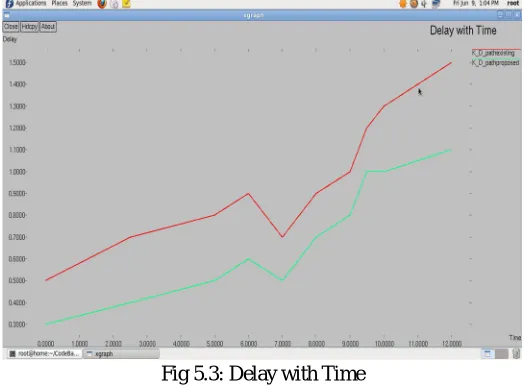
Fig 5.3: Delay with Time
The delay parameter is also studied in this paper, as one can observe that the delay for the proposed system is better than the existing one, this is possible because we are suing the shortest path where the congestion and other parameter is investigated before actually sending the packets.
VI. CONCLUSION AND FUTURE SCOPE
we have introduced a methodical investigation of outlining profoundly viable and vitality effective neighbor-revelation conventions in versatile remote systems. We have outlined Diff-Codes for the instance of symmetric obligation cycle and stretched out it to ADiff-Codes to manage the hilter kilter case. We have inferred a more tightly bring down destined for the most pessimistic scenario inactivity by misusing dynamic space nonalignment. Both our reenactment and test comes about have demonstrated that Di-ff-Codes can accomplish fundamentally better execution in both balanced and coterie neighbor disclosure, contrasted with condition of-craftsmanship neighbor revelation conventions.
REFERENCES [1] Sony, “Sony PS Vita–Near,” [Online]. Available: http://us.playstation. com/psvit
[2] Y. Agarwal et al., “Wireless wakeups revisited: Energy management for VoIP over Wi-Fi smartphones,” in Proc. MobiSys, 2007, pp. 179–191. [3] M. Bakht, M. Trower, and R. H. Kravets, “Searchlight: Won't you be my neighbor?,” in Proc. MobiCom, 2012, pp. 185–196.
[4] L. D. Baumert, Cyclic Difference Sets. New York, NY, USA: Springer-Verlag, 1971.
[5] S. Bitan and T. Etzion, “Constructions for optimal constant weight cyclically permutable codes and difference families,” IEEE Trans. Inf. Theory, vol. 41, no. 1, pp. 77–87, Jan. 1995.
[6] S. Boyd and L. Vandenberghe, Convex Optimization. Cambridge, U.K.: Cambridge University Press, 2004.