Comparison among single-phase test,
automated screening method and GC/MS for
the traceability of ketamine in urine
ABSTRACT
Background: The use of ketamine, for non-medical purpose, results widespread also in Italy. This drug is not searched by institutional centres, charged of the responsibility to realise the execution of toxicological analysis based on the article 187 of The New Italian Highway Code. We evaluated the reliability of the single-phase test comparing it with an automated screening method and a gas chromatography-mass spectrometry to search the presence of ketamine on casualty patients involved in car accidents in Rome.
Methods: The screening analyses were performed by a single-phase test (with a cut-off settled at 1000 ng/ml), and an automated immune enzymatic assay (cut-off settled at 330 ng/ml). The confirmation tests have been realised by gas chromatography-mass spectrometry.
Results: The single-phase test highlighted ten positive samples out of 294. The automated instrument confirmed only six out of ten previous positive samples, meanwhile the instrument found further four positive samples, considered negative by the single-phase test. The presence of ketamine is confirmed by gas chromatography-mass spectrometry only in seven samples out of fourteen resulted positives from both screening analysis. Three samples out of seven confirmed by gas chromatography-mass spectrometry were positive only to ketamine.
Conclusion:Comparing the two screening methods, we find a high difference of sensitivity and specificity. The different results between screening methods detect the dissimilar reliable of tests.
The automation and the standardisation of methodology and analytical procedures is essential to guarantee the reliability of toxicological screening tests, especially to medico-legal significance. This results highlight the absolutely necessity of the execution of the confirmation test, successively to screening analysis.
Keywords: ketamine, Rome, car accidents, urine
Giovanni M. Lagravinese (1), Miriam De Vita (2), Alice Visione (2), Angelica Capomassi (2),
Sara Visconti (2), Emanuele Guglielmelli (3)
(1) Referent of the toxicological area, U.O.C. Laboratory of Clinical Biochemistry, San Camillo-Forlanini’s Hospital Authority, Rome, Italy (2) U.O.C. Laboratory of Clinical Biochemistry, San Camillo-Forlanini’s Hospital Authority, Rome, Italy
(3) Director of Emergency Department, San Camillo-Forlanini’s Hospital Authority, Rome, Italy
CORRESPONDING AUTHOR: M.D. Giovanni M. Lagravinese, 332 Portuense Street, 00149 Rome, Italy. Fax: 0658704249. Telephone: +39 0658705202 – 3483338718 Email: [email protected]
DOI: 10.2427/11814
Accepted on July 12, 2016
INTRODUCTION
Ketamine is an arylcycloalkylamine, which is an amine bound to a benzene structure and a non-benzene structure defined as alicyclic. Ketamine is a synthetic molecule; it was created in a laboratory in 1962 and patented in Belgium in 1963 for clinical use as an anaesthetic and analgesic. In fact, in the 1960s a new branch of anaesthesia called dissociative anaesthesia
was formed due to the ability to cause an ‘out of body experience’, inducing a loss of response to pain stimuli, as well as to the surrounding environment. First, phencyclidine and then ketamine was used with exactly this aim. The state of anaesthesia produced by ketamine was first described in terms of a functional and electrophysiological disassociation between the thalamo-neocortical system and the limbic system [1]. Ketamine’s primary effect is upon the brain’s thalamo neo-cortical projection, where the neurons of the cerebral cortex and the thalamus are selectively inhibited, and at the same time, those of the limbic system, including the hippocampus are stimulated. This creates a situation of ‘functional disorganisation’ of the brain, which induces anaesthesia, altered emotional state and hallucinations. As with every other type of narcotic substance, its effect in qualitative terms and its duration of action is strictly determined by the quantity taken and the method of ingestion. Ketamine is capable of generating various different states of altered consciousness, and it is exactly for this reason that it is used in the quest for new sensory experiences and recreationally [2]. The psychedelic quality of ketamine is very different to that of other hallucinogens like LSD, mescaline and psilocybin [3]. This drug is its capacity to produce, in some consumers, if taken at high doses, a near death
experience [4,5] defined in slang as “K hole”. The anaesthetic and amnesic effects of this substance is often used with the aim of committing sexual violence. The increase of road accidents due to driving under the influence of alcohol or drugs is currently an increasing problem [6,7]. Many recent studies show the negative effect of Ketamine on driving performance [7,8]. In Italy, the New Highway Code has established under articles 186 and 186bis that a driving under the influence of alcohol is punishable by law; similarly, under article 187 a driver found to be in an altered state of consciousness due to taking either narcotic or psychotropic substances may also be punished by the law. A positive test involves a penalty and an administrative sanction. Ascertaining whether or not a driver is under the influence of drugs or alcohol may initially be done using qualitative non-invasive methods at the roadside, and following that through taking samples of body fluids in hospital. As a matter of routine, samples are screened for cannabinoid, cocaine and opiate metabolites, as well as amphetamine/methamphetamine, MDMA, benzodiazepine, buprenorphine and methadone; however, these are not the only substances used today.
Indeed, according to Italian epidemiological data, the use of ketamine, in particular, is an emerging problem [9,10]. Ketamine is not included in the list of substances to analyse, based on the Guidelines 2012 Gruppo Tossicologi Forensi Italiani (GTFI). The law gives to public hospitals the responsibility to realise the execution of toxicological analysis of medico-legal significance. The research of principal drugs’ catabolites on urine by screening tests [11] is followed by confirmation test [12]. In our previous works [13,14,15] we have already remarked the presence of ketamine on casualty patients involved in car accidents in Rome [16]. The assumption of ketamine by these patients occurred for voluptuary purpose: ketamine was administered to anyone of them for medical purpose. The aim of this work is to value the reliability of two screening methods to research the presence of ketamine. The results obtained by screening methods have been compared each other. To estimate the sensitivity and specificity of the two methods, the samples resulted positive by screening tests have been confirmed by gas chromatography-mass spectrometry (GC / MS).
METHODS
control zone containing goat antibodies, which indicates that the correct amount of sample has been used and that the sample has moved along the membrane [4]. The other screening method is based on the automated immune enzymatic assay (cut-off settled at 330 ng/ml), uses a highly specific monoclonal antibody that can detect both Ketamine and its major metabolite Norketamine in human urine. The assay is based on competition between drug labelled with glucose-6-phosphate dehydrogenase (G6PDH) and free drug from urine sample for a fixed amount of antibody binding sites. In the absence of free drug from the sample, the specific antibody binds the enzyme labelled drug causing a decrease in enzyme activity. In the presence of free drug from the sample, the drug occupies the antibody binding sites, and leaves the drug labelled G6PDH free and active. This phenomenon creates a direct relationship between the drug concentration in urine and enzyme activity. The enzyme activity is determined spectrophotometrically at 340 nm by measuring its ability to convert NAD to NADH. For this analysis, we have used instrument Thermo Scientific Indiko. The confirmation tests carried out in the present work [17], has been realised with gas chromatography-mass spectrometry (GC / MS) instrument Agilent 7890A with helium as the carrier gas. GC / MS is a technique that combines the possibility of separation of gas chromatography with mass spectrometry detection capability. Mass spectrometry in an analytical technique widely involving the production and subsequent separation and identification of charged species according to their mass to charge ratio. The analytical approach is simple and rapid, yet reliable, achieving over the concentration range of 30 to 1000 ng/mL, sensitivity (limits of quantification = 15 and 10 ng/mL for Ketamine e NorKetamine), accuracy (90-104%), and precision (RSD < 8.1%) for all analytes [18,19]. The technique of GC / MS is a selective, sensitive and reliable, and is therefore considered a “gold standard” for determining the illicit drugs, medicines and psychoactive substances.
RESULTS
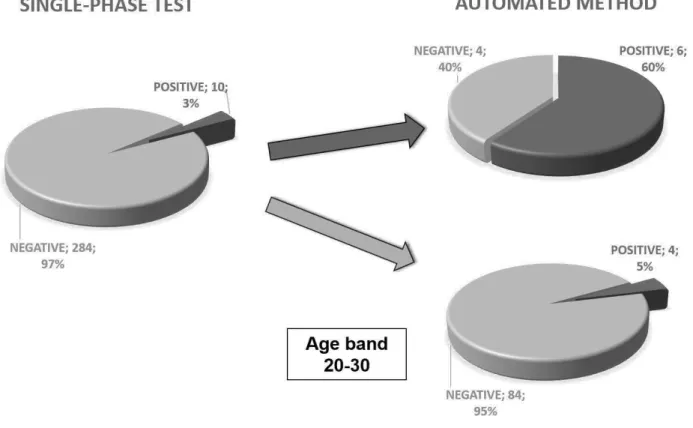
The single-phase test highlighted ten positive samples (3%) out of 294 patients involved in car accidents. The automated screening method confirmed only six out of ten samples resulted positive by single-phase test. All the patients were divided by age bands; we found positive results to ketamine in subjects between 18 and 47 years old. The 70% of the positivity belongs to the age band between 20 and 30 years old. For this reason, the 88 samples belonging to the age band 20-30 resulted negative by single-phase test, have been analysed with the automated instrument to perform a comparison between screening methods, highlighting any false negatives. The automated instrument
found further four positivity [figure 1] out of 88 samples. The confirmation analysis were carried out by a gas chromatography-mass spectrometry instrument (GC / MS), with which we have analysed 14 samples resulted positive from both screening analysis. The presence of ketamine was confirmed by GC/MS only in seven samples out of fourteen [figure 2]. The GC/MS confirmed the 50% of positivity checked by single-phase test, five true positives out of 10. The GC/MS confirmed the 70% of positivity checked by automated instrument, seven true positives out of 10. Three of these were positive only to ketamine. All the positive samples confirmed were arrived at casualty with a Red Emergency Code. All the consumers were males.
The graphics on the right show the number of positive samples checked by the automated instrument: the upper graphic shows the samples found by the single-phase test and then confirmed by the automated instrument, while the graphic below shows other four positive samples checked in the age band between 20 and 30 years old (88 samples). The presence of ketamine is confirmed by GC / MS only in seven samples out of fourteen. Three of these were positive only to ketamine.
DISCUSSION
with the automated instrument, overstate the positivity and exclude a part of positive samples (resulted false negatives) because it is under the cut-off value. Consequently, the single-phase method can only be used at an early stage of the toxicological test, so more analysis are necessary.
The automated instrument has a higher reliability, because of the standardisation of methodology and analytical procedures. The cut-off value could be adjusted to increase the reliability. In the field of analysis requested by the New Italian Highway Code to patients involved in car accidents,
a positive toxicological result provides a penalty and administrative sanction. Consequently, it is preferable to use a screening method more specific that can identify all the true negative samples and a limited percentage of false positives, which will be analysed by a confirmation test, that is the only one test with a medico-legal significance.
References
1. Sarbjeet S. Kalsi, Wood DM, Dargan PI. The epidemiology and patterns of acute and chronic toxicity associated with recreational ketamine use. Emerg Health Threats J. 2011; 4:10.3402/ehtj. v4i0.7107
2. Moore KA, Sklerov J, Levine B, Jacobs AJ. Urine concentrations of ketamine and norketamine following illegal consumption. J Anal Toxicol 2001;25(7):583-8.
3. Sanders-Bush, E. Neurochemical Evidence That Hallucinogenic Drugs are 5-HT2c Receptor Agonists: What Next? In: Lin GC, Glennon RA, editors. Hallucinogens: An Update. National Institute on Drug Abuse Research Monograph No. 146. NIH Pub. No. 94- 3872. Washington, D.C.: U.S. Government Printing Office, 1994. 4. Mozayani A. Ketamine - Effects on Human Performance and
Behavior. Forens Sci Rev 2002;14(1/2):123-31.
5. Curran HV, Morgan C. Cognitive, dissociative and psychotogenic effects of ketamine in recreational users on the night of drug use and 3 days later. Addiction 2000;95(4):575-90.
6. Benotsch EG, Martin AM, Koester S, Mason MJ, Jeffers AJ, Snipes DJ. Driving under the influence of prescription drugs used nonmedically: associations in young adult sample. Subst Abus 2015;36(1):99-105.
7. Penning R, Veldstra JL, Daamen AP, Olivier B, Verster JC. Drugs of abuse, driving and traffic safety. Curr Drug Abuse Rev 2010;3(1):23-32.
8. Giorgetti R, Marcotulli D, Tagliabracci A, Schifano F. Effects of ketamine on psychomotor, sensory and cognitive functions relevant for driving ability. Forensic Sci Int 2015;252:127-42.
9. Lagravinese GM, Mammone A, De Vita M, et al. The frequency of polydrug use in a driving population in Rome. Epidemiology Biostatistics and Public Health - 2015, Volume 12, Issue 1 - Suppl 1. 10. Pavarin RM. Substance use and related problems: a study on the
abuse of recreational and not recreational drugs in Northern Italy.
Ann Ist Super Sanita 2006;42(4):477-84.
11. Moeller KE, Lee KC, Kissack JC. Urine drug screening: pratical guide for clinicians- Mayo Clinic Proceedings, 2008 – Elsevier. 12. Lagravinese GM, Visione A, Visconti S, de Vita M, Mineo F, Curcio
S. Epidemiological aspects about the results of toxicological tests on patients, involved in car accidents, afferent to the Hospital Authority San Camillo-Forlanini’s casualty in Rome. The 52nd Meeting of the
International Association of Forensic Toxicologist (TIAFT). Buenos Aires, Argentina, 2014.
13. Lagravinese GM, Visione A, Visconti S, de Vita M, Mineo F, Curcio S. The frequency of ketamine’s consumption in drives involved in car accident in Rome. The 52nd Meeting of the International Association of Forensic Toxicologist (TIAFT). Buenos Aires, Argentina, 2014. 14. Lagravinese GM, Mineo F, Visconti S, Visione A, Brasili E, de Vita
M. Uso voluttuario della Ketamina: confronto fra test monofase ed il primo metodo di screening automatizzato per la rilevabilità dei metaboliti su urine. 17° Congresso Nazionale della Società Italiana di Tossicologia (SITOX). Milano, 2015.
15. Lagravinese GM, De Vita S, Curcio V, Marino A, Feola LT. Marsella. The frequency of consumption of ketamine in a Driving population in Rome. IALFS (International Association of Law and Forensic Science) Dubai, 2014.
16. Cheng WC, Ng KM, Chan KK, Mok VK, Cheung BK. Roadside detection of impairment under the influence of ketamine--evaluation of ketamine impairment symptoms with reference to its concentration in oral fluid and urine. Forensic Sci Int 2007;170(1):51-8. 17. Lagravinese GM, De Vita M, Visione A, Visconti S, Mineo F,
Scorretti M. Voluptuary use of Ketamine: comparison among single-phase test, automated screening method and confirmation test on GC/MS for the traceability of metabolites on urine. The 53nd
Meeting of the International Association of Forensic Toxicologist (TIAFT). Firenze, Italy, 2015.