The Relation between Contraception Methods
and Quality of Life, Gonabad-Iran
ABSTRACT
Objectives: To assess the relationship between contraception methods and quality of life in women of reproductive age.
Methods: This cross sectional study was conducted in Gonabad, Iran. Multi-stage sampling method was used to select 18-45 year-old women using a contraceptive method during the last six months. Demographic and the Short Form 36 (SF-36) Quality of Life Questionnaires were used for data collection. For statistical analysis the Stata 11 and SPSS 16 software were used. The level of significance was set at P < 0.05. After performing different statistical tests in bivariate analysis, the multi-variable linear regression was used to assess the association between method of contraception and domains of quality of life adjusting for other confounding factors
Results: Women with tubal sterilisation had significant worse “physical functioning” [adjusted regression coefficient = -5.14 (95%CI: -10.2 to -0.01)] but better “general health perceptions” [adjusted regression coefficient = 6.8 (95%CI: 2.1 to 11.5)] than those preferring male condom (reference group). Women whose husbands had vasectomy had also on average significant better score of “general health perceptions” than condom users (reference group) [adjusted regression coefficient = 7.1 (95%CI: 0.23 to 14)]. Withdrawal showed on average higher score of “vitality” than condom users (reference group) [adjusted regression coefficient = 25.07 (95%CI: 7.44 to 42.6)].
Conclusions: The results showed that some aspects of women's quality of life could be affected by using different contraception methods.
Keywords: Contraception methods, Quality of life
Narjes Bahri (1), Hamid R Tohidinik (2), Roghayeh R Bilandi (3), Mona Larki (4), Fatemeh Hooshangi (5), Maliheh Soltanian (5)
(1) PhD Student in Reproductive Health, Department of Midwifery, Nursing and Midwifery School, Gonabad University of Medical Sciences, Gonabad, Iran (2) PhD Student in Epidemiology, Department of Epidemiology and Biostatistics, School of Public health, Tehran University of Medical Sciences, Tehran, Iran. (3) PhD of Reproductive Health, Department of Midwifery, Nursing and Midwifery School, Gonabad University of Medical Sciences, Gonabad, Iran (4) PhD Student in Reproductive Health, Student Research Committee, Faculty of Nursing and Midwifery, Mashhad University of Medical Sciences, Mashhad, Iran
(5) Bsc in Midwifery, Student Research Committee, Department of midwifery, Gonabad University of Medical Sciences, Gonabad, Iran
CORRESPONDING AUTHOR:Mona Larki - E-mail: [email protected] - Tel: +989163519526
DOI: 10.2427/11986
Accepted on November 8, 2016
INTRODUCTION
Today, the problem of uncontrolled population growth affects all aspects of life in many societies. Developing
development, family planning is a vital tool for providing maternal and infant health [2]. In developing countries, maternal and infant mortality can be reduced by a minimum of 25% through appropriate family planning programs and birth spacing [3]. Contraception methods can control unwanted pregnancies and thus reduce their potential complications, and have a significant effect on women’s general health and quality of life due to the improvements made in their physical and psychological health [4-6].
Women’s quality of life is considered an important health marker [7]. Improving quality of life and control of population growth are among principle objectives in any society [1]. These two health markers are closely related, and some experts believe that contraception methods are among the factors affecting women’s quality of life [8]. In the Cairo Conference on Population and Development, it was proposed that the concept of family planning is changing from population control to a major element for empowerment of women and improvement of their standing [9]. In this regard, Macdonagh argues that quality of life of people and families is intensely influenced by fertility rate [10]. The results obtained by Li showed that choice of contraception methods is associated with its effect on women’s quality of life [7]. In another study, couples were interviewed about the type of contraception method they used as an important factor affecting their quality of life [11].
However, contraception methods also have short and long-term side-effects that may occasionally adversely affect women’s quality of life [12].
Generally, review of literature indicates no consensus on the relationship between contraception methods and quality of life. Ramayanji et al. (2014) reported that women using contraception methods have significantly higher quality of life compared to those that do not use any contraception [4]. The results of a study in Netherlands showed a significant improvement in quality of life of women using Lovonorgestrel intra-uterine device [13]. In contrast, some studies have shown that using contraception methods have no significant effect on people’s quality of life [4]. In a study by Van et al. (2004), no significant difference was observed in quality of life associated with physical and psychological health as a result of using oral contraception pills and transdermal contraception [14].
Since population control in Iran (as a developing country) is a major health priority, and continued use of contraceptive methods depends on consumer satisfaction and effects of these methods on their quality of life, and people’s understanding of quality of life is different in different societies and cultures, this study was conducted to assess the relationship between contraception method and quality of life in women of reproductive age.
MATERIALS AND METHODS
Study Design and Setting
This cross sectional study was conducted in the city
of Gonabad, a small traditional city in the northeast of Iran. Gonabad has an estimated population of 80,783 in 2011 national census. The entire population of the city is under supervision of three health care centres. At the time of the study the majority of modern contraceptive methods were accessible for women and there was full cover of these methods by national health system. Oral Contraceptive Pills (OCP), male condom, Depo Medroxy Progstron Acetat (DMPA), IntraUterine Device (IUD) were offers as free of charge and there was some facility for Tubal Ligation and Vasectomy.
Participants and Sampling
In this study, participants included 18-45 year-old women who had been using a contraceptive method during the last six months. They were fluent Persian speakers, with a minimum of elementary school education and no chronic diseases that would affect their quality of life. No cases such as physical disability, advanced psychiatric diseases or addiction were observed in participants, and they used contraceptive methods only to prevent pregnancy. Study exclusion criteria were unwillingness to take part and incomplete questionnaires.
Multi-stage sampling method was used to select women for the study. Firstly, proportional stratified random sampling was used to determine the quota of each health care centre as strata in total sample. Then, a random sample from the list of referring women in fertility age was selected using systematic random sampling to enter the study. The response rate of study was 97.3% and 2.7% of women who were invited to participate in the study refused to participate.
Measures
Data were collected using demographic and the Short Form 36 (SF-36) Quality of Life Questionnaires. The demographic questionnaire contained 11 items on age (years), occupation (employee/housewife), education (years), number of children (number), economic status (poor/moderate/good), spouse’s education (years), contraceptive method used (yes/no), possible side-effect (yes/no), and satisfaction with contraceptive method used (very low/ low/ high/ very high).
in the form of 0 and 100 in 2-option items, 0, 50, and 100 in 3-option items, 0, 25, 50, 75, and 100 in 5-option items, and 0, 20, 40, 60, 80, and 100 in the 6-option items. The overall score ranges from 0 to 100, and scores closer to 100 indicate healthier functioning. In Iran, reliability coefficient of this questionnaire has been reported between 0.7 and 0.9 [9, 16, 17].
Data collection
Telephone contacts were made to potential participants, and those meeting inclusion criteria were invited to take part by attending the health centre and signing informed consent forms. Next, participants completed demographic and SF-36 questionnaires in presence of one of the researchers. Afterwards, participants were gifted with an educational pamphlet on contraceptive methods as a token of appreciation.
Ethical considerations
All ethical considerations were observed. This study was approved by the Regional Research Ethics committee of Gonabad University of Medical Sciences, and informed written consent was obtained from all participants.
Statistical analysis
For statistical analysis the Stata 11 statistical software (College Station, TX: StataCorp LP) and SPSS software version 16.0 (SPSS Inc., Chicago, IL, USA) were used. Continuous variables were described as Mean ± Standard Deviation and categorical variables were reported as frequencies and per cents. Continuous and ordinal variables were compared in different groups using one-way analysis of variances (ANOVA) and Kruskal-wallis test, respectively. Chi-square test was used to evaluate the relations between categorical variables. Pearson’s and Spearman’s correlation coefficients were applied to assess correlation between continuous and ordinal variables, respectively. Significant or near significant variables (p<0.2) related to domains of quality of life were included in the multivariable linear regression to assess the association between method of contraception and quality of life adjusted for other confounding factors. As male condom was the most frequent contraceptive method, we considered it as reference group in multivariable regression. A two-tailed p<0.05 was considered statistically significant.
RESULTS
500 women aged between 18 and 50 (mean age: 32.5±7.1) entered the study. Most of the participants
457 (91.4%) were housewife and only 43 (8.6%) were employed. On average, they had 2.2±1.1 children and passed 10±3.9 years of schooling. The median duration of using contraceptive was 27 months (Inter-Quartile Range: 12 to 60). Mean score of quality of life in all participants was 54.1±7.2 (ranged from 32.5 to 72.8). Male condom was the most common (22.6%) and vasectomy was the least contraceptive method (4.4%).
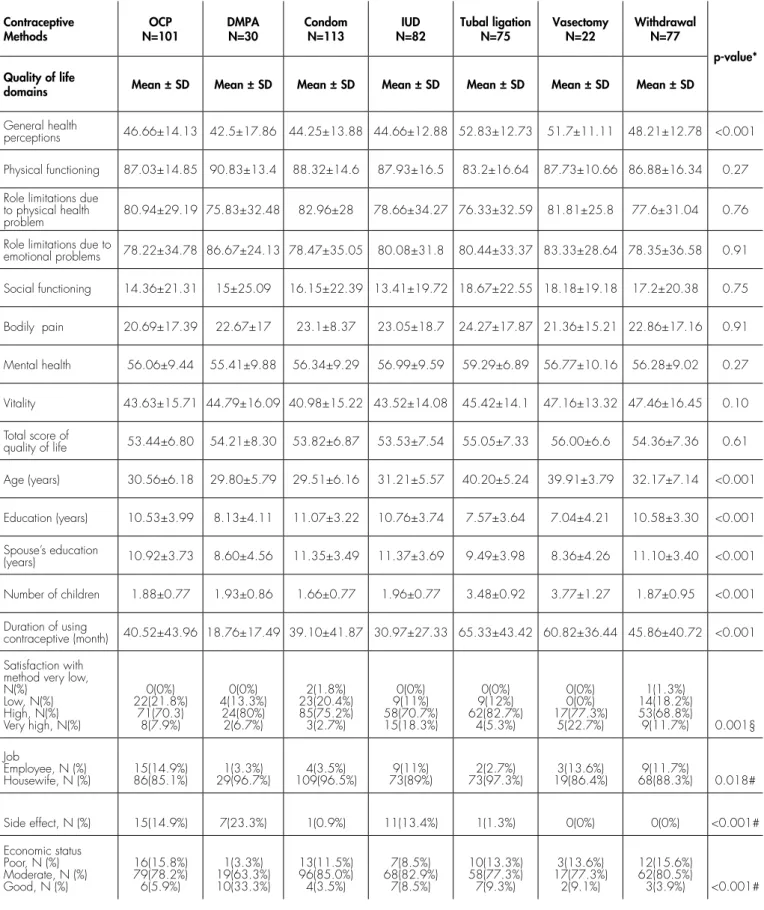
In bivariable analysis, the relation between contraceptive method and age, education, spouse’s education, number of children, duration of using contraceptive, satisfaction with method, job and economic status was significant (p<0.05). Among different aspects of “quality of life”, only “general health perceptions” and “physical functioning” were significantly different among women using different contraceptive methods (p<0.001). The mean score of “general health perceptions” was highest in women with tubal ligation (TL) and lowest in women whose husbands used condom as a method of contraception. Women using depo-medroxyprogesterone acetate (DMPA) had highest score of “physical functioning” domain while women with tubal ligation had the lowest score in this domain (table 1). Table 2 shows the association between domains of quality of life and different variables. It showed that total score of quality of life is weakly correlated with age, education of participants and their husbands, number of children and economic status (p<0.05). “General health perceptions” is weakly correlated with age, education, number of children, duration of using contraceptive and satisfaction with the method (p<0.01). “Mental health” is also correlated with age, education, number of children and duration of using contraceptive (p<0.01). “Vitality” was associated with age, education and economic status of participants (p<0.05).
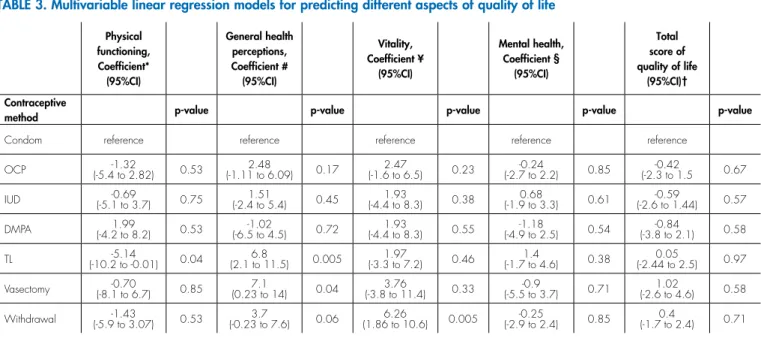
After adjusting for potentially confounding factors in multivariable analysis, comparing different contraceptive methods, women with tubal sterilisation had significant worse “physical functioning” but better “general health perceptions” than those preferring male condom (reference group). Women whose husbands had vasectomy had also on average significant better score of “general health perceptions” than condom users (reference group). Withdrawal showed on average higher score of vitality than condom users (reference group). Contraceptive method was not associated with total score of “quality of life” (table 3).
DISCUSSION
p-value* Withdrawal N=77 Vasectomy N=22 Tubal ligation N=75 IUD N=82 Condom N=113 DMPA N=30 OCP N=101 Contraceptive Methods
Mean ± SD Mean ± SD
Mean ± SD Mean ± SD
Mean ± SD Mean ± SD
Mean ± SD Quality of life
domains <0.001 48.21±12.78 51.7±11.11 52.83±12.73 44.66±12.88 44.25±13.88 42.5±17.86 46.66±14.13 General health perceptions 0.27 86.88±16.34 87.73±10.66 83.2±16.64 87.93±16.5 88.32±14.6 90.83±13.4 87.03±14.85 Physical functioning 0.76 77.6±31.04 81.81±25.8 76.33±32.59 78.66±34.27 82.96±28 75.83±32.48 80.94±29.19 Role limitations due
to physical health problem 0.91 78.35±36.58 83.33±28.64 80.44±33.37 80.08±31.8 78.47±35.05 86.67±24.13 78.22±34.78 Role limitations due to
emotional problems 0.75 17.2±20.38 18.18±19.18 18.67±22.55 13.41±19.72 16.15±22.39 15±25.09 14.36±21.31 Social functioning 0.91 22.86±17.16 21.36±15.21 24.27±17.87 23.05±18.7 23.1±8.37 22.67±17 20.69±17.39 Bodily pain
0.27 56.28±9.02 56.77±10.16 59.29±6.89 56.99±9.59 56.34±9.29 55.41±9.88 56.06±9.44 Mental health 0.10 47.46±16.45 47.16±13.32 45.42±14.1 43.52±14.08 40.98±15.22 44.79±16.09 43.63±15.71 Vitality 0.61 54.36±7.36 56.00±6.6 55.05±7.33 53.53±7.54 53.82±6.87 54.21±8.30 53.44±6.80 Total score of
quality of life
<0.001 32.17±7.14 39.91±3.79 40.20±5.24 31.21±5.57 29.51±6.16 29.80±5.79 30.56±6.18 Age (years) <0.001 10.58±3.30 7.04±4.21 7.57±3.64 10.76±3.74 11.07±3.22 8.13±4.11 10.53±3.99 Education (years) <0.001 11.10±3.40 8.36±4.26 9.49±3.98 11.37±3.69 11.35±3.49 8.60±4.56 10.92±3.73 Spouse’s education (years) <0.001 1.87±0.95 3.77±1.27 3.48±0.92 1.96±0.77 1.66±0.77 1.93±0.86 1.88±0.77
Number of children
<0.001 45.86±40.72 60.82±36.44 65.33±43.42 30.97±27.33 39.10±41.87 18.76±17.49 40.52±43.96
Duration of using contraceptive (month) 0.001§ 1(1.3%) 14(18.2%) 53(68.8%) 9(11.7%) 0(0%) 0(0%) 17(77.3%) 5(22.7%) 0(0%) 9(12%) 62(82.7%) 4(5.3%) 0(0%) 9(11%) 58(70.7%) 15(18.3%) 2(1.8%) 23(20.4%) 85(75.2%) 3(2.7%) 0(0%) 4(13.3%) 24(80%) 2(6.7%) 0(0%) 22(21.8%) 71(70.3) 8(7.9%) Satisfaction with
method very low, N(%)
Low, N(%) High, N(%) Very high, N(%)
0.018# 9(11.7%) 68(88.3%) 3(13.6%) 19(86.4%) 2(2.7%) 73(97.3%) 9(11%) 73(89%) 4(3.5%) 109(96.5%) 1(3.3%) 29(96.7%) 15(14.9%) 86(85.1%) Job
Employee, N (%) Housewife, N (%)
<0.001# 0(0%) 0(0%) 1(1.3%) 11(13.4%) 1(0.9%) 7(23.3%) 15(14.9%)
Side effect, N (%)
<0.001# 12(15.6%) 62(80.5%) 3(3.9%) 3(13.6%) 17(77.3%) 2(9.1%) 10(13.3%) 58(77.3%) 7(9.3%) 7(8.5%) 68(82.9%) 7(8.5%) 13(11.5%) 96(85.0%) 4(3.5%) 1(3.3%) 19(63.3%) 10(33.3%) 16(15.8%) 79(78.2%) 6(5.9%) Economic status
Poor, N (%) Moderate, N (%) Good, N (%)
*One way Analysis of variances was used, §Kruskal-Wallis test was used, # chi square test was used
Review of the available literature revealed that only two or three contraception methods were addressed in studies conducted to compare quality of life of women using different contraception methods, and no study has compared all contraception methods like the present study. In a study by Li et al. (2004) conducted in China, results showed that hormonal methods led to sexual dysfunction and reduced libido, and had no significant effect on women’s quality of life [7]. In a Iranian study, Sadatmahalleh (2015) concluded that tubectomy had no effect on quality of life [8]. In a double-blind clinical trial using SF36, Ramezanzadeh (2012) compared quality of life in two groups using IUD minera and IUD copper (380-A) and reported no significant difference in quality of life between the two groups six months after IUD use [18].
Ernest (2002) found different results and reported that contraceptive pills containing low doses of ethinyl estradiol and desogestrel improve women’s quality of life, and the most improvement occurs in their mood and sex life [19]. In a systematic review study,
Pasteur (2013) investigated the results from 36 studies conducted between 1978 and 2011 and concluded that OCP leaves a complex effect on the quality of women’s sex life, so that pills containing less than 20 µg of ethinyl estradiol reduce women’s libido more than those containing greater than 20 µg of ethinyl estradiol, and thus affect women’s quality of life [20]. Zhao et al. (2009) conducted a prospective cohort study on rural women using oral pills and IUD in Jiangsu Province in China and found that combined oral pills and IUD significantly improved women’s quality of life [21]. The difference in results between the present study and Zhao’s may have been due to the population differences (urban women in the present study and rural in Zhao’s). In a study conducted in Petersburg, physical and psychological quality of life of women using injection contraception methods was worse compared to women using combination method [22]. Interestingly in this study, possible use of contraception methods for reasons other than fertility control may have directly affected the
Variable
General health perceptions
Physical functioning
Role limitations due to physical health problem Role limitations due to emotional problems Social functioning
Bodily pain Mental health Vitality Total score of quality of life
Age (years) r* 0.227 -0.060 0.028 -0.011 0.050 -0.006 0.125 0.108 0.112 P-value <0.001 0.181 0.526 0.800 0.261 0.885 0.005 0.016 0.012 Education (years) r* -0.13 -0.03 -0.03 -0.15 0.07 0.01 -0.11 -0.06 -0.15
P-value 0.004 0.49 0.44 0.001 0.11 0.79 0.009 0.14 0.001
Spouse’s education (years)
r* -0.07 -0.07 0.002 -0.10 0.04 -0.017 -0.07 -0.06 -0.11
P-value 0.10 0.13 0.96 0.02 0.38 0.70 0.13 0.15 0.01
Number of children r* 0.17 -0.055 0.008 0.03 -0.002 0.006 0.11 0.09 0.09
P-value <0.001 0.22 0.85 0.52 0.96 0.89 0.01 0.04 0.04
Duration of using contraceptive (month)
r* 0.18 -0.08 -0.03 -0.04 0.04 0.02 0.09 0.08 0.04
P-value <0.001 0.07 0.51 0.40 0.33 0.65 0.03 0.06 0.34
Satisfaction with method
rho# -0.13 0.02 -0.004 0.01 -0.07 -0.02 -0.05 0.03 -0.06
P-value 0.004 0.69 0.92 0.75 0.11 0.66 0.25 0.48 0.19
Economic status (Mean±SD)
Weak 46.9±14.4 86.3±14.3 74.1±32.9 70.4±38.6 12.5±20.6 22.5±19.8 55.4±7.6 40.3±14.6 51.1±8.4 Moderate 46.6±13.5 87.1±15.8 81.2±29.6 80.9±33.1 15.9±20.9 21.7±17.0 56.9±9.1 44.0±15.1 54.33±6.9 Good 50.0±15.9 88.2±11.6 70.5±34.8 81.9±26.2 21.1±27.2 32.0±18.0 57.1±10.8 50.3±14.9 56.3±6.5
P-value§ 0.35 0.84 0.04 0.07 0.14 0.002 0.48 0.006 0.001
results. As Japanese researchers reported, women that used OCP for reasons other than pregnancy control to improve dysmenorrhea had significantly better quality of life in all aspects [23].
The present study results also showed that women in tubectomy group had better general health. In a study by Raymond et al. (2004) conducted in China, tubectomy was found to improve the quality of life in terms of sexual and social functioning [24]. It is possible that permanency and low failure rate of tubectomy abates women’s concerns about unwanted pregnancies, leading to greater sexual freedom and reduced mental stress and improved quality of life [24].
We faced some limitations in the study. One limitation was that this study was done in Gonabad city, which is a small and traditional city in Iran. Other limitation was that around 90% of participants didn’t work outside of house. Also this study was only performed on women using some method of contraception and it was impossible to compare the quality of life in users and non users.
In summary, the results showed that some aspects of women’s quality of life could be affected by using different contraception methods.
Acknowledgment
We gratefully acknowledge that this study is approved by the Student Research Committee of Gonabad University of Medical Sciences and supported by a grant-in-aid of research form Gonabad University of Medical Sciences.
References
1. Ranjbar F, Shirzad M, Kamali K, et al. Fertility behaviour of Iranian women: a community-based, cross-sectional study. Arch Iran Med 2015; 18(1):2-5.
2. Etefagh M, Shojaeizadeh D, Nori K, Sadeghi R. The Effect of Education to Reduce Depression Rate in Women with a History of Tubal Ligation Surgery. Journal of Education and Community Health 2014;1(1):55-61.
3. Tsehaye WT, Mengistu D, Birhanu E, Berhe KK. Assessment of Preference and Its Determinant Factors to Ward Modern Contraceptive Methods among Women of Reproductive Age Group in Shire Indaselassie Town, Northern Ethiopia. Int J Family Med. 2013; 2013: 317609.
4. Rayamajhi BRB, Paudel IS, Bhattarai S, Neupane B, Pokharel PK. Practice of Contraception and Quality of life among Bhutanese Refugee Women of Eastern Nepal. Global Journal of Medical research 2014;14(2-K): 14-21.
5. Akinyemi A, Adedini S, Hounton S, et al. Contraceptive use and distribution of high-risk births in Nigeria: a sub-national analysis. Glob Health Action. 2015; 8:29745.
6. Mwaikambo L, Speizer IS, Schurmann A, Morgan G, Fikree F. What Works in Family Planning Interventions: A Systematic Review. Stud Fam Plann. 2011; 42(2):67-82.
7. Li R, Lo S, Teh DK, et al. Impact of common contraceptive methods on quality of life and sexual function in Hong Kong Chinese women. Contraception 2004;70(6):474-82.
8. Sadatmahalleh ShJ, Ziaei S, Kazemnejad A, Mohamadi E. Evaluation of sexual function and quality of life in Iranian women with tubal ligation: a historical cohort study. Int J Impot Res 2015;27(5):173-7.
Physical functioning, Coefficient*
(95%CI)
General health perceptions, Coefficient #
(95%CI)
Vitality, Coefficient ¥
(95%CI)
Mental health, Coefficient §
(95%CI)
Total score of quality of life
(95%CI)† Contraceptive
method p-value p-value p-value p-value p-value
Condom reference reference reference reference reference
OCP (-5.4 to 2.82)-1.32 0.53 (-1.11 to 6.09)2.48 0.17 (-1.6 to 6.5)2.47 0.23 (-2.7 to 2.2)-0.24 0.85 (-2.3 to 1.5 -0.42 0.67
IUD (-5.1 to 3.7)-0.69 0.75 (-2.4 to 5.4)1.51 0.45 (-4.4 to 8.3)1.93 0.38 (-1.9 to 3.3)0.68 0.61 (-2.6 to 1.44)-0.59 0.57
DMPA (-4.2 to 8.2)1.99 0.53 (-6.5 to 4.5)-1.02 0.72 (-4.4 to 8.3)1.93 0.55 (-4.9 to 2.5)-1.18 0.54 (-3.8 to 2.1)-0.84 0.58
TL (-10.2 to -0.01)-5.14 0.04 (2.1 to 11.5)6.8 0.005 (-3.3 to 7.2)1.97 0.46 (-1.7 to 4.6)1.4 0.38 (-2.44 to 2.5)0.05 0.97
Vasectomy (-8.1 to 6.7)-0.70 0.85 (0.23 to 14)7.1 0.04 (-3.8 to 11.4)3.76 0.33 (-5.5 to 3.7)-0.9 0.71 (-2.6 to 4.6)1.02 0.58
Withdrawal (-5.9 to 3.07)-1.43 0.53 (-0.23 to 7.6)3.7 0.06 (1.86 to 10.6)6.26 0.005 (-2.9 to 2.4)-0.25 0.85 (-1.7 to 2.4)0.4 0.71
*Adjusted for age and duration of using contraceptive.
#Adjusted for age, education, spouse’s education, number of children, duration of using contraceptive, satisfaction with method ¥Adjusted for age, education, number of children, duration of using contraceptive, economic status
§Adjusted for age, education, number of children, duration of using contraceptive, job, economic status † Adjusted for age, education, spouse’s education, number of children, economic status.
9. Kohan S, Simbar M, Taleghani F. Role of Family Planning Services in Empowering Women: a Qualitative Study. Hakim 2012; 15(1):68-77.
10. Kermode S,MacLean D. A study of the relationship between quality of life, health and self-esteem. Aust J Adv Nurs. 2001;19(2):33-40. 11. Graziottin A. The shorter, the better: A review of the evidence for a
shorter contraceptive hormone-free interval. Eur J Contracept Reprod Health Care 2015;20:1-13.
12. Olarinmoye E, Adebimpe W, Bamidele J, Odu O, Asekun-Olarinmoye I, Ojofeitimi E. Barriers to use of modern contraceptives among women in an inner city area of Osogbo metropolis, Osun state, Nigeria. Int J Womens Health 2013;5:647-55.
13. Skrzypulec V, Drosdzol A. Evaluation of Quality of Life and Sexual Functioning of Women Using Levonorgestrel-Releasing Intrauterine Contraceptive System–Mirena. Contraception 2008; 4:1059–68. 14. Wan GJ, Barnowski CE, Ambegaonkar BM, Bolge SC, McDonnell
DD. Treatment satisfaction with a transdermal contraceptive patch or oral contraceptives. Contraception. 2007; 75(4):281-4.
15. Williams SL, Parisi SM, Hess R, Schwarz EB. Associations between recent contraceptive use and quality of life among women. Contraception 2012; 85(3):282-7.
16. Montazerghaem H, Asar O, Safaei N. Assessing patient's quality of life after open haert surgery in bandar abbass, Iran. Med J Hormozgan Univ 2011;15(4):254-9.
17. Javaheri R, Doost HTN, Molavi H, Zari M. Efficacy of cognitive-behavioral stress mangment theory on improving the quality of life
in females with temporal lobe epilepsy. Arak Medical University Journal(AMUJ) 2010;13(2):32-43.
18. Ramazanzadeh F, Tavakolianfar T, Shariat M, Firuzabadi SJP, Hagholahi F. Levonorgestrel-releasing IUD versus copper IUD in control of dysmenorrhea, satisfaction and quality of life in women using IUD. Iran J Reprod Med. 2012;10(1):41-6.
19. Ernest U, Baumgartner L, Bauer U, Janssen G. Improvement of quality of life in women using a low dose desogestrol – containing contraceptive. Eur J Contracept Reprod Health Care 2002; 7(4):238-43.
20. Pastor Z, Holla K, Chmel R. The infl uence of combined oral contraceptives on female sexual desire: A systematic review. Eur J Contracept Reprod Health Care 2013;18(1):27-43.
21. Zhao J, Yen Li, Yun Wu, et al. Impact of different contraceptive methods on quality of life in rural women of the Jiangsu province in China. Contraception 2009; 80(2):180-6.
22. Skrzypulec V, Drosdzol A. Evaluation of Quality of Life and Sexual Functioning of Women Using Levonorgestrel-Releasing Intrauterine Contraceptive System – Mirena. Collegium Antropologicum 2008;4:1059–68.
23. Matsumoto Y, Yamabe S, Ideta K, Kawabata M. Impact of use of combined oral contraceptive pill on the quality of life of Japanese women. J Obstet Gynaecol Res 2007; 33(4):529-35.