EVOLVING STRATEGIES OF MARKETING —
AN ANALYSIS
OF A FEW PRACTICES
*Dr. Raj Kumar, Director & Sr. Professor, Maharaja Agrasen Institute of Management and Technology, Jagadhri, Distt. Yamuna Nagar, Haryana, E-mail:
**Dr. Surender Kumar Gupta, Associate Professor, Maharaja Agrasen Institute of Management and Technology Jagadhri Distt. Yamuna Nagar, Haryana, email-
***Dr Veeran Kochar, Assistant Professor, Maharaja Agrasen Institute of Management and Technology Jagadhri Distt. Yamuna Nagar, Haryana, email-
Abstract
The traditional marketing with its marketing mix have for long been the dominating marketing strategy, where focus have been on placing the product at the best place with the best possible price. But today for business companies to be successful in terms of reasonable profit rate with multiplying sales and consistently rising market share, it is essential for these businesses to evolve the most appropriate marketing strategy for creating new customers and their retention. Customer creation and customer retention are infact two main strategic objectives of the marketing strategies of a modern business firm. Keeping in view the fast changing economic and non-economic environment and the volatile customer’s expectations, new and sometimes unusual strategies are adopted by the marketers to enhance the sales. In this paper an analysis has been made to highlight through cases, the genuineness of the evolving strategies of marketing
INTRODUCTION
The business environment today is more dynamic than 50-60 years ago. People are more stressful and both people and companies seek new challenges. These changes during the last century have led the business to a new direction and innovative strategies. Strategy is a game plan designed by every business firm for achieving its goals. Marketing strategy is obviously a game plan designed by the marketer for increasing its sales and market share for higher profitability and to retain customers continuously. A marketing strategy combines product development, pricing, promotion, channel, and relationship management. Over the years, with the growth of globalized environment, the ever increasing competition among the marketers and highly volatile business environment both nationally and internationally, has led to the dwindling of market share and rate of profitability. Marketing in such an environment is called the Red Ocean Marketing Strategy that involves the tactics of reducing price and spending huge amount on advertising to capture customers from each other’s domain. Guerrilla marketing in present times corroborates this view point. Whatever strategies are adopted, the modern organizations are customer oriented organizations which keep the customers on the top of a pyramid1. Customers today are, infact, more educated and informed than ever, and they have the tools to verify company’s claims and seek out superior alternatives2.
pros and cons of guerilla marketing. Next we discuss, and analyze through cases some of the innovative marketing strategies.
MARKETING STRATEGY PROCESS
The marketing strategy analysis, planning, implementation and management process is described in Exhibit -1. The strategic situation analysis considers market and competitor analysis, market segmentation, and continuous learning about markets. Designing marketing strategy examines customer targeting and positioning strategies, marketing relationship strategies and planning for new products. Marketing program development consists of product, distribution, price, and promotion strategies designed and implemented to meet the value requirements of targeted buyers. Strategy implementation and management consider organizational design and marketing strategy implementation and control.
Exhibit -1. Marketing Strategy Process
Traditionally the marketing strategy adopted by business organizations is to compete in the existing market space. Competition based red ocean strategy assumes that an industry’s structural conditions are given and that firms are forced to compete within them. In the red oceans, industry boundaries are defined and accepted and the competitive rules of the game are known3. Here companies try to out perform their rivals to garb a greater share of existing demand. As the market space gets crowded, prospects for profits and growth are reduced. Cut throat competition turns Red Ocean bloody. Each business organization tries to attract customers from the domain of the other firms. An important implication of ROMS is guerilla marketing which involves unnecessary expenses on advertising the products or services. Sometimes it goes against the marketing ethics. In this context, a case of HUL and P&G- The Two FMCG Giants seems quite consistent.
Strategic situation analysis
Designing marketing strategy
Marketing program development
Implementing and managing
Guerilla Marketing: A Case of HUL and P&G
HUL resorted to an overt comparison of its brand Rin with the leading brand of its market competitor P&G’s Tide on national network televisions for days together till the Calcutta High Court stepped in. this ambush or guerilla marketing has led to a debate on marketing ethics. Is the practice of being ‘direct’ in its comparison ethical?
One opinion has been expressed by Harish Bijoor- a brand strategy specialist. He finds such a tactic justified keeping in view the changing mindset of the Indian consumers who compare overtly. The question in his/her mind is whether your detergent give me whiteness that is really white? Does it all at a cost that is affordable? And tomorrow: Is your detergent eco-friendly and green? In the entire market evolution process, old definitions of what is right and what is wrong are bound to be questioned. The days of polite and discrete advertising may well be over. Overt comparison with rival brands may well become the norm in future4. In the Rin Vs. Tide Natural ad, the claim is of superior whiteness delivery of Rin based upon independent laboratory test. Besides, Tide has a substantial lead over Rin in market share, which perhaps explains why HUL has resorted to guerilla marketing.
Source: Harish Bijoor, Business Today, April 04, 2010.
Another opinion is one that objects to guerilla marketing tactics that involves waste full expenses on snatching customers from each other. Thos format of Red Ocean marketing strategy is not at all justified as it leads to brand wars by the companies as is shown in box-1.
Box-1 Brand Wars
PepsiCo vs. Coca-Cola (2008)
The ad tag line of Sprite, “Yeh hai Hindustan meri jaan” a coke barns, was a take off on Pepsi’s “Yeh hai Yangistan meri jaan”.
Jet vs. Kingfisher (2007)
After Jet acquires Sahara Airlines, its billboard said “We have changed”. Kingfisher’s response “We made them change”.
Cadbury vs. Nestle (2009)
Nestle mocked Cadbury’s “Pehli tarikh” ad with the tag line “Kabhi bhi kha sakte hai”. Airtel Digital vs. Big TV (2008)
Airtel Digital TV campaign had the punch line “See you at home”. Reliance ADAG’s Big TV spoofed the ad.
Source: Business Today, April 04, 2010.
Avoiding excessive selling costs and beating over competition, there is a need to look for alternative strategies for higher profitability and market share through customer creation. This is particularly when supply is exceeding the existing demand. In the next section, an attempt has been made to explore some of the new marketing strategies.
Innovative Marketing Strategies
strategies are suggested for customer creation. Some of the innovative marketing strategies are discussed as under.
1. Blue Ocean Marketing Strategy
Blue Ocean strategy for marketing, as against the Red Ocean strategy where rivals fighting over a shrinking profit pool for customer creation, provides a systematic approach to making the competition irrelevant. It will always be important to swim successfully in the red ocean by out competing rivals. Red Ocean will always matter and will always be a fact of life. But with supply exceeding demand in more industries, competing for a share of contracting markets, while necessary will not be sufficient to sustain high performance. Companies need to go beyond competing. For creating customers to seize new profit and growth opportunities, they also need to create blue oceans. The basic elements of BOMS are: Create uncontested market place, make the competition irrelevant, create and capture new demand, break the value cost trade off and, align the system for pursuit of differentiation and low cost.
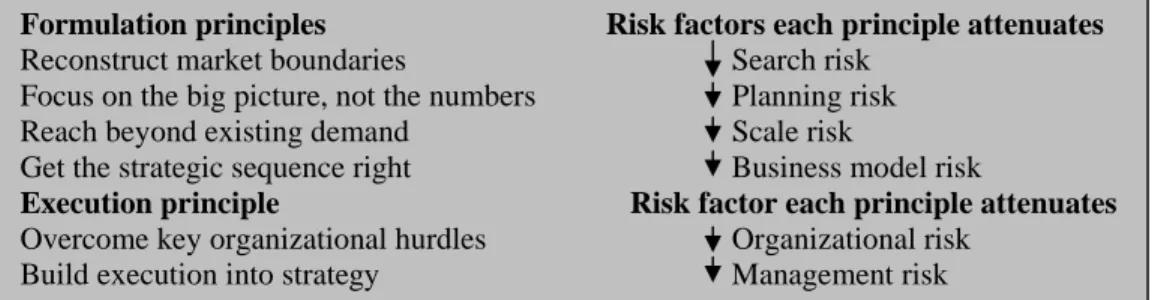
BOMS highlights the six principles that every company can use to successfully formulate and execute blue ocean strategy for rise in marketing share through customer creation. Four guiding principles are for the successful formulation of blue ocean strategy and two guiding principles are for strategy execution5. These principles along with the risk factor associated with each principle are shown in figure 1.
Figure 1: The Six principles of Blue Ocean Marketing Strategy
As it has been shown in Figure 1, the principles of BOMS are classified into two parts. I. Strategy Formulation Principles: It includes four principles pertaining to strategy formulation which are as under.
1. How to reconstruct Market Boundaries?
There are six paths that have been identified by Renee and Chan Kim which guide the companies to reconstruct market boundaries to open up blue oceans. These paths are (i) Look across alternative industries that offer substitutes/alternative products (ii) Look across strategic groups within industries
(iii) Look across the chain of buyers and to know which buyer group does your industry typically focus on?
(iv) Look across complementary products and service offerings by rival firms. (v) Look across functional or emotional appeal to buyers
(vi) Look across time and bring into consideration the rapid changes taking place overtime such as rise of internet or global movement towards protecting the environment. This will help in creating blue ocean opportunities.
Formulation principles Risk factors each principle attenuates
Reconstruct market boundaries Search risk
Focus on the big picture, not the numbers Planning risk
Reach beyond existing demand Scale risk
Get the strategic sequence right Business model risk
Execution principle Risk factor each principle attenuates
Overcome key organizational hurdles Organizational risk
2. Focus on the Big Picture, not the Numbers
It relates to the transition of the strategic planning process wedded to red oceans to Blue Ocean. Here we develop an alternative approach to the existing strategic planning process. For this, there is need to focus on big picture and drawing the strategy canvas. Over the past fifteen years, a structural process has been developed for drawing a strategy canvas that pushes a company’s strategy towards a blue ocean. It involves four steps of visualizing strategy such as visual awakening, visual exploration, visual strategy fair and, visual communication.
3. Reach beyond Existing Demand by retaining existing customers and tapping new customers
This is a key component of achieving value innovation. By aggregating the demand for a new offering, this approach minimizes the scale risk associated with creating a new market, To achieve this, the companies should challenge two conventional strategy practices. One is the focus on existing customers i.e. retaining and expanding them by greater tailoring of offerings to better meet customer preferences. Another is to focus on noncustomers that allow companies to reach beyond existing demand.
The three tiers of noncustomers can be transformed into customers. They differ in their relative distance from your market. As shown in figure 2, the first tier of noncustomer is closest to your market. For expanding the blue ocean the noncustomers have to be converted into customers.
Figure 2: The Three Tiers of Noncustomers that Needs to be Converted in Customers for Expanding Blue Ocean
(i) First Tier Noncustomers: These are soon to be noncustomers. There is need to look for the reasons why first tier customers want to jump out of your industry, look for the commonalities across their responses, and make offerings to tap untapped demand.
(iii) Third-Tier Noncustomers: These are quite far off from an industry’s existing customers. These unexpected noncustomers have not been targeted or thought of as potential customers by any player in the industry. These noncustomers have never thought of the market offerings as an option. Again by focusing on commonalities across these noncustomers and existing customers, companies can understand how to pull them into their new market.
In Box 2 a case of Prêt A Manager, a British Fast Food Chain is shown to highlight the strategy formulation for expanding blue oceans.
Box-2: Case Study of Prêt A Manager a British Fast Food Chain Converting Soon-to-be Noncustomers in to Core Customers
Company Profile
Prêt A Manager is a British fast food chain established in 1988. By 2002 it had 130 stores in the UK selling more than 25 million sandwiches a year. It also opened stores in New York and Hong Kong in 2002. Its sales were over $160 million in 2002. McDonald’s bought 33 percent share of the company.
Problem of Professionals
Before Pret, professionals in European cities had to depend upon sit-down restaurants for their lunch. Since professionals did not always have time for a sit-down meal and also can’t afford expensive lunch on a daily basis, they either bring a brown bag from home or even stripping lunch. These professionals’ as first-tier non customers were increasing in number and were in search of better solutions.
Commonalities of First-Tier Non Customers
Although there were numerous differences among them, they shared three key commonalities (i) They wanted lunch fact
(ii) They wanted fresh and healthy lunch (iii) They wanted lunch at a reasonable price Solution of the Problem
The insight gained from commonalities across these first-tier non-customers shed light on how Prêt could unlock and aggregate untapped demand. It offered restaurant-quality sandwiches made fresh everyday from only the finest ingredients and it makes the food available at a speed that is faster than that of restaurants and even fast food. It also delivers this in a sleek setting at reasonable prices. Prêt stocked thirty types of sandwiches in refrigerated shelves. People can choose from other freshly made items such as salads, blended juices etc. Each store has its own kitchen. Customers just spend ninety seconds from the time they get in line to the time they leave the shop. Whereas sit down restaurants have seen stagnant demand , prêt has been converting the mass of soon-to-be non-customers into core thriving customers who eat at Prêt A Manager often than they used to eat at restaurants
4. Get the Strategic Sequence Right
The next challenge is to build a business model to ensure that you make a healthy profit on your blue ocean idea. For this the fourth formulating principle of BOMS is to get the strategic sequence of blue ocean strategy right. The sequence runs through buyer utility, price, cost and adoption.
1. Overcome Key Organizational hurdles
Once a company has developed a BOMS with a profitable business model, it must execute it. These are so many hurdles in its execution. These hurdles are shown in figure 3.
Figure 3: The four organizational hurdles
These hurdles need to be crossed. The cognitive hurdle can be overcome only by dynamic leadership. The resource hurdle can be jumped by redistributing resources to your hot spots (activities that have low resource input but high potential performance gains), redirecting resources from your cold spots (activities that have high resource input but low performance impact), engaging in horse trading that involves trading excess resources of your unit in one area for another to fill remaining resources gaps
The motivational hurdle also needs to be jumped. The employees can be motivated by the policies of Kingpins, Fish bowl Management and, Atomization. Kingpins involve concentrating efforts on kingpins i.e. the key influencers in the organization. These are people inside the organizations who are the natural leaders, who are well respected and persuasive or who have availability to unlock or block access to key resources. It is easy for the CEO to identify and motivate such kingpins. The kingpins are to be kept in a shining position i.e. in fishbowl. To overcome motivational hurdle, the last disproportionate influencer factor is atomization. Atomization relates to the framing of the strategic challenge which is attainable. Finally the crossing of political hurdle is equally fundamental. To overcome these political forces, tipping point leaders focus on three factors such as leveraging analysis, Silencing devils, and Securing a consigliere on top management team. Angles are those who have the most to gain from the strategic shifts. Devils are those who have the most to lose from the future blue ocean strategy. A consigliere is a politically adopt but highly respected insider who knows in advance all the land mines, including who will fight you and who will support you.
2. Build Execution into Strategy
attitude and behaviour of its people deep in the organization6. A culture of trust and commitment has to be created that motivate people to execute the agreed strategy in letter and spirit. People infact, need to embrace new strategy. This sixth principle of BOS allows company to minimize the management risk of distrust and non-cooperation. The companies must reach to fair process in the making and executing of strategy. The presence or absence of fair process can make or break a company’s best execution efforts. The bases of the blue ocean systematic methodology is based upon a study of over 150 strategic moves from over 30 industries, spanning from 1880 to 2000
2. Unusual Sales Point Marketing Strategy
The FMCG marketers have adopted a new strategy to attract extraordinary consumers and partners. These include Kawariyas in Bihar, Bankers in Meerut, Mumbai’s Dabbawalas, Devotees at Kumbh Mela, Highway Dhaba Owners, and Resident Welfare Associations.
The FMCG companies such as Emami, Godrej, Dabur, Pepsi Co. and Perfetti Van Melle are now chasing these unlikely customers to keep demand tricking when prices of grocery items like soaps, shampoos, hair oils and beverages are rising. This strategy of chasing such customers through creating unusual points of sales is working very well. According to Mr. Aditya Aggarwal7, “point of sales are low-cost, effective ways to reach core target consumers. Even if it does not result in heavy sales, there is huge opportunity for creating consumer awareness.” A few instances of positive results achieved by these companies are shown in box 3.
Box-3FMCG Companies Creating Unusual Sales Points with Positive Results
• What Himani Fast Relief brand sells in one month in Bihar is equivalent to its sales from the remaining 11 months. Emami Co. has set up massage parlors for Kanwar (devotees of Lord Shiva) who walk 40-50 km every day for a month to reach the Ganges on Maha Shivaratri. Himani Fast Relief and Navratna hair oil are hot favourites in Bihar during Kawariya season. Emami massage parlors set up on routes taken by Kawariyas provide free massage but also create sales points.
• Perfetti Van Melle, a grocery co. too has followed the low-cost direct marketing method to derive demand as prices of various grocery items have gone up 3 to 5 percent since the budget of year 2010. The company has tied up with Mumbai’s Dabbawalas to sample its Mangofillz candies.
• Godrej is tapping one lakh barber shops to push shaving creams and hair colour. The half-a-million barbers in towns like Meerut, Nasik and Ghaziabad are key growth drivers for Godrej Consumer Products, which makes shaving cream, Expert and Renew hair colours and Cinthol talc.
• Other companies such as Dabur and Pepsi Co. too following this marketing strategy. Dabur has tied up with dhabas for its candies, Khumbh mela to push its Amla hair oil and beauty pageants for Fem bleach. Pepsi Co. has tapped resident welfare associations for Tropicana Juices.
Mr. Dalip Sehgal8, MD of Godrej Consumer Products has summarized the logic of the new marketing strategy of creating unusual points of sales in the following statement:
“If we can physically reach the half-a-million barber shops in the country with our products, we perhaps don’t even need to advertise. More than points of sale, the barbers are a great endorsement for us.”
3. Infiltrative Marketing Strategy of Customer Creation
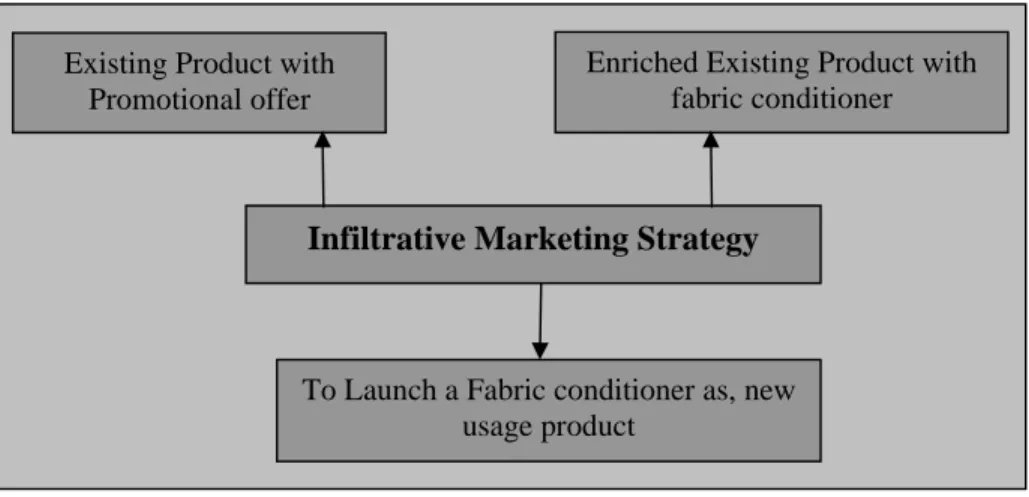
The infiltrative marketing strategy is also an innovative strategy developed by Professor B.Karthikeyan and N. Panchanatham of Annamalai University. This strategy comprises three way marketing to achieve more volume of market share. It was developed on the basis of the experience of southern Fabric Products Ltd.- a multi-crore company engaged in the manufacturing and marketing of detergent cakes and powders. The figure 4 shows the infiltrative marketing strategy involving existing product named “whether washing powder, enriched existing product with fabric conditioner and launching of a fabric conditioner as a new usage product.
Figure 4: Infiltrative Marketing Strategy
The authors quoted the case of Southern Fabric Products Ltd. In highlighting the formulation of this strategy, case study is given in the Box 4.
Box 4 Case Study—Infiltrative Marketing Strategy Adopted by Southern Fabric Products Ltd.
Company Profile
Southern Fabric Products Ltd. (SFPL) was a multi crore company engaged in the manufacturing and marketing of detergent cakes and powders. The Industry was located in Puducherry. They were high volume players catering to the lower end of the market. Their product named “Whiter” washing powder was available all over south India. Their washing powder was available in Re 1 sachet as well as in 250 g, 500g and 1 Kg packages. Their products had an attractive packaging and were competitively priced. The production capacity was 300 tonnes per day. They had a strong Research and Development team whose efforts helped them to frequently update their products.
Problem of the Case
To meet the growing aspirations of consumers and to offer them value added product portfolio, SFPL research and development (R&D) department brought out a new product which is better than ordinary detergent powders in preventing shrinkage and fading of colours
Existing Product with Promotional offer
Enriched Existing Product with fabric conditioner
Infiltrative Marketing Strategy
and also helps preserve the luster of silks. This fabric care product system is unique new Fabric Conditioner designed for use on special and delicate fabrics, including fine silk sarees and all winter wear. The special ingredients of the Fabric Conditioner developed by the R& D reached every fibre of the woolens leaving a conditioning layer over it and thus help in keeping the woolens soft and fluffy.
Strategy Formation
The General Manager, Mr. Selvem called for a meeting among their production and marketing team to discuss the modalities regarding marketing the product. One of the production executives felt that the fabric conditioner can be mixed with the existing washing powder “Whiter” and sell it as a washing powder with fabric conditioner effect. Another marketing executive insisted to market the fabric conditioner in sachet with the same brand name. This involved creation of new users rather than selling newly developed product. One executive provided a new idea to launch an absolutely new brand focused on the high end customers without modification of their existing product “Whiter”.
Three way Marketing Strategy
After discussion, Mr. Selvam decided to implement a three way marketing strategy to achieve more volume of market share.
The first strategy was to market the fabric conditioner in sachet by the name of “Smoother” which can be used with any brand of washing powders. This product ensured the shine, fragrance and smootheness of the clothes.
The second strategy implemented by the General Manager was launching a new washing powder packed in plastic container in the new name of “Easier”. The price of the product was far higher and was targeted to the high end consumer. The fabric conditioner was integrated with the washing powder and was made suitable to be used in both washing machine and hand wash system.
The third strategy was a promotion offer to consumers. A new fabric conditioner “Smoother” was offered free with their existing 1 Kg “Whiter” washing powder. Their idea was to create awareness about the new product “Smoother” and provide the customer of “Whitener” a chance to use the product. They believed that this offer would bring additional sales volume of both “Whiter” and “Smoother” products. They planned to introduce this offer for a three months period.
Conclusion
The three way marketing strategy is expected to bring positive results in multiplying customers with higher market share for the company. The simple reason is that it caters to the need of all segments of customers-the low and high end. This in fact approves of the logic of pursuing Blue Ocean Marketing Strategy discussed in the previous section.
4. Pipeline Marketing Strategy
How to build the pipeline of prospective customers?
There are a few tips or strategic moves in this context which are shown in Figure-4.
Source: Avinash Narula, Theory of Pipeline, Management Talk, February-April 2010, p.14-16.
Conclusion
The discussion of the marketing strategies in regard to customer creation and retention given above, boils down to the conclusion that modern business organizations design and adopt marketing strategies sometimes unusual and innovative so to create a continuously flowing stream of satisfied and highly engaged customers. This is perhaps an essential requirement on the part of the companies to maintain their profitability rate and market share. BOMS is practised particularly to make competition irrelevant. When supply exceeds demand in blue oceans, demand is created rather than fought over. Creating Blue Ocean, however, is a dynamic process and not static. Once a company creates a blue ocean-the uncontested market, its powerful performance consequences are known and sooner or later imitators
1. Develop New Market Segments for your products.
5. Focus on Retail Sales
2. Develop under-developed market segments.
6. Retain customers, Plug Hole and Fill-up the Pipeline 3. Develop Markets for different applications of home products.
appear on the horizon over crowding the blue-ocean. Other innovative strategies in the form of creating unusual sales points, marketing theory of pipe line and infiltrative strategy are worth emulating.
References
1. Avinash Narula, Management Talk, February-April, 2010, p.14-16. 2. Avinash Narula, Management Talk, February-April, 2010, p.7-10. 3. Business Today, April 04, 2010.
4. W. Chan Kim, Renee Mauborgne, “Blue Ocean Strategy”, Harvard Business School Press, 2005, p.18.
Notes
1
Ibid, p.118.
2
Glen L. Urban, “The Emerging Era of Customer Advocacy”, MIT, Sloan Management Review, Winter, 2004, p.77-82.
3
Gary Hamel and CK Prahalad, Competing for the Future- The Beat Selling Business Book of the Year in 1994.
4
Harish Bijoor (A Brand Startegy Specialist & CEO), “Focus Evolved Marketing for an Evolved Consumer” Business Today, April 04, 2010, p.12.
5
W.Chan Kim and Renee Marborgne, Blue Ocean Strategy, Harvard Business School Publishing Corporation, Boston, 2005, p.21
6
Ibid, pp.171-183. 7
Aditya Aggarwal, Group Director of Emami Co. revealed to ET, April 5, 2010 8