Volume 56 (2013)
Proceedings of the Combined workshop on
Self-organizing, Adaptive, and Context-Sensitive
Distributed Systems
and
Self-organized Communication in Disaster Scenarios
(SACS/SoCoDiS 2013)
Decentralized Coordination in Self-Organizing Systems based on
Peer-to-Peer Coordination Spaces
Thomas Preisler, Ante Vilenica and Wolfgang Renz
12 pages
Guest Editors: Michael Zapf, Florian Evers
Managing Editors: Tiziana Margaria, Julia Padberg, Gabriele Taentzer
Decentralized Coordination in Self-Organizing Systems based on
Peer-to-Peer Coordination Spaces
Thomas Preisler1, Ante Vilenica2and Wolfgang Renz1
1thomas.preisler;[email protected]
Multimedia Systems Laboratory, Faculty of Engineering and Computer Science Hamburg University of Applied Sciences, Berliner Tor 7, 20099 Hamburg, Germany
Distributed Systems and Information Systems, Computer Science Department University of Hamburg, Vogt-K¨olln-Str. 30, 22527 Hamburg, Germany
Abstract: Coordination is an important aspect to realize Self-organizing Systems usually implemented as part of the functional properties of the system. This paper promotes a separation of concerns via a declarative approach to realizedecentralized coordinationin Self-organizing Multi-Agent Systems (MAS). In previous work the concept ofCoordination Spaceswas developed which provides explicit support for the task of coordination in MAS. Coordination Spaces are part of the agent environ-ment and handle a declarative description of the coordination process. Thereby, this approach allows developers rather focusing on what to coordinate than on how to co-ordinate. Also by releasing the developer from programming coordination manually, the approach offers benefits like reusability and interoperability of coordination pro-cesses. This paper extends the approach by adistribution conceptfor coordination spaces. By using different techniques like remote service calls, group communica-tion and publish/subscribe models the distribucommunica-tion of informacommunica-tion among multiple platforms in a peer-to-peer like approach is achieved.
Keywords:Decentralized Coordination, Coordination Architecture, Self-Organization, Distributed Systems, Peer-to-Peer
1
Introduction
coordination which allows developers to easily apply different coordination strategies without the need to change the agents’ functionality. Therefore, this paper advocates a clear separation between application functionality and coordination. Environments as a conceptual part of MAS have been widely recognized. The definitions of agents point out the occurrence of an environ-ment in which the agent is situated [WJ95]. More recently it has been argued that environments have to be understood as first-class entities within MAS and therefore as an explicit concept to handle concerns apart from the core agent functionalities [WSR+05,KG06]. Following this concept, environment-mediated coordination [SGK06,WSR+05] as well as coordination by di-rect agent interaction has been analysed in order to propose a layered architecture with an agent coordination layer [SR08] in order to separate coordination from application programming. The work presented here extends the concepts originally proposed in [SR09a] to handle coordi-nation in MAS explicitly with environments treated as first-class entities. In [VSL+10] a model was presented that enables a declarative description of coordination entities and mechanisms in MAS. The environment can process this description automatically and therefore relieves devel-opers from implementing coordination functionality manually. Also, this allows the coordina-tion process to be modularized and coordinacoordina-tion mechanism to be exchanged as well, offering benefits like reusability and interoperability of coordination processes. These environments are calledCoordination Spaces. The work presented in this paper extends the Coordination Spaces by adding a distribution concept. As the Coordination Spaces are based on non-distributable environments in the Jadex framework [BP12b] they needed to be equipped with some sort of dis-tribution mechanism to realize distributed applications. Therefore, this paper presents a generic reference architecture which allows the usage of different techniques to achieve the required distribution. This architecture allows the interaction of multiple local Coordination Spaces to form a Peer-to-Peer network of Coordination Spaces to achieve decentralized coordination in Self-organizing Systems. Therefore, three different example implementations - based on remote service calls, Distributed Hash Tables (DHT) and a publish/subscribe model - are described to illustrate the flexibility benefits of the approach as the distribution concept can be adapted to the needs of the application context or the network topology.
This paper is structured as follows. The next Section discusses related work, Section3describes the concepts and the reference architecture behind distributed Coordination Spaces. In Section4
an example realization for the Jadex framework and a case study is described. Finally, Section5
concludes the paper and gives an overview about future work.
2
Related Work
enhances a tuple space with a behavior specification. Therefore, the tuple centers are a com-munication abstraction whose behavior can be defined to embed an overall law of coordination. This is similar to the approach presented in this paper which utilizes coordination media as com-munication abstractions. But it lacks a clean separation between application and coordination logic which is propagated by the presented approach.
In [JXJY06] another tuple space oriented approach for decentralized coordination is presented.
DTuplesis a peer-to-peer tuple space middleware built on top of a DHT. The approach aims at combining the advantages of peer-to-peer systems with the tuple space model firstly introduced inLinda[CG89]. Since a standard tuple space model like Linda is based on a central space for communication and coordination, it has to deal with problems like single point of failure and scalability issues. Peer-to-peer systems overcome these issues as they are based on a decentral-ized approach, but most of them lack coordination primitives like given in tuple spaces. There-fore, [JXJY06] builds a tuple space based on a DHT. Since in a dynamic peer-to-peer system network nodes can fail and new nodes can appear, for the realization of a fault-tolerant systems it is necessary that the the data stored in the distributed tuple space is replicated among multiple nodes and the data’s integrity is insured by transactions. The approach presented in [LP05] is also based on a DHT. The presentedComentis a scalable peer-to-peer content-based Coordina-tion Space for decentralized distributed environments. It provides a global virtual shared space that can be accessed by all system peers. By adding a transparent layer as an overlay network on the DHT, the system peers can access the virtual share space without requiring the host identifiers or location information of tuples. The usage of a DHT enables Coment to guarantee informa-tion lookup and performance. Both are essential requirements for a coordinainforma-tion middleware in decentralized environments. Transient Coordination Spaces are also supported to enable context locality to be explicitly exploited for improving system performance. Both presented approaches focus on transferring the tuple space model to peer-to-peer systems to overcome scalability and single point of failure issues, while ensuring performance and fault-tolerance. The approach pre-sented in this paper introduces a more flexible architecture which facilitates the usage of different technical distribution solutions and utilizes DHT only as one possible solution. So, an optimal solution for the given application and network topology can be chosen.
shared and used to support their individual and collective activities. For a MAS programmer the artifacts are first-class abstractions to program functional environments that agents will exploit at runtime, including functionalities that concern agent coordination. From a software-engineering perspective this improves modularity, extensibility and reusability.
3
Distributed Coordination Spaces
This Section describes the concepts and foundations of decentralized coordination in distributed Coordination Spaces. First, the overall design concept for decentralized coordination is intro-duced, which is based on the clean separation of application and coordination logic. Then the Coordination Space approach is described which provides a separate space within the environ-ment of MAS that is dedicated for coordination. The last part presents the Peer-to-Peer based reference architecture with enhances the Coordination Spaces with distribution mechanisms to realize flexible, distributed Coordination Spaces.
3.1 Coordination Enactment Architecture
The work on decentralized coordination in Self-organizing Systems is based on a tailored pro-gramming model for the purpose of software-technical utilization of coordination mechanisms as reusable design elements [SR09b]. This model provides both, a systematic modeling and configuration language calledMASDynamicsand theDeCoMASreference architecture to enable the enactment of pre-described coordination models [SR09a]. The architecture is based on the clean separation of activities that are conceptually relevant to the coordination of system enti-ties and the systems’ functionality. This allows coordination models to be treated as first class design elements that define application-independent coordination interdependencies. Figure1
Agent Coordination Enactment Input Output Coo rdin a tion In fo rma tio n Coordination Model (ACBG) Agent Coord. Enactment Coordination Medium 1 ... 2 3
B:
A:
Application Layer Coordination Layer Application Agent Coord. Enactment ...Figure 1: Coordination enactment architecture [VSL+10].
3.2 Coordination Spaces
The coordination enactment architecture was extended by [VSL+10] with the introduction of
Coordination Spaces. The Coordination Space concept is based on the architecture and princi-ples introduced in [SR09a,SR09b] and extends them by using environments as first class entities within MAS. It provides separate spaces within the environment of a MAS, that are used for coordination. Figure2illustrates the approach. Coordination Spaces are placed within the envi-ronment of a MAS, dedicated to all aspects related to coordination. All participating agents are observed by the space vialisteners. Therefore, whenever the space perceives an event relevant to the coordination via itsperceive interface, this event is published to thecoordination medium
which processes it and publishes it back to the Coordination Space by triggering an according event. The Coordination Space uses itspercept generatorto create a perceive event in the rele-vant agents, which are equipped with apercept processorto perceive coordination events. The triangle ofAgent Listeners,Percept Generatorin the Coordination Space andPercept Processor
in the agent as shown in Figure2maps the Coordination enactments (cf. Figure1) to the Coordi-nation Space model. As in the previously described work, all the aspects of a CoordiCoordi-nation Space are declaratively modeled and described in a separate configuration file [VSL+10]. Figure2also shows the three important interfaces the architecture relies on and which ensure the exchange of different coordination media and allow the usage of heterogeneous agent architectures. By pro-viding theICoordinationMediuminterface it is ensured that all coordination media implement certain basic methods and have a similar structure. In order to support the usage of heterogenous agent architectures it is only necessary to implement oneagent listener/observeras well as one
percept generator/processor for the according architecture, as these interfaces encapsulate all actions and percepts related to coordination for a specific agent architecture.
3.3 Peer-to-Peer Coordination Spaces
Application Environment
Coordination Space
Medium A
Perceive Interface
Perceive Event
Publish Interface
Percept Generator
Fire SpaceEvent
Perceive Event ICoordinationMedium
Init Agent Listeners and Observe
Oberserve according to MASDynModel
Publish Event Publish Event
Percept Processor
Agent
Figure 2: Conceptual model of Coordination Spaces [VSL+10].
application design and there is no need to modify the agent models to achieve coordination. The Coordination Spaces are conceptually designed to enable decentralized coordination in MAS on a local node. In order to support decentralized coordination in applications distributed over multiple nodes the Peer-to-Peer Coordination Spaces have been envisioned.
Agent Agent
CE CE
Space
Medium
Distributed Application
Medium Endpoint
Agent Agent
CE CE
Space
Medium
Medium Endpoint
Node Node
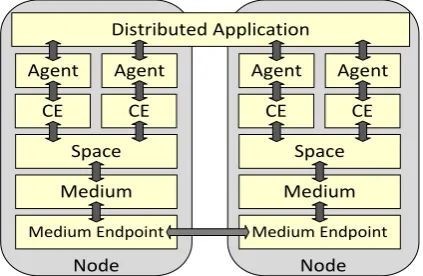
Figure 3: Peer-to-Peer Coordination Spaces architecture
information not only to the local Coordination Space but also to Coordination Spaces on remote nodes. Whenever a local coordination medium processes a coordination event, it can use its endpoint to distribute the coordination information to remote nodes. On the remote node the medium endpoint is used to forward the received coordination information to its medium. A coordination event then is published to the according local Coordination Space the same way as locally perceived coordination information.
On a technical level the distribution of coordination information can be realized with different approaches. Currently coordination media and endpoints have been implemented which facili-tate remote service calls, a group communication model based on DHTs and a message-queue inspired publish/subscribe model. These three approaches will be described in the next Section.
4
Realization
The Peer-to-Peer Coordination Space architecture has been implemented for the Jadex frame-work [BP12b]. Jadex is conceptually based on active components that combine properties of agents with software components. Jadex therefore allows the development of traditional MAS with BDI-agents1, reasoning and environments, but also allows the usage of more lightweight ac-tive components which can show a reacac-tive or proacac-tive behavior. Additionally to message based communication among the agents, following the FIPA standard2, Jadex also supports service-based architectures where the components can offer and require certain services. These services can also be offered as web services to allow an integration with other applications. Similarly, the active components are able to consume web services from third party applications [BP12a]. Jadex applications are described in a declarative way [PB10] akain to the MASDynamics lan-guages described in [SR09b].
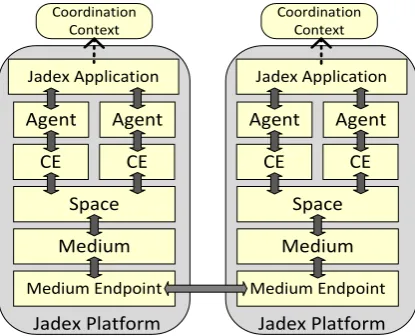
Figure4depicts the realization of the generic Peer-To-Peer Cordination Space architecture in the Jadex framework. Due to the lack of Jadex to inherently support fully distributed applications over network nodes the realization introduces the concept ofCoordination Contexts. It is used as a glue between different Jadex application instances on multiple platforms that should form together a distributed application. The following three paragraphs describe different realizations that enable Peer-To-Peer Coordination Spaces in Jadex.
Remote Service Calls
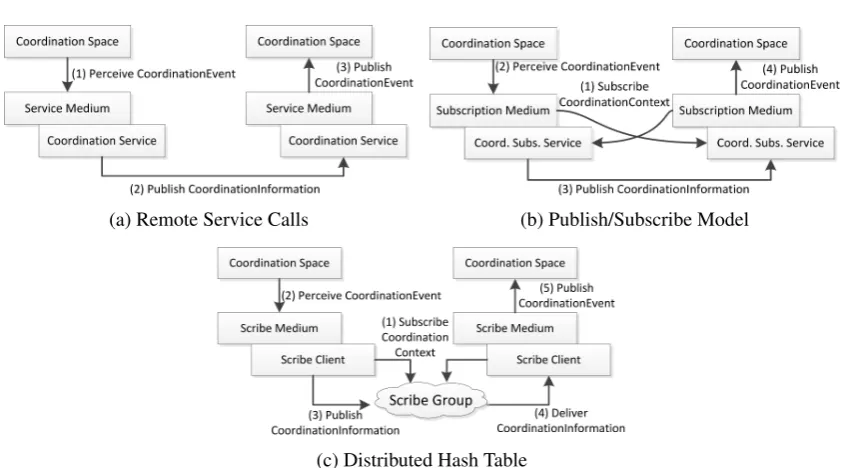
A first approach in realizing the distribution of coordination information among multiple local Coordination Spaces, was to utilize the service infrastructure of the Jadex framework. Therefore, each coordination medium offers a coordination service interface as its endpoint. This interface is called from a remote endpoint in case some coordination information should be published to the local Coordination Space. Figure5a illustrates the process. If a local Coordination Space perceives a coordination event, the event is forwarded to the local coordination medium to be processed (1). The coordination medium uses its endpoint, in this case realized as a coordina-tion service, to publish the event to Coordinacoordina-tion Spaces on remote platforms. Therefore, the
Agent Agent
CE CE
Space
Medium Jadex Application
Medium Endpoint
Agent Agent
CE CE
Space
Medium Jadex Application
Medium Endpoint
Jadex Platform Jadex Platform Coordination
Context
Coordination Context
Figure 4: Realization of Peer-to-Peer Coordination Spaces in Jadex
coordination service endpoint looks up all coordination services which are assigned to the same coordination context as itself and publishes the coordination information by calling the remote publish method (2). Finally, the remote coordination medium publishes the information as a coordination event by invoking the appropriate method on its local Coordination Space. Con-ceptually this resembles a broadcast push communication protocol.
Publish/Subscribe Model
The next approach (cf. Figure5b) realizes a publish/subscribe model for the distribution of coor-dination information, conceptually resembling a multicast push communication protocol. Each coordination medium, in this case called subscription medium, offers a coordination subscrip-tion service for its coordinasubscrip-tion context as its endpoint. Other coordinasubscrip-tion media endpoints can subscribe to this service, if they want to be informed in case any coordination events for the coordination context occur at the remote Coordination Space. In case an endpoint wants to be informed about all remote coordination events for a given coordination context, it has to lookup all subscription services and subscribe to them for the given coordination context (1). Again, if a local Coordination Space perceives a coordination event, it is forwarded to the local coordination medium to be processed (2). The medium publishes the coordination information to its endpoint and the service forwards it to all its remote subscribers (3). Finally, the remote subscription media will publish the coordination information as a coordination event on their local space (4).
Distributed Hash Table
(a) Remote Service Calls (b) Publish/Subscribe Model
(c) Distributed Hash Table
Figure 5: Peer-to-Peer Coordination Space Realizations
Internet for the implementation of a DHT. Scribe uses Pastry to create groups for specified topics and to build an efficient multicast tree for the dissemination of events to the topic’s subscribers. The usage of Scribe for the purpose of distributing coordination information is illustrated in Fig-ure5c. Each coordination medium has its own Scribe client as an endpoint which subscribes to a Scribe group for its coordination context (1). Like before, if a local Coordination Space per-ceives a coordination event, it is forwarded to its coordination medium (2). The Scribe medium uses its Scribe client endpoint to publish the coordination information to the Scribe group with the according coordination context (3). The coordination information is delivered by the Scribe group as a multicast message to all subscribers for this group (4). Finally, all Scribe client end-points which have received the coordination information publish it as a coordination event on their local space by invoking the appropriate method.
4.1 Decentralized Coordination in Natural Disaster Scenarios
cen-tralized ones. From this perspective on, the case study will study the benefits of the concept of Peer-To-Peer Coordination Spaces and compare it with approaches that base on centralized coordination. The main focus is on the ability to coordinate different types of rescue forces in a decentralized fashion. Thereby, each entity is performing its task independently of others and has also its own perception of the environment. If the entity requires coordination with others it uses the Peer-To-Peer Coordination Space to publish events and to receive events from others. Despite this basic usage of the Peer-To-Peer Coordination Space, i.e. transmission of events, it can also be used as a component with computational abilities. In the case study for instance it will be used to aggregate or delay events, if necessary. Furthermore, it will also be used to com-pute distances between different forces and utilize this information for the transmission of events. Another benefit of the approach consists in its ability to offer multiple coordination media at the same time within one Coordination Space, i.e. different tasks can be realized with different ways of coordination. With respect to the case study this can be used to coordinate police units in a swarm based fashion whereas ambulance cars use digital pheromones. Moreover, the distributed character of Coordination Spaces allows for implementing a visual control console which can be used to display the available information about the situation in the disaster area. In conclusion this case study will evaluate the effectiveness of Peer-To-Peer Coordination Spaces.
5
Conclusion and Future Work
runtime. Either controlled by some sort of system administrator or by the distributed application itself. Therefore, a convergence medium will be realized which will support the autonomous decision making among the coordination enactments whether or not certain mechanisms should be activated or deactivated including the adaption of certain configuration parameters.
Acknowledgements: We would like to thank the Deutsche Forschungsgemeinschaft (DFG) for supporting this work in a project on ”Self-organisation based on decentralized Coordination in Distributed Systems” (SodekoVS). Furthermore, we would like to thank Winfried Lamersdorf, Lars Braubach and Alexander Pokahr from the University of Hamburg for inspiring discussion.
Bibliography
[BP12a] L. Braubach, A. Pokahr. Conceptual Integration of Agents with WSDL and RESTful Web Services. In10th Int. Work. on Prog. MAS (ProMAS’12). 2012.
[BP12b] L. Braubach, A. Pokahr. Jadex Active Components Framework - BDI Agents for Disaster Rescue Coordination. In Essaaidi et al. (eds.),Software Agents, Agent Sys-tems and Their Applications. NATO Science for Peace and Security Series - D: In-formation and Communication Security 32, pp. 57–84. IOS Press, 2012.
[CG89] N. Carriero, D. Gelernter. Linda in context.Commun. ACM32(4):444–458, 1989.
[GC92] D. Gelernter, N. Carriero. Coordination languages and their significance.Commun. ACM35:97–107, February 1992.
[JXJY06] Y. Jiang, G. Xue, Z. Jia, J. You. DTuples: A Distributed Hash Table based Tuple Space Service for Distributed Coordination. InProc. of the 5th Int. Conf. on Grid and Coop. Comp.GCC ’06, pp. 101–106. IEEE Comp. Soc., Wash., DC, 2006.
[KG06] D. Keil, D. Goldin. Indirect Interaction in Environments for Multi-agent Systems. In Weyns et al. (eds.),Environments for Multi-Agent Systems II. Lecture Notes in Computer Science 3830, pp. 68–87. Springer Berlin / Heidelberg, 2006.
[LP05] Z. Li, M. Parashar. Comet : A Scalable Coordination Space for Decentralized Dis-tributed Environments. InProceedings of the Second International Workshop on Hot Topics in Peer-to-Peer Systems. Pp. 104–112. 2005.
[NVCO10] E. Nardini, M. Viroli, M. Casadei, A. Omicini. A Self-Organising Infrastructure for Chemical-Semantic Coordination: Experiments in TuCSoN. In Omicini and Viroli (eds.),WOA. CEUR Workshop Proceedings 621. CEUR-WS.org, 2010.
[Pro08] M. Prokopenko. Design vs. Self-organization. In Prokopenko (ed.),Advances in Ap-plied Self-organizing Syst.Adv. Inf. and Knowl. Proc., pp. 3–17. Springer, 2008.
[RD01] A. Rowstron, P. Druschel. Pastry: Scalable, decentralized object location, and rout-ing for large-scale peer-to-peer systems. InIFIP/ACM Int. Conf. on Distr. Systems Platforms (Middleware). Volume Nov. 2001, pp. 329–350. Heidelberg, Germ., 2001.
[RKCD01] A. Rowstron, A.-M. Kermarrec, M. Castro, P. Druschel. SCRIBE : The design of a large-scale event notification infrastructure. In3rd International Workshop on Net-worked Group Communication (NGC2001). Volume November 2001. 2001.
[RPV11] A. Ricci, M. Piunti, M. Viroli. Environment Programming in Multi-Agent Sys-tems – An Artifact-Based Perspective.Autonomous Agents and Multi-Agent Systems
23(2):158–192, Sept. 2011. Special Issue: Multi-Agent Programming.
[RVO08] A. Ricci, M. Viroli, A. Omicini. The A&A Programming Model and Technology for Developing Agent Environments in MAS. In Dastani et al. (eds.),Progr. Multi-Agent Systems. LNCS 4908, pp. 89–106. Springer Berlin / Heidelberg, 2008.
[SGK06] G. D. M. Serugendo, M. P. Gleizes, A. Karageorgos. Self-Organisation and Emer-gence in MAS: An Overview.Informatica (Slovenia)30(1):45–54, 2006.
[SR08] J. Sudeikat, W. Renz. On the Encapsulation and Reuse of Decentralized Coordina-tion Mechanisms: A Layered Architecture and Design ImplicaCoordina-tions. Communica-tions of SIWN4:140–146, 7 2008.
[SR09a] J. Sudeikat, W. Renz. DeCoMAS: An Architecture for Supplementing MAS with Systemic Models of Decentralized Agent Coordination. In IEEE/WIC/ACM Inter-national Conference on Web Intelligence. Pp. 104 – 107. IEEE, 2009.
[SR09b] J. Sudeikat, W. Renz. MASDynamics: Toward systemic modeling of decentralized agent coordination. InKomm. in Vert. Systemen (KiVS). Pp. 79–90. Springer, 2009.
[VL12] A. Vilenica, W. Lamersdorf. Benchmarking and Evaluation Support for Self-Adaptive Distributed Systems. InThe Sixth International Conference on Complex, Intelligent, and Software Intensive Systems (CISIS 2012). Pp. 20–27. 7 2012.
[VSL+10] A. Vilenica, J. Sudeikat, W. Lamersdorf, W. Renz, L. Braubach, A. Pokahr. Coordi-nation in Multi-Agent Systems: A Declarative Approach using CoordiCoordi-nation Spaces. In Trappl (ed.),Proc. of the 20th European Meeting on Cybernetics and Systems Re-search (EMCSR 2010) - Int. Workshop From Agent Theory to Agent Implementation (AT2AI-7). Pp. 441–446. Austrian Society for Cybernetic Studies, 4 2010.
[WJ95] M. Wooldridge, N. R. Jennings. Intelligent agents: theory and practice.The Knowl-edge Engineering Review10(02):115–152, 1995.
![Figure 1: Coordination enactment architecture [VSL+10].](https://thumb-us.123doks.com/thumbv2/123dok_us/7804038.2084723/6.595.145.443.159.286/figure-coordination-enactment-architecture-vsl.webp)