ISSN: 2501 - 1235 ISSN-L: 2501 - 1235 Available on-line at: www.oapub.org/edu
Copyright © The Author(s). All Rights Reserved.
doi: 10.5281/zenodo.1593401 Volume 5 │ Issue 1 │ 2018
THE ATTITUDES OF UNIVERSITY STUDENTS TOWARDS SPORTS:
ATTITUDE AND METAPHORICAL PERCEPTION
Öznur Kayai, Halil İbrahim Cicicoğlu, Gönül Tekkurşun Demir Gazi University, Faculty of Health Sciences,
Ankara, Turkey
Abstract:
The reactions and values that individuals possess towards objects or situations reflect their attitudes. A metaphor is to describe a situation or object by establishing an analogy to another situation or object. The aim of this study is to examine the attitudes and perceptions of undergraduate students studying at various faculties towards sports. The present study, in which a mixed method design was used, was conducted with undergraduate students of Gazi University in the 2017-2018 academic year. In this context, the sample of the study was comprised of a total of 481 (241 female, 240 male) undergraduate students studying at various departments, such as Physical Education Teaching, Banking and Insurance, Political Science and Public Administration, Law, Statistics, Finance, Chemical Engineering, Banking, Conservatory, and Psychological Counseling and Guidance (PCG). Data collection tools were "Demographic Information Form" developed by the researchers, "The Sports-Oriented Attitude Scale" developed by Koçak (2014), and "semi-structured form" prepared by researchers to collect qualitative data. In the analysis of the data, frequency, arithmetic mean, and standard deviation values were calculated and t-test and ANOVA were applied to the quantitative data. Besides, content analysis was applied to the qualitative data. Significant positive correlations were found between the subdimensions of the attitudes of university students towards sports and age. It was found that the subdimensions of the attitudes toward sports showed significant differences in favor of female participants, and the subdimensions of psychosocial development and mental development were found to be significantly different in favor of the students’ of departments of teaching. There were significant positive correlations between the subdimensions of the attitudes of university students towards sports and age. In the context of the qualitative data of the study, it was discovered that metaphors obtained from the participants were found to be clustered under the categories as life source, benefit provider, value, food, delighting, professional association, nature, addiction, and necessity. It was concluded
that the attitudes of university students towards sports were moderate. It was also determined that metaphors for sports were often composed of positive ones.
Keywords: sports, attitude, metaphor, university student
1. Introduction
Nowadays, human beings who look for a healthy and peaceful life, a physically fit appearance, a new social circle, and relaxation, and try to avoid the bad habits and the busy schedule with a desire for emotional satisfaction are inevitably inclined to do sports.
Sports is important to be a phenomenon that regulates personal and social relations though it is done for many different purposes such as competition, pleasure, health, aesthetics, entertainment, game, advertising, propaganda, and science. The basic element of sports is human. Hence, it has become an indispensable social phenomenon nowadays whether it is to raise constructive, creative and healthy young people for the future, or as a means to resist social discrimination and alienation for an efficient society (Yetim, 2011). It also plays an important role in combating stress, which is the modern plague. Since sports make individuals relaxed, happy and enjoyed what they have accomplished (Strong, 2005). In this respect, university students are expected to be inclined to do sports with the desire to deal with daily problems, stress, and troubles in the harmony with the social circle, and the desire to have a physically fit appearance and peace. In this context, the concept of "attitude" is critical because it is the basis for the university students to be able to be inclined to do sports.
│ │
related to attitude. In addition to revealing attitudes towards sports, identifying the metaphors towards sports is another important research topic.
A metaphor is a perfect technique that makes the conceptual knowledge more powerful. A concept can be described with more than one phrase with the help of a metaphor. According to Morgan (1998), the use of metaphors is a way of thinking and understanding the world. People try to explain how they see life, environment, events, and objects by using different metaphors (Cerit, 2008).
It is important for university students, who play an important role in the raising of the next generation, to determine their attitudes towards sports and express how they perceive sports with metaphors. In this context, it was aimed to determine the attitudes and metaphorical perceptions of undergraduate students studying at various faculties towards sports.
2.Methodology
2.1. Design of the Study
A mixed method design was used in the present study. According to Creswell (2008), the basic assumption of mixed method studies is that the use of qualitative and quantitative research methods together enables the research problem and questions to be better understood than the separate use of these methods. The survey method was used in the quantitative stage of the study while the semi-structured form was used in the qualitative stage.
2.2. Sample
The sample of the study was comprised of a total of 481 (241 female, 240 male) undergraduate students studying at various departments of Gazi University in Ankara during the spring semester of 2017-2018 education. Participants were from Physical Education Teaching (13 female, 37 male), Banking and Insurance (47 female, 2 male), Political Science and Public Administration (17 female, 35 male), Law (24 female, 26 male), Statistics (12 female, 37 male), Finance (22 female, 19 male), Chemical Engineering (31 female, 19 male), Banking (18 female, 29 male), Conservatory (17 female, 26 male), and PCG (40 female, 10 male).
2.3. Data Collection Tools
Data collection tools were comprised of "Demographic Information Form", "The Sports-Oriented Attitude Scale", and "semi-structured form" prepared by researchers to collect qualitative data
A. Demographic Information Form
B. The Sports-Oriented Attitude Scale
In this study, "The Sports-Oriented Attitude Scale" was used. The scale was developed by Koçak (2014) and is comprised of 22 items and 3 subdimensions which are psychosocial development, physical development, and mental development. The loading values of the items range from .452 to .850. Cronbach's Alpha reliability coefficient and Spearman-Brown internal consistency coefficient were used to test the reliability of the scale and these values were calculated as .86 and .88, respectively.
C.Semi-Structured Form
Metaphors were obtained using a semi-structured form. To determine the perceptions of the participants on the concept of sports, they were asked to complete the statement "Sports is like ... because ...” and write and explain the words that appear in their minds with the concept of sports.
2.4. Data Analysis
Parametric tests were applied to the data after it was determined that the skewness and kurtosis values of the data were within ±1. In this context, frequency, arithmetic mean, standard deviation, t-test and ANOVA were used in the analysis of the quantitative data.
"Content analysis" was performed to analyze the qualitative data. The content analysis method enables a researcher to make interpretation through the statistical data. The use of statistical data allows the researcher to make a systematic and objective interpretation (Koçak and Arun, 2006). In this context, the data were analyzed in four stages: coding of the data, determining the themes of the encoded data, the organization of codes and themes, identification and interpretation of the findings (Yıldırım and Şimşek, 2011). The data obtained by the metaphor technique were digitized and expressed as frequency. Similar items in the statements were grouped and categorized appropriately. At the next stage, to ensure the reliability of the study, an expert opinion was received to confirm whether the themes obtained represented codes. The field expert was asked to match the codes with the themes. The percentage of agreement formula of Miles and Huberman (1994) was used for the reliability of the study by comparing the matches made by the field expert with the matches made by the researchers. Accordingly, the percentage of agreement was calculated as 90%. Thus, it was found that a certain level of reliability was provided.
4. Findings
Table 1: The relationship between age and the attitude towards sports
Variable Age Psychosocial
Development
Physical Development
Mental
Development X ss
│ │
The findings of the Pearson Moment Correlation Test between the Sports-Oriented Attitude Scale and age are presented in Table 1. As a result of the analysis, no significant difference was found between age and the subdimensions of the scale (p<.05).
Table 2: Independent Group T-Test Results on Gender
Variable Gender N Ss df T p
Psychosocial Development Female 241 47,67 6,69 479 2,89 ,00* Male 240 45,49 9,55
Physical Development Female 241 25,91 3,82 479 3,13 ,00* Male 240 24,62 5,06
Mental Development Female 241 14,67 3,18 479 -,11 ,00* Male 240 14,66 3,49
*p<,05
According to the independent groups t-test, significant differences were found between gender and psychosocial development (t=2.89; p<0.05), physical development (t=3.13; p<.05), and mental development (t=.-11; p<.05). Therefore, it was found that the mean scores of female participants ( =47.67, =24.91, =14.67) were higher than of male participants ( =45.49, =24.62, =14.66) in all subdimensions, respectively. The differences between the scores were found to be significant.
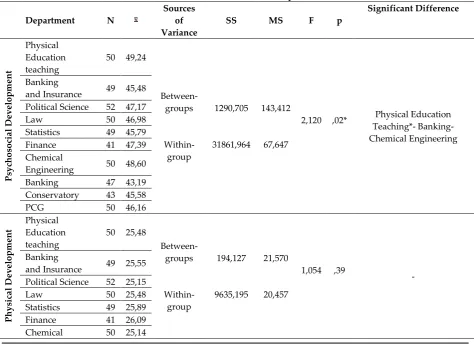
Table 3: ANOVA Results on Departments
Department N
Sources of Variance
SS MS F p
Significant Difference P sy cho so cia l D ev elo p m ent Physical Education teaching
50 49,24
Between-groups Within-group 1290,705 31861,964 143,412 67,647
2,120 ,02* Physical Education
Teaching*- Banking- Chemical Engineering Banking
and Insurance 49 45,48
Political Science 52 47,17
Law 50 46,98
Statistics 49 45,79
Finance 41 47,39
Chemical
Engineering 50 48,60
Banking 47 43,19
Conservatory 43 45,58
PCG 50 46,16
P hy sic al D ev elo p m ent Physical Education teaching
50 25,48
Between-groups Within-group 194,127 9635,195 21,570 20,457
1,054 ,39
- Banking
and Insurance 49 25,55
Political Science 52 25,15
Law 50 25,48
Statistics 49 25,89
Finance 41 26,09
Engineering
Banking 47 23,85
Conservatory 43 24,37
PCG 50 25,66
Me nta l D ev el o pm ent Physical Education teaching
50 16,36
Between-groups Within-group 291,314 5066,894 32,368 10,758
3,009 ,00* Physical Education
Teaching*-Banking and Insurance- Banking- PCG Banking
and Insurance 49 14,24
Political Science 52 14,75
Law 50 14,36
Statistics 49 14,32
Finance 41 14,80
Chemical
Engineering 50 15,00
Banking 47 13,97
Conservatory 43 15,30
PCG 50 13,38
*p<,05
The results presented in Table 3 shows that statistically significant differences were found between departments of the students and psychosocial development (F=2.120; p<.05) and mental development (F=3.009; p<.05). Post-Hoc test (Tukey HSD) was conducted to determine the source of the significant differences between groups. The groups having higher score differences are shown with the symbol (*). In the subdimension psychosocial development, it was determined that the mean score of the participants studying at the department of physical education teaching ( =49.24) was significantly higher than of the participants studying at the departments of banking ( =43.19) and chemical engineering ( =48.60). In the subdimension of mental development, it was found that the mean score of the participants studying at the department of physical education teaching ( =16.36) was significantly higher than of the participants studying at the departments of banking and insurance ( =14.24), banking ( =13.97) and PCG ( =13.38).
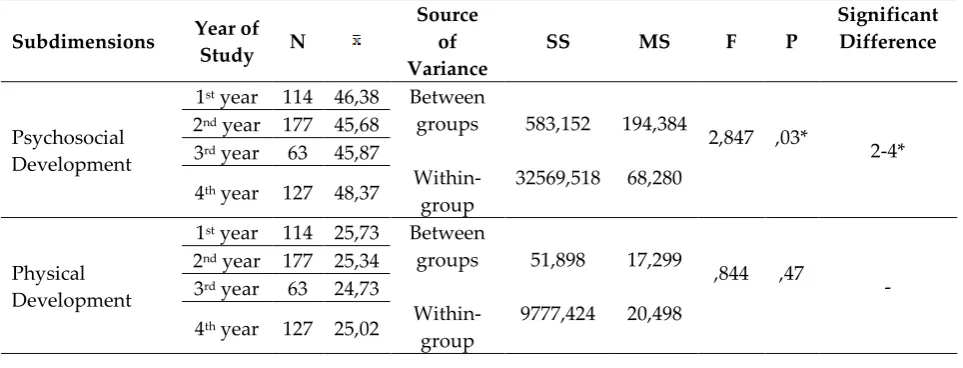
Table 4. ANOVA Results on the Year of Study
Subdimensions Year of
Study N
Source of Variance
SS MS F P
Significant Difference
Psychosocial Development
1st year 114 46,38 Between
groups Within-group 583,152 32569,518 194,384 68,280
2,847 ,03*
2-4* 2nd year 177 45,68
3rd year 63 45,87
4th year 127 48,37
Physical Development
1st year 114 25,73 Between
groups Within-group 51,898 9777,424 17,299 20,498
,844 ,47
- 2nd year 177 25,34
3rd year 63 24,73
│ │
Mental Development
1st year 114 15,04 Between
groups
Within-group
108,565
5249,643
36,188
11,006
3,288 ,02*
1*-2 2nd year 177 14,02
3rd year 63 14,98
4th year 127 14,93
*p<,05
The ANOVA results in Table 4 shows that statistically significant differences were found between the year of study and psychosocial development (F=2.847; p<0.05) and mental development (F=3.288; p<.05). Post-Hoc test (Tukey HSD) was conducted to determine the source of the significant differences between groups. The groups having higher score differences are shown with the symbol (*). In the subdimension of psychosocial development, it was determined that the mean score of the 4th year
students ( =48.37) was significantly higher than of 2nd year students ( =45.68). In the
subdimension of mental development, it was found that the mean score of the 1st year
students ( =15.04) was significantly higher than of the 2nd year students ( =14.02).
Table 5: Independent Group T-Test Results on Doing Regular Exercise
Variable Doing Regular Exercise N ss df T p
Psychosocial Development Yes 292 47,90 8,32 473 4,53 ,00*
No 183 44,40 7,95
Physical Development Yes 292 25,65 4,33 473 2,39 ,00*
No 183 24,63 4,81
Mental Development Yes 292 14,99 3,43 473 3,06 ,00*
No 183 14,03 3,09
*p<,05
According to Table 5, significant differences were found between doing regular exercise and psychosocial development (t=4.53; p<.05), physical development (t=2.39; p<.05) and mental development (t=3.06; p<.05). Therefore, it was found that the mean scores of those who do regular exercise ( =47.90, =25.65, =14.99) were higher than of those who do not do regular exercise ( =44.40, =24.63, =14.03) in all subdimensions, respectively.
Table 6: The categories of metaphors generated by the participants towards sports
Categories Metaphor
subject
Frequency Metaphor source
“Sports is like<.”
Life Source water (28), love (16), happiness (10), meal (7), need (2), breath (1), passion (1), sleeping (1), sun (1), life (1).
68
“<water. Because how the waterless tree dries up and loses productivity, the man without sports loses efficiency in the same way (K123).” “<..love. Because once you're fallen, you can never abandon (K451).”
(K276).” Benefit
Provider
Health (17), medicine (15), life(7), lifestyle (6), farming(3), rolling stone (2), order (2), laughter (2), engine (2), plaster (2), thinking (2), pencil (1), awareness (1).
62
“<.health. Because there is no disease that sports cannot cure (K187).”
“<..medicine. Because it is good for health (K341).” “<<laughter. Because it makes you burn calories (K195).”
Value I-Image
determination (10), homeland (7), happiness (6), military service (4), butterfly (3), pet (3), make-up (3), joke (3), time (3), father (3), ethics (2) powder (2), woman (1), game (1), lifestyle (1), fate (1) life (1), glasses (1), my own (1), heart (1), studying at Gazi University (1), insect (1).
59
“<.determination. Because it increases in value as you make a great effort on it (K240.”)
“<<.homeland. Because lives are sacrificed for her sake (K22).”
“<..a butterfly. Because it makes you grasp the importance of life (K132).” Food onion (11), bitter chocolate (9), barbecue
(8), dessert (4), pasta (3), chocolate (3), salt-free meal (3), green apple (3), waffle (2), hot pepper (2), pineapple (2), sugar (2), meal(1), bread (1), candied chestnut (1).
55
“<<..an onion. Because it has grades (K186).”
“<..bitter chocolate. Because it is bitter and hard (K195).” “<<<barbecue. Because it is difficult to do, but delighting (K312).”
Delighting happiness (10), green and blue (9), meditation (8), laughter(7), peace (6),complementary (4), arts (2), kunefe (1), antidepressant (2),lover (1), hobby (1), therapy (1), worship (1).
53
“<<. happiness. Because it gives happiness as it is done(K304).”
“<<.green and blue. Because they are the colors of peace and happiness (K307).” “<<<meditation. Because it delivers inner peace (K289).” Professional
Association
attorney (12), musician(7), jazzmusic (6), geometry (4), politics (4), finance (3), athletics (2), law (2), insurance (2), engineering (1), zero (1), arts (1), Chinese (1), statistics(1), contract (1), music box(1).
50
“<<..an attorney. Because everyone needs him/her (K257).”
“<<jazz music. Because it is not always performed (K227).”
“<<a musician. Because it is food of the soul (K165).” Nature
Image
mountain (14), soil (10), air (7), flower (4), river (3), plant (3), cold (1), sea (1), wave
(1), violet (1), fire (1) cloud (1), tree (1). 48
“<..a mountain. Because you become tough as you do it (K172).”
“<..soil. Because what you plant now you will harvest later (K258).”
│ │
drugs (4) vine (3), alcohol (2), whiskey (1), rakı (1), bet (1), internet (1), court shoes (1), desire to lose weight(1).
46
cannot quit if you start to do it (K176).”
“<<<a cigarette. Because you become addicted (K281).” “<<<series. Because you wait the next day impatiently (K327).”
Necessity course (22), discipline (8),
getting up early (5), money (1), sleep (1),
school (1), exam (1), necessity (1) 40
“<<<.a course. Because you feel like you have to do it although you don't like it (K116).”
“<<...discipline. Because if you don't do it, you will be in trouble (K101).”
“<<.getting up early. Because you feel like you have to do it although you don't like it (K92).”
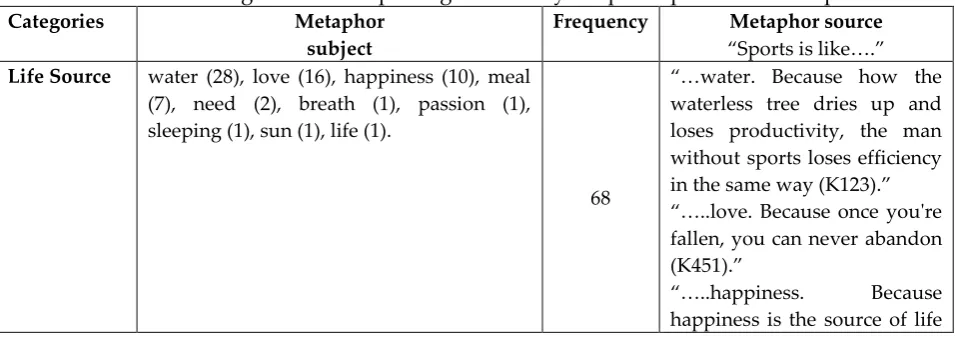
Table 6 lists the metaphors generated by the participants towards sports and the categories of these metaphors. While categorizing the metaphors towards sports, studies that listed similar categories (Arpa, 2014; Bek, 2008; Cudd, 2007; Deniş Çeliker and Akar, 2015; Fişek, 1998; Karakaya and Salici, 2016; Kesici and Muhiç, 2013; Koç, Murathan, Yetiş and Murathan, 2015; Kurtipek and Sönmezoğlu, 2018; Küçük and Koç 2004; Namlı, Temel and Güllü, 2016; Sevinç and Ergenç, 2007; Özsoy, 2011; Segrave, 2000; Yalçın and Enginer, 2012; Yetim, 2015; Zorba, 2012) and different categories (Segrave, 2000) were used. Analysis of the metaphors generated by the participants resulted in 9 categories. It was determined that 8 of these were comprised of positive metaphors and 1 of them was comprised of negative metaphors. The categories with positive metaphors and the highest frequency are Life Source (f=68), Benefit Provider (f=62), Value (f=59), Food (f=55), Delighting (f=50), Professional Association (f=50), Nature Image (f=48), and Addiction (f=46). The only category that contains negative metaphors is Necessity (f=40).
It was determined that the perceptions of the students and the metaphors they generated were clustered under the abovementioned categories.
The category with the highest frequency of responses from the participants related to their perceptions towards sports is "Life Source". In this category, sports was described by the metaphors of "laughter, engine, plaster, thinking, pencil, awareness". As seen in Table 6, the participant with the code K123 associated sports with water and stated "Sports is like water. Because how the waterless tree dries up and loses productivity, the man without sports loses efficiency in the same way."
participants associated sports with health and stated "Sports is like health. Because there is no disease that sports cannot cure (K187)."
Another category is called "Value" (f = 59). In this category, sports was described by the metaphors of "determination, homeland, happiness, military service, butterfly, pet, make-up, joke, time, father, ethics, powder, woman, game, lifestyle, fate, life, glasses, my own, heart, studying at Gazi University, insect". One of the participants associated sports with determination and stated "Sports is like determination. Because it increases in value as you make a great effort in it (K240)."
In the category of "Food", there are metaphors related to nutrients. The metaphors in this category are "onion, bitter chocolate, barbecue, dessert, pasta, chocolate, salt-free meal, green apple, waffle, hot pepper, pineapple, sugar, meal, bread, candied chestnut sugar". One of the participants associated sports with onion and stated "Sports are like an onion. Because it has grades.” (K186)
In "Delighting" category, the participants associated sports with happiness-related metaphors. In this context, sports were explained with the metaphors of "happiness, green and blue, meditation, laughter, peace, complementary, arts, kunefe, antidepressant, lover, hobby, therapy, worship".
In "Professional Association" category, the participants associated sports to various professions. Accordingly, sports was explained by the metaphors of "attorney, musician, jazz music, geometry, politics, finance, athletics, law, insurance, engineering, zero, arts, Chinese, statistics, contract, music box”.
Table 6 shows that the category of "Nature Image" is comprised of the metaphors of "mountain, soil, air, flower, river, plant, cold, sea, wave, violet, cloud, tree". In this category, sports was explained with the metaphor of "mountain" and one of the participants stated "Sports is like a mountain. Because you become tough as you do it (K172)."
The "category of "Addiction" is comprised of the metaphors of "beer, cigarette, series, drugs, wine, alcohol, whiskey, rakı, bet, internet, court shoes, desire to lose weight". One of the participants stated "Sports is like beer. Because you cannot quit if you start to do it.” (K176)
The category of "Necessity", which is the only negative category in the study, is comprised of the metaphors of "course, discipline, getting up early, money, sleep, school, exam, necessity" and one of the participants stated "Sports is like a course. Because you feel like you have to do it although you don't like it.” (K116)
5. Discussion and Result
In this context, it was aimed to determine the attitudes and metaphorical perceptions of the undergraduate students. In this context, it was tried to determine the attitudes of the students towards sports in terms of several variables such as age, gender, year of study, doing exercise in past life, and doing regular exercise.
│ │
the contributions of sports to mental, emotional, social and psychomotor developments of the human being thanks to the media. Moreover, the ages of the participants are close to each other. When compared to the results of the present study, there are studies in the literature that reached similar (Kangalgil, Hünük, Demirhan, 2006, Türkmen, 2016; Koçak 2014, Türkmen, Abdurahimoğlu, Varol and Gökdağ 2016; Göksel and Caz 2016; Keskin 2015; Tortop, 2005) and different results (Taşğın and Tekin, 2009; Wersch, Trew and Turner, 1992). Significant differences were found between gender and the subdimensions of psychosocial development, physical development, and mental development. Therefore, it can be said that the attitude level of the female participants is higher than of the male counterparts. The desire of women to have a fit and beautiful appearance and live healthier can be attributed to the reason for such a result. There are studies in the literature that reached similar results (Altay and Özdemir 2006; Çelik and Pulur, 2011; Güllü, 2007; Kangalgil et al., 2004; Koca and Demirhan, 2004; Koçak, 2014; Koçak and Hümeriç 2006; Kimbal 2007; King 1994; Şişko and Demirhan, 2002; Smoll and Shutz, 1980; Taşğın and Tekin, 2009; Türkmen et al., 2016) and different results (Göksel and Caz, 2016; Koçak, Tuncel and Tuncel 2015; Yanık and Çamlıyer 2015).
psychosocial, physical, and mental development. It can be argued that this is caused by the fact that factors such as the desire to maintain the fitness, relax the mind with sports, and maintain discipline and concentration. There are studies in the literature in which similar results were obtained (Alparslan, 2008; Cox et al., 2008; Güllü, 2007; Hünük, 2006; Kangalgil et al., 2004; Kangagil et al., 2006; Singh and Devi 2013; Türkmen et al., 2016).
│ │
sports with their profession. Besides, similar categories are found in the literature (Sevinç and Ergenç, 2007). The category of "nature" is comprised of the metaphors of mountain, soil, air, flower, river, plant, cold, sea, wave, violet, tree, fire, and cloud. It can be said that the participants associate sports with these metaphors in terms of being physically fit and having a healthy appearance. The studies in the literature with similar results support our findings (Deniş, Çeliker and Akar, 2015). In the category of "addiction", there are the metaphors of beer, alcohol, series, drugs, wine, whiskey, rakı, cigarette, court shoes, bet, internet, and desire to lose weight. It can be deduced from this category that the participants regard sports as a habit which is difficult to be abandoned. Similar results are found in the literature (Kurtipek and Sönmezoğlu, 2018). Finally, in the category of "necessity", it was found that the participants described sports with the metaphors of course, discipline, money, sleep, getting up early, school, exam, and necessity. This can be attributed to the fact that the participants consider sports as a task which is obligatory to be done, but not very popular.
Overall, in the quantitative stage of the study, it was determined that there were significant differences between the attitudes of the participants towards sports and gender, department and the year of study. However, no significant difference was found between their attitudes and age. On the other hand, in the qualitative stage of the study, 8 positive and 1 negative categories were obtained. In the light of all these results, it was concluded that the attitudes of the students towards sports are moderate and the metaphors generated by them are generally positive. This can be said to be due to their positive attitudes towards physical education and sports course. In the literature, there are several studies revealing that the positive attitudes of undergraduate students (MacPhail, 2011, Özbakır, Tannehill and Zakrajsek, 1993; Taşmektepligil, Yılmaz, İmamoğlu and Kılcıgil, 2006) and the participants of different age groups (Hünük, 2006) towards physical education and sports course increase positive attitudes towards sports. The positive attitudes and metaphors of the participants towards sports can be attributed to the kindness of physical education teachers, the policies of the Ministry of Youth and Sports for participation in sports, and media which often broadcasts physical, mental, cognitive, and emotional influences of sports.
have a positive attitude towards physical education course, know its contributions to students and prepare sports activities suitable for students.
Bibliography
Altay, F., & Özdemir Z. (2006). Ankara ili merkez ilçelerindeki ilköğretim1. kademesinde öğrenim gören 4. ve 5. sınıf öğrencilerinin beden eğitimi ve spor dersine ilişkin tutumlarının karşılaştırılması (591-593). Muğla: 3–5 Kasım, 9. Uluslararası Spor Bilimleri Kongresi.
Alparslan, S. (2008). Ortaöğretim öğrencilerinin beden eğitimi öğretmenlerinin sergilediği öğretim davranışlarına ilişkin algıları ve öğrencilerin bu derse karşı geliştirdikleri tutumları. Yüksek Lisans Tezi. Abant İzzet Baysal Üniversitesi, Bolu.
Alpman, C. (1972). Eğitim Bütünlüğü İçinde Beden Eğitimi ve Çağlar Boyunca Gelişimi. İstanbul: Millî Eğitim Basımevi.
Arpa, D. K. (2014). Ortaöğretimdeki erkek sporcuların karate ve taekwondo branşına yönelme nedenleri ve beklentileri. Yüksek Lisans Tezi. Haliç Üniversitesi Sağlık Bilimleri Enstitüsü, İstanbul.
Balyan, M., Balyan, K. Y., & Kiremitçi, O. (2012). Farklı Sportif Etkinliklerin İlköğretim 2. Kademe Öğrencilerinin Beden Eğitimi Dersine Yönelik Tutum, Sosyal Beceri ve Öz Yeterlik Düzeylerine Etkileri, Selçuk Üniversitesi Beden Eğitimi ve Spor Bilim Dergisi, 14(2), 196-201.
Carlson, T. B. (1995). Why Students Hate, Tolerate or Love Gym: A Study of Attitude Formation and Associated Behaviors in Physical, Dissertation Abstracts International, 14(4), 467-477
Çelen, A. (2012). Spor eğitimi modeli ile işlenen voleybol derslerinin öğrencilerin bilişsel, duyuşsal ve psikomotor erişi düzeylerine etkisi. Yayımlanmamış Doktora Tezi. Gazi Üniversitesi Eğitim Bilimleri Enstitüsü Beden Eğitimi ve Spor Öğretmenliği Anabilim Dalı, Ankara.
Çelik, Z., & Pulur, A. (2011). Ortaöğretim Öğrencilerinin Beden Eğitimi ve Spora İlişkin Tutumları. Ulusal BedenEğitimi ve Spor Öğretmenliği Kongresi. Eğitim Fakültesi Dergisi Özel Sayısı, Van, 25-27 Mayıs, 115-121.
Cerit, Y. (2008). Öğretmen Kavramı ile İlgili Metaforlara İlişkin Öğrenci, Öğretmenve Yöneticilerin Görüşleri.Türk Eğitim Bilimleri Dergisi, 6(4), 693-712.
Çetin, M. (2007). Ortaöğretim öğrencilerinin beden eğitimi ve spora ilişkin tutumlarının karşılaştırılması (Kırşehir İli Örneği). Yayımlanmamış Yüksek Lisans Tezi, Gazi Üniversitesi Eğitim Bilimleri Enstitüsü, Ankara.
│ │
Cox, A. E., Williams, L., & Smith, A. L. (2008). Change in Physical Education Motivation and Physical Activity Behavior during Middle School. Illinois State University, School of Kinesiology and Recreation, USA.
Creswell, J. W. (1994). Qualitative & Quantitative Approaches. California, USA: Sage Publications.
Creswell, J. W., & Garrett, A. L. (2008). The “movement” of mixed methods research and the role of educators. South African Journal of Education, 28(3), 321–333.
Cudd, A. E. (2007). Sporting Metaphors: Competition and the Ethos of Capitalism, Journal of the Philosophy of Sport, 34, 52-67.
Demirhan, G., & Altay, F. (2001). Lise Birinci Sınıf Öğrencilerinin Beden Eğitimi ve Spora İlişkin Tutum Ölçeği 2, Hacettepe Spor Bilimleri Dergisi, 12(2), 9-20.
Doydu İ, Çelen A., & Çoknaz H. (2013). Spor Eğitimi Modelinin Öğrencilerin Beden Eğitimi ve Spora Karşı Tutumuna Etkisi, E-International Journal of Educational Research, 4(2), 99-110.
Ekici S, Çolakoğlu T., & Bayraktar A. (2011). Dağcılık sporuyla uğraşan bireylerin bu spora yönelme nedenleri üzerine bir araştırma, Niğde Üniversitesi Beden Eğitimi ve Spor Bilimleri Dergisi, 5(2), 110-119.
Freedman, J. L., Sears, D. O., & Carlsmith, J. M. (2003). Sosyal psikoloji 4.Baskı. (Çev: A. Dönmez). Ankara: İmge Kitabevi.
Fişek, K. (1985). 100 soruda Türkiye Spor Tarihi. 1. Baskı; İstanbul: Gerçek Yayınevi. Güçlü, S. (2005). Kurumlara Sosyolojik Bakış. İstanbul: Birey Yayıncılık.
Göksel A. G., & Caz Ç. (2016). Anadolu Lisesi öğrencilerinin beden eğitimi dersine yönelik tutumlarının incelenmesi, Marmara Üniversitesi Spor Bilimleri Dergisi, 1(1), 1-10.
Güllü, M. (2007). Ortaöğretim öğrencilerinin beden eğitimi dersine ilişkin tutumlarının araştırılması. Yayımlanmamış Doktora Tezi. Gazi Üniversitesi Eğitim Bilimleri Enstitüsü Beden Eğitimi ve Spor Öğretmenliği Anabilim Dalı, Ankara
Güllü M., Güçlü, M., Arslan, C., (2009). Ortaöğretim Öğrencilerinin Beden Eğitimi Dersine İlişkin Tutumlarının İncelenmesi, E-Journal of New World Sciences Academy, 4(4), 273-278.
Güllü M., Güçlü M. (2009). Ortaöğretim Öğrencileri İçin Beden Eğitimi Dersi Tutum Ölçeği Geliştirmesi. Niğde Üniversitesi Beden Eğitimi ve Spor Bilimleri Dergisi, 3(2), 138-151.
Gürbüz, A. & Özkan, H. (2012). İlköğretim ikinci kademe öğrencilerinin beden eğitimi ve spor dersine ilişkin tutumlarının belirlenmesi (Muğla il örneği), Pamukkale Üniversitesi Spor Bilimleri Dergisi, 3(2), 78-89.
Harriet D, Richard B., & Tokie I. (2006). Japanese and English School Students Views of Physical Education, A Comparative Study, International Journal of Sportand Health Science, 4, 74– 85.
cinsiyeti, öğretmen cinsiyeti ve spora aktif katılımları açısından karşılaştırılması. Yüksek Lisans Tezi. Hacettepe Üniversitesi, Ankara.
Johnson, B., & Onwuegbuzie, A. (2004). Mixed methods research: A research paradigm whose time has come. Educational Researcher, 33(7), 14-26.
Kangalgil, M., Hünük, D., & Demirhan, G. (2004). Spor yapan ve yapmayan öğrencilerin beden eğitimi ve spora ilişkin tutumları. 10thIchper-Sd European Congress and the Tssa 8th International Sport Science Congress 17 Nowember, İstanbul.
Kangalgil M., Hünük, D. & Demirhan, G. (2006). İlköğretim, Lise ve Üniversite öğrencilerinin Beden Eğitimi ve Spora İlişkin Tutumlarının Karşılaştırılması. Spor Bilimleri Dergisi, 2006, 17 (2), 48-57.
Karakaya, E. D. & Salici, O. (2016). Isparta’da Öğrenim Gören 11-13 Yaş Gurubu Öğrencilerin Popüler Spor Branşları Hakkındaki Metaforik Algılarının Belirlenmesi. International Journal of Social Sciences and Education Research, 2(3), 1059-1076.
Kesic, D., & Muhic, E. (2013). Sports in Metaphor and Metaphor in Sports, Sport Logia, 9(1), 28–33.
Keskin, Ö. (2015). Ortaokul Öğrencilerinin Beden Eğitimi Dersine Yönelik Tutumlarının Bazı Değişkenlere Göre İncelenmesi. Sakarya İli Örneği Yüksek Lisans Tezi. Sakarya Üniversitesi, Sakarya.
King, M. H. (1994). Student attitudes toward physical education at the intermediate level (Masters thesis, Memorial University of New foundland, Canada). Masters Abstracts International, 34-02, 0499.
Koca, C. & Demirhan, G. (2004). An examination of high school students attitudes toward physical education with regard to sex and sport participation, Perceptual & Motor Skills, 98(3),754-758.
Koç, M., Murathan, F. Yetiş, Ü. & Murathan, T. (2015). İlköğretim 7. Sınıf Öğrencilerinin Spor Kavramına İlişkin Algıları, Akademik Sosyal Araştırmalar Dergisi, 3(9), 294-303.
Koçak, A. & Arun, Ö. (2006). İçerik Analizi Çalışmalarında Örneklem Sorunu, Selçuk İletişim Dergisi, 3(4), 21-28.
Koçak F. (2014). Üniversite öğrencilerinin spora yönelik tutumları: Bir ölçek geliştirme çalışması, Spormetre Dergisi, 12(1), 59-69.
Koçak, F. Tuncel, S., & Tuncel F. (2015). Spor alanında öğrenim gören üniversite öğrencilerinin sporda sürdürülebilirliğe ilişkin tutumlarının belirlenmesi, Ankara Üniversitesi Spor Bilimleri Fakültesi Dergisi, 13(1), 29-39.
Kuru, E. (2000). Sporda psikoloji. Ankara: Gazi Üniversitesi İletişim Fakültesi Basımevi. Kurtipek, S., & Sönmezoğlu, U. (2018). Determination of the Perceptions of Sports
Managers about Sport Concept: A Metaphor Analysis Study, International Journal of Higher Education, 7(4), 17-25
Küçük, V., & Koç, H. (2004). Psikososyal Gelişim Süreci İçerisinde İnsan ve Spor İlişkisi.
│ │
Macphail, A. (2011). “Youth voices in physical education and sport: what are they telling us and what do they say they need?”. Sport Pedagogy an Introduction for Teaching and Coaching. Editör: Kathleen Armour, Pearson Education Limited, Essex.
Özbakır, İ. (2006). Sivas ili özel ve devlet ilköğretim okullarında okuyan öğrencilerin beden eğitimidersine bakış açıları ve beklentilerinin karşılaştırılması. Yayınlanmamış Yüksek Lisans Tezi,Cumhuriyet Üniversitesi, Sivas.
Özgüven, İ. E. (2005). Bireyi tanıma teknikleri. (s.125). Ankara: PDREM Yayınları.
Özsoy, S. (2011). Spor Gazetelerinin Başlıklarında Militarist ve Şiddet İçerikli Metaforlar. Gümüşhane Üniversitesi İletişim Fakültesi Elektronik Dergisi, 1, 88-114. Rice, P. L. (1988). Attitudes of high school students towards physical education
activities, Teachers and Personal Health Physical Education, 45, 94-99.
Schneider, R. C. & Marriott, S. T. (2010). Applying sport education model to basketball.
Journal of Physical Education, Recreation & Dance, 81(2), 15-17.
Segrave, J. O. (2000). The Sports Metaphor in American Cultural Discourse. Culture, Sport, Society, 3(1), 48-60.
Sevinç, Ö., Ergenç, M. (2017). Düzce üniversitesi’nin bazı fakültelerinde öğrenim görmekte olan lisans öğrencilerinin “spor” hakkındaki metaforları. Düzce Üniversitesi Sosyal Bilimler Enstitüsü Dergisi, 7(2), 106-131.
Singh R. K. C. & Devi KS (2013). Attitude of higher secondary level student towards games and sports, International Journal of Physical Education, Fitness and Sports, 2(4), 80-85.
Smoll, F. L., & Schutz, R. V. (1980). Children’s Attitudes Towards Physical Activity: A Longitudial Analysis, Journal of Sport Psychology, 2, 137-147.
Subramanıam, P. R., & Silverman S. (2007). Middle school students attitudes toward physical education. Teaching and Teacher Education, 23, 602-611.
Şişko, M. & Demirhan, G. (2002). İlköğretim Okulları Ve Liselerde Öğrenim Gören Kız ve Erkek Öğrencilerin Beden Eğitimi Spor Dersine İlişkin Tutumları, Hacettepe Üniversitesi Eğitim Fakültesi Dergisi, 23, 205-210.
Tannehill, D., & Zekrajsek, D. (1993). “Student Attitudes Toward Physical Education: A Multi-cultural Study”, Journal of Teaching Physical Education. 13,78-84.
Taşğın Ö., & Tekin M. (2009). Çeşitli Değişkenlere Göre İlköğretim ve Orta Öğretim Kurumlarında Öğrenim Gören Öğrencilerin Beden Eğitimi ve Spor Dersine İlişkin Tutum ve Görüşleri, Kastamonu Eğitim Dergisi, 17(2), 457-466.
Taşmektepligil, Y., Yılmaz, Ç., İmamoğlu, O. & Kılıçgil, E. (2006). İlköğretim okullarında beden eğitimi ders hedeflerinin gerçekleşme düzeyi. Spormetre Beden Eğitimi ve Spor Bilimleri Dergisi, IV(4), 139- 147.
Tekkurşun Demir G., Cicioğlu, & İlhan (2017). Sınıf Öğretmeni Adaylarının Beden Eğitimi Dersine Yönelik Tutumları. Internatıonal Journal of Sports Exercıse & Traınıng Scıences, 3(4), 120–128.
Tomik R., Olex-Zarychta D., & Mynarski W. (2012). Social values of sport participation and their significance for you that attitudes towards physical education and sport, Studies in Physical Culture and Tourism, 19(2), 99-104.
Tortop, Y. (2005). Sınıf öğretmenlerinin beden eğitimi dersi ve eğitsel oyun uygulamaları. Yüksek Lisans Tezi. Afyon Kocatepe Üniversitesi, Afyon.
Türkmen, M., Abdurahimoğlu, Y., Varol, S., & Gökdağ, M. (2016). İslami ilimler fakültesi öğrencilerinin spora yönelik tutumlarının incelenmesi (Bartın Üniversitesi örneği), International Journal of Contemporary Educational Studies (IntJCES),
2(1), 48-59.
Van Wersch, A., Trew, K., & Turner, I. (1992). Post-Primary School Pupil's İnterest İn Physical Education: Age and Gender Differences. British Journal of Educational Psychology. 62(1), 56-72.
Yalçın, M., & Enginer, A., (2012). İlköğretim Okullarında Okul Müdürüne İlişkin Metaforik Algılar, Öğretmen Eğitimi ve Eğitimcileri Dergisi, 1(2), 229-256.
Yetim, A. (2011). Sosyoloji ve Spor, Ankara: Berikan Yayınevi. Yetim, A. (2015). Sosyoloji ve Spor. Ankara: Berikan Yayınevi.
Yıldız, Ö. (2010). Sınıf öğretmenlerinin beden eğitimi dersine yönelik tutumları ve karşılaştıkları problemler. Doktora Tezi. Gazi Üniversitesi, Ankara.
│ │
Creative Commons licensing terms
Authors will retain the copyright of their published articles agreeing that a Creative Commons Attribution 4.0 International License (CC BY 4.0) terms will be applied to their work. Under the terms of this license, no permission is required from the author(s) or publisher for members of the community to copy, distribute, transmit or adapt the article content, providing a proper, prominent and unambiguous attribution to the authors in a manner that makes clear that the materials are being reused under permission of a Creative Commons License. Views, opinions and conclusions expressed in this research article are views, opinions and conclusions of the author(s). Open Access Publishing Group and European Journal of Physical Education and Sport Science shall not be responsible or answerable for any loss, damage or liability caused in relation to/arising out of conflict of interests, copyright violations and inappropriate or inaccurate use of any kind content related or integrated on the research work. All the published works are meeting the Open Access Publishing requirements and can be freely accessed, shared, modified, distributed and used in educational, commercial and