Available online throug
ISSN 2229 – 5046
EFFECT OF THERMO-DIFFUSION AND CHEMICAL REACTION ON CONVECTIVE HEAT AND
MASS TRANSFER FLOW OF WALTER’S MEMORY FLUID OVER A VERTICAL PLATE
Y. DEVASENA*, A. LEELA RATNAM
Dept. of Applied Mathematics, Sri Padmavati Mahila University, Tirupati, India.
(Received On: 03-05-15; Revised & Accepted On: 30-08-15)
ABSTRACT
I
n this paper an attempt has been made to study the effect of chemical reaction and radiation absorption on unsteady hydromagnetic free convective heat and mass transfer flow of an incompressible electrically conducting memory fluid past an infinite vertical plate in the presence of heat sink. The non-linear, coupled equations governing the flow, heat and mass transfer have been solved by a perturbation technique. The velocity, temperature, concentration and the rate of heat and mass transfer have been analyzed for different parametric variations.Keywords: Chemical reaction, Radiation absorption, Memory fluid, Heat & Mass Transfer.
1. INTRODUCTION
Combined heat and mass transfer problems with chemical reaction are important in many processes and have, therefore, received a considerable amount of attention in recent years. In processes such as drying, evaporation at the surface of a water body, energy transfer in a wet cooling tower and the flow in a desert cooler, heat and mass transfer occur simultaneously. Possible applications of this type of flow can be found in many industries. For example, in the power industry, among the methods of generating electric power is one in which electrical energy is extracted directly from a moving conducting fluid.
Dekha et al. [2] examined the effect of the first order homogeneous chemical reaction on the process of an unsteady flow past a vertical plate with a constant heat and mass transfer. Muthucumaraswamy [6] presented the heat and mass transfer effects on a continuously moving isothermal vertical surface with uniform suction by taking into account the homogeneous chemical reaction of first order. Vijaya Sekhar [11] has studied the Chemical reaction effects on MHD unsteady free convective Walter’s Memory flow with constant suction and heat sink.
An extensive range of mathematical models has been developed to simulate the diverse hydrodynamic behavior of the non-Newtonian fluids. An eloquent exposition of viscoelastic fluid models has been presented by Joseph [4]. Examples of such models are the Oldroyd model [7], Johnson-Seagalman model, the upper convected Maxwell model and the Walter-K model [12]. Abel et al. [1] investigated the non-Newtonian viscoelastic boundary layer flow of Walter’s liquid-B past a stretching sheet, taking account into of non-uniform heat source and frictional heating. Gireesh Kumar
et al. [3] have examined the mass transfer effects on MHD unsteady free convective Walter’s memory flow with constant suction and heat sink. Khan et al. [5] also investigated the effects of work done by deformation in Walter’s liquid-B but with uniform heat source. Sharma et al. [9] have analyzed the Rayleigh-Taylor instability of Walter’B elastic-viscous fluid through porous medium. Thermosolutal instability of Walter’s (model-B) visco-elastic rotating fluid permitted with suspended particles and variable gravity field in porous medium was studied by Sharma and Rana [10]. Recently Pavan Kumar et al. [8] have investigated the combined effect of chemical reaction and thermo diffusion effects on hydromagnetic free convective Walter’s memory flow with constant suction and heat sink.
The requirements of modern technology have stimulated interest in fluid flow studies which involve the interaction of several phenomena. One such study is related to the effects of free convective flow with mass transfer, which plays an important role in geophysical sciences, astrophysical sciences and in cosmical studies.
2. FORMULATION OF THE PROBLEM
We consider an unsteady hydromagnetic, chemically reacting free convective flow of an incompressible and electrically conducting fluid past an infinite vertical porous plate in the presence of constant suction and heat absorbing sink. Let x′ - axis be taken in the vertically upward direction along the infinite vertical plate and y′ - axis normal to it. The magnetic field of uniform strength is applied and induced magnetic field is neglected. Boussineq’s approximation within the boundary layer, the governing equations of continuity, momentum, energy and diffusion are as follows:
Continuity equation
0
=
′
∂
′
∂
y
v
(1) Momentum equation 22 3 3
' 0 1
2 2 3
(
)
(
)
B
u
u
u
u
u
v
g
T
T
g
C
C
B
v
u
t
y
y
t u
y
σ
β
β
υ
ρ
∗ ∞ ∞′
′
′
′
′
∂
+
′
∂
=
′
−
′
+
′
−
′
+
∂
−
∂
+
′
∂
−
′
′
′
′ ′
′
∂
∂
∂
∂ ∂
∂
(2)Energy equation
)
(
S
2 2 ∞′
−
′
+
′
∂
′
∂
=
′
∂
′
∂
′
+
′
∂
′
∂
T
T
y
T
k
y
T
v
t
T
f (3)
Diffusion equation 2 ' 2 11 ' r 2 2
)
(
k
y
T
k
C
C
y
C
D
y
C
v
t
C
m∂
∂
+
′
−
′
−
′
∂
′
∂
=
′
∂
′
∂
′
+
′
∂
′
∂
∞ (4)
Where u, v are the velocity components along the x and y directions respectively. θ′, C′ are the temperature and
concentration in the fluid. θ∞ , C∞ are the temperature and concentration far away from the plate, ρ is the density of the
fluid, g is the acceleration due to gravity, υ is the kinematic viscosity, β is the volumetric coefficient of expansion, β* is
the volumetric coefficient of concentration expansion, θw, C∞ are the temperature and concentration on the plate, kf is the thermal conductivity, Dm is the mass diffusion, kr is the chemical reaction coefficient, k11 is the cross diffusivity, B1 is the kinematic visco-elasticity, σ is the electrical conductivity of the medium, μe is the magnetic permeability, Cp is
the specific heat at constant pressure and α is the strength of the heat source.
From (1) we have
v′ = −v0 (5)
On disregarding the Joulean heat dissipation, the boundary conditions of the problem are
y′ = 0: u′ = 0,
T
′
=
T
∞′
+
ε
(
T
w′
−
T
∞′
)
e
iω′t′,C
C
C
wC
e
i t ′ ′ ∞∞
′
+
′
−
′
=
′
ε
ω)
(
y′→∞: u′→ 0,
T
′
→
T
∞′
,C
′
→
C
∞′
(6)In order to write the governing equations and the boundary conditions in dimensionless form, the following non-dimensional variables are introduced
υ
0v
y
y
=
′
,υ
4
2 0v
t
t
=
′
,2 0
4
v
w
=
υ
ω
′
,ρ
η
υ
=
0 ,)
(
)
(
' ' ' ' ∞ ∞−
−
=
θ
θ
θ
θ
θ
w ,
(
)
)
(
∞ ∞′
−
′
′
−
′
=
C
C
C
C
C
w (7)
In view of the equation (7) the equations (2), (3) and (4) reduced to the following non-dimensional form
u
M
y
u
y
t
u
R
y
u
C
N
T
Gr
y
u
t
u
m 2 3 3 2 3 2 24
1
)
(
4
1
−
∂
∂
−
∂
∂
∂
−
∂
∂
+
+
=
∂
∂
−
∂
∂
(8)4
Pr
Pr
4
Pr
22
θ
αθ
θ
θ
+
∂
∂
=
∂
∂
−
∂
∂
y
y
t
(9)2 2
2 2
4
N
y
The corresponding boundary conditions are
0 :
0,
1
,
1
:
0,
0,
0
i wt i wt
y
u
ee
C
ee
y
u
C
θ
θ
=
=
= +
= +
→ ∞
→
→
→
(11)Where
3 0
(
w)
gv
Gr
v
β
θ
−
θ
∞=
(Grashof number)3 0
)
(
v
C
C
g
Gc
w ∞∗
′
−
′
=
υ
β
(Modified Grashof number)(
)
(
)
*
w wc
c
N
β
β θ
θ
∞∞−
=
−
(Buoyancy ratio)2 2 0 2 0
B v
M
v
σ
ρ
=
(Magnetic parameter)p r f
C
P
k
µ
=
(Prandtl Number)'
2 0
S v
v
α =
(Heat source parameter)c m
v
S
D
=
(Schmidt number)2 0 l r r
k v
k
v
=
(Chemical reaction parameter)11
*
k
Sr
v
β
β
=
(Soret parameter)2 1 0 2 m
B v
R
υ
=
(Magnetic Reynolds number)3. SOLUTION OF THE PROBLEM
Equations (8), (9) and (10) are coupled, non-linear partial differential equations and these cannot be solved in closed form. However, these equations can be reduced to a set of ordinary differential equations, which can be solved analytically. This can be done by representing the velocity, temperature and concentration of the fluid in the neighborhood of the plate as:
( )
( )
( )
( )
( )
( )
( )
( )
( )
0 1 0 1 0 1,
,
,
i wt i wt i wtu y t
u
y
ee u
y
y t
y
ee
y
C y t
C
y
ee C
y
θ
θ
θ
=
+
=
+
=
+
(12)where u0, θ0 and C0 are mean velocity, mean temperature and mean concentration. Substituting (12) in equations (8), (9) and (10), equating harmonic and non-harmonic terms for mean velocity, mean temperature and mean concentration, after neglecting coefficient of ε2, we get
Zero order of ε
2
0 0 0 0 0 0
'' ' 0
0 0
''
0 0 0 0
[
]
0
4
m r r rR u
u
u
M u
Gr
NC
P
P
ScSr
C
ScC
K ScC
First order of ε
1 1 1 1 1 1
'' ' 1
1 1
''
1 1 1 1
[
]
(
)
0
4
4
mr r
r
R u
u
u
Mu
Gr T
NC
P
i
P
i
ScSr
C
ScC
k
ScC
N
α ω θ
θ
θ
ω
θ
′′′ ′′
+ + −
′
= −
+
−
+
+
=
′′
+
′
−
−
=
(14)
The equations (13) and (16) are third order differential equations due to presence of elasticity. Therefore u0 and u1 are expanded using Beard and Walters rule [1964]
0 00 01
1 10 11
m
m
u
u
R u
u
u
R u
=
+
=
+
(15)Zero order of Rm 2
0 00 00 0 0
2
10 10 10 1 1
[
]
[
]
4
u
u
M u
Gr
NC
i
u
u
M
u
Gr
NC
θ
ω
θ
′′
+
′
−
= −
+
′′
+
′
−
−
= −
+
(16)
First order of Rm 2
01 01 01 00
2
11 11 11 10
4
u
u
M u
u
i
u
u
M
ω
u
u
′′
+
′
−
= −
′′′
′′
+
′
−
−
= −
′′′
(17)
The equations (13)-(17) have been solved by using fourth order Runge-Kutta technique together with shooting technique.
4. SKIN FRICTION, NUSSELT NUMBER AND SHERWOOD NUMBER
The skin friction (τ) across the walls y = 0 is given by
( )
0 0
=
=
∂
∂
=
y y
y
u
τ
Local rate of heat transfer across the walls (Nusselt Number) is given by
0 0
)
(
=
=
∂
∂
=
y y
y
Nu
θ
The rate of mass transfer across the walls (Sherwood Number) is given by
0 0
)
(
=
=
∂
∂
=
y y
y
C
Sh
Particular Case
5. RESULTS AND DISCUSSION
Fig. 1: Variation of velocity and concentration with kr
The magnitude of u depreciates with increase in kr in entire flow region for Gr>0 while for Gr<0 |u| depreciates in the region (0, 2.0) and enhances in the region (3, 6) whereas the actual concentration depreciates in the degeneration chemical reaction case (kr > 0).
Fig. 2: Variation of u, θ and C with Sr
From fig (2)An increase in Soret parameter (Sr) depreciates u in the entire flow region for Gr > 0 while for Gr < 0,
u depreciates in the region (0, 2.0) and enhances far away from the boundary, with maximum u attained at y=1 whereas the temperature and concentration depreciates with increase in Sr in the entire flow region.
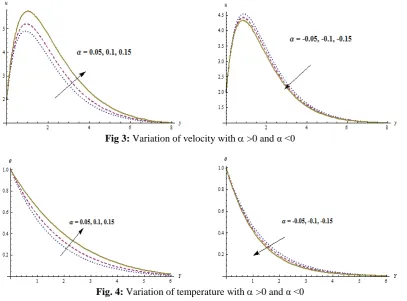
Fig 3: Variation of velocity with α >0 and α <0
Fig. 4: Variation of temperature with α >0 and α <0
The variation of τ with magnetic parameter M shows that higher the Lorentz force smaller |τ| at the wall. With respect to Sc we find that |τ| depreciates in the heating case and enhances in the cooling case with increase in Sc. An increase in the Soret parameter Sr reduces |τ|for G>0 and enhances for G<0. The variation of τ with chemical reaction parameter kr reveals that the skin friction reduces for G>0 and enhances for G<0 in the degenerating chemical reaction case. With respect to heat source parameter α, it is found that |τ| enhances with increase in the strength of heat generating source / absorbing source (|α|≤4) and reduces for further higher values of |α|≥ 6.
The rate of mass transfer (Sherwood number) at the plate y=0 is exhibited in table - 3 for different parametric values. It is found that the rate of mass transfer reduces with α>0 and enhances with α<0. With respect to Sc and Pr, it is found that lesser the molecular diffusivity / thermal diffusivity larger the rate of heat transfer at the plate. An increase in the Soret parameter Sr or chemical reaction parameter kr results in an enhancement in |Sh| at the plate.
6. REFERENCES
1. Abel, M.S., and Nandeppanavar, M.M., Heat transfer in MHD viscoelastic boundary layer flow over a
stretching sheet with space and temperature dependent heat source, Int. J. Appl. Mech. Eng. 13(2): pp. 293-309, 2008.
2. Dekha, R., Das, U.N., and Soundalgekar, V.M., Effects on mass transfer on Flow past an impulsively started infinite vertical plate with constant heat flux and chemical reaction. Forschungim Ingenieurwesen, 60, pp. 284-309, 1994.
3. Gireesh Kumar, J., and Satyanarayana , P.V., Mass transfer efects on MHD unsteady free convective Walter’s memory flow with constant suction and heat sink, Int. J. of Appl. Math and Mech. 7(19): 97-109, 2011. 4. Joseph, D.D., Fluid dynamics of viscoelastic liquids. New York: Springer-Verlag 1990.
5. Khan,S.K., Abel, M.S., Sonth, R.M., Viscoelastic MHD flow heat and mass transfer over a porous stretching sheet with dissipation of energy and stress work. Heat Mass Transfer 40: pp. 47-57, 2003.
6. Muthucumaraswamy, R., Effects of a chemical reaction on a moving isothermal surface with suction. Acta Mechanica, 155, pp. 65-72, 2002.
7. Oldroyd, J.G., On the formulation of rheological equations of state. Proc Roy Soc (Lond) Ser, A. 200: pp. 451-523, 1950.
8. Pavan Kumar Cintaginjala, Rajeswara Rao U, Prasada Rao D.R.V.: “Chemical reaction and thermo-diffusion effects on hydromagnetic free convective walter’s memory flow with constant suction and heat sink”, Int. J. of Math. Arc., Vol.4(7), pp.1-11, 2013.
9. Sharma, R.C., Kumar, P., and Sharma, S., Rayleigh-Taylor instability of Walter’B elastic-viscous fluid through porous medium, International Journal of Applied Mechanics and Engineering, 7, pp. 433-444, 2002. 10. Sharma, V., and Rana, G.C., Thermosolutal instability of Walters’ (model B ) visco-elastic rotating fluid
permeated with suspended particles and variable gravity field in porous medium, International Journal of Applied Mechanics and Engineering, 6, pp. 843-860, 2001.
11. Vijaya Sekhar, D., and Viswanadh Reddy, G., Chemical reaction effects on MHD unsteady free convective walter’s memory flow with constant suction and heat sink, Journal of Advances in Applied Science Research, 3(4):2141-2150, 2012.
12. Walter, K., Non-Newtonian effects in some elastic-viscous liquids whose behavior at small rates of shear is characterized by a general linear equation of state, Quarterly Journal of Mechanics and Applied Mathematics, 15(1), pp. 63-76, 1962.