ELECTRONIC AND SPECTRAL PROPERTIES OF
PHOSPHONIUM YLIDES-BETAINES, DERIVATIVES OF
2-OXAZOLINE-5-ONE WITH CONJUGATED AND
NON-CONJUGATED SUBSTITUENTS
Oleksandr Holovchenko
[a], Antonina Naumenko
[b],
Roman Vydzhak
[a],
Esma Abdurakhmanova
[a], Yaroslav Prostota
[a], Oleksiy Kachkovsky
[a]and Volodymyr
Brovarets
[a]*Keywords: phosphonium ylides, derivatives of 2-oxazoline-5-one, charge distribution, molecular geometry, 13C NMR spectroscopy,
electron transitions, absorption spectra.
The spectral and quantum-chemical studies of phosphonium ylides derivatives of 2-oxazoline-5-one with both conjugated and non-conjugated substituents were performed. It was found that considerable positive charge is located at phosphorus atom, whereas the substantial negative charge is fixed at sulphur atom. It has been found from the calculations and 13C NMR spectral data that introducing of
the non-conjugated and conjugated substituents in the position 2 of the oxazole cycle in thiaphosphonium ylides causes only small change in the molecular equilibrium geometry and in charge distribution in oxazole moiety, whereas spectral characteristics of substituted derivatives are very sensitive to the nature of the lowest electron transitions which reflects in changes of their absorption maxima.
* Corresponding Author Fax: +38044-573-25-52 E-Mail: [email protected]
[a] Institute of Bioorganic Chemistry and Petrochemistry, National Academy of Sciences of Ukraine, 1 Murmanska Str., 02094 Kyiv, Ukraine
[b] Taras Shevchenko National University of Kyiv, 64/13 Volodymyrs'ka Str., 01601 Kyiv, Ukraine
INTRODUCTION
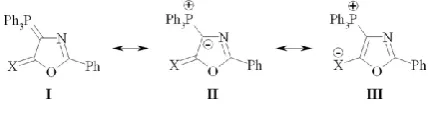
Phosphonium ylides of 2-oxazoline-5-one (PYOA) moiety are unique reagents in fine organic syntheses and enable ways to the broad range of novel stabilized compounds - all possible derivatives of azole.1 So, it has resulted that the oxazole derivatives containing both positively charged PPh3 group and, simultaneously, the exocyclic mono-coordinated oxygen or sulfur/selenium atom, bearing the negative charge formally; their general formulae can be presented by one neutral and two betainic structures: I-III,2 as it is shown in Fig 1.
Figure 1. Canonical forms of PYOA.
The chemical constitution and some physical properties of 2-phenyl-2-oxazolin-5-one with X = O, S, Se were studied in details; so, it was shown that contribution of structure III with the separated charges decreases in the order, O > S > Se, whereas the dipole momentum increases regularly.
The ylide betaine molecules contain branched conjugated system and hence absorb the light in UV region at 340-370 nm. Earlier, it has been suggested that introduction of conjugated substituents at X causes an extension of the total -electron system and should naturally be accompanied by a decrease in the gap energy resulting in a bathochromic shift of the absorbance band so that compounds become even colored.3 On the other hand, the essential spectral effect can be reached upon introduction of highly polar substituents in the phenyl residue in 2-position of oxazole ring. Also, it is well known that an introduction of the mono-coordinated sulphur atom in the extensive -electron system could promote the intersystem conversion from the singlet excited state to the triplet state, that is what happened upon going from the squaraine dyes to their thiaanalogues.4 This paper incorporates the results of the spectral and quantum-chemical investigation of the electronic and spectral properties of phosphonium ylides and their sensitivity upon introduction of the simplest non-conjugated and conjugated substituents.A series of compounds, derivatives of phosphonium ylides of oxazole (1) has been studied (Figure 2). The reference virtual compound (2) was chosen as a model one for comparison with (1) in quantum-chemical calculations. Phosphonium ylides (1) were obtained from corresponding phosphonium salts (4a-4l).
EXPERIMENTAL
1H, 13C, 31P NMR spectra were obtained on a Bruker
AVANCE DRX-500 spectrometer (TMS as internal reference or 85% phosphoric acid as external reference) in DMSO-d6. IR spectra were recorded on a Vertex 70 spectrometer in KBr pellets.
GC-MS spectra were recorded on an LC-MS system - HPLC Agilent 1100 Series equipped with a diode array detector Agilent LC\MSD SL. Parameters of GC-MS analysis: Zorbax SB - C18 column (1.8 μm, 4.6 15 mm, PN 821975-932), solvent water – acetonitrile mixture (95 : 5), 0.1% of aqueous trifluoroacetic acid; eluent flow 3 mL min–1; injection volume 1 μL; UV detecting at 215, 254, 265 nm; chemical ionization at atmospheric pressure (APCI), scan range m/z 80 - 1000. UV-Vis absorption spectra were recorded on a Shimadzu UV-3100 spectrophotometer in toluene of spectral grade.
Elemental analysis was carried out in the Analytical Laboratory of the Institute of Bioorganic and Petrochemistry of the National Academy of Sciences of Ukraine by manual methods. The carbon and hydrogen contents were determined using the Pregl gravimetric method, while nitrogen was determined using the Duma’s gasometrical micromethod. Sulfur was determined by the Scheininger titrimetric method, chlorine content was determined by the mercurometric method, phosphorus content was determined by the colorimetric method.5 M. P. were determined on a Fisher–Johns apparatus and are uncorrected. Reactions and purity of the products were monitored by thin-layer chromatography on Silufol UV-254 plates using 9:1(v/v) chloroform–methanol as eluent. All reagents and solvents were purchased from Aldrich and used as received.
Quantum-Chemical Calculations
Optimized molecular geometry was performed by DFT/CAM-B3LYP//6-31(d,p) method. The electron transition characteristics were calculated by the non-empirical (TD/DFT/6-31G(d,p)/CAM-B3LYP) method using the package Gauss-03.6 Certainly, there is not a perfect agreement of the calculated and experimental data but it is typical for such approach.7-9 However the agreement is enough to analyze the nature of the electron transitions correctly.
Synthesis of 1-acylamino-2,2-dichloroethenyl triphenylphos-phonium salts (general procedure)
Phosphonium salts (4a-4l) that are easily obtained from available N-(1,2,2,2-tetrachloroethyl)amides of carboxylic acids (3а-3l) were used in the synthesis of betaines (1а-1l).10,11 To a solution of N-1,2,2,2-tetrachloroethylamides (0.01 mol) in 10 mL of dry benzene was added solution of triphenylphosphine (0.011 mol) in 5 mL of dry benzene. The mixture was heated at 70-80 C for 2-3 h. Precipitates of compounds (4a-4l) were filtered, washed with THF, dried and analyzed without further purification. For the facilitation of identification chlorides (4a-4c), (4f), (4g) and (4j) were converted to corresponding perchlorates (5a-5c), (5f), (5g) and (5j) and analyzed without further purification. (Scheme 1).
Compounds (4a)-(4l) and (5a-5c), (5f), (5g) and (5j) are colourless crystalline substances soluble in methanol and sparingly soluble in water, THF, dichloromethane and benzene.
Scheme 1. Synthesis of 1-acylamino-2,2-dichloroethenyl triphenylphosphonium salts.
The structure and composition of phosphonium salts (4a-4l and 5a-5c, 5f, 5g and 5j) are in accordance with data of elemental analysis, 1Н, 13С, 31Р NMR, IR spectroscopy and mass-spectrometry. Signals of NH proton in the 1H NMR spectra of compounds 4d, 4e, 4h, 4i, 4k and 4l appeared as a singlet at 11.26 - 12.56 ppm, while the same signal of correspondent perchlorates (5a-5c, 5f, 5g and 5j) ranging from 10.32 to 10.86 ppm. The signals of protons belong to СН3 (5b), CH2 and CH (5c) groups were shifted to the more strong field and appeared as singlet at 1.54 ppm (5b), 3.24 ppm, doublet at 4.54 ppm (splitted on F atom with coupling constant 46.2 Hz) in (4d) and multiplet ranging from 2.11 to 2.23 ppm in (5c).
Particular attention is to be paid to 13C NMR data. The most typical resonances were signals of carbons in dichloroethenyl fragment appearing as doublets due to the interaction with the phosphorus nuclei. Thus, the signals of carbon nuclei (-С) Р–СССl2 appeared in the range 119.5 - 121.5 ppm (with coupling constant 103.7 - 105.7 Hz), the signals of carbon nuclei (β-С) Р–СССl2 revealed in the range 142.5 - 145.5 ppm (coupling constant 27.4 - 31.4 Hz). The signals of phosphorus nuclei in 31Р NMR spectra of compounds 4d, 4e, 4h, 4i, 4k and 4l and 5a-5c, 5f, 5g and 5j were observed in the range of 23.7 - 24.7 ppm.
The intensive absorption bands of amide C=O bond appeared at 1659-1705 cm-1 in the IR spectra of compounds 4d, 4e, 4h, 4i, 4k and 4l and 5a-5c, 5f, 5g and 5j. Also, the broad intensive bands at 1102 – 1106 cm-1 correspond to perchlorate anion of 5a-5c, 5f, 5g and 5j were observed.
Synthesis of [2-R-4-(triphenylphosphoniumyl)-1,3-oxazol-5-yl]sulfanides
Dichloroenamides (4a-4l) reacted with an excess of sodium hydrosulfide in methanol stirred at ambient temperature for a 24 h giving betaines (1a-1l) which crystallized out from reaction mixtures in high yields. The conversion of phosphonic salts (4a-4l) to betaines (1a-1l) is monitored using 1Н, 13С, 31Р NMR and IR spectroscopy. Thus, in the 1H NMR spectra of (1a-1l) the NH proton
R NH O Cl
Cl Cl
Cl R NH
O
Cl Cl
O N R
R NH O
Cl Cl PPh3Cl
NaSH (exc.)
3a-3l 4a-4l 1a-1l
R = H(a), Me(b), Me2CH(c), FCH2(d), PhCH2(e), Ph(f), 4-MeC6H4(g), PhCH=CH(h),
2-ClC6H4(i), 4-ClC6H4(j), 2,4-Cl2C6H3(k), 4-NO2C6H4(l)
PPh3ClO4
5a-5c, 5f, 5g, 5j
+ - +
+
-PPh3
S PPh3
signal disappeared whereas the signal of СН3 protons of 1d revealed as singlet at 2.22 ppm, which indicated the formation of heterocyclic ring where a methyl group directly connected to cyclic fragment.12 Signals of СН
2 groups in 1d and 1e and methine proton in 1с shifted to more weak field and appeared as singlet at 3.94 ppm in 1e, as a doublet splitted on interaction with F atom with coupling constant 48.0 Hz at 5.23 ppm in 1d and multiplet ranged from 2.92 to 2.80 ppm in 1c. The 13С NMR spectra where signals of carbon nuclei of oxazole ring appeared as doublets due to the interaction with phosphorus nuclei are indicative for the confirmation of the ring formation. Thus, С(5) carbon atom signals were observed at 183.5 - 185.0 ppm (coupling constant 31.5 - 33.0 Hz), signals of С(4) carbon atoms appeared at 103.1 - 108.3 ppm (coupling constant 150.6 - 153.3 Hz), signals С(2) atoms of 1a-1c and 1e-1l were observed in range of 150.3 - 165.8 ppm (coupling constant 20.5 - 22.9 Hz), while that of 1d as doublet (splitted on P atom with coupling constant 22.7 Hz and on F atom with coupling constant 18.3 Hz). The signals of phosphorus nuclei in the 31Р NMR spectra of 1a-1l were observed at 12.4 - 13.1 ppm. On the other hand the absorption bands correspond to the carbonyl group in their IR spectra disappeared.
2,2-Dichloro-1-(2-fluoroacetamido)ethenyl]triphenylphos-phonium chloride (4d) was obtained from 2-fluoro-N-(1,2,2,2-tetrachloroethyl)acetamide (3d).13 Yield 3.80 g (81 %); m.p. 194-196 C. 1H NMR (400 MHz, DMSO-d
6): δ = 11.24 (s, 1 H, NH), 7.99 - 7.88 (m, 9 H, PC6H5), 7.86 – 7.77 (m, 6 H, PC6H5), 4.54 (d, 2J(F,C) = 46.2 Hz, 2 H, CH2) ppm. 13C NMR (100.6 MHz, DMSO-d
6): δ = 170.6 (d, 2J(F,C) = 19.8 Hz, C=O), 145.4 (d, 2J(P,C) = 29.3 Hz, C- enamide), 136.0 (d, 4J(P,C) = 2.9 Hz, C-4 PC
6H5), 135.0 (d, 3J(P,C) = 11.0 Hz, C-3, C-5 PC
6H5), 130.8 (d, 2J(P,C) = 13.2 Hz, C-2, C-6 PC6H5), 119.9 (d, 1J(P,C) = 105.6 Hz, C- enamide), 116.5 (d, 1J(P,C) = 89.5 Hz, C-1 PC
6H5), 79.8 (d, 1J(F,C) = 181.9 Hz, CH
2) ppm. 31P NMR (202.4 MHz, DMSO-d6): δ = 24.4 ppm. IR (KBr): = 3054 (br), 2555 (br), 1705, 1554, 1513 1482, 1437, 1238, 1164, 1104, 1064, 964, 755, 722, 688, 520 cm-1. LCMS: [M+H-M(An-)]+ = 432.0, 434.1. C22H18Сl3FNOP (468.715): calcd. C 56.37, H 3.87, Cl 22.69, N 2.99, P 6.61; found C 56.16, H 4.14, Cl 22.83, N 3.20, P 6.47.
2,2-Dichloro-1-(2-phenylacetamido)ethenyl]triphenyl-phosphonium chloride (4e) was obtained from 2-phenyl-N-(1,2,2,2-tetrachloroethyl)acetamide (3e).14 Yield 4.59 g (87 %); m.p. 205-207 C. 1H NMR (400 MHz, DMSO-d
6): δ = 11.72 (s, 1 H, NH), 7.99 - 7.88 (m, 9 H, PC6H5), 7.86 – 7.77 (m, 6 H, PC6H5), 7.25 – 7.16 (m, 3 H, C6H5), 6.97 – 6.87 (m, 2 H, C6H5), 3.24 (s, 2 H, CH2) ppm. 13C NMR (100.6 MHz, DMSO-d6): δ = 171.6 (C=O), 144.1 (d, 2J(P,C) = 30.4 Hz, C- enamide), 135.8 (d, 4J(P,C) = 3.0 Hz, C-4 PC6H5), 134.9 (d, 3J(P,C) = 10.5 Hz, C-3, C-5 PC6H5), 134.5 (C6H5), 130.7 (d, 2J(P,C) = 13.0 Hz, C-2, C-6 PC6H5), 129.7 (C6H5), 128.7 (C6H5), 127.1 (C6H5), 121.5 (d, 1J(P,C) = 104.2 Hz, C- enamide), 116.9 (d, 1J(P,C) = 89.3 Hz, C-1 PC6H5), 41.2 (CH2) ppm. 31P NMR (202.4 MHz, DMSO-d6): δ = 23.7 ppm. IR (KBr): = 3014 (br), 2686 (br), 1671, 1554, 1488, 1435, 1315, 1248, 1179, 1137, 1102, 959, 758, 721, 688, 556, 494 cm-1. LCMS: [M+H-M(An-)]+ = 490.0, 492.0. C28H23Сl3NOP (526.820): calcd. C 63.84, H 4.40, Cl 20.19, N 2.66, P 5.88; found C 63.61, H 4.55, Cl 20.33, N 2.89, P 5.79.
{2,2-Dichloro-1-[(2E)-3-phenylprop-2-enamido]ethenyl}-triphenylphosphonium chloride (4h) was obtained from (2E)-3-phenyl-N-(1,2,2,2-tetrachloroethyl)prop-2-enamide (3h).15 Yield 3.81 g (71 %); m.p. 163-165 C. 1H NMR (400 MHz, DMSO-d6): δ = 11.58 (s, 1 H, NH), 8.04 - 7.93 (m, 6 H, PC6H5), 7.92 – 7.84 (m, 3 H, PC6H5), 7.82 – 7.70 (m, 6 H, PC6H5), 7.51 – 7.45 (m, 2 H, C6H5), 7.43 – 7.34 (m, 3 H, C6H5), 7.28 (d,3J(H,H)= 15.9 Hz, 1 H, CH=CH), 6.46 (d,3J(H,H)= 15.9 Hz, 1 H, CH=CH) ppm. 13C NMR (100.6 MHz, DMSO-d6): δ = 166.1 (C=O), 143.9 (d, 2J(P,C) = 31.4 Hz, C- enamide), 142.5 (CH=CHC6H5), 135.7 (d, 4J(P,C) = 2.5 Hz, C-4 PC6H5), 135.0 (d, 3J(P,C) = 11.0 Hz, C-3, C-5 PC6H5), 134.4 (CH=CHC6H5), 130.8 (CH=CHC6H5), 130.6 (d, 2J(P,C) = 13.0 Hz, C-2, C-6 PC
6H5), 129.5 (CH=CHC6H5), 128.4 (CH=CHC6H5), 121.6 (d, 1J(P,C) = 103.7 Hz, C- enamide), 119.0 (CH=CHC6H5), 117.0 (d, 1J(P,C) = 89.8 Hz, C-1 PC
6H5) ppm. 31P NMR (202.4 MHz, DMSO-d6): δ = 24.0 ppm. IR (KBr): = 3417(br), 3055(br), 2794 (br), 1663, 1625, 1560, 1481, 1437, 1333, 1205, 1152, 1104, 953, 753, 725, 689, 522 cm-1. LCMS: [M+H-M(An-)]+ = 502.0, 504.0. C29H23Сl3NOP (538.831): calcd. C 64.64, H 4.30, Cl 19.74, N 2.60, P 5.75; found C 64.78, H 4.32, Cl 19.63, N 2.71, P 5.59.
{2,2-Dichloro-1-[(2-chlorophenyl)formamido]ethenyl}tri-phenylphosphonium chloride (4i) was obtained from 2-chloro-N-(1,2,2,2-tetrachloroethyl)benzamide (3i).16,17 Yield 4.87 g (89 %); m.p. 192-195 C. 1H NMR (400 MHz, DMSO-d6): δ = 11.51 (s, 1 H, NH), 8.05 - 7.90 (m, 9 H, PC6H5), 7.87 – 7.77 (m, 6 H, PC6H5), 7.49-7.43 (m, 2 H, 2-ClC6H4), 7.32-7.25 (m, 1 H, 2-ClC6H4), 6.75 (d,3J(H,H)= 7.8 Hz, 1 H, 2-ClC6H4) ppm. 13C NMR (100.6 MHz, DMSO-d6): δ = 166.6 (C=O), 145.5 (d, 2J(P,C) = 28.9 Hz, C- enamide), 135.9 (d, 4J(P,C) = 3.0 Hz, C-4 PC
6H5), 135.1 (d, 3J(P,C) = 11.0 Hz, C-3, C-5 PC
6H5), 133.2 (2-ClC6H4), 132.9 (2-ClC6H4), 131.0 (2-ClC6H4), 130.8 (d, 2J(P,C) = 13.0 Hz, C-2, C-6 PC
6H5), 130.8 (2-ClC6H4), 129.5 (2-ClC6H4), 127.4 (2-ClC6H4), 120.7 (d, 1J(P,C) = 104.7 Hz, C- enamide), 116.9 (d, 1J(P,C) = 90.3 Hz, C-1 PC6H5) ppm. 31P NMR (202.4 MHz, DMSO-d6): δ = 24.3 ppm. IR (KBr): = 3500 (br), 3048 (br), 2708 (br), 1669, 1556, 1484, 1437, 1294, 1257, 1105, 954, 727, 689, 520, 495 cm-1. LCMS: [M+H-M(An-)]+ = 512.1, 513.0. C27H20Сl4NOP (547.238): calcd. С, calcd. H, calcd. C 59.26, H 3.68, Cl 25.91, N 2.56, P 5.66; found C 59.18, H 3.82, Cl 25.69, N 2.47, P 5.56.
{2,2-Dichloro-1-[(2,4-dichlorophenyl)formamido]ethe-nyl}triphenylphosphonium chloride (4k) was obtained from 2,4-dichloro-N-(1,2,2,2-tetrachloroethyl)benzamide (3k).18 Yield 5.29 g (91 %); m.p. 189-191 C. 1H NMR (400 MHz, DMSO-d6): δ = 12.02 (s, 1 H, NH), 8.02 - 7.98 (m, 6 H, PC6H5), 7.97 - 7.89 (m, 3 H, PC6H5), 7.87 – 7.76 (m, 6 H, PC6H5), 7.66 (d,4J(H,H)= 1.4 Hz, 1 H, 2,4-Cl2C6H3), 7.42 (dd,3J(H,H)= 8.4 Hz, 4J(H,H)= 1.4 Hz, 1 H, 2,4-Cl
2C6H4), 6.87 (d,3J(H,H)= 8.4 Hz, 1 H, 2,4-Cl
2C6H3) ppm. 13C NMR (100.6 MHz, DMSO-d6): δ = 165.7 (C=O), 145.4 (d, 2J(P,C) = 28.9 Hz, C- enamide), 136.8 (2,4-Cl2C6H3), 135.9 (d, 4J(P,C) = 2.5 Hz, C-4 PC
31P NMR (202.4 MHz, DMSO-d
6): δ = 24.1 ppm. IR (KBr): = 3458 (br), 3036 (br), 2713 (br), 1670, 1583, 1550, 1438, 1249, 1192, 1107, 958, 903, 854, 798, 763, 727, 690, 582, 562, 528, 450 cm-1. LCMS: [M+H-M(An-)]+ = 512.1, 513.0. C27H19Сl5NOP (581.683): calcd. С, calcd. H, calcd. C 55.75, H 3.29, Cl 30.47, N 2.41, P 5.32; found C 55.58, H 3.42, Cl 30.69, N 2.63, P 5.17.
{2,2-Dichloro-1-[(4-nitrophenyl)formamido]ethenyl}tri-phenylphosphonium chloride (4l) was obtained from 4-nitro-N-(1,2,2,2-tetrachloroethyl)benzamide (3l).17 Yield 5.12 g (92 %); m.p. 206-208 C. 1H NMR (400 MHz, DMSO-d6): δ = 12.56 (s, 1 H, NH), 8.21 (d,3J(H,H)= 8.4 Hz, 2 H, 4-NO2C6H4), 8.13 - 7.96 (m, 8 H, PC6H5, 4-NO2C6H4), 7.91 – 7.82 (m, 3 H, PC6H5), 7.81 – 7.69 (m, 6 H, PC6H5), ppm. 13C NMR (100.6 MHz, DMSO-d
6): δ = 165.5 (C=O), 150.2 (4-NO2C6H4), 144.7 (d, 2J(P,C) = 29.4 Hz, C- enamide), 137.0 (4-NO2C6H4), 135.8 (d, 4J(P,C) = 2.5 Hz, C-4 PC6H5), 135.1 (d, 3J(P,C) = 10.5 Hz, C-3, C-5 PC6H5), 130.6 (d, 2J(P,C) = 13.5 Hz, C-2, C-6 PC
6H5), 129.8 (4-NO2C6H4), 124.0 (4-NO2C6H4), 121.4 (d, 1J(P,C) = 105.2 Hz, C- enamide), 116.7 (d, 1J(P,C) = 88.8 Hz, C-1 PC
6H5) ppm. 31P NMR (202.4 MHz, DMSO-d
6): δ = 24.2 ppm. IR (KBr): = 3437 (br), 3054 (br), 1669, 1563, 1517, 1476, 1438, 1345, 1278, 1105, 952, 755, 723, 689, 520, 498 cm-1. LCMS: [M+H-M(An-)]+ = 521.1, 523.0. C
27H20Сl3N2O3P (557.791): calcd. С, calcd. H, calcd. C 58.14, H 3.61, Cl 19.07, N 5.02, P 5.55; found C 58.31, H 3.48, Cl 19.01, N 5.33, P 5.31.
(2,2-Dichloro-1-formamidoethenyl)triphenylphosphonium perchlorate (5a) Yield 3.65 g (73 %); m.p. 202-204 C. 1H NMR (400 MHz, DMSO-d6): δ = 10.32 (s, 1 H, NH), 8.06 - 7.75 (m, 16 H, CH, PC6H5), ppm. 13C NMR (100.6 MHz, DMSO-d6): δ = 162.1 (C=O), 145.0 (d, 2J(P,C) = 27.4 Hz, C- enamide), 136.0 (C-4 PC6H5), 134.9 (d, 3J(P,C) = 11.0 Hz, C-3, C-5 PC6H5), 130.8 (d, 2J(P,C) = 13.0 Hz, C-2, C-6 PC6H5), 119.8 (d, 1J(P,C) = 105.7 Hz, C- enamide), 116.6 (d, 1J(P,C) = 89.3 Hz, C-1 PC
6H5) ppm. 31P NMR (202.4 MHz, DMSO-d6): δ = 24.2 ppm. IR (KBr): = 3222 (br), 1698, 1553, 1480, 1437, 1106 (br), 954, 861, 750, 724, 688, 621, 547, 522, 498, 471 cm-1. LCMS: [M+H-M(An-)]+ = 400.0, 402.0. C21H17Сl3NO5P (500.695): calcd. C 50.37, H 3.42, Cl 21.24, N 2.80, P 6.19; found C 50.61, H 3.21, Cl 21.33, N 3.05, P 6.12.
(2,2-Dichloro-1-acetamidoethenyl)triphenylphosphonium perchlorate (5b) Yield 4.02 g (78 %); m.p. 208-210 C (205-205 C).191H NMR (400 MHz, DMSO-d
6): δ = 10.32 (s, 1 H, NH), 7.99 - 7.92 (m, 3 H, PC6H5), 7.91 – 7.79 (m, 12 H, PC6H5), 1.54 (s, 3 H, CH3) ppm. 13C NMR (100.6 MHz, DMSO-d6): δ = 170.6 (C=O), 143.9 (d, 2J(P,C) = 30.8 Hz, C- enamide), 135.8 (d, 4J(P,C) = 2.9 Hz, C-4 PC
6H5), 135.0 (d, 3J(P,C) = 11.0 Hz, C-3, C-5 PC
6H5), 130.7 (d, 2J(P,C) = 13.2 Hz, C-2, C-6 PC
6H5), 121.6 (d, 1J(P,C) = 104.5 Hz, C- enamide), 117.0 (d, 1J(P,C) = 89.5 Hz, C-1 PC6H5) ppm. 31P NMR (202.4 MHz, DMSO-d6): δ = 24.5 ppm. IR (KBr): = 3500 (br), 1666 (br), 1556, 1440, 1277, 1190, 1106 (br), 980, 751, 727, 689, 623, 521, 499 cm-1. LCMS: [M+H-M(An-)]+ = 414.0, 416.0. C
22H19Сl3NO5P (514.722): calcd. C 51.34, H 3.72, Cl 20.66, N 2.72, P 6.02; found C 51.18, H 3.85, Cl 20.81, N 3.01, P 6.21.
2,2-Dichloro-1-(2-methylpropanamido) ethenyl]triphenyl-phosphonium perchlorate (5c) Yield 3.84 g (71 %); m.p. 204-206 C. 1H NMR (400 MHz, DMSO-d
6): δ = 10.69 (s, 1
H, NH), 7.98 - 7.87 (m, 9 H, PC6H5), 7.85 – 7.76 (m, 6 H, PC6H5), 2.23 – 2.11 (m, 1 H, CH), 0.68 (d, 3J(H,H) = 4 Hz, 6 H, 2 CH3) ppm. 13C NMR (100.6 MHz, DMSO-d6): δ = 177.4 (C=O), 144.1 (d, 2J(P,C) = 30.4 Hz, C- enamide), 135.8 (d, 4J(P,C) = 2.5 Hz, C-4 PC
6H5), 135.0 (d, 3J(P,C) = 10.5 Hz, C-3, C-5 PC6H5), 130.1 (d, 2J(P,C) = 13.0 Hz, C-2, C-6 PC6H5), 121.3 (d, 1J(P,C) = 105.2 Hz, C- enamide), 116.9 (d, 1J(P,C) = 89.8 Hz, C-1 PC
6H5), 34.1 (CH), 18.9 (CH3) ppm. 31P NMR (202.4 MHz, DMSO-d6): δ = 24.1 ppm. IR (KBr): = 3269 (br), 1682 (br), 1558, 1483, 1440, 1217, 1191, 1103 (br), 997, 970, 935, 756, 718, 689, 624, 525, 514, 493 cm-1. LCMS: [M+H-M(An-)]+ = 442.0, 444.0. C24H23Cl3NO5P (542.775): calcd. C 53.11, H 4.27, Cl 19.60, N 2.58, P 5.71; found C 53.38, H 4.41, Cl 19.48, N 2.81, P 5.59.
2,2-Dichloro-1-(phenylformamido)ethenyl]triphenylphos-phonium perchlorate (5f) Yield 4.90 g (85 %); m.p. 228-230 C. 1H NMR (400 MHz, DMSO-d
6): δ = 10.73 (s, 1 H, NH), 7.99 - 7.86 (m, 9 H, PC6H5), 7.83 – 7.75 (m, 6 H, PC6H5), 7.57 (t,3J(H,H)= 7.0 Hz, 1 H, C
6H5), 7.51 (d,3J(H,H)= 7.5 Hz, 2 H, C6H5), 7.46 – 7.40 (m, 2 H, C6H5) ppm. 13C NMR (100.6 MHz, DMSO-d6): δ = 167.6 (C=O), 145.0 (d, 2J(P,C) = 29.4 Hz, C- enamide), 136.0 (d, 4J(P,C) = 3.0 Hz, C-4 PC6H5), 134.9 (d, 3J(P,C) = 11.0 Hz, C-3, C-5 PC6H5), 133.5 (C6H5), 131.7 (C6H5), 130.8 (d, 2J(P,C) = 13.0 Hz, C-2, C-6 PC6H5), 129.2 (C6H5), 127.9 (C6H5), 121.3 (d, 1J(P,C) = 104.7 Hz, C- enamide), 116.8 (d, 1J(P,C) = 89.8 Hz, C-1 PC6H5) ppm. 31P NMR (202.4 MHz, DMSO-d6): δ = 24.7 ppm. IR (KBr): = 3239 (br), 1659, 1564, 1506, 1469, 1449, 1275, 1104 (br), 996, 961, 751, 717, 687, 622, 522 cm-1. LCMS: [M+H-M(An-)]+ = 476.1, 478.0. C
27H21Сl3NO5P (576.791): calcd. C 56.22, H 3.67, Cl 18.44, N 2.43, P 5.37; found C 56.38, H 3.78, Cl 18.29, N 2.61, P 5.19.
{2,2-Dichloro-1-[(4-methylphenyl)formamido]ethenyl}-triphenylphosphonium perchlorate (5g). Yield 4.84 g (84 %); m.p. 232-234 C. 1H NMR (400 MHz, DMSO-d
6): δ = 10.65 (s, 1 H, NH), 8.01 - 7.85 (m, 9 H, PC6H5), 7.83 – 7.73 (m, 6 H, PC6H5), 7.42 (d,3J(H,H)= 7.5 Hz, 2 H, 4-CH3C6H4), 7.24 (d,3J(H,H)= 7.5 Hz, 2 H, 4-CH3C6H4), 2.32 (s, 3 H, CH3) ppm. 13C NMR (100.6 MHz, DMSO-d6): δ = 167.0 (C=O), 144.8 (d, 2J(P,C) = 29.9 Hz, C- enamide), 143.6 (4-CH3C6H4), 135.9 (d, 4J(P,C) = 2.5 Hz, C-4 PC6H5), 134.9 (d, 3J(P,C) = 11.0 Hz, C-3, C-5 PC
6H5), 130.7 (d, 2J(P,C) = 13.0 Hz, C-2, C-6 PC
6H5), 129.6 (4-CH3C6H4), 128.9 (4-CH3C6H4), 127.8 (4-CH3C6H4), 121.4 (d, 1J(P,C) = 105.2 Hz, C- enamide), 116.8 (d, 1J(P,C) = 88.8 Hz, C-1 PC6H5), 21.5 (CH3) ppm. 31P NMR (202.4 MHz, DMSO-d6): δ = 24.6 ppm. IR (KBr): = 3202 (br), 1660, 1559, 1480, 1439, 1277, 1192, 1105 (br), 962, 750, 723, 689, 621, 521 cm-1. LCMS: [M+H-M(An-)]+ = 490.0, 492.0. C28H23Сl3NO5P (590.818): calcd. C 56.92, H 3.92, Cl 18.00, N 2.37, P 5.24; found C 60.18, H 4.17, Cl 17.87, N 2.43, P 5.13.
{2,2-Dichloro-1-[(4-chlorophenyl)formamido]ethenyl}tri-phenylphosphonium perchlorate ( j). Yield 4.84 g (89 %); m.p. 225-227 C. 1H NMR (400 MHz, DMSO-d
1J(P,C) = 105.7 Hz, C- enamide), 116.6 (d, 1J(P,C) = 89.8 Hz, C-1 PC6H5) ppm. 31P NMR (202.4 MHz, DMSO-d6): δ = 24.7 ppm. IR (KBr): = 3271 (br), 1670, 1556, 1464, 1440, 1269, 1194, 1102 (br), 964, 755, 724, 690, 622, 527 cm-1. LCMS: [M+H-M(An-)]+ = 512.0, 513.0. C27H20Сl4NO5P (611.236): calcd. C 53.05, H 3.30, Cl 23.20, N 2.29, P 5.07; found C 53.21, H 3.49, Cl 23.08, N 2.33, P 5.01.
Synthesis of [2-R-4-(Triphenylphosphoniumyl)-1,3-oxazol-5-yl]sulfanides (1a)-(1l) (General Procedure)
To a solution of 1-acylamino-2,2-dichloroethenyltri-phenylphosphonium chlorides (0.01 mol) in 10 mL of methanol, a solution of NaSH (0.035 mol) in 50 mL of methanol was added. The mixture kept at 20-25 C for 24 h. The residue formed was filtered, washed with water and dried in vaccuo over phosphorus pentoxide in vacuum desiccator. Analytically pure samples were obtained after recrystallization from methanol.
[4-(Triphenylphosphoniumyl)-1,3-oxazol-5-yl]sulfanide (1a) was obtained from (2,2-dichloro-1-formamido)-ethenyltriphenylphosphonium chloride (4a). Yield 3.21 g (89 %); m.p. 192 - 194 C. 1H NMR (400 MHz, DMSO-d
6): δ = 8.01 (d, 4J(P,H) = 2.0 Hz, 1 H, 2-H oxazole), 7.82 - 7.75 (m, 3 H, PC6H5), 7.74 - 7.62 (m, 12 H, PC6H5) ppm. 13C NMR (100.6 MHz, DMSO-d6): δ = 183.5 (d, 2J(P,C) = 32.9 Hz, C-5 oxazole), 150.3 (d, 3J(P,C) = 21.9 Hz, C-2 oxazole), 134.5 (d, 3J(P,C) = 10.5 Hz, C-3, C-5 PC
6H5), 134.4 (C-4 PC6H5), 130.0 (d, 2J(P,C) = 13.0 Hz, C-2, C-6 PC6H5), 120.8 (d, 1J(P,C) = 92.4 Hz, C-1 PC
6H5), 103.5 (d, 1J(P,C) = 152.7 Hz, C-4 oxazole) ppm. 31P NMR (202.4 MHz, DMSO-d
6): δ = 13.1 ppm. IR (KBr): = 1437, 1396 (br), 1110, 1047, 722, 689, 573, 517 cm-1. LCMS: [M+H]+ = 362.2. C
21H16NOPS (361.398): calcd. C 69.79, H 4.46, N 3.88, P 8.57, S 8.87; found C 69.96, H 4.67, N 4.03, P 8.65, S 8.62.
[2-Methyl-4-(triphenylphosphoniumyl)-1,3-oxazol-5-yl]-sulfanide (1b) was obtained from (1-acetamido-2,2-dichloroethenyl)triphenylphosphonium chloride (4b). Yield 3.42 g (91 %); m.p. 219 - 220 C (184-186 C).101H NMR (400 MHz, DMSO-d6): δ = 7.82 - 7.60 (m, 15 H, PC6H5), 2.22 (s, 3 H, CH3) ppm. 13C NMR (100.6 MHz, DMSO-d
6): δ = 183.6 (d, 2J(P,C) = 32.3 Hz, C-5 oxazole), 158.6 (d, 3J(P,C) = 22.7 Hz, C-2 oxazole), 134.5 (d, 3J(P,C) = 10.3 Hz, C-3, C-5 PC6H5), 134.3 ( d, 4J(P,C) = 2.9 Hz, C-4 PC6H5), 129.9 (d, 2J(P,C) = 13.2 Hz, C-2, C-6 PC
6H5), 121.1 (d, 1J(P,C) = 93.9 Hz, C-1 PC
6H5), 103.4 (d, 1J(P,C) = 153.3 Hz, C-4 oxazole) ppm. 31P NMR (202.4 MHz, DMSO-d
6): δ = 12.4 ppm. IR (KBr): = 1599, 1438, 1397 (br), 1109,1074, 1030, 756, 690, 560, 517, 497 cm-1. LCMS: [M+H]+ = 376.2. C22H18NOPS (375.424): calcd. C 70.38, H 4.83, N 3.73, P 8.25, S 8.54; found C 70.12, H 4.98, N 3.98, P 8.37, S 8.67.
[2-(Propan-2-yl)-4-(triphenylphosphoniumyl)-1,3-oxazol-5-yl]sulfanide (1c) was obtained from [2,2-dichloro-1-(2-methylpropanamido)ethenyl]triphenylphosphonium chloride (4c). Yield 3.68 g (91 %); m.p. 182 - 184 C. 1H NMR (400 MHz, DMSO-d6): δ = 7.81 - 7.57 (m, 15 H, PC6H5), 2.92 - 2.80 (m, 1 H, CH), 1.22 - 1.12 (6 H, CH3) ppm. 13C NMR (100.6 MHz, DMSO-d6): δ = 183.5 (d, 2J(P,C) = 33.0 Hz, C-5 oxazole), 16C-5.8 (d, 3J(P,C) = 20.5 Hz, C-2 oxazole), 134.5 (d, 3J(P,C) = 10.3 Hz, C-3, C-5 PC
6H5), 134.3 ( d, 4J(P,C) =
2.2 Hz, C-4 PC6H5), 129.9 (d, 2J(P,C) = 12.5 Hz, C-2, C-6 PC6H5), 121.2 (d, 1J(P,C) = 93.9 Hz, C-1 PC6H5), 103.1 (d, 1J(P,C) = 153.3 Hz, C-4 oxazole), 28.4 (CH), 20.6 (CH
3) ppm. 31P NMR (202.4 MHz, DMSO-d
6): δ = 12.1 ppm. IR (KBr): = 1438, 1407 (br), 1109, 994, 722, 690, 559, 518 cm-1. LCMS: [M+H]+ = 404.2. C
24H22NOPS (403.477): calcd. C 71.44, H 5.50, N 3.47, P 7.68, S 7.95; found C 71.15, H 5.74, N 3.68, P 7.42, S 8.17.
[2-Flouromethyl-4-(triphenylphosphoniumyl)-1,3-oxazol-5-yl]sulfanide (1d) was obtained from [2,2-dichloro-1-(2-fluoroacetamido)ethenyl]triphenylphosphonium chloride (4d). Yield 3.22 g (82 %); m.p. 150 - 154 C. 1H NMR (400 MHz, DMSO-d6): δ = 7.82 - 7.76 (m, 3 H, PC6H5), 7.75 - 7.62 (m, 12 H, PC6H5), 5.23 (d, 2J(F,H) = 48.0 Hz, 2 H, CH2F) ppm. 13C NMR (100.6 MHz, DMSO-d6): δ = 185.0 (d, 2J(P,C) = 31.5 Hz, C-5 oxazole), 155.9 (dd, 3J(P,C) = 22.7 Hz, 2J(F,C) = 18.3 Hz C-2 oxazole), 134.6 (C-4 PC
6H5), 134.5 (d, 3J(P,C) = 11.0 Hz, C-3, C-5 PC
6H5), 130.1 (d, 2J(P,C) = 13.2 Hz, C-2, C-6 PC
6H5), 120.5 (d, 1J(P,C) = 94.6 Hz, C-1 PC6H5), 105.4 (d, 1J(P,C) = 152.6 Hz, C-4 oxazole), 76.0 (d, 1J(F,C) =163.6 Hz, CH
2F) ppm. 31P NMR (202.4 MHz, DMSO-d6): δ = 13.0 ppm. IR (KBr): = 1437, 1402 (br), 1109, 963, 723, 688, 565, 520 cm-1. C
22H17FNOPS (393.415): calcd. C 67.16, H 4.36, N 3.56, P 7.87, S 8.15; found C 67.44, H 4.71, N 3.78, P 7.96, S 8.03.
[2-Benzyl-4-(triphenylphosphoniumyl)-1,3-oxazol-5-yl]-sulfanide (1e) was obtained from [2,2-dichloro-1-(2-phenylacetamido)ethenyl]triphenylphosphonium chloride (4e). Yield 3.91 g (87 %); m.p. 192 - 194 C. 1H NMR (400 MHz, DMSO-d6): δ = 7.81 - 7.59 (m, 15 H, PC6H5), 7.35 - 7.19 (m, 5 H, C6H5), 3.94 (s, 2 H, CH2) ppm. 13C NMR (100.6 MHz, DMSO-d6): δ = 184.0 (d, 2J(P,C) = 32.3 Hz, C-5 oxazole), 160.2 (d, 3J(P,C) = 22.0 Hz, C-2 oxazole),136.4 (C6H5) 134.5 (d, 3J(P,C) = 11.0 Hz, C-3, C-5 PC6H5), 134.3 ( d, 4J(P,C) = 2.2 Hz, C-4 PC
6H5), 130.0 (d, 2J(P,C) = 12.5 Hz, C-2, C-6 PC6H5), 129.2 (C6H5), 129.1 (C6H5), 127.3 (C6H5), 121.0 (d, 1J(P,C) = 93.9 Hz, C-1 PC6H5), 103.6 (d, 1J(P,C) = 152.6 Hz, C-4 oxazole), 34.6 (CH
2) ppm. 31P NMR (202.4 MHz, DMSO-d6): δ = 12.4 ppm. IR (KBr): =1577, 1435, 1410 (br), 1108, 995, 732, 723, 564, 521, 503 cm-1. LCMS: [M+H]+ = 452.2. C
28H22NOPS (451.520): calcd. C 74.48, H 4.91, N 3.10, P 6.86, S 7.10; found C 74.11, H 4.78, N 3.22, P 6.59, S 6.97.
[2-Phenyl-4-(triphenylphosphoniumyl)-1,3-oxazol-5-yl]-sulfanide (1f) was obtained from [2,2-dichloro-1-(phenylformamido)ethenyl]triphenylphosphonium chloride (4f). Yield 4.06g (93%); m.p. 189 - 191 C (183-185 C, 188-189 C).10,11 1H NMR (400 MHz, DMSO-d
6): δ = 7.87 - 7.74 (m, 11 H, PC6H5), 7.72 - 7.62 (m, 6 H, PC6H5, C6H5), 7.51 - 7.35 (m, 3 H, C6H5) ppm. 13C NMR (100.6 MHz, DMSO-d6): δ = 183.9 (d, 2J(P,C) = 32.9 Hz, C-5 oxazole), 158.2 (d, 3J(P,C) = 21.9 Hz, C-2 oxazole), 134.6 (d, 3J(P,C) = 10.5 Hz, C-3, C-5 PC6H5), 134.5 (C-4 PC6H5), 130.0 (d, 2J(P,C) = 13.0 Hz, C-2, C-6 PC
6H5), 130.0 (C6H5), 129.5 (C6H5), 129.1 (C6H5), 127.3 (C6H5),125.4 (C6H5), 120.8 (d, 1J(P,C) = 93.7 Hz, C-1 PC
6H5), 106.2 (d, 1J(P,C) = 152.1 Hz, C-4 oxazole) ppm. 31P NMR (202.4 MHz, DMSO-d
[2-(4-Methylphenyl)-4-(triphenylphosphoniumyl)-1,3-oxazol-5-yl]sulfanide (1g) was obtained from {2,2-dichloro- 1-[(4-methylphenyl)formamido]ethenyl}triphenylphospho-nium chloride (4g). Yield 4.28 g (95 %); m.p. 197 - 198 C (194-197 C).61H NMR (400 MHz, DMSO-d
6): δ = 7.85 - 7.73 (m, 9 H, PC6H5), 7.73 - 7.62 (m, 8 H, PC6H5, 4-CH3C6H4), 7.26 (d, 3J(H,H) = 7.9 Hz, 2 H, 4-CH3C6H4), 2.32 (s, 3 H, CH3) ppm. 13C NMR (100.6 MHz, DMSO-d6): δ = 183.6 (d, 2J(P,C) = 32.9 Hz, C-5 oxazole), 158.5 (d, 3J(P,C) = 21.9 Hz, C-2 oxazole), 139.8 (4-CH3C6H4), 134.6 (d, 3J(P,C) = 10.5 Hz, C-3, C-5 PC
6H5), 134.5 (d, 2J(P,C) = 3.0 Hz, C-4 PC6H5), 130.0 (4-CH3C6H4), 130.0 (d, 2J(P,C) = 13.0 Hz, C-2, C-6 PC6H5), 125.4 (4-CH3C6H4), 124.8 (4-CH3C6H4), 120.8 (d, 1J(P,C) = 93.7 Hz, C-1 PC6H5), 105.9 (d, 1J(P,C) = 152.1 Hz, C-4 oxazole) ppm. 31P NMR (202.4 MHz, DMSO-d6): δ = 12.5 ppm. IR (KBr): =1437, 1392 (br), 1111, 1078, 972, 819, 754, 720, 699, 686, 646, 567, 518 cm-1. LCMS: [M+H]+ = 452.0. C
28H22NOPS (451.520): calcd. C 74.48, H 4.91, N 3.10, P 6.86, S 7.10; found C 74.56, H 4.69, N 3.34, P 6.51, S 7.19.
{2-[(E)-2-Phenylethenyl]-4-(triphenylphosphoniumyl)-1,3-oxazol-5-yl]sulfanide (1h) was obtained from {2,2- dichloro-1-[(2E)-3-phenylprop-2-enamido]ethenyl}triphe-nylphosphonium chloride (4h). Yield 4.12 g (89 %); m.p. 200 - 202 C. 1H NMR (400 MHz, DMSO-d
6): δ = 7.90 - 7.60 (m, 17 H, PC6H5, C6H5), 7.44 - 7.27 (m, 3 H, C6H5), 7.20 (d, 3J(H,H) = 16.3 Hz, 1 H, CH=CH), 6.89 (d, 3J(H,H) = 16.3 Hz, 1 H, CH=CH) ppm. 13C NMR (100.6 MHz, DMSO-d6): δ = 183.8 (d, 2J(P,C) = 32.9 Hz, C-5 oxazole), 158.8 (d, 3J(P,C) = 22.4 Hz, C-2 oxazole), 136.2 (CH=CHC6H5), 134.5 (d, 3J(P,C) = 10.5 Hz, C-3, C-5 PC6H5), 134.5 (C-4 PC6H5), 133.3 (CH=CHC6H5), 130.0 (d, 2J(P,C) = 13.0 Hz, C-2, C-6 PC
6H5), 129.3 (CH=CHC6H5), 129.1 (CH=CHC6H5), 127.5 (CH=CHC6H5), 120.7 (d, 1J(P,C) = 93.7 Hz, C-1 PC
6H5), 114.0 (CH=CHC6H5), 106.8 (d, 1J(P,C) = 152.1 Hz, C-4 oxazole) ppm. 31P NMR (202.4 MHz, DMSO-d6): δ = 12.7 ppm. IR (KBr): =1437, 1389 (br), 1218, 1109, 753, 723, 685, 560, 518, 499 cm-1. LCMS: [M+H]+ = 464.0. C
29H22NOPS (463.531): calcd. C 75.14, H 4.78, N 3.02, P 6.68, S 6.92; found C 74.93, H 4.91, N 3.29, P 6.81, S 7.06.
[2-(2-Chlorophenyl)-4-(triphenylphosphoniumyl)-1,3-oxa-zol-5-yl]sulfanide (1i) was obtained from {2,2-dichloro-1-[(2-chlorophenyl)formamido]ethenyl}triphenylphosphonium chloride (4i). Yield 3.97 g (84 %); m.p. 211 - 213 C. 1H NMR (400 MHz, DMSO-d6): δ = 7.90 - 7.75 (m, 10 H, PC6H5), 7.73 - 7.62 (m, 6 H, PC6H5, 2-ClC6H4), 7.57-7.51 (m, 1 H, 2-ClC6H4), 7.48-7.38 (m, 2 H, 2-ClC6H4) ppm. 13C NMR (100.6 MHz, DMSO-d6): δ = 183.9 (d, 2J(P,C) = 32.4 Hz, C-5 oxazole), 155.6 (d, 3J(P,C) = 22.9 Hz, C-2 oxazole), 134.6 (d, 3J(P,C) = 10.5 Hz, C-3, C-5 PC
6H5), 134.6 (C-4 PC6H5), 131.7 (2-ClC6H4), 131.2 (2-ClC6H4), 130.7 (2-ClC6H4), 130.1 (2-ClC6H4), 130.0 (d, 2J(P,C) = 13.0 Hz, C-2, C-6 PC6H5), 128.0 (2-ClC6H4), 125.7 (2-ClC6H4), 120.7 (d, 1J(P,C) = 93.7 Hz, C-1 PC
6H5), 106.5 (d, 1J(P,C) = 152.1 Hz, C-4 oxazole) ppm. 31P NMR (202.4 MHz, DMSO-d
6): δ = 12.4 ppm. IR (KBr): =1471, 1437, 1392 (br), 1220, 1109, 980, 770, 758, 741, 719, 686 (br), 657, 589, 563, 538, 514 cm-1. LCMS: [M]+ = 472.2, 473.2.C
27H19ClNOPS (471.938): calcd. C 68.71, H 4.06, N 2.97, P 6.56, S 6.79, Cl 7.51; found C 68.79, H 4.28, N 3.24, P 6.51, S 6.63, Cl 7.49.
[2-(4-Chlorophenyl)-4-(triphenylphosphoniumyl)-1,3-oxazol-5-yl]sulfanide (1j) was obtained from {2,2-dichloro- 1-[(4-chlorophenyl)formamido]ethenyl}triphenylphosphoni-um chloride (4j). Yield 4.53 g (96 %); m.p. 222 - 223 C (216-218 C).5 1H NMR (400 MHz, DMSO-d
6): δ = 7.84 - 7.62 (m, 17 H, PC6H5, 4-ClC6H4), 7.74 - 7.50 (d, 3J(H,H) =8.8 Hz, 2 H, 2-ClC6H4) ppm. 13C NMR (100.6 MHz, DMSO-d6): δ = 184.1 (d, 2J(P,C) = 32.3 Hz, C-5 oxazole), 157.3 (d, 3J(P,C) = 22.0 Hz, C-2 oxazole), 134.6 (d, 3J(P,C) = 11.0 Hz, C-3, C-5 PC6H5), 134.6 (C-4 PC6H5),134.5 (4-ClC6H4), 130.0 (d, 2J(P,C) = 12.5 Hz, C-2, C-6 PC6H5), 129.6 (4-ClC6H4),127.1 (4-ClC6H4), 126.1 (4-ClC6H4), 120.6 (d, 1J(P,C) = 93.9 Hz, C-1 PC
6H5), 106.5 (d, 1J(P,C) = 151.9 Hz, C-4 oxazole) ppm. 31P NMR (202.4 MHz, DMSO-d6): δ = 12.7 ppm. IR (KBr): =1482, 1438, 1384 (br), 1219, 1111, 1077, 834, 752, 721, 686 (br), 603, 563, 539, 520 cm-1. LCMS: [M]+ = 472.2, 473.2. C
27H19ClNOPS (471.938): calcd. C 68.71, H 4.06, N 2.97, P 6.56, S 6.79, Cl 7.51; found C 69.03, H 3.85, N 3.19, P 6.68, S 6.87, Cl 7.74.
[2-(2,4-Dichlorophenyl)-4-(triphenylphosphoniumyl)-1,3-oxazol-5-yl]sulfanide (1k) was obtained from {2,2-dichloro- 1-[(2,4-dichlorophenyl)formamido]ethenyl}triphenylphos-phonium chloride (4k). Yield 4.81 g (95 %); m.p. 178 - 179 C. 1H NMR (400 MHz, DMSO-d
6): δ = 7.87 - 7.73 (m, 10 H, PC6H5), 7.72 - 7.63 (m, 7 H, PC6H5, 2,4-Cl2C6H3), 7.50 (d, 3J(H,H) = 8.3 Hz, 1 H, 2,4-Cl
2C6H3) ppm. 13C NMR (100.6 MHz, DMSO-d6): δ = 184.0 (d, 2J(P,C) = 32.3 Hz, C-5 oxazole), 1C-54.7 (d, 3J(P,C) = 22.7 Hz, C-2 oxazole), 134.7 (2,4-Cl2C6H3),134.6 (d, 4J(P,C) = 2.9 Hz, C-4 PC6H5), 134.6 (d, 3J(P,C) = 10.3 Hz, C-3, C-5 PC
6H5), 131.6 (2,4-Cl2C6H3), 131.2 (2,4-Cl2C6H3), 131.1 (2,4-Cl2C6H3), 130.0 (d, 2J(P,C) = 13.0 Hz, C-2, C-6 PC6H5), 128.3 (2,4-Cl2C6H3), 124.5 (2,4-Cl2C6H3), 120.6 (d, 1J(P,C) = 93.9 Hz, C-1 PC6H5), 107.0 (d, 1J(P,C) = 151.9 Hz, C-4 oxazole) ppm. 31P NMR (202.4 MHz, DMSO-d6): δ = 12.5 ppm. IR (KBr): =1468, 1437, 1395 (br), 1221, 1108, 1082, 975, 841, 753, 718, 685 (br), 623, 611, 543, 514 cm-1. LCMS: [M]+ = 506.2, 507.2. C27H18Cl2NOPS (506.383): calcd. C 64.04, H 3.58, N 2.77, P 6.12, S 6.33, Cl 14.00; found C 64.29, H 3.41, N 2.94, P 6.21, S 6.51, Cl 14.39.
[2-(4-Nitrophenyl)-4-(triphenylphosphoniumyl)-1,3-oxa-zol-5-yl]sulfanide (1l) was obtained from {2,2-dichloro-1-[(4-nitrophenyl)formamido] ethenyl} triphenylphosphonium chloride (4). Yield 4.62 g (96 %); m.p. 207 - 208 C. 1H NMR (400 MHz, DMSO-d6): δ = 8.29 (d, 3J(H,H) = 8.4 Hz, 2 H, 4-NO2C6H4), 7.94 (d, 3J(H,H) = 8.4 Hz, 2 H, 4-NO2C6H4), 7.90 - 7.66 (m, 15 H, PC6H5) ppm. 13C NMR (100.6 MHz, DMSO-d6): δ = 185.0 (d, 2J(P,C) = 32.4 Hz, C-5 oxazole), 1C-56.4 (d, 3J(P,C) = 21.9 Hz, C-2 oxazole), 147.6 (4-NO2C6H4), 134.7 (C-4 PC6H5), 134.6 (d, 3J(P,C) = 11.0 Hz, C-3, C-5 PC6H5), 132.3 (4-NO2C6H4), 130.1 (d, 2J(P,C) = 13.0 Hz, C-2, C-6 PC6H5),126.1 (4-NO2C6H4), 125.0 (4-NO2C6H4), 120.3 (d, 1J(P,C) = 94.2 Hz, C-1 PC6H5), 108.3 (d, 1J(P,C) = 150.6 Hz, C-4 oxazole) ppm. 31P NMR (202.4 MHz, DMSO-d6): δ = 12.8 ppm. IR (KBr): =1595, 1511, 1489, 1389, 1213, 1108, 722, 695 (br), 660, 563, 540, 520 cm-1. LCMS: [M+H]+ = 483.2. C
RESULTS AND DISCUSSION
Effect of substituent at 2-position of oxazole ring-
Optimized Molecular Geometry
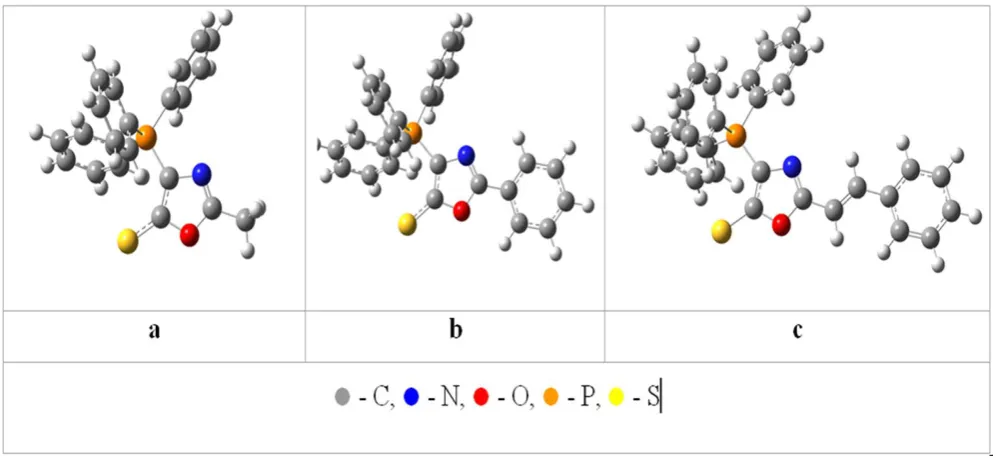
The optimized molecules of PYOA with the different substituents in the 2-position are shown in Figure 3. One can see that the non-variable core molecular part (including oxazole cycle and phenyl substituent in position 2 and the amino group in position 5) are situated in the same plane, i.e. this molecular fragment is planar with maximum conjugation between oxazole and both substituents. The thickness of -electron systems is 1.4 Å.
The variable substituents in positions 4 differ essentially by their spatial constitution. In the reference molecule, R = Me, the methyl group (Figure 3, a) has the spherical structure with radius 1.8 Å. The CN group is situated in the same plane with the molecular core and conjugate with them; its thickness is also 1.4 Å, while the total length is 1.6 Å. Other substituents that are bonded with oxazole cycle by tri-coordinated atom (S or P) and are of propeller-type, hence can rotate around S–C or P–C bond.
Additionally, the phenyl group at sulfur or phosphorus atom can rotate practically freely; its extension is approximately following: 6.5×6.5×1.4 Å3.
It was found that the introducing of the Cl atoms as well as NO2 groups has not disturbed the planar constitution. The planar spatial position of the conjugated molecular fragments is obtained upon optimization of the stilbene-like molecule (1h) (Figure 3, c), whereas three phenyl substituents at the phosphorus atoms form propeller-like space structure, and the torsion angles between P–Ph bonds
and oxazole cycle plane are following: 22o, 97o and -38o, every phenyl ring is twisted relatively to P–oxazole bond at 71o, 167o and -40o, correspondingly. As regard to the optimized bonds, their values for the (1f) are presented in Figure 4.
The calculated bond lengths are close to the experimental values (within 0.02 Å). The lengths of two C–O and two C–N bonds are not equivalent. The carbon-phosphorus bond to phosphorus atom with oxazole cycle (1.740 Å) is somewhat shorter than the bonds linked that phosphorus atom with the phenyl substituents (1.816 Å), as experimentally confirmed. The exocyclic C–S bond connecting the oxazole with the single-coordinated sulphur atom is longer (1.671 Å) in comparison, for example, with the calculated C = S bond in thioacetone (1.622 Å).
In the other PYOA derivatives, the bond lengths in PYOA core are negligibly modified, with the exception of PYOA – R length i.e., 1.492 Å (R = Me), 1.466 Å (1f), 1.465 Å (1i ), 1.467 Å (1j) and 1.457 Å (1l). The bonds in 5-membered oxazole cycle are close to aromatic bonds excepting the comparative short double C=N bond (1.29 Å) (Figure 4). The calculations give the theoretical aromatic C–C bond length for phenyl substituents in (1f) and (1h). C–C bond lengths in the open chain of the stilbene (1h) are substantially alternated viz., 1.448, 1.339 and 1.465 Å, exactly as in the ordinary polyenes. It is also to be mentioned that the aromatic bonds in the phenyl substituents at the phosphorus are slightly distorted from standard values of 1.40 Å. It can be assumed that in the PYOA molecule (1) two main conjugated systems exist: -electron system of the planar oxazole moiety with its conjugated substituents R and the-electron system of the three phenyl residues at the phosphorus atom forms propeller-like structure. Both conjugated systems are interconnected by the phosphorus atom. Other bonds in PYOA contained the non-conjugated substituents were not analyzed in this study.
Figure 4. Optimized bond lengths in (1f), bond lengths obtained
Atomic charges
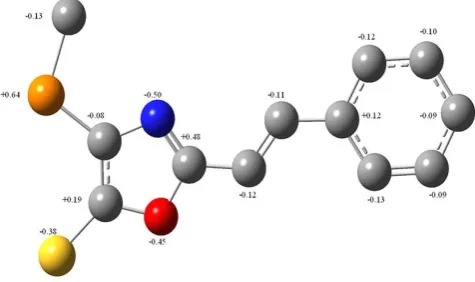
At first, it should be pointed that the DFT calculations indicated considerable polarization of C–H bonds, for example, in the phenyl substituents, as well as in the open polyenic chain in the stilbene (1h) and consequently these carbon atoms bear the negative charges. The charges on the hydrogen atoms are not shown in Figure 5, only the charges on carbon atoms and heteroatoms are shown.
Figure 5. Charges on carbon atoms and heteroatoms in (1h).by X-spectroscopy are in brackets (ref. 2)
One can see that the charges at the carbon atoms of the exocyclic phenyl ring are in a narrow range, -0.09-013. Practically the same charges are obtained for the carbon atoms in three phenyl substituents at the phosphorus atom.
The atomic charges of the carbon atoms in the oxazole cycle depend appreciably on the adjacent heteroatoms because of the high polarization of the C–N and C–O bonds; the maximum positive charge is seen to be present at C-2 connected with the conjugated substituent, while the positive charge at the position 5 is appreciably lower, evidently, because of the opposite polarization C–S bond. Also, the carbon atom bonded to the phosphorus atom of the low electronegativity bear the small negative charges because of the considerable opposite polarization of the C–P bond directed to the carbon atom.
The calculation showed the presence of appreciable negative charge at the double-coordinated oxygen atom. An
excess of electron density is obtained for the double-coordinated nitrogen atoms and mono-double-coordinated sulphur atom also. It is obvious that the maximum deficit of the electron density (Figure 5) is obtained, from the calculation, for the tetra-coordinated phosphorus atom with the minimum electronegativity.
The calculations also give the negligible influence of the substituents (Cl, NO2) and/or lengthening of the open conjugated chain on the charge distribution in oxazole cycle, only atomic charges at the carbon atoms bonded with such substituents are affected. Thus, introduction of the chlorine atom in o-position increases slightly the negative charge from -0.12 to -0.15 (while q[Cl] = +0.03), the calculated effect of p-Cl atom differs somewhat: q[C] = -0.09, q[Cl] = +0.03). At the same time, the effect of high acceptor group is appreciably greater q[C] = +0.24, q[N] = +0.10 and q[O] = -0.40.
To summarise, the negligible influence of the non-conjugated and non-conjugated substituents on the atomic charges in PYOA moiety is seen in figure 6a where the charges at the carbon atoms and heteroatoms upon variation of the residue R are presented. The quantum-chemical conclusion about the negligible influence of the non-conjugated and non-conjugated substituents on the atomic charges on PYOA moiety is experimentally confirmed by 13C NMR spectroscopy data. The measured signals for three
carbon atoms are given in the figure 6b.
The atomic charges in the benzene cycle depend weakly on the carbon atom position, except the carbon atom bonded with PYOA cycle (Figure 6). The calculated data are in good agreement with the experimental results obtained by 13C NMR spectroscopy (Table 1). For comparison, the
signals for benzene ring in non-conjugated residue CH2Ph (compound 1e) are also presented.
The measured values δ for the carbon atoms in the corresponding positions coincide practically for both conjugated phenyl substituent (compound 1f), and non-conjugated benzyl substituent (compound 1l), except the atom in the benzene ring connected with the rest of molecule. Introducing of one chlorine atom (compound 1i) or two atoms (compound 1k) makes the substituent unsymmetrical, the charges on the atoms C-2 and C-5 become different (Table 1), which also confirmed experimentally. The maximum change of the charge occurs for the atom in para-position upon introducing of the high acceptor nitro group in the molecule (compound 1l). The calculation gives the considerable atomic charge: +0.235. The signal δ (C-4) is appreciably shifted in the weak field at 147.6 ppm. Regarding carbon atoms in the open chain of the molecule (1h), the atomic charges (Figure 5) are close: -0.12 and -0.11. However, the 13C NMR data show the appreciable difference in the chemical shifts: δ() = 136.2 ppm and δ(β) = 114.0 ppm.
Figure 6. (a) Calculated charges at carbon atoms and heteroatoms and (b) 13C NMR signals within PYOA moiety.
Summarizing, both non-conjugated and conjugated substituents R affect comparatively weak on the equilibrium molecular geometry and charge distribution in PYOA moiety, i.e. the electron structure in the ground state is weakly sensitive to the nature of exocyclic substituents. It is supposed that the excited state should be more perceptible.
Delocalized and local MOs
The influence of the substituents is more clearly recognized in the shape of molecular orbitals and, hence, in nature of the lowest electron transitions involved the frontier and nearest MOs. It is noted that the three phenyl substituents at the phosphorus atom do not conjugate with the oxazole cycle and their -orbitals should generate own conjugated systems. Therefore, let us first compare the MOs in the simplest molecule (1b)and the reference molecule (2). After this, we have considered the influence of the phenyl substituent (1f) and the lengthening of the chain, and finally the effects of the introduction of chlorine atoms and the nitro group have been analyzed.
MOs and electron transitions in PYOA and reference compound (2)
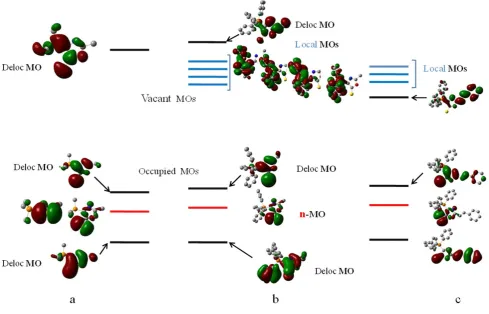
The shape of the frontier and some nearest MOs of the molecules studied are shown in figure 7. According to the obtained data, there are three types of orbitals:
(a) MOs delocalized within the planar molecular fragment, we have named them as delocalized MOs (Deloc. MO),
(b) lone electron pair (LEP or n-MO) located only on the sulphur atom. It lies in the PYOA plane and hence is perpendicular to the -orbitals of the main conjugated system and
(c) orbitals localized in three phenyl substituents on the phosphorus atoms, named as local MOs (Loc MO). They appear only in compounds containing P+Ph
3 substituent and are absent in the model molecule (2).
These MOs generate the lowest electron transitions of following different types.
• π π transitions; we should differ two types of such transitions:
(i) Π (Del) π* (Del), the transition between the HOMO and lowest occupied delocalized π-orbital;
(ii) π (Del) π* (Loc), transitions from the delocalized occupied MOs to the lowest vacant local MO.
• n π* -transitions: n π* (Del) and n π* (Loc).
The calculated characteristics of the lowest transitions of different types are collected in Table 2.
Table 1.13C NMR signals, δ, of carbon atoms in benzene ring.
Molecule C-1*, ppm C-2, ppm C-3, ppm C-4, ppm C-5, ppm C-6, ppm
1e 136.4 129.1 129.2 127.3 129.2 129.1
1f 130.0 129.5 125.4 127.5 125.4 129.5
1g 124.6 130.0 125.5 139.8 125.5 130.0
1h 133.3 129.3 127.5 129.1 127.5 129.3
1i 130.7 131.2 130.1 131.7 125.7 128.0
1j 126.1 129.6 127.1 134.5 127.1 129.6
1k 124.5 131.6 131.2 134.7 128.8 131.1
1l 132.3 125.0 126.1 147.6 126.1 125.0
Figure 7. Energy levels of molecules (a) = (2),(b) = (1b), (c)= (1h).
In the reference model molecule (2) only π (Del) π* (Del) and n π* (Del) transitions exist (Figure 7, a). The calculation showed that the transition involved LEP orbital has the minimum energy, its oscillator strength, f1, is negligible, so as the n- and π-MOs are situated in the perpendicular plane and, hence, are not overlap. In contrast, the oscillator strength of the transition between the totally delocalized frontier MOs, f2, is comparatively large, mainly because of the high overlapping of both the orbitals.
The molecule PYOA (with the non-conjugated substituent R), as seen in Figure 7 b, additionally processes local vacant levels, disposed below the delocalized level, LUMO+4. As a result, the transitions from delocalized HOMO to MOs, located at the phenyl substituents at the phosphorus atom, have the lowest energies. As the overlapping between HOMO and local MOs is practically absent, the oscillator strength of these transitions is negligible (table 2). Therefore, such electron transitions should not manifest themselves in the absorption spectra. Also, the transitions started from n-MO are not observed spectrally as their oscillator strengths are very small.
Only the transitions involving delocalized HOMO and high situated delocalized LUMO+4 has comparatively large oscillator strength, f11 (see Table 2). Thus, we can postulate that the band maximum observed in the absorption spectra (Figure 8) at max = 337 nm corresponds to the S0 S11 transition of the π (Del) π*(Del) type. Similar nature of the lowest electron transitions take place in other PYOA derivatives with non-conjugated substituents: (1c-1e).
MOs and electron transitions in PYOA derivatives with conjugated substituents
The MO shapes in PYOA containing the π-enhanced substituents (1h) are presented in Figure 7,c, while the MO shapes PYOA containing phenyl groups at phosphorus atom are similar. The calculated characteristics of the some lowest transitions are collected in Table 2.
Table 2. Calculated wavelengths () and oscillator strength (f) of compounds (1) and (2).
Compound Transition Type , nm f Main configuration
1a
S0 S1,2 π (Del) π*(Loc) 345, 331, 317 <0.01 HOMO LUMO+0,1,2>
S0 S3,4 n π*(Loc) 313, 294 <0.01 HOMO-1 LUMO+0,1>
S0 S5,6,7 π (Del) π*(Loc) 278 <0.01 HOMO LUMO+3>
S0 S8 π (Del) π*(Del) 262 0.0637 HOMO LUMO +4>
1b
S0 S1,2 π (Del) π*(Loc) 380, 365 <0.01 HOMO LUMO+0,1>
S0 S3,4 n π*(Loc) 322, 315 <0.01 HOMO-1 LUMO+0,1>
S0 S5,6,7 π (Del) π*(Loc) 311, 293, 283 <0.01 HOMO LUMO+2,3>
S0 S8 π (Del) π*(Del) 278 0.0767 HOMO LUMO +4>
1f
S0 S1,2 π (Del) π*(Loc) 372, 354 <0.01 HOMO LUMO+0,1>
S0 S3,4,5 n π*(Loc) 318, 311, 307 <0.01 HOMO-1 LUMO+0,1,2>
S0 S6 π (Del) π*(Del) 302 0.4368 HOMO LUMO +4>
1h
S0 S1 π (Del) π*(Loc) 359 0.0603 HOMO LUMO+1>
S0 S2 π (Del) π*(Del) 351 0.6712 HOMO LUMO>
S0 S3,4 π (Del)) π*(Loc) 342, 334 <0.01 HOMO-1 LUMO+2,3>
S0 S5 n π*(Loc) 315 <0.01 HOMO-1 LUMO>
1i
S0 S1,2,3 π (Del) π*(Loc) 365, 344, 321 <0.01 HOMO LUMO+0.1,2>
S0 S4 π (Del) π*(Del) 316 0.4730 HOMO LUMO+3>
S0 S5 n π*(Loc) 315 <0.01 HOMO-1 LUMO>
1k
S0 S1,2 π (Del) π*(Loc) 360, 344 <0.01 HOMO LUMO+0,1>
S0 S3 π (Del) π*(Del) 326 0.4336 HOMO LUMO+3>
S0 S4 π (Del) π*(Loc) 323 0.1597 HOMO LUMO+2>
S0 S5 n π*(Loc) 316 <0.01 HOMO-1 LUMO>
1l
S0 S1 π (Del) π*(Del) 374 0.5648 HOMO LUMO>
S0 S2 π (Del) π*(Loc) 345 0.0018 HOMO LUMO+1>
S0 S3 n π*(Del) 326 <0.01 HOMO-1 LUMO>
2 S0 S1 n π* 285 0.0001 HOMO-1 LUMO>
S0 S2 π π* 277 0.1793 HOMO LUMO>
Table 3. Effects of substituents in PYOA compounds(1) on absorption spectra.
Compound , nm 1*, nm 1calc, nm 2**, nm 2calc, nm
1b 337 -
1c 336 -1
1d 332 -5
1e 338 +1
1f 351 +14 +24
1g 350 +13 -1
1h 401 +64 +73 +50 +49
1i 355 +18 +38 +4 +14
1j 360 +23 +43 +9 +19
1k 365 +28 +48 +14 +24
1l 440 +103 +162 +89 +72
The experimental spectrum of (1) (R = Ph) is presented in Figure 8 and the Table 3.
Further increasing of the conjugated chain length (upon introducing of the vinyl-phenyl substituent in (1h), as seen figure 7 c, causes a decrease of delocalized level energy, so its LUMO becomes delocalized. As a result, the transition energy of π (Del) π*(Del) decreases and becomes like the second electron transition. Noteworthy, this transition with large oscillator strength should manifest itself as an intensive band shifted bathochromically to nearly 73 nm in the absorption spectra, in compare with the PYOAwith the simplest non-conjugated substituent (compound 1b) and on 49 nm, in compare with compound (1f): this is “pure”
spectral effect of lengthening of the chromophore. Other transitions have small-scale oscillator strengths. The experimental spectrum of the compound (1f) is presented in figure 8 and table 3 is in good agreement with the calculated data.
MOs and electron transitions in PYOA with the substituted phenyl derivatives
In this series, the vacant delocalized levels shifts regularly down, so that PYOA with the p-nitrophenyl residue has both frontier MOs delocalized along whole planar conjugated system which follows from calculations. It should be noted that view of the higher occupied MOs remains nearly similar, only the region of the delocalization becomes wider. Usually, the delocalization region of corresponding vacant delocalized MO also increases. The widening of -system leads to the decreasing of the energy of the π(Del) π*(Del) transition with the large oscillator strength which is connected with the intensive spectral band. The calculations predict the regular bathochromic shift of this band in absorption spectra so that the lowest electron transition in the nitro derivative should be π(Del) π*(Del) transition type. As a general rule, the n π* transition for all molecules (Table 2) is not the lowest transition.
The experimental spectra of the compounds containing substituents (Cl or NO2) in side benzene ring are presented in Figure 8 and Table 3. The nitro group shifted the absorption maximum on 103 nm, as it has seen from absorption spectra of the compound 1b, and on 89 nm, for 1f (Figure 8; Table 2). The calculated effects differ somewhat. These spectral effects of the influence of the substituents on the value of absorption maxima are most demonstrative.
Figure 8. Absorption spectra (1f), (1g), (1h) and (1l) in toluene (CM = 1·10-5).
CONCLUSION
The study has shown that introducing of the non-conjugated and non-conjugated substituents in the position 2 of the oxazole cycle in thiaphosphonium ylides cause only small change in the molecular equilibrium geometry and in charge distribution in oxazole moiety, whereas spectral characteristics of substituted derivatives are very sensitive to the nature of the lowest electron transitions which reflects in changes of their absorption maxima.
ACKNOWLEDGMENTS
The Enamine Co, LTD is acknowledged for the financial support of this work.
REFERENCES
1Johnson, A.W., Ylides and Imines of Phosphorus, John Wiley &
Suns, Inc.: New York, 1993, 1-99.
2Van Meervelt, L., Schuerman, G.S., Brovarets, V.S., Mishchenko,
N.I., Romanenko, E.A., Drach, B.S., Tetrahedron, 1995, 51, 1471. DOI: 10.1016/0040-4020(94)01041-W
3Valeur, B., Molecular Fluorescence. Principles and Applications.
Wiley-VCH Verlag GmbH. Weinheim 2001, 381. DOI: 10.1002/3527600248
4Webster, S., Peceli, D., Hu, H., Padilha, L. A., Przhonska, O. V.,
Masunov, A. E., Gerasov, A. O., Kachkovski, A. D., Slominsky, Yu. L., Tolmachev, A. I., Kurdyukov, V. V., Viniychuk, O. O., Barrasso, E., Lepkowicz, R., Hagan, D. J., Van Stryland, E. W., J. Phys. Chem. Lett., 2010, 1, 2354. DOI:10.1021/jz100381v
5Klimova, V. A., Basic Micromethods for the Analysis of Organic
Compounds [in Russian], Khimiya, Moscow, 1975.
6M. J. Frisch, G. W. Trucks, H. B. Schlegel, G. E. Scuseria,M. A.
Robb, J. R. Cheeseman, J. A. Jr Montgomery, T. Vreven, K. N. Kudin, J. C. Burant, M. Millam, S. S. Iyengar, J. Tomasi, V. Barone, B. Mennucci, M. Cossi, G. Scalmani, N. Rega, G. A. Petersson, H. Nakatsuji, M. Hada, M. Ehara, K. Toyota, R.Fukuda, J. Hasegawa, M. Ishida., T. Nakajima, Y. Honda, O.Kitao, H. Nakai, M. Klene, X. Li, J. E. Knox, H. P. Hratchian, J. B. Cross, C. Adamo, J. Jaramillo, R. Gomperts, R. E. Stratmann, O. Yazyev, A. J. Austin, R. Cammi, C. Pomelli, J. W. Ochterski, P. Y. Ayala, K. Morokuma, G. A. Voth, P. Salvador, J.J Dannenberg, V. G. Zakrzewski, S. Dapprich, A. D. Daniels, M. C. Strain, O. Farkas, D. K. Malick, A. D. Rabuck, K.Raghavachari, J. B. Foresman, J. V. Ortiz, Q. Cui, A. G. Baboul, S. Clifford, J. Cioslowski, B. B. Stefanov, G. Liu, A. Liashenko, P. Piskorz, I. Komaromi, R. L. Martin, D. J. Fox, T.Keith, M. A. Al-Laham, C. Y. Peng, A. Nanayakkara, M.Challacombe, P. M. W. Gill, B. Johnson, W. Chen, M. W. Wong, C. Gonzalez, J. A. Pople, GAUSSIAN03; revision B.05, Gaussian, Inc., Pittsburgh PA, 2003.
7Fabian, J., Dyes & Pigments,2009,84, 36. DOI: 10.1016/j.dyepig. 2009.06.008
8Karaca, S., Elmaci, N., Comput. Theor. Chem., 2011, 964, 160.
DOI:10.1016/j.comptc.2010.12.016
9Jacquemin, D., Zhao, Ya., Valero, R., Adamo, C., Ciofini, I.,
Truhlar, D. G., J. Chem. Theor. Comput., 2012, 8, 1255. DOI:10.1021/ct200721d
10Lobanov, O. P., Martynyuk, A. P., Drach, B. S., J. Gen. Chem.
USSR (Engl), 1980, 50, 1816.
11Brovarets, V. S., Lobanov, O. P., Drach, B. S., J. Gen. Chem.
USSR (Engl),1983, 53, 574.
12Drach, B. S., Sviridov, E. P., Kisilenko, A. A., Kirsanov, A.V., J.
Org. Chem.USSR(Engl.)1973, 9, 1842.
13Pianka, M., Polton, D. J., J. Sci. Food Agric., 1965, 16, 330. DOI:10.1002/jsfa.2740160607
14Drach, B. S., Sinitsa, A. D., Kirsanov, A. V., J. Gen. Chem.
USSR (Engl),1970, 40, 1917.
15Liu, J., He, K.-L., Li, X., Li, R.-J., Liu, C.-L., Zhong, W., Li, S.,
Curr. Med. Chem., 2012, 19, 6072. DOI:
16Guirado, A., Andreu, R., Cereso, A., Galves, J., Tetrahedron, 2001, 57, 4925. DOI:10.1016/S0040-4020(01)00434-3 17Kasper, F., Bottger, H., Zeitsch. Chem., 1987, 27, 70.
DOI:10.1002/zfch.19870270215
18Hudson, H. R., Mavrommatis, Ch. N., Pianka, M., Phosp. Sulf.
and Silicon, 1996, 108, 141.
DOI:10.1080/10426509608029647
19Drach, B. S., Sviridov, E. P., Kirsanov, A. V., J. Gen. Chem.
USSR (Engl),1975, 45, 10.