PLEASE CITE AS:Insulander, E., Lindstrand, F., & Selander, S. (2016). Designing the Middle Ages: Knowledge emphasis and designs for learning in the history classroom. Historical Encounters: A journal of historical consciousness, historical cultures, and history education, 3(1), 31-42.
ISSN 2203 7543 | © Author | This work is licensed under a Creative Commons Attribution 3.0 Unported License
Publication Date: 14 May 2016 | Available Online: http://hej.hermes-history.net
Designing the Middle Ages: Knowledge
emphasis and designs for learning in the
history classroom
Eva Insulander
Stockholm University, Sweden
Fredrik Lindstrand
Konstfack University College of Arts, Crafts and Design, Sweden
Staffan Selander
Stockholm University, Sweden
ABSTRACT:Contemporary teaching and learning implies that pupils encounter curricular content in
the form of multimodal representations such as film, museum visits, PowerPoint presentations, roleplay and digital games. Spoken language is no longer the only mode for knowledge representation and meaning-making. This means a new demand for teaching (and assessment), since the school tradition is heavily based on verbal language and assessments of verbal representations. In this article, we will present an analysis of the use of resources and different media in classroom work about the Middle Ages, and discuss the need for the development of assessment tools.
KEYWORDS: multimodality, framing, salience, learning design, curriculum, substantive knowledge, procedural knowledge
Introduction
A multimodal design perspective on teaching and learning
Both teaching and learning can be understood as multimodal design activities (for respectively in learning), where knowledge is constantly interpreted and modally expressed anew (Selander & Kress, 2010). Thus, knowledge is not seen as a fixed entity that can be transmitted to the learner (Danielsson & Selander, 2014; Jewitt, 2006, 2009; Kress, Jewitt, Ogborn & Tsatsarelis, 2001; Kress 2003; Selander 2008).
In multimodal research of sign-making and knowledge representations, the notion of salience refers to content (or units) that has been attributed particular value or importance (Kress, 2003; Kress & van Leeuwen, 1996/2006; van Leeuwen, 2005). We will use this concept in line with Roberts’ (1982) notion of curriculumemphases – developed in relation to science education and defined as ‘a coherent set of messages about science’ (Roberts, 1982: 245) which organises what is seen as specifically important subject domain knowledge (cf. Seixas & Morton, 2013). Here, we will specifically highlight this in terms of substantive and procedural knowledge (Lee, 2006; Levesque, 2008). Substantive knowledge concerns content and central concepts like ‘war’, ‘nobility’ and ‘merchant’ (First Order Concepts), whilst procedural knowledge enhances processes and such aspects as ‘cause/effect’, ‘change/continuity’, ‘historical empathy’ and the ‘taking of a perspective’ (Second Order Concepts). We will also show how emphases may change during a learning design sequence (Selander, 2008).
The concept of design in this article refers to the organizing principles of a learning environment and resources, and its consequences for communication and learning (Rostvall & Selander, 2008; Insulander, 2010; Kempe & West, 2010; Selander & Kress, 2010; Elm Fristorp & Lindstrand, 2012). Designs for learning articulates learning as sign-making, transformative processes and knowledge representations in learning environments of different designs. Learning design sequences is an analytical tool that intends to capture activities such as teaching and learning in different learning environments, including sketching, negotiations and choices (Selander, 2008; Selander & Kress, 2010). This model consists of 1) a contextual framing for the outlines of teaching and learning 2) the primary transformation unit where pupils, by way of different resources (modes and media), work with information and represent their understanding 3) the second transformation unit where the work and the result of work is assessed, discussed and (sometimes) graded. One sequence may consist of a lesson, a theme or a series of lessons. It starts with the teacher’s introduction of the subject area and continues throughout the evaluation and assessment.
Method and empirical setting
Various materials were gathered during several visits to two different classrooms in two different schools in Sweden. The pupils were 10 – 11 years old and were in the 5th grade. In
The video data consist of 22 hours of film, recorded during ten lessons at each school and during two museum visits. The entire video collection was viewed several times during the process of transcription. The transcription, which was made in linear form, focused on teachers’ and students’ speech, body posture and gestures. In the first step of the analysis, all the material was printed and processed several times, using different colours for the codes. The analytical concepts of procedural activities, resources and content focus was used as a filter, through which the material was coded. In the second step of the analysis, condensed meanings concerning the procedural activities, resources and content focus were summarised in a matrix that also took into account the time aspect, i.e. the different phases of learning design sequences. Thus, the analysis was organised chronologically: as educational material was introduced or produced in class, condensed meanings concerning the content’s focus was noted in the matrix. Our intent has not been to make a detailed multimodal analysis of human interaction, but rather to study transformative processes and instances where modes and media are used by teachers and students. Our empirical examples are used to illustrate how different didactic designs produce different images of a knowledge area and create different opportunities for learning. This research has been performed in accordance with ethical guidelines set by the Swedish Research Council, including confidentiality, consent, information and autonomy, with an emphasis that participation in the study was voluntary.
The Urban School
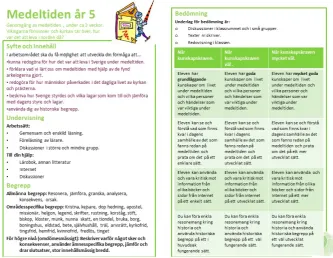
The setting: In the first lesson, the teacher demonstrated a local educational plan, using PowerPoint, on a computer and projector. This plan is part of the teacher’s didactic design and based on re-formulations from the syllabus. It shows that both substantive knowledge and procedural knowledge is important. In terms of substantive knowledge there is a list of concepts, e.g. ‘being a Christian’, ‘baptism’, ‘saint’, ‘crusade’, ‘a suit of armour’. Procedural knowledge concerns source criticism, historical empathy and cause/effect. The teacher also gives examples of how pupils can demonstrate their knowledge of history and asks them to compare the past with the present.
During the subsequent PowerPoint presentation, called A quick presentation of the Middle Ages, substantive knowledge is considered salient through the use of words like: ‘king’, ‘realm’ and ‘Hundred Years War’. As stated in the educational plan, the teaching methods are related to verbal language: reading, listening to a lecture and participating in discussions. The presentation includes both text and images, but the text is orally presented and discussed. The teacher regularly asks the students to explain subject-specific words and words connected to the knowledge requirements. Examples included explaining the implication of ‘the most powerful’, ‘tyrant’, ‘to account for’, ‘pedagogical’, and ‘to have basic or a good knowledge’. Each week, the pupils’ homework was to learn some subject-specific concepts and words. Apart from these examples, the focus was on substantive knowledge, where political and social history is discussed. In terms of political history, the teacher emphasized members of the ruling classes, kings and queens, their jobs, abilities and ways of controlling the realm. Sweden as a realm is placed in relation to England, France, Germany and Russia. The struggle for power between Sweden and Denmark is exemplified through the historical event, the Stockholm Bloodbath. The computer and projector were used as resources to present the local education plan and the PowerPoint presentation. The PowerPoint presentation and educational plan was also printed into hand-outs and distributed. The knowledge representations in this setting concern both procedural and substantive knowledge, but it is substantive knowledge that is being stressed.
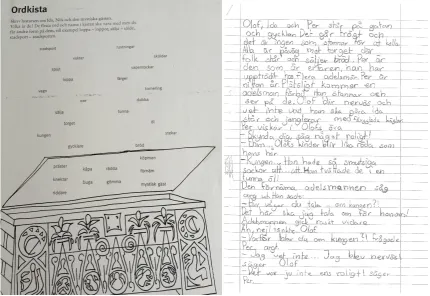
on cultural history and the influence of church, procedural knowledge and cause/effect. Additionally first order concepts and substantive knowledge are emphasised and explained: ‘pious’, ‘preach’, ‘missionary’ and ‘apostle’. Their next assignment, as presented in a handout, was to write a story through using a set of given words. The pupils had to write at least two pages, using pencil and paper. Most of these words were discussed in class, and pupils gave suggestions of what ‘tournament’, ‘to knight somebody’ and ‘noble’ means. The focus was on social and cultural history. In the story-based assignment, pupils had to learn words related to the everyday lives of people in the countryside and in towns during the Middle Ages.
Fig. 2–3. Assignment and essay, the Urban School
Even though the assignment was focused on historical empathy, it is the substantive knowledge that remained in focus. The pupils had to use most of the given words in the story. The teacher gave examples of how to write and held up certain phrases as an example. During their work, they got to see an episode of the film series to get inspiration for writing and as yet another model for how to tell a story. After this assignment, the class read aloud from their textbook - a chapter on the plague - which was focused on social history and substantive knowledge. They also watched a film, which discussed the plague. During the primary transformation unit, knowledge representations mostly concerned substantive knowledge.
shows them the display and takes the class on a guided tour of the Old Town. The emphasis here is on social and cultural history.
The Countryside School
The setting: During the first lesson, the teacher started by asking the pupils to write down what they already knew and what they wanted to learn during this unit. Social history and topics like clothing, hygiene and punishments appeared to be important to the pupils. As the pupils finished writing, using pen and paper, they jointly make a mind map on the Smart board. In terms of content, first order concepts like ‘gallows’, ‘plague’, ‘castle’ and ‘knights’ were suggested by the pupils. Then, the teacher displayed a document on the Smart board. It was a re-formulation from the syllabus focusing on core content and learning goals, which covered political, social and cultural history. The content includedCultural interchange between Europe and other parts of the world through e.g. trade and migration; The evolution of the Nordic countries (How Sweden came to be); The introduction of Christianity in the Nordic area; The importance of religion for cultures and states in Sweden and other Nordic countries; How religion and other changes affected peoples’ living conditions. Goals: To have basic knowledge of social changes (cultural meetings, migration, religion etc.); To know the consequences of these changes for peoples’ living conditions and actions (how the changes affected people); To be able to account for the effects of cultural meetings and migration in our own age; To be able to account for how peoples’ living conditions have effected today’s society.
The teacher then introduced the pupils’ main assignment: they were supposed to make their own history book. On the white board, next to the mind map, the teacher displayed a prepared book page as a source of inspiration.
Fig. 4-5. “Life in town”, the teacher’s book page and a mind map made by the teacher and pupils, the Countryside School.
during the Middle Ages’, addressing cultural and social history. In the setting, in the teacher’s design for learning, it is the procedural knowledge that is salient.
During the primary transformation unit, the class read aloud from the textbook, dealing with cultural and political changes during the Middle Ages. The teacher wrote down first and second order concepts and phrases like: ‘Christianity a new religion’, ‘Sweden as a united realm with kings and common laws’ and ‘bondsmen are set free’. These notes were later summarised into a text by the teacher, displayed on the Smart board and later distributed to the pupils as a handout. A film was shown on the Smart board, as an introduction to the period, focusing on changes in terms of a new religion, a united Sweden and common laws. Thus the emphasis was on procedural knowledge and political and cultural history. Next, the pupils began to produce material for their book; they designed in learning. They will use this text with content from their textbook to draw an image which is inspired from the film. They can cut-out sections of the text and glue them onto a white piece of paper and use colour pencils. In the following lesson, the teacher and pupils went through the homework. As pupils answered questions aloud, the teacher wrote down their answers on the whiteboard. The focus was on social history: ‘What were the different occupations on a farm?’, ‘If you were living in the Middle Ages, what would you do during the day’? This activity could have been a way to encourage historical empathy. Next, there was some repetition from the previous lesson as the mind map was displayed on the Smart board. First order concepts such as ‘self-subsistent household’ and ‘pay one’s tithes’ were explained. A new assignment was introduced, where pupils had to read a few pages in the textbook and then work on a worksheet called ‘Life in a Medieval village’. From this worksheet, a new mind map is produced on the Smart board, with suggestions from the pupils about life in a typical village. Social history terms such as ‘most people lived in the country’, ‘the houses were built from logs’ and ‘several people slept in the same bed’ are articulated. The next step was to produce a new page for their book. Pupils started to work, using laptops, colour pencils, and occasionally paper and pencil. Some pupils printed their texts, cut-out sections of text and pasted them onto a new sheet of paper. The teacher assisted them in terms of providing a model from the page, technical support and help getting started.
As homework, pupils were asked to read a text about ‘life in town’. In what followed, the teacher read a literary text about a boy arriving to medieval Stockholm. The teacher asked the pupils to consider what life was like in those days, thus focusing on procedural knowledge. The next assignment was a new worksheet with questions that focused on social and economic history and substantive knowledge in terms of ‘craft’, ‘guild’ and ‘Hansan’. Some pupils worked individually, while others worked in pairs. From the worksheet, the teacher and pupils together produced a new mind map on the Smart board.
Christianity, life in the city, archaeology and history as disciplines, crime and punishment and diseases - thus focusing on social and cultural history.
During the visit the teacher took pictures. Back in school, the pupils were able to choose which pictures to use when making a new page on their visit to the museum. Some used their laptops to write captions, while others used pencil and paper. The images were printed on paper, and the pupils cut them out and pasted them onto new sheets of paper, along with captions. The teacher assisted with technical issues, encouraged pupils to continue writing, and she also used models to show the pupils what such a page might look like. For this project the pupils worked individually. The project ended with a short film that presented the core content of the Middle Ages. Altogether, the first transformation unit focused on both substantive and procedural knowledge.
Fig. 6. “Medieval museum”, Pupil’s book page, the Countryside school
During the secondary transformation unit, the books were ready. They were presented to the pupils during a ceremony, where mead was served and ‘medieval music’ was played. As the class was about to evaluate the unit, the teacher repeated the central content and learning goals concerning cultural interchange between the Nordic area and Europe, the evolution of the Nordic countries, reasons for societal changes, the consequences of these changes and how they have affected today’s society. The pupils were encouraged to discuss how they had been working with these goals. Jointly they concluded that Christianity was a big change for people, that Sweden was united as a realm, that immigration through trade had a large effect on the culture, that laws were legislated and that food, language and clothing changed as a consequence of the cultural influences. During the secondary transformation unit, procedural knowledge appeared to be central.
Knowledge emphases and implications for assessment
with verbal texts, while pupils in the Countryside School composed multimodal texts both individually and through collaborating with others.
Classroom conversations occurred in both environments: in the Urban School through pupils’ understanding of first order concepts, and in the Countryside School on the pupil’s previous knowledge and interests, entailing both first and second order concepts. The contextual framings of the two classrooms were also different: in the more multi-cultural Urban School, in the multilingual classroom, the focus was to scaffold the academic language proficiency in history. In the Countryside School there was a focus on multimodal literacies, and the pupils were offered other and more diverse ways of making meaning.
In both examples, classroom work was not based on school textbooks. The Urban School used a mix of teacher-produced materials and other materials such as written texts and videos. Digital media was used both as a resource for dissemination and as a starting point for conversations of conceptual understanding. Additionally the Countryside School involved a variety of learning resources such as mind maps, role play, photographs and museum exhibitions. Digital media was used as a resource for collective meaning-making, co-authoring activities and as a tool for composing multimodal texts. Thus, the pupils at the Countryside School also acquired digital literacy.
In the Urban School, the teacher framed first order concepts as being central for the subject – an emphasis of history as substantive knowledge. The teacher at the Countryside School highlighted second order skills – procedural knowledge. The framing of the subject and what seemed salient changed during the learning design sequences: In the Urban School, there was a shift from procedural and substantive knowledge towards an emphasis on substantive knowledge. In the Countryside School, we noticed a shift from procedural knowledge to procedural/substantive knowledge and then back to procedural knowledge.
The Urban School had a focus on substantive knowledge in verbal texts, which meant that a rather abstract version of the Middle Ages was produced. In the Countryside School, procedural knowledge was stressed and other potentials for learning were offered through the use of many different modes and resources. In this way the Middle Ages was presented in a more concrete way where the pupils were able to see, taste, feel and design history. Additionally, the exchange between teacher, pupil and content was more intense in the Countryside School. This can be described in terms of modal density (Norris, 2009), if we look at the communicative modes at play in interactions. Modal density may come about through modal complexity, and in this case there was an intricate combination of spoken and written language, moving and still images, layout and object handling.
To conclude this paper, we would like to point at some tentative consequences for assessment. The multimodal character of the classroom – emphasised in the Countryside School – gave access to multimodal resources. The texts produced and used in this class were more diverse than the Urban School in terms of composition and possibilities for interaction. What was seen as significant knowledge (knowledge emphasis) about the Middle Ages differed in many ways between the two schools: a focus on verbal concepts versus a focus on wider multimodal representations. We can only reflect upon what influence the choice of schools was on the results of this study. The focus on verbal texts and conceptual understanding in the Urban School seemed to be connected to an explicit strategy and approach to develop pupils’ language. As we will argue below, this may not always be the only way to teach history.
(Jewitt, 2003; Wyatt-Smith & Cummings, 2003; Wyatt-Smith & Kimber, 2009). For such a change to come about, we need to reflect on the social arrangements of power and the authority of the teacher (Kress, 2009).
In a society which continues to be more culturally and linguistically diverse, it no longer seems valid to think of assessment in terms of single standards and targets (Johnsson & Kress, 2003). Johnsson & Kress (2003) argue that assessments need to be redefined so that the diversity of pupils and their different ways of knowing and making meaning will be recognised as being productive in class. They believe that the assessment of children’s literacy can, and must, be democratic. Researchers in the field of assessment also stress the active role of students in assessments, such as in self-assessment and peer assessment (e.g. Black & William, 2005). For instance, Seixas and Morton (2013) have emphasised students’ active roles in the creation of historical narratives. Teachers can bring forward the importance of establishing historical significance with pupils in much the same way that a historian would do. In classroom discussions about historical change, teachers can ask insightful questions about sources and discuss how different sources have been selected and used to produce certain narratives. The Historical thinking project also (http://historicalthinking.ca) proposes that ‘Historical literacy’ should involve active engagement with a variety of historical texts.
References
Black, P. & Wiliam, D. (2005). “Working inside the black box: Assessment for learning in the classroom”. Phi Delta Kappan, 86 (1), 9–21.
Danielsson, K. & Selander, S. (2014). Multimodala texter i ämnesdidaktiskt arbete. [Multimodal texts in subject didactic work] Stockholm: Natur och kultur.
Ercikan, K. & Seixas, P. (Eds. 2015) New directions in assessing historical thinking. New York & London: Routledge.
Elm Fristorp, A. & Lindstrand, F. (2012). Design för lärande i förskolan. [Designs for learning in preshool] Stockholm: Norstedts.
Insulander, E. (2010). Tinget, Rummet, Besökaren. Om meningsskapande på museum. [Artefacts, spaces, visitors. A study of meaning-making in museums]. Diss., Stockholm: Stockholm University.
Insulander, E, Lindstrand, F. & Selander, S. (2015). REMAKE. Representation, resurser och meningsskapande. Medeltiden som kunskapsområde i olika lärmiljöer. [REMAKE. Representation, resources and meaning making. The Middle Ages as a knowledge domain in various learning environments]. Stockholm: Vetenskapsrådet, Resultatdialog 2015, 205– 215.
Jewitt, C. (2003). Re-thinking assessment: multimodality, literacy and computer-mediated learning. Assessment in education 10(1), 83-102.
Jewitt, C. (2006). Technology, literacy and learning. A multimodal approach. London: Routledge.
Jewitt, C. (2009). The Routledge Handbook of Multimodal Analysis. London: Routledge. Johnson, D. & Kress, G. (2003) Globalisation, Literacy and Society: redesigning pedagogy
and assessment. Assessment in Education: Principles, Policy, Practices, 10(1), 5-14. Kempe, A-L. & West, T. (2010) Design för lärande i musik. [Designs for learning in music]
Kress, G. (2003). Literacy in the new media age. London and New York: Routledge. Kress, G. (2009). Assessment in the perspective of a social semiotic theory of multimodal
teaching and learning. In C. Wyatt-Smith & J. Cumming (Eds.) Educational assessment in the 21st century. Connecting theory and practice. London: Springer Dordrecht.
Kress, G. & Selander, S. (2012). Multimodal design, learning, and cultures of recognition. Internet and Higher Education 15(4), 265–268.
Kress, Gunther & van Leeuwen, Theo (1996/2006). Reading images: The grammar of visual design, London & New York: Routledge.
Kress, G., Jewitt, C., Ogborn, J. & Tsatsarelis, C. (2001). Multimodal teaching and learning. The rhetorics of the science classroom. London & New York: Continuum.
Lee, P. (2006). ‘Understanding History’ in P. Seixas (Ed.). Theorizing Historical Consciousness. Toronto: University of Toronto Press.
Lévesque, S. (2008). Thinking Historically: Educating Students for the Twenty-First Century. Toronto: University of Toronto Press.
Lindstrand, F., Insulander, E. & Selander, S. (in press) Mike the Knight in the Neo-Liberal Era. Journal of Language and Politics, 15(3).
Norris, S. (2009). Modal density and modal configuration. In: Jewitt, C. (Ed.) The Routledge handbook of multimodal analysis. Routledge: New York.
Roberts, D.A. (1982). Developing the concept of “curriculum emphases” in science education. Science Education 66(2), 243-260.
Rostvall, A-L. & Selander, S. (Eds. 2008). Design för lärande. [Designs for learning]. Stockholm: Nordsteds akademiska förlag.
Selander, S. (2008). Designs for learning – a theoretical perspective. Designs for learning 1(1), 10-22.
Selander, S. & Kress, G. (2010). Design för lärande – ett multimodalt perspektiv. [Designs for learning – a multimodal perspective]. Stockholm: Norstedts.
Seixas, P. & Morton, T. (2013). The big six historical thinking concepts. Toronto, ON: Nelson Education.
van Leeuwen, T. (2005). Introducing social semiotics. London & New York: Routledge. Wyatt-Smith, C., & Cumming, J. (2003). Curriculum literacies: Expanding domains of
assessment. Assessment in Education: Principles, policy and practice, 10(1), 47-59. Wyatt-Smith, C.M., & Kimber, K. (2008). Working multimodally: challenges for assessment.
English Teaching: Practice and Critique. 8(3), 70-90.
About the Authors
Eva Insulander holds a PhD in Didactic Science and is a senior lecturer in didaktik at the Department of Education, Stockholm University. Her research interests' centers on designs for learning and multimodal social semiotics, learning and assessment, primarily in the context of history education in different learning environments.
Design in Stockholm. His research interests center on issues regarding learning and designs for learning, multimodal social semiotics and knowledge representations. A recurring theme in his work concerns the social and epistemological consequences of design in different contexts.
Staffan Selander, PhD, has a position as professor in Education at the Department of Computer- and Systems Sciences, Stockholm University. He is also visiting professor at Aalborg University in Copenhagen and at Konstfack University College of Arts, Crafts and Design in Stockholm. His research interest focuses designs for learning, knowledge
representations, technology-enhanced learning, games for learning and simulations, multimodality, as well as text analysis and interpretation theories/hermeneutics.
Endnotes
1 The paper reports findings from the research project, ‘REMAKE: Representations, resources and meaning-making. The