INTRODUCTION
Our research is based on the well-known and respect-ed theory of the benefi cial infl uence of physical activity on health at every stage of development (Dishman & Buckworth, 1996; Dishman, Washburn, & Heath, 2004; Haskell et al., 2007; Hendl & Dobrý, 2008; Nelson et al., 2007). In particular, productive and post-productive age is characterized by the body’s gradual aging and the rising need and signifi cance of physical activity to preserve health, and physical effi ciency to prolong active age (Šimonek, 2000). It is not only the natural aging process which decreases the quality of life. There are also other factors, including urbanization and increased technological development, which signifi cantly reduce the volume and intensity of natural physical activity pos sibly resulting in health disorders (Hendl & Dobrý, 2008; Stejskal, 2005).
Epidemiological studies bring us evidence that only a small portion of inhabitants are physically active in their leisure time. When considering Czech inhabitants, a basic study by Frömel, Bauman et al. (2006) confi rms trends of decreasing vigorous physical activity and in-volvement in organized forms of physical activity with age.
The quality of women’s life is mostly threatened in middle and older adult age (Slattery et al., 2006) when the health risks associated with menopause occur (Klebanoff , Miller, & Fernhall, 1998). In this period, women often make a serious evaluation of their perso-nal qualities and previous way of life (Štěrbová et al., 2008). Regular physical activity may be one of the ways of maintaining or improving one’s physical and psycho-logical condition and thus, coping with the syndromes typical of this period of a woman’s life. Physical acti vity makes it possible to develop social contacts and friendly relationships; thereby it extends social-cultural dimen-sions. Group forms of exercising can, above all, not only bring a feeling of satisfaction, but also encourage the participants to achieve better performance and de velop adherence to a regular physical activity. Spink and Car ron (1992) denote group cohesion as a key factor determining a degree of adherence in most adults and directly infl uencing adherence of women to group forms of exercise.
The World Health Organization (WHO) recommends that exercise have an endurance pattern and ac count for 50–60% of oneʼs total physical activity (in Šimonek, 2000). Endurance exercises aff ect a substantial part of the major muscular groups. A higher intensity of shorter
ADHERENCE TO THE AEROBICS EXERCISE PROGRAM IN WOMEN AGED 40 TO 65
Liběna Kováčová, Pavel Stejskal, Filip Neuls, Milan Elfmark
Faculty of Physical Culture, Palacký University, Olomouc, Czech Republic
Submitted in February, 2010
BACKGROUND: The analysis of exercise adherence belongs among the basic criteria for evaluation of the effi ciency of intervention exercise programs.
OBJECTIVE: The aim of this study was to analyze the adherence of participants to the half year dance and step aerobics program.
METHODS: The experimental group consisted of 47 women aged 40 to 65 years old who exercised three times per week for a period of six months. The participant’s attendance sheets and their answers to two questions from the checklist were used for the evaluation of their adherence to the workouts.
RESULTS: The mean value of the adherence of the whole group to the intervention exercise program was 70.43%. Mean values of the group gradually decreased from 85.39% to 68.35% during the fi rst four months of the intervention exercise program. In the last two months of the intervention, the adherence continued to decrease when the average values of their attendance were slightly under 60%. Compared to other months, these diff erences were statistically and logically signifi cant.
CONCLUSIONS: Reasons for diff erent or possibly decreasing degrees of adherence to long lasting intervention exercise programs are mostly objective, e.g. health (55.17%), family (13.70%) and work (22.41%). Other reasons (8.62%) are based on psychological factors (motivational and personal characteristics), the off erings and attractiveness of the activities, which are closely associated to the current health status and movement experience of the individual. Even the group form of exercise does not guarantee a high rate of the participant’s adherence.
term endurance exercises may compensate for low inten-sity physical activity lasting for several hours (Stejskal, 2004). Both, too high or too low intensities decrease the effi ciency of exercises and do not provide health benefi ts. Therefore, it is necessary to prescribe an optimal physi-cal activity program with respect to age, gender, health, physical fi tness, etc.
Research confi rms that aerobics as a form of en-durance exercise belongs to the most preferred physi-cal activities, especially in women (Nieman, 1992). In con cordance with this fact, Bowyer (1996) or Frömel, Novosad and Svozil (1999) point out that especially the female population gives preference to esthetically oriented physical activities, such as aerobics.
From the biomedical point of view, moderate-inten-sity aerobic exercise programs of 6–12 months induce only a modest reduction in weight or waist circumfer-ence in overweight and obese women. However, isolated aerobic exercise provides some benefi ts to blood pres-sure and lipid levels and may still be an eff ective weight loss therapy in conjunction with diets (Thorogood et al., 2011).
An effi cient solution seems to be adequate interven-tion exercise programs designed to increase the pro-portion of physical activity in an individualʼs lifestyle. The effi ciency of an intervention exercise program is de pendent on many factors – on the exercise content (off ering) of the program, the volume and intensity of the exercise, the participants’ age and health status, their motivation, their feeling of satisfaction, etc.
On the other hand, research also underlines a prob-lem of adherence to physical activity programs and phy-sical activity itself. Almost 50% of individuals, who start their participation in some physical activity program, terminate within 2 to 6 months (Dishman, 1988). Thus, worldwide attempts to support drafts and realization of adequate intervention programs exist with objectives not only to increase the physical activity level in anyoneʼs respective personal lifestyle but also to motivate indivi-duals to undertake long lasting behavioral changes sup porting permanent adherence to regular physical activity.
Factors infl uencing anyoneʼs adherence to physi-cal activity are recognized in a variety of theories, e.g. a theory accenting the setting and defi nition of goals, estimates of progress and planning, increases in resist-ance and stamina (Annesi, 2004). Bandura’s social-cog-nitive theory (Bandura, 2001) emphasizes self effi cacy and the awaited result in fulfi lling set aims. However, in the study of Opdenacker, de Bourdeaudhuij, Vanden Auweele and Boen (2009), the mechanisms proposed by the social-cognitive theory and transtheoretical model could not explain the positive eff ect of the intervention on physical activity. Identifying the working components of an intervention attempt remains a challenging and
necessary step in the development of eff ective lowcost and high reach physical activity intervention.
A motivational factor in the area of lifestyle is a sub-jective self perception which signifi cantly contributes to increasing quality of life indicators (Štěrbová, 2008). Thus, the majority of studies assessing adherence to physical activity analyze adherence from the psychologi-cal point of view and focus on motivational orientation and the motivational climate (Stornes, 2001).
AIMS
The aim of this study was to analyze the adherence of women to an intervention program of aerobics exer-cise. Exercise adherence is one of the basic criteria for the evaluation of a programʼs effi ciency.
METHODS
Subjects
All participants were involved on a voluntary basis and provided a written agreement with conditions of the intervention program. The conditions were presented during the fi rst information meeting of potential par-ticipants and the organization team of the intervention study. The sample consisted of 47 women aged between 40–65 years (M = 47.32; SD = 5.38) with a mean body mass index of 26.48 kg × m–² (SD = 4.18 kg × m–²).
En-trance criteria were: an interest in exercise, a sedentary lifestyle, the appropriate age category, health status al-lowing for participation in the exercise program as much and as often as possible and willingness to undergo psy-chological examination before and after the intervention program. The group was divided into two subgroups ac cording to the type of aerobics, subgroup A (n = 24; dance aerobics) and subgroup B (n = 23, step aerobics).
The intervention exercise program
The intervention exercise program was held from Sep tember 2005 to March 2006, lasted six months and was carried out as group exercise with music under the supervision of an expert instructor.
Dance aerobics was based on walking and step va-riations, knee bends, lunges (low impact aerobics; LIA), running, skipping and hopping (high impact aerobics; HIA) and their combination (low high impact aerobics). This exercise was accompanied by controlled move-ments of the arms.
composi-tion (choreography), which was modifi ed after a month. The choreography followed methodology and learning techniques called learning patterns (Bolton, 1996).
The intervention exercise program was based on three workouts of aerobics per week (subgroup A – Mon-day, WednesMon-day, Friday; subgroup B – TuesMon-day, Thurs-day, Sunday) for 6 months. The total number of training lessons was 81 (100%). Each workout lasted 60 minutes and consisted of an initial part (warming up, pre-stretch-ing), main part (aerobics), bodybuilding and a fi nal part (cooling down, deep stretching, re laxing). When summa-rized, the initial part and the main part lasted 40–45 mi-nutes, whereas the other parts took 15 mi nutes.
The intensity of the exercise was also based on the tempo of the music (beats per minute; BPM), which was different in every part of the unit and accord-ing to the type of aerobics (LIA: 130–145 BPM; HIA: 150–160 BPM; step aerobics: 125–135 BPM). The tempo of the music was slower at the beginning, then it was gradually accelerated (on average, the tempo of the music was 135–142 BPM at the end).
Evaluation of adherence
For the evaluation of the women’s adherence to the training units and the intervention exercise program itself, the participant’s attendance sheets and their an-swers to two questions from the checklist were used. The checklist was developed especially for the research pro ject of the Faculty of Physical Culture at Palacký Uni versity (project no. 6198959221), which includes also this study.
Both questions referred to adherence and factors in-fl uencing its level (question no. 1 “Did you participate in the last exercise?” and question no. 2 “If not, what was the reason?”). The analysis of the factors infl uencing the level of adherence of the women to the aerobics exer-cise program was based on the results of psychological examinations focused on performance motivation and the life satisfaction of women, self monitoring, reaching the chosen aims and the self-perception of physical and mental fi tness referred to as intentional physical ac tivity. These examinations were carried out by a team of psy-chologists at the Faculty of Physical Culture, Palacký University in Olomouc via the questionnaire method (Questionnaire of performance motivation, Question-naire of life satisfaction; Štěrbová et al., 2008).
Statistical methods
Statistica 8.0 software was used for the data analy-sis of the women’s attendance sheets. Basic statistical charac teristics were calculated (mean, standard devia-tion, minimum value, maximum value, percent values, etc.) for each subgroup for each month and day.
To evaluate the whole sample according to the vo-lu me of exercise without differentiating groups into
subgroups according to the aerobics type, the method of cluster analysis was used. This method divided the sample into three new subgroups. Input parameters were in attendance in particular months and the evaluation method was the K – means method.
The comparison of the subgroups A and B according to the type of aerobics in particular months and days was carried out by means of the one way analysis of va-riance for repeated measurement (ANOVA). Fischer’s LSD test was used as a post hoc test. Logical signifi can-ce was expressed by the coeffi cient η2. Answers to
ques-tion no. 2 from the checklist are presented in the form of percent values. The level of statistical signifi cance was set to p < 0.05.
RESULTS
None of the participants from the sample (n = 47) showed 100% adherence during the whole intervention period. To evaluate and compare the intra-sample ad-herence regardless of the type of aerobics, the sample was divided into three subgroups by cluster analysis. The fi rst subgroup consisted of 22 women, who attend-ed the highest number of training units (83.7 ± 7.9%) and had the least decreasing tendency of attendance dur ing the whole intervention exercise program. The third subgroup consisted of 7 women, who attended the lowest number of training units (43.1 ± 14.0%) and had the highest decreasing tendency of exercise attend-ance during the six month period. The second subgroup consisted of 18 women whose values of their volume of exercising were between both accumulation extremes and who had moderate decreases in exercise attendance (Fig. 2).
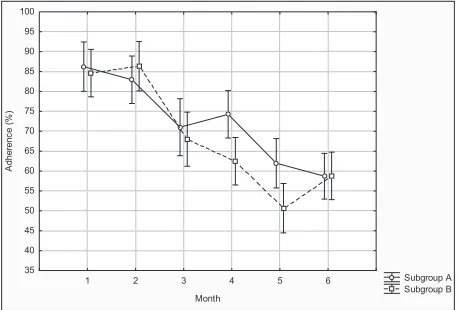
TABLE 1 displays the fact that the average value of the adherence of the whole group to the intervention exercise program was 70.43%. The average values of the group were gradually decreasing from 85.39% to 68.35% during the fi rst four months of the intervention exercise program (October, November, December and January). During the last two months (February, March) the aver-age value of their attendance was slightly under 60% and this value was statistically and logically signifi cant when compared to the other months.
TABLE 1
Percent values of the adherence of women to the intervention exercise program according to subgroups, months and days
Eff ect Factor N M% SD% F p η2
Total 146 70.43 15.94
Subgroup A 73 72.36 14.54
5.71 0.02 0.05
Subgroup B 73 68.49 17.11
Day 1 50 75.92 13.62
12.06 < 0.01 0.18
Day 2 49 70.10 16.46
Day 3 47 64.94 16.04
Month 1 25 85.39 7.49
37.72 < 0.01 0.63
Month 2 25 84.57 7.54
Month 3 19 69.43 18.29
Month 4 26 68.35 11.27
Month 5 24 56.31 13.00
Month 6 27 58.73 8.41
Legend: η2 – logical signifi cance coeffi cient, N – number of training units, M% – mean (percent), SD% – standard deviation (percent), A – dance aerobics (n = 24), B – step aerobics (n = 23)
Fig. 1
The adherence of women in particular months and sub-groups divided according to the type of aerobics (A – dance, n = 24; B – step, n = 23)
Subgroup A Subgroup B
1 2 3 4 5 6
Month 35
40 45 50 55 60 65 70 75 80 85 90 95 100
A
d
h
e
re
n
c
e
(
%
)
Fig. 2
Adherence of women in particular months within the three subgroups (n1= 22, n2 = 18, n3 = 7) divided accord ing to the volume of exercise (see also Stejskal et al., 2007)
group 1 group 2 group 3
1st month 2nd month 3th month 4th month 5th month 6th month
0,0 0,2 0,4 0,6 0,8 1,0
intervention program and peaks negatively in the last month (p < 0.01). The same progress of their attendance can be recognized also in subgroup B where the lowest attendance is in the next to last month (p = 0.01).
The mean value of the attendance during six months was 72.36% in subgroup A and 68.49% in subgroup B (TABLE 1). This diff erence is statistically signifi cant (p = 0.02) but the coeffi cient η2 denotes only a low
ef-fect.
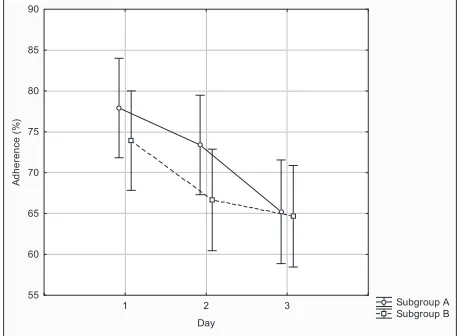
The decreasing tendency of the attendance within the sample is recognizable also on a weekly basis on par ticular exercise days. TABLE 1 displays the fact that the highest attendance was always at the beginning of
the week and decreased towards the weekend. The dif-ference between particular days was statistically and logically signifi cant (p < 0.01, η2 = 0.18). This tendency
can be seen in Fig. 3 which displays and graphically com pares attendance on the days of exercise within the subgroups divided according to the type of aerobics.
Fig. 3
Adherence of women in particular days of exercise in subgroups divided according to the type of aerobics (A – dance, n = 24; B – step, n = 23)
Subgroup A Subgroup B
1 2 3
Day 55
60 65 70 75 80 85 90
A
d
h
e
re
n
ce
(
%
)
DISCUSSION
Song, June, Kim and Jeon (2004) confi rm that the six-month program with dance aerobic activity has a po-sitive motivational eff ect, not only on adherence but also on behavioral changes according to principles of a healthy lifestyle at later adult age. In other study, Cox et al. (2003) observe that 6 months of center based exercise can pro-mote short term adherence and energy expenditure. In the presented study, analyses of the adherence of women to the six month physical activity program of aerobics with music indicate that the adherence of women to regular physical activity is infl uenced by many factors. Štěrbová et al. (2008) claims that women have had positive expe-rience with the intervention exercise program and give a positive evaluation to the infl uence of group exercises.
Spink and Carron (1992) assume that the key fac-tor determining the extent of adherence to exercise is primarily group cohesion (the level and intensity of mutual relationships, integral self perception within the group). A high level of cohesion increases the enjoy-ment of the group members, participation in a common task or performance, self satisfaction, and brings addi-tional psychological benefi ts. According to Irvin et al. (2004), a signifi cant predictor of the exercise adherence in women is a history of participating in any sports or recreational physical activity.
We found out that the frequency of attendance at workouts during the program decreased in some women more than in others. Instructors did not infl uence this spontaneous diff erence between the women’s adherence on purpose, but the given factor signifi cantly infl uenced the results of the whole intervention exercise program (Jakubec et al., 2006; Přidalová et al., 2007; Stejskal et al., 2007).
We suppose that the decreasing tendency to attend over a given period of time may be a signal of the de-creasing level of the women’s motivation to take exer-cise. So the reasons for different adherence may be identifi ed in the motivational orientation of individuals and some specifi c personality features – as, for example, the ability to exert oneself, one’s resolution, diligence, tendency to stick to an activity and accomplish a set goal. The motivational process is also an evaluating pro-cess and motivation corresponds to goals relevant to the individual. From this point of view, individual satis-faction with reaching relevant goals leading to regular exercising played a signifi cant role in the results of the women involved in the program. On the other hand, especially external motivation oriented to body image and mass-media supported ideals can lead to involve-ment in physical activity and exercise programs, but this involvement will probably not be persistent, especially in middle aged women (Annesi, 2004; Biddle & Mutrie, 1991; Ryan et al., 1997). Thus, unrealistic expectations can become demotivating (Roberts, 2001).
Štěrbová et al. (2008) also perceive reasons for quan titative diff erences in psychological factors (as, for example, the degree of the initial motivation, fulfi lling individually determined goals, the ability to organize one’s family duties and leisure time, ambition, endur-ance, self confi dence, etc.) and in objective reasons (as, for example, health, work and family problems, etc.). These opinions correspond to our results based on an analysis of the checklists.
A team of psychologists from the Faculty of Physical Culture at Palacký University carried out detailed analy-ses of the reasons for the women’s diff erent adhe rence to exercises before the beginning of the whole inter-vention exercise program. The women’s motivation to achieve a certain performance level and their life satis-faction were examined.
The function of performance motivation refers to in creased perceived self esteem or experiencing pride in performance. Biddle (1997) and Roberts (2001) con-fi rm that people are motivated to do activities which allow them to have positive feelings of competence and effi cacy.
According to Štěrbová et al. (2008), six dimensions of personality (belief in success, courage, self reliance, internalization, compensational eff ort and endurance) contribute to the sense of life satisfaction in women in middle and advanced adult age who take exercise regu-larly. These personal dimensions related to performance emphasize the signifi cance of individual resources as, for example, time, talent or eff ort, which make achieve-ment of the determined goal possible.
level of life satisfaction is a good precondition for adher-ence to regular physical activity.
Determinants of adherence to physical activity and exercise are as follows: personal (history of participation in exercise programs, knowledge of and belief in health benefi ts of exercising, self motivation, age, education level, health and fi tness, mood), physiological (body weight, cardiovascular diseases, injuries, general health status), situational (social support, suitable opportuni-ty, lack of time, atmosphere, cost, family and personal problems, stereotype), behavior (bad habits, lifestyle, type of behavior) and program (group or individual ex-ercise, exercise intensity, qualities of instructor, physical activity choice). Possibilities to choose an appropriate type of physical activity and a preferred type of exercise can be very important for adherence because it can also strongly depend on enjoyment of the concrete form of exercise (White, Ransdell, Vener, & Flor, 2005).
We found out that the movement content of the in-ter vention program (in this case – aerobics) is the next reason for diff erent adherence. The analysis of exer cise intensity showed that the duration of the participants’ exercise in the recommended HR zone was highly varia-ble. The average duration of exercise in the recommend-ed range of HR was 18.68 ± 6.40 minutes (Kováčová, Stejskal, Neuls, Jakubec, & Elfmark, 2007). With re-spect to the total duration of the training unit, the length of the average duration of exercise in the recom mended HR zone was relatively low. This fact may be explained by the participantsʼ problems with technique, rhythm and coordination, as well as by didactic limits connected with the method of gradual drilling of the choreography used. In addition, the movement content of aerobics should be in harmony with music and not everybody has the corresponding predisposition for this skill. The majority of women in the examined sample did not have any experience with aerobics, thus, it is possible that they did not enjoy this type of exercise.
Another problem with the duration of exercise in the recommended HR zone might be in the group ex-ercising. In the group, the exercise intensity should be adjusted to the participants with a lower degree of fi t-ness, which may not be enough for participants with a higher degree of fi tness.
Although the benefi ts of the group form of exercise are generally well-known, some authors assume that in-dividually tailored exercise intervention can be the most accessible to the sedentary population of women in mid-dle and older adult age (Findorff , Wyman, & Gross, 2009). To facilitate the increased physical activity level in women of middle and older adult age, comprehen-sive, cognitive-behavioral, and gender-tailored physical activity intervention is emphasized (Hanlon, Morris, & Nabbs, 2010; Segar, Jayaratne, Hanlon, & Richardson, 2002).
It remains unanswered which minimum level of ex-ercise adherence can be acceptable so that the inter-vention program could be denoted as being successful although the eff ectiveness of the intervention programs themselves in increasing physical activity had been re-viewed systematically by Kahn et al. (2002). However, it is possible to expect that successful exercise intervention has the potential to change physical activity behavior on a long term basis and to increase the physical activity of participants to a level corresponding with generally respected physical activity recommendations (e.g. to perform moderate physical activity for at least 30 minu-tes fi ve times a week or vigorous physical activity for at least 20 minutes three times a week; U.S. Department of Health and Human Services, 2000).
CONCLUSIONS
Women’s adherence to exercises is one of the basic criteria for the evaluation of the effi ciency of an inter-vention exercise program. Reasons for the diff erent or possibly decreasing adherence to long lasting interven-tion exercise programs are mainly in psychological fac-tors (motivational and personal characteristics) and objective reasons (health, family, work, etc.). The off er and attractiveness of the activities are also important and closely connected with the current health and move-ment experience of the individual. Even the group form of exercising does not guarantee a high rate of the par-ticipant’s adherence.
ACKNOWLEDGEMENT
The study h as been supported by the research grant from the Ministry of Education, Youth and Sports of the Czech Republic (No. MSM 6198959221) “Physical Activity and Inactivity of the Inhabitants of the Czech Republic in the Context of Behavioral Changes”.
REFERENCES
Annesi, J. J. (2004). Relationship of percieved health and appearance improvement, and self motivation, with adherence to exercise in previously sedentary women. European Journal of Sport Science, 4, 1–13. Bandura, A. (2001). Social cognitive theory: An agen-tive perspecagen-tive. Annual Review of Psychology, 52, 1–26.
Biddle, S. J. H. (1997). Cognitive theories of motivation and the physical self. In K. R. Fox (Ed.), The
physi-cal self: From motivation to well-being (pp. 59–82).
Biddle, S. J. H., & Mutrie, N. (1991). The psychology of
physical activity. London: Springer-Verlag.
Bolton, A. (1996). Aerobics instructor course. Sydney: Network for Fitness Professionals.
Bowyer, G. R. (1996). Student perceptions of physical education. Journal of Physical Education, Recreation
and Dance, 67(1), 23–26.
Cox, K. L., Burke, V., Gorely, T. J., Beilin, L. J., & Pud dey, I. B. (2003). Controlled comparison of re-tention and adherence in home vs center initiated exercise interventions in women ages 40–65 years: The S.W.E.A.T. Study (Sedentary Women Exercise Adherence Trial). Preventive Medicine, 36, 17–29. Dishman, R. K. (1988). Exercise adherence: Its impact
on public health. Champaign, IL: Human Kinetics.
Dishman, R. K., & Buckworth, J. (1996). Increasing phy sical activity: A quantitative synthesis. Medicine
and Science in Sports and Exercise, 28, 706–719.
Dishman, R. K., Washburn, R. A., & Heath, G. W. (2004). Physical activity epidemiology. Champaign, IL: Human Kinetics.
Findorff , M. J., Wyman, J. F., & Gross, C. R. (2009). Predictors of long term exercise adherence in a com-munity based sample of older women. Journal of
Wo-menʼs Health, 11, 1769–1776.
Frömel, K., Novosad, J., & Svozil, Z. (1999). Pohybová
aktivita a sportovní zájmy mládeže. Olomouc:
Univer-zita Palackého.
Frömel, K., Bauman, A. et al. (2006). Intenzita a objem pohybové aktivity 15–69leté populace České repub-liky. Česká kinantropologie, 10(1), 13–28.
Hanlon, C., Morris, T., & Nabbs, S. (2010). Establish-ing a successful physical activity program to recruit and retain women. Sport Management Review, 13, 269–282.
Haskell, W. L. et al. (2007).Physical activity and public health.Updated recommendation for adultsfrom the American College of Sports Medicine and the Amer-ican Heart Association. Circulation, 116, 1081–1093. Hendl, J., & Dobrý, L. (2008). Teorie a modely in ter-venčních programů pro zvýšení pohybové aktivnosti.
Česká kinantropologie, 12(3), 26–33.
Irwin, M. L., Tworoger, S. S., Yasui, Y., Rajan, B., McVarish, L., LaCroix, K., Ulrich, C. M., Bowen, D., Schwartz, R. S., Potter, J. D., & McTiernan, A. (2004). Infl uence of demographic, physiological, and psychosocial variables on adherence to a year-long moderate intensity exercise trial in postmeno-pausal women. Preventive Medicine, 39, 1080–1086. Jakubec, A., Stejskal, P., Kováčová, L., Řehová, I.,
Petr, M., & Přidalová, M. (2006). Změny spektrální ana lýzy variabi lity srdeční frekvence a vybra ných funkčních parametrů po šestiměsíčním cvi čení aero-bi ku u 40–60letých žen [Abstract]. In D. Hamar (Ed.), Pohybová aktivita v zdraví a chorobe: 3.
više-grádsky kongres telovýchovného lekárstva (pp. 14–15).
Bratislava: Slovenská spoločnosť telovýchovného le-kárstva.
Jakubec, A., Stejskal, P., Kováčová, L., Elfmark, M., Ře-hová, I., Botek, M., & Petr, M. (2008). Changes in heart rate variability after a six month long aerobic dance or step dance program in women 40–65 years old: The infl uence of diff erent degrees, intensity and initial levels. Acta Universitatis Palackianae
Olomu-censis. Gymnica, 38(2),35–44.
Kahn, E. B., Ramsey, L. T., Brownson, R. C., Heath, G. W., Howze, E. H., Powell, K. E., Stone, E. J., Rajab, M. W., Corso, P., & the Task Force on Community Preventive Services (2002). The eff ectiveness of interventions to increase physical activity: A systematic review.
Ameri-can Journal of Preventive Medicine, 22, 73–107.
Klebanoff, R., Miller, V. T., & Fernhall, B. (1998). Ef fects of exercise and estrogen therapy on lipid pro fi les of postmenopausal women. Medicine and
Scien ce in Sports and Exercise, 30, 1028–1034.
Kováčová, L., Stejskal, P., Neuls, F., Jakubec, A., & Elf-mark, M. (2007). Půlroční program dance a step aerobiku u žen ve věku od 40 do 65 let. In A. Ma-rousek (Ed.), Konference plná barev: Mezinárodní stu-dentská vědecká konference v oboru kinantropologie
(pp. 62–66). Olomouc: Univerzita Palackého. Nelson, M. E. et al. (2007). Physical activity and
pub-lic health in older adults: Recommendation from the American College of Sports Medicine and the American Heart Association. Medicine and Science
in Sports and Exercise, 39, 1435–1445.
Opdenacker, J., de Bourdeaudhuij, I., Vanden Auweele, Y., & Boen, F. (2009). Psychosocial mediators of a life-style physical activity intervention in women.
Psycho-logy of Sport and Exercise, 10, 595–601.
Přidalová, M., Dostálová, I., Kováčová, L., Neuls, F., Ja-nura, M., Elfmark, M., & Švec, J. (2007). The chang-es of selected somatic characteristics by the eff ect of organized physical activity of aerobic character. In
Auksologia a promocja zdrowia (pp. 187–195). Kielce:
Kieleckie Towarzystwo Naukowe.
Roberts, G. C. (2001). Advances in motivation in sport
and exercise. Champaign, IL: Human Kinetics.
Ryan, R. M. et al. (1997). Intrinsic motivation and exer-cise adherence. International Journal of Sport
Psy-chology, 28, 335–354.
Segar, M., Jayaratne, T., Hanlon, J., & Richardson, C. R. (2002). Fitting fi tness into women’s lives: Eff ects of a gender tailored physical activity intervention.
Women’s Health Issues, 12(6), 338–347.
Slattery, M. L., Sweeney, C., Edwards, S., Herrick, J., Murtaugh, M., Baumgartner, K., Guiliano, A., & Byers, T. (2006). Physical activity patterns and obesi-ty in Hispanic and non Hispanic white women.
Song, R., June, K. J., Kim, C. G., & Jeon, M. Y. (2004). Comparison of motivation, health behaviors, and func tional status among elders in residential homes in Korea. Public Health Nursing, 21, 361–371. Spink, K. S., & Carron, A. C. (1992). Group cohesion
and adherence in exercise classes. Journal of Sport
and Exercise Psychology, 14, 78–86.
Stejskal, P. (2004). Proč a jak se zdravě hýbat. Presstem-pus.
Stejskal, P., Jakubec, A., Kováčová, L., Elfmark, M., Ře hová, I., Petr, M., & Cypryan, L. (2007). Vliv roz-dílné adherence k půlročnímu programu aerobiku na aerobní zdatnost. Medicina Sportiva Bohemica et
Slovaca, 16(1), 14–25.
Stornes, T. (2001). Sportspersonship in elite sports: On the eff ects of personal and envirommental fac-tors on the display of sportspersonship among elite male handball players. European Education Review, 7, 281–301.
Šimonek, J. (2000). Pohybová aktivita v živote súčas-ného človeka. In Pohybová aktivita žien (pp. 23–65). Bratislava: Slovenský olympijský výbor.
Štěrbová, D., Hrubá, R., Harvanová, J., Elfmark, M., & Otipková, D. (2008). Faktory adherence k pohybové aktivitě žen ve věku 40–65 let. Československá
psy-chologie, 52(4),378–387.
Thorogood, A., Mottillo, S., Shimony, A., Filion, K. B., Joseph, L., Genest, J., Pilote, L., Poirier, P., Schif-frin, E. L., & Eisenberg, M. J. (2011). Isolated aero-bic exercise and weight loss: A systematic review and meta analysis of randomized controlled trials. The
American Journal of Medicine, 124, 747–755.
White, J. L., Ransdell, L. B., Vener, J., & Flor, J. A. (2005). Factors related to physical activity adher-ence in women: Review and suggestions for future research. Women’s Health, 41, 123–148.
U.S. Department of Health and Human Services (2000).
Healthy People 2010 (Vols. 1 & 2). Washington, DC:
U.S. Government Printing Offi ce.
ADHERENCE KE CVIČEBNÍMU PROGRAMU AEROBIKU U ŽEN VE VĚKU 40 AŽ 65 LET
(Souhrn anglického textu)
VÝCHODISKA: Jedním ze základních kritérií hod nocení efektivity dlouhodobých intervenčních po-hybových programů je analýza adherence účastníků ke cvičení.
CÍLE: Cílem této studie bylo analyzovat adherenci souboru žen k šestiměsíčnímu programu dance aerobiku a step aerobiku.
METODIKA: Skupinu tvořilo 47 žen ve věku od 40 do 65 let (47,32 ± 5,38 let), které cvičily třikrát týdně po dobu 6 měsíců. K analýze adherence byla použita
meto-da záznamového (prezenčního) listu účasti frekventan-tek a odpovědi na dvě otázky z anketního listu.
VÝSLEDKY: Průměrná hodnota adherence celého souboru k pohybovému intervenčnímu programu byla 70,43 %.První čtyři měsíce pohybového intervenčního programu průměrné hodnoty souboru postupně klesa-ly od 85,39 % do 68,35 % a poslední dva měsíce se prů měry docházky stále snižovaly až pod hranici 60 %, přičemž v porovnání s ostatními měsíci byly tyto rozdíly statisticky i věcně významné.
ZÁVĚRY: Příčiny rozdílné, popř. klesající adherence žen k intervenčnímu pohybovému programu jsou hlavně v ob jektivních důvodech jako nemoc (55,17 %), péče o ro dinu (13,70 %) a zaměstnání (22,41 %). Dalšími dů vody (8,62 %) jsou psychologické faktory (motivační a osobnostní charakteristiky), výběr a atraktivita pohy-bové aktivity, která úzce souvisí s aktuálním zdravotním stavem, a pohybová zkušenost jednotlivce, související s intenzitou cvičení. Ani skupinová forma cvičení ne-musí být zárukou vysoké míry adherence k pohybovému programu.
Klíčová slova: životní styl, pohybová aktivita, aerobik, in-tervenční program, motivace.
PaedDr. Liběna Kováčová
Education and previous work experience
1979–1984 – Pedagogical Faculty, Palacký University – Physical Education – Biology, Mgr.
1984–1987 – teacher at elementary school.
1987–1994 – Pedagogical Faculty, J. E. Purkyne Uni-versity – Assistant Professor.
1990 – Pedagogical Faculty, J. E. Purkyne University – PaedDr.
1994–present – Faculty of Physical Culture, Palacký Uni versity – Assistant Professor.
First-line publications
Kováčová, L. (2002). Aerobik. Tělesná výchova a sport
mládeže, 68(1), 10–15.
Kováčová, L., Stejskal, P., Neuls, F., Jakubec, A., & Elf-mark, M. (2007). Půlroční program dance a step aero biku u žen ve věku od 40 do 65 let. In A. Ma-rousek (Ed.), Konference plná barev: Mezinárodní
Palacký University Faculty of Physical Culture tř. Míru 115
studentská vědecká konference v oboru kinantropologie
(pp. 62–66). Olomouc: Univerzita Palackého. Kováčová, L., Stejskal, P., & Elfmark, M. (2010).
Sub-jektivní hodnocení intervenčního pohybového pro-gramu žen středního a pozdního věku. Medicina
Spor tiva Bohemica et Slovaca, 19(4),226–229.
Stejskal, P., Jakubec, A., Kováčová, L., Elfmark, M., Ře-hová, I., Petr, M., & Cipryan, L. (2007). Infl uence of diff erent adherences to the six month aerobic dan ce or step dance on the aerobic fi tness. Medicina
Spor-tiva Bohemica et Slovaca, 16(1), 14–25.
Přidalová, M., Dostálová, I., Kováčová, L., Neuls, F., Janura, M., Elfmark, M. et al. (2007). The changes
of selected somatic characteristics by the eff ect of organized physical activity of aerobic character. In
Auksologia a promocja zdrowia (pp. 187–195). Kielce:
Kieleckie Towarzystwo Naukowe.
Jakubec, A., Stejskal, P., Kováčová, L., Elfmark, M., Kli-mešová, I., Botek, M. et al. (2008). Changes in heart rate variability after a six month long aerobic dance or step dance programme in women 40–65 years old: The influence of different degrees, intensity and initial levels. Acta Universitatis Palackianae