Proceedings of the
Third International Workshop on
Foundations and Techniques for
Open Source Software Certification
(OpenCert 2009)
Automatic Analysis of Applications for Portability Across Linux
Distributions
Vladimir Rubanov
9 pages
Guest Editors: Luis Barbosa, Antonio Cerone, Siraj Shaikh
Managing Editors: Tiziana Margaria, Julia Padberg, Gabriele Taentzer
Automatic Analysis of Applications for Portability Across Linux
Distributions
Vladimir Rubanov1
Institute for System Programming of the Russian Academy of Sciences, Russian Linux Verification Center
http://linuxtesting.org/
Abstract: Problems with portability of applications across various Linux distribu-tions is one of the major sore spots of independent software vendors (ISVs) wishing to support the Linux platform in their products. The source of the problem is that dif-ferent distributions have difdif-ferent sets of system libraries that vary in the interfaces (APIs) provided, with respect to both composition and behavior. And the critical questions arise such as which distributions my application would run on or what can I specifically do to make my application run on a greater number of distribu-tions. This article presents an approach and the Linux Application Checker tool that help to answer such questions by automatically analyzing the target application and confronting collected data with the internal knowledge base containing information about the various real world distributions. Additionally, Linux Application Checker is an official tool approved by the Linux Foundation for certifying applications for compliance with the Linux Standard Base (LSB) standard, the leading effort for the single Linux specification.
Keywords: Linux, Application portability
1
Introduction
There are more than 500 public Linux distributions in the modern world (see for example http://lwn.net/Distributions/). And each of these distributions represents a unique combination of versions/modifications of the base upstream components such as kernel, shared libraries, system commands, etc. In this article, we consider Linux distributions mainly as system platforms en-abling operation of third-party applications. In this perspective, the main components of a Linux distribution are the kernel itself and a set of system libraries that provide application program-ming interfaces (APIs – functions or global data) to the applications.
their applications portable in the binary form (which is critically important for commercial ven-dors). That is why applications that work on one distribution may fail on another and supporting multiple distributions becomes a serious problem for application developers. Of course, it is pos-sible to develop specific versions of an application for particular distributions but this is rather expensive and may not be affordable for some developers so that they might completely reject supporting Linux platform. This inhibits growth of Linux applications and the adoption of the platform itself as developers want to develop applications for Linux not just for RedHat or Suse. Distribution developers try to mitigate these problems by supplying several versions of the same shared library in their distributions so that applications could find and use appropriate versions. Efforts to standardize some common subset of libraries and their interfaces that can be found in most of the modern distributions also help to deal with the portability problems (see Linux Standard Base (LSB) [LSB], [Rub07]).
However, application developers still have to separately analyze each specific distribution that they want to target their application at to check which libraries and interfaces it provides. And then manually extract the common subset in all the target distributions to understand which func-tions can be relied upon by the application. The application then needs to be developed/modified to use only this subset of libraries and interfaces. Automating this process of portability analysis and decision support is a critical step to help developers to create portable applications that can be run out-of-the-box on a wide variety of Linux distributions.
In this article, we present results of the Russian Linux Verification Center [LVC] at the Insti-tute for System Programming of the Russian Academy of Sciences (ISPRAS) [ISP]. Under cooperation with the Linux Foundation [LF] we collected data about main Linux distributions in a central knowledge base and developed a tool (Linux Application Checker) for automatic analysis of application portability across these analyzed distributions. The data in the knowledge base is constantly updated to be in synch with the state of the Linux art.
The article contains two sections. The first one introduces the knowledge base about mod-ern Linux distributions maintained under the auspices of the Linux Foundation – the leading consortium dedicated to fostering growth of Linux. The second section presents the Linux Ap-plication Checker tool designed for automated analysis of cross-distribution portability of Linux applications.
2
Linux Foundation Ecosystem Knowledge Base
To standardize, protect and promote Linux, the leading IT-companies (IBM, Intel, HP, Novell, Oracle and many others) formed an international non-profit consortium The Linux Foundation [LF], which now represents the main power in the World that unites efforts and expertise of various organizations and persons that are interested in ensuring the further growth and success of Linux as a platform. The consortium also provides a neutral forum to discuss various issues and make collaborative decisions.
should provide the same functionality in each of them. Description in the standard should include information about binary level symbols (i.e. names of ELF (Executable Link Format) symbols) of all interfaces and API-level information (parameters, return values and corresponding types) including behavior specification of the interfaces.
LSB is a living standard, which means it is regularly revisited and new versions are released. Usually, each LSB version corresponds to one generation of the main Linux distributions (e.g. LSB 3.0 is for RHEL 4 and SLES 10, while LSB 4.0 is for RHEL 5 and SLES 11). So one of the key success factors for developing and supporting an interface standard like LSB (covering more than 30,000 interfaces!) is a proper technical infrastructure that automates the main processes for maintaining the standard itself and that brings the standard closer to real developers.
The Linux Foundation (formerly Free Standards Group) already developed a basic infrastruc-ture for the first LSB versions in the early 2000s. But with the growth of the standard, it was realized that a next-generation infrastructure is needed that should include many more compo-nents and automate many more processes in the standards development. In 2006, the Linux Foundation jointly with ISPRAS launched a new LSB Infrastructure Program [Inf].
In context of this paper, the important direction of this new program was building a new central
database (MySQL based), which became the backbone of the entire technical LSB infrastructure.
The database contains integrated information about the LSB standard itself, about its surrounding Linux ecosystem and various operational matters like active certifications. The current database contains 97 tables with over 89 million records. There are three parts of the database:
1. The standardization part includes information about LSB elements that constitute the essence of the standard itself.
2. The community part contains information about real-world modern Linux distributions and applications.
3. The certification part keeps information about the certification status of various products, audit operations, fee payments, etc.
The second part of the database (also known as Linux Foundation Ecosystem Knowledge Base) is most interesting for the topic of this paper because it is this part that enabled creation of the Linux Application Checker tool for automated analysis of cross-distribution portability of Linux applications. Basically, the information in this part represents the structure of popular Linux distributions in terms of specific libraries and their interfaces provided by each distribution to applications. As of March 2009 the database includes information about 88 versions of Linux distributions.
The contents of the database are open to the community and can be browsed in a user-friendly way using the LSB Navigator [Nav] web-portal.
3
Linux Application Checker
order to effectively implement this analysis, it was important to create a tool that automates corresponding further steps:
1. Understand external dependencies (external libraries and interfaces needed) of the target application.
2. Compare the applications dependencies with the information about libraries and interfaces
provided by each Linux distribution from the knowledge base.
3. Visualize the results and provide additional hints on how to fix some issues.
The Linux Application Checker tool (or App Checker in short) developed jointly by ISPRAS and Linux Foundation serves this purpose. Additionally, it checks some other compatibility issues (e.g. names of ELF sections in binary files) but the main point remains in the match of the libraries/interfaces required by application with the libraries/interfaces provided by distributions. Linux Application Checker provides visual user interface based on a simple embedded web-server. At the starting page (Application Check), users should select a set of components that constitute the target application package. The leaf components to be analyzed are single binary files in ELF format (executables or .so libraries). Also, App Checker checks Perl, Python and shell scripts for compatibility issues. To facilitate the selection process for complex applications, it is possible to indicate groups of components by selecting aggregate entities:
• whole directories (all executable files and .so libraries as well as Perl, Python and shell
scripts in the directory will be considered as belonging to the application);
• installation packages or tarballs in RPM, DEB, tar.gz, tar.bz2 formats (all files of the
proper types in the packages will be considered as belonging to the application);
• packages already installed in the system.
During analysis, App Checker inspects all the components indicated as belonging to the appli-cation (both directly and through the aggregate entities) and performs a number of checks. All the checks can be divided into two groups:
• cross-distribution compatibility analysis based on the Linux Foundation Knowledge Base
(LF KB);
• certification checks on compliance with the LSB standard.
between the components of the application itself are excluded from the list of external depen-dencies.
If available and appropriate, App Checker provides additional information and recommenda-tions on how to fix detected compatibility issues. These recommendarecommenda-tions are taken from the known issues sections in the Linux Foundation Knowledge Base (for example, advice on replac-ing some deprecated interfaces by more portable modern counterparts or recommendations to include some missing library as a part of the application package).
LSB checks are more specific. Their main purpose is to analyze compliance of the appli-cation with the LSB standard in the context of formal certifiappli-cation. The report generated by these checks serves as the main input on which to base decisions about LSB certification of applications. Analysis of external dependencies of the application is performed as well but the dependencies are confronted with the libraries and interfaces included in the LSB, not in any specific distribution. Basically, it is checked that the application uses only those libraries and interfaces that are standardized by the LSB. Also, App Checker ensures compliance of other as-pects like binary structure of ELF-files and .rpm packages, usage of the specific dynamic loader, etc.
3.1 Using Linux Application Checker Reports to Analyze Applications
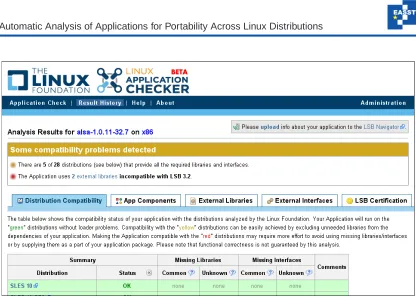
At the end of the analysis, Linux Application Checker provides a report structured into a few subsections shown in separate tabs. The general look of the report is presented at Figure 1. There is a short summary at the top of the report starting with a color coded one-line compat-ibility verdict (green – no compatcompat-ibility issues, yellow – some issues, red – numerous issues) supplemented with a few lines of statistics on the number of found issues of different kinds like the number of incompatible distributions, unused libraries, non-LSB elements, etc. There are 5 tabs/reports below that present detailed information about compatibility issues in different views. The sections below discuss each of these reports in more detail.
3.1.1 Distribution Compatibility Report
Figure 1: Linux Application Checker Report Header
approved libraries as it would consume too much space if we stored information about all li-braries present in each distribution. Meanwhile, the list of approved lili-braries covers those that are most widely-used by applications and currently includes 1177 names. This list was formed by analyzing more than a thousand popular applications and creating a union of all the libraries required by these applications. And we continue adding to the list as we come across new li-braries needed by new applications.
So, the first report allows easy understanding of which particular distributions contain all the necessary libraries and interfaces for the application while allowing the user to choose to see the list of missing entries for incompatible distributions (the list is shown in separate window when clicking on a proper links inside the table).
Another interesting aspect that App Checker can also detect is so called unused libraries. Such libraries are included in the external dependencies of some applications components but no actual interfaces are then used from these libraries. Usually, unused libraries can be easily eliminated by just correcting build options of the application, which improves portability of the application.
3.1.2 Application Components Report
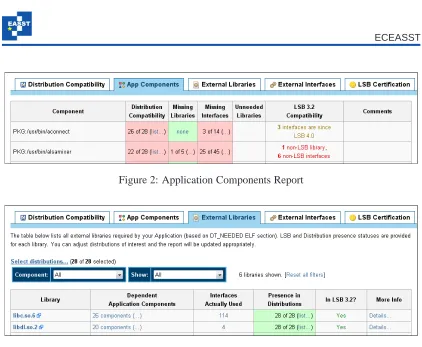
num-Figure 2: Application Components Report
Figure 3: External Libraries Report
ber of unused libraries is shown for each component (if any) and a special column summarizes LSB-compliance status of the components. Any cell in the table can be clicked to see the list of specific entries behind the summary numbers shown.
3.1.3 Reports on External Libraries and Interfaces
The third and the fourth tabs (see Figure3) present information about the applications external libraries and external interfaces respectively (the union for all app components excluding internal dependencies).
For each library, the following information is shown:
• the list of app components that require this library;
• the actual number of interfaces that are used by the app from this library (unused libraries
have red 0 in this column);
• the number of distributions that provide this library;
• LSB status of the library.
• interfaces version (like GLIBC 2.3);
• name of the library that provides this interface.
At both tabs, there are a number of filters that allow the view to be limited to only interesting records. For example it is possible to define specific distributions that are of interest for analysis (e.g. by excluding old distributions) – the compatibility column will be recalculated accordingly including the color coding. Also, it is possible to limit the view to only those entries that are relevant to a specific app component or library (in case of interfaces). A special filter allows the view to be focused on entries concerning particular problem types (entries with compatibility problems, unused libraries, non-LSB entries, deprecated entries, etc.).
3.1.4 LSB Certification Report
The fifth (the last) tab is devoted to the official certification report on compliance of the target application with the LSB standard (a specific LSB version is selected at the initial screen when specifying the application to check). The list of issues found is displayed in subsections that can be grouped either by application component or by issue type. If there are no critical issues then it is easily possible to apply for the formal certification right away by clicking a link in the report, which will smoothly bring the user to the online certification system at the Linux Foundation server and will ensure all the data necessary for initiating the certification process is transparently transferred to the server (first of all the technical certification report). As soon as the certification process is complete the application is automatically included into the official LSB-certified Product Registry.
3.2 Sharing Data about Applications with the Community
As a part of its Linux Ecosystem Knowledge Base, the Linux Foundation maintains information about real world applications. Thats why all ISVs (Independent Software Vendors) are invited to provide information about their applications to the Linux Foundation, which then can be shared with the community through the LSB Navigator web-portal [Nav].
Apart of the general information (name, home page, application type, etc.), this information basically includes the list of external dependencies of the application. The information about applications is useful to the Linux Foundation and the community for understanding which li-braries and interfaces are most popular among ISVs. This in particular helps to make decisions on which libraries and interfaces to include/exclude to/from the LSB standard.
4
Conclusion
Differences between Linux distributions regarding the services, libraries and the library inter-faces provided to applications create serious difficulties for ISVs, who have to create different builds of their applications for different Linux distributions. Fortunately, initiatives like Linux standardization and efforts of distribution vendors to support legacy applications help to form a common basis that can be found in most of distributions. Applications that use only this basis become portable across various distributions. The core of this basis is the LSB standard while there are actually many different surrounding bases dependent on the target segment of distribu-tions. That is why it is very important for ISVs to have automated tools that can help them to understand this basis in the case of their specific segment of target distributions in the context of their particular application.
The leading IT-companies are committing significant resources (partly through the Linux Foundation) to making it possible to easily build portable applications for Linux. The Linux Foundation Ecosystem Knowledge Base and the Linux Application Checker tool presented in this paper that help ISVs analyze (and consequently fix appropriately) their applications for cross-distribution portability are the flagship achievements in this field at the moment. Addi-tionally, Linux Application Checker is an official tool for certifying applications for compliance with the various versions of the LSB standard. The latest version of this open source tool can be downloaded from the pages of the LSB Infrastructure Program [Inf].
Bibliography
[Inf] LSB Infrastructure Program. http://ispras.linuxfoundation.org/
[ISP] Institute for System Programming of the Russian Academy of Sciences. http://ispras.ru/
[LF] Linux Foundation.
http://linuxfoundation.org/
[LSB] Linux Standard Base Homepage. http://www.linuxfoundation.org/en/LSB/
[LVC] Russian Linux Verification Center. http://linuxtesting.org/
[Nav] LSB Navigator Portal.
http://linuxfoundation.org/navigator/