GEOCHEMICAL PROPERTIES AND ENVIRONMENTAL
IMPACTS OF THE MAZINO COAL DEPOSIT, CENTRAL IRAN
Mohammad Yazdi
[a]and Hadi Golzar
[a]Keywords: Coal composition, Tabas coalfield, Central Iran
Tabas coalfield is one of the most important coalfields in Central Iran. The area is located in the central desert of Iran, very far from any inhabited areas. Mazino is the largest thermal coal deposit in Tabas coalfield. Coal-bearing strata in Tabas coalfield (as well as in Mazino deposit) are within the Middle Jurassic formations. This sedimentation has been developed in alluvial plain and coastal environment in Tabas coalfield. The coal-bearing sediments mainly consist of sandstone, shale, siltstone, and carbonatic rocks. Several coal seams with different thickness are interbedded with these sediments. Petrographic observations have shown that coals of the Mazino deposit are mainly anthracite to semi-anthracite and dominated by macerals of the vitrinite group; amounts of inertinite macerals are relatively very low. The dominant mineral phases of these coals are pyrite, siderite, calcite, gypsum, illite, and clays. The Mazino coals have high ash (average of 27.78%), low volatile matter (average of 5.2%), and high sulphur (average of 2.62%) content, and high calorific value with average of 22.94 MJ/Kg. The chemical composition shows that the Mazino coals range from semi-anthracite to anthracite (thermal coal), which are suitable as power-plant fuels with low chemical hazards to environment in the area.
* Corresponding Authors Fax: +98212990643 E-Mail: [email protected]
[a] Faculty of Earth Science, Shahid Beheshti University P.O. Box.19396-4716, Evin, Tehran, Iran
Introduction
The coal is going to have new role in the economy of Iran. The coals in Iran are generally used for metallurgical purposes, however, due to increasing oil price, Iran is going to use thermal coal deposits as new energy sources. Since 10 years, the first Iranian coal power plant is going to be established in central Iran, at Tabas coalfield. It is one of the five coal power plant projects that will be established in central and northern coal basins of Iran.
Tabas coal resources are estimated to be about 2 Gt, most of them occur in two main areas, in Parvadeh and Mazino. Our study area is located in the Mazino area which is a steaming coal deposit. The Mazino deposit with 650 Mt estimated reserve is the largest steaming coal deposit not only in Tabas coalfield but also in all parts of Iran. Geological studies on Mazino coal deposits started in the 1995 by Iran Steel Company. During the last decades, several investigations involving geology, drilling, and even palynology were performed in order to study the relationship between coal-forming environments and coal properties in the Tabas coalfield. No systematic petrological and geochemical investigations were performed during the following decades, and published data about Mazino coal deposit is limited. The aims of the present paper are to explain coal geochemistry and coal quality in the Mazino deposit. During different exploration activities 123 boreholes have been made in different depths up to 600 m. During these explorations by Tabas Steel Co. and Russian TPE Co., about 1000 samples from different trenches and boreholes have been analyzed for ash, sulphur, moisture, volatile matter, and heating value. 30 representative coal samples from different trenches and boreholes have been chosen for this study.
This research is mainly based on the interpretation of seam geology, petrography, and ash yields. Finally, we use a combination of petrography and geology to yield additional information on the coal-forming environments and reconstruct the depositional environment of Iran coal-bearing formations. The ash and sulphur contents of coals are very important factors for using coals in power plants. These factors depend on the environment of deposition and subsequent geological history. Therefore, geological history and reconstruction of the depositional environment of these coals would give useful information.
Geological setting
Geological studies have been limited so far in the Tabas
coalfield, central Iran. Comprehensive literature reviews1-4
of the geological character of Iranian coals are available. In the early geological work, the emphasis was on the determination of the minability of the coals in the Tabas coalfield.
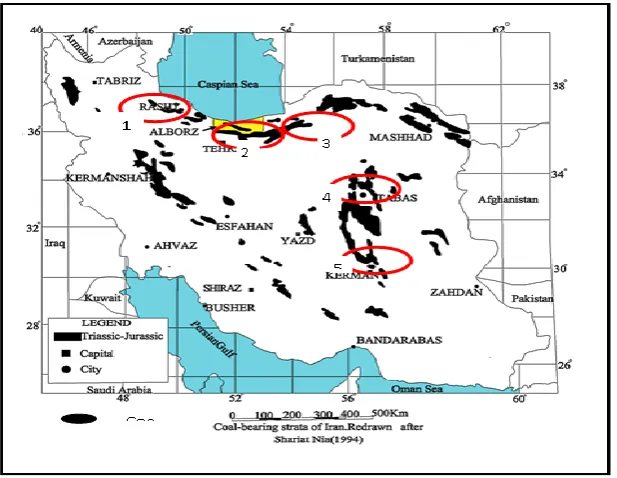
The Mazino deposit is located in the western part of the
Tabas coalfield (Fig.1).5 The Tabas coalfield includes
Mazino and Parvadeh deposits but there are also coal seams in Kemar Mehdi, Kalishour, and Kouchek Ali areas, close to Mazino deposits. These coal seams are also steaming coals. All of these coals are formed within the Middle Jurassic formations. The coal-bearing sediments in the Mazino area are called Mazino (Hojadk) Formation (central Middle Jurassic).
Fig. 1. The Mazino coal deposit in the Tabas coalfield, in central Iran (1-Lushan coalfield in Western Alborz zone; 2-Zirab coalfield in Central Alborz zone; 3-Shahroud coalfield in Eastern Alborz zone; 4- Tabas coalfield in Central Iran zone; 5- Kerman coalfield in Central Iran zone)
The Mazino Formation is underlined by the upper Middle Jurassic oolitic limestones (Badamu Formation). It is composed of sandy to oolitic limestones and organic detrital matters that overlain the sandstones. The thickness of Badamu Formation is about 60 m in the Mazino area. The Mazino Formation is also overlained by the lower Middle Jurassic sandy oolitic limestones (Tabas
or Parvadeh Formation). Parvadeh Formation is dark
oolitic and crystalline limestone. The thickness of
Parvadeh Formation is about 40 m in the Mazino area.
The above explanation shows that shallow marine environment was developed in the Tabas basin, whereas the continental alluvial plain was developed in the
northern part of Iran in the Alborz basin.6 The main coal
deposits were developed in both the alluvial and littoral plains. During the end of the Upper Middle Jurassic, the marine transgression dominated, and shallow marine and littoral plain environments covered the Tabas basin. The Central Middle Jurassic coal-bearing deposits in the Tabas basin and also in Mazino area have been formed in the shallow marine and littoral plain environments.
All of the coal seams in the Mazino Formation are formed within the complicated monoclines and synclinal folds. The geology of the area is within a syncline which has been deepen to east, and has been cut by several faults. The general dip of strata and coal seams vary from
6 to 25 E. Coal seams of the Mazino deposit are
characterized by a complicated and variable structure due to the presence of intraseam dirt bands and due to the variation of their thickness within a broad range. Therefore, the reserve calculation is very complicated.
The method of geological block was used by Russian
geologists to estimate coal reserve8-9.
Coal reserves for categories of C1 and C2 were calculated
separately for oxidized and non-oxidized coals. The reserve of useful coals (anthracite) was calculated on the basis of isolines of thickness of mine able coal seams and dirty coal bands. Coal reserves mainly belong to the
seams with irregular thickness, such as, M1, M2, M6, M9,
M10, M14 (78.5%) and coal seams with relatively regular
thickness such as M4, M5 and M8.
The mineable coal reserve in the Mazino area was calculated by Iranian geologists as follows; in category of
C1 pure coal seams were estimated to be about 146 Mt for
30% ash contents and estimation for dirty coal seams was 211 Mt for 50% ash contents. The estimation in category
of C2, for pure coal seams was 316 Mt and for dirty coal
seams was 417 Mt.7 The detailed mineable coal reserve
was also calculated by Russian geologists. According to
their reserve estimation, in category of C1 pure coal
seams were estimated to be about 147 Mt for 28% ash contents and estimation for dirty coal seams was 250 Mt for 48% ash contents.
Analytical methods
layers of M1-M9 and in depth of below 20 m (below coal
oxidation zone). All samples were analyzed for ash,
volatile matters, moisture, heating value, and sulphur at the department of chemical laboratory of Energy Ministry of Iran, Foolad Tabas and Rostov regional laboratory center in Yuzhgeologiya of Russia. The ash, volatile matters, moisture, and sulphur values are reported as wt/wt in this study.
The coal samples were initially crushed to smaller than
850 m and then homogenized. The crushed samples
were stored in sealed containers under an inert atmosphere to avoid oxidation. Then, 100 g from each sample was heated to 850 °C for three hours and the ash
percentage was determined by analytical balance
(conventional method). Other factors also were
determined according to Russian GOST (Russian: ГОСТ)
standard. The results of the analyses are given in Tables 1 and 2.
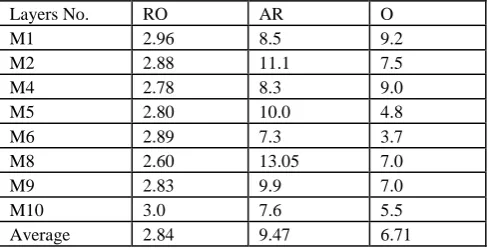
Petrographic details have been studied at Skochinsky Institute of Mining in Russia. Also, average value of reflection of vitrine and sum of depleted components were analyzed in this institute by Russians. The results of the analyses are given in Table 3. 5 samples were analysed by XRD (Phillips 1400) in Iranian laboratory and 10 samples were analysed in Russia at Rostov laboratory by XRD (DRON-6).
Table 1. Average values of ash, total sulphur, moisture, volatile matter (in wt/wt), and heating value of different samples from Mazino coal deposit
Ash (Ad%)
Sulphur (St%)
Moisture (Wa%)
Volatile matter (Vd%)
Heating Value MJ/kg
C (%)
H (%)
O+N (%)
(n=359) (n=183) (n=359) (n=199) (n=480) (n=183) (n=183) (n=183) 27.78 2.62 0.68 5.2 22.94 89.87 3.40 6.73
Table 2. Average values of ash and total sulphur (as % wt/wt) in representative samples (n=19) from coal seams and rock inter layers of Mazino coal deposit
Layer No. Thickness Layer
Thickness coal seam
Ash% Layer Ash% coal seam
St% Layer St% coal seam
M1 4.32 2.58 48.73 25.10 2.98 3.41
M2 7.08 3.47 57.17 27.87 1.82 2.26
M4 1.70 1.35 36.95 26.08 2.83 3.17
M5 1.74 1.29 40.67 28.43 1.80 1.96
M6 2.67 1.25 54.39 36.47 2.42 2.73
M8 1.04 0.70 42.53 34.40 2.27 2.50
M9 2.18 1.25 47.35 29.66 1.37 1.52
Average 2.96 1.69 50.56 28.68 2.13 2.56
Table 3. Average value (n=19) for reflection of vitrain in oil (RO), anisotropy reflection (AR), and sum of depleted components (O) from coal seams of Mazino coal deposit
Layers No. RO AR O
M1 2.96 8.5 9.2
M2 2.88 11.1 7.5
M4 2.78 8.3 9.0
M5 2.80 10.0 4.8
M6 2.89 7.3 3.7
M8 2.60 13.05 7.0
M9 2.83 9.9 7.0
M10 3.0 7.6 5.5
Average 2.84 9.47 6.71
Results and discussions
The ash, sulphur contents, heating values, major chemical compounds, major mineral compounds, volatile
matters, and moisture of coals are very important factors
for using coals in power plants.
These factors mainly depend on the environment of deposition and subsequent geological history. Therefore, the factors are explained as follows:
Ash contents
The result of the analyses of 500 samples shows that all of coal seams in the Mazino deposit have relatively high ash content except coals in M1 and M2. Average of ash contents in rock inter layers is 50.56% and in coal seams 27.78%. We have to take into account that high ash content in coal seams occurs due to rock particle contamination.
Volatile matters and moisture
The result of analyses shows that the moisture content ranges from 0.1% to 2.3% with average of 0.68%.
Major chemical compounds
183 samples were analyzed in Iranian laboratory and 19 samples were analyzed in Russia at Rostov laboratory. The result of analyses shows that sulphur content varies from 1.52 to 3.41, while layers of M1, M4, and M6 have relatively high sulphur. Average of sulphur contents in layers is 2.13% and in coal seams is 2.56%. The sulphur contents in the studied samples can be divided into two groups: a) in the samples with less than 1.5% sulphur, sulphatic sulphur is 0.05% and in the other part, sulphur is approximately equally distributed between pyrite and organic sulphur. b) In the samples with more than 1.5% of sulphur, total sulphur is 2.96%. In these samples the average of sulphatic sulphur is 0.12%, organic sulphur is
0.92%, and pyritic sulphur is 1.92%.8 Thesesamples were
also analysed for C, H, and O+N in Iranian laboratory. The results show average values of C=89.87%, H=3.40% and O+N=6.73% (Table 1).
Heating values
480 samples were analyzed for heating value in Iranian laboratory and in Russia at Rostov laboratory. The result of analyses shows that heating value content varies from 15.21 to 39.32 MJ/kg with average of 22. 94 MJ/kg.
Reflection ability of vitrain
The reflection ability of vitrain was analyzed in Russia at laboratory of Skochinsky institute of mining. Reflection of vitrain in oil (RO) changes within the limits of 2.60 to 3.0 % in different coal layers with average of 2.84 %. Anisotropy of reflection ability of vitrain in air (AR) varies from 7.3 to 13.05 with average of 9.47. The sum of depleted components (O) varies from 3.7 to 9.2 with average of 6.71. Reflection of vitrain in oil is characterized by the low values not exceeding 3.0 % and sum of depleted components not exceeding 9.2 %. The vitrinite reflectance in these coals exceeds 9.9 %. The
vitrinite reflectance’s (Rmax) is ranging from 1.71 % to
2.45 %, spanning the low volatile semi anthracite to anthracite rank.
According to petrographic studies the coals are
anthracite to lean-anthracite.9 The reflection ability of
vitrain and sum of depleted components on the maceral structures of these coals also confirm that these coals are anthracite type. In these coals, the dominant maceral phases are vitrinite group and the amounts of inertinite and exinite macerals are relatively very low.
Major mineral compounds
The XRD analysis and petrographic studies showed that dominant mineral phases of these coals are quartz, pyrite, marcasite, siderite, ankerite, calcite, gypsum, halite, barite, illite, sericite, and clays. The clays are argillite, kaolinite, and montmorilinite. Semi quantitative
XRD analysis shows that the major minerals are as 70-80% of free silica (mainly quartz and argillite). Under microscope argillites and quartz are the main mineral phases in coals. The argillites have mainly pelitic texture,
and quartz has mainly angular textures10-11.
These coals have the carbonate syngenetic sequence, but a complete sulfide syngenetic precipitation sequence is characterized by radial marcasite precipitation phases and euhedral and massive pyrite. This high-sulfide mineralization stage is probably due to the marine influence affecting the Tabas basin as well as the Mazino area.
Conclusions
The Mazino coals from Tabas basin in central Iran were investigated for their geological, geochemical, and coal properties. The studies show that the Central Middle Jurassic coal-bearing deposits in the Tabas basin and as well as in Mazino area have been formed in the shallow marine and littoral plain environments. The dominant maceral phases of these coals are vitrinite (97-100%) and inertinite (1-3%). The dominant mineral phases are kaolinite, quartz, illite, siderite, and argillite. Traces of calcite, pyrite, and marcasite are also evident. The Mazino coals have reflectances consistent with low volatile matters through anthracite to semi-anthracite rank. These coals have maximum vitrinite reflectance of 9.9%.
The vitrinite reflectances (Rmax) are ranging from 1.71%
to 2.45%. Both C and H contents of these coals indicate semi-anthracite to anthracite rank. Data from these studies show that the Mazino coals have high-ash (27.78%), high sulfur (2.6%), low volatile matter (5.2%), low moisture contents (0.68%), and intermediate calorific value (23 MJ/kg).
All of these data show that the Mazino coals range from
semi-anthracite to anthracite (thermal coal
),
which aresuitable as power-plant fuels with low chemical hazards to environment in the area. In addition, the area is located in central desert of Iran very far from any inhabited area.
Acknowledgments
The author would like to express his gratitude to Mr. Rabbani vice dean of Managing director of Iran Power Development Co. (IPDC) and Mr. Zirak Zadeh head of Tabas project, those give me opportunities to work as consultant of this project and his colleague for their supports, to Russian company of TPE and Foolad Tabas geologists for their generous helps during the sampling, geochemical and petrological studying of samples.
References
1 Yazdi M., Coal - from origin to environmental impacts,
Polytechniques Jahad Daneshgahi Publishing Co., 2003, 263 p. (in Persian).
2 Zadeh Kabir A., A national project to study coals for
3 Shariat Nia H., Geological characteristics of the Parvadeh
region of the Tabas coal-bearing basin, Central, Iran, Report, 1993. 22 p.
4 Razavi Armagani M. B. and Moinosadat S.H., Coal of Iran,
Geological Survey of Iran, 1994, 286 p. (in Persian).
5 Yazdi M., 32nd international Geological Congress, Florence,
Italy, 2004, Part. 2, pp. 881.
6 Yazdi M., Int. Earth Sci. Coll. Aegean Regions, Turkey,
IESCA-2005, 2005, p. 173.
7 Foolad Tabas, Steaming coal exploration project in Mazino,
Tabas, Preliminary report, 2001, 17, 220p.
8 Provisional results of chemical and coal-petrographic analyses
of coal from Mazino deposit, Iran TPE Report, Power Development Company (IPDC), 2003, 24 p.
9 Review of the data of preliminary exploration of Mazino-1,
TPE report, Iran Power Development Company (IPDC),
2002, 242 p.
10 Golzar H., Geochemistry and mineralogy of coals in the
Mazino deposit of Tabas, MSc thesis, Faculty of Earth Science, Shahid Beheshti University, unpublished, 2007, pp. 121.
11Golzar H., M. Yazdi and A. Khakzad, Maceral and mineral in
coals of Mazino deposit, proceeding of 14th meeting of
crystallography and mineralogy in Iran, 2007, p.297-302.