NOVEL FUSED AND SPIRO HETEROCYCLIC COMPOUNDS
DERIVED FROM
4-(4-AMINO-5-MERCAPTO-4H-1,2,4-TRIAZOL-3-YL)PHTHALAZIN-1(2H)-ONE
M. R. Mahmoud,
[a]W. S. I. Abou-Elmagd,
[a]M. M. El-Shahawi
[a]and M. H.
Hekal
[a]*Keywords: triazolothiadiazole; triazolothiadiazine; spiro thiadiazole derivatives; phthalazin-1(2H)-ones; 4-amino-5-mercapto-1,2,4-triazoles.
Some new fused heterocyclic systems such as 1,2,4-triazolo[3,4-b]1,3,4-thiadiazoles and 1,3,4-thiadiazines were synthesized through the reaction of the starting material 4-(4-amino-5-mercapto-4H-1,2,4-triazol-3-yl)phthalazin-1(2H)-one with triethyl orthoformate, furoyl chloride, thiophene-2-aldehyde, phenylisothiocyanate, chloroacetonitrile, and p-nitro-2-bromoacetophenone. Also spiro systems were achieved from reaction of the starting compound with isatine, and fluorenone. The newly synthesized thiadiazoles and 1,3,4-thiadiazines were obtained in good yields and their structures were elucidated by spectral data and elemental analysis.
* Corresponding Authors
E-Mail: [email protected]
[a] Chemistry Department, Faculty of Science, Ain Shams University, Abbassia, Cairo, Egypt, post code 11566
Introduction
A survey of the literature revealed that compounds bearing 1,2,4-triazole ring are well known as antimicrobial, anticonvulsant, antidepressant, antihypertensive, antitumarial and analgesic agents.1-3 Moreover, some
1,2,4-triazolo[3,4-b]1,3,4-thiadiazoles and triazolo-1,3,4-thiadiazines derived from 4-amino-3-mercapto-1,2,4-triazoles are associated with diverse pharmacological activities.4-6 On the other hand, phthalazines and
phthalazinones are N-heterocycles with a wide range of biological activities.7-13
Continuing our efforts directed toward the synthesis of new heterocyclic compounds with anticipated biological activities.14-20 Much attention has been directed in our
laboratory for synthesis of heterocycles containing the phthalazine and triazolothiadiazole or triazolothiadiazine rings.
Results and discussions
We previously reported19 that hydrazinolysis of the
lactone 1 with hydrazine hydrate afforded the hydrazide 2 (unexpected product) which when treated with carbon disulphide in ethanol containing potassium hydroxide gave the corresponding potassium dithiocarbazate 3, finally treatment of compound 3 with hydrazine hydrate in refluxing water afforded 4-(4-amino-5-mercapto-4H -1,2,4-triazol-3-yl)phthalazin-1(2H)-one 4. (Scheme 1)
Scheme 1
The structure of 4 was deduced from the spectroscopic and analytical data. Thus, IR spectrum of compound 4 displayed νNH2, NH at 3245, 3162, 3108 cm-1, νC=O at 1665
cm-1. Moreover 1H-NMR spectrum of compound 4 exhibited
signals at δ (ppm) 14.2 (s, 1H, SH, exchangeable with D2O),
13.27 (s, 1H, NH, exchangeable with D2O), 8.33 (d, 1Harom.,
J = 1.5 Hz), 7.95 (dd, 2Harom., J = 10.8 Hz), 7.82 (d, 1Harom.,
J = 3.6 Hz) and 5.74 (brs, 2H, NH2, exchangeable with D2O).
Furthermore, the mass spectrum show the correct molecular ion peak at m/z = 260 (100 %) which represent the base peak.
A plausible mechanism for the formation of compound 4 is shown in Scheme 2.
Scheme 2 N H O
COOMe O
O
(1)
(2)
N2H4.H2O
Dioxane/ N
H N O
O N H
NH2 CS2/ KOH
(3)
N H N O
O N H H N S
S K EtOH
N2H4.H2O Water/
N H N O
N NH N
S
NH2
(4)
N H N O
N N N
SH
NH2
NH2-NH2
N H N O
O H N
HN S
NH-NH2
N H N O
N NH N
S
NH2
HO H
N H N O
N NH N
S
NH2
N H N O
N N N
SH
NH2
(4)
1,5-exo-trig cyclization
-H2O
(3)
N H N O
O
N H H N S
S K
N H N O
O
N H N
C S H2O
The functionalities in 4-amino-5-mercapto-3-substituted-1,2,4-triazoles made them valuable key precursors for the formation of fused heterocyclic compounds containing 1,2,4-triazolo[3,4-b] 1,3,4-thiadiazoles and 1,3,4-thiadiazines.20, 21 Treatment of 4 with thiophene-2-aldehyde
in refluxing DMF yielded 4-[6-(thiophen-2-yl)-5,6-di-hydro[1,2,4]triazolo[3,4-b]1,3,4-thiadiazol-3-yl] phthalazin-1(2H)-one 5. (Scheme 3)
Scheme 3
Treatment of compound 4 with cyclic ketone and isatin was found to give spiro thiadiazole derivatives. Thus, the reaction of 4-amino-5-mercapto-3-substituted-1,2,4-triazole 4 with fluorenone and/or isatin in refluxing DMF in the presence of the catalytic amount of p-toluene sulphonic acid [PTSA] resulted in the formation of 4-(5H -spiro-1,2,4-triazolo[3,4-b]1,3,4-thiadizole-6,9′-fluorene-3-yl] phthal-azin-1(2H)-one 6 and 3-(4-oxo-3,4-dihydro-phthalazin-1-yl)-5H -spiro-1,2,4-triazolo[3,4-b]1,3,4-thiadizole-6,3′-indo-lin-2′-one 7, respectively. (Scheme 3)
The conversion of 4 to compounds 5, 6 and 7 could be explained on the basis of nucleophilic addition by the nitrogen nucleophile of the amino group on the carbonyl group to give the corresponding Schiff’s bases followed by cyclization process via the nucleophilic addition for the thiol group on the azomethine to give 5 and spiro compounds 6 and 7. (Scheme 4)
Scheme 4
The reaction of compound 4 with one carbon donors such as TEOF (triethyl orthoformate) and phenylisothiocyanate has been investigated. Thus, treatment of compound 4 with TEOF in freshly distilled acetic anhydride yielded the unexpected product which identified as 4-(6-ethoxy- [1,2,4]triazolo[3,4-b][1,3,4]thiadiazol-3-yl)phthalazin-1(2H)-one 8.22 (Scheme 5)
The structure 8 was confirmed using the analytical and spectroscopic data (IR and 1H-NMR). The IR spectrum of 8
displayed νNH at 3214, 3159 cm-1 and νC=O at 1667 cm-1. The 1H-NMR of this unexpected product confirmed the structure
8, a result of possible formation of 8 indicated the presence of quartet and triplet of ethoxy protons and the absence of a signal corresponding to the thiol and formyl protons. The
1H-NMR exhibited signals at δ (ppm) 13.3 (s, 1H, NH,
exchangeable with D2O), 8.96 (d, 1Harom., J = 7.8 Hz), 8.35
(d,1Harom., J = 6.9 Hz), 8.06 (dd, 1Harom.), 7.9 (dd, 1Harom.),
3.38 (q, 2H, CH2, J = 7.5 Hz) and 1.4 (t, 3H, CH3, J = 7.5
Hz).
Refluxing compound 4 with phenylisothiocyanate in the presence of sodium hydroxide in DMF afforded 4-(6-(phenylamino)-[1,2,4]triazolo[3,4-b][1,3,4]thiadiazol-3-yl) phthalazin-1(2H)-one 9. (Scheme 5)
Scheme 5
Stirring compound 4 with furoyl chloride in dry dimethylformamide in the presence of triethyl amine at room temperature followed by acidification yielded the triazolothiadiazole derivative 10. (Scheme 5).
The formation of compound 10 could be formulated as shown in Scheme 6.
Scheme 6 DMF PTSA N H N O N N N SH NH2 (4) N H N O N N N S HN (5) N H N O N N N S HN (7) N H N O N N N S HN (6) S H O N H O O O H S NH O DMF PTSA DMF PTSA N N N SH NH2 (4) Z O Y N N N SH N Phth. H Z O Y H -H, +H -H2O
N N N SH N Phth. Z Y 1,5-endo-trig cyclization
Z = H, Y =
Z, Y = Z, Y = S N H O N H N O N N N S HN (7) N H N O N N N S HN (6) NH O N H N O N N N S HN (5) H S Phth.
Ac2O/
TEOF N H N O N N N SH N H OEt -H2 N H N O N N N S N OEt (8) N H N O N N N SH NH2 (4) N H N O N N N S N (9) PhN=C=S NaOH/ DMF NHPh
DMF, NEt3
stir. r.t. N H N O N N N S HN (10) O O Cl Cl O N H N O N N N SH NH2 (4)
- H2O
Carboethoxymethylation of 4 with ethyl chloroacetate in boiling dioxane in the presence of fused sodium acetate for 2 hrs resulted in the S-alkylation and afforded the uncyclized product 11 rather than the cyclized product 12 or 13. (Scheme 7)
The uncyclized nature of 11 was confirmed from its elemental analysis which was consistent with the molecular formula C14H14N6O3S and the existence of νNH2, NH at 3315,
3217, 3160, 3106 cm-1, ν
C=O(ester) at 1734 cm-1 in the IR
spectrum. Moreover, the presence of one singlet in 1
H-NMR spectrum at δ 6.108 ppm integrated for two protons disappeared in D2O corresponding to the NH2 protons which
ruled out the existence of the cyclized compound 12 and 13.
Furthermore, the recorded peaks in the mass spectrum at
m/z = 346 (20.4 %) and m/z = 273 (100%) represent the molecular ion peak and the base peak [M-C2H4, -CO2]
which completely in accord with the assigned structure.
Cyanomethylation of 4 with chloroacetonitrile in boiling dioxane in the presence of fused sodium acetate for 10 hrs yielded the cyclized product 4-[6-amino-6,7-dihydro-5H -1,2,4-triazolo[3,4-b]1,3,4-thiadiazin-3-yl]phthalazin-1(2H )-one 14. (Scheme 7)
The absence of the stretching absorption band for the nitrile group in the IR spectrum ruled out the uncyclized product.
Scheme 7
4-[6-(4-Nitrophenyl)-7H -1,2,4-triazolo[3,4-b]1,3,4-thiadi-azin-3-yl]phthalazin-1(2H)-one 15 was prepared in quantitative yield upon treatment of compound 4 with p -nitro-2-bromoacetophenone in refluxing dioxane. (Scheme 7)
The absence of the stretching absorption bands for NH2 in
the IR and 1H-NMR confirm the cyclized structure 15. The
IR spectrum of 15 displayed one absorption band for NH group at 3301 cm-1 and one absorption band for carbonyl
group (phthalazinone) at 1674 cm-1. The formation of
compound 14 and 15 may proceed via nucleophilic substitution reaction (SN2) followed by 1,6-dig and
exo-trig cyclization, respectively. (Scheme 8)
Scheme 8
Antimicrobial evaluation
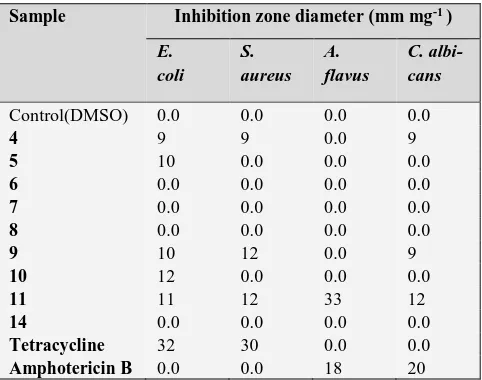
The antibiotic resistance is a growing problem; this is due the overuse of antibiotics in human, and the use of antibiotics as growth promoters in food of animals, so there is a growing demand for new antibiotics. Some selected examples were evaluated for their in vitro antimicrobial activity against two strains of bacteria and two fungus strains; tetracycline was used as standard drug for bacteria and amphotericin was used as standard drug for fungi. Preliminary screening of the synthetic derivatives and standard drugs were performed at fixed concentration 20 mg/ ml, inhibition was recorded by measuring the diameter of the inhibition zoon at the end of 18hrs for bacteria.
Based on the results of the inhibition zoon, data in table 1 revealed that compounds 4, 5, 9, 10 and 11 exhibited moderate antibacterial and antifungal activities compared with the standard drugs. Compounds 6, 7, 8 and 14 exhibited no antimicrobial activity.
Experimental
All melting points were taken on Griffin and Geory melting point apparatus and are uncorrected. IR spectra were recorded on Pye Unicam SP1200 spectrophotometer using KBr Wafer technique. 1H-NMR spectra were determined on
a Varian Gemini 300 MHz using TMS as internal standard (chemical shifts in δ-scale). EI-MS were measured on a Schimadzu-GC-MS operating at 70 eV. Elemental analyses were carried out on a Perkin-Elmer 2400 CHN elemental analyzer and satisfactory analytical data (± 0.4) were obtained for all compounds.
(4)
NaOAc/dioxane
Cl COOEt
N H N O
N N N
S
NH2
O
O
N H N O
N N N
S
HN O
N H N O
N N N
S
N O
(11)
(12)
(13)
NaOAc/dioxane
Cl CN
N H N O
N N N
S
N
(14) NH2
dioxane/
Br O
NO2
N H N O
N N N
S
N
NO2
(15)
(4)
N N N
S
N
NO2
(15) N
N N
SH
NH2
Cl Y B
SN2
Y = CN, CO NO2
Phth N
N N
S
NH2
Phth Y
Y = CN
Y = CO
NO2
1,6-exo-trig cyclization
N N N
S
NH2
Phth
N N N
S
N
O2N
OH H
- H2O
NO2
O
Phth
Phth N
N N
S
HN
(14) NH N
N N
S
NH2
N
N N N
S
N
NH2
1,6-exo-dig. cyclization Phth
Phth
Biological activities were carried out at microanalytical center, Faculty of Science, Cairo University. The homogeneity of the synthesized compounds was controlled by TLC [Using TLC aluminum sheets silica gel F254
(Merck)].
Table 1. Antimicrobial screening results of the tested compounds against Escherichia coli (G+), Staphylococcus aureus (G-),
Aspergillus flavus and Candida albicans
Sample Inhibition zone diameter (mm mg-1 )
E. coli
S. aureus
A. flavus
C. albi-cans
Control(DMSO) 0.0 0.0 0.0 0.0
4 9 9 0.0 9
5 10 0.0 0.0 0.0
6 0.0 0.0 0.0 0.0
7 0.0 0.0 0.0 0.0
8 0.0 0.0 0.0 0.0
9 10 12 0.0 9
10 12 0.0 0.0 0.0
11 11 12 33 12
14 0.0 0.0 0.0 0.0
Tetracycline 32 30 0.0 0.0
Amphotericin B 0.0 0.0 18 20
G: Gram reaction; Solvent: DMSO; 0.0: no activity (inhibition zone less than 7 mm); 7-10 mm - weak activity; 11-15 mm - moderate activity; more than 15 mm - strong activity
Synthesis of 4-(4-amino-5-mercapto-4H-1,2,4-triazol-3-yl)-phthalazin-1(2H)-one, 4
To a stirred solution of 4-oxo-3,4-dihydrophthalazine-1-carbohydrazide 2 (2 g, 10 mmol) and potassium hydroxide (0.84 g, 15 mmol) in absolute ethanol (30 mL), carbon disulfide (0.88 mL, 15 mmol) was added dropwise and the mixture was stirred at room temperature for 6 h. The precipitated potassium dithiocarbazate salt 3 was collected by filtration, washed with dry ether, and dried under vacuum.
This salt was obtained in quantitative yield and was used in the next step without further purification. To a suspension of the potassium salt 3 (1 g, 2.8 mmol) in water (10 mL), hydrazine hydrate (0.28 mL, 5.7 mmol) was added and the whole mixture then heated under reflux until all hydrogen sulfide evolved. The reaction mixture was cooled then acidified with cold dilute hydrochloric acid and the precipitated product was filtered off, dried, and then recrystallized from EtOH/dioxane to give 4 as beige crystals; mp: 240-2 ºC, yield: 65 %. IR (υ/cm-1): 3245, 3162,
3108 (NH2, NH), 1665 (C=O). MS m/z (%): 260 (M.+; 100),
172 (38.7), 145 (4.5), 115 (18), 102 (15.2), 89 (11.4). 1
H-NMR (DMSO-d6) δ (ppm): 14.2 (s, 1H, SH, exchangeable
with D2O), 13.27 (s, 1H, NH, exchangeable with D2O), 8.33
(d, 1Harom., J = 1.5 Hz), 7.95 (dd, 2Harom., J = 10.8 Hz), 7.82
(d, 1Harom., J = 3.6 Hz), 5.74 (brs, 2H, NH2, exchangeable
with D2O). Anal. Calcd. for C10H8N6OS (260.28): C, 46.15;
H, 3.10; N, 32.29; S, 12.32. Found: C, 46.03; H, 2.98; N, 32.11; S, 12.21.
Synthesis of 4-[6-(thiophen-2-yl)-5,6-dihydro[1,2,4]triazolo[3,4-b]1,3,4-thiadiazol-3-yl] phthalazin-1(2H)-one, 5
A mixture of 4 (1 g, 3 mmol), thiophene-2-aldehyde (0.4 mL, 3 mmol) and catalytic amount of p-toluene sulphonic acid (0.3 g) in DMF (20 mL) was heated under reflux for 16 hrs. The reaction mixture was concentrated and then poured onto cold water and the deposited solid was collected by filtration and recrystallized from EtOH/dioxane to give 5 as pale yellow crystals; mp: 334-336 ºC, yield: 72 %. IR (υ/cm-1): 3142, 3101 (NH), 1649 (C=O). MS m/z (%): 354
(M.+; 7.3), 245 (100), 109 (93.1), 101 (16.3). 1H-NMR
(DMSO-d6) δ (ppm): 14.2 (s, 1H, NH, exchangeable with
D2O), 13.2 (s, 1H, NH, exchangeable with D2O), 9.9
(brs,1H), 8.3 (d, 1H, C4-Hthiophene ring, J = 1.2 Hz), 8.0-7.75
(m, 4Harom.), 7.7 (d, 1H, C2-Hthiophene ring, J = 1.2 Hz), 7.2 (dd,
1H, C3-Hthiophene ring, J = 3.6 Hz). Anal. Calcd. for
C15H10N6OS2 (354.41): C, 50.83; H, 2.84; N, 23.71; S, 18.09.
Found: C, 50.77; H, 2.63; N, 23.55; S, 18.12.
Synthesis of 4-(5H-spiro-1,2,4-triazolo[3,4-b]1,3,4-thiadizole-6,9′-fluorene-3-yl]phthalazin-1(2H)-one, 6
A mixture of 4 (1 g, 3 mmol), fluorenone (0.69 g, 3 mmol) and catalytic amount of p-toluene sulphonic acid (0.3 g) in DMF (20 mL) was heated under reflux for 18 hrs. The reaction mixture was concentrated and then poured onto cold water and the precipitated product was filtered off, dried and recrystallized from dioxane/DMF to give 6 as yellow crystals; mp: >300 ºC, yield: 78 %. IR (υ/cm-1): 3372
(NH), 1700 (C=O), 1666 (C=N).MS m/z (%): 422 (M.+; 0.8),
421 (72.9), 366 (67), 173 (100), 145 (58.7). 1H-NMR
(DMSO-d6) δ (ppm): 12.9 (s, 1H, NH, exchangeable with
D2O), 11.3 (s, 1H, NH, exchangeable with D2O), 8.8-7.6 (m,
12Harom.). Anal. Calcd. for C23H14N6OS(422.46): C, 65.39;
H, 3.34; N, 19.89; S, 7.59. Found: C, 65.45; H, 3.23; N, 19.76; S, 7.49.
Synthesis of 3-(4-oxo-3,4-dihydrophthalazin-1-yl)-5H-spiro-1,2,4-triazolo[3,4-b]1,3,4-thiadizole-6,3′-indolin-2′-one,7
A mixture of 4 (1 g, 3 mmol), isatin (0.56 g, 3 mmol) and catalytic amount of p-toluene sulphonic acid (0.3 g) in DMF (20 mL) was heated under reflux for 3 hrs. The deposited solid on hot was filtered off, dried and recrystallized from DMF to give 7 as white crystals; mp: >300 ºC, yield: 55 %. IR (υ/cm-1): 3157, 3113 (NH), 1671 (C=O). MS m/z (%):
387 (M-2; 75), 245 (50), 172 (87.5), 129 (87.5), 102 (75), 57 (100). 1H-NMR (DMSO-d
6) δ (ppm): 13.2 (s, 1H, NH,
exchangeable with D2O), 11.0 (s, 1H, NH, exchangeable
with D2O), 9.1 (s, 1H, NH, exchangeable with D2O), 8.8-7.4
(m, 8Harom.). Anal. Calcd. for C18H11N7O2S (389.39): C,
55.52; H, 2.85; N, 25.18; S, 8.23. Found: C, 55.46; H, 2.72; N, 25.03; S, 8.15.
Synthesis of 4-(6-ethoxy-[1,2,4]triazolo[3,4-b][1,3,4]thiadiazol-3-yl)phthalazin-1(2H)-one, 8
The reaction mixture was concentrated and the deposited product was filtered off, washed with petroleum ether (b.p. 60-80ºC ), dried and recrystallized from dioxane to give 8 as beige crystals; mp: > 300 ºC, yield: 48 %. IR (υ/cm-1): 3214,
3159 (NH), 1667 (C=O). MS m/z (%): 314 (M.+; 23.6), 286
(17.7), 270 (38.8), 171 (91.3), 145 (100), 119 (12.6). 1
H-NMR (DMSO-d6) δ (ppm): 13.3 (s, 1H, NH, exchangeable
with D2O), 8.96 (d, 1Harom., J = 7.8 Hz), 8.35 (d, 1Harom., J =
6.9 Hz), 8.06 (d, 1Harom., J = 3.7 Hz.), 7.9 (d, 1Harom., J = 2.9
Hz), 3.38 (q, 2H, CH2,J = 7.5 Hz), 1.4 (t, 3H, CH3, J = 7.5
Hz). Anal. Calcd. for C13H10N6O2S(314.32): C, 49.67; H,
3.21; N, 26.74; S, 10.20. Found: C, 49.55; H, 3.11; N, 26.60; S, 10.03.
Synthesis of 4-(6-(phenylamino)-[1,2,4] triazolo[3,4-b][1,3,4]-thiadiazol-3-yl)phthalazin-1(2H)-one, 9
A mixture of 4 (1 g, 3 mmol), phenylisothiocyanate (0.4 mL, 3 mmol) and sodium hydroxide (0.8 g) in DMF (25 mL) was heated under reflux for 4 hrs. The reaction mixture was acidified with cold dilute hydrochloric acid and the precipitated solid was filtered off, dried, and recrystallized from dioxane to give 9 as beige crystals; mp: >300 ºC, yield: 51 %. IR (υ/cm-1): 3160 (NH), 1687 (C=O).MS m/z (%):
361 (M+.; 13.5), 171 (35.1), 128 (70.3), 102 (37.8), 92 (21.6),
91 (45.9), 64 (100). 1H-NMR (DMSO-d
6) δ (ppm): 13.1 (s,
1H, NH, exchangeable with D2O), 9.8 (s, 1H, NH,
exchangeable with D2O), 8.9-7.6 (m, 9Harom.). Anal. Calcd.
for C17H11N7OS(361.83): C, 56.50; H, 3.07; N, 27.13; S,
8.87. Found: C, 56.39; H, 2.97; N, 27.02; S, 8.72.
Synthesis of 4-(6-chloro-6-(furan-2-yl)-5,6-dihydro-[1,2,4]tri-azolo[3,4-b][1,3,4] thiadiazol-3-yl)phthalazin-1(2H)-one, 10
To a solution of 4 (1 g, 3 mmol) and triethyl amine (0.5 mL) in DMF (10 mL), furoyl chloride (0.3 mL, 3 mmol) was added dropwise in ice bath and the mixture was stirred at room temperature for 2 hrs. The reaction mixture was acidified with cold dilute hydrochloric acid and the precipitated product was filtered off, dried, and then recrystallized from EtOH/dioxane to give 10 as beige crystals; mp: 290-292 ºC, yield: 43 %. IR (υ/cm-1): 3160,
3108 (NH), 1688 (C=O). MS m/z (%): 370 (M-2; 2), 246 (100), 186 (58.2), 145 (15.2), 102 (52.0). Anal. Calcd. for C15H9N6O2SCl (372.79): C, 48.33; H, 2.43; N, 22.54; S,
8.60; Cl, 9.51. Found: C, 48.23; H, 2.29; N, 22.48; S, 8.50; Cl, 9.44.
Synthesis of ethyl 2-(4-amino-5-(4-oxo-3,4-dihydrophthalazin-1-yl)-4H-1,2,4-triazol-3-ylthio) acetate, 11
A mixture of 4 (1 g, 3 mmol), ethyl chloroacetate (0.37 mL, 3 mmol) in dioxane (20 mL) in the presence of fused sodium acetate (0.5 g) was heated under reflux for 2 hrs. The reaction mixture was concentrated and then poured onto cold water and the precipitated product was filtered off, dried and recrystallized from EtOH/dioxane to give 11 as beige crystals; mp: 194-196 ºC, yield: 80 %. IR (υ/cm-1):
3315, 3217, 3160, 3106 (NH2, NH), 1734 (C=Oester). MS
m/z (%): 346 (M+.; 20.4), 300 (21.7), 273 (100), 172 (55.4),
145 (16.5), 130 (21.8), 115 (31.1). 1H-NMR (DMSO-d 6) δ
(ppm): 13.38 (s, 1H, NH, exchangeable with D2O), 8.93 (d,
1Harom., J = 7.8 Hz), 8.3 (d, 1Harom., J = 7.8 Hz), 8.07-7.9 (dd,
2Harom.), 6.1 (s, 2H, NH2, exchangeable with D2O), 4.3 (s,
2H, SCH2), 4.21-4.14 (q, 2H, CH2,J = 7.2 Hz, J= 3.6 Hz),
1.23 (t, 3H, CH3, J = 7.2 Hz). Anal. Calcd. for C14H14N6O3S
(346.36): C, 48.55; H, 4.07; N, 24.26; S, 9.26. Found: C, 48.31; H, 3.97; N, 24.13; S, 9.11.
Synthesis of 4-[6-amino-6,7-dihydro-5H-1,2,4-triazolo[3,4-b]-1,3,4-thiadiazin-3-yl]phthalazin-1(2H)-one, 14
A mixture of 4 (1 g, 3 mmol), chloroacetonitrile (0.22 mL, 3 mmol) in dioxane (20 mL) in the presence of fused sodium acetate (0.5 g) was refluxed for 10 hrs. The reaction mixture was concentrated and then poured onto cold water and the precipitated product was filtered off, dried and recrystallized from dioxane/DMF to give 14 as white crystals; mp:254-256 ºC, yield: 59 %. IR (υ/cm-1): 3347, 3287, 3161 (NH
2, NH),
1662 (C=O). MS m/z (%): 299 (M.+; 70.8), 283 (63.2), 258
(11), 228 (14.7), 198 (24.6), 172 (100), 130 (34.2), 114 (70), 88 (62.3), 50 (33.6). 1H-NMR (DMSO-d
6) δ (ppm): 13.9 (s,
1H, NH, exchangeable with D2O), 8.38-7.93 (m, 4Harom.),
6.17 (s, 2H, NH2, exchangeable with D2O), 4.39 (s, 2H,
CH2). Anal. Calcd. for C12H9N7OS(299.31): C, 48.15; H,
3.03; N, 32.76; S, 10.71. Found: C, 48.03; H, 2.91; N, 32.58; S, 10.64.
Synthesis of 4-[6-(4-nitrophenyl)-7H-1,2,4-triazolo[3,4-b]1,3,4-thiadiazin-3-yl]phthalazin-1(2H)-one, 15
A mixture of 4 (1 g, 3 mmol) and p -nitro-2-bromoacetophenone (0.73 g, 3 mmol) in dioxane (20 mL) was heated under reflux for 6 hrs. The reaction mixture was cooled and the deposited solid was filtered off, dried and recrystallized from dioxane/DMF to give 15 as beige crystals; mp: 246-248 ºC, yield: 71 %. IR (υ/cm-1): 3301
(NH), 1674 (C=O). 1H-NMR (DMSO-d
6) δ (ppm): 13.36 (s,
1H, NH, exchangeable with D2O), 8.9-8.3 (dd, 4Harom.),
8.3-7.9 (m, 4Harom.), 5.3 (s, 2H, CH2). Anal. Calcd. for
C18H11N7O3S(405.39): C, 53.33; H, 2.73; N, 24.19; S, 7.91.
Found: C, 53.24; H, 2.62; N, 24.03; S, 7.80.
Conclusion
From the foregoing survey, it seems that functionalities in 4-amino-5-mercapto-3-substituted-1,2,4-triazoles provide a useful and convenient strategy for synthesis of numerous fused heterocyclic compounds containing 1,2,4-triazolo[3,4-b]1,3,4-thiadiazole and 1,3,4-thiadiazine derivatives. The subject of such reactions is still ongoing and undoubtedly will provide new fused functionalized 1,3,4-thiadiazoles of both industrial and biological interests.
References
1Whang, J., Song, Y. H. J. Heterocycl. Chem. 2013, 50, 603.
2Zanatta, N., Amaral, S. S., Santos, J. M. D., Fernandes, L. D. S.,
Bonacorso, H. G., Martins, M. A. P. J. Heterocyc.c Chem.
2011, 48, 1085.
3Demibas, N., Ugurluoglu, D. A. Bioorg. Med. Chem. 2002, 10,
3717.
4Mathew, V., Keshavayya, J., Vaidya, V. P., Giles, D. Eur. J. Med.
5Al-Masoudi, N. A., Al-Soud, Y. A. Nucleos Nucleot Nucleic Acids
2008, 27(9), 1034.
6Arunkumar, S., Ilango, K., Ravindar, B., Ramalakshmi, N. Der
Pharma Chem.2009, 1, 70.
7El-Hashash, M. A., El-Kady, A. Y., Taha, M. A., El-Shamy, I. E.
Chin. J. Chem. 2012, 30, 616.
8Awadallah, F. M., El-Eraky, W. E., Saleh, D. O. Eur. J. Med.
Chem. 2012, 52, 14.
9Sriram, D., Yogeeswari, P., Senthilkumar, P., Sangaraju, D.,
Nelli, R., Banerjee, D., Bhat, P., and Manjashetty, T. H.
Chem. Biol. Drug. Des.2010, 75, 381.
10Abdalla, M. S. M., Hegab, M. I., Abo Taleb, N. A.,
Hasabelnaby, S. M., Goudah, A. Eur. J. Med. Chem.2010,
45, 1267.
11Zhang, L., Guan, L. P., Sun, X. Y., Wei, C. X., Chai, K. Y., Quan,
Z. S. Chem. Biol. Drug. Des.2009, 73, 313.
12Ryu, C. K., Park, R. E., Ma, M. Y., Nho, J. H. Bioorg. Med.
Chem Lett.2007, 17, 2577.
13Del Olmo, E., Barboza, B., Ybarra, M. I., López-Pérez, J. L.,
Carron, R., Sevilla, M. A., Boselli, C., Feliciano, A. S.
Bioorg. Med. Chem Lett. 2006, 16, 2786.
14Mahmoud, M. R., Abu El-Magd, W. S. I., Abd El-Wahab, S. S.,
Soliman, S. A. J. Chem. Res.2012, 66.
15Mahmoud, M. R., Abu El-Magd, W. S. I., Derbala, H. A., Hekal,
M. H. J. Chem. Res.2012, 75.
16Mahmoud, M. R., Abu El-Magd, W. S. I., Abd El-Wahab, S. S.,
Soliman, S. A. Synth. Commun. 2013, 43, 1484.
17Mahmoud, M. R., El-Ziaty, A. K., Abu El-Azm, F. S. M., Ismail,
M. F., Shiba, S. A. J. Chem. Res. 2013, 80.
18Mahmoud, M. R., Abu El-Azm, F. S. M. J. Chem. Res. 2013, 535. 19Mahmoud, M. R., Abu El-Magd, W. S. I., Derbala, H. A., Hekal,
M. H., Chin. J. Chem.2011, 29(7), 1446.
20Ghorab, M. M., El-Sharief, A. M. S., Ammar, Y. A., Mohamed, S.
I. Il Farmaco2000, 55(5), 354-361.
21Shi, H., Wang, Z., Shi, H., J. Heterocycl. Chem. 2001, 38(2),
355-357.
22Ghattas, A. A. G., Moustafa, H. M., Hassanein, E. A. A., Hussein,
B. R. M. Phosphorus Sulfur Silicon 2012, 187(12), 1469-1481.
Received: 16.05.2014.