JPRHC
Research Article
JPRHC Volume 3 Issue 3 Page 63-67
IMMUNOMODULATORY ACTIVITY OF BALANITE ROXBURGHIK. J.KORE*, R.V.SHETE, M.P.KABRA, R.M.RACHHADIYA, A.R.ATTAL
For Author affiliations see end of the text
This paper is available online at www.jprhc.in
ABSTRACT:
Besides having traditional use as an immunomodulatory action, it is not well scientifically establish. Hence present study was undertaken to screen the immunomodulatory activity of ethanolic extract of
Balanite roxburghi leaves.Traditionally, leaves of Balanite roxburghi are claimed to possess immunomodulatory activity and hence the reason behind evaluating the immunomodulatory activity of ethanolic extract of
Balanite roxburghi (EBR) leaves. The animals were distributed into three groups consisting of six animals each. The first group served as control, the second and third group received low dose and high dose of ethanolic
extract of Balanite roxburghi (EBR) at 200 mg/kg, p.o.
and 400 mg/kg, p.o. respectively. The
immunomodulatory activity of EBR was evaluated in
Carbon clearance test, Effect on serum immunoglobulin, Cyclophosphamide induced neutropenia. In all these paradigms 400mg/kg dose of EBR was more effective than its 200 mg/kg of dose.These results suggest that
Balanite roxburghi can be use as immunomodulator.
Keywords: Immunomodulator, Balanite roxburghi, Carbon clearance test, serum immunoglobulin, neutropenia.
1. INTRODUCTION:
Natural products of plant and animal origin offer vast resources of newer medicinal agents with potential in clinical use [1]. Some of these are believed to promote positive health and maintain organic resistance against infection by re-establishing the body’s equilibrium and conditioning the body tissue [2]. The historic use of herbal medicines to treat and prevent infectious disease has been supplanted with the emergence of specific synthetic drugs and antimicrobial agents. However, the use of plant remedies, known to possess natural antioxidant, immunomodulatory and other activities, has increased in the last decade in human and animal medicine, as it is perceived as a natural approach to treat disease. Intensive farming system rely heavily on the use of pharmaceuticals, but there is increasing public concern regarding their use, mostly for the emergence of drug resistance [3], the associated risk of developing antibiotic resistance in human pathogens [4] and contamination in the food chain [5]. Balanite roxburghi is native of Africa [6]. Most part of the plant is considered to posses various medicinal properties. Traditionally, leaves of Balanite roxburghi are claimed to possess immunomodulatory activity [7] and hence the reason behind evaluating the immunomodulatory activity of ethanolic extract of
Balanite roxburghi leaves.
2. OBJECTIVE:
Besides having traditional use as an immunomodulatory action, it is not well scientifically establish. Hence present study was undertaken to screen the immunomodulatory activity of ethanolic extract of
Balanite roxburghi lea
3. MATERIALS AND METHODS:
3.1 Experimental animals:
Albino wistar rats weighing between 180– 220 g and Swiss albino mice weighing between 25–35 g were used. Institutional Animal Ethics Committee approved the experimental protocol. Animals were maintained under standard conditions in an animal house approved by the Committee for Purpose of Control and Supervision on Experiments on Animals (CPCSEA). The animals were given pellet food and water ad libitum.
3.2 Materials:
3.2.1 Chemicals : Ethanol, anhydrous sodium sulphate, 2% carboxy methyl cellulose, Indian ink, 0.1% sodium carbonate, zinc sulphate, standard barium sulphate (BaSO4) solution, cyclophosphamide, etc.
3.2.2 Equipments: Soxhlet apparatus, UV-Visible Spectrophotometer, micro-centrifuge, pH meter, TLC.
3.3 Treatment:
The animals were distributed into three groups consisting of six animals each. The first group served as control, the second and third group received low dose and high dose of ethanolic extract of Balanite roxburghi
(EBR) at 200 mg/kg, p.o. and 400 mg/kg, p.o. respectively.
3.4 Preparation of extract:
The leaves were dried in shade at room temperature and coarsely powdered. The ethanolic extract was prepared using ethanol by soxhlet method at temperature of 40-60o c. The extract was dried over
JPRHC
Research Article
JPRHC Volume 3 Issue 3 Page 63-67
3.5 Phytochemical screening of extract of leaves ofBalanite roxburghi :
Quantitaive chemical tests were conducted for the extract of leaves of Balanite roxburghi to identify the various phytoconstituents like alkaloid, carbohydrates, tannins etc [8].
3.6 Determination of Acute oral toxicity:
Three female mice were randomly selected and marked for individual identification. Animals were fasted 24 h prior to dosing of ethanolic extract of leaves of Balanite roxburghi were administered in a single dose orally. Toxicity study was carried out using a starting dose of 5000 mg/kg body weight. Animals were observed individually after dosing at least once during the first 30 min. periodically during the first 24 h, with special attention given during first 4 h, and subsequently daily for 14 days. The observation comprised the behavior and according to the Guidelines of the Organization for Economic Cooperation and Development (OECD 1998).
3.7 Evaluation of Immunomodulatory activity:
3.7.1 Carbon clearance test [9,10] :
The three groups of Swiss albino mice were administered drug or vehicle for 5 days orally. After 48 h of the last dose of the drug, mice were injected with 0.1 ml of Indian ink via the tail vein. Blood samples were withdrawn at 0 min and 15 min. A 50 μl blood sample was mixed with 4 ml of 0.1% sodium carbonate solution and the absorbance of this solution was determined at 660 nm. The phagocytic index K was calculated using the following equation:
K = (Loge OD1-Loge
OD2)/15
Where OD1 and OD2 are the optical densities at 0 and
15 min respectively.
3.7.2 Effect on serum immunoglobulins [11, 12] : Albino rats were treated with the drug or vehicle orally for 21 days. Six hours after the last dose, blood samples were collected and the serum was separated by centrifugation, the collected serum was used for estimation of immunoglobulin levels. Briefly, for each serum sample to be analyzed, a control tube containing 6 ml of distilled water and a test tube containing 6 ml of zinc sulphate solution were prepared. To each, 0.1 ml of serum was added from a pipette. They were inverted to enable complete mixing of the reagents and left to stand for 1 h at room temperature in plugged tubes. The pH of the solution was monitored through out the experimental period using pH meter. The first tube served as blank and the second tube was taken as sample. The turbidity developed was measured. The turbidity obtained
(sample-blank) was compared with that obtained with standard barium sulphate (BaSO4) solution. The turbidity obtained with this solution was expressed as zinc sulphate turbidity (ZST) units.
3.7.3 Cyclophosphamide induced neutropenia [13, 14] :
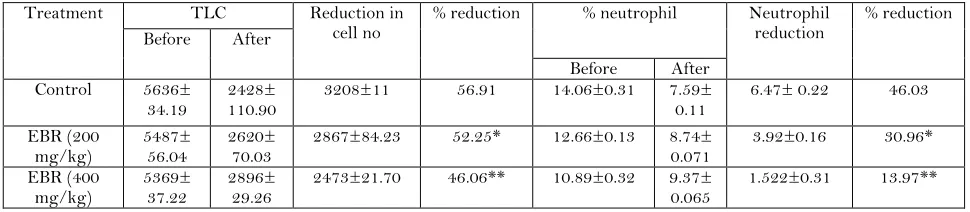
Swiss albino mice received the drug or vehicle orally for 10 days. On 10th day, a neutropenic dose of cyclophosphamide (200 mg/kg, s.c.) was administered and this day was labeled as day zero. Blood samples were collected through retro-orbital vein. The total leucocyte count (TLC) and % reduction in neutrophil count were performed prior to and on day 3 after injection of cyclophosphamide. The TLC and % reduction in neutrophil count in treated groups were compared with the values of the control group.
4.STATISTICAL ANALYSIS :
The Statistical analysis was performed by using One Way ANOVA followed by Dunnet’s comparision test.The values are expressed as mean ± SEM and the P<0.05 was taken as significant.
5. RESULTS :
5.1 Phytochemical screening :
The ethanolic extract of Balanite roxburghi
showed the presence of alkaloids, glycosides, saponin, flavanoids, steroids, and phenolic compounds.
5.2 Acute oral Toxicity :
It was observed that ethanolic extract of the
Balanite roxburghi leaves was not lethal even at the dose of 2000mg/kg body weight. Hence 200mg/kg and 400 mg/kg were fixed as dosage.
5.3 Carbon clearance assay :
Administration of EBR at doses 200mg/kg and 400 mg/kg produced increase in clearance of carbon particles from blood as indicated by a significant increase in phagocytic index (P<0.01) as shown in table 1.
5.4 Serum immunoglobulin levels :
The administration of EBR at doses 200 mg/kg (P<0.05) and 400 mg/kg (P<0.01) significantly increased the serum immunoglobulin levels when compared to control as shown in table 1.
5.5 Cyclophosphamide induced neutropenia :
JPRHC
Research Article
JPRHC Volume 3 Issue 3 Page 63-67
compared to control. The EBR 400 mg/kgadministration produced a 46.06% reduction in TLC and 13.19% reduction in neutrophil count and EBR 200 mg/kg administration produced a 52.25%
reduction in TLC and 30.96% reduction in neutrophil count and compared to 46.03% reduction in neutrophil count and 56.91% reduction in TLC in control, as shown in table 2.
Table1. Effect of EBR on Phygocytic index and immunoglobulin level.
Treatment Phagocytic index Serum immunoglobulin
Control 0.0079 ± 0.000294 17.74± 0.2394
EBR (200 mg/kg) 0.06435± 0.001064** 23.2± 0.3866*
EBR (400 mg/kg) 0.0347 ± 0.00118** 27.19± 0.4193**
Values are expressed as mean ± S.E.M., n=6, EBR 200 mg/kg, EBR 400 mg/kg, *p<0.05, **p<0.01, as compared with control using one way ANNOVA followed by Dunnet test.
Table 2. Effect of EBR on cyclophosphamide induced neutropenia.
Treatment TLC Reduction in
cell no % reduction % neutrophil Neutrophil reduction % reduction Before After
Before After Control 5636±
34.19 110.90 2428± 3208±11 56.91 14.06±0.31 7.59± 0.11 6.47± 0.22 46.03 EBR (200
mg/kg) 5487± 56.04 2620± 70.03 2867±84.23 52.25* 12.66±0.13 8.74± 0.071 3.92±0.16 30.96* EBR (400
mg/kg) 5369± 37.22 2896± 29.26 2473±21.70 46.06** 10.89±0.32 9.37± 0.065 1.522±0.31 13.97**
Values are expressed as mean ± S.E.M., n=6, EBR 200 mg/kg, EBR 400 mg/kg, *p<0.05, **p<0.01, as compared with control using one way ANNOVA followed by Dunnet test
6. DISCUSSIONS :
The carbon clearance test was carried out to evaluate the effect of drugs on the reticulo- endothelial system (RES). This is a diffuse system comprising of phagocytic cells, comprising of fixed tissue
JPRHC
Research Article
JPRHC Volume 3 Issue 3 Page 63-67
of particles from the bloodstream. When colloidal inkcontaining carbon particles are injected directly into the systemic circulation, the rate of clearance of carbon from the blood by macrophage is governed by an exponential equation [9, 10]. Balanite roxburghi at both doses showed significant increase in the phagocytic index. Hence, these agents may stimulate the reticulo endothelial system.
The estimation of serum immunoglobulin level is a direct measure to detect the humoral immunity. Serum immunoglobulin refers to a group of serum molecules produced by B-lymphocytes, they are soluble and secreted form of B-cell receptors and are produced to a maximum level to counter the invasion by an antigen, hence, they are also called as antibodies. Blood contains three types of globulins-alpha, beta and gamma, based on their electro phoretic migration rate. In the present study, estimation of serum immunoglobulins was carried out using zinc sulphate turbidity test (ZST). This test determines the amount of immunoglobulins present in the serum. A small amount of serum was added to a zinc sulphate solution and allowed to incubate at room temperature for 1 h.
Zinc sulphate causes precipitation of the
immunoglobulins, which makes the solution cloudy instead of clear. This test is fairly specific for immunoglobulins, but does not do a very good job of quantitating them and it is difficult to distinguish a borderline problem. However, this test is relatively quick and inexpensive test [11]. Its drawbacks include the dependence of results on a number of factors, such as time, temperature, and particularly pH of the reaction mixture. A serious drawback is the dependence of the final turbidity on pH of the zinc sulphate solution. Prolonged storage or even a short exposure to atmospheric carbon dioxide considerably changes pH and affects the result of the reaction. The
possible ways of overcoming this problem are buffering or the use of pH indicators [12]. The turbidity was expressed as ZST units, which in turn indicate the amount of immunoglobulin present in the sample. Balanite roxburghi at a low dose showed a significant increase in the serum immunoglobulin level.
Cyclophosphamide induces myelo
suppression in the experimental animals. It belongs to nitrogen mustard subclass of alkylating agents and acts as an immunosuppressive agent by causing alkylation of DNA, in turn by interfering in DNA synthesis and function. It is also used extensively as immunosuppressant [13]. Balanite roxburghi at a 400mg/kg of dose caused a 46.06% reduction in the cyclophosphamide induced neutropenia suggesting that it may have an effect on the haemopoetic system. The prevention of neutropenia induced by cyclophosphamide may be through activation of macrophages, which secrete a large number of substances including colony stimulating factor and interleukin 1 [13, 14].
7. CONCLUSION :
From the given data we conclude that
ethanolic extract of Balanite roxburghi have
immunomodulator activity this might be due to presence of of alkaloids, glycosides, saponin, flavanoid, steroids, and phenolic compounds in its ethanolic extract.
8. ACKNOWLEDGEMENT :
Authors are thankful to Rajgad Dnyanpeeth’s college of Pharmacy, Bhor for providing platform to carry out this work.
9. REFERENCES :
1. Saudi M, Phansalkar N, Patki P,
Patwardhan B, Studies of immunomodulatory effect of Ashwagandha, Journal of Ethnopharmacology, 1996, 50, 69-76.
2. Fulzele SV, Sattaurwar PM, Joshi SB, Dorle AK, Study of immunomodulatory activity of Haridradi ghrita in rats, Indian journal of Pharmacology, 2003, 35, 51-54.
3. Rochfort S, Parker AJ, Dunshea FR, Plant bio actives for ruminant health and productivity, Phytochemistry, 2008, 69, 229-322.
4. Borton MD, Antibiotic use in animal feed and its impact on human health, Nutr. Res. Rev, 2000, 13, 279-299.
5. Farinacci M, Colotti M, Sgorlon S, Stefanon B, Immunomodualtory activity of plant residues on ovine neutrophils, Veterinaty Immunology and Immunopathology, 2008, 126, 54-63.
6. Daniel M, Medicinal plants: Chemistry and properties, ed 1st, Oxford and IBH
publishing house co. pvt. Ltd, new Delhi 2006, 122-123.
7. Nadkarni KM, 2000. Indian Material Medica, Bombay Popular prakashan, Vol1, 166-167.
8. Khandelwal KR, 2006. Practical pharmacognosy technique and experiments, Nirali prakashan, 162-165.
9. Das M, Dasgupta SC, Gomes A,
JPRHC
Research Article
JPRHC Volume 3 Issue 3 Page 63-67
10. Gokhale AB, Damre AS, Saraf MN,
Investigations into the
immunomodulatory activity of Argyreia speciosa, J Ethnopharmacol, 2003, 84, 109–114.
11. Mullen PA. Zinc sulphate turbidity test as an aid to diagnosis, Veter Ann 1975, 15, 451–455.
12. Sedlinsk M, Krej J, Vysko M.
Evaluation of field methods for
determining immunoglobulins in
Sucking Foals, Acta Vet Brno, 2005, 74, 51–58.
13. Thatte UM, Chhabria SN, Karandikar SM, Dahanukar SA, Protective effects of
Indian medicinal plants against
cyclophosphamide neutropenia, J
Postgrad Med, 1987, 33(4), 185– 188.
14. Heppner GH, Calabresi P, Selective suppression of humoral immunity by
anti-neoplastic drugs, Annu Rev
Pharmacol Toxicol, 1976, 16, 367–379.
*Correspondance Address:
Department of Pharmacology,
Rajgad Dnyanpeeth’s College of Pharmacy Bhor, Dist. Pine
Pin- 412206