ABSTRACT
Amine compounds are believed to have acceptable results regarding their use as clay swelling inhibitor and corrosion inhibitor additives in drilling fluids. It is crucial to know the capability of amine compounds to enhance the thermal stability of drilling fluid; herein, a water-based fluid composed of biopolymer and other additives as the proper representatives of muds used in the pay zone section of a well is used. In order to enhance drilling fluid thermal stability to 250 °F (which is about 200 °F for starch in common drilling fluids), the compatibility of four amine compounds (mono ethanolamine, 1,6-diaminohexane, polyamine, and choline chloride) with three polymers (green, poly-anionic cellulose, and starch-high temperature) is investigated; one of the named polymers is also chosen to examine its thermal stability performance along with the mentioned amine compounds at 250 °F. Two percent by volume concentration (2 Vol.%) of the mentioned amines were used. For these purposes, the rheological and filter loss properties were studied. The results showed that the starch-green is almost compatible with four amines. Moreover, mono ethanolamine and 1,6-diaminohexane acted better in terms of thermal stability at elevated temperatures.
Keywords: Amine, Polymer, Swelling Inhibitor, Thermal Stability Khalil Shahbazi1*, Alireza Arshadi1, and Majid Valizadeh2
1 Department of Petroleum Engineering, Ahwaz Faculty of Petroleum Engineering, Petroleum University of Technology, Ahwaz, Iran 2 Petroleum Engineering Research Division, Research Institute of Petroleum Industry (RIPI), Tehran, Iran
An Experimental Study of the Effect of Amines on Polymer Efficiency
and Thermal Stability of Water-based Drilling Fluid
*Corresponding author Khalil Shahbazi
Email: [email protected] Tel: +98 61 3555 1019 Fax: +98 61 3555 1019
Article history
Received: October 08, 2016
Received in revised form: February 21, 2017 Accepted: February 26, 2017
Available online: May 22, 2018 DOI: 10.22078/jpst.2017.2306.1404
INTRODUCTION
In drilling operations, drilling fluid is one of the main contributors to the overall cost. What makes this component crucial is its direct contact with wellbore formation and almost all the equipment from mud pit to drill bit. It is also considered as a conduit for making changes in the bottom hole condition and for transferring helpful data during drilling operations. However, the mentioned tasks are achievable only if drilling fluid sustains its
properties when it undergoes different conditions during drilling such as high temperature and troublesome shales.
Journal of Petroleum Science and Technology 2018, 8(2), 29-37 http://jpst.ripi.ir
solids build up in mud, and poor cementing jobs. These cover 90% of wellbore instability problems and cost annually $500 million [2]. To solve the drilling problems associated with shaly formations, various nonaqueous drilling fluids (NADF) have been used in fields by the operators. In addition to shale inhibition, suitable lubricity and temperature stability were seen by using these systems [3,4]. However, these advantages are realized as the ultimate goal in High Performance Water Base Mud (HPWBM) research. NADF has disadvantages such as high cost, environmental limitations, disposal problems, health, and safety issues [5,6]. High performance (HP) water-based drilling fluids are particularly advantageous in comparison with conventional water-based systems because they provide faster penetration rates, enhanced hole cleaning, greater shale inhibition, and improved wellbore stability [7]. Generally, High Pressure High Temperature (HPHT) wells have been drilled via oil-based muds, formate brines, or high temperature synthetic polymers. These conventional systems can overcome HPHT circumstances through using: 1: Oil-based mud or synthetic muds, which can be formulated to withstand high temperatures over long periods of time because of their high thermal stability; 2: formate brines, which can protect polymers from thermal degradation; 3: synthetic polymers, which are modified chemically in a way to enhance their thermal stability in order to postpone the degradation time [8].
Amine-based drilling fluids, which are considered as one of the examples of high performance water-based drilling fluids (substitution for oil-water-based muds), are believed to have acceptable applications mainly as clay swelling inhibitor additives. Clay swelling inhibition, a paramount challenge is
to overcome low thermal stability when amine compounds in HPWBM are used. Today, with the drilling of the deeper wells, we encounter higher bottom hole pressures and temperatures. Thus, we need mud additives with high thermal stability for the accomplishment of such deep drilling operations.
It is worth mentioning that the component of drilling fluid which is highly vulnerable to high temperature is polymer. Starch is one of the most common natural polymers used as a fluid loss controller additive in drilling fluids. This additive is cost-effective and affluent [9].
Starch is the principal component of the seeds of cereal grains (such as corn, wheat, and rice) and tubers (such as potato and tapioca). Starch is degraded by heat and agitation. With continued circulation in a hole at temperatures of 200 °F (93 °C) and higher, starch breaks down rapidly and loses the sealing action of the filter cake [10].
In addition to all the applications of amine compounds as drilling fluid additives, it can also enhance the thermal stability of mud. The addition of poly-ethoxylated alkyl diamine compound can provide thermal stability at 200 °F [11]. Therefore, the thermal stability of starch should be increased for applications at higher temperatures considered in this study, i.e. 250 °F.
EXPERIMENTAL PROCEDURES
Experimental Equipment and Materials
concentration. Three different polymers (starch-green, low viscosity polyanionic cellulose (PAC-LV), and modified starch) were used as the base fluids. The rheological properties of the fluid were measured directly using a rotational viscometer (Fann 35 SA model), and the filtration properties of the fluids were measured by filter press (Fann model). A rolling oven (Fann model) was used for the dynamic heating of the fluids at 250 °F for 16 hours.
METHODOLOGY
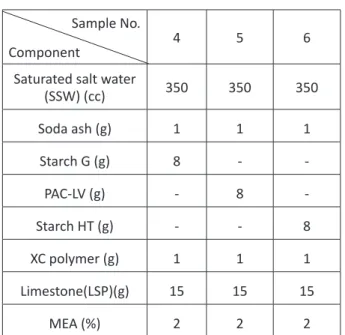
In order to find the effects of each amine on the thermal stability of drilling fluid, firstly, it is intended to investigate the compatibility of the amine compounds with the three mentioned polymers. Fifteen samples were prepared for this purpose the detailed compositions of which are tabulated in Tables 1-5. Three of these samples are base fluids (from three polymers) which contain no amine compounds, and the other ones contain only one amine compound at 2 vol.%. Thus, all the samples contain the same amount of an additive like limestone, xanthan gum, and soda ash. Rheological properties were measured at ambient temperature for each sample after hot rolling. Rheological parameters (Av, Pv, and YP) were calculated based on Bingham plastic model using the following equations (Equations 1-3):
θ = 600
2
Av (1) Pv= θ600- θ300 (2) YP= θ300- Pv (3) Filtration tests were run at ambient temperature and at the pressure of 100 psig with a multifilter press, and the filtrate volume collected in 30 minutes was reported as a filter loss of fluid.
As it was mentioned before, in this study, the effect of amine compounds on the compatibility and thermal stability of drilling fluid is presented. The rheological properties and filtrate volume were measured for each sample both before and after hot rolling for 16 hours at 250 °F. It should be noted that all the amine additives were used at two percent by volume concentration (2 vol.%).
Table 1: Base samples containing no amine.
Sample No.
Component 1 2 3
Saturated salt water
(SSW) (cc) 350 350 350
Soda ash (g) 1 1 1
Starch G (g) 8 -
-PAC-LV (g) - 8
-Starch HT (g) - - 8
XC polymer (g) 1 1 1
Limestone(LSP)(g) 15 15 15
Table 2: Samples containing MEA.
Sample No.
Component 4 5 6
Saturated salt water
(SSW) (cc) 350 350 350
Soda ash (g) 1 1 1
Starch G (g) 8 -
-PAC-LV (g) - 8
-Starch HT (g) - - 8
XC polymer (g) 1 1 1
Limestone(LSP)(g) 15 15 15
Journal of Petroleum Science and Technology 2018, 8(2), 29-37 http://jpst.ripi.ir Table 3: Samples containing polyamine.
Sample No.
Component 7 8 9
Saturated salt water
(SSW) (cc) 350 350 350
Soda ash (g) 1 1 1
Starch G (g) 8 -
-PAC-LV (g) - 8
-Starch HT (g) - - 8
XC polymer (g) 1 1 1
Limestone(LSP)(g) 15 15 15
Polyamine(%) 2 2 2
Table 4: Samples containing choline chloride.
Sample No.
Component 10 11 12
Saturated salt water
(SSW) (cc) 350 350 350
Soda ash (g) 1 1 1
Starch G (g) 8 -
-PAC-LV (g) - 8
-Starch HT (g) - - 8
XC polymer (g) 1 1 1
Limestone(LSP)(g) 15 15 15
Choline chloride(%) 2 2 2
Table 5: Samples containing 1-6, diaminohexane.
Sample No.
Component 13 14 15
Saturated salt water
(SSW) (cc) 350 350 350
Soda ash (g) 1 1 1
Starch G (g) 8 -
-PAC-LV (g) - 8
-Starch HT (g) - - 8
XC polymer (g) 1 1 1
Limestone(LSP)(g) 15 15 15
1,6-diaminohexane
(%) 2 2 2
RESULTS AND DISCUSSION
Compatibility Investigation
For compatibility purposes, some properties of the aged samples are compared to that sample which contains no amine (base sample) of its own polymer.
The best compatible polymer is the one the properties of which show improvement or have the least deterioration after amine addition. This concept means higher rheological properties like yield point and apparent viscosity, and denotes lesser filtrate volume in the case of filter loss measurement.
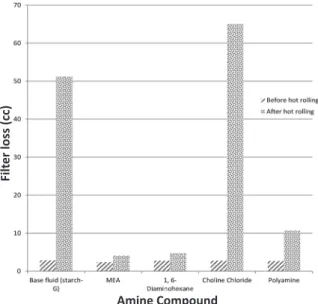
Regarding Figure 1 showing the filter loss of different fluid types, the high filtrate volume of sample one, which is the base fluid of starch-G without any amine compounds in its formulation, is noticed. Comparing this column with the other columns of the same polymer (starch-G) shows that except choline chloride, all the other three amines actually decreased filtrate volume and had a better impact on filter loss.
Figure 1: Filter loss of different fluid types after 16
hours hot rolling at 250 °F.
Polymer
Filt
Regarding PAC-LV and modified starch, almost MEA and 1,6-diaminohexane made an improvement in filter loss; however, the base fluid of these two polymers had much lower filtrate volume than starch-G.
Figure 2 shows that both starch-G and modified starch had a better improvement regarding apparent viscosity after amine addition. However, MEA and 1,6-diaminohexane showed a more viscous behavior with PAC-LV.
Figure 2: Apparent viscosity of different fluid types after 16 hours hot rolling at 250 °F.
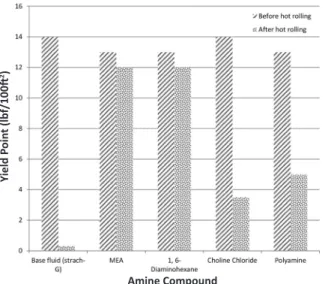
Also, Figure 3 shows that the yield point of the base fluid of starch-G is zero, which is considerably improved with all the amines after amine addition.
Figure 3: Yield point of different fluid types after 16
hours of hot rolling at 250 °F.
Thermal Stability
The investigation of the impact of adding amine on thermal stability needs a comparison between the two states of (before and after) hot rolling data of the same amine type. Just like the pervious section, concerning filter loss, less filtrate volume is desirable. It should be emphasize that the more stable rheological properties such as apparent viscosity, yield point and gel strength is also desirable for drilling fluids.
According to Figure 4, except choline chloride that almost made no difference to the base fluid (no amine), all the other amine types acted better at maintaining their filter loss property especially MEA and 1, 6-diaminohexane; this means that better thermal stability was observed after the addition of these amines.
Figure 4: Filter loss comparison before and after 16
hours hot rolling at 250 °F (the base of starch-G).
Figure 5 accordingly shows that MEA and 1,6-diaminohexane were able to maintain their apparent viscosity better than polyamine and choline chloride respectively because hot rolling decrease apparent viscosity less, and apparent viscosity is close to the value obtained before hot rolling.
Polymer
Appar
en
t Visc
osity (cP)
Yield P
oin
t (lb
f/100ft
2)
Polymer
Amine Compound
Filt
Journal of Petroleum Science and Technology 2018, 8(2), 29-37 http://jpst.ripi.ir Figure 5: Apparent viscosity comparison before
and after 16 hours hot rolling at 250 °F (the base of
starch-G).
Regarding the yield point, Figure 6 shows that MEA and 1,6-diaminohexane were able to maintain their yield point better than polyamine and choline chloride respectively because after hot rolling the yield point is higher and closer to the value obtained before hot rolling.
Figure 6: Yield point comparison before and after 16
hours hot rolling at 250 °F (the base of starch-G). Regardless of the better compatibility of amines with starch-G polymer, thermal stability was also investigated for the other two polymers (PAC-LV and modified starch), and the compared results are shown in Figures 7-12.
Figures 7 to 9 also show that, similar to the starch-G results, MEA, and 1,6-diaminohexane had
better thermal stability regarding filtrate volume, apparent viscosity, and yield point.
Figure 7: Filter loss comparison before and after 16
hours hot rolling at 250 °F (the base of PAC-LV).
Figure 8: Apparent viscosity comparison before and
after 16 hours hot rolling at 250 °F (the base of PAC-LV).
Figure 9: Yield point comparison before and after 16
hours hot rolling at 250 °F (the base of PAC-LV).
Amine Compound
Appar
en
t Visc
osity (cP)
Yield P
oin
t (lb
f/100ft
2)
Amine Compound
Amine Compound
Filt
er loss (cc)
Appar
en
t Visc
osity (cP)
Amine Compound
Yield P
oin
t (lb
f/100ft
2)
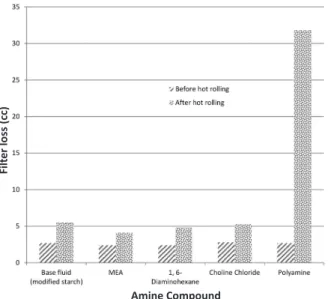
Figure 10 shows that filter loss deterioration is so high for polyamine that causes its slight advantage over MEA and 1,6-diaminohaxane regarding rheological properties to pale into insignificance.
Figure 10: Filter loss comparison before and after 16 hours hot rolling at 250 °F (the base of modified starch).
Moreover, Figures 11 and 12 show that polyamine acted better at maintaining its rheological properties after a rise in temperature.
Figure 11: Apparent viscosity comparison before
and after 16 hours hot rolling at 250 °F (the base of modified starch).
Figure 12: Yield point comparison before and after 16 hours hot rolling at 250 °F (the base of modified starch).
According to the above figures, MEA and 1,6-diaminohexane along with PAC-LV base had better thermal stability than polyamine and choline chloride. However, with modified starch being the base fluid, polyamine had slightly better (higher) gel strength than MEA and 1,6 diaminohexane. The effect of amine compounds on the thermal stability enhancement of water-based drilling fluids was investigated in this study. The results clarified that almost all of the four amines are compatible with starch-green specially MEA and 1,6-diaminohexane. Also, the rheological properties of fluids with the base of PAC-LV are slightly higher because PAC-LV has higher rheological properties compared to starch-green. Moreover, with the presence of amine additives (MEA and 1,6-diaminohexane in this study) in water-based drilling fluids, thermal stability can be reached up to 250 °F at two volume percent (2 Vol.%) of the amine additive.
CONCLUSIONS
One of the main characteristics of amines as clay swelling inhibitors is due to the possession of
Filt
er loss (cc)
Amine Compound
Amine Compound
Appar
en
t Visc
osity (cP)
Yield P
oin
t (lb
f/100ft
2)
Journal of Petroleum Science and Technology 2018, 8(2), 29-37 http://jpst.ripi.ir
multiple active ionic sites, usually cationic ones. This feature allows this compound to interact closely with materials; however, amines with higher chain length as MEA (chain with two carbon atoms) and 1,6-diaminohexane (chain with six carbon atoms) act better by maintaining the original properties of drilling fluid as temperature rises. On the other hand, choline chloride simply behaves like potassium in potassium chloride which does not possess those multiple active sites of MEA or 1,6-diaminohexane. Also, polyamines are believed to have a plenty of active sites; however, their bigger size compared to linear amines lowers their efficiency in improving rheological properties at their original state by rising temperature.
Considering the experimental data, the better compatibility of amine compounds with green starch is mainly ascribed to the presence of stronger hydrogen bonding between amine molecules and starch molecules, which causes persistence in the rheological behavior of the whole mud.
ACKNOWLDEGMENTS
The authors are thankful to the Drilling and Well Completion Technologies and Research Group of the Research Institute of Petroleum Industry (RIPI).
NOMENCLATURES
Av : Apparent Viscosity (cP) HP : High Performance
HPHT : High-Pressure and High-Temperature θ600 : Dial reading at 600 rpm
θ300 : Dial reading at 300 rpm MEA : Mono ethanolamine NADF : Non-aqueous Drilling Fluids Pv : Plastic Viscosity (cP)
PAC-LV : Poly anionic cellulose-low viscosity Starch-G : Green starch
YP : Yield Point (lbs/100ft2)
REFERENCES
1. Hanyi Z., Qiu Z., Huang W., Huang D., and et al., “Successful Application of Unique Polyamine High Performance Water-based Drilling Fluid in Bohai Bay Shale formations,” Presented
at IPTC (International Petroleum Technology
Conference), Beijing, China, 2013.
2. Tas B. T., Hakki G. I., and Parlaktuna M., “An Experimental Investigation of the Shale Inhibition Properties of a Quaternary Amine Compound,” Presented at 19th International
Petroleum and Natural Gas Congress and
Exhibition of Turkey, Turkey, 2013.
3. Friedheim J. E., Hans G. J., Park A., and Ray C. R., “An Environmentally Superior Replacement for Mneral-oil Drilling Fluids,” Presented at Offshore Europe, Journal Society of Petroleum Engineers, Aberdeen, United Kingdom, 1991, 299-312.
4. Friedheim J. E. and Conn H. L., “Second Generation Synthetic Fluids in the North Sea: are they Better?” Presented at SPE/IADC Drilling Conference. Society of Petroleum Engineers, New Orleans, Louisiana, 1996, 215-227.
5. Beihoffer T. W., Dorrough D. S., Deem C. K., Schmidt D. D., and et al., “Cationic Polymer Drilling Fluid can Sometimes Replace Oil-based Mud,” Oil and Gas Journal, United States, 1992,
90(11), 1-12.
6. Patel A. D., Stamatakis E., Davis E., and MIli C., “Shale Hydration Inhibition Agent and Method of Use,” United States Patent 6 247 543, 2001. 7. Galindo K. A., Zha W., Zhou H., and Deville
International Symposium on Oilfield Chemistry, Texas, USA, 2015, 1-9.
8. Mojammadi A., Kalhor M., Taraghikhah S., and Tahmasbi Nowtaraki K., “A Brief Introduction to High Temperature and Foam Free Water Based Drilling Fluids,” IADC/SPE Asia Pacific Drilling Technology Conference, Society of Petroleum Engineers, Singapore, 2016, 1-7.
9. Annis M. R. and Smith V., “Drilling Fluids Technology,” Revised Edition Exxon Company, 1996.
10. Darley H. C. H. and Gray G. R., “Composition and Properties of Drilling and Completion Fluids,” Gulf Professional Publishing, 1988. 11. Gholizadeh-Doonechaly N., Tahmasbi K., and
Davani E., “Development of High-performance Water-based Mud Formulation Based on Amine Derivatives,” Presented at SPE International
Symposium on Oilfield Chemistry, Society of