SKILL PROPORTION IN EDUCATION SECTOR
Rusmawati Saida
Faculty Economics and Management Universiti Putra Malaysia.
Asmaddy Haris
Universiti Sains Islam Malaysia Bandar Baru Nilai, Nilai 71800 Negeri Sembilan Malaysia.
Kamarul Hidayah Abdul Hamid Faculty Economics and Management
Universiti Putra Malaysia.
Abstract
This paper is concerned with the two main causes of skill proportion in education sector in Malaysia during the period 2002 to 2007. These are the impact of changes in within and between industrial effects. As well documented in labour economics literature, the within effects represent the changes in technological change or known as SBTC and the between effects so called the effects of trade. The paper has employed set of data comprises micro-level data from the Household Income Survey (HIS) for several years during the period 2002 to 2007. Decomposition approach was chosen to identify the specific impact of changes in the pattern of trade and technological change on the skill proportion in education sector. Perhaps these analyses help us to look whether employment or wages factors are dominant to lead the changes in overall labour market. We found that skill proportion in education sector in Malaysia was favour to profesional workers as compared to technical and associates profesionals. Technological change seemed to increase the demand for profesional workers especially at tertiaty sub sector. The decreasing in demand for technical and accociates profesional in education sector was lead by primary sub sector.
Keywords: Labor Demand, Wage Differentials, Trade and Labor Market Interaction, Technological Change.
JEL classification codes: J21,J23,J31,O33
a
1. Introduction
Emerging imbalance labor market has created problems such as polarized occupation structure, unemployment and wage inequality that attracts huge attention. Though numerous changing labor market trends have been identified, such as decline of skilled workers in several industries, researchers are still arguing on the exact factors that lead to these changes. A number of different possible causes of these changes have been identified, including technological progress, knowledge expansion, industrial causes and certain government policies, market or monopoly power and trade and globalization. There is a need to clarify and distinguish the specific reasons for these labor market changes which is important because different determinants implicate different policy positions and solution in addressing the problem of imbalance labour markets.
Although the pattern of movement in the Malaysian occupational structure has been documented in a study by Said et al. (2008), this study focuses on sectoral level using aggregate data from manufacturing sector. The study found that changes in the relative demand for labour seem to favour semi-skilled workers and that technological change has been the main reason for the changing employment pattern in Malaysia. Most studies focused on underlying factors that shift the relative demand for occupation, where trade and technology are suspected to be the main cause (Manasse et al. 2004). Thus, this study sets out to examine the changes in the current composition of skills and to explore the reasons behind these changes in education sector using the decomposition techniques. Different from previous studies, this study employed set of micro level data from the Household Income Survey (HIS) for several years during 2002-2007 and the selection of micro data allows detailed observation in particular sectors. In general, this study attempts to address the presence of significant gap in the previous literature on the causes of changes in occupational structure in Malaysia and specifically looks into the case of education sector. The reminder of this paper is structured as follows. The next section discusses the previous study gives an overview of the research background, followed by the data presented in section 3. Section 4 reports the empirical findings and the last section summarizes and concludes.
2. Research Background
The analysis of labour demand suggests that as the Malaysian economy progresses towards knowledge based economy during the period 2002-2007, significant effects in the changes of occupational structure have become visible in the labour market. These changes further raises the question as to whether the changes in occupational structure related to a specific factor shocks such as changes in relative productivity or specific sector shock which alters relative market share or average wage rate has been adequately documented in previous studies.
increased the flow of international trade. For instant, in the late 1990s, the share of the agriculture to GDP was only 8 percent compared to 33 percent share of the manufacturing sector and 45 percent share of the service sector.
However, the 1997 financial crisis had imposed significant impacts on the economy though such effects were temporary. During this period, effort has been focused on preparing Malaysia to face the world new challenging phenomenon of globalization, trade liberalization and rapid advancement of science and technology (S&T) including IT and biotechnology. Corresponding to these industrial transitions, the labor structure will supposedly also experienced a change in occupational structure from primarily, low skill occupation to middle skill and ultimately to higher skill (Wei, 2002). In Taiwan, Liou (2001) traced the influence of industrial structure transformation on employment and income distribution from 1991-1996 and found that the labour structure was actually determined by industrial structure transformation.
As a greater part of the plan to develop a knowledge society, the Third Outline Perspective Plan (OPP3) highlights that Malaysia is building up a knowledge-based economy and is working towards establishing a knowledge-based workforce. Consequently, employment growth increases rapidly but may create its own problem as predicted by the International Labour Organization (ILO). Reflecting on the experience of many East Asian countries and some Latin American economies, trade liberalization has increased the demand of skilled workers, which occasionally fell short of supply, despite increasing wage. In Malaysia, for example, between 1986 and 1994, a small function of the rising wage gap between skilled and unskilled workers is attributable to the differentials in demand elasticity. Skilled workers also have smaller supply elasticity than semiskilled and unskilled workers. In China, the pressure from improved competitiveness and the adoption of new technology has increased the demand for skilled or professional workers more than the supply and created an imbalanced labour market. This situation has also arisen in Chile since it underwent trade liberalization in the 1980’s, Chile has been concerned with the increase inequality between skilled and unskilled workers due to the scarcity of skilled workers (Said, 2008).
Table 1: Malaysia Characteristics of a first world talent base compares with other high income country.
1
Tertiary education is the educational level following the completion of secondary education. i.e. after 11-12 years
of basic schooling, colleges, universities, institution of technology and polytechnics are the main institutions that provide tertiary education.
2
Management, professional and other skill occupation
3
Adjusted to Purchasing Power Parity.
Source: World Bank, Education Statistics, Economic Intelligence Agency, International Labour Organization, Republic of Korea Ministry of Labour, Singapore Ministry of Manpower, U.S Bureau of Labour Statistics.
3. Data and Methodology
3.1 Data
The study covers the period 2002 until 2007 and will observe the structural demand for occupation in fifteen major industries and detailed observation in the education industries. Overall, the research uses data from HIS, a household income survey provided by Malaysia Department of Statistics (DOS) which will enable a detailed analysis of the changing nature of labour demand over time. The selection of HIS data from year 2002 until end of 2007 is done to allow concentration on recent data and also the availability of the data. Another relevant reason for such selection of data is due to the fact that during those years Malaysian economy had undergone structural changes, from industrial economics to knowledge economics. In addition starting from the years 2000s Malaysia economy policy focuses on knowledge based economy and aspires to be among the high income economy by 2020 through rapid growth in technology application in several industries. There is no HIS survey done in year 2000. The years in 1970’s, 1980’s and 1990’s are not covered because variable definitions and measurement in those years’ data are different from that of the later years which cannot be reconciled. Data on education is not complete and many sub-sectors in this industry are too small to contribute.
In HIS, the economic activities are measured according to the seven categories of samples: whether someone is self-employed or an employer, employee, student, housewife, unpaid family worker, children with no schooling and others (babies, the unemployed and pensioners). Although this paper focuses on the economic activities based on employees categories. The categories ‘self-employed’ and ‘employer/owner’ refer to owners of establishments or businesses while employees are those who receive payment for full-time or part-time work. All employees are further categorized into the following occupational groups: professional; technical and associate professional; clerical support workers; skilled agriculture, forestry and fishery workers; crafts and related trades workers; plant and machine operators and assemblers; and elementary. Unpaid family workers include all persons within a household of those classed as owners of an establishment who, during the specified period, worked a minimum of one-third of the normal working timebut did not receive payment for the work done. Such workers receive food, shelter and other support as part of the household but this ‘payment in kind’ would continue whether they worked or not. Other categories include retired persons, babies and people who are unemployed. This is a broad residual category and it is not suitable for any sort of analysis.
[image:5.595.65.515.668.728.2]With respect to the education sector, this study will cover three categories of the sector (see Table 2): pre-primary and primary education sub-industry; secondary education sub-industry; and tertiary education sub-industry. However, this study does not take into consideration education support services such as the non-instructional services that support educational process such as consulting, educational guidance, counseling services, educational testing evaluation services, music dancing services and organizational of student exchange programs due to the limitation of data.
Table 2: Education Sub-Industry
Section Division Description
Primary Education (Private) Secondary Education General Secondary Education
Technical and Vocational Secondary Education
Higher Education College and University Education (Public)
College and University Education (Private)
Sources: Malaysia Standard Industrial Classification (MSIC) 2000, Malaysia, Department of Statistics
3.2 Methodology
This study followed extended decomposition approach by Manasse et al. (2004) where both employment and wage data are evaluated together. According to Machin (1998) and Katz and Murphy (1992), decomposing a change in an aggregate proportion into a term reflecting reallocation of employment between industries denotes trade changes and reflecting changes of proportions within industries denotes technological change. In this section, the analysis is further developed by breaking down the overall changes in the wage bill share into two components: wage premiums and employment components. Then, each of these components is split into their respective parts: within and between industries. As has been documented by Manasse et al. (2004) in the context of the wage component, two changes are expected to influence variations in wage share. These changes may be due to either an individual industry having, on average, higher paid skilled workers (within changes (Wwit )) and on contrary, it may be due to the fact that average wages have grown more rapidly in those industries paying relative higher wages across all skill groups (between changes (Wbet)). With the employment component, the skilled employment share comes from two separate factors: either an individual industry has, on average, become more or less skill-intensive (the within-industry effect (Ewit )), or employment has shifted towards industries that are relatively intensive in terms of skilled workers (the between-industry effect(Ebet )). Thus, this analysis provides us with direct information about how movements in employment and wage premium components affect relative demand for occupation.
To discuss this issue, let industries in the sample be indexed by superscript i1,..,I, andP, and Tdenotes profesional workers , and technical workers respectively. Using the decomposition approach described earlier, the change in the wage bill going to each group can be classified into between-industry and within-between-industry components (in this case for skilled workers) as follows:
I i Pi Pi PWE
E
W
WB
WB
I i Pi Pi Pi Pi I i Pi Pi W W E E E E W W WE E W 1(Wtot) (Etot) (Equation 1)
is
E
i
E
Pi
E
Pi. Total employment is
I
i i
E
E and the total profesional employment
is
I
i Pi P E
E . The average wage in an industry is defined
as
W
i
(
W
PiE
Pi
W
TiE
Ti)
/(
E
Pi
E
Ti)
(
WB
i)
/(
E
i)
. The profesional worker’s wage is defined as
Pi Pi
Pi
Pi
Pi
Pi
W
E
E
WB
E
W
/
/
. Finally, let W W E E WB EI i I i i i
i / /
. The first term inthe squared brackets
I i Pi Pi E E W W 1
in Equation 1 represents the sum of changes in wage
premia, weighted by average skilled employment shares. The first term is called Wtot measuring total wage component. In the context of the wage component, there are two changes that are expected to influence the increase in wage premia. This increase may be due either to individual firms having, on average, paid higher skill premia (within-firm changes or Wwit), or to the fact that average wages have grown more rapidly in firms paying relatively higher premia (between-industry effect Wbet). The weighted wage component of the changes in the professional wage bill share can be decomposed as follows:
E E R D D R E E WW I Pi
i i Pi Pi i Pi I i Pi 1 1
Wtot Wwit Wbet (Equation 2)
where
D
Pi
W
Pi/
W
i is the wage differential paid by industryi
, andR
i
W
i/
W
is the average wage paid by industryi
to the average wage rate. The first term in squared brackets in Equation 2 is the part that can be attributed to the change in each industry’s wage differentialD
Pi, keepingconstant the industry’s relative wage,
R
i. We call this the wage within-industry’s component (Wwit). A positive value of the within-industry component suggests that industries have paid larger premia on average. On the other hand, the between-industries component (Wbet) accounts for the variation in each industry’s average rate. A positive value of (Wbet) shows that wages have risen faster in industries that pay higher wage premia.The second term
I i Pi Pi W W E E 1
in Equation 2 labeled (Etot), measures the total employment
component effect. This effect represents the sum of changes in the professional employment share weighted by the average wage premia. In the employment component, the rise in professional employment share comes from two separate factors: either individual industry has, on average, become more skill-intensive (within-industries effect-Ewit), or employment has shifted towards industries that are relatively intensive in terms of professional workers (between-industries
W
W
P
C
C
P
W
W
E
E
I Pii Pi i i Pi Pi I i Pi 1 1
)
(
(Etot) (Ewit) (Ebet) (Equation 3)
where
P
Si
E
Si/
E
iis the proportion of professional workers in industries i's employment andE
E
C
i
i/
is the share of the industryi
in total employment. In summary, the purpose of this section is to identify in detail the factors that shift labour demand. In this section, the changes in trade patterns and in technology are explored on how those changes affect relative wages and employment, in contrast to the decomposition approach before this where only causes of changes in skill structure are shown whether the effect is from trade or technological change. Manasse et al. (2004) conducted the analysis based on the establishment-level survey on pay and labour conditions collected byFedermeccanica, the national association of Italian private metal-mechanical firms. They aggregated the establishment-level data up to firm-level, given that wages disaggregated by employment class were only available at firm level. They found that the changes of technological change and trade seemed to largely offset each other. Technological change was found to raise the relative demand for unskilled labour within firms and on the other hand, trade reduced the relative demand for skills while employment shifted towards firms producing unskilled-intensive goods by offsetting the changes of technology upon factor proportion and wage shares.
4. Result and Discussion
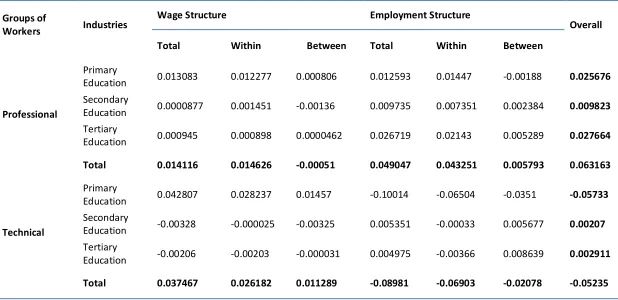
The motivation of this analysis can be divided into three rationales. First, there is a need to investigate the demand for skill propositions in three categories of sub-sector in education sector. Secondly, there is a need to classify which of the effects of skill proposition are dominant to technological change or trade; and finally, the changes of skill proposition are measured to determine if it derives from employment effects or wage effects. Hence, these analyses will help to determine the factors that affect the changes in demand of skills proportion in education sector.
Table 3: The Aggregate Change in Skill Proportion over the Period 2002-2007 of Education Industry
Groups of
Workers Industries
Wage Structure Employment Structure
Overall
Total Within Between Total Within Between
Professional
Primary
Education 0.013083 0.012277 0.000806 0.012593 0.01447 -0.00188 0.025676
Secondary
Education 0.0000877 0.001451 -0.00136 0.009735 0.007351 0.002384 0.009823
Tertiary
Education 0.000945 0.000898 0.0000462 0.026719 0.02143 0.005289 0.027664
Total 0.014116 0.014626 -0.00051 0.049047 0.043251 0.005793 0.063163
Technical
Primary
Education 0.042807 0.028237 0.01457 -0.10014 -0.06504 -0.0351 -0.05733
Secondary
Education -0.00328 -0.000025 -0.00325 0.005351 -0.00033 0.005677 0.00207
Tertiary
Education -0.00206 -0.00203 -0.000031 0.004975 -0.00366 0.008639 0.002911
The demand for professional workers in the primary education sub-sector also rises as a result of the increasing number of programmes at that level. During the sample period, the demand for professional workers was increased in primary education sub-sector. This factor was due to increasing in programmes at primary levels. In line with the thrusts of the Education Development 2001-2010, human resource development programmes continued to give priority to pre and primary education levels by including children with special needs education for example children with Dyslexia and Down Syndrome. Apart from this, there are other programmes drawn to suit the culturally sensitive population such as programs to motivate children of Malaysia’s Orang Asli and other indigenous communities to enroll and complete their primary education. One of the initiative under this programmes is organized by the Ministry of Education (MoE) and the United Nations Children’s Funds (UNICEF) through remedial programs of story telling techniques in the classroom and the use of story books to capture the imagination of close to 6000 Orang Asli children. The ultimate aim of these programmes is to encourage reading habits and improve writing skills. According to MoE, an estimated 14 percent of Orang Asli children of primary school age do not attend school and more than half drop out before reaching year 6 of primary education. Hence, the implementation of these programmes is needed to stimulate and ensure the sustainable growth in the development of human capital. Without special and focused attention, these children are likely to be trapped and forgotten in their childhood world of negligence and violence, and the possibility of being lured by unscrupulous adults into gang, drug peddling and sex work. Needless to say, all these intricate programmes require special talent, experienced and professional workers.
For instant, during the period 2004 to 2005, the number of teachers with degree levels of qualification increased to 15.7 percent while non-graduate teachers decrease by 54.6 percent (Midterm Review 2001-2006). English as the medium of instruction in schools was implemented in 2003 for mathematics and science subjects. These teachers were supplied with computers and computer aided teaching tools to increase their competency and quality of teaching. These facts are evidence of why there exists a strong demand for professional workers in primary education sub-sector during the period of this study.
Another interesting finding in this study is the dominance of technological changes which is apparently noticeable in the current situation in Malaysia. The use of information technology as a catalyst of technological change is widespread even at primary level education sub-sector through the implementation of the smart school pilot project in 87 selected schools. In 2001, the computer infrastructure project was launched to widen the coverage of computer aided teaching and learning and as a result, 29 percent of schools in Malaysia has internet connection installed by the end of the introduction year. At tertiary education sub-sector, four new universities were established in year 2000 to facilitate the teaching and learning of critical field in science and technology, engineering and related areas with the hope to stimulate innovation. These universities are University Tun Hussein Onn Malaysia (UTHM), Universiti Teknikal Malaysia Melaka (UteM), University Malaysia Pahang (UMP) and University Malaysia Perlis (UNIMAP).
is rising steadily during the sample period. Rising demand of employment in professional workers in the education sector is driven by the changes in positive shocks of technological change and the effects of falling real wages in other sectors.
If comparison is to be made with other sectors, the education sector would be the one which shows a unique increasing trend in employment structure as well as in real wage. As shown in Table 3 the changes in employment structure of professional workers show an increase of 202 percent whilst the changes in real wage increase to 208 percent. Looking from real wage perspective, these results indicate that the pattern of employment and wage structure are quite balanced in the education sector. This situation is lead by the involvement of private enterprises in education sector which put a healthy pressure on the increasing trend of the real wage. During the period of this study, it was observable that the number of private enterprises participating in the higher education sector grew larger to converge with the need of increasing the number of higher education learners. Three private universities were established, namely, University Tunku Abdul Rahman, University Teknikal Kuala Lumpur and Open University. Moreover, most of the cases of imbalance in the labour market between employment and wage structure are due to wage inequality. Wage inequality happened because of the flexibility in labour market and the influx of foreign workers from other countries. In Malaysia the involvement of foreign workers in the education sector only occurs at expatriate levels. This situation has prevented real wage from declining in the education sector.
Table 3 also shows the demand for technical and associate profesionals workers in education sector. The overall trend shows that the demand for technical and associatiates profesioanal workers decreased by 5 percent during the period of study. The main contributor for this change is led by the decreasing demand for technical and associates profesioanal workers at primary education sub-sector followed by tertiary education sub-sector. This situation is attributed by the nature of the work itself. At primary education sub-sector, the number of technicians and associate professionals are decreasing because with the positive shocks of technological change, we can easily solve our problem using self manuals and guidance from internet. Under the Education Development Master Plan 2001/2010, skills training are provided to teachers to encourage multi-tasking work and reduce the labour cost. Recalling the definations of this type of workers, technicians and associate professionals are those performing mostly technical and related tasks related to research and the application of scientific or artistic concepts, operational methods, government or business regulations and teach at certain educational levels. Most occupations in this major group require skills at the third level. In conclusion, the changes in skill proposition in education sector are inclined towards professional workers where by these changes are congruent with the Malaysian Development plan.
5. Conslusion
sectors. The main causes of these changes were dominant by factor specific shocks (within effects). At tertiary education sub sector, employment structure is more dominant compared to wage structure. However, at primary education sub sector, wage structure is more dominant compared to employment sector. Contradictory, the demand for technical and associated professional workers was favor to primary education sub sector and employment structure was the dominant determinant.
There are several possible reasons for the observed changes in Malaysia’s labour market during the period. Transition of the economy from manufacturing to knowledge based economy was in conflict with the educational system and the development of human capital. In that Malaysia lacked the skilled workforce necessary for economic development. Initially, in the Fifth Malaysia Plan (1986-1990) it began to focus on transition to manufacturing sector and the Sixth Malaysia Plan stress on human capital development. Until these policies had an effect on the labour market the country relied on bringing in foreign labour to meet the mismatch between supply and demand.
References
Harbinson, F. and Myers, C. A. (1964). Education, Manpower, and Economic Growth: Strategies of human resource development. New York: McGraw-Hill.
Liu, J.T. Tsou, M.W. and Hammit, J. 2001. The Impact Of Advanced Technology Adoption On Wage Structures: Evidence From Taiwan Manufacturing Firms. Economica 68. pp. 359-378.
Malaysia 2010. Tenth Malaysia Plan (2011-2015). Kuala Lumpur: Government Press.
Malaysia, B. N. 2004. Annual Report 2003. Kuala Lumpur:
Malaysian Manufacturing Sector. Asian Economic Journal 17(2), pp. 325-340.
Manasse, P. Stanca and Turrini. 2004. Wage Premia and Skill Upgrading in Italy: Why Didn't the Hound Bark? Labour Economics 11, pp. 59-83.