Creating and Employing On-line
Dynamic Learning Objects for an
Introductory Programming Module
Poppy Pickard , Peter Chalk and Ray Jones
Department of Computing and Electronic Technology, Bolton Institute of Higher Education, United Kingdom Department of Computing, Communications and Mathematics, London Metropolitan University, United Kingdom
The paper shows how learning objects can be designed to promote a constructivist learning environment whilst maintaining flexibility for reuse and repurposing. These learning objects, which support an introductory Java programming module, are employed across two UK HE institutions that both use the same virtual learning environment(WebCT)to link to these objects, together
with a graphic software library creating a rich and varied learning environment. Collaboration was ongoing during the parallel process of development and delivery. The first semester is evaluated, and suggestions are made for future work.
Keywords: learning objects, pedagogy, VLE, program-ming, Java, repurposing, visualisation.
1. Introduction
Succesful learning takes place when learners are able to construct their own meaning and under-standing from a rich and varied pallette of learn-ing materials. Creatlearn-ing such an environment can be costly for a single author, particularly if the learning materials are single use. This paper tracks the development and use of freestanding and reusable learning objects for the teaching of an introductory Java programming module. The context in which this development took place was within two UK institutions, London Metropolitan University and Bolton Institute of Higher Education. UK universities are increas-ingly dealing with a larger and more diverse study body, particularly in popular disciplines like computing. This in turn has resulted in a growing national concern regarding the teach-ing of introductory programmteach-ing. An
increas-ing number of students claim to find program-ming difficult and try to avoid it during later stages of their degree course. Even universi-ties with students with higher entrance qualifi-cations than the two in this study, report on this trend. 6]
In response to this problem a study of first year programming was undertaken at London Metropolitan University (formerly University of North London) between 2001-2002. The study, which recommeded pedagogic principles such as congnitive apprenticeship and a spiral curriculum for confidence building, was a cata-lyst for the development of the learning objects and graphic software library described in this paper.
A development team was formed in spring 2002 to take this forward. One of the team subse-quently moved to Bolton Institute of Higher Ed-ucation which enabled the planting of the work in a second institution at developement stage. After an exciting first semester of using these new learning materials, the project is showing very promising results.
2. Pedagogic Context
difficulties, which can mean that when errors occur the learner often cannot “see” what is happening. This can give rise to a lowering of confidence, in particular for mature learners, who make up a considerable part of our student body.
The project sought to address these issues by providing a rich and supportive environment in which visualisation was a key factor. 9] The learning environment would use a cognitive apprenticeship model, where students would be encouraged to develop the cognitive skills nec-essary for programming in Java, whilst being encouraged to extend their knowledge through exploration and investigation. 3]
The structural aspects of the Java language would form the subject matter for learning ob-jects which would be visually rich using an-imated explanations, simulations and quizzes giving immediate feedback. Programming prac-tice would use a complementary graphic soft-ware library that would scaffold students in the initial stages of learning by hiding some of the complexity of Java and giving visual feedback. Even using "public static void main" can be dif-ficult for beginners.
The order of teaching was designed so as not to overload students with too many variants of essentially the same topic. For example many programming courses teach all three types of iteration or loops at once, and introduce all the data types at once, which can cause confusion for the novice programmer. The aim of this de-sign was to provide a spiral curriculum where topics are introduced and then revisited to give additional variations or deeper meanings. 7]
3. Learning Object Design
Much work has been emerging over recent years on standardization and packaging of learning objects by organisations like the IMS and IEEE. This work has no doubt influenced and accel-erated the development of e-learning materials, fostering the important precepts of reusability, extensibility, accessibility, flexibility, interoper-ability.
The IEEE standardization draft defined learning objects as:
“a learning object is defined as any entity, digi-tal or non-digidigi-tal, that may be used for learning, education or training.” IEEE 5]
This is a very broad definition and is pedagog-ically neutral. Thus there is no reference to the size, scope or authoring of any learning object. Boyle suggests:
“there is a marked limit to the productive reuse and repurposing of learning objects that have not been designed for these purposes in the first place.” 2]
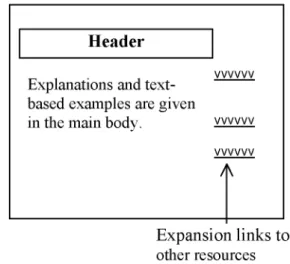
From a theoretical perspective Boyle 2]goes on to argue for a design that synthesizes software engineering and pedagogic principles. Good commercial software from its inception is de-signed to be maintainable, often achieved thro-ugh modularity. A learning object needs to be cohesive, i.e. to do one thing and one thing only. Thus a learning object could be mapped to a learning outcome or some clearly stated learn-ing goal. There should be minimal bindlearn-ing or interdependency between learning objects, i.e. the educator should be able to use them in any desired order. Boyle calls this the principle of ’decoupling’, which is critical for re-use. In order to provide pedagogical richness a pound learning object was conceived. The com-pound learning object is presented through a single web page, Figure 1, featuring a header for the title; a main body where a complete and succinct exposition and example of the learning content is given. This could itself be seen as a learning object and is indeed referred to as a text learning aid later in this paper. The right-hand
column is used for autonomous links, which offer a variety of independent extension activi-ties, e.g. visualizations using Flash animations, further examples, quizzes, etc.
The compound learning object layout is very simple, the URL expansion links in the right hand column are purposely separated from the main text to give the level of modularity that will ease maintenance and future repurposing providing a second level of decoupling.
3.1. Development Work
Development of compound learning objects star-ted around July 2002, the academics were re-sponsible for the design of each compound learning object and they worked closely with a developer who created the main page of each compound learning object to a standard format taking into account all the recent accessibility legislation. 10] A multimedia developer was responsible for the Flash animations. These compound learning objects underwent a spiral development process. Through discussions be-tween the academics and developers various im-provements and standardisations were brought into use. More than half of the learning objects were in place when delivery of the new Java modules started in autumn 2002. Later learning objects were authored and developed during the semester with almost daily conversations be-tween team members in London Metropolitan University and Bolton Institute.
3.2. Example Compound Learning Object
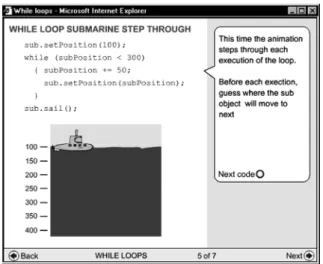
To date, 50 learning objects have been devel-oped. Figure 2. shows part of a link from a compound learning object about While Loops.
This is a page from an animated description of a Java while loop, which shows a submarine moving down through the water as its position, is changed.
The learning objects are complemented by a graphic software library, which is used in the programming environment.
Fig. 2. Learning object animated explanation.
4. The Graphic Software Library
The graphic library was written to complement the pedagogy of the project. Students receiving a visual output from a program could construct their own interpretation of this output and feel motivated to use different inputs to test that un-derstanding.
The graphic library was designed around two packages. One package provided classes for primitive shapes such as rectangles, ovals and lines, as well as a die, which could be rolled to give a value from 1 to 6, and a text output facil-ity for writing on the output window. The sec-ond package of utilities included an input box and a timer. Java was taught from an object’s first approach where the students would first learn to create and use objects from pre-written classes. Although an object’s first approach is the subject of much debate, it has been imple-mented successfully in many contexts. 1, 4] It can also be argued that from a standing start as a programmer, it is easier to learn the objects paradigm from the outset, rather than meet it af-ter having learnt to program procedurally. The graphical screen objects also provided a perfect metaphor for Java objects making it a natural route to follow.
of the graphic library are all visible to the stu-dents so they can at any time explore the code in these classes and see how, for example, in-heritance has been used to simplify the writing of classes.
The familiar programming constructs such as iteration are used to animate the graphic objects or a decision could be made on the result of ’rolling’ a die object.
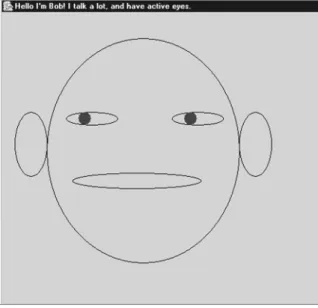
Students were often invited to ’create’ their own graphic pictures from the classes available to them. For example in Figure 3 one student used loops to create a face with moving eyes and an opening and closing mouth, from a simple filled and unfilled oval. Animations such as these are fun and motivating.
Fig. 3.Graphic picture.
The Integrated Development Environment(IDE) JCreatorLE was chosen for use with the soft-ware library. It is produced by Xinox Softsoft-ware and is freely downloadable. It is reasonably easy to install on top of Sun Microsystem’s Java 2 Software development Kit and it also allows the creation of application templates which were utilised for holding the graphic software library.
5. Employment of Learning Objects
The learning objects were made available to students through a virtual learning environment
(VLE). A VLE is a piece of software that can
manage a student group, deliver learning con-tent, provide assessment, discussion and mail facilities. The one used for this project was We-bCT 11]. London Metropolitan University had many years experience of using WebCT, Bolton Institute of Higher Education was in its first year of using this VLE. One advantage of using WebCT, apart from its commonality between the two institutions, was the tracking facility it offered. It is possible to collect data for use of a single page, in this case a learning object. Besides linking to the compound learning ob-jects the VLE contained lecture slides, weekly practical programming activities based around the learning aids, sample Java code, feedback from weekly practicals.
The testing facility of WebCT was used for sur-veys and multiple choice quizzes which formed part of the assessment. Writing of multiple choice questions was shared between the two in-stitutions, meaning a sufficiently large database of questions was created to allow each question to be chosen randomly from a set of questions on a particular topic.
A selected programming exercise was uploaded to the WebCT assignment page each week for marking and feedback. Each of these pro-gramming exercises could earn 1final module mark, which proved very motivating. Super-vised timed programming exercises were given on two occasions as part of the more formal as-sessment; again these were uploaded and mark-ed within WebCT. Each student therefore had access to his or her assessment results to date within the VLE. Students also made good use of the discussion and e-mail provided by WebCT there was some useful sharing of programming tips as well as the inevitable queries to the mod-ule tutor. There was very much a sense in which the students became a community of learners within the VLE. 12]
6. Evaluation
An evaluation framework for the first semester was managed by a researcher who was part of the design team. Students responded to three questionnaires, start, mid and end of semester, together with individual interviews conducted several weeks into the course. WebCT pro-vided page-tracking statistics to monitor the use of learning objects.
The in-course assessment and examination pro-vided further basis for comparison together with results from previous cohorts taking the same subject.
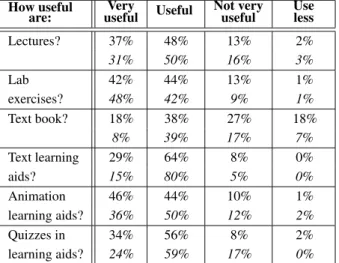
The mid semester questionnaire(Figure 4.) gi-ves a reflection of student opinion half way through the module. It is surprising how closely the Bolton and London opinions match de-spite the difference in student bodies: Lon-don Metropolitan University with 600 students studying for HND, BSc and MSc again on a variety of computing courses and Bolton with 120 students studying for a BSc in a range of computing disciplines such as Computer Games Software Development. The age profile of the Bolton students is lower than that of London students, the cultural diversity at Bolton is nar-rower than London and it is also only 5% female compared to 25% in London.
How useful
are: usefulVery Useful Not veryuseful Useless
Lectures? 37% 48% 13% 2%
31% 50% 16% 3%
Lab 42% 44% 13% 1% exercises? 48% 42% 9% 1%
Text book? 18% 38% 27% 18%
8% 39% 17% 7%
Text learning 29% 64% 8% 0% aids? 15% 80% 5% 0%
Animation 46% 44% 10% 1% learning aids? 36% 50% 12% 2%
Quizzes in 34% 56% 8% 2% learning aids? 24% 59% 17% 0%
Results for London in normal type, and forBolton in Italic.
Fig. 4.Results from questionnaire — usefulness of module components.
Students are showing a very positive response to the learning objects(referred to in the course as
learning aids)and also the lab exercises which were based around using the graphic software library.
Further feedback on learning aids was sought through structured interviews primarily under-taken at London Metropolitan University. Stu-dents were asked if they had used a specific learning aid, 78% had used the text based aid and 81% the animated learning aids. Some of the students’ comments give more insight into their views.
Usefulness of text-based learning aids:
“Good – better than reading a big book. Bet-ter on the eye.”
“Very useful – no problem understanding it.” “Not useful – would prefer more teaching.” Usefulness of the animated learning aids:
“Good, you can see the code, shows what’s going on when you press run. Interactive.”
“Good – shows step by step the program. Animations help a lot.”
“Nice, but no code – can’t make the hammer or nail in Java or the horse run.”
Usefulness of the quizzes:
“OK – helps you to look closely at the syntax of the code to get the right order.”
“Good – reconfirms you know what you’re doing.”
“OK – not hard enough or complex enough.” The best feature of the course:
“Learning aids very helpful as I don’t have all the books.”
“Everything is on the web. Can access from home.”
The majority of the comments listed above are positive in keeping with the pattern of the ments made. The proportion of negative com-ments made about the learning aids was about 12%.
The end of module results have shown a marked improvement in both institutions,when compar-ing pass rates with the previous year(Figure 5). The figures are for those completing the mod-ule.
Percentage
Course Increase in Pass
Rate MSc London Metropolitan +12 HND London Metropolitan +15 BSc London Metropolitan +19
BSc Bolton +23
Fig. 5.Increase in pass rates.
It is perhaps yet early to conclude which aspect of a radically changed course has led to this success.
7. Ongoing and Future Work
The Java module is continuing to be taught dur-ing the second semester in both institutions, but with smaller cohorts. A second version of the graphic software library has now been written and this is being piloted at Bolton. Some un-used code has been removed from the classes in order to improve readability.
The learning objects will remain the same for this semester pending the completion of the evaluation. A future aim of the learning ob-ject work is to create a shareable repository that can be used across different universities and managed by the LTSN (Learning and Teach-ing Support Network)National Subject Centre for Information and Computer Sciences part of which is based at London Metropolitan Uni-versity 8]. This is in line with the e-learning movement nationally which is working towards standardization and reuse.
8. Acknowledgements
Our thanks to the following who have also made valuable contributions to the development of this work. Claire Bradley of the Learning Technology Research Institute which is based
at London Metropolitan University, who man-aged the development of the learning objects and conducted the London part of the eval-uation; Richard Haynes of the Teaching and Learning Techology Centre London Metropoli-tan University, who wrote the Flash code for learning object animations and Professor Tom Boyle project leader.
References
1] BERGIN J., Why Procedural is the Wrong
First Paradigm if OOP is the Goal. 2000
http://csis.pace.edu/ bergin/papers/ Whynotproceduralfirst.html28/2/2003]
2] BOYLET., Design Principles for authoring dynamic,
reusable learning objects. Accepted for publication in Australian Journal of Educational Technology
(AJET)2003, 19(1).
3] COLLINSA, BROWNJ, NEWMANS.,Cognitive
Ap-prenticeship: Teaching the Crafts of Reading, Writ-ing and Mathematics, NJ: Lawrence Erlbaum; 1989, pp. 453–495.
4] GREY D, MILES M., Teaching Java
Objec-tively – Reflections on a Web-based Java Course, in: The Sixth Annual Java & the Internet in the Computing Curriculum Con-ference, University of North London 2002.
http://www.ics.ltsn.ac.uk/pub/jicc6/
3/3/2003]
5] IEEE Draft Standard for Learning
Ob-ject Metadata 2002]. pp. 6. http://ltsc.
ieee.org/doc/wg12/LOM WD6 4.pdf
26/2/2003]
6] JENKINS T., On the difficulty of learning
to program, in Proceedings of 3rd An-nual conference of the LTSN-ICS, 2002.
http://www.ics.ltsn.ac.uk/pub/conf2002/ jenkins.html6/3/2003]
7] KOLB D.A., Experiential Learning, Englewood
Cliffs: NJ, Prentice-Hall; 1984.
8] LTSNhttp://www.ltsn.ac.uk/9/5/2003] 9] PETREM., BLACKWELLA. & GREENT., Cognitive
Questions in Software Visualization, in Stasko et al.(Eds.)Software Visualization: Programming as
a Multimedia Experience, MIT Press; 1998. pp. 453–480.
10] SLOAN D., Creating Accessible e-learning
con-tent in Access All Areas: disability, tech-nology and learning, pp. 35–38, http:// www.techdis.ac.uk/accessallareas/AAA.pdf
5/3/2003]
11] WebCThttp://www.webct.com/9/5/2003] 12] WENGERE., Communities of Practice: Learning,
Received:June, 2003 Accepted:September, 2003
Contact address: Poppy Pickard Department of Computing and Electronic Technology Bolton Institute of Higher Education Deane Road Bolton BL3 5AB United Kingdom e-mail:[email protected] Peter Chalk, Ray Jones Department of Computing, Communications and Mathematics London Metropolitan University Holloway Road London N7 8DB United Kingdom e-mail:[email protected] k
POPPYPICKARDteaches programming at Bolton Institute of Higher Edu-cation. Her research interests are in the use of e-learning environments and the pedagogic effectiveness of learning objects.
PETERCHALKteaches introductory programming to very large courses
at London Metropolitan University. His main research interest is in the use of on-line technologies to support the diverse learning needs of a modern student.