Quick Adaptation of Web-Based
Information Systems with
Aspect-Oriented Features
Sa
so Greiner, Simon Tutek, Janez Brest and Viljem
ˇ
Zumer
ˇ
University of Maribor, Faculty of Electrical Engineering and Computer Science, Maribor, SloveniaAspect-oriented programming paradigm 4] has proven
to be a viable approach to simplifying complex software systems. We are particularly concerned with systems where basic functionality interlaces with more specific and repetitive tasks such as exception handling, log-ging or message redirection. Aspect-oriented approach enables separation of concerns 19] which are better
designed independently, but must operate together. We have extended this approach to distributed enterprise web-based information systems based on J2EE platform.
Keywords: information systems, J2EE, web applications, aspect-orientation, modification, adding functionality.
1. Introduction
Aspect-oriented programming(AOP)paradigm is an emerging discipline which has proven suc-cessful in simplifying complex software sys-tems. AOP is a technique to express modular and orthogonal adaptations of existing software components10]. The main idea behind aspects is separation of concerns in software design. Ideally, aspects are designed and implemented independently and then incorporated into a sin-gle environment to operate in a cooperative way. When software matures, it often gets more com-plicated as well. Modifying or adding new functionality to an existing large-scale system may be extremely difficult or even impossible at times. Aspects may be used to assist in situ-ations like that. Additional functionality can be represented as an aspect which is then interwo-ven into existing software model.
We show how aspect orientation is used in an enterprise web-based information system 22]
which we have been developing for the past two years. The system is built on top of J2EE application environment to achieve maximum scalability, portability, and efficiency. The evo-lution process of our system is like that of many industrial-strength production systems. Changes and additional demands which have not been present in the design phase, are oc-curring. Aspects come in where existing func-tionality must be altered in a transparent way to retain any dependencies between software modules. We have implemented almost all ad-ditional functionality through the use of aspects. These include authentication mechanisms, log-ging facilities, and some presentation aspects. J2EE servlet techology provides an excellent way to apply aspects to existing functionality of web applications. This is achieved by in-put and outin-put servlet filtering. A very simple pragmatic example is reroute aspect. If a mul-titude of web applications reference a single web application to acquire some service, and only some of those applications suddenly need a service with additional functionality, then the reroute aspect is applied in a transparent way only to those applications. Existing applica-tions need not be modified. The HTTP GET request may be viewed as a method invocation where web page within the application repre-sents the method’s name, with page parameters as arguments.
realised explicitly through method interposition
17], servlet filtering performs the same task in the background. Classic method interposition is promoted to HTTP request and response in-terposition. The mapping is almost 1:1, except that for standard method interposition proxy ob-jects and reflection features are the key factors. In addition to HTTP manipulation, language level aspects3, 6]may be used in conjunction. Aspect-oriented frameworks which enable dy-namic weaving 8, 9] obviously provide much greater flexibility in defining and applying as-pects. Servlet filtering allows chaining, which enables us to successively apply aspect mod-ules which have been designed separately. This also means that we may insert new or remove existing aspect modules from operation.
We will present examples of problematic situa-tions that frequently occur in real-time software systems and are difficult to solve. In our discus-sion we will remain oriented towards Java and J2EE software platform based on it.
In section 2 we present an architectural overview of J2EE servlet filtering and how it may be ex-ploited to apply certain aspects to existing func-tionality. In section 3 we present an example of a real world enterprise information system which requires additional functionality, but can-not have its code changed. Section 4 gives some additional possibilites of using aspects and, fi-nally, section 5 concludes with brief notions on related and future work.
2. Architectural View
J2EE is a software platform for large-scale en-terprise applications which operate in a dis-tributed object-oriented environment. The pri-mary language of J2EE is Java. Architectural design enforced by J2EE has been successfully applied to many industrial environments with high demands for stability, scalability, and ge-neral efficiency.
We are concerned with web applications be-cause the trends nowadays require access and platform transparency. The feature which is at the core of aspect-orientation is message inter-position(interception). The message is usually a method invocation5], but in the case of a web
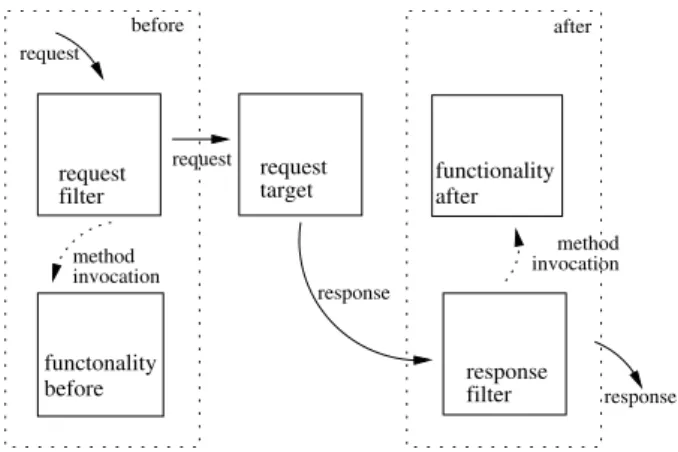
application the message is wrapped within the client request. In order to intercept a message certain mechanisms are needed. In Java, this may be achieved with AspectJ. In web environ-ment, servlet request and response filtering7] are used. Servlet filtering mechanism is closely related to composition filters1, 2]. It should be stressed that request and response interception cannot realise all possible aspects, but they can be used to implement most of them. We have two join points – before and after, which are used to apply additional or alternative functio-nality(Figure 1).
filter response
response invocationmethod request
request
method invocation
target request
filter
request
functonality before
functionality after
response
before after
Fig. 1.Request/response-based join points for aspect
applicationbeforeandaftertarget functionality.
Pointbeforeexecutes advice before the request reaches its target destination. Similarly, point
after captures response after the request has been processed and just before it is sent to the client. Both points are realised within the
doFiltermethod:
public void doFilter(ServletRequest r, ServletResponse s, FilterChain c) throws IOException,
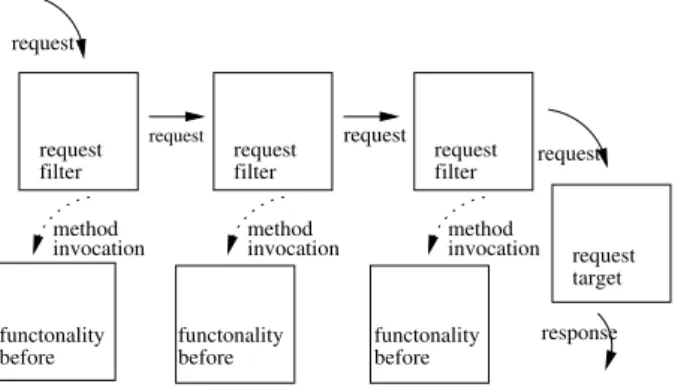
To ensure simple and efficient management of software, the architecure must be designed in a component-oriented fashion. This is also re-flected in the design and implementation of fil-ters. Because filters may be very complex and diverse in their functionality, they should be de-signed and deployed as independent modules. To achieve successive applications of multiple filters, they are placed in a filter chain. If we represent filter withα, we may write filter chain withnfilters as
α1 α2 ::: αn
or shortly
Y
1 i n αi
Filter chain does have some dynamics built into it, because it allows modification at run time. Existing filters may be removed or altered and new ones inserted(Figure 2).
before functonality
before functonality
before
functonality response request
request request
request
request target method
invocation methodinvocation methodinvocation request filter request
filter request
filter
Fig. 2.Request-based filter chain.
Filters are used to model aspects. But, instead of subjecting all servlets and/or JSP pages within a single web application to a specific aspect, only certain servlets/JSP pages may have their advices realised. This is because not all pages in an application need the same treatment. Se-curity aspect, for example, may be applied to the controller servlet in an MVC 20] applica-tion, but not to other JSP pages. Another ex-ample is the logging aspect which is applied only to action servlets, i.e. those that actually perform some action. It would make no sense to apply logging aspects to every single page
or servlet in an application. Selection of des-tination where aspects will be applied is done through standardised web application configu-ration web.xml. Join point before may also
be used to implementinstead-of pattern that
comes in handy at message redirection which may then be used in applying alternative func-tionality.
3. Rapid Adaptation with Aspects – a Practical Approach
3.1. Motivation
High availability of information infrastructure is cruical. Because the total cost of down-time in an enterprise environment is potentially devastating, the companies cannot afford such fallouts of business. When changes in exist-ing functionality, either because of failures or system inefficiency are to be made, they should be applied as rapidly and transparently as pos-sible. Availability is sometimes so important that adaptation must be carried out with system remaining in operation.
3.2. Implementation
<web-app> <description>
Storage application. </description>
....
<!-- filters --> <filter>
<filter-name> Authenticator </filter-name> <filter-class>
system.auth.Authenticator </filter-class>
</filter>
<filter>
<filter-name>
StorageAuthenticator
</filter-name> <filter-class>
storage.auth.StorageAuthenticator
</filter-class> </filter>
<!-- mappings --> <filter-mapping>
<filter-name> Authenticator </filter-name>
<url-pattern>/*</url-pattern> </filter-mapping>
<filter-mapping> <filter-name>
StorageAuthenticator
</filter-name>
<url-pattern>/actions.do</url-pattern> </filter-mapping>
<welcome-file-list> <welcome-file>
actions.do?action=showMyStorage </welcome-file>
</welcome-file-list> ....
</web-app>
Each filter is defined by putting its name and class betweenfiltertags and its mapping
be-tween filter-mappingxml tags.
Authentica-tion mechanism uses the before join point of
HTTP request. Current authentication is based on groups of people. This means that if a person belongs to a specific group and access rights of that group for a specific application are granted by the authenticator, that person is allowed access to application. Additional authentication is now transparently applied to a person that has already been authenticated by the global me-chanism. Second authentication is user-based, which means that not all users may access full application functionality, even though they may belong to a group which is otherwise allowed
access. If the authentication should fail, an ex-ception is raised and message delegated to the error page. Yet additional authentication rules
(location-based or time-based)could be imple-mented in a similar manner. It is significant to notice that this addition is applied transpar-ently, without any intervention in existing code. Existing Java classes need not even be recom-piled, because filtering does not modify code, but operates on request information instead.
4. Rapid Adaptation – Additional Possiblities
4.1. Manipulation and Validation of Request Parameters
Request signature consists of destination name and parameters. This is very similar to method signature in Java and other languages. The be-haviour of method is usually controlled by the values of its parameters. The same applies to request parameters which are passed asname= value pairs. Filtering allows manipulation of parameter names and their values. This is again very useful in retaining consistency between disparate web applications which were designed in the past, but must now interoperate with addi-tional funcaddi-tionality. Instead of altering the ap-plication itself, its request may be filtered and parameters manipulated to conform to newly defined signature.
If parameters may be modified, they can also be validated. This means validation of parameter names and their values.
4.2. Message Redirection
Message redirection is a well known pattern which proves to be very useful when one wants to transparently implement alternative function-ality. This is achieved by rerouting aspect which maps original message to an alternative one.
4.3. Around Advice
Performance evaluator is an aspect that takes advantage of bothbeforeandafterjoin points
HTTP HTTP request request
responseHTTP HTTPresponse functionality old
functionality alternative
performance filter starting
timer
HTTP request HTTP
request HTTP
request authentication
filter
logging
filter filter performance
filter instead−of
stopping timer logging
facility HTTP
request
method invocation method
invocation
HTTP response
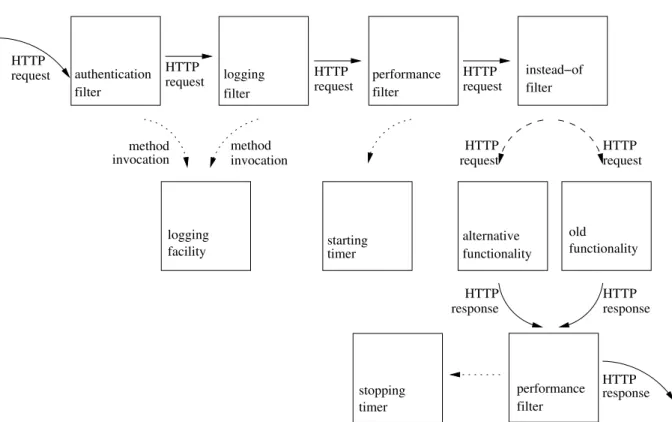
Fig. 3.Filtering facility for authentication, logging, and performance measurement.
time spent in processing the actual request. The design of filter servlet enables quick and ef-fective implementation of such measurements, because single method (doFilter) is used for filtering both request and response.
4.4. Putting It All Together
To efficiently implement all desirable aspects, we first need to properly design the filtering scheme. This includes resolving any potential conflicts that might occur after filters become operational. Another factor that should be con-sidered is overall efficiency. Because of ad-ditional functionality, filters may significantly increase response times when designed poorly. Our design of all aspects put together is shown in Figure 3. First filter in the chain is the au-thentication filter which is responsible for al-lowing or rejecting users to specific application. Next is the logging filter which logs actions performed. Next is perfomance filter which implements the around advice to measure re-sponse times. This is used mainly during devel-opment stage. Fourth filter is implementation of instead-of pattern which enables switch-ing between multiple functionalities. After the
request is processed, the prerformance filter is reactivated. It stops the timer and calculates performance indicators.
5. Conclusion and Future Work
We have shown how aspect features may be em-ployed as a mechanism for quick adaptation of existing functionality to an environment with new demands. Adaptation had to be carried out rapidly, without altering old code. Our real-life example demonstrates how separation of concerns using aspects not only gives cleaner approach to application development, but also provides more effective and modular adapta-tion.
Nevertheless, aspect-orientation and its features have been used in web environments and dis-tributed architectures. This is especially true for systems where security is among the princi-pal concerns16, 15].
Our future work will include design and imple-mentation with even more dynamics in apply-ing aspects to existapply-ing applications. This should obviate the need to write certain aspects from scratch, because they could be parametrised. This means that aspects are written in a more abstract way and then concretised with actual tasks. Dynamic features can also be added through the use of Java reflection mechanisms, which should allow true run-time modification of aspects themselves.
References
1] M. AKSIT, L. BERGMANS& S. VURAL, An
Object-Oriented Language-Database Integration Model: The Composition-Filters Approach, ECOOP ’92, LNCS 615, pp. 372–395, Springer-Verlag, 1992. 2] M. AKSIT, B. TEKINERDOGAN & L. BERGMANS,
Achieving Adaptability through Separation and Composition of Concerns, Issues in Object-Oriented Programming, pp. 12–23, 1997.
3] G. KICZALES, E. HILSDALE, J. HUGUNIN, M. KER
-STEN, J. PALM, W. G. GRISWOLD, An Overview of
AspectJ, Lecture Notes in Computer Science, vol. 2072, pp. 327–355, 2001.
4] G. KICZALES, J. LAMPING, A. MENHDHEKAR, C.
MAEDA, C. LOPES, J. LOINGTIER, J. IRWIN, Aspect-Oriented Programming, Proceedings European Conference on Object-Oriented Programming, vol. 1241, pp. 220–242, Springer-Verlag, 1997.
5] E. AVDICAUSEVIC ANDM. LENIC ANDM. MERNIK
ANDV. ZUMER, AspectCOOL: An Experiment in Design and Implementation of Aspect-Oriented Language,ACM SIGPLAN Notices, 36(12): 84–94,
December 2001.
6] R. HIRSCHFELD, AspectS-Aspect-Oriented
Pro-gramming with Squeak,Lecture Notes in Computer Science: International Conference NetObjectDays, NODe 2002, Erfurt, Germany, October 7–10, 2002. 7] S. ALLAMARAJU, C. BEUST, J. DAVIES, T. JEWELL,
R. JOHNSON ET AL., Professional Java Server Pro-gramming: J2EE 1.3 Edition, Wrox, September 2001.
8] A. POPOVICI, T. GROSS, G. ALONSO, Dynamic
Weaving for Aspect-Oriented Programming, Pro-ceedings of the 1st International Conference on Aspect-Oriented Software Development, April 2002.
9] K. B ¨OLLERT, On Weaving Aspects, International Workshop on Aspect-Oriented Programming at ECOOP99, 1999.
10] A. POPOVICI, T. GROSS ANDG. ALONSO, Dynamic
Homogenous AOP with PROSE,Technical report, ETH Zurich, Department of Computer Science, March 2001.
11] S. CHIBA, A Metaobject Protocol for C++,ACM Conference on Object-Oriented Programming Sys-tems, Languages, and Applications (OOPSLA’95), SIGPLAN Notices 30(10): 285–299, October 1995.
12] G. KICZALES, J. RIVIRES ANDD. G. BOBROW, The
Art of the Metaobject Protocol, MIT Press, 1991. 13] T. BREUEL, Implementing Dynamic Language
Fea-tures in Java using Dynamic Code Generation,
In Proceedings 39th International Conference and Exhibition on Technology of Object-Oriented Lan-guages and Systems, TOOLS 39, pp. 143–152, 2001.
14] M. O. KILLIJIAN, J. C. RUIZ-GARCIA AND J. C.
FABRE, Using Compile-Time Reflection for Ob-jects’State Capture, Lecture Notes in Computer Science, vol. 1616, pp. 150–156, 1999.
15] B. DE WIN, B. VANHAUTE AND B. DE DECKER,
Security Through Aspect-Oriented Programming,
Network Security, pp. 125–138, 2001.
16] B. DEWIN, J. VAN DENBERGH, F. MATTHIJS, B. DE
DECKER ANDW. JOOSEN, A Security Architecture for Electronic Commerce Applications, SEC, pp. 491–500, 2000.
17] J. PRYOR ANDN. BASTAN, A Reflective Architecture
for the Support of Aspect-Oriented Programming in Smalltalk,ECOOP Workshops, pp. 300–301, 1999. 18] N. BOURAQADI-SADANI, T. LEDOUX, F. RIVARD,
Safe Metaclass Programming, Proceedings of the 1998 ACM SIGPLAN Conference on Object-Oriented Programming Systems, Languages and Applications, OOPSLA’98, ACM SIGPLAN No-tices, vol. 33, no. 10, 84–96, October 1998. 19] R. J. WALKER, E. L. A. BANIASSAD ANDG. C. MUR
-PHY, An Initial Assessment of Aspect-Oriented Pro-gramming, International Conference on Software Engineering, pp. 120–130, 1999.
20] F. BUSCHMANN, R. MEUNIER, H. ROHNERT, P. SOM
-MERLAD, M. STAL, Pattern-Oriented Software Ar-chitecture: A System of Patterns, John Wiley and Sons, 1996.
21] B. DEWIN, B. VANHAUTE ANDB. DEDECKER, How
Aspect-Oriented Programming Can Help to Build Secure Software, Informatica 26(2002), no. 2, pp.
103–243, 2002.
22] S. GREINER, D. REBERNAK, B. BOSKOVIˇ Cˇ, J. BREST,
Received:June, 2004 Accepted:June, 2004
Contact address: Saˇso Greiner Simon Tutek Janez Brest ViljemZumerˇ University of Maribor Faculty of Electrical Engineering and Computer Science Smetanova 17 2000 Maribor, Slovenia Phone:++386-2-220-7458
Fax:++386-2-2511-178
e-mail:[email protected] [email protected]
SAˇSOGREINERgraduated in 2002 and is currently a teaching assistant
at the Faculty of Electrical Engineering and Computer Science of the University of Maribor. His research focuses on object-oriented pro-gramming languages, compilers, computer architecture and web-based information systems.
SIMONTUTEKhas been employed as technical staff in the Laboratory
for Computer Architecture and Programming Languages at the Faculty of Electrical Engineering and Computer Science of the University of Maribor since 2003. His fields of expertise are computer architecture, programming languages and web-based information systems.
JANEZBRESTgraduated in 1995, received his M.Sc. in 1998 and his
Ph.D. in 2001 from the Faculty of Electrical Engineering and Computer Science of the University of Maribor. He has worked in the Laboratory for Computer Architecture and Programming Languages since 1993. He researches web-oriented programming, parallel and distributed com-puting focused on task scheduling. His fields of expertise embrace also programming languages and optimisation research.