10
The Effect of Propolis Extract on Internal Quality
Parameters of Table Eggs
Henrieta Arpášová
*, Peter Haš
č
ík, Veronika Pistová,
Martin Mellen, Branislav Gálik, Martin Fik
Slovak University of Agriculture, 949 76 Nitra, Tr. A. Hlinku 2, Slovak Republic
Abstract
The aim of our experiment was to evaluate the influence of propolis extract on internal egg quality parameters of laying hens’ hybrid Hy-Line Brown. For housing hens (n=40) three storey enriched battery cage was used in which hens were divided in groups (n=10). In the control group of hens complete feed mixtures without any additions were fed. In the first experimental group complete feed mixture was enriched with propolis extract in a dose of 0.1 g.kg-1. In the second experimental group propolis extract was added to the feed mixture at a dose of 0.25 g.kg-1. The third experimental group was enriched with propolis extract in a dose of 0.4 g.kg-1. All groups were fed
ad libitum.
Complete analysis of the table egg quality was used to evaluate quality parameters: egg weight (g), albumen weight (g), albumen index, Haugh Units (HU), yolk weight (g), yolk index, yolk colour (HLR). The results show that supplementation of feed mixture with propolis extract in a doses 0.25 g.kg-1 and 0.4 g.kg-1 significantly increased egg albumen index and Haugh Units (p0.05) (values of Haugh Units of albumen in the order of the groups (mean±S.D): 79.87±7.23, 80.58±7.60, 82.11±8.36, and 81.66±9.16 HU). However, the addition of propolis extract in a same doses significantly decreased yolk weight (p0.05). The values of the other eggs quality indicators were comparable with the control group (p>0.05).
Keywords: egg quality, egg weight, laying hens, propolis extract
1. Introduction
Propolis is a bee product with a characteristic smell and excellent disinfection effects. Propolis is collected by bees from flower buds, parts of trees and plants secretions. The basis of propolis is sticky resin (oil) from growing up buds of trees and flowers. Bees collect resin, processed and mixed with enzymes and wax to propolis [1]. Propolis is used in the pharmaceutical industry, in human and veterinary medicine [2]. Propolis is composed of 30% wax, 50% resin, 10% of essential oils, 5% pollen and other substances. It was shown to contain iron, calcium, copper,
* Corresponding author: Arpášová Henrieta
Email: [email protected]
11 the resin harvested. Administration of propolis increases the production of immunoglobulin G, specific for natural antibody and can be used to increase the specific immune response after vaccination [11].
The basis of propolis is a sticky resin [1]. Propolis is natural substance and harmoniously balanced with a strong antibiotic, immunostimulating, anti-inflammatory and antibacterial effects [9]. Its biological characteristics improve immune response, depending on the concentration and the dose intensity. Antimicrobial activity of propolis but strictly related to its physical structure [10]. The composition of propolis depends on the tree species from which oil is harvested. Propolis can be used to increase the specific immune response after vaccination. Freitas et al., 2011 [11] and Sahinler et al., 2009 [12] observed favorable effect of propolis extract on the chemical composition of internal egg quality. Laying hens reared under tropical conditions are usually under heat stress. Propolis is known for its pharmaceutical properties, such as increasing cell tolerance to hyperthermia, because of its antioxidants effects [13].
The aim of this work was to observe the influence of various doses of propolis extract additions on internal quality parameters eggs of Hy-Line Brown laying hens.
2. Materials and methods
Animals, diets and treatments
In this experiment 80 17-wk-old Hy-Line Brown layers were distributed according to a completely randomized experimental design into four treatments dietary propolis extract inclusion levels, with two replicates of ten birds each.
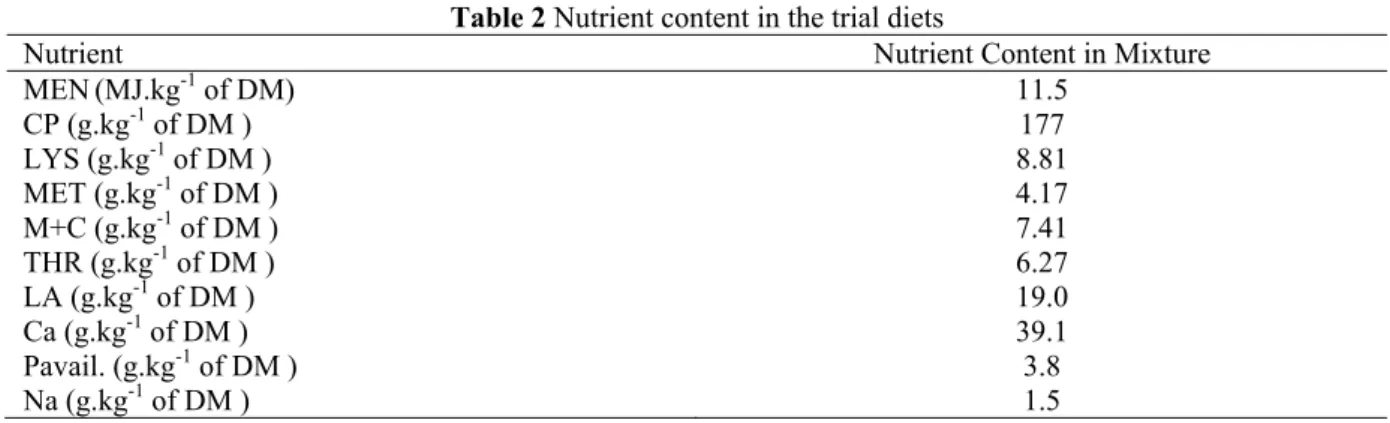
At the beginning of the experiment, the hens were kept in the three–deck cage technology system. The technology system was in accordance with requirements specified by the Directive 1999/74 EC. The layer hens were kept by the standard bioclimatic conditions. Experiment lasted 23 weeks. The composition of the basal diet (BD) fed to the laying hens is shown in Table 1 and Table 2. Analysis of feed mixture was realized on the Department of animal nutrition of SPU in Nitra.
Table 1 Composition of the trial diets
Component Participation in the Diet (%)
Wheat 26.30
Rye 15.00 Barley 20.00
Soybean meal (47% crude protein) 22.00
Soybean oil 2.50
Fat 2.00
Monocalcium phosphate 1.70
Calcium carbonate 9.14
Natrium chloride (38% Na) 0.30
Sodium bicarbonate (28% Na) 0.10
Methionin (99% DL-Methionin) 0.16
Vitamin Premix 0.40
Mineral Premix 0.10
Choline chloride 0.20
Caroten premix 0.10
In the control group hens received feed mixture without additions. The diets in the first, second and third experimental groups were supplemented with 0.1, 0.25, and 0.4 g/kg propolis extract. Laying hens accepted fodder ad libitum. Propolis samples were collected from Slovak Republic. Hand collected propolis samples were kept dried
12
Table 2 Nutrient content in the trial diets
Nutrient Nutrient Content in Mixture
MEN (MJ.kg-1 of DM) 11.5
CP (g.kg-1 of DM ) 177
LYS (g.kg-1 of DM ) 8.81
MET (g.kg-1 of DM ) 4.17
M+C (g.kg-1 of DM ) 7.41
THR (g.kg-1 of DM ) 6.27
LA (g.kg-1 of DM ) 19.0
Ca (g.kg-1 of DM ) 39.1
Pavail. (g.kg-1 of DM ) 3.8
Na (g.kg-1 of DM ) 1.5
*MEN: metabolisable energy for poultry, CP: crude protein, LYS: lysine, MET: methionine, M+C: methionine plus cysteine, THR: threonine, LA: linoleic acid, Ca: calcium, Pavail.: available phosphorus, Na: natrium.
Sample Analysis
Eggs of laying hens of Hy-Line Brown strain were collected regularly one a month (n=30 per group) and were assessed immediately after collection. The egg weight (g), egg yolk weight (g), egg yolk index, egg yolk color (HLR), albumen weight (g), egg albumen index and Haugh units (HU) were evaluated. All these parameters were detected using routine methods. Weight parameters were detected using analytical weighting machine and the growth intensity and percentage contents were calculated from weight data. Indexes were calculated as the length: width ratio. Haught units (HU) detected egg quality as relation of albumen weight and egg weight [100 log.(dense albumen height–1.7x egg weight0.37 + 7.6)]. Yolk color was
evaluated using Hoffman la Roche color scale (Hoffman–La Roche, Switzerland).
Statistical analysis
Statistical analysis was done using one–way analysis of variance (ANOVA) with the post hoc Duncan’s multiple comparison test in the program SAS.
3. Results and discussion
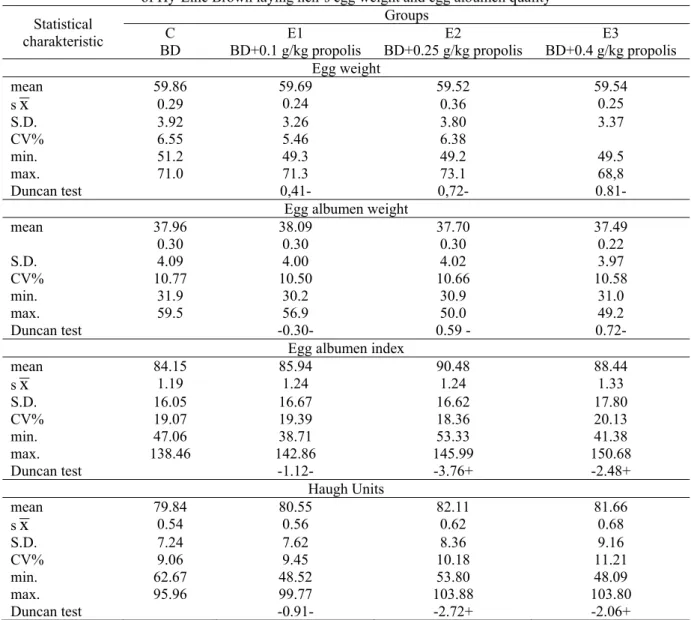
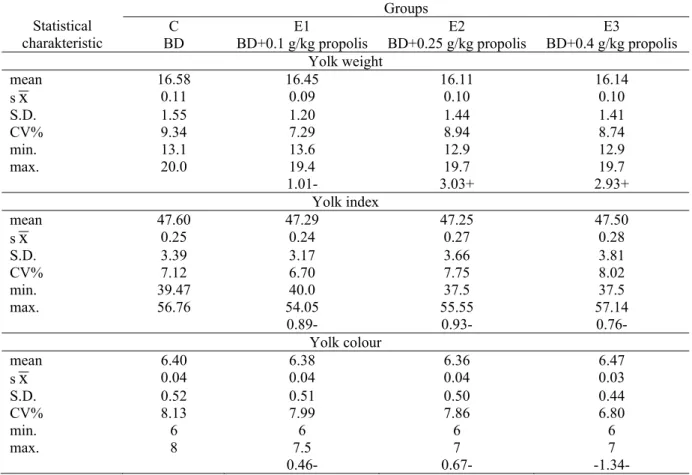
Egg weight and albumen quality indicators in each group for the observed laying period express Table 3. Quality indicators yolk during the period provided in Table 4.
The average weight of analyzed eggs in all groups receiving propolis extract enriched diets was of 59.85±3.92; 59.69±3.26; 59.52±4.80 and 59.54±3.37 g (x ±S.D.), (p>0.05), respectively.
How results from values were not recorded markedly differences between among the groups. In the group with addition of 0.25 g/kg of propolis extract has been detected insignificantly lowest difference compared to the control group (p>0.05). Similarly, in the experiment of Yang et al., 2003 [15] average egg weight in the group with the supplement of propolis was on the level of the control group. On the contrary in the experiment of Galal et al., 2008 [16] laying hens fed by diets containing 100 and 150 mg of propolis produced significantly heaviest egg mass compared to control group. The hens fed by diets with addition of 50 mg of propolis were intermediate. Alike Seven et al., 2008 [17] also found a significant beneficial effect of propolis on weight produced eggs at a dose of 2 and 5 g of ethanol extract of propolis per kg of feed mixture after administration hens exposed to heat stress.
13 also in Haugh Units were recorded average higher values in all experimental groups compared to the control group in our experiment.
Significantly higher Haugh Units were in the experimental group with propolis extract in doses 0.25 g/kg and 0.4 g/kg (p≤0.05).
Table 3 Influence of propolis extract addition into laying hens feed mixture on the alterations of Hy-Line Brown laying hen’s egg weight and egg albumen quality
Statistical charakteristic
Groups C
BD
E1
BD+0.1 g/kg propolis
E2
BD+0.25 g/kg propolis
E3
BD+0.4 g/kg propolis Egg weight
mean 59.86 59.69 59.52 59.54
s
x
0.29 0.24 0.36 0.25S.D. 3.92 3.26 3.80 3.37
CV% 6.55 5.46 6.38
min. 51.2 49.3 49.2 49.5
max. 71.0 71.3 73.1 68,8
Duncan test 0,41- 0,72- 0.81-
Egg albumen weight
mean 37.96 38.09 37.70 37.49
0.30 0.30 0.30 0.22
S.D. 4.09 4.00 4.02 3.97
CV% 10.77 10.50 10.66 10.58
min. 31.9 30.2 30.9 31.0
max. 59.5 56.9 50.0 49.2
Duncan test -0.30- 0.59 - 0.72-
Egg albumen index
mean 84.15 85.94 90.48 88.44
s
x
1.19 1.24 1.24 1.33S.D. 16.05 16.67 16.62 17.80
CV% 19.07 19.39 18.36 20.13
min. 47.06 38.71 53.33 41.38
max. 138.46 142.86 145.99 150.68
Duncan test -1.12- -3.76+ -2.48+
Haugh Units
mean 79.84 80.55 82.11 81.66
s
x
0.54 0.56 0.62 0.68S.D. 7.24 7.62 8.36 9.16
CV% 9.06 9.45 10.18 11.21
min. 62.67 48.52 53.80 48.09
max. 95.96 99.77 103.88 103.80
Duncan test -0.91- -2.72+ -2.06+
n=180; Significant difference (p<0.05); Values are means.
Values of Haugh Units in order the groups: 79.84±7.24, 80.55±7.62, 82.11±8.36, and 81.66±9.16 HJ (x ±SD).
On the contrary any significant differences in albumen index and Haugh Units were observed as a result of propolis extract supplementation in experiment of Seven et al., 2008 [17]. At the end of the study of Ozkok et al., 2013 [18] it was determined that the live weight of laying hens fed
14
Table 4 Influence of propolis extract addition into laying hens feed mixture on the alterations of Hy-Line Brown laying hen’s egg weight and egg yolk quality
Statistical charakteristic
Groups C
BD
E1
BD+0.1 g/kg propolis
E2
BD+0.25 g/kg propolis
E3
BD+0.4 g/kg propolis Yolk weight
mean 16.58 16.45 16.11 16.14
s
x
0.11 0.09 0.10 0.10S.D. 1.55 1.20 1.44 1.41
CV% 9.34 7.29 8.94 8.74
min. 13.1 13.6 12.9 12.9
max. 20.0 19.4 19.7 19.7
1.01- 3.03+ 2.93+
Yolk index
mean 47.60 47.29 47.25 47.50
s
x
0.25 0.24 0.27 0.28S.D. 3.39 3.17 3.66 3.81
CV% 7.12 6.70 7.75 8.02
min. 39.47 40.0 37.5 37.5
max. 56.76 54.05 55.55 57.14
0.89- 0.93- 0.76-
Yolk colour
mean 6.40 6.38 6.36 6.47
s
x
0.04 0.04 0.04 0.03S.D. 0.52 0.51 0.50 0.44
CV% 8.13 7.99 7.86 6.80
min. 6 6 6 6
max. 8 7.5 7 7
0.46- 0.67- -1.34-
n=180; Significant difference (p<0.05); Values are means. HLR–colored Hoffman La Roche scale
The effect of propolis extract supplementation
to
the feed mixture of laying hens caused in our experiment significant decrease in yolk weight. (p≤0.05). The values were found in the order of groups: 16.5±1.55; 16.45±1.20; 16.11±1.44 and 16.14±1.41 g (x ±SD). In groups with addition of different doses of propolis extract in our experiment were recorded values of yolk index at the level of the control group. In this parameter were observed among all experimental groups and the control group statistically insignificant differences (p>0.05).Similarly, Seven et al., 2008 [17] recorded that vitamin C or propolis supplementation did not affect the yolk index.
In the yolk color were observed insignificant differences among the groups, shades of yellow color on the color scale Hoffman La Roche were in the normal range at propolis extract addition. Regarding addition of propolis and pollen in experiment of Ozkok et al., 2013 [18] was found slightly lighter shade in the groups with addition
of both bee products. Belloni et al., 2015 [13] observed effect of 0, 1, 2 and 3% dietary propolis inclusion levels addition. Egg production, egg mass, feed intake, and feed conversion ratio were influenced by the treatments. The egg yolk color changed with the treatment (p≤0.05) when brightness and red and yellow concentration were considered. The use of propolis in the hens' diet did not improve performance and worsened the eggs' quality.
Conclusions
15 Acknowledgements
This study was supported by Grant KEGA No 035 SPU-4/2015
References
1. Valle, M. L., Quantitative determination of antibacterian capacities of propolis, Apiacta, 2000, 35, 152-161.
2. Haščík, P., Kačániová, M., Čuboň, J., Bobko, M., Vavrišinová, K., ArpášovÁ, H., Mihok, M., Pavličová, S., Effect of Lactobacillus fermentum application by
water to chicken Ross 308 at meat chemical composition, Potravinárstvo, 2009, 3(2), 22-29.
3. Burdock, G. A., Review of the biological properties and toxicity of bee propolis (propolis), Food and Chemical Toxicology, 1998, 36, 347-363.
4. Sun, F., Hayami, S., Haruna, S., Ogiri, Y., Tanaka, K., Yamada, Y., Ikeda, K., Yamada, H., SUGIMOTO, H., Kawai, N., Kojo, S., In: vivo antioxidative activity of propolis evaluated by the interaction with vitamin C and vitamin E and the level of lipid hydroperoxides in rats, J. Agric. Food Chem., 2000, 48, 1462-1465. 5. Isla, M. I., Moreno, M. I. N., Sampietro, A. R., Vattuone, M. A., Antioxidant activity of Argentina propolis extracts, J. Ethnopharmacol., 2001, 76, 165-170.
6. Miyataka, H., Nishiki, M., Matsumoto, H., Fujimoto, T., Matsuka, M. M., Satoh, T., Evaluation of Brazilian and Chinese propolis by enzymatic and physicochemical methods, Biol. Pharm. Bull., 1997, 20, 496-501.
7. Ota, C., Unterkicher, C., Fantinato, V., Shimizu, M. T., Antifungal activity of propolis on different species of Candida, Mycoses, 2001, 44, 375-378.
8. Banskota, A. H., Tezuka, Y., Adnyana, I. K., Hepatoprotective and anti Helicobacter pylori activities of constituents from Brazilian propolis, Phytomedicine, 2001, 8, 16-23.
9. Velikova, M., Banková, V., Tsvetkova, I., Kujumgiev, A., Marcucci, M. C., Antibacterial
ent-kaurene from Brazilian propolis of native stingless bees, Fitoterapia, 2000, 71, 693–696.
10. Dias, L. G., Pereira, A. P., Estevinho, L. M., Comparative study of different Portuguese samples of propolis: Pollinic, sensorial, physicochemical, microbiological characterization and antibacterial activity, Food and Chemical Toxicology, 2012, (50), 12, 4246-4253.
11. Freitas, J. A., Vanat, N., Pinheiro, J. W., Balarin, M. R., Sforcin, J. M., Venancio, E. J., The effects of propolis on antibody production by laying hens, Poultry science, 2011, 90(6), 1227-1233.
12. Sahinler, N., Gul, A., Copur, G., Chemical Composition and Preservative Effect of Thurkish Propolis on Egg Quality Durig Storage, Asian Journal of Chemistry, 2009, 21(3), 1877-1886.
13. Belloni, M., Almeida Paz, I. C. L., Naeaes, I. A., Productive, Qualitative, and Physiological Aspects of Layer Hens Fed with Propolis, Brazilian Journal of Poultry Science, 2015, 17(4), 467-472.
14. Blonska, M., Bronikowska, J., Pretsz, G., Czuba, Z. P., Scheller, S., Krol, W., Effects of ethanol extract of propolis (EEP) and flavones on inducible gene expression in J774a, 1 makrophages, J. Ethnopharmacol, 2004, 91(1), 25–30.
15. Yang, C. J., Uuganbayar, D., Sun, S. S., Firman, J. D., Effect of dietary green tea on productivity and egg composition in laying hens, Animal Science Journal, 2003, 81, 204.
16. Galal, A., Abd el-MotaaL, A. M., Ahmed, A. M. H., Zaki, T. G., Productive performance and immune response of laying hens as affected by dietary propolis supplementation, International Journal of Poultry Science,2008, 7(3), 272-278.