Domain-aware Evaluation of
Named Entity Recognition
Systems for Croatian
ˇ
Zeljko Agi´c
1and Bo
zo Bekavac
ˇ
21Department of Information and Communication Sciences, Faculty of Humanities and Social Sciences,
University of Zagreb, Croatia
2Department of Linguistics, Faculty of Humanities and Social Sciences, University of Zagreb, Croatia
We provide an evaluation of the currently available named entity recognition systems for Croatian. The evaluation puts special emphasis on domain dependence. To this goal, we manually annotated a dataset of approx-imately 1 million tokens of Croatian text from various domains within the newspaper text genre. The dataset was annotated using a three-class named entity tagset – denoting personal names, locations and organizations. We give insight to feature selection, domain sensitivity and effects of increase in training set size for statisti-cal named entity recognition using the state-of-the-art Stanford NER system. We also sketch a comparison of publicly available named entity recognition systems for Croatian considering domain dependence, regardless of their underlying paradigms. Our top-performing system achieved an F1-score of 0.884 in a mixed-domain testing
scenario, scoring 0.925 and 0.843 in the two domains separated for the experiment. The system shows con-sistency in state-of-the-art scores for detecting names of persons, locations and organizations.
Keywords: named entity recognition, Croatian language, text domain, domain dependence, evaluation
1. Introduction and related work
Named entity recognition(NER, sometimes also NERC – named entity recognition and clas-sification) is a subtask of information extrac-tion and a well-established task in natural lan-guage processing (NLP). It involves detecting and classifying named entities in natural lan-guage text. A named entity is loosely defined as a phrase that clearly identifies one item from a set of other items with similar attributes. More specifically, in our interpretation, named enti-ties are basically phrases in which natural lan-guage text and physical reality intersect. As
with most information extraction tasks, defin-ing named entity classes is goal-oriented, but it usually includes such classes as names of persons, locations and organizations(the three canonical ENAMEX classes), followed by tem-poral(TIMEX)and other numerical(NUMEX) expressions, such as monetary and percentage phrases. Since the usefulness of detecting, e.g., names of people and organizations in relation to certain properties of texts in which they are im-mersed – such as text domain, genre and topic, opinion or sentiment conveyed – was evident even in the early stages of information retrieval development, the first named entity recogni-tion systems appeared as early as 1991[19, 21]. Further development, especially regarding En-glish language processing, included elaboration of the task definition and named entity classes at the MUC-6 conference[12]and the CoNLL 2003 shared task on named entity recognition [23] to the point of supporting NER through publicly available state-of-the-art systems such as Stanford NER[10]or generic sequence label-ing solutions such as CRF++ [14]or CRFSuite [20]. Based on these facts, it is safe to state that detecting and classifying named entities in En-glish text has reached a point of performance-, scalability- and integration-wise maturity.
research topic in general at this specific point in time. Research highlights for NER include various approaches to semi-supervised learning and domain adaptation[9, 25]and entity recog-nition in non-standard text such as blog posts, newspaper article comments, Twitter posts and other user-generated content from web sources in which text standardness is not guaranteed or expected[13, 22].
In contrast, research in advancing NER – both genre- or domain-wise and otherwise – for Slavic languages is not nearly as abundant as for En-glish[11]. Since Croatian is a generally under-resourced South Slavic language, the Croatian-oriented NLP community is still dealing with basic NLP resource and tool development[26]. Ensuring public availability of NLP resources for Croatian still poses a challenge[2, 17]. More specifically, until recently, named en-tity detection in Croatian texts has only been addressed by a rule-based approach using fi-nite state transducer cascades [5, 6]. Just re-cently, two systems were presented that ad-dress Croatian NER by statistical approaches using sequence labeling with conditional ran-dom fields (CRF) [11, 16]. All three systems report state-of-the-art performance on their re-spective datasets, which differ in size, text do-mains and specifications of named entity classes. The rule-based system OZANA[5, 6] uses the MUC-7 specification [7]. It organizes named entities into three top-level classes or seven classes overall:
1. named entities (ENAMEX): names of per-sons (PERSON), politically or geographi-cally defined locations (LOCATION) and named corporate, governmental, or other or-ganizational entities(ORGANIZATION), 2. temporal expressions(TIMEX): absolute or
relative, complete or partial date (DATE) and time(TIME)expressions,
3. numeric expressions (NUMEX): monetary (MONEY)and percentage(PERCENT) ex-pressions in numeric or alphabetic form. CroNER[11]extends the MUC-7 specification with five additional experimental named entity classes and finally adds one of them – namely, the ethnic class – into the respective models. Stanford NER models of[16]annotate names of persons(PERS), locations(LOC)and organiza-tions(ORG)respecting the MUC-7 guidelines
for the ENAMEX top class and introduce a class for miscellaneous entities (MISC), following the guidelines of the CoNLL 2003 shared task [23]. OZANA and CroNER are developed and tested in the general domain of Croatian news-paper text and, therefore, they do not explicitly address the influence of dataset alterations on system performance. In contrast, the third line of research[16]does implicitly denote general domains included in the training set by stating the used sources – general, information technol-ogy, business, newspaper – but does not provide domain-dependent evaluation.
As documented, being a rule-based system, no training set or development set was used while constructing OZANA. CroNER was trained on approximately 310 000 tokens(310 kw)of un-classified Croatian newspaper text from a sin-gle source – the daily newspaperVjesnik. The mixed-domain or domain-aware Stanford NER models were trained on a much smaller dataset of approximately 60 kw. The latter line of re-search also addresses some issues in linguistic preprocessing and feature selection in statistical NER, as it investigates the usefulness of lemma-tization, part-of-speech tagging(POS tagging) and distributional similarity features for Croat-ian NER.
In this paper, we attempt to address four aspects regarding Croatian NER that were left largely unaddressed by previous research.
1. We investigate the effects of introducing domain-dependent training and testing data on statistical NER for Croatian.
2. We create a 1 million token NER-annotated corpus of Croatian by collecting and classi-fying newspaper text by domain, aiming at observing the effects of enlarging the train-ing data for Croatian NER beyond the cur-rent 300 kw limit.
3. We provide a comparison of available NER systems for Croatian by conducting an em-pirical evaluation using domain-sensitive test sets created from our 1 Mw dataset.
systems for Croatian, improved in terms of domain adaptability.
Together with the test sets, we also make a se-lection of documented NER models publicly available for research purposes.
2. Experiment setup
In this section, we present the setup of our ex-periment with domain-dependent evaluation of Croatian NER systems. We define the experi-ment objectives and its workflow, which is di-vided into four experimental batches. We de-scribe the datasets and their subdivision into training and testing samples, as well as the NER tools used in each of the experimental batches.
2.1. Objectives
Our experiment aims at investigating proper-ties of named entity recognition in Croatian text from a viewpoint of text domain sensitiv-ity. Keeping that in mind, we set several main objectives for the experiment:
• investigating general properties of state-of-the-art approaches to statistical NER when applied to Croatian text varying in domain, including an investigation of benefits of in-troducing certain linguistic features to these approaches;
• inspecting the effects of adding large(r) amounts of manually NER-annotated data to statistical NER training procedure for Croa-tian;
• investigating domain-sensitivity of statisti-cal NER for Croatian by introducing domain-dependent data in training and testing stages and
• providing a survey of currently available NER systems for Croatian by performing a domain-dependent empirical evaluation. Respecting these general guidelines and ob-jectives, along the lines of ample research in domain-dependence for named entity recog-nition in English text, we seek to provide a new viewpoint for observing Croatian NER. By making the test sets publicly available, we hope to enable the research community with a more
uniform evaluation approach for Croatian NER in the future, following a previous line of re-search in Croatian NER[16].
2.2. Training and testing sets
The texts in our experimental dataset were col-lected from the Vjesnik newspaper in the pe-riod of 2008-2010. The collection was done by a custom crawler and the texts were fur-ther cleansed, sentence-delimited and tokenized by using Apache OpenNLP tools[4]trained on manually delimited Croatian data and POS/MSD annotated using CroTag MSD tagger[1]. Man-ual annotation for named entities from the MUC-7 ENAMEX category(locations, organizations, persons) was done by expert annotators. The annotations were not overlapped and inter-anno-tator agreement was therefore not observed. High agreement on these classes was expected, following what was observed in previous re-search, e.g., in the process of developing the CroNER system[11], where the average inter-annotator agreement on ENAMEX was shown to be approximately 95%.
The reason we selected only the three ENAMEX classes from MUC-7 for our dataset is mainly a practical one. From one viewpoint, inter-annotator agreement is shown to be very high for these categories [11]and from another, in-stances of NUMEX and TIMEX classes are eas-ily detectable automatically, i.e., by simple rule-based modules[5], enabling the focus switch to ENAMEX for the human annotators.
The data collection consists of texts separated into two main text domains:
1. internal affairs, i.e., articles mainly regard-ing Croatian internal politics and
2. other newspaper text domains, evenly dis-tributed between culture, foreign affairs and other news, lifestyle and sports.
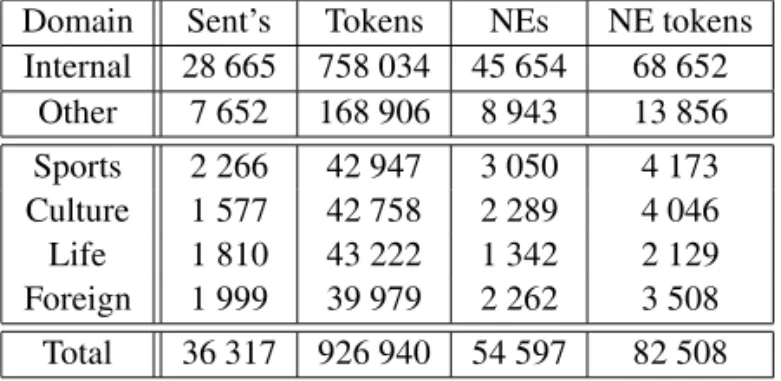
9.05% tokens in the internal affairs domain be-longs to named entities, while it holds for 8.20% in other domains. The differences are also ev-ident within subdomains of the latter domain, e.g., with texts belonging to the lifestyle sub-domain having as few as 4.93% named entity tokens.
Regarding the absolute size of the dataset, to our knowledge, this is the largest manually an-notated corpus of Croatian text used in any ex-periment with Croatian NER to this point. It has approximately 55 thousand manually an-notated ENAMEX entities or approximately 82 thousand named entity tokens.
Domain Sent’s Tokens NEs NE tokens
Internal 28 665 758 034 45 654 68 652
Other 7 652 168 906 8 943 13 856
Sports 2 266 42 947 3 050 4 173
Culture 1 577 42 758 2 289 4 046
Life 1 810 43 222 1 342 2 129
Foreign 1 999 39 979 2 262 3 508
Total 36 317 926 940 54 597 82 508
Table 1.Dataset stats.
Domain LOC ORG PERS
Internal 15 514 15 880 14 260
Other 3 079 1 833 4 031
Sports 988 547 1 515
Culture 593 498 1 198
Life 361 137 844
Foreign 1 137 651 474
Total 18 593 17 713 18 291
Table 2.Distribution of named entity classes.
Table 2 provides additional insight as to the spread of the named entities in the dataset across the three ENAMEX classes. In the internal affairs domain, the entities are pretty evenly spread between the classes, with approximately 15 thousand entities per class. In text from the other domains, however, the distribution is gov-erned by names of persons, as there are twice as much person mentions than mentions of or-ganizations and 30% more than instances of lo-cation names. Moreover, there are interesting differences between the subdomains of the other domains test set. For example, while names of
persons are predominant in sports, culture and lifestyle texts(49%, 52% and 63% of all named entities, respectively), distribution of named en-tities in foreign affairs texts is governed by lo-cations(50%), in which names of organizations are also relatively more frequent than in other subdomains(29%).
The dataset was split into training and testing sets for five-fold cross-validation by random sampling and respecting the document bound-aries to avoid the bias of syntactic transfer[16]. The split was done separately for the internal affairs domain and for the other domains. Ap-proximately 50 kw was left out for testing pur-poses for each of the two top domains, leaving out a test set of approximately 100 kw, evenly spread between five internal affairs samples of 10 kw each and five samples of 10 kw each for the other domains. A mixed test set of ten 10 kw samples was also created, randomly com-bining sentences from these two domain test sets to provide an uniform evaluation across the domains. The remaining 700 kw of internal af-fairs texts and 100 kw of texts from the other domains was used for training the models using Stanford NER.
It should be noted that splits or groupings of the test sets other than the internal vs. other domains could also be implemented. We chose to split the dataset in this manner mainly because of the prevailing size of the internal domains dataset and the fact that its annotation predates the an-notation of the other domains dataset. Addi-tionally, we envisioned the usage of the internal affairs models in certain real-world applications of named entity detection regarding relation dis-covery between Croatian political entities.
2.3. Workflow
In order to achieve the previously set research objectives, we define four interlinked batches of experiments with Croatian NER. Their work-flows are exposed in the following four subsec-tions.
2.3.1. Feature selection
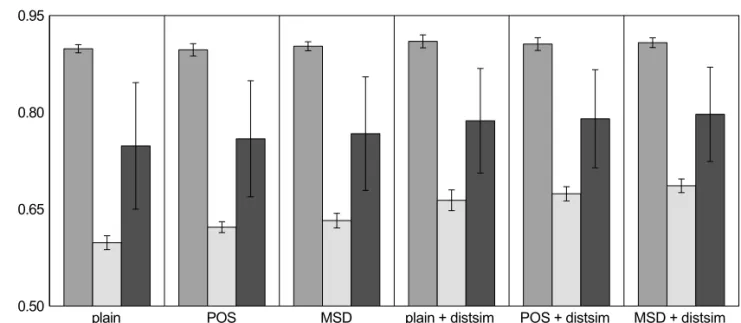
Figure 1.Overall F1-scores for models trained on 300 000 tokens internal affairs training set with respect
to features selected(plain, POS, MSD, with or without the use of distributional similarity features). The 95% confidence intervals are indicated by the error bars.
of the art in named entity detection. We focus on four specific sets of linguistic features: tokens, their part-of-speech annotation(POS tags)and full morphosyntactic annotation (MSD tags) and distributional similarity features (distsim). The POS and MSD annotation was provided by the CroTag tagger[1]. Lemmatization was dis-regarded as it was shown to introduce noise by previous research [16]. Distributional similar-ity features were calculated and shared freely in [16]by utilizing the clustering tool described in [8]over a 100 Mw sample of Croatian from the hrWaC corpus[15]with 400 clusters.
Since its sole purpose was to establish the opti-mal feature set for further experimentation, this batch of experiments was done by using only the internal affairs texts for training the models as the text from other domains was still un-der development at the time of conducting the batch. Eighteen 5-folded models were built in this batch, defined by a product of training set sizes and features used: (100 kw, 200 kw, 300 kw)×(plain text, POS, MSD)×(no distsim, distsim). Precision, recall and F1-scores were
calculated for the three named entity classes and overall on all available test sets.
2.3.2. Domain sensitivity
For the second testing batch, the internal affairs training sets from the first batch were injected
with texts from the other domains training sets and tested on all test sets. In these experiments, only the size of the training sets varies, as only the best linguistic preprocessing feature set es-tablished in the first experiment batch is used. The linguistic feature sets are addressed in the previous paragraph, i.e., the description of the first experiment batch. The training set sizes with text domain denotation were as follows: 50 kw(internal) +50 kw(other), 100 kw( in-ternal) +100 kw(other)and 200 kw(internal) +100 kw(other). The results of detection us-ing the mixed models are compared with those of the internal-affairs-only models from the first batch that used the same feature set.
2.3.3. Training set enlargement
Having created a 1 Mw manually ENAMEX-annotated corpus of Croatian newspaper text, in this testing batch, we implemented an ex-periment with increasing the amount of training data beyond the limit of approximately 300 kw from the previous two batches of our experi-mentation and previous research in statistical NER for Croatian[11].
text from the internal affairs domain. We intro-duce more text to the training procedure, step-ping by 100 kw: from 300 kw to 700 kw. Fol-lowing the previous scheme, we introduce four new models trained on internal affairs text only (400, 500, 600 and 700 kw)and four new mod-els trained by mixing internal affairs text with text from other domains(300+100 kw,. . ., 600 +100 kw). Since text from the other domains has a size cap of 100 kw for training and since we wanted to evaluate it against the internal af-fairs models, the last remaining option(700+ 100)was not used in the experiment as it would be 100 kw larger than the largest internal affairs model and thus not directly comparable.
2.3.4. System comparison
In the final batch of experiments, we compare the top-performing model, selected within the previous three batches, with the other avail-able NER systems for Croatian. We use our ENAMEX-annotated and domain-sensitive test sets to provide this comparison. Since the other systems were either trained on manually anno-tated data following other annotation schemes and using other feature sets or were otherwise designed to match other annotation schemes, this comparison might introduce a bias towards our top-performing system. However, this be-ing to our knowledge the first such comparative evaluation of Croatian NER systems, we chose to provide it as a reference point for compar-ing the existcompar-ing systems in terms of underlycompar-ing paradigms, while separating our top-performing model. Additionally, extracting the ENAMEX categories from text is generally considered as the most important subtask of NER[19]. Thus we consider measuring the performance of all existing Croatian NER systems on these specific categories to be of major importance regardless of the underlying named entity models imple-mented by specific systems.
2.4. Tools
For the first three batches of experiments, we utilized the Stanford NER system for detect-ing named entities usdetect-ing sequence labeldetect-ing with conditional random fields (CRF) [10]. It is a well-documented and supported state-of-the-art
system ubiquitously used in today’s NLP re-search. In the fourth batch, we compared the best model obtained by using Stanford NER on our dataset in the previous batches with other existing named entity recognizers for Croatian: 1. CroNER [11], a named entity recognition and classification system for Croatian lan-guage based on supervised sequence label-ing with conditional random fields (CRF), developed from scratch using CRFSuite[20] and a rich set of features,
2. OZANA [5, 6], a rule-based NER system based on finite state transducer cascades, ad-ditional supporting heuristics and heavy use of specialized Croatian inflectional lexica, implemented using the Intex linguistic de-velopment environment[24]and
3. Stanford NER models trained on approxi-mately 60 kw of Croatian mixed-domain text by Ljubesi´c et al.ˇ (2012) [16].
As previously discussed, the systems differ with respect to the named entity models they imple-ment. CroNER implements the MUC-7 cat-egories and introduces the category of ethnic. Ljubeˇsi´c et al. (2012) use the four categories from the CoNLL 2003 shared task, ENAMEX and MISC, while OZANA closely follows the MUC-7 specification. Our models use the three-class ENAMEX model encoded in our dataset. Since the four systems’ named entity models overlap precisely in the three-class ENAMEX model, we observe only these three classes throughout the experiment.
Other than in underlying paradigms, the sys-tems also differ in levels of public availability. The rule-based system OZANA is not publicly available. CroNER was made available for pur-poses of our experiment as a web service. The 60 kw Stanford NER models of[16]were freely available online via permissive licensing at the time of conducting this experiment. To the best of our knowledge, no other Croatian NER sys-tems existed at that point in time.
3. Results and discussion
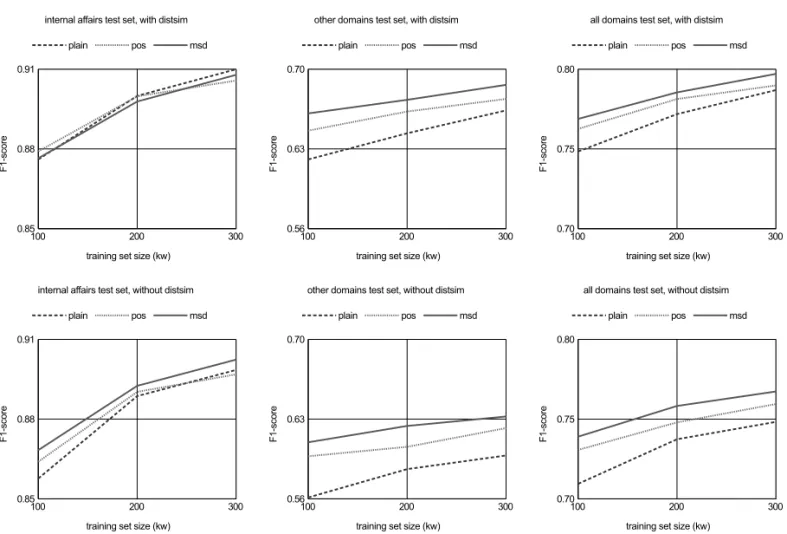
Figure 2.F1-score learning curves for models trained on internal affairs training set with respect to features selected (plain, POS, MSD, distributional similarity)and test set used(internal affairs, other domains, all domains).
3.1. Feature selection
The results of the first experiment batch in terms of F1-scores achieved by Stanford NER models
trained on internal affairs 300 kw training sets and tested on internal affairs and other domains test sets are given in Figure 1 with test sets, feature sets and overall scores indicated. Overall F1-scores show that the top-performing
models are consistently using a training set size of 300 kw, MSD features and distributional sim-ilarity(distsim)features. The highest observed F1-score on the internal affairs test set is,
how-ever, achieved by the model trained on unan-notated text(plain) and distsim features and it amounts to 0.910. The top-performer for the other domains test set is the 300 kw MSD and distsim model with an F1-score of 0.686. This
is also reflected in the all domains test scenario, where the same 300 kw MSD distsim system scored an overall F1-score of 0.797. It should be
noted that the small differences between the in-domain scores are not statistically significant. Models using distributional similarity features
consistently outperform the respective models without these features. The overall difference in F1-scores between these two groups of
mod-els increases with the complexity of the test set: from less than 1% increase for the internal af-fairs test set to 5% increase for the other domains test scenario which is in turn reflected in the all domains test set increase of approximately 3% in favor of the models using distributional sim-ilarity features.
Domain selection influence on overall named entity detection accuracy is substantial. F1
-score decrease of 0.224 is observed between the best NER systems when comparing inter-nal affairs and other domains test set. Domain dependence is also reflected by the impact of feature selection on the results across domains. While introducing additional training set data and additional features to the internal affairs models does not provide a substantial increase in F1-scores for internal affairs texts, the scores
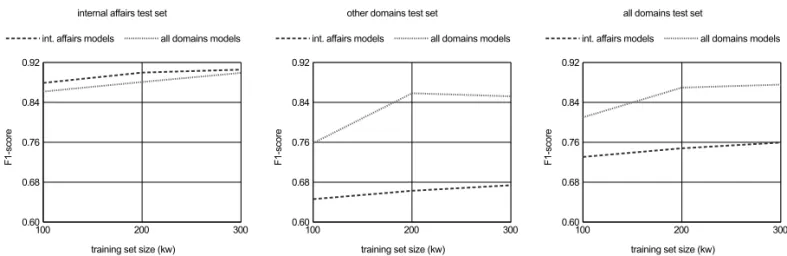
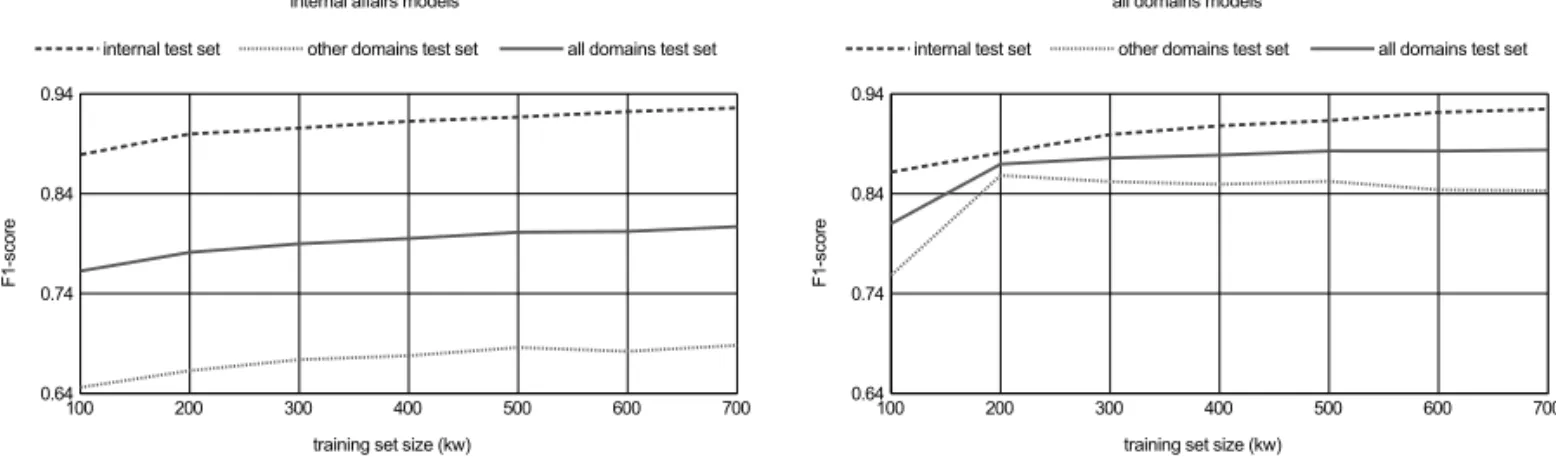
Figure 3.Comparison of F1-score learning curves for internal affairs models and all domains models
on all test sets, using POS and distributional similarity features.
Internal affairs test set Other domains test set All domains test set
Model P R F
1 P R F1 P R F1
Internal affairs 0.906 0.906 0.906 0.725 0.629 0.674 0.816 0.767 0.790
All domains(200+100) 0.900 0.899 0.899 0.869 0.837 0.852 0.884 0.868 0.876
Table 3.Overall F1-scores for internal affairs system and all domains system trained on 300 000
tokens with POS and distributional similarity features.
Functional dependencies of training set sizes, selected training features and overall system performances are additionally illustrated by Fig-ure 2. It clearly indicates both the strength of feature selection influence and the learning rates for the internal affairs models in the two test sce-narios. The groupings of learning curves also illustrate the significance of differences in the results. Moreover, the learning curves indicate that the internal affairs training set size of 300 kw is sufficient to achieve in-domain state-of-the-art performance in comparison with other NER systems for Croatian.
Statistical significance exploration using t-tests indicates that the difference between POS and MSD models using distributional similarity fea-tures is in fact not significant in this specific five-fold cross-validation testing scenario. Respect-ing this fact and considerRespect-ing that NER models using POS and distsim features are also substan-tially smaller and faster to train and use, they are further observed in more detail. For the same reasons, the POS and distsim feature set is the only feature set used in the following batches of experiments. Regarding the observed absence of statistical significance of differences between the F1-scores of NER models using POS and
MSD features, it should be noted that the POS
tagging accuracy of CroTag can be estimated at 95%, while its MSD tagging accuracy with the full tagset depends on the number of out-of-vocabulary word forms and peaks at approx-imately 85% for 20% unknown words [1, 2]. Thus the difference between models using POS and MSD would probably be more significant if the models were trained and tested using perfect tagging. However, as perfect tagging is almost never available in real-life scenarios for natu-ral language processing systems, accuracy and speed of POS taggers paired with speed of train-ing and ustrain-ing the resulttrain-ing NER systems and a statistically insignificant decrease in named en-tity detection accuracy should be considered to be the most feasible choice, at least judging from the results presented here.
3.2. Domain sensitivity
Internal affairs test set Other domains test set All domains test set
Model LOC ORG PER LOC ORG PER LOC ORG PER
Internal affairs 0.905 0.855 0.960 0.705 0.440 0.753 0.805 0.648 0.857
All domains(200+100) 0.895 0.841 0.964 0.869 0.733 0.890 0.882 0.787 0.927
Table 4.Named entity classification F1-scores for internal affairs system and all domains system trained on
300 000 tokens with POS and distributional similarity features.
Figure 4. Overall F1-score learning curves for enlarged internal affairs systems and all domains systems
with POS and distributional similarity features.
training set, 200 kw equals the 100 kw+ 100 kw mix and 300 kw amounts to 200 kw of in-ternal affairs text and 100 kw of other domains text. On all models from the second batch, POS and distributional similarity features are used. The all domains models are compared with the respective internal affairs models. Figure 3 pro-vides a comparison of learning curves for the two sets of models, while the top-performing internal affairs model and the top-performing all domains model are compared for overall ac-curacy in Table 3 and for acac-curacy on the three ENAMEX classes in Table 4.
The results show that joining data from dif-fering text domains into single named entity detection models creates more robust and less error-prone NER systems. Standard statistical tests show that the difference in accuracy be-tween the best internal affairs model and the top-performing mixed-domain model is not sig-nificant for the internal affairs test sets, while being substantially significant – with a high F1
-score difference of 0.178 and 0.086 – for the other domains and the all domains test sets. The top-performing mixed model still maintains the state-of-the-art accuracy of 0.899 in the internal affairs domain test scenario and 0.876 overall. Table 3 is complemented with learning curves for the two sets of models in Figure 3. They
indicate a large difference in the observed F1
-scores. The decline in the learning curve of the mixed-domain model when advancing from 200 kw to 300 kw training samples is subject to interpretation, as it might represent saturation of the model with text from the other domains as well as a local inflection point. This obser-vation is further investigated by enlarging the training set in the following subsection.
Table 4 is a breakdown of the overall scores of the top-performing internal affairs models and all domains models into three named entity classes. The best mixed-domain model (300 kw)is significantly better at detecting personal and organizational names in the internal affairs test set than in the other domains test set – with overall difference of 0.074 and 0.108 in F1
-scores – and to some extent also at detecting locations. This might indicate that enlarging the out-of-domain training set might improve the mixed-domain model accuracy. What was previously observed when comparing the over-all F1-scores is decomposed in this table into
three named entity classes and their respective F1-scores follow a similar pattern of difference
names and organization names. This effect is most likely due to the frequency of these enti-ties in the training data and the data for distribu-tional similarity modeling, as well as due to the inherently higher linguistic complexity of orga-nizational names when compared with names of persons and locations. It should be taken into account that person tokens are most often regu-lar in terms of capitalization while this does not hold for organization tokens.
Inspecting the differences between precision and recall in Table 3 also reveals room for improvement by introducing additional train-ing data from other domains, as the difference between the two metrics is non-existent for the internal affairs test set and substantial( approx-imately 0.1) for the other domains test set. It should be noted that specific utilizations of NER systems might favor precision over recall and vice versa. (For example, OZANA, the rule-based system we use in the fourth batch, favors precision over recall.) This should be taken into account in a more elaborated system optimiza-tion and fine-tuning for specific tasks. Here, we focus mainly on optimizing F1-scores by
in-creasing both precision and recall and we thus consider them to be of equal importance. The mixed-domain system outperforms the in-ternal affairs system on all classes but loca-tions and organizaloca-tions in the internal affairs test set, with the latter difference not being sta-tistically significant. As with the overall re-sults in Table 3, the subdivision of rere-sults into
the ENAMEX classes shows statistically sig-nificant differences in results in favor of the mixed-domain model in the other domains and all domains test sets. This fully supports the argument for domain-aware design of statistical NER training sets for Croatian.
3.3. Training set enlargement
In this experiment batch, we dealt with enrich-ing the internal affairs and the all domains train-ing sets from 300 kw to 700 kw in order to observe the overall improvements when more than doubling the training set size. Figure 4 provides two sets of learning curves: three for the internal affairs models(one curve for each of the three test sets) and three for the all do-mains models. The learning curves for the in-ternal affairs models all rise steadily, but their increase is unsubstantial, as supported by the data in Table 5. Namely, the accuracy gain for moving from the 300 kw to the 700 kw training set amounts to 0.020 and 0.014 for the inter-nal affairs test set and the other domains test set, respectively. However, introducing new in-ternal affairs data benefits the mixed-domain models as their increase is observed at 0.026 for the internal affairs test set when compared with the 300 kw mixed-domain model. On the other hand, they yield a statistically insignifi-cant decrease in accuracy in the other domains test set. This is most likely due to bias intro-duction considering the 6:1 ratio in favor of one
Internal affairs test set Other domains test set All domains test set
Model P R F
1 P R F1 P R F1
Internal affairs 0.924 0.928 0.926 0.734 0648 0.688 0.829 0.788 0.807
All domains(600+100) 0.922 0.928 0.925 0.854 0.832 0.843 0.888 0.880 0.884
Table 5.Overall F1-scores for internal affairs system and all domains system trained on 700 000 tokens
with POS and distributional similarity features.
Internal affairs test set Other domains test set All domains test set
Model LOC ORG PER LOC ORG PER LOC ORG PER
Internal affairs 0.922 0.885 0.973 0.701 0.446 0.785 0.811 0.665 0.879
All domains(600+100) 0.918 0.884 0.974 0.847 0.719 0.895 0.883 0.802 0.934
Table 6.Named entity classification F1-scores for internal affairs system and all domains system trained
Internal affairs test set Other domains test set All domains test set
System P R F
1 P R F1 P R F1
CroNER 0.797 0.853 0.824 0.719 0.700 0.709 0.758 0.777 0.767
Ljubeˇsi´c et al.(2012) 0.782 0.715 0.747 0.598 0.510 0.551 0.690 0.612 0.649
OZANA 0.897 0.735 0.808 0.867 0.460 0.601 0.882 0.597 0.712
Our best system 0.922 0.928 0.925 0.854 0.832 0.843 0.888 0.880 0.884
Table 7.Overall F1-scores for system comparison.
Internal affairs test set Other domains test set All domains test set
System LOC ORG PER LOC ORG PER LOC ORG PER
CroNER 0.835 0.743 0.922 0.691 0.552 0.811 0.763 0.648 0.867
Ljubeˇsi´c et al.(2012) 0.777 0.661 0.835 0.650 0.277 0.680 0.714 0.469 0.757
OZANA 0.777 0.748 0.900 0.632 0.314 0.698 0.704 0.531 0.799
Our best system 0.918 0.884 0.974 0.847 0.719 0.895 0.883 0.802 0.934
Table 8.Named entity classification F1-scores for system comparison.
text domain over the other in the 700 kw mixed-domain test set. The learning curve for the all domains models in the other domains test set indicates an inflection point at 200 kw: intro-ducing new data beyond the 200 kw (100 kw +100 kw)dataset slowly biases the system to-wards the internal affairs test set, making the task of detecting named entities in text from other domains slightly more difficult. These figures should by all means be taken into ac-count when designing statistical NER systems for Croatian and targeting a specific text do-main, as we show an importance of establishing the optimal ratio in mixing data from different domains. Document weighting schemes might also be considered in future research.
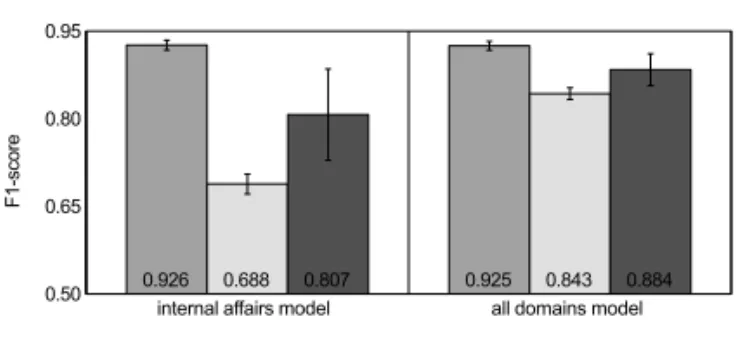
Overall scores from Table 5 are further sup-ported by the illustration in Figure 5, which clearly indicates the positive effects of intro-ducing other domain data into the training set across test set domains.
In terms of overall scores on the all domains test set as a single reference point for overall system accuracy, however, the 6:1 ratio mixed domain system (700 kw; 600 kw internal + 100 kw other)is the top-performing system for all three batches of our experiments with Stanford NER. Therefore, we select this system as our entry point to the fourth batch of experiments, i.e., for comparison with other existing systems for Croatian NER. Differences between precision
and recall that we observed in the all domains 300 kw models in Table 3 are evened out in the 700 kw models as they are shown to be virtu-ally non-existent by Table 5. This might serve as another indicator of this model reaching a high point in overall accuracy.
Table 6 provides the split of accuracy for the 700 kw internal affairs model and the 600 kw + 100 kw mixed-domain model on the three ENAMEX classes. The patterns observed for the 300 kw systems in the second experimen-tal batch are maintained and follow the pattern of overall scores from Table 5 as mixed-domain model scores increase on the internal affairs test set and slightly decrease on the other domains test set in comparison to the scores in Table 4, amounting to a slight general increase across domains.
Figure 5.Overall F1-scores for internal affairs system
and all domains system trained on 700 000 tokens with POS and distributional similarity features. The 95%
3.4. System comparison
For the fourth and final experimental batch of this research plan, we compared the per-formance of our best 700 kw mixed-domain Stanford NER model with other Croatian NER systems: CRF-based system CroNER, rule-based OZANA and 60 kw Stanford NER model of Ljubesi´c et al.ˇ (2012). This evaluation serves not only as a comparison against our top-performing model, but to our knowledge the first uniform evaluation of the three systems on a single test set.
The overall scores – precision, recall and F1
-score on the two domains and the joint test set – are given in Table 7. As the training sets used for our system and test sets are derived from the same dataset, even with respecting docu-ment boundaries and randomizing the samples accordingly, introduces a positive bias of the results towards our system. Thus we present its scores in separation from the scores of the three other systems. It should also be noted that the three systems – CroNER, Ljubeˇsi´c et al. (2012)and OZANA – significantly vary in training set domains and sizes and even under-lying paradigms. However, as their implemen-tations and licensing schemes prevent us from providing uniform datasets at training, we are only able to provide their black-box comparison using existing models.
As expected, our system is the top-performer of the group by a large margin on all test sets. The difference in overall F1-scores is maintained at
at least 0.1 in all the test scenarios. Out of the three remaining systems, CroNER consistently outperforms OZANA and Ljubeˇsi´c’s Stanford NER model – this fact is maintained across the domains. CroNER performs the best on the in-ternal affairs test set, with a 0.113 decrease in its F1-score when moving to other domains. Its
precision-recall ratio remains even across do-mains. OZANA scores a second place in the group of existing systems. Its precision is con-sistently higher than recall by approximately 0.1, as it is a rule-based system that was tuned specifically for higher precision by design. Its precision is actually higher than the one of our top-performing model for the other domains test set. Its performance is significantly higher on the internal affairs test set, with a difference of approximately 0.2 in F1 over the other
do-mains test set. This is also due to system de-sign, since it was developed to target Croatian text from this specific domain. We believe that fine-tuning the OZANA system by applying a set of relaxed rule cascades for increased recall, possibly even simple orthography-based rules, would further enhance its overall performance. Ljubeˇsi´c’s 2012 system peaks at approximately 0.75 F1on internal affairs and 0.55 on other
do-mains, thus displaying the lowest performance in the group. This is due to its limited 60 kw training set size with mixed data from differing domains and sources from the Croatian web. The overall scores are separated by ENAMEX classes in Table 8. As expected, the system rankings are maintained. All systems perform the best in the subtask of personal name detec-tion, followed by names of locations and finally names of organizations on all test sets. De-creases when moving from the internal affairs test set to the other domains test set are sub-stantial for all systems. CroNER suffers an F1
-score decrease of approximately 0.11 for per-sonal names, 0.14 for locations and almost 0.2 for organizational names. OZANA maintains this pattern, but with a much steeper decrease for names of persons and organizations – 0.2 and almost 0.45 in F1, respectively, once again
most likely due to targeting its design towards one text domain. Ljubesi´c’s system suffers aˇ
0.4 decrease in F1 for detecting organizations
in texts from other domains and maintains the pattern of its statistical sibling CroNER for the other two classes.
Keeping in mind the positive bias introduced by syntactic transfer, our top-performing Stanford NER model outperforms the other systems on all ENAMEX classes by a large margin. The margin enlarges when moving from the easiest class(personal names, at least 0.05 difference in F1 – inferred by comparing our system to
CroNER) to names of locations (0.12)and fi-nally names of organizations(0.15). It scores a state-of-the-art F1-score of 0.934 for
detect-ing personal names across domains, followed by 0.883 for locations and 0.802 for names of organizations. The scores we observed for the internal affairs test set are even higher.
top-performing mixed-domain system – in compar-ison with OZANA as a rule-based NER system. All the systems, especially statistical ones, ex-hibit an issue with detecting ending words of organizational names as they are of higher com-plexity and may vary in length. Examples in-clude Muzej suvremene umjetnosti (en. Mu-seumof contemporary art)andKazalisteˇ Kerem-puh(en. Theater Kerempuh) – only boldfaced words are recognized by the systems.
OZANA underperforms in detecting names of foreign, e.g., non-Croatian persons due to its un-derlying lexical resources. Namely, its foreign persons and foreign organizations lexica are of lower quality than the ones for Croatian names. Thus it also exhibits lower accuracy in detect-ing foreign organizations. On the other hand, it sometimes annotates multi-word expressions as organization names even if they do not refer to specific organizations, but rather to generic entities.
Statistical systems err by falsely classifying cer-tain occurrences of the preposition u (en. in) followed by words with uppercased first let-ter as names of locations, e.g., u Nedinu ili u
Pamelinu(en.inNeda’sor inPamela’s– names of persons, not locations)anduGavelli(en.in
Gavella– organization, not location). They also exhibit and issue with detecting entities linked by conjunctions, as they are usually of the same type and most frequently indicate names of lo-cations. Thus, in some of the occurrences, they annotate, e.g., FedereraiNadala(en. Federer
and Nadal) as names of locations instead of personal names.
4. Conclusions and Future Work
In this contribution, we have addressed text domain dependence of statistical named en-tity recognition and classification in Croatian texts. We have observed a strong preference for models trained on datasets encompassing multiple domain text, where state-of-the-art ac-curacy in terms of overall scores and scores on all ENAMEX categories(detecting personal names, names of locations and names of organi-zations)was observed in all test scenarios. We
have also provided what we believe is the first empirical comparative evaluation of the avail-able NER systems for Croatian. Three systems were compared to our top-performing model and evaluated for overall scores and scores on the ENAMEX classes. We made a subset of the developed Stanford NER models and domain-specific datasets for testing Croatian NER pub-licly available for research purposes1.
Our future work plans include enlarging the used datasets and introducing datasets for other text genres and domains. It should be noted that our experiment addressed only issues with detecting named entities in various domains of the newspaper genre with domains collapsed into two disjoint classes. Experiments with fine-grained domain separation, genre variation and non-standard text processing have yet to be conducted for Croatian NER. Following the experience of [11], we should attempt to uti-lize a wider selection of features in pair with our dataset, possibly moving from the Stanford NER platform towards a more generic sequence labeling solution such as CRF++ [14]or CRF-Suite[20]. Semi-supervised learning for NER [18]seems like another feasible line of research, as well as implementing voting NER systems, keeping in mind the observed differences be-tween systems, especially across the underly-ing paradigms. Domain adaptation strategies for NER in Croatian texts should be thoroughly investigated.
As a final remark, we take note of Stanford NER models for Croatian that were developed upon completion of our experiment [17]. The two systems use the three-class ENAMEX and the four-class CoNLL 2003 named entity models, respectively. The former one is trained by com-bining the dataset of [16], our mixed-domain 100 kw test sets and the newly-developed 180 kw NE-annotated SETimes.HR corpus and de-pendency treebank of Croatian[2, 3], amount-ing for an aproximately 340 kw large trainamount-ing set. The authors report an overall named entity recognition score of 0.899[17]and provide the models to the general public with a very permis-sive licensing scheme. Along with the positive bias of our test set documented in our exper-iment setup, this further establishes the need for a newer and more unbiased genre-,
domain-1The data is freely downloadable fromhttp://zeljko.agic.me/andhttp://nlp.ffzg.hr/under the Creative Commons
and text-standardness-aware test set to compare this newly-developed system with the systems presented in this paper to provide a more up-to-date uniform comparative evaluation of Croat-ian NER systems.
5. Acknowledgement
We would like to thank the anonymous review-ers for their valuable feedback. Many thanks to the team of annotators – Ana Agi´c, Dasaˇ
Berovi´c, Danijela Merkler, Matea Srebaci´c andˇ
a number of students from the Department of Linguistics – for their hard work in creating our 1 Mw ENAMEX gold standard for Croat-ian NER.
This work was partly funded by the European Commission within the Seventh Framework Pro-gramme (FP7/2007-2013 STREP) under the grant number 288342(project XLike).
References
[1] Z. Aˇ GIC´, M. TADIC´, Z. DOVEDAN, Improving Part-of-Speech Tagging Accuracy for Croatian by Mor-phological Analysis. Informatica, 32(4) (2008), 445–451.
[2] Z. Aˇ GIC´, N. LJUBEˇSIC´, D. MERKLER,
Lemmatiza-tion and Morphosyntactic Tagging of Croatian and Serbian. InProceedings of the 4th Biennial Interna-tional Workshop on Balto-Slavic Natural Language Processing (BSNLP 2013), ACL;(2013).
[3] Z. Aˇ GIC´, D. MERKLER, Three Syntactic Formalisms
for Data-Driven Dependency Parsing of Croatian. In Text, Speech and Dialogue, Lecture Notes in Artificial Intelligence,8082(2013), 560–567.
[4] APACHEOPENNLP, The Apache Software
founda-tion; 2010. URLhttp://opennlp.apache.org/
[5] B. BEKAVAC, Strojno prepoznavanje naziva u
suvre-menim hrvatskim tekstovima. PhD thesis, Univer-sity of Zagreb, 2005.
[6] B. BEKAVAC, M. TADIC´, Implementation of
Croat-ian NERC System. InProceedings of the Workshop on Balto-Slavonic Natural Language Processing (BSNLP 2007), ACL;(2007), pp. 11–18.
[7] N. CHINCHOR, P. ROBINSON, MUC-7 Named Entity
Task Definition. InProceedings of the 7th Confer-ence on Message Understanding (MUC 7); 1997. [8] A. CLARK, Combining Distributional and
Morpho-logical Information for Part of Speech Induction. In Proceedings of the 10th Annual Meeting of the Eu-ropean Association for Computational Linguistics (EACL 2003), EACL;(2003), pp. 59–66.
[9] H. DAUME´ III, Frustratingly Easy Domain
Adapta-tion. InProceedings of the 45th Annual Meeting of the Association of Computational Linguistics (ACL 2007), ACL;(2007), pp. 256–263.
[10] J. R. FINKEL, T. GRENAGER, C. MANNING,
Incor-porating Non-local Information into Information Extraction Systems by Gibbs Sampling. In Proceed-ings of the 43rd Annual Meeting of the Association for Computational Linguistics (ACL 2005), ACL; (2005), pp. 363–370.
[11] G. GLAVAˇS, M. KARAN, F. SˇARIC´, J.SˇNAJDER, J.
MIJIC´, A.SˇILIC´, B. DALBELOBAˇSIC´, CroNER: A
State-of-the-Art Named Entity Recognition and Classification for Croatian. InProceedings of the 8th Language Technologies Conference (IS-LTC 2012), Jozef Stefan Institute, Ljubljana, Slovenia;ˇ (2012), pp. 73–78.
[12] R. GRISHMAN, B. SUNDHEIM, Message Understand-ing Conference 6: A brief history. InProceedings of the 16th International Conference on Computa-tional Linguistics (COLING 1996), The COLING Organizing Committee;(1996), pp. 466–471. [13] V. JIJKOUN, M. ALAMKHALID, M. MARX, M.DERI
-JKE, Named Entity Normalization in User Generated Content. In Proceedings of the 2nd Workshop on Analytics for Noisy Unstructured Text Data (AND 2008), ACM;(2008), pp. 23–30.
[14] T. KUDO, CRF++: Yet Another CRF Toolkit; 2005.
URL https://code.google.com/p/crfpp/
(accessed 2013-07-18)
[15] N. LJUBEˇSIC´, T. ERJAVEC, hrWaC and slWac: Com-piling Web Corpora for Croatian and Slovene. In Text, Speech and Dialogue, Lecture Notes in Com-puter Science,6836(2001), 395–402, Springer.
[16] N. LJUBEˇSIC´, M. STUPAR, T. JURIC´, Building Named
Entity Recognition Models for Croatian and Slovene. InProceedings of the 8th Language Tech-nologies Conference (IS-LTC 2012), Jozef Stefanˇ
Institute, Ljubljana, Slovenia;(2012), pp. 129–134.
[17] N. LJUBEˇSIC´, M. STUPAR, T. JURIC´,Z. Aˇ GIC´,
Com-bining Available Datasets for Building Named En-tity Recognition Models of Croatian and Slovene. Slovensˇcina 2.0: empirical, applied and interdisci-ˇ plinary research,(2013), in press.
[18] S. MILLER, J. GUINNESS, A. ZAMANIAN, Name
Tag-ging with Word Clusters and Discriminative Train-ing. In Human Language Technology Conference of the North American Chapter of the Association for Computational Linguistics: Proceedings of the Main Conference, ACL,(2013), pp. 337–342. [19] D. NADEAU, S. SEKINE, A Survey of Named Entity
Recognition and Classification.Lingvisticae Inves-tigationes,30(1) (2007), 3–26.
[20] N. OKAZAKI, CRFsuite: A Fast Implementation
of Conditional Random Fields(CRFs); 2007. URL
http://www.chokkan.org/software/crfsuite/
[21] L. F. RAU, Extracting Company Names from Text.
InProceedings of the 7th IEEE Conference on Ar-tificial Intelligence Applications, IEEE,(1991), pp. 29–32.
[22] A. RITTER, S. CLARK, M. ETZIONI, O. ETZIONI,
Named Entity Recognition in Tweets: An Ex-perimental Study. InProceedings of the 2011 Con-ference on Empirical Methods in Natural Language Processing (EMNLP 2011, ACL,(2013), pp. 1524– 1534.
[23] E. F. TJONGKIMSANG, F. DEMEULDER, Introduc-tion to the CoNLL-2003 Shared Task: Language-Independent Named Entity Recognition. In Pro-ceedings of the Seventh Conference on Natural Language Learning at HLT-NAACL 2003 (CONLL 2003), ACL,(2003), pp. 142–147.
[24] M. SILBERZTEIN, Text Indexing with INTEX. Com-puter and the Humanities,33(3) (1999), Kluwer.
[25] A. SØGAARD, Semi-Supervised Learning and
Do-main Adaptation in Natural Language Processing. Morgan & Claypool Publishers, 2013.
[26] M. TADIC´, D. BROZOVIC´-RONCEVIˇ C´, A. KAPETANO
-VIC´, The Croatian Language in The Digital Age.
Springer, 2012.
Received:July, 2013
Revised:September, 2013
Accepted:September, 2013
Contact addresses:
ˇ
Zeljko Agi´c Department of Information and Communication Sciences Faculty of Humanities and Social Sciences University of Zagreb Ivana Luci´ca 3ˇ
10000 Zagreb Croatia e-mail:[email protected]
Boˇzo Bekavac Department of Linguistics Faculty of Humanities and Social Sciences University of Zagreb Ivana Luci´ca 3ˇ
10000 Zagreb Croatia e-mail:[email protected]
ˇ
ZELJKOAGIC´received his BSc(2005)in computer science and engi-neering from the University of Split and his PhD(2012)in information and communication science from the University of Zagreb. He is cur-rently a postdoctoral researcher at the Department of Information and Communication Sciences, Faculty of Humanities and Social Sciences, University of Zagreb. His research interests lie in the field of language technology.