Sharif University of Technology
Scientia IranicaTransactions D: Computer Science & Engineering and Electrical Engineering www.scientiairanica.com
A trac-aware scheduling algorithm for IEEE 802.16
mesh mode
F. Dabiran
a, H.R. Rabiee
a;, M. Salehi
band A.A. Amidian
c a. Department of Computer Engineering, Sharif University of Technology, Tehran, Iran.b. Faculty of New Sciences and Technologies, University of Tehran, Tehran, P.O. Box 14395-1374, Iran.
c. Department of Communication, Faculty of Applied Science of Post and Communication, Tehran, P.O. Box 44484005, Iran. Received 18 February 2012; received in revised form 16 July 2013; accepted 9 September 2013
KEYWORDS IEEE 802.16 mesh mode;
Slot allocation; Centralized scheduling; Download trac; Concurrent transmission.
Abstract. Since there is no dierence between uplink and downlink subframes in the IEEE 802.16 mesh mode; both downlink and uplink tracs are transmitted within a single time frame. Hence, in most scheduling methods, only one scheduling algorithm is used for both uplink and downlink trac. However, because of the dierent characteristics of uplink and downlink trac, dierent scheduling methods should be used for each of the trac types. In this paper, we focus on the mesh centralized scheduling of downlink ow in the data subframe. After comprehensive analysis of the characteristics of downlink trac, we propose a new algorithm, called Trac-Aware Scheduling (TAS). In this algorithm, the downlink trac distribution is tuned for maximum concurrent transmission rate. This goal is achieved by choosing dierent link selection criteria, such as maximum demandant sender, farthest receiver and least interfered path, based on the downlink trac analysis results. The simulation results show that our algorithm outperforms existing methods in terms of scheduling length, link concurrency, and throughput (about 13.7% in average) for the downlink trac. Moreover, the proposed algorithm is scalable. In particular, on average, 3% improvement is achieved in terms of scheduling length at higher trac loads and in the number of nodes.
c
2014 Sharif University of Technology. All rights reserved.
1. Introduction
The IEEE 802.16 is a broadband wireless communi-cation standard for the development and deployment of data transmission networks such as internet, VPN and VoIP in metropolitan areas. Features such as high bandwidth, easy installation and inexpensive maintenance charge have made IEEE 802.16 a suitable substitute for wired and cabled modem networks.
The initial IEEE 802.16-2004 [1] standard was developed to serve xed Subscriber Stations (SSs)
*. Corresponding author. Tel.: +98 21 66046719; Fax: +98 21 66047662
E-mail addresses: [email protected] (F. Dabiran); [email protected] (H.R. Rabiee); mostafa [email protected] (M. Salehi); [email protected] (A.A. Amidian)
through a central Base Station (BS) using a Point to Multi Point (PMP) mode, and the mesh mode was provided as an additional operating topology. The main dierence between these two modes is that in the PMP mode, the BS acts as a coordinator and relays all the communications, and any SS that has a direct link with BS has to communicate with BS rst before transmitting data to other SSs. But, in the mesh mode, any SS can send its data packets to BS through sponsor or relay nodes. Hence, the mesh topology not only increases wireless coverage and network throughput [2] , but also provides features such as lower backhaul deployment cost, rapid deployability and re-congurability [3].
Employing appropriate scheduling algorithms is becoming a challenging task in improving the Quality of Service (QoS) in interactive applications over IEEE
802.16 [4]. In the mesh mode, channel multiplexing is TDMA-based and each time frame is divided into mini-slots. An SS uses these time slots to send and receive its data packets. A scheduler computes the range and position of mini-slots and allocates them based on SS bandwidth requests in an interference-free manner. Since there is no dierence between uplink and downlink subframes in the mesh mode, both down and uplink trac is transmitted within a single time frame. Here, downlink (DL) refers to data transmission from the BS to the SS, and uplink (UL) to data transmission in the reverse direction. Hence, in most scheduling methods, only one scheduling algorithm is used for both up and downlink trac. However, uplink and downlink ows have dierent characteristics, and, therefore, by considering each of the ow characteristics in the scheduling algorithm, more ecient networks can be expected.
In this paper, we propose a centralized scheduling algorithm for downlink trac based on an analytical study of trac distribution in the mesh mode. Consid-eration of the characteristics of downlink ow and the use of multiple criteria for choosing the sender node are among the main features of the proposed algorithm. To the best of our knowledge, this is the rst centralized scheduling algorithm in mesh mode that considers multiple criteria in scheduling downlink trac. The experimental results show that the proposed algorithm has high throughput, reduction in scheduling length, and more concurrent transmission, compared to the state of the art algorithms. The rest of the paper is organized as follows. Section 2 provides a discussion on related works. The scheduling mechanism in the IEEE 802.16 mesh mode is described in Section 3. Section 4 presents the proposed algorithm, along with a discussion on interference modeling and downlink ow analysis. Section 5 provides the performance evaluation, and the concluding remarks are provided in Section 6.
2. Related work
Early work on the IEEE 802.16 standard has primarily focused on the PMP mode [5-8]. Studies on mesh mode have been devoted to tree construction [3,9,10], packet scheduling [11-14], spatial reuse [15-17] and QoS support [18-21]. It has been proved that the problem of nding the minimum scheduling length in centralized scheduling is NP-complete [3,18,22]. Therefore, some heuristic algorithms have been developed to solve this problem.
The authors in [18] and [20] proposed a QoS algorithm to allocate bandwidths to various types of ow, separately. In [12] , the authors introduce an Enhanced-Frame Registry Tree Scheduler (E-FRTS) that uses the frame registry tree; a data structure that
aims to prepare the time frame creation and to reduce processing needs at the beginning of each frame.
Several studies have addressed the issue of spec-tral reuse to solve the resource allocation problem in the context of concurrency. In [23], the scheduler uses four separate criteria (random node, min interference node, nearest to BS and farthest to BS) for selecting the scheduled link. The results show that the nearest criterion has the best performance in scheduling length for the uplink trac. In [24] , the authors have improved the scheduler in [23], and have used multi-ple measures in scheduling, such as node hop count, amount of bandwidth request and interference.
In [3], the authors proposed three dierent scheduling algorithms. the Fair Queuing algorithm schedules the maximum number of packets from the entire network in each time slot. The Max Weight algorithm schedules the layer closest to the BS rst, before scheduling the other layers. The Line Scheduling algorithm considers the fairness of each node. This algorithm uses a greedy approach to schedule the network after scanning the entire network. In [25], a weighted time slot scheduler is designed for IEEE 802.16 multi-hop relay networks to improve network throughput and guarantee the desired frame length. It independently assigns time slots to uplinks and downlinks, in accordance with the specications of IEEE 802.16j in which both links may become active in dierent sub-frames.
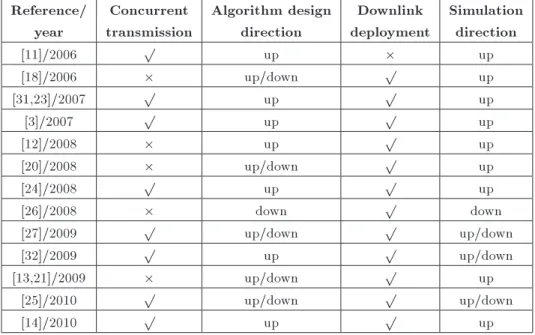
Table 1 provides a comparison of the current centralized scheduling schemes in the IEEE 802.16 mesh mode. According to this table, most previous work has focused on the design of scheduling algorithms for uplink trac. Little work has been done on downlink scheduling by considering the characteristics of this kind of trac, such as the source and destination of ow, interference model and concurrent transmis-sion. Because of the dierent characteristics of uplink and downlink trac, it is more reasonable to employ dierent scheduling methods for each of the trac types.
In downlink scheduling, the BS is responsible for allocating the resources to the subscribing stations. In [26], a scheduler has been designed for downlink video trac, but it does not eciently incorporate an interference model. The algorithm proposed in [27] is the only scheme that considers downlink scheduling with concurrent transmission. However, this work does not provide any analytical analysis on the downlink ows. Moreover, [27] shows that the scheduling algo-rithm introduced in [23] for downlink trac has a lower performance than for uplink trac.
In this paper, we focus on the centralized schedul-ing of downlink trac ow in the IEEE 802.16 mesh mode. We propose a new algorithm by considering the characteristics of this type of trac ow, which
Table 1. Comparison of centralized scheduling studies in the IEEE 802.16 mesh mode (up: uplink and down: downlink). Reference/ Concurrent Algorithm design Downlink Simulation
year transmission direction deployment direction
[11]/2006 p up up
[18]/2006 up/down p up
[31,23]/2007 p up p up
[3]/2007 p up p up
[12]/2008 up p up
[20]/2008 up/down p up
[24]/2008 p up p up
[26]/2008 down p down
[27]/2009 p up/down p up/down
[32]/2009 p up p up/down
[13,21]/2009 up/down p up
[25]/2010 p up/down p up/down
[14]/2010 p up p up
improves concurrent transmission rate and network throughput.
3. Overview of the IEEE 802.16 mesh mode A mesh frame is partitioned into two subframes: con-trol and data. The concon-trol subframe itself consists of schedule control and the network control subframe. The network control subframe is designed to manage the joining a new node to the mesh network. The schedule control subframe contains symbols that are introduced for centralized or distributed scheduling requests. The data subframe is used for data transmis-sion and includes multiple mini-slots. This subframe is partitioned into centralized and distributed data.
There are two kinds of scheduling in the mesh mode: centralized and distributed. In centralized scheduling, the BS coordinates all the bandwidth re-quests within the network. For backhaul applications, such as Internet, centralized scheduling is preferable because all trac is to or from the BS. Each node in a distributed scheduling scheme, including the BS, coordinates the specication of its transmission, such as its resources and bandwidth request with a two-hop neighborhood. Moreover, distributed scheduling can be established by directed uncoordinated requests between two nodes. Although distributed scheduling schemes are more scalable, they are inecient in the QoS guarantee and more complicated than centralized ones. This is used only for intranet trac [28]. Based on the scope of this paper, we will focus on centralized scheduling in the mesh mode. For distributed schedul-ing, we refer interested readers to [1,29,30].
As mentioned above, a frame includes control and data subframes, both of which need to schedule. A
con-trol and data scheduler is used to manage bandwidth request and data, respectively. In control scheduling, the BS sends the scheduling tree to the subscribing stations using a MSH-CSCF message. This process denes the order of the subscribing stations in sending their bandwidth requests. A Breadth-First Search (BFS) algorithm is used to create a scheduling tree. In data scheduling, the BS schedules the transmission of each subscribing station by allocating the mini-slots of data subframes. Data scheduling is not introduced by the IEEE 802.16 standard. Moreover, concurrent transmission is not considered by the standard and, in each mini-slot, only one node can transmit data. Since using concurrent transmission can signicantly lower scheduling length and will not increase computa-tional overhead for the scheduling algorithm notably, this method has, recently, been even more consid-ered.
4. The proposed algorithm
As mentioned before, there are dierences between uplink and downlink trac, which necessarily should be considered in dening scheduling algorithms. There-fore, in this section, rst, uplink and downlink trac are going to be analyzed and compared. Then, based on the results, the proposed scheduling algorithm is introduced.
4.1. Uplink and downlink trac distribution The distribution of trac load in an 802.16 network is one of the important dierences between uplink and downlink trac. In uplink trac, the load is distributed in the network, initially, and gradually concentrates on BS. However, in downlink, the load is
concentrated in BS and progressively distributes in the network. If simultaneous transmission is not possible, scheduling lengths for downlink and uplink will be the same, because the load is equal in both directions and gets, transmitted over the same path. In the case of simultaneous transmission, scheduling length varies based on the number of simultaneous transmissions. It is important to note that the concentration or dispersion of trac in the network gives a measure of concurrent transmission rate and scheduling length. Most scheduling algorithms consider concurrency to decrease scheduling length, while these algorithms are used for uplink trac.
In uplink scheduling, the load is initially dis-tributed through the entire network. Therefore, at the beginning of scheduling, the possibility of simultaneous transmissions (the concurrency rate) is high. This rate decreases progressively as the load gets closer to the BS. Therefore, it is necessary to consider this issue to design an ecient uplink algorithm.
Since, in downlink scheduling, the network load is initially concentrated in the BS, the scheduling algorithm should distribute the load in such a way as to increase the possibility of simultaneous transmis-sions. In fact, downlink scheduling is more dicult than uplink. In uplink scheduling, the concurrency exists inherently. However, in downlink scheduling, it happens gradually as a result of load distribution in the network. Therefore, an ecient scheduling algorithm for downlink trac must consider the distribution of load in the network to achieve the maximum possibility of simultaneous transmission.
4.2. Interference model
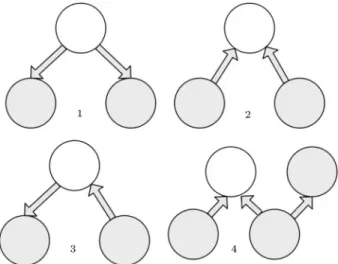
Since multiple SSs may be allowed to transmit in the same mini-slot, a time slot can be reused by multiple SSs, as long as the SSs do not interfere with each other. This property is called spatial reuse, which can be used to increase the capacity of the wireless mesh network by decreasing the length of scheduling. Wireless links interfere with other links, if their packets collide in simultaneous transmissions. There are four types of transmission interference that need to be considered in TDMA networks. Figure 1 shows a complete interference model. The rst three types of conict are between the links that share a neighbor. In case 1, a single transmitter cannot separate packets intended for the two dierent receivers. In Case 2, the parallel transmissions garble each other at the common receiver. Case 3 cause conict because the nodes cannot transmit and receive at the same time. In case 4, the two interfering links are shown with a solid line. Since the two transmitters share a neighbor hearing both transmissions, they cannot transmit at the same time, which is shown by a dashed line for the overheard transmission. The rst three cases are called, Primary
Interference, and the fourth case is called, Secondary Interference.
The collision between two sender (or receiver) nodes in a downlink transmission can be shown in a matrix. The collision matrix is an nn binary matrix (n represents the number of nodes) that is obtained from the network topology and interference model, regardless of the status of bandwidth requests of the nodes. If nodes a and b interfere with each other, the entries (a; b) and (b; a) of this matrix are 1, otherwise they are 0. This matrix will be updated only when a node joins or leaves the network.
4.3. Downlink ow analysis
The number of simultaneous transmissions in downlink scheduling varies, based on network topologies. In Fig-ure 2, various possible structFig-ures for a 5-node network
Figure 1. Interference model in the wireless mesh network.
Table 2. Concurrency in 5-node structures. Structure Downlink Number of Path
number concurrency leaves cost opportunity
1 1 1 10
2 1 2 6
3 1 2 6
4 0 2 8
5 0 3 5
6 0 2 9
7 0 4 4
are illustrated. In these structures, in order to com-pute the number of possible concurrent transmissions, the nodes have been presumed in the best possible situation. It means that there are no links between the nodes other than the connection links designated in the gure. Any extra link will result in a need to lower the number of simultaneous transmissions, and since, in this section, the goal is to determine the maximum number of those transmissions, there is no need to consider the other links. Table 2 shows that there are more simultaneous transmissions in a chain (structure 1) and semi-chain structures (structures 2 and 3) than in other structures in the network. Semi-chain structures are similar to a chain with more leaves, and have rather saved the shape of a chain. For example, both structures 2 and 4 have two leaves, but structure 2 has two chains with the most connections to the BS. Therefore, it is called a semi-chain structure.
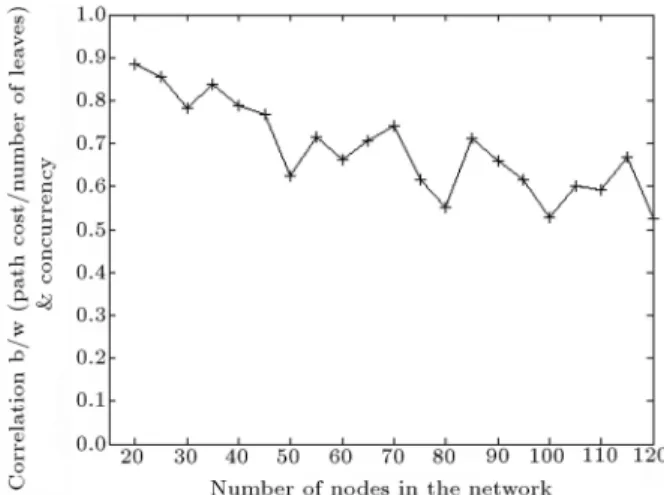
In order to obtain a better understanding, the relation between the number of leaves, path cost (the sum of distance of all nodes to BS) and the number of possible concurrent transmissions in downlink has been studied through simulation. In this simulation, for every randomly generated network with a determined number of nodes, a network tree is derived and the number of leaves, path cost and collision matrix in downlink are computed. Let X represent the path cost of a network, Y denotes the number of leaves and Z is the number of zeros in the collision matrix. Due to Figure 2 and Table 2, the greater node distance to the BS (higher X values) and the fewer network leaves (less Y values) makes more likely the network chain or semi-chain structure. So, the higher value of (X=Y ) (more X and less Y values) shows that the network topology is closer to a chain pattern. By computing the correlation between (X=Y ) and Z (Figure 3), we can study the relation between simultaneous transmissions and the network topology in downlink scheduling.The correlation ratio will be a value within a [-1,1] interval. The closer this value is to 1, the correlation between
Figure 3. Correlation between path cost/number of leaves and concurrency.
parameters is more and in direct relation. Figure 3 shows that there is a direct relation between chain or semi-chain structures and the number of concurrent transmissions in a network. For small size networks, this correlation is high (close to 1), but decreases by increasing the number of nodes. It is because of the high interference in large and accumulated networks.
According to Figure 3, if the structure of a network is chain or semi-chain, there is a higher probability of nding more concurrent transmissions. Despite the opportunity of having a chain structure is low, the chain or semi-chain structures can be extracted from the network topology. These paths can increase concurrency in the network. In the proposed algorithm, network structure is considered and the load is distributed through semi-chain paths to increase the chance of simultaneous transmission.
4.4. Downlink scheduling formulation
In [3], an Integer Linear Programming (ILP) model is proposed for uplink scheduling in the mesh mode. Here, we use this model and modify it for downlink scheduling, i.e. by allocating mini-slots of the data subframe to the sender nodes in an interference-free manner. The mesh network is composed of one BS and several SSs. Let node v0 denote BS and node
vi (1 6 i 6 n) denote each SS, where n is the number
of SSs. We assume that in adjacency matrix, Enn, we
have Eij= Eji= 1 (i.e., links are bidirectional) if and
only if nodes viand vj are connected, and 0 otherwise.
The number of packets to be delivered to node vi
through downlink is denoted by wi. We assume that
the network topology is xed over scheduling time, and the upper bound of scheduling, U, is known. With these assumptions, the modeling problem can be stated as follows:
Variables. We introduce the following variables to represent the routing tree:
The routing matrix is presented by R. In this matrix, we have Rij = 1 if vj is the parent of vi in the
routing tree, and 0, otherwise. As the routing tree is a subgraph of the network graph, we have:
Rij 6 Eij 8i 2 f1 : : : ng; 8j 2 f0 : : : ng: (1)
Since each node can have only one parent, we have:
n
X
j=0
Rij = 1 8i 2 f1 : : : ng: (2)
We dene binary variable Xijt by the following
con-straints: 1 6 i 6 n, 0 6 j 6 n and 1 6 t 6 U. Each binary variable, Xijt, takes values dened as follows.
Xijt is 1 if vi receives a data packet from vj in time
slot t, and 0, otherwise. Since each node has only one parent and can receive packets in the same way, we have:
Xijt6 Rij; (3)
8i 2 f1 : : : ng; 8j 2 f0 : : : ng; 8t 2 f1 : : : Ug: The interference constraints can be mathematically captured for all pairs of edges (i1; j1) and (i2; j2) in
time slot t, as follows;
Xi1j1t+ Xi2j2t6 1: (4)
Let witbe the number of packets that have not reached
vi at the end of time slot t. If node vi receives one
packet from node vj in time slot t, the number of
received packets at vj increases by 1. Thus, for each
node, vi, the packet ow constraints can be specied
as:
wit= wi(t 1)+ Xijt
X
k
Xkit: (5)
Let At be the total number of packets that have not
yet reached their destination at the end of time slot t. Therefore, Atcan be presented as follows:
At= n
X
i=1
wit: (6)
Then, the problem is to nd a scheduling, such that t is minimized, where At = 0. We introduce U binary
variables, Yt, where 1 6 t 6 U, to simplify our
scheduling problem, and add the following constraints:
U
X
t=1
Yt= 1; At6 A0(1 Yt) 8t 2 f1 : : : Ug: (7)
These two equations together imply that there is exactly one Yt = 1, and that must happen for some
timeslot for which At= 0.
Objective function. The objective function is ex-pressed as follows:
MinimizeXU
t=1
tYt: (8)
Subject to : XU
t=1
Yt= 1;
At6 A0(1 Yt) 8t 2 f1 : : : Ug:
Complexity analysis. The complete problem con-sists of O(n2U) variables and O(n4U) constraints.
It is a NP-complete problem [3]. This means that the time required to solve this problem is signicant. Therefore, in the following section, we propose a heuristic algorithm to solve the downlink scheduling problem.
4.5. The proposed algorithm
The proposed algorithm called Trac-Aware Schedul-ing (TAS) can be compared with the introduced algo-rithm in [27] to schedule downlink trac. The greedy algorithm of [27] is based on the distance of a node from the BS. However, our proposed algorithm is based on downlink ow analysis and uses multiple measures in scheduling. To this end, a special matrix, called the Request Matrix, is introduced. In every timeslot, this matrix can be dened by the following equation:
Dijt= k;
if node i has k data packet for node j then:
s.t. 8j 2 f1; :::; ng; time slot t; 8 i 2 f0; :::; ng: (9) In the rst time slot, the whole load is concentrated in the BS. Therefore, in this slot, only the rst line of the request matrix has non-zero value. For each transmission in each time slot, one unit will be de-ducted from the entry related to the specied (sender, receiver) pair in the request matrix, and one unit will be added to the (relay, receiver) pair. Therefore, the value of the entries in the rst line of this matrix decreases progressively and the trac load is distributed over the other lines.
The proposed algorithm consists of two phases (refer to Algorithm 1): selection of sender node, and selection of simultaneous sender nodes. In the rst phase, in each time slot, t, the criterion for selection of sender node vi is as follows:
1. The sender with the maximum number of transmis-sion requests is selected in the current time slot.
2. If there exists more than one node in this situation, the sender with request from the farthest receiver is selected.
Algorithm 1. The pseudo code of the proposed Trac-Aware Scheduling (TAS) algorithm.
3. If there is more than one node at the previous stage, the node is selected that transmits with the least possible interference with the other nodes.
4. If there is more than one node with minimum interference, the sender with the least node number is selected.
The selected sender node in the rst phase will enter into a list, called the Transmission List. The nodes in the Transmission List will transmit in time slot t. In the second phase of algorithm, the nodes that can transmit simultaneously to the nodes in the transmission list will be determined. The steps of this phase are as below:
1. Considering the collision matrix, the nodes with a request for transmission that can transmit con-currently with nodes in the Transmission List, are extracted. These nodes are added to the Concurrent Transmission List.
2. The Concurrent Transmission List is provided to the rst phase to select the simultaneous sender nodes. The selected node is removed from the Concurrent Transmission List and added to the Transmission List.
The second phase continues until all the requests are granted or there is no possibility for simultaneous transmission. At the end of the second phase, the scheduling algorithm is repeated for time slot t+1. This
process continues until all data packets are received by their destinations. At the start of the scheduling algorithm, the fact that the load is mainly concentrated at the BS makes the BS selected as the rst sender. This circumstance continues for the rst few time slots. Selection of the sender with maximum transmission request in the rst phase, results in fast distribution of load over the network. Although the possibility of simultaneous transmission is not feasible during the rst few time slots, it can be achieved after distributing the load over the network. We mentioned before that in downlink scheduling, the network load is initially concentrated in the BS, and the possibility of simultaneous transmission is low. If load distribution is not considered in the scheduling algorithm, we cannot easily use the concurrent transmission opportunity. The rst stage selects the most demanding sender, so the trac is separated from the BS in the rst time slots and is distributed over the network. After some time slots, load distribution in the network is the same as uplink ow, and concurrent transmission possibility is high. In the second stage, the distance of the packet receiver is considered. As shown in Section 4.3, there are more opportunities for simultaneous transmissions in chain structures. In the second stage, the chain manner is used to distribute the load in the network to increase the concurrency rate. The network structures are random and are not in chain form necessarily, but it is more probable that the father node to the BS is on a chain or semi-chain structure. So, the
farthest receiver selection transfers the load to the farthest points of the network and simulates motion on the chain or semi-chain conguration. Specically, this is the dierence between the TAS algorithm and the proposed algorithm in [27]. If there are multiple nodes that satisfy the second stage condition, the node with minimum interference with other nodes is selected. This selection increases the possibility of simultaneous transmission. Finally, at the last stage, a random criterion is considered for sending the package. 5. Experimental results
5.1. Performance metrics
Three metrics are set up for performance evaluation. They are scheduling length, network throughput, nthr, and link concurrency ratio, lcr [27].
Scheduling length is the number of time slots needed to transfer all downlink trac from BS to SSs. It is the most important measure of the performance of a scheduling algorithm, and it is considered in most of the previous literature. The scheduling length has upper and lower bounds. The scheduling length gets closer to the upper bound when there is no concurrent transmission and only one link transmits at each time slot. Let hi be the hop count of SSi to the BS and di
be the slot request of SSi. The upper bound can then
be calculated by Eq. (10). upper bound =X
iN
hidi: (10)
The lower bound is the sum of all requests without considering the nodes distance from BS. Then, the lower bound can be computed by:
lower bound =X
iN
di: (11)
The network throughput is used to evaluate the throughput performance. According to [27], we dene network throughput as the ratio of the scheduling lower bound to the actual scheduling length:
nthr =scheduling lengthlower bound =
P
iNdi
scheduling length: (12) The link concurrency ratio is used to evaluate the spatial reuse eciency, which means how many links can transmit concurrently at a time slot [27]. Due to Eq. (13), the link concurrency ratio can be expressed as the ratio of the upper bound scheduling length to the actual scheduling length. Its minimum value is 1 when there is no concurrency. By using spatial reuse, the link concurrency ratio gets higher values.
lcr = scheduling lengthupper bound = P
iNhidi
scheduling length: (13)
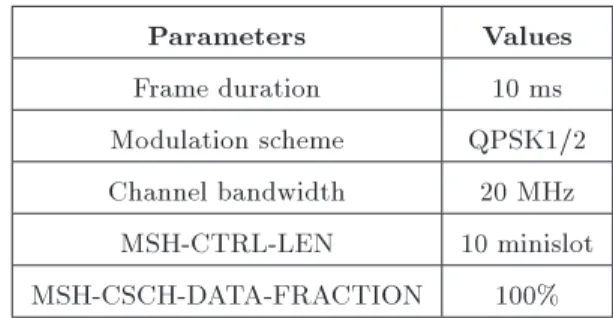
Table 3. Simulation parameters.
Parameters Values
Frame duration 10 ms Modulation scheme QPSK1/2 Channel bandwidth 20 MHz
MSH-CTRL-LEN 10 minislot MSH-CSCH-DATA-FRACTION 100%
5.2. Simulation setup
The MATLAB simulation tool was used to evaluate the performance of the proposed algorithm. We assume that the SSs are randomly and uniformly distributed in a square area of size 100100 units. The BS is located at the center of this area. All nodes have the same xed transmission range of 20 units. Two nodes are neighbors if the distance between them is less than the transmission range. We assume a single channel in the network without any bit errors. In our simulation, the number of SSs is varied from 20 to 100, and the slot demands of all SSs within the allocation cycle time are varied from 0 to 10. We assume the trac is non-real-time and Variable Bit Rate (VBR). The simulation results presented in this section are averaged over 300 independent simulation experiments. Other simulation parameters are provided in Table 3.
5.3. Main results
In this section, we compare our algorithm with three other algorithms: Farthest Sender, Max Weight [3] and Farthest Receiver [27]. The Max Weight algorithm is proposed for uplink trac. Because of its similarity to the rst and second steps of our algorithm, we optimize this algorithm for downlink trac. In the Max Weight algorithm, for each time slot, across the farthest senders, the scheduler selects the sender with maximum data packets. The Farthest Receiver is actually the second step of our algorithm, which is implemented to study the impact of the second step of our algorithm on global eciency. The dierence between Farthest Sender and Farthest Receiver is that the rst one selects the farthest sender from the BS in each time slot, but the other algorithm chooses the sender who has the data packet for the farthest receiver from the BS.
Figures 4, 5 and 6 show the simulation results in downlink scheduling of TAS (the proposed algorithm), Farthest Sender, Max Weight andFarthest Receiver. From Figure 4, we can see that the scheduling length increases with the number of nodes, and this is because the trac demand increases with the number of nodes. The scheduling length of TAS and Max Weight is lower than the two other algorithms. The proposed algorithm has the best results in scheduling length and the performance of the Farthest Sender is the worst.
Figure 4. Scheduling length vs. number of nodes.
Figure 5. Network throughput vs. number of nodes.
Figure 6. Concurrency ratio vs. number of nodes.
On average, the scheduling length of TAS is 13.7% less than the other algorithms.
In Figure 4, the Max Weight algorithm has better results than the Farthest Sender and Farthest Receiver, but TAS has the best performance. In TAS and Max Weight, we select the sender with the maximum number of waiting packets. In the rst time slots, the BS has the most data packets; then our selection helps the BS to distribute the trac load which leads to more concurrency. Moreover, Figure 4 shows that choosing the node with the farthest receiver in the Farthest Receiver and the TAS algorithms is better than selecting the farthest sender. Therefore, the download trac load distributes in the network faster, i.e. in a chain-like manner, and more nodes can take advantage of the concurrent transmission. Since the
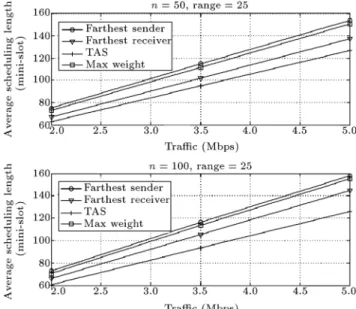
Figure 7. Scheduling length vs. network load.
load is concentrated in a few nodes (the BS and its neighbours) in the rst time slots, choosing the farthest sender leads to provide chances for fewer nodes to send their packets.
Figure 5 shows that only in the TAS algorithm does the network throughput increase vs. the number of nodes, i.e. the proposed algorithm is scalable. When the number of nodes increases, although the interference may be more, we can compensate for its eect and improve the network throughput using spatial reuse. Moreover, this gure demonstrates that choosing the farthest sender is a more eective measure than choosing the node with the maximum load, in terms of network throughput.
The result of studying the concurrency ratio is shown in Figure 6. According to this result, the concurrency ratio of the TAS algorithm is more than other algorithms and does not decrease after reaching its peak. Although interference increases with the number of nodes, the TAS algorithm uses concurrency opportunities better than the other algorithms and maintains the concurrency ratio constant.
In Figures 7-9, the eect of increasing network load on the performance of the TAS algorithm is studied for two sizes of network. As seen in Fig-ure 7, by increasing the network load, scheduling length increases for all four methods, and the proposed algorithm has a minimum value. Scheduling length in all methods are close to each other for low trac load. However, with increasing the load, the dierence in scheduling length becomes more. Therefore, the proposed algorithm is more ecient for high load. Like Figure 4, the Farthest Sender has the longest length and the performance of the Farthest Receiver is close to the proposed method. Moreover, changing the number of nodes has little impact on the scheduling length. If
Figure 8. Network throughput vs. network load.
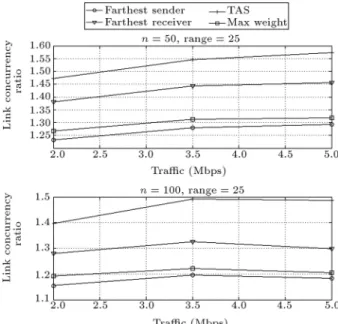
Figure 9. Concurrency ratio vs. network load.
the number of nodes in the network increases, but the network load remains constant, the scheduling length will be independent of the number of nodes.
According to Figure 8, TAS provides the best network throughput compared to other algorithms. By increasing the number of nodes from 50 to 100 nodes, only the throughput of the proposed algorithm has increased. Therefore, if the network load is low and the number of nodes is high, the throughput of the proposed algorithm, compared to the others, will be better.
Figure 9 shows the concurrency ratio of TAS compared to other methods. Although the proposed method leads to the best result, the growth rate of the
concurrency ratio in a 50-node network is more than in a 100-node one. Therefore, if the network load remains constant, increasing the number of nodes will have an undesirable eect on the concurrency ratio.
6. Conclusion and future work
In this paper, a novel algorithm was presented to improve centralized scheduling and optimal time slot allocation for downlink trac in IEEE 802.16-based wireless mesh networks. The proposed algorithm considers the specications of downlink trac, spatial reuse, and a complete interference model. We have demonstrated the eectiveness of this algorithm across a range of scenarios by performing simulations. The experimental results showed that the proposed algo-rithm has high throughput, reduction in scheduling length, and more concurrent transmission, compared to the state of the art algorithms. Our future work is expanding the algorithm to consider QoS requirements in applying the algorithm to multimedia applications. Acknowledgement
The authors would like to thank Mr. Hadi Asheri of Sharif University of Technology for his help in preparing the manuscript.
References
1. \IEEE. Standard 802.16-2004. Part 16: Air Inter-face for Fixed Broad-band Wireless Access Systems" (2008).
2. Mach, P. and Bestak, R. \Wimax throughput eval-uation of conventional relaying", Telecommunication Systems, 38(1-2), pp. 11-17 (2008).
3. Fanchun, J., Arora, A., Jinho, H. and Hyeong-Ah, C. \Routing and packet scheduling in WiMAX mesh networks", in Fourth International Conference on Broadband Communications, Networks and Systems, pp. 574-582 (2007).
4. Tarhini, C. and Chahed, T. \Qos-oriented resource allocation for streaming ows in ieee802.16e mobile wimax", Telecommunication Systems, 51(1), pp. 65-71 (2012).
5. Cho, D.H., Song, J.H., Kim, M.S. and Han, K.J. \Performance analysis of the IEEE 802.16 wireless metropolitan area network", pp. 130-136 (2005).
6. Singh, V. and Sharma, V. \Ecient and fair scheduling of uplink and downlink in IEEE 802.16 OFDMA networks", in IEEE Wireless Communications and Networking Conference, pp. 984-990 (2006).
7. Chen, J., Jiao, W. and Wang, H. \A service ow management strategy for IEEE 802.16 broadband wireless access systems in TDD mode", Proceedings of IEEE International Conference on Communications, pp. 3422-3426 (2005).
8. Fathi, M., Rashidi-Bajgan, S., Khalilzadeh, A. and Taheri, H. \A dynamic joint scheduling and call admis-sion control scheme for ieee 802.16 networks", Telecom-munication Systems, 52(1), pp. 195-202 (2013).
9. Ghiamatyoun, A., Nekoui, M., Esfahani, S.N. and Soltan, M. \Ecient routing tree construction algo-rithms for multi-channel WiMax networks", in In-ternational Conference on Computer Communications and Networks, (Honolulu, HI), pp. 957-960 (2007).
10. Lu, Y. and Zhang, G. \Maintaining routing tree in IEEE 802.16 centralized scheduling mesh networks", in Proceedings of 16th International Conference on Computer Communications and Networks, pp. 240-245 (2007).
11. Cao, Y. and Liu, Z. \A centralized scheduling algo-rithm based on multi-path routing in WiMAX mesh network", in International Conference on Wireless Communications, Networking and Mobile Comput-ing, pp. 1-4 (2006).
12. Xergias, S., Passas, N. and Salkintzis, A.K. \Cen-tralized resource allocation for multimedia trac in IEEE 802.16 mesh networks", Proceedings of the IEEE, 96(1), pp. 54-63 (2008).
13. Mai, Y., Yang, C. and Wen, C. \A new cut through mechanism in IEEE 802.16 mesh networks", Proceed-ings of World Academy of Science, Engineering and Technology, 41, pp. 98-104 (2009).
14. Liang, J.-M., Wu, H.-C., Chen, J.-J. and Tseng, Y.-C. \Mini-slot scheduling for IEEE 802.16d chain and grid mesh networks", Computer Communications, 33(17), pp. 2048-2056 (2010).
15. Salehi, M. and Khorsandi, S. \A centralized scheduling with spatial reuse in IEEE 802.16 based wireless mesh network", in Iranian Conference on Electrical Engineering (2008).
16. Chen, L.-W., Tseng, Y.-C., Wang, Y.-C., Wang, D.-W. and Wu, J.-J. \Exploiting spectral reuse in routing, resource allocation and scheduling for IEEE 802.16 mesh networks", 58(1), pp. 301-313 (2009).
17. Xiao, J., Zhang, W. and Wang, N. \Tsals - a cen-tralized scheduling and channel assignment scheme in third generation router based WiMax mesh net-work", in International Conference on Networks Secu-rity, Wireless Communications and Trusted Comput-ing (NSWCTC), 01, pp. 262-265 (2009).
18. Shetiya, H. and Sharma, V. \Algorithms for routing and centralized scheduling to provide QoS in IEEE 802.16 mesh networks", in ACM workshop on Wireless Multimedia Networking and Performance Modeling, pp. 140-149 (2006).
19. Kuran, M., Yilmaz, B., Alagoz, F. and Tugcu, T. \Quality of service in mesh mode IEEE 802.16 net-works", in International Conference on Software In telecommunications and Computer Networks, pp. 107-111 (2006).
20. Sharma, V., Kumar, A.A., Sandeep, S.R. and
Sankaran, M.S. \Providing QoS to real and data
applications in WiMAX mesh networks", in IEEE Wireless Communications and Networking Conference, pp. 2645-2650 (2008).
21. Yang, C.-C., Mai, Y.-T. and Tsai, L.-C. \Design of the QoS frame-work for the IEEE 802.16 mesh networks", International Journal of Communication Systems, 22, pp. 1543-1562 (2009).
22. Gandham, S., Dawande, M. and Prakash, R. \Link scheduling in sensor networks: Distributed edge color-ing revisited", 4, pp. 2492-2501 (2005).
23. Han, B., Jia, W. and Lin, L. \Performance evaluation of scheduling in IEEE 802.16 based wireless mesh net-works", Computer Communications, 30(4), pp. 782-792 (2007).
24. Al-Hemyari, A., Noordin, N.K., Ismail, A., Khatun, S., Tahir, Y.H. and Qassem, Y.A. \Centralized schedul-ing, routing tree in WiMAX mesh networks", in In-ternational Conference on Innovations in Information Technology, pp. 539-543 (2008).
25. Ishii, R., Hasegawa, G., Taniguchi, Y. and Nakano, H. \Time slot assignment algorithms in IEEE 802.16 multi-hop relay networks", pp. 265-270 (2010).
26. Xie, F., Hua, K.A. and Jiang, N. \A cross-layer framework for video-on-demand service in multi-hop WiMax mesh networks", Computer Communications, 31(8), pp. 1615-1626 (2008).
27. Liu, S., Feng, S., Ye, W. and Zhuang, H. \Slot allo-cation algorithms in centralized scheduling scheme for IEEE 802.16 based wireless mesh networks", Computer Communications, 32(5), pp. 943-953 (2009).
28. Ali, N.A.A., Taha, A.-E.M. and Hassanein, H.S. \IEEE 802.16 mesh schedulers: Issues and design challenges", IEEE Network, pp. 58-65 (2008).
29. Zhang, S., Yu, F.R. and Leung, V.C.M. \Joint con-nection admission control and routing in IEEE 802.16-based mesh networks", in IEEE International Confer-ence on Communications, pp. 4938-4942 (2008).
30. Kas, M., Yargicoglu, B., Korpeoglu, I. and Karasan, E. \A survey on scheduling in IEEE 802.16 mesh mode", IEEE Communications Surveys and Tutorials, 12(2), pp. 205-221 (2010).
31. Han, B., Tso, F.P., Ling, L. and Jia, W. \Performance evaluation of scheduling in IEEE 802.16 based wireless mesh networks", in IEEE International Conference on Mobile Adhoc and Sensor Systems, pp. 789-794 (2006).
32. Tang, Y., Cheng, R., Wu, T. and Yu, J. \On cen-tralized scheduling and channel assignment scheme for WiMAX mesh networks", Internet Technology, 10(3), pp. 207-215 (2009).
Biographies
Fatemeh Dabiran received her BSc and MSc degrees in Information Technology Engineering from Sharif University of Technology, Tehran, Iran, in 2008, and 2011, respectively. Currently, she is Research Assistant
in the Rahavard Research Communications Company, Tehran, Iran. Her research interests include mul-timedia networks, communication networks, wireless communications and signal processing.
Hamid Reza Rabiee received his BS (1987) and MS (1989) degrees in Electrical Engineering from CSULB, his EEE degree in Electrical and Computer Engineering from USC, USA, and his PhD (1996) in Electrical and Computer Engineering from Purdue University, West Lafayette, USA. From 1993 to 1996 he was a Member of the Technical Sta at AT&T Bell Laboratories. From 1996 to 1999 he worked as a Senior Software Engineer at the Intel Corporation. He was also with PSU, OGI and OSU universities as an Adjunct Professor of Electrical and Computer Engineering from 1996-2000, and is currently Professor of Computer Engineering at Sharif University of Technology, Tehran, Iran, and the Director of AICT, DML, and VASL. He is the founder of the Sharif University Advanced Informa-tion and CommunicaInforma-tion Technology Research Center (AICT), Advanced Technologies Incubator (SATI), Digital Media Laboratory (DML), and Mobile Value Added Services Laboratory (VASL). He has been the initiator and director of international and national projects in the context of the UNDP International Open Source Network (IOSN), and the Iran National ICT Development Plan. He has received numerous awards and honors for his industrial, scientic and academic contributions. He has acted as Chairman in a number of national and international conferences, and holds three patents.
Mostafa Salehi received his BS (2005) degree in Computer Engineering from Iran University of Science and Technology, and his MS (2008) and PhD (2012) degrees in Computer Architecture from Amirkabir University of Technology and Sharif University of Technology, Tehran, Iran, respectively. He is currently Assistant Professor in the Faculty of New Sciences and
Technologies at the University of Tehran, Iran. He has also been involved in a number of large scale network design and consulting projects in the telecom industry. His research interests include multimedia networks, and complex networks.
Ali Asghar Amidian received his BS degree from K.N. Toosi University of Technology, Tehran, Iran, in 1986, his MS degree from Amirkabir University, Tehran, Iran, in 1993, and his PhD from Laval Uni-versity, Quebec, Canada in 2002 in Telecommunication Engineering. He is currently Assistant Professor in the faculty of Applied Science of Communications, aliated to the Ministry ICT and a Member of the Strategic Council of the Advanced Information and Communication Technology Research Center of Sharif University of Technology, Tehran, Iran. From Oc-tober 2005 to January 2007 he acted as Consultant to the ICT Ministry and Director of the Iranian Telecommunication Research Center (ITRC) and also worked as Executive Manager of the National ICT Research Project. From 2004 to 2007 he worked as a Board Member and Managing Director of the Telecommunication Infrastructure Company of Iran (TIC). From 2002 to 2004 he acted as Chairman of the Board and Managing Director of the Iranian Remote Sensing Center (presently: Space Agency of Iran). From October 2009 to 2010, he worked as Deputy of Statistics and Informatics at the National Registration Organization and the Executive Director of the National Smart ID Card Project, and, from 2008 to 2009, he acted as Planning Deputy of Qom Governor-Generalship. Dr. Amidian has published a number of research papers, books, and translations, and has contributed academically to numerous Ira-nian Universities, such as Amirkabir University, and the council for socio cultural and economic studies and researches, at the ICT Ministry. He has also lectured at many national and international confer-ences.