Using Commitment to Improve
Environmental Quality
Proefschrift
ter verkrijging van
de graad van Doctor aan de Universiteit Leiden, op gezag van Rector Magnificus prof. mr. P. F. van der Heijden,
volgens besluit van het College voor Promoties te verdedigen op donderdag 17 september 2009
klokke 13.45 uur door
Anne Marike Lokhorst
geboren te Amsterdam
Promotiecommissie
Promotoren Prof. Dr. E. van Dijk (Universiteit Leiden) Prof. Dr. G. R. de Snoo (Universiteit Leiden) Co-promotor Dr. H. Staats (Universiteit Leiden)
Overige leden Prof. Dr. N. Ellemers (Universiteit Leiden)
Prof. Dr. C. J. H. Midden (Technische Universiteit Eindhoven) Prof. Dr. J. Thøgersen (Aarhus University)
This research was financially supported by the Netherlands Organization for Scientific Research (NwO), program Social Scientific Research on the Environment and Nature (GaMON).
ISbN: 978-90-76269-77-1 DTP: Textcetera, The Hague.
Contents
Chapter 1 Using Commitment to Improve Environmental Quality:
an Introduction 7
Chapter 2 A Social-Cognitive Explanation Of Motivational Differences Between Farmers’ Subsidized And Non-Subsidized Nature Conservation
Practices 15
Method 21
Results 23
General Discussion 26
Chapter 3 Using Tailored Information and Public Commitment to Improve the
Environmental Quality of Farm Lands 29
Method 34
Results 37
General Discussion 41
Chapter 4 Public Commitment Making as a Structural Solution in Social
Dilemmas 45
Method Study 1 52
Results Study 1 53
Method Study 2 55
Results Study 2 56
General Discussion 58
Chapter 5 A Review of Commitment Making Strategies in Environmental
Research 61
Theory 64
Environmental studies that use a commitment manipulation 70 Comparing environmental studies to theory 83
Conclusion 87
References 97
Nederlandse samenvatting 105
Acknowledgements 109
Chapter 1
Using Commitment to Improve
Environmental Quality:
Using Commitment to Improve Environmental Quality: an Introduction 9
Using Commitment to Improve Environmental Quality: an Introduction 99
One of the biggest problems facing the world today is the degradation of our natural envi-ronment. This degradation is mainly due to human behavior (Stern, 2000). because of this, there is ample pressure on social scientists to develop instruments that are effective in altering human behavior in a more pro-environmental direction. This thesis deals with that issue. More specifically, in this thesis I will investigate a specific instrument aimed at altering environmental behavior: the making of public commitments. I will show that commitment making is an effective instrument for improving actual conservation behavior, investigate the conditions under which people are willing to make commitments, and I will describe in detail the processes through which commitment making may alter behavior. The goal of this thesis is to provide a perspective on the entire process of commitment making. by doing so, I hope to contribute to the improvement of public commitment making as a tool to promote pro-environmental behavior.
This thesis consists of both field and laboratory studies. The research conducted was part of the NwO funded program “Feedback, social support and public commitment to improve environmental quality of farm lands”. Therefore, the field studies focus on nature conservation practiced by arable farmers. In this introductory chapter, I will first describe and explain these nature conservation practices. After that I will describe the background of this research project by reviewing the social psychological literature on interventions focussing on environmental behaviors. Then, I will formulate the research questions under-lying this project. The chapter ends with an outline of the thesis and an overview of its chap-ters.
Farmers and nature conservation
C
ha
pt
er 1
10 10
It has been recognized that these agri-environmental schemes are not always effective in changing farmers’ attitudes and behavior concerning conservation (burton, 2006). In the current thesis and especially in Chapters 2 and 3, I will describe studies that investigate the relevant aspects of farmers’ motivation to engage in nature conservation practices and how these practices can be improved.
Environmental intervention research
within the social psychological literature there is a vast amount of research dealing with interventions aimed at altering environmental behaviors (for reviews, see Abrahamse, Steg, Vlek, & Rothengatter, 2005; De Young, 1993; Dwyer et al., 1993). Interventions usually focus at household behaviors such as recycling and energy saving. One technique that seems par-ticularly promising is the making of public commitments whereby an individual is asked to publicly commit to a certain behavior. It seems that people are likely to adhere to previously made commitments. Several studies have shown that commitment making is effective in, for instance, increasing recycling (burn & Oskamp, 1986; DeLeon & Fuqua, 1995; wang & Katzev, 1990), energy saving (Pallak & Cummings, 1976), and choosing public transport over car use (Matthies et al., 2006). The details of this process whereby commitment influences behavior will be discussed in greater detail in Chapter 5.
Another technique that has often been applied in intervention research is the presen-tation of information. This can be and is done in several different ways. Information can be given about general environmental issues or about specific problems and their solu-tions. Information can consist of feedback, whereby people are confronted with their cur-rent behavior, possibly compared to that of others. Feedback can be combined with advices on how to improve current behavior. These advices can vary in the extent to which they are tailored to the individual. In general, providing information serves to create awareness of the current behavior and to increase knowledge that is needed to change that behavior (Abrahamse et al., 2005). In respect to the latter function, it seems plausible to assume that the more tailored the information given is, the more it will result in change at the behavioral level. In Chapter 3, we will combine tailored information and public commitment making in an intervention aimed at improving farmers’ nature conservation practices.
Overview of the current dissertation
Using Commitment to Improve Environmental Quality: an Introduction 11
Using Commitment to Improve Environmental Quality: an Introduction 11
Chapter 2: A Social-Cognitive Explanation Of Motivational Differences Between
Farmers’ Non-Subsidized And Subsidized Nature Conservation Practices
In this chapter I focus on the social psychological underpinnings of nature conservation performed by farmers. In a subsequent chapter I will argue that these underpinnings can be influenced by a commitment manipulation, but in this chapter the emphasis will be on the current motivation farmers experience when it comes to nature conservation. In order to successfully alter behavior and its motivation using a commitment manipulation it is essential to develop knowledge about this behavior. Therefore, this chapter is dedicated to investigating the motivation to perform nature conservation, using the Theory of Planned behavior, to which the concepts of self-identity and personal norms were added. A dis-tinction is made between nature conservation practices done on a non-subsidized basis and nature conservation practices for which farmers receive some form of remuneration from the Dutch government. 85 Arable farmers participated in this survey study. Results show that the model explains more variance in the intention to perform non-subsidized than subsidized nature conservation practices. Also, the concept of self-identity seems to affect intention to perform non-subsidized but not subsidized nature conservation practices. The results suggest that aside from a reward-based motivation, farmers can simultaneously have an identity-based motivation to engage in nature conservation practices. Increasing farmers’ self-identity as conservationists therefore seems a promising way to improve their nature conservation efforts.
Chapter 3: Using Tailored Information and Public Commitment to Improve the
Environmental Quality of Farm Lands
C
ha
pt
er 1
12 12
Reflections on the previous studies and a preview of the next chapters
As mentioned earlier, Chapters 2 and 3 were performed as part of the NwO funded pro-gram “Feedback, social support and public commitment to improve environmental quality of farm lands”. Two years were spent on conducting these studies and designing the tai-lored information and commitment intervention. while commitment making had been used previously as an intervention tool to stimulate pro-environmental behavior, the process whereby commitment making changes behavior was still for a large part unknown. Further investigation of this concept was clearly needed. Specifically, what needed clarification was a) what determines people’s willingness to make commitments, and b) how exactly these commitments affect subsequent behavior. I sought to answer these questions in the follow-ing chapters.
The conditions under which people are willing to make commitments had, to the best of my knowledge, not yet been addressed in social psychological research. This is surprising, since the success of any commitment intervention is highly dependent on people’s willing-ness to take part in it. In fact, the effectivewilling-ness of commitment making is rendered use-less unuse-less people make such commitments. Therefore, a new perspective on commitment making was needed, which I will further explain in Chapter 4.
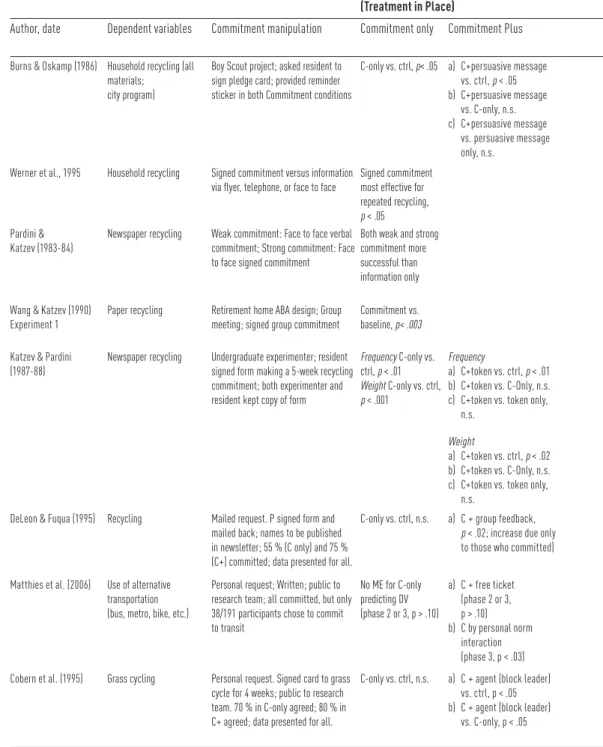
To answer my second question, I reviewed the literature on commitment making. There are several studies that have tested the effect of commitment on environmental behavior (see, for instance, burn & Oskamp, 1986; Pardini & Katzev, 1984; and wang & Katzev, 1990). However, they had not yet been systematically documented (but see Katzev & wang, 1994). Furthermore, what was lacking was a theoretical framework through which the effect of commitment making on behavior could be interpreted. Therefore, I performed a literature study that is described in Chapter 5. In this chapter, I turn to fundamental research on social influence to propose three ways through which commitment may alter behavior. I review studies that apply commitment making to increase environmental behaviors and investigate to what extent they offer evidence for these processes.
by following these two pathways I aim to provide the reader with a more complete pic-ture of the ways commitment making can be used to change behavior.
Chapter 4: Public Commitment Making as a Structural Solution in Social
Dilemmas
Using Commitment to Improve Environmental Quality: an Introduction 13
Using Commitment to Improve Environmental Quality: an Introduction 13
be enjoyed by all group members regardless of their contribution. In this situation it is highly attractive for individual group members not to contribute, since chances are the public good will be realized any way, and they will be able to enjoy it without having to bear the costs of contributing. Such behavior is called free riding. In these dilemmas, contributing for the public good is called cooperation, while behavior for the sake of the individual is called defec-tion (for overviews, see Komorita & Parks, 1995; weber, Kopelman, & Messick, 2004).
Seen from this perspective, trying to increase environmental behaviors is in fact trying to increase cooperation. Research has shown that the making of public commitments increases cooperation (Kerr & Kaufman-Gilliland, 1994). what remains unknown, however, is under which conditions people are willing to make such commitments. based on the lit-erature on structural solutions to social dilemmas, I expected dispositional trust and situa-tional expectations to determine the willingness to install a system of public commitments. In this chapter I will present two studies which both show that group members who are low in dispositional trust are likely to invest in a system of commitments when their situational expectations concerning other group members’ contributions are high. On the other hand, group members who are high in dispositional trust are likely to invest in a system of com-mitments when their situational expectations concerning other group members’ contribu-tions are low. It appears that both low trusters with high situational expectacontribu-tions and high trusters with low situational expectations choose for a system of public commitments in order to gain maximal joint outcomes.
Chapter 5: A Review of Commitment Making Strategies in Environmental
Research
C
ha
pt
er 1
14 14
making as a potentially useful technique which could be improved by following up on find-ings from fundamental research.
Chapter 6: Summary and Conclusion
In this 6th and final chapter I will briefly summarize the major findings presented in this
dissertation and I will elaborate on the general conclusions that can be drawn from these results. Also I will discuss the relevant practical implications of the current research, and offer some suggestions for future research on the making of commitments in the environ-mental domain.
To conclude, the central goal of this dissertation is to investigate if and how commitment making can be used to alter environmental behavior. More specifically, in the first chap-ters, I focus on conservation behavior as performed by Dutch farmers. I will study farmers’ motivation for nature conservation practices, and test whether commitment making can improve these practices. These chapters are followed by two more general chapters on commitment making in which I will investigate the conditions under which people are willing to make commitments, and describe the processes through which commitment making can affect environmental behavior in general. by doing so, I aim to provide a perspective on the entire process of commitment making. Ultimately, I hope this will contribute to the effec-tiveness of commitment making as a tool to promote pro-environmental behavior.
Chapter 2
A Social-Cognitive Explanation Of
Motivational Differences Between Farmers’
Subsidized And Non-Subsidized Nature
Conservation Practices
1
A Social-Cognitive Explanation Of Motivational Differences 1717
biodiversity is decreasing at an alarmingly high rate (world Resources Institute, 2005). It is generally recognized that in order to solve the environmental problems facing the world today, human behavior is key (Stern & Oskamp, 1987). Numerous psychological studies have investigated how to change peoples’ behavior in more environmentally friendly ways (for reviews, see Abrahamse, Steg, Vlek, & Rothengatter, 2005; De Young, 1993; Dwyer et al., 1993). Those studies include for instance recycling (e.g. DeLeon & Fuqua, 1995), envi-ronmental household behaviors (e.g. Harland, Staats & wilke, 1999), and choosing public transport over car use (e.g. Matthies, Klockner & Preissner, 2006). Typically, the behav-iors studied are consumer behavbehav-iors: performed more or less by all members of society and relatively easy to execute. However, Gardner and Stern (2002) argue that psychologists studying interventions in the environmental domain should be very careful in selecting their target behaviors: The research focus should be on those behaviors that have the greatest effect on our environment.
Given the large areas of land in agricultural use, farmers’ behavior and decision-making regarding sustainability and conservation issues have an extraordinary large influence on biodiversity. In this context, it is remarkable that this group has been somewhat overlooked in social psychological research.
C
ha
pt
er 2
18 18
psychology and in this way contribute to a better understanding of the process that lead farmers to invest in nature conservation.
Farmers’ conservation efforts usually consist of reducing emissions of pesticides and fertilizer to the environment, as well as the management and maintenance of semi-natural habitats such as field margins, riparian zones, hedges and other small scale landscape elements (for example boatman et al., 1999). In recognition of the value of such efforts for biodiversity conservation in rural areas, many European countries have set up subsidy schemes to promote farmer conservation activities. These so-called agri-environmental schemes also stimulate farmers to set aside part of their productive area for the creation of semi-natural habitats for conservation purposes. The offered subsidies come with an extensive set of rules and regulations regarding size and management of these habitats; minimum standards farmers are required to comply with.
In addition, farmers have the possibility to perform nature conservation practices on a non-subsidized basis. The natural elements derived from such practices are not compen-sated for by any monetary rewards. It seems plausible that different underlying processes are at stake here. If a farmer can get compensated for one kind of natural element or prac-tice, then why spend energy on other kinds? For subsidized nature conservation practices, it can be expected that the monetary reward is of prime interest; hence living up to the rules of the subsidy regulation to obtain the allowance can be identified as an important motivation for these conservation practices. Non-subsidized conservation however, is inde-pendent of a monetary goal and can therefore be expected to be related to more intrinsic conservation motives.
From a policy perspective it seems important to reward behavior that is believed to be desirable. From a social psychological perspective, however, monetary rewards can be det-rimental and may actually backfire instead of producing the desired increase in behavior. As numerous studies have shown (for a meta-analysis, see Deci, Koestner & Ryan, 1999), behav-ior that is rewarded runs the risk of losing its intrinsic motivation. when people are rewarded for performing a behavior they attribute their motivation to this reward and thus come to think of themselves as extrinsically motivated. This attribution might then lead them to stop per-forming the behavior when the monetary reward is taken away. This possible reduce in effort caused by an external reward has been named the crowding out effect (Frey, 1997).
A Social-Cognitive Explanation Of Motivational Differences 19
A Social-Cognitive Explanation Of Motivational Differences 19
In this study, we will take a closer look at farmers’ motivation to participate in nature con-servation practices. Our focus will be on the differences between subsidized and non-sub-sidized practices. we will examine these possible different underlying social psychological constructs using a social-cognitive model based on the Theory of Planned behavior (Azjen, 1991).
Theory of Planned Behavior
The Theory of Planned behavior, or TPb, is perhaps the most influential and well-known social psychological model to predict human behavior. A plethora of research (for a review, see Armitage & Conner, 2001) has shown that it is capable of predicting a wide range of behaviors, for example donating to charity (Smith & McSweeney, 2007), recycling behavior (e.g. Terry, Hogg and white, 1999), environmental household behaviors (Harland, Staats and wilke, 1999), and landholders’ riparian zone management practices (Fielding, Terry, Masser, & Hogg, 2008; Fielding, Terry, Massar, bordia & Hogg, 2005).
The TPb states that the most proximal predictor of any given behavior is the intention to perform that behavior. The intention to perform can be predicted by the three other compo-nents of the model: the attitude towards the behavior, the subjective norm and the perceived behavioral control (PbC). Attitude is described as an individual’s evaluation of the specific behavior: it is a personal evaluation of whether the behavior is positive or negative (Azjen & Fishbein, 1980). Subjective norm is the perceived social pressure to perform a certain behavior. It reflects the extent to which a person thinks relevant others believe the actor should perform the behavior. PbC reflects how easy or difficult the individual thinks it will be to perform the behavior.
Ajzen (1991) has stated that ‘the theory of planned behavior is, in principle, open to the inclu-sion of additional predictors if it can be shown that they capture a significant proportion of the variance in intention or behavior’ after the original TPb variables have been taken into account. In fact, several studies have been conducted in which new constructs have been successfully added to the model, thereby increasing its explanatory power (for an overview focusing on environmentally relevant behaviors, see Staats, 2003). In the current study, we have therefore added two constructs to the TPb model, for which we expected an increase of explanatory power for the behavior under study. These constructs are discussed in detail below.
Additional constructs
C
ha
pt
er 2
20 20
first. Activation occurs when people are aware of the negative consequences of their behav-ior and feel that they are responsible for these consequences. Also, norms are activated when people identify actions that can counter these negative consequences, and feel that they can perform these actions (Harland, Staats, & wilke, 2007). This activation results in a feeling of having to perform a certain behavior.
Several studies have shown that personal norms can significantly predict behavioral intention. Harland, Staats and wilke (1999) studied environmentally relevant behavior in a household setting. They found that personal norms significantly explained intentions and behaviors such as using unbleached paper and using energy-saving light bulbs after the TPb constructs were accounted for. Moan and Rise (2005) examined if an extended version of the TPb could predict intentions to stop smoking and the subsequent behavior 6 months later. They found that personal norms predicted both intentions to stop smoking and actual quitting behavior. bamberg, Hunecke and blöbaum (2007) reported two studies in which they found that personal norm was a significant predictor of intention to use public trans-port and this effect was independent of attitude and perceived behavioral control.
Self-identity. The construct of self-identity stems from identity theory, which describes the self as a collection of identities derived from the various social roles someone occupies (Stryker, 1968). Although all these role identities have the potential to influence behavior, it depends on their relative salience which of these identities will have the strongest influence on behavior. Some roles are more salient than others: These roles have more self-relevance than other roles and they are more likely to be invoked in different situations (Hogg, Terry & white, 1995). Used in combination with the TPb, self-identity refers to the extent to which a certain behavior is seen as part of the self. Research shows that self-identity is an impor-tant predictor of behavioral intentions (see Armitage & Conner, 1999). Sparks and Sheperd (1992) found that self-identity explained intentions to consume organically grown food, even when accounting for the TPb constructs and past behavior. In a subsequent study, Sparks and Guthrie (1998) found that self-identity explained intentions to adopt a more healthy diet. This effect was independent of personal norm and the TPb constructs. Fielding et al. (2008) showed that self-identity was an independent predictor of the intention to engage in envi-ronmental activism.
A Social-Cognitive Explanation Of Motivational Differences 21
A Social-Cognitive Explanation Of Motivational Differences 21
the work of Fielding et al. did not include the concept of self-identity: A concept that plays a central role in the current study.
The current study: aims and hypotheses
based on the above, our first aim was to investigate the social-psychological underpinnings of nature conservation practices using the TPb, including self-identity and personal norm. Moreover, we were interested in the possible differences in subsidized and non-subsidized practices. The second aim of this study therefore is to investigate whether different proc-esses underlie these two types of nature conservation practices.
we believe that farmers will be more extrinsically motivated to perform subsidized nature conservation practices, and more intrinsically motivated to perform non-subsidized nature conservation practices. Associated with intrinsic motivation are feelings of personal obligation to perform nature conservation practices and seeing these practices as some-thing that is part of the self. Thus, we believe that feelings of self-identity and personal norm will be associated more with non-subsidized then with subsidized practices.
More specifically, we hypothesize that: The TPb constructs will significantly predict both the intention to perform non-subsidized nature conservation practices as well as the inten-tion to perform subsidized nature conservainten-tion practices (Hypothesis 1) and that self-identity and personal norm will be more associated with the intention to perform non-subsidized nature conservation practices than subsidized nature conservation practices (Hypothesis 2). Furthermore, we were interested in the relation between our psychological model and self-reported behavior: we therefore included a measure on time spent on nature conserva-tion practices, and we predict that the intenconserva-tion to perform both non-subsidized as well as subsidized practices will significantly predict the amount of time spent on these practices (Hypothesis 3).
Method
Pilot
C
ha
pt
er 2
22 22
Procedure and participants
Our sample consisted of 109 arable farmers from Zeeland, a province in the southwest of the Netherlands. These farmers were recruited through their local agricultural organiza-tions. These agricultural organizations generally have three goals: to increase the ecologi-cal values of farms, to jointly apply for conservation subsidies, and to increase the general publics’ goodwill towards farmers. we specifically chose to select farmers through agricul-tural organizations for a reason: these organizations are rapidly growing and their members already make up 10 % of all the farmers in the Netherlands, while the amount of farmland owned by their members is 50 % of the total Dutch farmland (Oerlemans, Guldemond, & Visser, 2007). Since this group of farmers is becoming more and more important it makes sense to focus on them specifically.
Participants were initially contacted by telephone. After having agreed on participating, they received the questionnaire at home, together with a return envelope. In total, 85 farm-ers (94.1 % male, mean age 46.9 years) filled out and returned the questionnaire, making the response rate 78 %.
Questionnaire
All questionnaire items were measured on 5-point scales. because we were interested in the possible differences between non-subsidized and subsidized nature conservation prac-tices, all items were measured for both types of practices.
Attitude was measured using the items “I think that subsidized/ non-subsidized nature conservation practices are: negative-positive”, “I think that subsidized/ non-subsidized nature conservation practices are: useless – useful”, and “I think that subsidized/ non-subsidized nature conservation practices are: unimportant– important” (Azjen & Fishbein, 1980). This scale yielded a sufficiently high reliability for both subsidized (α= .77) and non-subsidized practices (α= .87).
Perceived behavioral Control was measured using the item “I am capable of carrying out subsidized/ non-subsidized nature conservation practices: completely disagree – com-pletely agree” (Azjen & Fishbein, 1980).
Subjective Norm was measured using the item “Most people that are important for me think it is important that I carry out subsidized/ non-subsidized nature conservation prac-tices: completely disagree – completely agree” (Azjen & Fishbein, 1980).
A Social-Cognitive Explanation Of Motivational Differences 23
A Social-Cognitive Explanation Of Motivational Differences 23
Cronbach’s α for this scale is 0.77 for subsidized nature conservation practices and 0.85 for non-subsidized nature conservation practices.
Self-identity was measured with 2 items, both on a scale ranging from completely disa-gree to completely adisa-gree (Terry, Hogg & white, 1999): “Subsidized/ non-subsidized nature conservation practices are part of who I am” and “Subsidized/ non-subsidized nature con-servation practices are something for that is typical for me”. Cronbach’s α for this scale is 0.80 for subsidized nature conservation practices and 0.90 for non-subsidized nature con-servation practices.
Intention was measured using 2 items (Perugini & bagozzi, 2001), being: “In the future, under the same conditions I would perform these nature conservation practices again” and “Given the opportunity I would perform these nature conservation practices again”: certainly not – certainly”. Cronbach’s α for this scale is 0.84 for the intention to perform sub-sidized nature conservation practices and 0.90 for the intention to perform non-subsub-sidized nature conservation practices.
Results
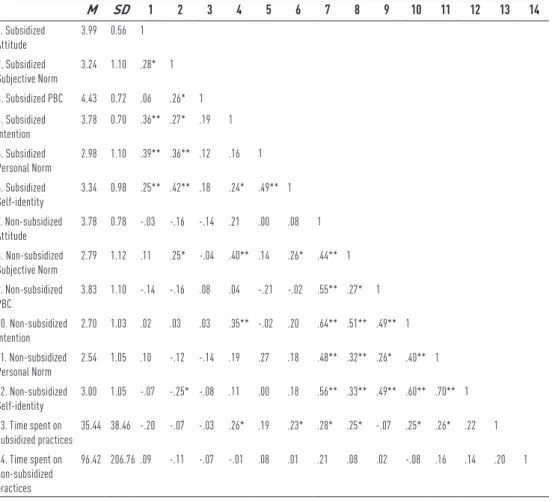
The means, standard deviations, and correlations for both subsidized and non-subsidized practices are listed in Table 2.1. Inspection of this table shows that the mean scores on scales used in our model were above the scale means, and that the intention to perform subsidized practices was positively correlated with the intention to perform non-subsidized practices.
Subsidized practices
C
ha
pt
er 2
24 24
Table 2.1 Means, Standard deviations, and Correlations
M SD 1 2 3 4 5 6 7 8 9 10 11 12 13 14
1. Subsidized
Attitude 3.99 0.56 1
2. Subsidized
Subjective Norm 3.24 1.10 .28* 1 3. Subsidized PBC 4.43 0.72 .06 .26* 1 4. Subsidized
Intention 3.78 0.70 .36** .27* .19 1
5. Subsidized
Personal Norm 2.98 1.10 .39** .36** .12 .16 1
6. Subsidized
Self-identity 3.34 0.98 .25** .42** .18 .24* .49** 1 7. Non-subsidized
Attitude 3.78 0.78 -.03 -.16 -.14 .21 .00 .08 1
8. Non-subsidized
Subjective Norm 2.79 1.12 .11 .25* -.04 .40** .14 .26* .44** 1 9. Non-subsidized
PBC 3.83 1.10 -.14 -.16 .08 .04 -.21 -.02 .55** .27* 1
10. Non-subsidized
Intention 2.70 1.03 .02 .03 .03 .35** -.02 .20 .64** .51** .49** 1
11. Non-subsidized
Personal Norm 2.54 1.05 .10 -.12 -.14 .19 .27 .18 .48** .32** .26* .40** 1
12. Non-subsidized Self-identity
3.00 1.05 -.07 -.25* -.08 .11 .00 .18 .56** .33** .49** .60** .70** 1
13. Time spent on subsidized practices
35.44 38.46 -.20 -.07 -.03 .26* .19 .23* .28* .25* -.07 .25* .26* .22 1
14. Time spent on non-subsidized practices
96.42 206.76 .09 -.11 -.07 -.01 .08 .01 .21 .08 .02 -.08 .16 .14 .20 1
* p <.05. ** p < .01
A Social-Cognitive Explanation Of Motivational Differences 25
A Social-Cognitive Explanation Of Motivational Differences 25
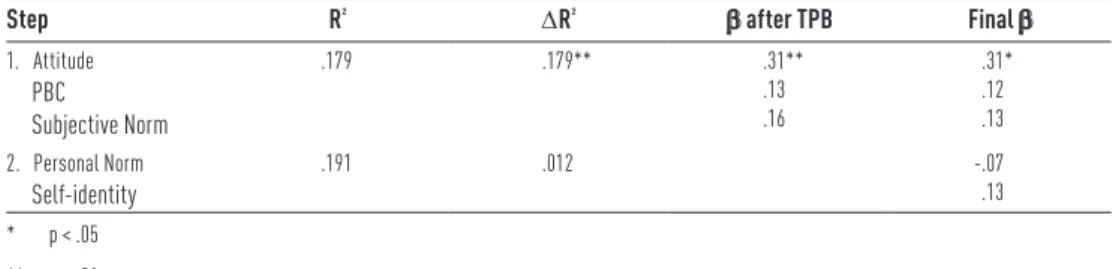
Table 2.2 Subsidized nature conservation practices. Regression analysis with intention as the dependent variable
Step R² ΔR² β after TPB Final β
1. Attitude
PBC
Subjective Norm
.179 .179** .31**
.13 .16
.31* .12 .13 2. Personal Norm
Self-identity .191 .012 -.07.13
* p < .05 ** p < .01
Non-subsidized practices
As with subsidized nature conservation practices, a regression analysis was performed with intention as the dependent variable and attitude, perceived behavioral control, subjec-tive norm, self-identity and personal norm as the independent variables. In the first step, the TPb-concepts attitude, perceived behavioral control and subjective norm were entered into the equation. both attitude (β = 0.52, p < .01), subjective norm (β = 0.27, p < .05) and per-ceived behavioral control (β = 0.20, p < .05) were effective in predicting intention, see Table 2.3. The proportion of the variance in intention to perform non-subsidized nature conserva-tion practices explained by the TPb concepts was 47.1 %.
In the second step, personal norm and self-identity were added to the analyses. Attitude and subjective norm remained significant predictors although their betas slightly decreased. Perceived behavioral control no longer had a significant effect on intention. Self-identity (β= 0.36, p < .01) had a significant effect on intention whereas personal norm did not. Adding personal norm and self-identity improved the proportion explained variance by 6.2 % and this step was significant, p < .01
Table 2.3 Non-subsidized nature conservation practices. Regression analysis with intention as the dependent variable
Step R² ΔR² β after TPB Final β
1. Attitude
PBC
Subjective Norm
.496 .496** .40**
.20* .27*
.31** .10 .26* 2. Personal Norm
Self-identity
.558 .062** -.11
.36** * p< .05
C
ha
pt
er 2
26 26
Self-reported intentions and time spent on nature conservation practices
we were also interested in testing whether self-reported intentions to engage in nature conservation practices were significant predictors of how much time was spent on these practices. As a self-reported measure of spent time we asked participants how much time they spent on either non-subsidized or subsidized nature conservation practices per season, and then aggregated these scores over the year. On average, participants spent 35.44 hours per year on subsidized practices (Sd = 38.46) and 96.42 hours on non-subsidized practices (Sd = 206.76). we then regressed the amount of time spent on nature conservation practices on intention and found that this effect was significant for subsidized practices (β = 0.26, p < .05) but not for non-subsidized practices (β= -0.8, n.s.).
Summary and conclusion
we tested a model based on the Theory of Planned behavior, to which personal norm and self-identity were added. This model was tested twice: Once for subsidized and once for non-subsidized practices. we hypothesized that the TPb would predict both non-subsidized and subsidized practices; and that personal norm and self-identity would better predict non-subsidized than subsidized practices.
The first hypothesis was supported: The intention to perform subsidized practices was predicted by attitude, while the intention to perform non-subsidized practices was pre-dicted by both attitude and subjective norm. Perceived behavioral control had no effect on the intention to perform nature conservation practices.
Our second hypothesis was also partly supported. Contrary to our expectations, per-sonal norm did not significantly predict intention to perform non-subsidized practices. Self-identity, however, did have a significant positive impact on intention.
Furthermore we saw that self-reported intentions to perform nature conservation prac-tices were significant predictors for self-reported time spent on subsidized pracprac-tices but not on non-subsidized practices. Finally, our model explained 19 % of the variance in inten-tion to perform subsidized practices, versus 56 % of the variance in inteninten-tion to perform non-subsidized practices.
General Discussion
A Social-Cognitive Explanation Of Motivational Differences 27
A Social-Cognitive Explanation Of Motivational Differences 27
In the analysis presented here, a major finding was that these processes differ between subsidized and non-subsidized practices
A first distinction between subsidized and non-subsidized practices is the role played by self-identity. As we have seen self-identity significantly predicts intention to perform non-subsidized but not non-subsidized nature conservation practices. How can this difference be explained? we have mentioned before that self-identity is associated with intrinsic motiva-tion. This relation can be explained in greater detail when we look at self-perception theory (bem, 1972). This theory holds that people construe their self-image on the basis of their actions instead of the other way around. People who believe they are free to choose to per-form a certain behavior attribute the perper-formance of this behavior to their self-concept. As Cialdini (2001, p. 82) said: “we accept inner responsibility for a behavior when we think we have chosen to perform it in the absence of strong outside pressure”. we believe a similar process explains our finding that self-identity is related to the intention to perform non-subsidized but not non-subsidized nature conservation practices. Farmers engage in these practices while not being rewarded for them. This leads them to reason that they must be “the kind of people who do these things “and that these nature conservation practices are part of who they are.
A second difference between subsidized and non-subsidized practices is the relation between self-reported intention and self-reported time spent on these practices. As we have seen this relation is significant for subsidized but not for non-subsidized practices. we believe this (lack of) effect mirrors the difference in perspectives on both types of nature management. Since subsidized management is basically a business agreement between a farmer and the government, it comes with an “economic rationalist” perspective. within this perspective it is important to keep track of how many hours are spent on nature con-servation practices in order to see whether the remuneration is sufficient. Non-subsidized practices, however, are usually not fully incorporated into the farm management and are often carried out in between other tasks. It is therefore difficult to keep track of the hours spent on these practices, which may cause for the lack of a significant relation between intention and behavior in this study. It is important to note that the average amount of time spent on non-subsidized practices exceeded the average amount of time spent on subsi-dized practices.
C
ha
pt
er 2
28 28
concluded that the behavior investigated in the current study does not seem to carry moral implications. That is, farmers do not engage in these practices because they feel a moral obligation to do so, but rather as a result of a positive attitude towards the behavior and the perception that these practices fit their identity as conservationists.
The goal of this study was to investigate farmers’ motivation to engage in nature conser-vation practices and to find out whether there are fundamental differences in moticonser-vation for subsidized and non-subsidized practices. Our results clearly show that there are. we hope this study contributes to a better understanding of why farmers choose to engage in nature conservation practices.
Chapter 3
Using Tailored Information and Public
Commitment to Improve the Environmental
Quality of Farm Lands
1
Using Tailored Information and Public Commitment 31
Using Tailored Information and Public Commitment 3131
Scientists, policy makers and the general public agree that action must be undertaken to stop the rapid degradation of our natural environment. while technical solutions and environmental policies are promising, they can only be successful when accompanied by changes in human behavior (Stern & Oskamp, 1987). Unfortunately, changing human behav-ior is not an easy task. A vast amount of research has focused on changing people’s environ-mental attitudes and behaviors and has yielded mixed results (for reviews, see Abrahamse et al., 2005; De Young, 1993; Dwyer et al., 1993). while these studies typically focus on household behaviors such as recycling (e.g. DeLeon & Fuqua, 1995, Harland et al., 1999) and energy conservation (Pallak & Cummings, 1976; Katzev & Johnson, 1983), Gardner and Stern (2002) argue that research should target those behaviors that have the largest impact on our environment.
One approach is to distinguish environmental behaviors such as using energy-efficient lamps and lowering the thermostat in terms of their effect on the environment, and then target the behaviors that affect the environment the most. A complementary approach would be to distinguish between groups of people in these terms. Some people might have a stronger influence on the environment based on their societal or job position. If this is the case, then it makes sense to target these people and their environmental behaviors specifi-cally.
Following this line of reasoning, in the current study we therefore focus on farmers, who have a tremendous influence on the environment due to the large areas of land in agricultural use. More specifically, by adopting nature conservation practices, farmers can strongly improve the environmental quality of their land. This study focuses on improving these conservation practices by developing and testing an intervention, for which we relied on the vast body of social psychological research on interventions in the environmental domain. A key aspect of the current study is that it combines social psychological measures with ecological ones, making it possible to test relations between aspects of motivation and outcomes on the level of environmental quality.
Intervention
C
ha
pt
er 3
32 32
the provision of tailored information: information that is tailored specifically to a person’s individual needs. This technique has been used for example to give garage managers advice on how to reduce oil pollution of wastewater in a study done by Daamen, Staats, wilke, and Engelen (2001) and was found effective. An important aspect of this study is that it targeted professionals instead of the more usual and more general sample of consumers. The current study focuses on farmers, who are professionals as well; therefore, the work by Daamen et al. served as an important impetus for the current study to include tailored advices.
An important distinction between feedback and tailored advice giving is that feedback is a so-called consequent strategy (informing participants about the consequences of their behavior) where as tailored advice giving is an antecedent strategy (informing participants on how to alter their future behavior effectively; see Dwyer et al., 1993). In the current inter-vention we used both techniques in order to increase the effectiveness of the information provided.
The effects of feedback techniques are often limited to shorter periods of time (Staats et al., 2000). Also, it is assumed that interventions are more successful when they are mul-tifaceted and consist of multiple strategies (Gardner & Stern, 2002; werner et al., 1995). Therefore in the current research we decided to further enrich our intervention package with a technique called public commitment making, in which an individual is asked to make a commitment to perform a certain behavior with others present. Commitment making is generally seen as a promising intervention technique (Abrahamse et al., 2005; Katzev & wang, 1994; De Young, 1993; Dwyer et al., 1993) and has been shown to influence for instance recycling (DeLeon & Fuqua, 1995; wang & Katzev, 1990) and choosing public transport over car use (Matthies et al., 2006). Commitment can influence behavior in several ways (see Lokhorst et al., 2008). First, commitment can change people’s self-concept such that the new behavior becomes a part of the self. Second, commitments can evoke either a social or personal norm to engage in the behavior at stake. Third, making a commitment can set in motion a process generally referred to as cognitive elaboration (Petty & Cacioppo, 1986): A process whereby the individual elaborates on the possible reasons to engage in the behav-ior and strategies to accurately perform the behavbehav-ior, resulting in a strong and accessible attitude towards the behavior.
The current research: farmers and conservation
Com-Using Tailored Information and Public Commitment 33
Using Tailored Information and Public Commitment 33
mission, Directorate-General for agriculture, 2003). As a result, many countries have set up subsidy schemes to promote farmer conservation practices. These schemes stimulate farmers to set aside part of their productive area for the creation of semi-natural habitats for conservation purposes. In addition, farmers have the possibility to perform conserva-tion practices on a non-subsidized basis. The natural elements stemming from such prac-tices are not compensated for by any monetary rewards.
Our intervention, combining both tailored information and public commitment, is aimed at improving farmers’ conservation practices and is based on the assumption of voluntary behavior change. both subsidized and non-subsidized are voluntary behaviors. Even though subsidized conservation is contingent on contracts and thus less flexible, farmers are still free to choose for this type of conservation or not. Also, they are free to exert as much effort as they choose for this type of conservation, as long as they meet the required stand-ards. Therefore one could reason that both subsidized and non-subsidized conservation may be influenced by our intervention package. However, it could also be that the effect of our intervention is stronger in the absence of any monetary rewards. Research has shown that rewarding a behavior can cause a decline in intrinsic motivation for this behavior. This process is called the crowding out effect (Frey, 1997). Seen from this perspective it could be that farmers are more motivated to perform non-subsidized conservation, raising the pos-sibility that our intervention will be more successful in affecting this type of conservation. To test the full effect of our intervention and to be able to compare possible changes in non-subsidized conservation with changes in non-subsidized conservation we did include measures for both types of conservation.
C
ha
pt
er 3
34 34
Method
Participants
This study took place in Zeeland, a province in the southwest of the Netherlands. we restricted the research to arable farms in the marine clay district to minimize the influ-ence of differinflu-ences in soil or landscape. Farmers were recruited through their local agri-cultural organizations. These agriagri-cultural organizations generally have three goals: to increase the ecological values of farms, to do so by jointly apply for conservation subsidies, and to increase the general publics’ goodwill towards farmers. These organizations are rapidly growing: The amount of farmland owned by their members is 50 % of the total Dutch farmland (Oerlemans et al., 2007). Since this group of farmers is becoming more and more important we chose to focus on them specifically.
Participants were initially contacted by telephone. After having agreed on participating, they received the baseline questionnaire at home, together with a return envelope. The ini-tial wave of data collection took place in March 2006. In total, the questionnaire was sent to 112 farmers, of which 84 farmers (94.1 % male, mean age 46.9 years) filled out and returned the questionnaire, making the response rate 78 % (see also Lokhorst et al., 2009a).
During the course of the study, 26 participants dropped out. Total attrition from pretest to posttest was 31 %. To examine the nature of attrition, a comparison was made between participants who had dropped out and those who remained in the study on average scores of time spent on nature conservation, attitude towards nature conservation, farm size, age and gender. None of these differences were statistically significant, suggesting that the dropout in this study was not selective.
Study design
Using Tailored Information and Public Commitment 35
Using Tailored Information and Public Commitment 35
Feedback reports were tailor made for each farm, based on self reported data on habi-tat area and management. based on this information, each farm was rated on 4 aspects of agri-environmental management by a team of ecologists with expertise in this area. These aspects were: 1) total area of semi-natural habitat on the farm; 2) habitat diversity; 3) man-agement quality of semi-natural habitats on the farm; 4) the contribution of the habitats and specific measures (e.g. nesting boxes) on the farm to landscape quality and the occurrence of specific groups of organisms (e.g. farmland birds, raptors, amphibians, etc.). Partici-pants’ performance on each of these aspects was compared with the performance of oth-ers in their area. we created feedback reports in which this information was presented in a clear and understandable way. The feedback was combined with tailored advices on how to improve their score in each of the 4 aspects of nature conservation (see also De Snoo, 2006).
In the information plus commitment condition (N = 16), participants were invited to a meeting. we organized two of such meetings: One for each agricultural organization in the information plus commitment condition. So, all participants in this condition went to one meeting, together with their fellow agricultural organization members. During these meet-ings, the reports, similar to those in the information only condition, were handed out. Par-ticipants were given the opportunity to read their reports and discuss the contents among themselves. At the end of each meeting we asked participants to publicly state which of the advices given in the report they were going to follow up on. This way, a public commitment manipulation was administered. In order to enhance the manipulation, minutes of the meet-ing, including every participant’s commitments, were sent to all participants in this condi-tion. Of the 17 participants in the information plus commitment condition, 12 were able to attend the meetings. All the participants present at the meeting made a commitment. Par-ticipants who did not attend the study groups and thus received no treatment were excluded from further analysis.
The control condition (N = 24) received no treatment. A year later, in March 2007, all participants were sent the post-intervention questionnaire.
Questionnaire
All questionnaire items were measured on 5-point scales. because we were interested in the possible differences between non-subsidized and subsidized conservation, all items were consequently phrased for both types of practices. All items were measured before and after the intervention.
sub-C
ha
pt
er 3
36 36
sidized/ non-subsidized nature conservation practices are: unimportant– important” (Azjen & Fishbein, 1980). This scale yielded a sufficiently high reliability for both subsidized (α= .77) and non-subsidized practices (α= .87) in the pre-test as well as in the post-test (subsidized
α= .76, non-subsidized α= .91). The behavioral desire to perform nature conservation was measured with the item “I want to perform subsidized/non-subsidized nature conserva-tion practices”. According to the Model of Goal-Directed behavior, desires “represent the motivational state of mind wherein appraisals and reasons to act are transformed into a motivation to do so” (Perugini & bagozzi, 2001, p. 84). Therefore, they can be seen as a determinant of behavior. For the current study we were particularly interested in using this variable as it reflects an individual’s motivation to perform a given behavior irrespective of possible practical barriers. Nature conservation is characterized by plenty of practical bar-riers such as subsidies, changing regulations and income. Using this measure provided us with the opportunity to measure the effect of our intervention at the personal motivation to perform conservation.
Surface area of (semi-) natural habitat was calculated from self reported data on spe-cific semi-natural habitats present on the farm. Also, we asked participants if they were interested in expanding their current surface area of subsidized (semi-)natural habitat.
Finally, we asked participants how much time they had spent on both subsidized and non-subsidized nature conservation practices per season in the past year. we then aggre-gated these season scores to measures indicating how much time they had spent on both subsidized and non-subsidized conservation practices per year.
Ecological measures. Conservation quality was assessed by asking questions regarding the use of fertilizer and pesticides, mowing/cutting/vegetation removal regime and timing of conservation in relation to breeding and overwintering periods of fauna and seeding peri-ods of flora. These were aggregated into the following 4 categories to enable comparison between differently managed habitats (Van Dijk et al., 2009): 1) protection of the habitat from regular farm practice (e.g. actively avoiding fertilizer or pesticide misplacement); 2) war-ranting spatial and/or temporal continuity of the habitat (e.g. phased mowing or replanting trees); 3) actively influencing vegetation structure (e.g. selective cutting of trees, removal of exuberant water plant growth); 4) active nutrient reduction (e.g. haymaking). If a farmer performed one or more management options within a specific category, one point for man-agement quality was awarded. In total, a manman-agement quality score between 0 (no benefi-cial management) and 4 (high management quality) could be calculated for each habitat. Overall agri-environmental management quality was defined as the average of the manage-ment scores of all semi-natural habitats present at the farm.
dif-Using Tailored Information and Public Commitment 37
Using Tailored Information and Public Commitment 37
ferent habitats and was calculated from the self reported data by adding the number of habitats reported to be present on the farm.
Results
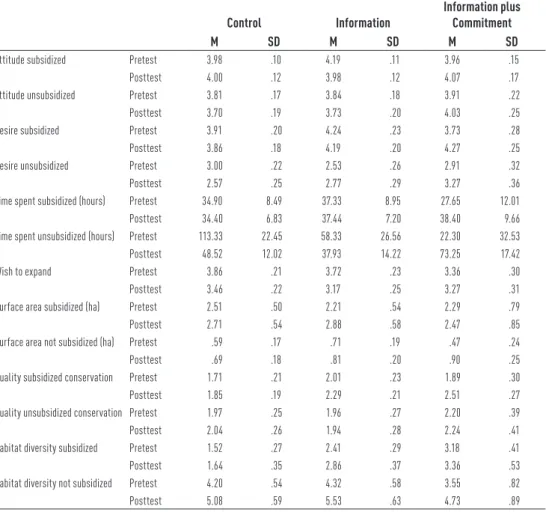
All means and standard deviations are listed in Table 3.1. we will first discuss self-report measures, after which we will turn to effects found on the ecological measures.
One important feature of the current study is that it involves a collaboration of social psy-chological and ecological scientists. Using ecological measures implies selecting a sample that is not affected by differences in soil or landscape. because of these stringent criteria, our final sample was relatively small. Since this study is, to the best of our knowledge, the first to test the effects of a social psychological intervention on nature conservation practiced by farmers, it is exploratory in nature. Therefore, we believe the need to reveal possible effects to be greater than the risk of false positive decisions (Myers, 1972; see also Hartig et al., 1991). we will thus also report effects at the p < .10 level.
Self-report measures
Attitude. A repeated measures analysis of variance on attitude towards conservation was performed. Subsidy (subsidized versus non-subsidized) and time (before and after the inter-vention) were used as the within subjects factors and experimental condition as the between subjects factor. This analysis showed a significant main effect of subsidy, F(1, 40) = 4.56, p = .04). Attitude towards subsidized conservation was more positive (M = 4.02) than attitude towards non-subsidized conservation (M = 3.81). There were no effects of our intervention.
C
ha
pt
er 3
38 38
Surface area of (semi-)natural habitat. A repeated measures analysis of variance on the sur-face area of natural habitat with time and subsidy as the within subjects factors and experi-mental condition as the between subjects factor was performed. This analysis showed a significant main effect of subsidy, F(1, 39) = 28.15, p = .00). Our participants had more sub-sidized (M = 2.60 hectare) than non-subsub-sidized (M = .64 hectare) surface area of natural habitat. This analysis also showed a significant main effect of time F(1, 39) = 7.88, p = .01, showing that that the surface area of natural habitat increased across all conditions (from M = 1.47 hectare to M = 1.77 hectare).
The three-way interaction of time*subsidy*condition was not significant overall, F(2,39) = 1.99, p = .15. However, given our specific hypothesis that especially the combina-tion of tailored informacombina-tion and commitment would affect surface area of natural habitat, we looked at subsidized and non-subsidized conservation separately. A repeated measures analysis of variance on the surface area of subsidized natural habitat with time as the within subjects factor and experimental condition as the between subjects factor showed no sig-nificant interaction of time*experimental condition, F(2,42) = 0.95, ns. However, a similar analysis on the surface area of non-subsidized natural habitat did show an interaction of time*experimental condition, F(2,48) = 2.89, p = .07. Repeated measures analysis per condi-tion showed that the largest change occurred in the tailored informacondi-tion plus commitment condition, where participants increased their surface area of non-subsidized natural habi-tat from 0.47 to 0.90 hectare, p = .06, one-sided. This confirms our hypothesis that espe-cially the combination of tailored information and public commitment would be successful in increasing conservation.
Using Tailored Information and Public Commitment 39
Using Tailored Information and Public Commitment 39
Table 3.1 Means and standard deviations for all the dependent variables before and after the intervention, for every condition
Control Information Information plus Commitment
M SD M SD M SD
Attitude subsidized Pretest 3.98 .10 4.19 .11 3.96 .15
Posttest 4.00 .12 3.98 .12 4.07 .17
Attitude unsubsidized Pretest 3.81 .17 3.84 .18 3.91 .22
Posttest 3.70 .19 3.73 .20 4.03 .25
Desire subsidized Pretest 3.91 .20 4.24 .23 3.73 .28
Posttest 3.86 .18 4.19 .20 4.27 .25
Desire unsubsidized Pretest 3.00 .22 2.53 .26 2.91 .32
Posttest 2.57 .25 2.77 .29 3.27 .36
Time spent subsidized (hours) Pretest 34.90 8.49 37.33 8.95 27.65 12.01
Posttest 34.40 6.83 37.44 7.20 38.40 9.66
Time spent unsubsidized (hours) Pretest 113.33 22.45 58.33 26.56 22.30 32.53
Posttest 48.52 12.02 37.93 14.22 73.25 17.42
Wish to expand Pretest 3.86 .21 3.72 .23 3.36 .30
Posttest 3.46 .22 3.17 .25 3.27 .31
Surface area subsidized (ha) Pretest 2.51 .50 2.21 .54 2.29 .79
Posttest 2.71 .54 2.88 .58 2.47 .85
Surface area not subsidized (ha) Pretest .59 .17 .71 .19 .47 .24
Posttest .69 .18 .81 .20 .90 .25
Quality subsidized conservation Pretest 1.71 .21 2.01 .23 1.89 .30
Posttest 1.85 .19 2.29 .21 2.51 .27
Quality unsubsidized conservation Pretest 1.97 .25 1.96 .27 2.20 .39
Posttest 2.04 .26 1.94 .28 2.24 .41
Habitat diversity subsidized Pretest 1.52 .27 2.41 .29 3.18 .41
Posttest 1.64 .35 2.86 .37 3.36 .53
Habitat diversity not subsidized Pretest 4.20 .54 4.32 .58 3.55 .82
Posttest 5.08 .59 5.53 .63 4.73 .89
C
ha
pt
er 3
40 40
subjects factor and experimental condition as the between subjects factor showed no sig-nificant interaction of time*experimental condition, F(2,45) = 0.57, p = .57. However, a simi-lar analysis on time spent on non-subsidized practices did show a significant interaction of time*experimental condition, F(2,46) = 4.56, p = .02. Repeated measures analysis per condition showed that the time spent on non-subsidized practices decreased in the control condition from M = 111.59 to M = 46.32 (p = .01). The time spent on non-subsidized practices in the tailored information only condition decreased as well (from M = 58.33 to M = 37.93, p = .33). It did, however, increase in the tailored information plus commitment condition (from M = 22.30 to M = 73.25, p =. 06, one-sided). This analysis shows that during the course of our intervention, participants in the tailored information plus commitment condition had spend more time on conservation, and that this was especially true for non-subsidized conserva-tion. because of the large differences in time spent on conservation between conditions before our intervention, these results must be interpreted with caution. However, they are in line with our hypotheses.
Ecological measures
Conservation quality. Next, we looked at the quality of conservation. A repeated measures analysis of variance on quality of conservation practices and time and subsidy as the within subjects factors and experimental condition as the between subjects factor showed a signif-icant main effect of time, F(1,35) = 5.56, p = .03. Quality of conservation practices increased across all conditions, from M = 2.04 to M = 2.20. The interaction of time*subsidy was also significant F(1,35) = 3.29, p = .04, one-sided. This means that the quality of subsidized con-servation practices increased over time (M = 1.89 to M = 2.22, p = .00) whereas the quality of non-subsidized conservation practices did not. In other words, the main effect of time was qualified by the interaction effect of time*subsidy. This increase in quality of conservation was not due to our intervention.
Using Tailored Information and Public Commitment 41
Using Tailored Information and Public Commitment 41
higher to begin with, but it also increased more than subsidized diversity during the course of our intervention. Since there were no significant differences between experimental con-ditions, this increase cannot be attributed to our intervention.
General Discussion
by adopting conservation practices, farmers can strongly affect environmental quality and biodiversity. In this study we have seen that an intervention strategy containing tailored information and commitment making can improve these conservation practices. we distin-guished between subsidized and non-subsidized conservation practices. Participants were divided into three groups: One group received information only, one group received informa-tion plus a commitment manipulainforma-tion, and one group served as a control. Our results show that especially the combination of tailored information and the making of commitments was effective in eliciting behavior change: participants in this condition showed a stronger behavioral desire to engage in conservation, increased their surface area of non-subsidized natural habitat, and reported to spend more time on non-subsidized conservation. Partici-pants in the tailored information only condition also increased their surface area of non-subsidized natural habitat but did not show any change on our other measures. In addition, we found that while our intervention affected both types of conservation, the effects were stronger for non-subsidized conservation.
we found some more noteworthy differences between subsidized and non-subsidized conservation. Attitude towards subsidized conservation was more positive than attitude towards non-subsidized conservation. This difference can be explained in terms of Azjen’s (1991) Theory of Planned behavior, according to which the monetary reward for behavior increases the positive attitude towards that behavior. The fact that the desire to perform subsidized conservation was also stronger than the desire to perform non-subsidized con-servation should be seen from the same perspective.
Also, we saw that the quality of subsidized conservation increased over time whereas the quality of non-subsidized conservation did not. However, non-subsidized conservation was characterized by higher habitat diversity than subsidized conservation. These finding are hard to explain from the current data. It could be that farmers have more knowledge of sub-sidized conservation and are therefore better able to improve the quality of this type of con-servation. As for habitat diversity, it could be that since non-subsidized conservation is not contingent on contracts and thus more flexible, it gives farmers a higher extent of freedom in choosing how to set up this conservation. This might then result in higher habitat diversity.
C
ha
pt
er 3
42 42
The results presented here are particularly impressive when it is taken into account that the commitment manipulation used in this study was not a very strong one: Participants were only asked to attend one meeting during the course of the intervention. Yet, our com-mitment manipulation resulted in a stronger desire to engage in nature conservation and an increase in the reported time spent on conservation. Participants who had committed to conservation showed more change in these aspects of conservation than participants who had only been given tailored information. Our commitment manipulation did not affect all the dependent measures in our study. Attitude, quality of conservation and habitat diversity did not change as a function of our experimental conditions. Apparently our commitment manipulation was not successful in eliciting a more favorable attitude. This might be due to the fact that participants committed themselves only once: It might be that in order to change an attitude, commitments must be made several times. As for quality of conserva-tion and habitat diversity, these are ecological measures that might very well be too multi-determined to change within a year.
Another reason why we believe our results to be very promising is that research has shown that farmers’ attitudes and involvement concerning biodiversity are very resistant to change. In fact, it has been shown in several studies that conservation practices themselves do not influence farmers’ attitudes and behavior (burton et al., 2008). Research by Herzon and Mikk (2007) showed that 12 years of agri-environmental measures did not increase farmers’ understanding of biodiversity, nor how to improve it. Although our intervention was not successful in eliciting attitude change, it did prompt farmers to expand their surface area of non-subsidized (semi-)natural habitat, and to devote more time to conservation.
It is important to note that our intervention lasted only one year. Considering the often complex decision making and the fact that subsidized conservation is contingent on con-tracts of multiple years, it seems reasonable to assume that had we been able to stretch the intervention for a longer period of time, we would have been able to find more and or stronger effects.
Using Tailored Information and Public Commitment 43
Using Tailored Information and Public Commitment 43
Chapter 4
Public Commitment Making as a Structural
Solution in Social Dilemmas
1
Public Commitment Making as a Structural Solution in Social Dilemmas 47
Public Commitment Making as a Structural Solution in Social Dilemmas 47
Public commitment making has been used as an intervention strategy to promote environ-mental friendly behavior in several studies (e.g., DeLeon & Fuqua, 1995; Matthies, Klöckner, & Preissner, 2006) and is seen as quite successful (for overviews see De Young, 1993; Dwyer et al., 1993). In these studies, participants are usually asked to make a formal and public commitment to engage in a particular type of environmental behavior. However, as DeLeon and Fuqua note, “an unknown number of the entire community might refuse to make a commitment.” (1995, p. 236). In their own study on the effects of public commitment and group feedback on curbside recycling, an average of 36 % of the participants in the commit-ment conditions did not make a commitcommit-ment. Other studies on recycling behavior (wang & Katzev, 1990) and the use of public transport (Matthies et al., 2006) have reported similar reluctance to make commitments.
Although studies on the effects of public commitments do acknowledge that some peo-ple may be unwilling to make public commitments, the willingness to make public commit-ments has not been addressed as a focal issue. Thus, to our knowledge, no research has yet been done that identifies the conditions under which people will be willing to make public commitments to change their environmental behavior. This paper aims to answer that ques-tion by identifying public commitment making as a structural soluques-tion to social dilemmas.
A social dilemma situation occurs when the individual and the collective welfare are at odds with each other. The course of action that is attractive for the individual leads to an undesirable outcome for the group. This type of situation is very common in everyday life. Think for example of the various kinds of environmentally responsible behaviors, such as recycling. On the individual level, they are often not attractive to perform, because they are costly in terms of resources such as time, attention or money. It is often more attractive for the individual not to recycle. On the collective level, however, not recycling leads to an undesirable outcome: the rapid decline of our environment. In social dilemmas, behavior for the sake of the collective is called cooperation, while behavior for the sake of the individual is called defection (for overviews, see Komorita & Parks, 1995; weber, Kopelman, & Mes-sick, 2004).