0022-538X/10/$12.00 doi:10.1128/JVI.01130-10
Copyright © 2010, American Society for Microbiology. All Rights Reserved.
Transcriptomic Analysis Reveals a Mechanism for a Prefibrotic
Phenotype in STAT1 Knockout Mice during
Severe Acute Respiratory Syndrome
Coronavirus Infection
䌤
†
Gregory A. Zornetzer,
1ঠMatthew B. Frieman,
2‡ Elizabeth Rosenzweig,
1Marcus J. Korth,
1Carly Page,
2Ralph S. Baric,
3and Michael G. Katze
1*
Department of Microbiology, School of Medicine, University of Washington, Seattle, Washington 981951; Department of Microbiology and Immunology, University of Maryland, Baltimore, Maryland 212022; and Department of
Epidemiology, University of North Carolina at Chapel Hill, Chapel Hill, North Carolina 275993
Received 26 May 2010/Accepted 5 August 2010
Severe acute respiratory syndrome coronavirus (SARS-CoV) infection can cause the development of severe end-stage lung disease characterized by acute respiratory distress syndrome (ARDS) and pulmonary fibrosis. The mechanisms by which pulmonary lesions and fibrosis are generated during SARS-CoV infection are not known. Using high-throughput mRNA profiling, we examined the transcriptional response of wild-type (WT), type I interferon receptor knockout (IFNAR1ⴚ/ⴚ
), and STAT1 knockout (STAT1ⴚ/ⴚ
) mice infected with a recombinant mouse-adapted SARS-CoV (rMA15) to better understand the contribution of specific gene expression changes to disease progression. Despite a deletion of the type I interferon receptor, strong expres-sion of interferon-stimulated genes was observed in the lungs of IFNAR1ⴚ/ⴚ
mice, contributing to clearance of the virus. In contrast, STAT1ⴚ/ⴚ
mice exhibited a defect in the expression of interferon-stimulated genes and were unable to clear the infection, resulting in a lethal outcome. STAT1ⴚ/ⴚ
mice exhibited dysregulation of T-cell and macrophage differentiation, leading to a TH2-biased immune response and the development of
alternatively activated macrophages that mediate a profibrotic environment within the lung. We propose that a combination of impaired viral clearance and T-cell/macrophage dysregulation causes the formation of prefibrotic lesions in the lungs of rMA15-infected STAT1ⴚ/ⴚ
mice.
The severe acute respiratory syndrome coronavirus (SARS-CoV) is a highly pathogenic respiratory virus that emerged in the human population to cause a global epidemic in 2002 and 2003. The virus infected roughly 8,000 people and resulted in approximately 800 deaths, with high case mortality in popula-tions of the elderly (9). In humans, SARS-CoV infection caused mortality due to development of acute respiratory dis-tress syndrome (ARDS) (19, 23). The lung pathology in SARS-CoV-infected patients is believed to be caused by host immune dysregulation as well as by viral factors (1, 28, 63).
ARDS, with a mortality rate of approximately 50%, is the most severe form of acute lung injury and affects more than one million people per year worldwide (32, 77). No effective therapies for ARDS currently exist, making it a major chal-lenge for critical-care medicine. The first phase of ARDS is the exudative phase, presenting with diffuse alveolar damage (DAD), inflammation, proteinaceous edema, hyaline mem-brane formation, and severe hypoxia. This may progress to a second phase of ARDS, the organizing phase, characterized by
pulmonary fibrosis. In addition to SARS-CoV, viruses that can cause ARDS include influenza virus, respiratory syncytial vi-rus, adenovivi-rus, varicella zoster vivi-rus, human metapneumovi-rus, and hantavirus (5, 12, 34, 37, 38, 47, 69). Mice infected with select strains of SARS-CoV or influenza virus serve as models for the initial exudative phase of ARDS (63, 64, 80), but these animals do not develop pathology consistent with later ARDS phases, and there are few infection systems that serve as models of pulmonary fibrosis (75). Instead, most stud-ies focused on pulmonary fibrosis utilize the bleomycin model, which does not recapitulate the effects of a viral inducer of the disease (50).
Several studies have shown the importance of interferon-and STAT1-dependent signaling for reducing viral replication as well as for limiting pathogenesis in animal models. Infection
of type I interferon receptor knockout (IFNAR1⫺/⫺) animals
with highly pathogenic H5N1 influenza virus results in accel-erated mortality compared with wild-type (WT) animal results (71). Mouse hepatitis virus, another coronavirus, causes lethal disease in type I interferon receptor knockout mice but not in
wild-type mice (7). Likewise, STAT1⫺/⫺mice exhibit dramatic
defects in the immune response, leading to mortality in
re-sponse to Listeria monocytogenes, vesicular stomatitis virus,
and herpes simplex virus infections (46, 58).In vivotreatment
with interferon reduces SARS-CoV replication and lung pa-thology in macaques, suggesting that the innate immune re-sponse does protect animals from SARS-CoV pathogenesis (29).
* Corresponding author. Mailing address: Department of Microbi-ology, School of Medicine, University of Washington, Box 358070, Seattle, WA 98195-8070. Phone: (206) 732-6135. Fax: (206) 543-8297. E-mail: [email protected].
† Supplemental material for this article is available at http://jvi.asm .org/.
¶ Present address: Institute for Systems Biology, Seattle, WA. ‡ G.A.Z. and M.B.F. contributed equally to this work.
䌤Published ahead of print on 11 August 2010.
Previous gene expression studies of SARS-CoV in model systems have provided some insight into the mechanism of pathogenesis. Initial studies using macaques infected with sub-lethal inoculums revealed a strong innate immune response that corresponded with peak viral replication and a later pro-liferative response associated with increased expression of cell-division genes and the healing of the damaged tissue (17). Further studies of lethal SARS-CoV infection in aged mice revealed an accelerated upregulation of acute-phase response genes associated with ARDS, including the cytokines
interleu-kin-1 beta (IL-1), IL-6, and tumor necrosis factor alpha
(TNF-␣) (63). However, infection with clinical isolates of
SARS-CoV did not cause significant lung disease in young mice and resulted in delayed upregulation of immune response genes compared with the results seen with aged mice. To enable routine studies of SARS-CoV pathogenesis, mouse-adapted SARS-CoV strains have been developed using serial passage techniques (16, 52, 62). The first of these strains, designated rMA15 (representing a recombinant mouse-adapted SARS-CoV), contains 6 mutations with respect to the Urbani clinical isolate of SARS-CoV (62). Both young and aged mice infected with rMA15 develop lung pathology, and several strains of mice succumb to infection. Using this virus, we have been able to infect young mice and elicit ARDS pathophysiology (61).
Our previous work (24) revealed that young type I interferon
receptor knockout (IFNAR1⫺/⫺) mice did not exhibit
in-creased pathogenesis as a result of rMA15 infection compared to wild-type (WT) mice. However, rMA15 infection of young
STAT1⫺/⫺mice resulted in increased pathology, including
ev-idence of pulmonary fibrosis-like lesions and mortality by 9 days postinfection (dpi). In this work, we extended the initial biological characterization of rMA15 infection in WT, IFNAR1⫺/⫺, and STAT1⫺/⫺mice by using microarray profil-ing, immunohistochemistry, and cell-sorting techniques to ex-amine the molecular mechanisms governing severe end-stage
lung disease. We found that STAT1⫺/⫺ mice infected with
rMA15 exhibited a shift to a TH2 response, with expansion and
activation of alternatively activated M2 macrophages, resulting in fibrosis-like protein deposition in the lungs.
MATERIALS AND METHODS
Mouse infection. 129S6/SvEv (abbreviated here as “129”) wild-type and STAT1⫺/⫺mice (catalog number 002045-M-F) were obtained from Taconic Farms (Germantown, NY). IFNAR1⫺/⫺mice bred on a 129SvEv background were a gift from Mark Heise (University of North Carolina [UNC]-Chapel Hill) and were bred at the University of North Carolina mouse facility (Chapel Hill, North Carolina). All animal studies were conducted using animal biosafety level 3 laboratories and Sealsafe cages with HEPA filters, and personnel wore per-sonal protective equipment, including Tyvek suits and hoods as well as positive-pressure air respirators with HEPA filters. Ten-week-old mice were anesthetized with a ketamine (1.3 mg/mouse)-xylazine (0.38 mg/mouse) mixture administered intraperitoneally in a 50-l volume. Mice were infected intranasally with either phosphate-buffered saline (PBS) alone (Invitrogen, Carlsbad, CA) or 1⫻105
PFU rMA15–PBS. A total of 5 infected mice from each strain were euthanized at days 2, 5, and 9 postinfection (dpi) for virological, histological, and microarray analyses. Mock-infected animals from each of the strains were euthanized at 5 dpi. Samples from the right lung were reserved for viral titers and histology, and the entire left lung was reserved for microarray analyses. Animal housing, care, and experimental protocols were in accordance with all UNC-Chapel Hill Insti-tutional Animal Care and Use Committee guidelines.
RNA preparation and oligonucleotide microarray processing.The entire left lung of each mouse was dissected and homogenized using Trizol and a
Magnal-yser system (Roche) according to manufacturer instructions. RNA was further purified using RNeasy columns (Qiagen) according to manufacturer instructions. RNA samples were spectroscopically verified for purity, and the quality of the intact RNA was assessed using an Agilent 2100 Bioanalyzer. For each set of treatment conditions, 3 of the 5 RNA samples exhibiting the highest RNA integrity number (RIN) determined using the Bioanalyzer were used for mi-croarray analysis. cRNA probes were generated from each sample by the use of an Agilent one-color Quick-Amp labeling kit. Individual cRNA samples were hybridized to Agilent mouse whole-genome oligonucleotide microarrays (4⫻44) according to manufacturer instructions. Samples from individual animals were not pooled to enable examination of animal-to-animal variations as part of the data analysis. Select samples were hybridized a second time (n⫽2 technical replicates) to verify the quality of the process. Slides were scanned with an Agilent DNA microarray scanner, and the resulting images were analyzed using Agilent Feature Extractor software. Data were warehoused in a Katze Labkey system (Labkey, Inc., Seattle, WA) and analyzed using Resolver 7.1 software (Rosetta Biosoftware, Seattle, WA), and Spotfire DecisionSite for Functional Genomics 9.1 software (Tibco Spotfire, Somerville, MA). Primary data are avail-able (http://viromics.washington.edu) in accordance with proposed Minimum Information About a Microarray Experiment (MIAME) standards.
Analysis of microarray data.An initial analysis of gene expression in each mouse line was performed as a function of time (kinetic analysis). Genes were selected based on textbook analysis of variance (ANOVA) of microarray inten-sity scores, with a significance criterion ofP⬍0.05. The following infection groups (n⫽3 per group) were compared for WT, IFNAR1⫺/⫺, and STAT1⫺/⫺ mice, for a total of 9 gene lists: mock and 2 dpi, 2 dpi and 5 dpi, and 5 dpi and 9 dpi. These gene lists were reduced by requiring a change of at least 1.5-fold between the group averages. Genes that met these criteria were characterized using Ingenuity Pathways Analysis (IPA) (Ingenuity Systems, Redwood City, CA) functional annotations. Functional annotations were scored using the Fisher exact test. Subsequent analysis was performed to better understand the differ-ences between strains. Textbook ANOVA was performed on the ratio data (i.e., ratios determined with respect to the averages of the strain-matched mock-infected sample results) at 2 dpi. The following comparisons of mouse groups were performed: WT versus IFNAR1⫺/⫺, WT versus STAT1⫺/⫺, and IFNAR1⫺/⫺versus STAT1⫺/⫺. As described above, a significance criterion of
P⬍0.05 was applied. The gene lists were trimmed by requiring that the change of at least one ratio comparing mock results was greater than 1.5-fold. The gene lists were then split based on the sample that exhibited the greater magnitude of change, yielding 6 gene lists based on both ANOVA and the relative differential regulation results for the mouse groups, as follows: genes that are differentially regulated more in WT than in IFNAR1⫺/⫺, more in IFNAR1⫺/⫺than in WT, more in WT than in STAT1⫺/⫺, and so forth. As described above, these gene lists were functionally annotated using IPA. This process was repeated for data obtained at 5 dpi. The resulting top 5 statistically significant canonical pathways for each gene list are shown (see Table 2). Additional analysis of interferon-stimulated genes (ISGs) was performed using a panel of genes induced in the lungs of WT mice upon intranasal stimulation with 10,000 units of interferon alpha for a 24-h time period (14). Gene lists characteristic of TH1 and TH2
immune responses were derived from annotations from the SABiosciences and NCBI Entrez Gene databases. Gene lists characteristic of M1 and M2 activated macrophages were derived from the work of Mantovani and coworkers (45) and NCBI Entrez Gene.
Masson’s trichrome staining.Lung tissues were fixed in PBS–4% paraformal-dehyde (pH 7.3) and embedded in paraffin, and 5-m-thick sections were pre-pared by the UNC histopathology core facility. Prior to use, sections were deparaffinized in xylene with 2 changes of 5 min each and washed with water. Slides were left to incubate overnight in picric acid at room temperature. Slides were then washed in running tap water for 10 min to remove the yellow color and rinsed with deionized water. The slides were then incubated in Weigert’s iron hematoxylin solution (catalog number HT079; Sigma) for 10 min. After incuba-tion, slides were washed in running water for 10 min and rinsed in deionized water. The slides were then incubated in Biebrich scarlet-acid fuschin solution (catalog number HT151; Sigma) for 5 min and washed in deionized water. After the washing was performed, the slides were incubated in phosphomolybdic-phosphotungstic acid (catalog number F9252; Sigma) for 10 min and then in aniline blue for 5 min (catalog number 415049; Sigma) before being rinsed in deionized water. The slides were then fixed in 1% acetic acid for 3 min followed by two rinses of 95% and 100% ethanol and a final xylene rinse.
absolute alcohol and in 95% and 70% alcohol, with 2 washes of 2 min each. After 2 washes in PBS, the slides were immersed in methanol–0.3% H2O2for 30 min
to quench the endogenous peroxidase. The slides were then preincubated with 10% goat serum for 20 min at room temperature followed by incubation with primary antibody for 1 h at room temperature. Rabbit anti-arginase I (Santa Cruz Biotechnology, Santa Cruz, CA) was used at a 1:50 dilution, polyclonal rabbit anti-YM1 (StemCell Technologies, Vancouver, BC, Canada) was used at a 1:200 dilution, and monoclonal rat anti-Mac3 (Cedarlane Laboratories, Burl-ington, NC) was used at a 1:500 dilution. Slides were washed 3 times in PBS, and biotin secondary antibody was applied for 30 min at room temperature. The sections were washed in PBS 3 times and incubated with ABC reagent (Vector Laboratories Inc.). After 2 changes of PBS, DAB (3,3-diaminobenzidine) was used to develop the sections, which were then counterstained with Mayer’s hematoxylin for 2 min. Slides were dehydrated in 2 changes of 95% and absolute alcohol and then mounted with coverslips.
Quantitative RT-PCR.Relative quantitative reverse transcription-PCR (RT-PCR) was performed to validate a number of gene expression changes as de-tected with microarrays. A QuantiTect reverse transcription kit (Qiagen Inc., Valencia, CA) was used to generate cDNA, and quantitative RT-PCR was performed using an Applied Biosystems 7500 PCR system. The following TaqMan assays for mouse genes were obtained from Applied Biosystems: for Igf1, assay Mm00439560_m1; for Ccl11, assay Mm00441238_m1; for Arg1, assay Mm00475988_m1; for Il17a, assay Mm00439619_m1; and for Col3a1, assay Mm 01254476_m1. The TaqMan assay for SARS nucleoprotein (NP) was described previously (39). Loading variations were normalized using the invariant calibra-tor gene Mfap-1a according to the 2⫺⌬⌬CT
threshold cycle method (41). Differ-ences in gene expression are represented as log ratios relative to cDNA samples from strain-matched mock-infected animals.
FACS analysis of alternatively activated macrophages (AAMs).Ten-week-old 129SvEv and STAT1⫺/⫺mice (Taconic Laboratories) were infected with 105
PFU of rMA15 as described previously. Mice were euthanized at day 8 postin-fection and their lungs dissected for fluorescence-activated cell sorter (FACS) analysis. Lungs of the mice were dissociated in collagenase and DNase, after which the cells were incubated with PerCP-Cy5.5-labeled anti-CD11b (eBio-science, San Diego, CA) and phycoerythrin-labeled anti-CD14 (eBio(eBio-science, San Diego, CA). Cells were permeabilized and stained with anti-Mac3 (Cedarlane Laboratories Ltd., Burlington, NC) and then with allophycocyanin-labeled goat anti-rat IgG (Biolegend, San Diego, CA). Samples were processed on a Becton Dickinson LSR II FACS machine and analyzed using FlowJo 7.6.
RESULTS
To better understand the contributions of specific signaling pathways and gene expression changes to SARS-CoV-induced lung disease, we examined the global transcriptional changes that occur during rMA15 infection of WT mice or mice con-taining genetic defects associated with innate immune
signal-ing. WT, IFNAR1⫺/⫺, and STAT1⫺/⫺mice were infected with
1⫻105PFU of rMA15. Five animals per group were sacrificed
at 2, 5, and 9 dpi. Weight loss, tissue pathology, and viral titer data are shown in Fig. 1 and 2 and Table 1; a detailed descrip-tion of the disease course was previously reported (24). Briefly,
WT and IFNAR1⫺/⫺mice experienced similar disease courses
based on viral titer, weight loss, and lung pathology results. WT and IFNAR1⫺/⫺mice lost 15% of their starting weight by 5 dpi but regained this weight by 9 dpi. Peak viral titers in the lung for both mouse strains were observed at 2 dpi and diminished over the course of the infection. At 9 dpi, virus was not de-tectable by plaque assay or byin situhybridization.
STAT1⫺/⫺mice exhibited weight loss and pathology similar
to the results seen with the WT and IFNAR1⫺/⫺mice at 2 dpi
but experienced increased weight loss and inflammatory cell infiltration into the lungs at 5 and 9 dpi. Notably, extensive
collagen deposition was observed in the lungs of STAT1⫺/⫺
mice by Frieman et al. (24) and in this work as judged by Masson’s trichrome staining (Fig. 3), suggesting early-stage pulmonary fibrosis. STAT1⫺/⫺mice also exhibited higher viral titers in the lung throughout the time course, including 5⫻106 PFU per gram of tissue at 9 dpi. Gene expression profiling analyses of RNA samples from 3 of the 5 mice per group were used to identify mechanisms of protection against rMA15
ex-hibited by wild-type and IFNAR1⫺/⫺mice and to identify the
pathological mechanisms that lead to fibrosis-like disease in the STAT1⫺/⫺mice, as described in the following sections.
Immune and mitotic gene expression reveals common anti-viral response and damage repair mechanisms.We began our gene expression studies by performing ANOVA of gene
ex-pression data obtained from the lungs of WT, IFNAR1⫺/⫺,
and STAT1⫺/⫺mice. ANOVA identifies genes for which the
variation in expression levels between biological replicates is significantly smaller than the variation between different treat-ment groups (based on either time or mouse strain). We initially focused on identifying functional gene classes that were associ-ated with the progression of rMA15 infection and pathology. To accomplish this, we performed three comparisons for each strain: (i) expression data from mock-infected animals were compared with expression data from infected animals sacrificed at 2 dpi; (ii) expression data from infected animals sacrificed at 2 dpi were compared with expression data from infected animals sacrificed at 5 dpi; and (iii) expression data from infected animals sacrificed at 5 dpi were compared with expression data from infected animals sacrificed at 9 dpi.
Using IPA to evaluate the gene sets determined using our ANOVA results, we identified responses common to
rMA15-infected WT, IFNAR1⫺/⫺, and STAT1⫺/⫺ mice relative to
mock-infected animals. The commonly identified response at 2 dpi consisted of a set of genes involved in immunity and the inflammatory response to infection that were annotated by the IPA “immunological disease” functional category. WT mice
differentially regulated 183 genes (P ⫽ 1.85 ⫻ 10⫺36),
IFNAR1⫺/⫺ mice differentially regulated 230 genes (P ⫽
4.36⫻10⫺11), and STAT1⫺/⫺mice differentially regulated 202
genes (P ⫽8.30⫻10⫺45) in this category. A union of these
genes is shown as a heat map in Fig. 4 (top panel). Increased expression of a subset of these genes at 2 dpi, including genes encoding cytokines (Il1a, Il1b, Il6, Il10, Il12b, and Tnf), che-mokines (Ccl2, Ccl3, Ccl4, Ccl7, Ccl20, Cxcl2, Cxcl3, and Cxcl10), and immune sensor molecules (Tlr1, Tlr2, and Tlr3), suggested a common initial immune and inflammatory
sponse in all three strains of mice (Fig. 4, top panel [yellow box]) (individual genes are listed in Table S1 in the supple-mental material).
By 5 dpi, the mRNA abundance of these same
immune-related genes was reduced in WT and IFNAR1⫺/⫺mice, which
correlated with the reduced pathology seen with these animals. In contrast, expression of this gene set in STAT1⫺/⫺mice was
increased at 5 dpi, reflecting an observed increase in
inflam-mation. At 9 dpi, expression of immune-related genes was
further reduced in WT and IFNAR1⫺/⫺mice whereas
expres-sion of these genes was still significantly increased in
STAT1⫺/⫺mice. This may reflect the extensive immune cell
infiltration observed in the lungs of these animals (24). Our ANOVA and IPA results also suggested the presence of extensive cell proliferation by 5 dpi. In particular, the IPA “cell stage” functional category was strongly associated with this
FIG. 2. Sustained inflammation in the lungs of STAT1⫺/⫺mice infected with rMA15. Representative tissue samples from WT, IFNAR⫺/⫺, and
STAT1⫺/⫺mice infected with rMA15 or mock-infected (2, 5, and 9 dpi) were stained with hematoxylin and an eosin counterstain. Images at lower
magnification are available in Fig. S1 in the supplemental material. Magnification,⫻40.
TABLE 1. Summary of clinical and virological measures
Characteristic
Value for indicated mouse straina
129 IFNAR1⫺/⫺ STAT1⫺/⫺
Time of maximum weight loss (dpi) 4 4 9
Maximum wt loss (% of starting wt) 14–16 14–16 ⬎20
Peak viral titer (PFU/g) 2.6–3.8⫻107 3–7.2⫻107 7.6⫻107–3.4⫻108
Viral RNA level at 2 dpi 6.4–16⫻104 1.4–2.8⫻105 8.9–23⫻104
Viral RNA level at 5 dpi 1.2–20⫻102 3.7–25⫻102 3.1–4.4⫻104
Viral RNA level at 9 dpi 1.0–7.5 5.2–84 5.5–9.5⫻103
Alveolar protein deposition at 9 dpi No No Yes
Endpoint Recovery Recovery Death
a
time point. WT mice differentially regulated 171 genes (P ⫽ 1.05⫻10⫺30), IFNAR1⫺/⫺mice differentially regulated 185
genes (P⫽1.82⫻10⫺19), and STAT1⫺/⫺mice differentially
regulated 160 genes (P ⫽ 4.71 ⫻ 10⫺14) in this category.
Expression of a union of these genes is shown in Fig. 4 (lower panel). Of particular interest are members of a subset of these genes that exhibit low expression at 2 dpi and high expression at 5 dpi, with the results being independent of the mouse strain (Fig. 4, cyan box). These genes include DNA damage repair-associated genes (Brca1, Rad51, and Rad54l), cyclins (Ccna2, Ccnb1, Ccne1, Ccne2, and Ccnf), cell division cycle genes (Cdc6, Cdc20, Cdc25c, Cdca5, and Cdca8), and genes associ-ated with DNA replication initiation (Mcm10 and Pole). A full list of these genes is included in Table S2 in the supplemental
material. In particular, IFNAR1⫺/⫺mice exhibited the
stron-gest expression of these genes, sugstron-gesting that more cell divi-sion occurs in these animals at 5 dpi. By 9 dpi, the expresdivi-sion
of these genes was reduced in WT and IFNAR1⫺/⫺ mice,
suggesting a decrease in cell proliferation as the virus was
cleared. In contrast, STAT1⫺/⫺mice exhibited a further
in-crease in gene expression associated with the cell cycle at 9 dpi. This may have been due to proliferation of fibroblasts or cell division of infiltrating immune cells.
Differential host response patterns suggest mechanisms of pathogenesis and survival.In order to reveal the differences in the host response that underlie the inability of STAT1⫺/⫺mice
to clear the virus and the subsequent development of pulmo-nary fibrosis-like lesions, we performed ANOVA to identify genes that were differentially expressed based on the mouse strain. These genes were then functionally annotated using pathway information from IPA. Table 2 contains the pathways most significantly enriched in the ANOVA gene lists from 2 dpi. Genes associated with the interferon signaling pathway, including Ifi35, Ifit1, Ifit3, Irf1, Irf9, Jak2, Med14, Oas1, Psmb8, Socs3, Stat1, Stat2, and Tap1, were robustly
upregu-lated in WT or IFNAR1⫺/⫺mice compared with STAT1⫺/⫺
mice (Table 2).
Since most of the genes noted above are induced in response to interferon stimulation, we compared our ANOVA gene list with a more comprehensive list of genes that have been shown to be upregulated in mice treated intranasally with interferon alpha (see Materials and Methods and reference 14). We
iden-STAT1-/- + PBS STAT1-/- + rMA15
10X
40X
FIG. 3. Abnormal protein deposition in the lungs of STAT1⫺/⫺
mice infected with rMA15. Representative tissue samples from STAT1⫺/⫺mice infected with rMA15 or subjected to mock infection (9
dpi) were stained with Masson’s Trichrome. The presence of blue-purple staining indicates protein deposition in the alveolar spaces. Images at lower magnification are available in Fig. S2 in the supple-mental material.
FIG. 4. Kinetics of the transcriptional response to infection corre-late with pathological findings. Expression profiles of 261 immune-related genes (top) and 204 cell cycle-immune-related genes (bottom) selected by ANOVA are shown. Each column represents averages of data from the results of 3 replicate animal experiments performed using WT, IFNAR1⫺/⫺, or STAT1⫺/⫺mice at 2, 5, or 9 dpi compared to averages
tified 268 interferon-stimulated genes that were more strongly
induced or repressed in WT or IFNAR1⫺/⫺ mice than in
STAT1⫺/⫺mice (Fig. 5, orange and yellow bars). Genes
an-notated with an antiviral function were most significantly en-riched in this gene set (Fig. 5, yellow bar), suggesting that signaling independent of the type I interferon receptor, but dependent on STAT1, activates interferon-stimulated gene (ISG) expression during rMA15 infection, including expression of genes required for clearance of rMA15. Such signaling could be the result of interferon lambda production. Il28b (inter-feron lambda 3) is modestly induced at 2 dpi, averaging
4.5-fold induction in 129 mice, 7.4-4.5-fold induction in IFNAR1⫺/⫺
mice, and 10.2-fold induction in STAT1⫺/⫺ mice but not at
later time points (data not shown). This level of induction is modest compared with the more than 10-fold induction seen with a number of type I interferons at 2 dpi (data not shown). In contrast, only 48 ISGs were identified as being more
strongly induced in STAT1⫺/⫺ mice than in WT or
IFNAR1⫺/⫺mice (Fig. 5, blue and cyan bars). Many of these
genes are involved in leukocyte trafficking (Fig. 5, cyan bar). In particular, S110a9, Csf3r, Mmp8, Cxcl1, Saa1, Cxcl10, Ccl7, and Il6 gene expression is associated with neutrophil
infiltra-tion (4, 10, 22, 48, 55, 74), Ccl8 and Ccl11 are associated with eosinophilia (10), and Ccl4 is associated with macrophage ac-tivation (20). Notably, levels of neutrophils, eosinophils, and
macrophages were elevated in the lungs of STAT1⫺/⫺mice
infected with rMA15 (24). These results suggest that leukocyte infiltration of the lung is the main antiviral response available
to STAT1⫺/⫺mice in the absence of effective ISG induction.
Although these genes were identified as stimulated by inter-feron, many of these genes are also activated by other
proin-flammatory signaling pathways, most notably AP-1 and NFB
(18, 54, 72).
STAT1ⴚ/ⴚ
mice exhibit induction of genes associated with leukocyte recruitment, TH2 bias, and fibrosis.In order to un-derstand the regulatory patterns associated with the increased
pathogenesis of rMA15 in STAT1⫺/⫺mice, we examined those
genes selected by ANOVA with the STAT1⫺/⫺ and WT or
IFNAR1⫺/⫺datasets (described above) that exhibited greater
differential regulation in STAT1⫺/⫺mice. At 2 dpi, this anal-ysis revealed a significant enrichment for genes associated with leukocyte trafficking (Table 2). In addition, eosinophilic che-mokine Ccl24 and TH2 signaling transcripts (Csf3, Il5, and Il9)
were identified. The involvement of TH2-associated genes was
TABLE 2. Top differentially expressed pathways at 2 dpi
Gene regulation comparison for
indicated strainsa Canonical pathwayb
No. of
genes Score c
129 more regulated than IFNAR1⫺/⫺ Acute-phase response signaling 15 4.3
LXR/RXR activation 9 4.1
FXR/RXR activation 10 4.0
TREM1 signaling 8 4.0
Hepatic cholestasis 11 3.1
129 more regulated than STAT1⫺/⫺ Pattern recognition receptors in recognition of bacteria and viruses 21 7.6
Interferon signaling 11 5.9
Allograft rejection signaling 12 5.3
Antigen presentation pathway 11 5.3
Graft-vs-host disease signaling 12 5.2
IFNAR1⫺/⫺more regulated than 129 Valine, leucine, and isoleucine degradation 25 7.4
Propanoate metabolism 21 5.9
LPS/IL-1-mediated inhibition of RXR function 43 4.9
-alanine metabolism 18 4.8
Pyruvate metabolism 22 4.8
IFNAR1⫺/⫺more regulated than STAT1⫺/⫺ Valine, leucine, and isoleucine degradation 28 8.9
Propanoate metabolism 23 6.1
Pyruvate metabolism 23 5.5
-alanine metabolism 18 4.4
Interferon signaling 12 4.1
STAT1⫺/⫺more regulated than 129 Arginine and proline metabolism 9 4.3
Urea cycle and metabolism of amino groups 6 4.2
Bile acid biosynthesis 7 4.0
IL-10 signaling 7 3.2
Complement system 5 2.9
STAT1⫺/⫺more regulated than IFNAR1⫺/⫺ LXR/RXR activation 9 6.2
Acute-phase response signaling 12 5.2
IL-10 signaling 7 4.6
Cytokine mediation of communication between immune cells 6 3.9
Hepatic cholestasis 9 3.8
a
Lists of differentially expressed genes were determined as described in Materials and Methods and were investigated using IPA. The 5 top-scoring canonical pathways are shown.
b
LXR, liver X receptor; RXR, retinoid X receptor; FXR, farsenoid X receptor; LPS, lipopolysaccharide. c
unexpected in the context of an acute viral infection of naïve
animals. TH2 responses are associated with humoral immunity
to bacteria and viruses, wound healing, and helminth infection, whereas clinical and experimental SARS infections are
gener-ally characterized by a TH1 immune response (40, 63). In
addition, STAT1⫺/⫺mice exhibited increased gene expression
associated with the arginine-proline metabolism pathway at 2 dpi (Table 2), including inducible arginase (Arg1), a marker for profibrotic “alternatively activated macrophages,” as de-scribed in detail below.
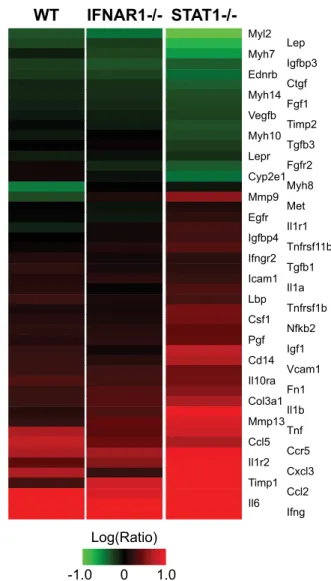
Of particular significance, numerous genes associated with the development of fibrosis were differentially induced by
STAT1⫺/⫺mice compared with WT and IFNAR1⫺/⫺mice at
5 dpi (Fig. 6), including mediators of inflammation (Ccl2, Cxcl3, Ifng, Il1a, Il1b, Il6, Nfkb2, and Tnf) and tissue remod-eling (Igf1, Igfbp4, Igfbp3, Timp1, Timp2, Mmp9, Mmp13, Fn1, and Col3a1). These results suggested that we were able to detect the activation of profibrotic gene expression several days prior to observing a fibrotic phenotype in the infected lung; we previously observed a similar phenomenon in the context of he-patic fibrosis caused by hepatitis C virus (68). RT-PCR validation performed using Col3a1 and Igf1 confirmed this pattern of gene expression (data not shown). Fibrosis genes included extracellular matrix proteins (Col3a1 and Fn1), metalloprotease inhibitor Timp1, and insulin-like growth factor (Igf1), which have previ-ously been implicated as hallmarks of pulmonary fibrosis progres-sion in the bleomycin model (11, 43, 70).
Knockout mice exhibit a bias in T-helper and macrophage differentiation.Because several genes identified in the
time-FIG. 5. Deviant interferon response in STAT1⫺/⫺mice. Expression
profiles are shown for interferon-stimulated genes (identified by intrana-sal administration of 10,000 units of interferon alpha for 24 h) (see details in Materials and Methods and reference 14) that were significantly dif-ferent between STAT1⫺/⫺mice and WT or IFNAR1⫺/⫺mice as judged
by ANOVA. Each column represents gene expression data from an av-erage of 3 animal replicate experiments compared to mock-infected ani-mal results. Genes shown in red were upregulated, genes shown in green were downregulated, and genes shown in black indicate no change in expression relative to mock-infected animal results. Genes are marked according to whether greater differential regulation was observed in STAT1⫺/⫺mice (blue and cyan) or in WT and IFNAR1⫺/⫺mice (orange
and yellow). Genes marked with a cyan bar were functionally annotated as involved with “cell movement of leukocytes” by IPA (14 genes;P ⫽ 8.61⫻10⫺11). Genes marked with a yellow bar were functionally
anno-tated as “antiviral response” genes by IPA (18 genes;P⫽8.58⫻10⫺12).
Genes in these functionally annotated categories are listed by Entrez Gene name. Genes comprising this heat map are listed in Table S3 in the supplemental material.
FIG. 6. Increased fibrotic gene expression in STAT1⫺/⫺mice.
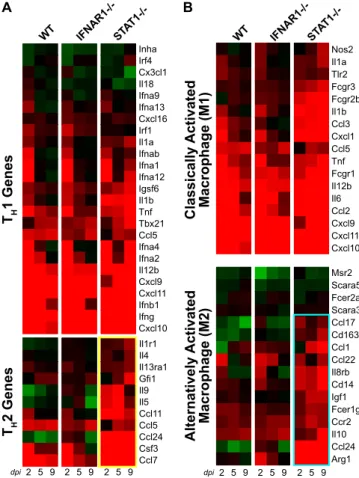
matched ANOVA were associated with a TH2 immune re-sponse, we investigated gene regulation associated with the TH1/TH2 balance in greater detail. Expression levels for TH 1-associated genes (Fig. 7A) were similar in all mouse strains at
2 dpi. However, the STAT1⫺/⫺mice exhibited stronger
induc-tion of TH1 genes at 5 and 9 dpi compared with WT and
IFNAR1⫺/⫺mice. This may reflect the ongoing viral
replica-tion and activareplica-tion of the TH1 master regulator T-bet in the
lungs of STAT1⫺/⫺ mice. In contrast, whereas WT and
IFNAR1⫺/⫺mice exhibited little regulation of T
H2-associated
gene expression, STAT1⫺/⫺mice exhibited significant
induc-tion of several TH2 genes, including Il5, Il9, Ccl7, Ccl11, Ccl24, and Csf3 (Fig. 7A, yellow box). RT-PCR performed on Ccl11 confirmed this pattern of gene regulation (data not shown).
These data suggest that STAT1⫺/⫺animals experience a T
H2 bias compared with WT mice.
Because STAT1⫺/⫺mice exhibited dysregulation of the T
H1
and TH2 responses, we examined the possibility that the
re-cently described TH17 lineage could also be perturbed in these animals. These cells contribute to pathogenesis in asthma and chronic inflammation (49, 73, 81) and could be relevant to the
ongoing pathogenesis observed in STAT1⫺/⫺mice. Although
induction of TH17 cytokine gene Il17a was negligible in WT
and IFNAR1⫺/⫺ mice, expression of this gene was strongly
induced at 9 dpi in STAT1⫺/⫺ mice (averaging 86-fold by
microarray and 1,600-fold by RT-PCR) (data not shown). Likewise, the expression of Il23a, a cytokine responsible for survival of TH17 cells, was induced 4-fold (based on microarray data) in STAT1⫺/⫺animals at 9 dpi. These results suggest that
activation of the TH17 pathway occurs concurrently with the
development of fibrosis in STAT1⫺/⫺mice.
Effect of the TH2 bias on macrophage phenotype.Previous studies have suggested that macrophage phenotypes play a role
in TH2-mediated fibrosis (2, 25, 51). In response to viral or
bacterial pathogens, macrophages become activated by gamma interferon along a classical pathway (M1 macrophages). These cells are characterized by production of proinflammatory cy-tokines as well as nitric oxide synthase (45). Gene expression for individual M1-associated genes was strong at 2 dpi in all mouse strains studied (Fig. 7B). This gene expression
de-creased in the WT and IFNAR1⫺/⫺mice at 5 and 9 dpi as
these strains cleared the virus. In contrast, M1 gene expression
remained elevated in STAT1⫺/⫺mice, reflecting sustained
in-fection in these animals.
Under certain circumstances, such as response to helminth infections, macrophages (specifically, M2 macrophages) can become activated by Il4 along an alternative pathway. These AAMs are characterized by production of arginase I, Il10, eosinophilic chemokines, and insulin-like growth factor-1. In-creased expression of individual M2-associated genes, includ-ing arginase I, Ccl24, Cd14, and Il8rb by 2 dpi and Ccl1, Igf1, and Ccr2 by 5 dpi, revealed strong activation of the M2
re-sponse only in STAT1⫺/⫺animals (Fig. 7B, cyan box). This
pattern of gene expression was also confirmed using RT-PCR for Arg1 and Igf1 (data not shown).
Lungs of STAT1ⴚ/ⴚ
mice exhibit macrophage infiltration and activation along the alternative pathway.To confirm the
production of arginase I by M2 macrophages in STAT1⫺/⫺
mice, we performed immunohistochemistry to detect several protein markers of alternative macrophage activation: arginase I, Ym1, and Mac3. As shown in Fig. 8, minimal staining was detected in the lungs of mock-infected animals. By 9 dpi, both the number of cells staining for these proteins and the density of the staining had increased in STAT1⫺/⫺mice. Increased staining was also observed at 2 and 5 dpi (data not shown). Of particular interest, the cells exhibiting high levels of staining exhibited mor-phology characteristics consistent with macrophages. These re-sults extend our gene expression data, suggesting that, in STAT1⫺/⫺mice, arginase I-expressing M2 macrophages infiltrate
the lung in large numbers during rMA15 infection.
To confirm that lung macrophages were being activated along the alternative pathway, we performed flow cytometry using antibodies to CD11b and CD14 to identify macrophages and Mac3 to identify AAMs (A. Q. Ford, P. Dasgupta, E. A. Smith, N. Noben-Trauth, and A. D. Keegan, submitted for publication). Numbers of AAMs remained low in strain 129
mice and uninfected STAT1⫺/⫺ mice. However, STAT1⫺/⫺
mice infected with rMA15 exhibited a dramatic increase in the population of AAMs (Fig. 9A) as well as in the number of AAMs as a percentage of total macrophages (Fig. 9B). Based on these data, we conclude that AAMs are disproportionately
activated in STAT1⫺/⫺mice infected with rMA15.
FIG. 7. Increased TH2- and M2-associated gene expression in
STAT1⫺/⫺mice. (A and B) Expression profiles are shown for genes
associated with TH1 and TH2 responses (A) and for M1 classical
macrophage activation and M2 alternative macrophage activation (45) (B). Individual genes are identified by the mouse Entrez Gene name. TH2 responses and M2 responses were upregulated only in STAT1⫺
/⫺
DISCUSSION
Previous studies have demonstrated that SARS-CoV infec-tion of mice mirrors the acute exudative phase of ARDS (63,
64). More recently, STAT1⫺/⫺mice were shown to be highly
susceptible to rMA15 infection, whereas disruption of inter-feron signaling at the level of the type I, II, or III interinter-feron receptors did not significantly alter the disease course from that observed in WT mice (24). Our current gene expression analyses further demonstrate that although there were
differ-ences in the transcriptional profiles of WT and IFNAR1⫺/⫺
mice, signaling through the type I interferon receptor was not necessary for a protective antiviral transcriptional response during rMA15 infection. Other studies performed by our
group have revealed that IFNAR1⫺/⫺mice, and mouse
em-bryonic fibroblasts derived from these animals, also induce ISG expression in response to infection with influenza virus (14, 27), suggesting that there exists a common mechanism of com-pensation for the loss of type I interferon receptor signaling. Our results also reveal molecular mechanisms by which
STAT1⫺/⫺mice progress to fibrosis-like disease, mirroring the exudative and fibrotic phases of ARDS.
Compensatory gene expression in IFNAR1ⴚ/ⴚ
mice.
Al-though WT and IFNAR1⫺/⫺mice exhibited similar weight loss
and pathology characteristics, absence of the type I interferon receptor was associated with changes in host gene expression with respect to the immune response and healing. For exam-ple, at 2 dpi, a large number of genes associated with
metab-olism exhibited decreased expression in IFNAR1⫺/⫺mice
(Ta-ble 2). Similar metabolic changes have been observed in response to a variety of viral infections, suggesting that this is an additional protective response to viral infection (3, 8, 13). Although genes associated with mitosis were induced in WT
and IFNAR1⫺/⫺ mice at 5 dpi, IFNAR1⫺/⫺mice exhibited
greater induction of these genes, particularly those associated with DNA damage repair. In addition, we observed a slight
attenuation of ISG expression in IFNAR1⫺/⫺mice compared
with WT mice (Fig. 5). This attenuation may be responsible for the larger viral load observed in the lungs of IFNAR1⫺/⫺mice at 5 dpi compared with that observed in WT mice at the same time point (24). This compensatory ISG activation was poten-tially the result of interferon lambda signaling, but only modest induction of Il28b (interferon lambda 3) was observed in the
FIG. 8. Detection of AAM markers in lung tissue of infected STAT1⫺/⫺mice by the use of immunohistochemistry. Lung sections
were stained for the AAM markers arginase I, Ym1, and Mac3 with a hematoxylin counterstain. At 9 dpi, prominent staining is observed in STAT1⫺/⫺mice infected with rMA15 compared with uninfected
ani-mals and WT aniani-mals infected with rMA15. Magnification,⫻40.
FIG. 9. Enrichment of alternatively activated macrophages in STAT1⫺/⫺ mice infected with SARS-CoV. Ten-week-old strain 129
WT and STAT1⫺/⫺mice were infected with MA15, and their induction
lungs of all strains at 2 dpi. However, Frieman et al. showed that mice with defects in both type I and type III interferon signaling cleared rMA15 infection, suggesting the presence of additional compensatory pathways (24). We also cannot rule out the possibility that induction of some ISGs was the result of secondary signaling through other pathways, including that involving interferon gamma. However, Frieman et al. showed that interferon gamma signaling was also dispensable for clear-ing rMA15 (24). Through redundant pathways, some defects in innate immunity can be overcome, including removal of type I interferon signaling. By comparison, there was a dramatic
re-duction of ISG expression in rMA15-infected STAT1⫺/⫺mice;
this reduction correlated with increased pathology and death for these animals. Since many immune response pathways, including the interferon response, signal through STAT1, the
STAT1⫺/⫺mice appear to be unable to mount an effective
antiviral response to rMA15 infection.
Macrophage dysregulation in STAT1ⴚ/ⴚ
mice. Our gene
expression data suggest that infection of STAT1⫺/⫺mice with
rMA15 dysregulates TH1/TH2 and macrophage host responses,
resulting in a profibrotic phenotype. A model consistent with
our data is shown in Fig. 10. In WT and IFNAR1⫺/⫺mice (but
not STAT1⫺/⫺ mice), T cells that differentiate with a T
H1 program repress TH2 differentiation via gamma interferon sig-naling through STAT1 (82). Gamma interferon also stimulates the differentiation of macrophages along a classical activation pathway (M1) characterized by production of interleukins 1 and 6, tumor necrosis factor, and Cxcr3 ligands (Cxcl9, Cxcl10, and Cxcl11) (45); upregulation of these genes was observed in
WT and IFNAR1⫺/⫺mice at 2 dpi.
In contrast, we found that STAT1⫺/⫺mice exhibited a T
H
2-biased immune response to infection with rMA15. TH2 cells
produce Il4 (production of which was transcriptionally
in-creased in STAT1⫺/⫺mice infected with rMA15), which
trig-gers the differentiation of macrophages along an alternative activation pathway (M2). Alternatively activated macrophages
were observed at 2 dpi in STAT1⫺/⫺mice, and their numbers
increased at 5 and 9 dpi. The TH2/M2 response is associated
with a variety of biological functions, including wound healing, chronic inflammation, and fibrotic immune responses to hel-minths (15, 66, 78). Notably, similarities with respect to
TH2/M2 bias and pulmonary fibrosis have been observed in
gamma interferon receptor knockout (IFNGR⫺/⫺) mice
in-fected with murine gammaherpesvirus 68 (51). In contrast, we
did not observe fibrosis in IFNGR⫺/⫺ mice infected with
rMA15 (24). This could have been due either to inhibition of uncontrolled cell proliferation by STAT1 (76) or to effective clearance of the virus in these mice.
Thus, a signaling pathway that promotes healing under fa-vorable conditions may instead promote fibrosis in the context of continuing immune dysregulation, uncontrolled fibroblast proliferation, and/or persistent viral replication (Fig. 10). One hallmark of M2 macrophages is the production of arginase I (31), which regulates the first committed step in the conversion of arginine to proline (42). Proline is an important building block for collagen production, so increases in proline concen-trations are considered profibrotic. It is interesting that, al-though arginase I was strongly induced transcriptionally at all
time points in STAT1⫺/⫺mice, we observed a lag in the
pro-duction of arginase I protein in the lung (Fig. 8). Likewise, genes in a panel associated with fibrosis progression (Fig. 6)
were differentially induced in STAT1⫺/⫺ mice prior to the
appearance of protein deposition in the lungs. Similar results have also been found in the context of hepatic cell apoptosis and fibrosis (68). These results suggest the potential for diag-nostic tests to detect gene expression changes predictive of the initiation of fibrosis.
STAT1⫺/⫺mice also exhibited increased expression of
ad-ditional M2 macrophage-associated genes that contribute to fibrosis and eosinophilia. For example, we observed increased expression of Igf1, an important regulator of cell proliferation (65) that promotes fibroblast survival and increased extracel-lular matrix protein deposition (79). It is negatively regulated by several IGF-binding proteins (Igfbp1 through Igfbp6), and expression of genes encoding these proteins was decreased in
STAT1⫺/⫺ mice in response to rMA15 infection (data not
shown). In addition, we observed increased expression of Mmp9 and Mmp12, which are expressed by M2 macrophages to promote wound healing (56) and tissue remodeling (33), respectively.
Contribution of eosinophils and TH17 cells.TH2-mediated inflammation causes eosinophil infiltration, which is generally not observed during acute viral infection. Mmp12 is an impor-tant contributor to airway eosinophilia in mice (60), and eo-sinophilia is associated with pulmonary fibrosis in humans (21) and with ARDS (35) and is also observed in some cases of persistent inflammation. Expression of genes encoding eosin-ophil attractants, including Ccl11, Ccl24, and Mmp12, was
observed in STAT1⫺/⫺mice as early as 2 dpi, and significant
eosinophilia was observed at 8 dpi (24).
TH17 cells are a recently described T-helper population
dis-tinct from TH1 and TH2 cells (57) and are associated with
Ifnγ
Stat1
Th1
WT
Stat1-/-M1 Active
WT
Stat1-/-Th2
WT
WT
Stat1-/-M2 Active
Fibrosis Tissue
regeneration Anti-viral
Mmp12 Mmp9 Igf1 Arg1
Resting Macrophage Naive
T-cell
FIG. 10. Dysregulation of T-helper and macrophage differentiation in STAT1⫺/⫺mice. A functional network that depicts the effects of
T-helper differentiation on macrophage phenotype and disease reso-lution is shown. The regulation of genes associated with TH1, TH2, M1,
asthma, chronic obstructive pulmonary disease, and autoim-mune inflammation (30, 36, 53, 73, 81). As with eosinophilia,
the presence of TH17 cells, which mediate inflammation
through the production of Il17 and Il23, is not characteristic of most acute viral infections. However, gene expression charac-teristic of TH17 cells was observed in STAT1⫺/⫺mice at 9 dpi.
As with TH2, TH17 differentiation is repressed by gamma
in-terferon signaling through STAT1 (57), suggesting that
re-moval of this block in STAT1⫺/⫺mice enables the expansion
of TH17 cells. The occurrence of eosinophils and TH17 cell
markers in the lungs of STAT1⫺/⫺mice at 8 to 9 dpi suggests
that these cells may play a role in the later progression rather than the initiation of fibrosis, although this has not been di-rectly examined.
Comparison of rMA15-infected STAT1ⴚ/ⴚmice with other SARS-CoV models.This is the first report of a study examining the host transcriptional responses elicited by the mouse-adapted rMA15 variant of SARS-CoV in young mice. The disease course caused by rMA15 infection in young strain 129 mice was similar to that observed in aged BALB/c mice in-fected with SARS-CoV Urbani (63). Of particular interest, a
comparison of TH2 and M2 gene expression characteristics in
aged and young BALB/c mice (63) reveals greater induction of Il13ra1, Ccl5, Ccl7, Fcer1g, and Igf1 in aged mice, suggesting
that TH2 and M2 induction upon viral infection is a common
feature of aged BALB/c and STAT1⫺/⫺ mice. In contrast,
induction of TH17-associated genes was not observed in aged
BALB/c mice infected with SARS-CoV. In addition, previously described SARS-CoV mouse models that used stain rMA15 or Urbani (62–64, 67) exhibited either mortality or recovery from
infection within 6 dpi. In contrast, STAT1⫺/⫺ mice did not
succumb to the infection until approximately 10 dpi and ex-hibited protein deposition in the lungs consistent with fibrosis.
This suggests that rMA15-infected STAT1⫺/⫺mice represent a
model of both the exudative and the organizing (fibrotic) phases of ARDS pathophysiology (61).
Previous transcriptome analysis of blood samples from pa-tients suffering from SARS-CoV infection suggested that sus-tained innate immune activation and a failure to switch to humoral immunity are associated with a severe disease course (6). STAT1⫺/⫺mice exhibited a similar sustained, yet
ineffec-tive, immune response. However, these clinical cases exhibited gene expression more characteristic of the type I interferon
response and not of the TH2, M2, and TH17 cell expression
observed in STAT1⫺/⫺mice. These differences may reflect the
choice of tissue used for microarray analysis (Cameron and coworkers used blood from patients whereas our analysis used lung tissue), but they could also be the result of the profound dysregulation associated with the loss of STAT1-dependent
transcription. However, similar TH2 bias and macrophage
dys-regulation characteristics have been observed in aged human populations (26, 59), members of which are more susceptible to pulmonary fibrosis (44) and exhibited greater mortality rates during the SARS outbreak (9). Based on these common
fac-tors, STAT1⫺/⫺mice may be a good model for investigation of
the SARS-dependent initiation of fibrosis observed in aged populations.
In conclusion, rMA15 infection of STAT1⫺/⫺mice resulted
in an aberrant TH2 response, sustained viral infection, inflam-mation, and a profibrotic phenotype. This infection system
serves as a model for the early and intermediate stages of ARDS and should be of value for the testing of therapeutic interventions to alleviate virus-induced ARDS. In addition, this model may be useful for studying the role of eosinophils
and TH17 cells in mediating persistent inflammation in
re-sponse to viral infection.
ACKNOWLEDGMENTS
We thank Elizabeth Smith (University of Maryland School of Med-icine) for her help with immunohistochemistry. We thank Sean Proll, Sarah Belisle, and Chester Ni for assistance with statistical analysis and figure design.
This work was supported by Public Health Service grants AI66542 to M.B.F., AI075297 and AI059443 to R.S.B., and HL080621 to M.G.K. Additional SARS-CoV work in the Katze laboratory is supported by U.S. Public Health Service grant U54 AI081680 and by federal funds from the National Institute of Allergy and Infectious Diseases, Na-tional Institutes of Health, Department of Health and Human Ser-vices, under contract HHSN272200800060C.
REFERENCES
1.Baas, T., A. Roberts, T. H. Teal, L. Vogel, J. Chen, T. M. Tumpey, M. G. Katze, and K. Subbarao. 2008. Genomic analysis reveals age-dependent innate immune responses to severe acute respiratory syndrome coronavirus. J. Virol.82:9465–9476.
2.Belperio, J. A., M. Dy, L. Murray, M. D. Burdick, Y. Y. Xue, R. M. Strieter, and M. P. Keane.2004. The role of the Th2 CC chemokine ligand CCL17 in pulmonary fibrosis. J. Immunol.173:4692–4698.
3.Billharz, R., H. Zeng, S. C. Proll, M. J. Korth, S. Lederer, R. Albrecht, A. G. Goodman, E. Rosenzweig, T. M. Tumpey, A. García-Sastre, and M. G. Katze.
2009. The NS1 protein of the 1918 pandemic influenza virus blocks host interferon and lipid metabolism pathways. J. Virol.83:10557–10570. 4.Bjo¨rkman, L., J. Karlsson, A. Karlsson, M. Rabiet, F. Boulay, H. Fu, J.
Bylund, and C. Dahlgren.2008. Serum amyloid A mediates human neutro-phil production of reactive oxygen species through a receptor independent of formyl peptide receptor like-1. J. Leukoc. Biol.83:245–253.
5.Boivin, G., Y. Abed, G. Pelletier, L. Ruel, D. Moisan, S. Coˆte´, T. C. T. Peret, D. D. Erdman, and L. J. Anderson.2002. Virological features and clinical manifestations associated with human metapneumovirus: a new paramyxo-virus responsible for acute respiratory-tract infections in all age groups. J. Infect. Dis.186:1330–1334.
6.Cameron, M. J., L. Ran, L. Xu, A. Danesh, J. F. Bermejo-Martin, C. M. Cameron, M. P. Muller, W. L. Gold, S. E. Richardson, S. M. Poutanen, B. M. Willey, M. E. DeVries, Y. Fang, C. Seneviratne, S. E. Bosinger, D. Persad, P. Wilkinson, L. D. Greller, R. Somogyi, A. Humar, S. Keshavjee, M. Louie, M. B. Loeb, J. Brunton, A. J. McGeer, and D. J. Kelvin.2007. Interferon-mediated immunopathological events are associated with atypical innate and adaptive immune responses in patients with severe acute respiratory syn-drome. J. Virol.81:8692–8706.
7.Cervantes-Barragan, L., R. Zu¨st, F. Weber, M. Spiegel, K. S. Lang, S. Akira, V. Thiel, and B. Ludewig.2007. Control of coronavirus infection through plasmacytoid dendritic-cell-derived type I interferon. Blood109:1131–1137. 8.Chan, E. Y., J. N. Sutton, J. M. Jacobs, A. Bondarenko, R. D. Smith, and M. G. Katze.2009. Dynamic host energetics and cytoskeletal proteomes in human immunodeficiency virus type 1-infected human primary CD4 cells: analysis by multiplexed label-free mass spectrometry. J. Virol.83:9283–9295. 9.Chan-Yeung, M., and R. Xu.2003. SARS: epidemiology. Respirology8:S9–
S14.
10.Chen, K., Y. Wei, A. Alter, G. C. Sharp, and H. Braley-Mullen.2005. Che-mokine expression during development of fibrosis versus resolution in a murine model of granulomatous experimental autoimmune thyroiditis. J. Leukoc. Biol.78:716–724.
11.Choi, J., S. Lee, D. A. Sunde, I. Huizar, K. L. Haugk, V. J. Thannickal, R. Vittal, S. R. Plymate, and L. M. Schnapp.2009. Insulin-like growth factor-I receptor blockade improves outcome in mouse model of lung injury. Am. J. Respir. Crit. Care Med.179:212–219.
12.Chou, D. W., C. H. Lee, C. W. Chen, H. Y. Chang, and T. R. Hsiue.1999. Varicella pneumonia complicated by acute respiratory distress syndrome in an adult. J. Formos. Med. Assoc.98:778–782.
13.Chow, E. K., A. Castrillo, A. Shahangian, L. Pei, R. M. O’Connell, R. L. Modlin, P. Tontonoz, and G. Cheng.2006. A role for IRF3-dependent RXR␣repression in hepatotoxicity associated with viral infections. J. Exp. Med.203:2589–2602.
15.Coutinho, H. M., L. P. Acosta, H. W. Wu, S. T. McGarvey, L. Su, G. C. Langdon, M. A. Jiz, B. Jarilla, R. M. Olveda, J. F. Friedman, and J. D. Kurtis.2007. Th2 cytokines are associated with persistent hepatic fibrosis in human Schistosoma japonicum infection. J. Infect. Dis.195:288–295. 16.Day, C. W., R. Baric, S. X. Cai, M. Frieman, Y. Kumaki, J. D. Morrey, D. F.
Smee, and D. L. Barnard.2009. A new mouse-adapted strain of SARS-CoV as a lethal model for evaluating antiviral agents in vitro and in vivo. Virology
395:210–222.
17.de Lang, A., T. Baas, T. Teal, L. M. Leijten, B. Rain, A. D. Osterhaus, B. L. Haagmans, and M. G. Katze.2007. Functional genomics highlights differ-ential induction of antiviral pathways in the lungs of SARS-CoV-infected macaques. PLoS Pathog.3:e112.
18.Dendorfer, U., P. Oettgen, and T. A. Libermann.1994. Multiple regulatory elements in the interleukin-6 gene mediate induction by prostaglandins, cyclic AMP, and lipopolysaccharide. Mol. Cell. Biol.14:4443–4454. 19.Ding, Y., H. Wang, H. Shen, Z. Li, J. Geng, H. Han, J. Cai, X. Li, W. Kang,
D. Weng, Y. Lu, D. Wu, L. He, and K. Yao.2003. The clinical pathology of severe acute respiratory syndrome (SARS): a report from China. J. Pathol.
200:282–289.
20.Dorner, B. G., A. Scheffold, M. S. Rolph, M. B. Huser, S. H. E. Kaufmann, A. Radbruch, I. E. A. Flesch, and R. A. Kroczek.2002. MIP-1␣, MIP-1, RANTES, and ATAC/lymphotactin function together with IFN-␥as type 1 cytokines. Proc. Natl. Acad. Sci. U. S. A.99:6181–6186.
21.Emad, A., and Y. Emad.2007. Relationship between eosinophilia and levels of chemokines (CCL5 and CCL11) and IL-5 in bronchoalveolar lavage fluid of patients with mustard gas-induced pulmonary fibrosis. J. Clin. Immunol.
27:605–612.
22.Fielding, C. A., R. M. McLoughlin, L. McLeod, C. S. Colmont, M. Na-jdovska, D. Grail, M. Ernst, S. A. Jones, N. Topley, and B. J. Jenkins.2008. IL-6 regulates neutrophil trafficking during acute inflammation via STAT3. J. Immunol.181:2189–2195.
23.Franks, T. J., P. Y. Chong, P. Chui, J. R. Galvin, R. M. Lourens, A. H. Reid, E. Selbs, C. P. L. McEvoy, C. D. L. Hayden, J. Fukuoka, J. K. Taubenberger, and W. D. Travis.2003. Lung pathology of severe acute respiratory syn-drome (SARS): a study of 8 autopsy cases from Singapore. Hum. Pathol.
34:743–748.
24.Frieman, M. B., J. Chen, T. E. Morrison, A. Whitmore, W. Funkhouser, J. M. Ward, E. W. Lamirande, A. Roberts, M. Heise, K. Subbarao, and R. S. Baric.
2010. SARS-CoV pathogenesis is regulated by a STAT1 dependent but a type I, II and III interferon receptor independent mechanism. PLoS Pathog.
6:e1000849.
25.Gangadharan, B., M. A. Hoeve, J. E. Allen, B. Ebrahimi, S. M. Rhind, B. M. Dutia, and A. A. Nash.2008. Murine gammaherpesvirus-induced fibrosis is associated with the development of alternatively activated macrophages. J. Leukoc. Biol.84:50–58.
26.Glaser, R., R. C. MacCallum, B. F. Laskowski, W. B. Malarkey, J. F. Sheri-dan, and J. K. Kiecolt-Glaser.2001. Evidence for a shift in the Th-1 to Th-2 cytokine response associated with chronic stress and aging. J. Gerontol. A Biol. Sci. Med. Sci.56:M477–M482.
27.Goodman, A. G., H. Zeng, S. C. Proll, X. Peng, C. Cillo´niz, V. S. Carter, M. J. Korth, T. M. Tumpey, and M. G. Katze.2010. The␣/interferon receptor provides protection against influenza virus replication but is dispensable for inflammatory response signaling. J. Virol.84:2027–2037.
28.Gu, J., and C. Korteweg.2007. Pathology and pathogenesis of severe acute respiratory syndrome. Am. J. Pathol.170:1136–1147.
29.Haagmans, B. L., T. Kuiken, B. E. Martina, R. A. M. Fouchier, G. F. Rimmelzwaan, G. van Amerongen, D. van Riel, T. de Jong, S. Itamura, K. Chan, M. Tashiro, and A. D. M. E. Osterhaus.2004. Pegylated interferon-␣ protects type 1 pneumocytes against SARS coronavirus infection in macaques. Nat. Med.10:290–293.
30.Hashimoto, T., K. Akiyama, N. Kobayashi, and A. Mori.2005. Comparison of IL-17 production by helper T cells among atopic and nonatopic asthmatics and control subjects. Int. Arch. Allergy Immunol.137(Suppl. 1):51–54. 31.Hesse, M., M. Modolell, A. C. La Flamme, M. Schito, J. M. Fuentes, A. W.
Cheever, E. J. Pearce, and T. A. Wynn.2001. Differential regulation of nitric oxide synthase-2 and arginase-1 by type 1/type 2 cytokines in vivo: granulo-matous pathology is shaped by the pattern of L-arginine metabolism. J. Im-munol.167:6533–6544.
32.Hudson, L. D., J. A. Milberg, D. Anardi, and R. J. Maunder.1995. Clinical risks for development of the acute respiratory distress syndrome. Am. J. Respir. Crit. Care Med.151:293–301.
33.Kahnert, A., P. Seiler, M. Stein, S. Bandermann, K. Hahnke, H. Mollenkopf, and S. H. E. Kaufmann.2006. Alternative activation deprives macrophages of a coordinated defense program to Mycobacterium tuberculosis. Eur. J. Immunol.36:631–647.
34.Klinger, J. R., M. P. Sanchez, L. A. Curtin, M. Durkin, and B. Matyas.1998. Multiple cases of life-threatening adenovirus pneumonia in a mental health care center. Am. J. Respir. Crit. Care Med.157:645–649.
35.Kollef, M. H., and D. P. Schuster. 1995. The acute respiratory distress syndrome. N. Engl. J. Med.332:27–37.
36.Komiyama, Y., S. Nakae, T. Matsuki, A. Nambu, H. Ishigame, S. Kakuta, K. Sudo, and Y. Iwakura.2006. IL-17 plays an important role in the
develop-ment of experidevelop-mental autoimmune encephalomyelitis. J. Immunol.177:566– 573.
37.Ksiazek, T. G., C. J. Peters, P. E. Rollin, S. Zaki, S. Nichol, C. Spiropoulou, S. Morzunov, H. Feldmann, A. Sanchez, A. S. Khan, et al.1995. Identifica-tion of a new North American hantavirus that causes acute pulmonary insufficiency. Am. J. Trop. Med. Hyg.52:117–123.
38.Ku, A. S., and L. T. Chan.1999. The first case of H5N1 avian influenza infection in a human with complications of adult respiratory distress syn-drome and Reye’s synsyn-drome. J. Paediatr. Child Health35:207–209. 39.Kuiken, T., R. A. M. Fouchier, M. Schutten, G. F. Rimmelzwaan, G. van
Amerongen, D. van Riel, J. D. Laman, T. de Jong, G. van Doornum, W. Lim, A. E. Ling, P. K. S. Chan, J. S. Tam, M. C. Zambon, R. Gopal, C. Drosten, S. van der Werf, N. Escriou, J. Manuguerra, K. Sto¨hr, J. S. M. Peiris, and A. D. M. E. Osterhaus.2003. Newly discovered coronavirus as the primary cause of severe acute respiratory syndrome. Lancet362:263–270. 40.Lam, C. W. K., M. H. M. Chan, and C. K. Wong.2004. Severe acute
respiratory syndrome: clinical and laboratory manifestations. Clin. Biochem. Rev.25:121–132.
41.Livak, K. J., and T. D. Schmittgen.2001. Analysis of relative gene expression data using real-time quantitative PCR and the 2⫺⌬⌬Ctmethod. Methods
25:402–408.
42.Maarsingh, H., T. Pera, and H. Meurs. 2008. Arginase and pulmonary diseases. Naunyn Schmiedebergs Arch. Pharmacol.378:171–184. 43.Maeda, A., K. Hiyama, H. Yamakido, S. Ishioka, and M. Yamakido.1996.
Increased expression of platelet-derived growth factor A and insulin-like growth factor-I in BAL cells during the development of bleomycin-induced pulmonary fibrosis in mice. Chest109:780–786.
44.Mallick, S.2008. Outcome of patients with idiopathic pulmonary fibrosis (IPF) ventilated in intensive care unit. Respir. Med.102:1355–1359. 45.Mantovani, A., A. Sica, S. Sozzani, P. Allavena, A. Vecchi, and M. Locati.
2004. The chemokine system in diverse forms of macrophage activation and polarization. Trends Immunol.25:677–686.
46.Meraz, M. A., J. M. White, K. C. Sheehan, E. A. Bach, S. J. Rodig, A. S. Dighe, D. H. Kaplan, J. K. Riley, A. C. Greenlund, D. Campbell, K. Carver-Moore, R. N. DuBois, R. Clark, M. Aguet, and R. D. Schreiber.1996. Targeted disruption of the Stat1 gene in mice reveals unexpected physiologic specificity in the JAK-STAT signaling pathway. Cell84:431–442. 47.Merk, J., F. X. Schmid, M. Fleck, S. Schwarz, C. Lehane, S. Boehm, B.
Salzberger, and D. E. Birnbaum.2005. Fatal pulmonary failure attributable to viral pneumonia with human herpes virus 6 (HHV6) in a young immu-nocompetent woman. J. Intensive Care Med.20:302–306.
48.Michalec, L., B. K. Choudhury, E. Postlethwait, J. S. Wild, R. Alam, M. Lett-Brown, and S. Sur.2002. CCL7 and CXCL10 orchestrate oxidative stress-induced neutrophilic lung inflammation. J. Immunol.168:846–852. 49.Molet, S., Q. Hamid, F. Davoine, E. Nutku, R. Taha, N. Page´, R. Olivenstein,
J. Elias, and J. Chakir.2001. IL-17 is increased in asthmatic airways and induces human bronchial fibroblasts to produce cytokines. J. Allergy Clin. Immunol.108:430–438.
50.Moore, B. B., and C. M. Hogaboam.2008. Murine models of pulmonary fibrosis. Am. J. Physiol. Lung Cell. Mol. Physiol.294:L152–L160. 51.Mora, A. L., E. Torres-Gonza´lez, M. Rojas, C. Corredor, J. Ritzenthaler, J.
Xu, J. Roman, K. Brigham, and A. Stecenko.2006. Activation of alveolar macrophages via the alternative pathway in herpesvirus-induced lung fibro-sis. Am. J. Respir. Cell Mol. Biol.35:466–473.
52.Nagata, N., N. Iwata, H. Hasegawa, S. Fukushi, M. Yokoyama, A. Ha-rashima, Y. Sato, M. Saijo, S. Morikawa, and T. Sata.2007. Participation of both host and virus factors in induction of severe acute respiratory syndrome (SARS) in F344 rats infected with SARS coronavirus. J. Virol.81:1848–1857. 53.Nakae, S., A. Nambu, K. Sudo, and Y. Iwakura.2003. Suppression of im-mune induction of collagen-induced arthritis in IL-17-deficient mice. J. Im-munol.171:6173–6177.
54.Ne´meth, J., I. Stein, D. Haag, A. Riehl, T. Longerich, E. Horwitz, K. Breu-hahn, C. Gebhardt, P. Schirmacher, M. Hahn, Y. Ben-Neriah, E. Pikarsky, P. Angel, and J. Hess.2009. S100A8 and S100A9 are novel nuclear factor kappa B target genes during malignant progression of murine and human liver carcinogenesis. Hepatology50:1251–1262.
55.Nicola, N. A., and D. Metcalf.1985. Binding of125I-labeled granulocyte
colony-stimulating factor to normal murine hemopoietic cells. J. Cell. Physiol.124:313–321.
56.Okuma, T., Y. Terasaki, K. Kaikita, H. Kobayashi, W. A. Kuziel, M. Kawa-suji, and M. Takeya.2004. C-C chemokine receptor 2 (CCR2) deficiency improves bleomycin-induced pulmonary fibrosis by attenuation of both mac-rophage infiltration and production of macmac-rophage-derived matrix metallo-proteinases. J. Pathol.204:594–604.
57.Park, H., Z. Li, X. O. Yang, S. H. Chang, R. Nurieva, Y. Wang, Y. Wang, L. Hood, Z. Zhu, Q. Tian, and C. Dong.2005. A distinct lineage of CD4 T cells regulates tissue inflammation by producing interleukin 17. Nat. Immunol.
6:1133–1141.
58.Pasieka, T. J., T. Baas, V. S. Carter, S. C. Proll, M. G. Katze, and D. A. Leib.
2006. Functional genomic analysis of herpes simplex virus type 1 counterac-tion of the host innate response. J. Virol.80:7600–7612.