Kimberly J. Reisler. Cognitive Authority and the Christian Worldview: An Examination of Goodreads Reviews of Christian Books. A Master’s Paper for the M.S. in I.S. degree. March, 2019. 81 pages. Advisor: Ryan Shaw.
This study examines how individuals engage with and evaluate Christian books and the cognitive authorities referred to when assessing these resources. 816 book reviews pulled from the reviews for 10 books identified as Christian on the social media book site Goodreads were analyzed by qualitative coding. This content analysis identified themes relating to reader awareness of worldview, evaluative measures used to assess resources, and cognitive authorities referenced.
Evaluation of Christian books largely aligns with existing understanding of the general process of information assessment, with a few exceptions. The spiritual nature of the text, for many reviewers, led them to consider the information in light of personal spiritual experience and lent spiritual overtones to their evaluation of the author’s character and expertise. Reviews also demonstrate the way in which individuals can weigh cognitive authorities differently within a shared worldview, resulting in differing information assessments.
Headings:
Information behavior
COGNITIVE AUTHORITY AND THE CHRISTIAN WORLDVIEW: AN EXAMINATION OF GOODREADS REVIEWS OF CHRISTIAN BOOKS
by
Kimberly J. Reisler
A Master’s paper submitted to the faculty of the School of Information and Library Science of the University of North Carolina at Chapel Hill
in partial fulfillment of the requirements for the degree of Master of Science in
Information Science.
Chapel Hill, North Carolina March 2019
Approved by
Table of Contents
Introduction ... 2
Literature Review ... 6
Theory of Normative Behavior ... 6
Cognitive Authority ... 7
Authority in Christianity ... 9
Religious Engagement with Information ... 12
Methodology ... 16
Sample ... 18
Data Collection ... 20
Data Analysis ... 22
Biases ... 24
Findings ... 26
Spiritual Verification ... 26
Author’s Expertise ... 35
Intrinsic Plausibility ... 41
Conclusions ... 54
Implications ... 57
Bibliography ... 61
Appendix A: Book Selection ... 65
Appendix B: Coding Manual ... 70
Appendix C: Quantitative Analysis of Reviews ... 75
Introduction
Well-noted in American public discourse are apparent contradictions and idiosyncrasies in the ways that Christians, particularly evangelical Christians, interact with information.1 Christians have, for example, been characterized as dismissive of the scientific evidence of the earth’s age and climate change despite accepting other scientific information as factual. In recent years, evangelical Christians’ large support for
conservative politicians has led many to question the cogency of their religious and political views, as the political agendas espoused by these politicians are seen to counter Christian tenets. The discussion within the public sphere concerning the way in which Christian beliefs inform individuals’ understandings of the world prompts the question of how Christians negotiate interactions with information under a Christian worldview.
Information scholars are familiar with the principle of cognitive bias, which describes how one’s prior beliefs influence one’s assessment of information
1 The term “evangelical” is nebulously defined, understood to refer to different Christian characteristics or groups in different contexts. Evangelicalism has historical roots in eighteenth-century Europe, growing out of Methodism, Pietism, and Moravianism and their attention to inner spiritual life, personal experience of God, and adherence to the authority of the Bible (Noll, 2012). Historian David Bebbington has identified four theological principles common to evangelicalism past and present. These include the centrality of Jesus’s crucifixion and resurrection, the authority of the Bible as inerrant or infallible, a personal experience of salvation, and an outward focus of sharing the
message of Jesus with others (Bebbington, 1989). In broader American culture,
(Lewandowsky et al., 2012). Greater complexities exist, however, than this theory can explain or describe. Christians may be biased to accept or reject certain pieces of information on the basis of their beliefs but in addition they must negotiate between epistemological paradigms as they assess information in and for different contexts, and between cognitive authorities when they encounter information that has implications for their spiritual or religious beliefs and the potential to shift or build upon their worldview in fundamental ways.
In the case of scientific evidence, for example, many evangelicals argue from a literal interpretation of the Bible, which states that God created the world in seven days and traces all human lineage to the first two humans, countering scientific claims regarding the origins of the universe and the development of the human race. Yet some evangelicals who subscribe to such beliefs are members of the scientific community, operating by the scientific paradigm that privileges empirical evidence as the highest source of truth-confirming authority. While not all Christians subscribe to a literal interpretation and such beliefs, there is still at some level dissociation between the scientific worldview and the Christian worldview in the most fundamental question of forces at work in the universe. There are thus different levels of Christian acceptance of scientific information under the same broader Christian worldview. What differentiates these ideological positions? What cognitive authorities or evaluative processes guide a Christian to adopt certain ideological positions?
historian professional association, the Conference on Faith and History, describes the “compartmentalist angst” he feels in writing history according to academic principles (Yerxa, 2018, p. vii). This tension springs from the belief that theological principles, such as the incarnation of God as man in Jesus, Jesus’s death and resurrection, and God’s sovereignty, speak to the nature of human history and that the practice of writing history should in some way reflect this. Due to the inability to empirically attest to God’s intervention in time as well as the standards of history as an academic discipline, however, it is difficult to incorporate these theological beliefs with academic historical study. Christian historians are left to separate the beliefs they hold from the history that they write, even as they personally feel the influence of their beliefs in their study of the past. How do Christians negotiate the privileging of certain authorities in different contexts when the Christian worldview is existentially normative for one’s approach to all of life? How do they manage the affective consequences of balancing cognitive authorities in different spheres?
counters their pre-existing Christian beliefs, too, how do they negotiate this process? What role does cognitive authority play in these processes?
Answering these questions is far outside the scope of a single study, particularly a study as limited in scope as the current one. However, this research seeks to begin to answer these questions, even if from a narrow perspective. Specifically, the aim of this qualitative, flexible, and exploratory study is to describe how individuals engage with and evaluate religious books, as articulated in their reviews of Christian books posted to the social media book site Goodreads. By what cognitive authorities do they assess these resources? With this approach, the study explores the frameworks by which individuals (of Christian, non-Christian, or unspecified backgrounds) engage with Christian
Literature Review Theory of Normative Behavior
Central to this study is the concept of worldview. The theory of normative behavior supplies a definition of worldview that helps to establish this concept with regard to information use. It describes how the culture within a group influences group members’ interaction with and use of information and emphasizes context and belief as central to engagement with information (Burnett, 2009). The theory is built upon the concept of small worlds, which understands an individual’s circumstances and context as an insulated world unto itself that shapes information behavior (Burnett, Besant, and Chatman, 2001). The theory seeks to explain what exactly occurs vis-à-vis information within that small world of the individual or the group. Burnett, Besant, and Chatman articulate four components of the theory of normative behavior: social norms, worldview, social types, and information behavior. They define worldview as “a collective
The theory of normative behavior is not entirely appropriate for a study of Christians as an entire group but Burnett et al. (2001)’s definition of worldview is still useful in explaining how one’s group membership shapes one’s outlook. Individual churches or denominations might function as small worlds for some Christians but as a whole, Christians are too diverse and dispersed to be considered a small world unto themselves. Burnett (2009) applied the worldview concept to an analysis of the online discussion regarding the Grateful Dead online archives and found there were multiple communities of thought that, though they shared values, weighted these values so differently that Burnett determined they were effectively their own worldviews. Such is true of Christianity as well, as Christians may share values but weight these values differently in belief and application, thus leading to different worldviews. Despite the diversity in belief and practice in Christianity that might be considered as different worldviews, certain tenets of the faith are common to the majority of Christians and provide a structure for an understanding of the world. These include beliefs in a God of three persons, salvation through Jesus, and deference to the Bible. Authority is found in common sources within Christianity as well: in the Bible, the church and its leadership, and God (Campbell, 2010). Considerations of what is “important or trivial” (Burnett, Besant, and Chatman, 2001, p. 537) conform to the precepts of these shared authorities and influence how Christians interact with the world and each other and can mold worldviews in similar, if not identical, ways.
Cognitive Authority
interact with information. Wilson writes from a position of social epistemology in which knowing is possible through social groups and relationships, just as Burnett, Besant, and Chatman understand individuals’ information worlds to be constrained by their social group. Wilson emphasizes the universal and inevitable dependence upon “second-hand knowledge,” as individuals obtains ideas and information from others that would be impractical or impossible to gain on their own. Trusting the information others provide enables one to possess an understanding of the world that is larger than one could feasibly imagine based on one’s personal experience alone. These others (which may include institutions, roles, or information objects as well as people) are considered cognitive authorities; their opinions carry weight within a certain sphere of influence for an individual. One accepts a cognitive authority as such based on one’s assessment of their expertise, reputation, or charisma, as well as the “intrinsic plausibility” of the content of their message, and its confirmation via personal experience.
Wilson’s ideas on cognitive authority are borne out in empirical studies. Lewandowsky et al. (2012), for example, found that people tend to accept information instead of rejecting it, as an in-depth evaluation requires greater cognitive effort. When individuals do engage in this evaluation, they compare the information with their prior knowledge, its internal coherence, the credibility of its source, and others’ acceptance. Studies have also found that in making these judgments about the authority of a resource, people often rely upon heuristics, which connect the appearance of traits or individuals with a judgment of the text’s authority without systematically reasoning through the process of judgment (Rieh, 2010).
Authority in Christianity
Pertinent to consideration of cognitive authority within a Christian worldview are studies of Christian authority in general. This research provides insights for considering the different ways reviewers engage with the concept of authority and reference it in their book reviews.
Other research touches upon sources of authority in more focused Christian settings. Gunton, Bruce, and Stoodley (2012) examined information literacy practices among the members of an Australian church. They found five different variations of the information learning experience within the church and discuss the meaning, focus, information experience, learning experience, and margin (that which is not a focus of the experience) of each. All information learning experiences were interpersonal in various ways rather than grounded in textual sources, and congregants described applying information gained through relationships with both equals (fellow congregants) and leaders (pastors) in the church to their everyday life and to build relationships further. These findings illuminate the domain in which information gained at church, a place with imputed authority, is applied, both inside and outside the church.
Darin Freeburg has also, in several studies, explored information and the
Indeed, Abby Day (2005) conducted a similar study of one women’s prayer group in England and found that shared theology was used to frame one’s interaction with information when engagement on a more personal or intellectual level was difficult or potentially more challenging to one’s worldview. This confirms Lewandowsky et al.’s (2012) findings, describing how familiar ideas can be used to reframe new information as part of the process of a more shallow assessment. As long as this yields no great
inconsistencies or contradictions, the information is accepted and the worldview is affirmed. It also demonstrates how cognitive authorities can be deferred to when an information gap is significant but a strong desire for information does not exist. Individuals resist the effort of a cognitive restructuring that might ensue by a deeper engagement and so prefer to have their information need satisfied by accepting the information proffered by an authority.
In Andrew Todd’s (2005) study of an English Bible study group, he found that the members frequently negotiated and debated deference to established authority and the authority of individual interpretation. Borrowing a heuristic of interpretative repertoire, or patterns of speech and behavior, that had previously been applied in a study of scientists, Todd classifies the group members’ conversation as part of either the “canonical
In contrast, the “contingent repertoire” allows for multiple interpretations of the Bible and defers to the meanings that individuals derive from their interaction with the text, allowing for and dealing with the existence of conflict between individual
interpretations. It involves a consideration of the text’s purpose, audience, author, and the reader’s own perspective, especially as factors that may contribute to a multiplicity of understandings. Engaging with the text in this way, the readers “play an active part in interpretation, sifting and personalizing different understandings of what the text might have to say to them” instead of accepting an interpretation that is considered absolute, as given from an authority figure. Todd found that group members exercised these
repertoires in constant conversation with each other, stimulating the group’s discussion and the meaning they derived from it. By dichotomizing engagement with a text, Todd’s heuristic facilitates a closer analysis of the place of authority in reader response.
Religious Engagement with Information
expectation and desire for religious texts to inform one’s behavior and values, both practically and existentially. Religious and spiritual information is approached in the belief that it relates to one’s foundational understanding of self and world, which decides in large part how one engages with the world. In other words, Vamanu and Guzik’s typology defines the degrees to which religious readers view the power of the information they read to shape their worldview.
There is little evidence in their study to explain what in a text or one’s
information world influences the meaning-making process of reading, though they rely upon a hermeneutic concept of reading that prompts greater exploration of that meaning-making process. They cite a law and literature scholar, James Boyd White, who describes a text as propositional, requiring the reader to evaluate “‘what this text is asking him to assent to and to become and whether or not he wishes to acquiesce’. The reader is thus involved in a process of ‘assimilation and rejection, response and judgment.’” (Vamanu and Guzik, 2015, p. 64-5). This is a particularly helpful understanding in relation to the concept of worldview, as values prominent in a worldview and structures that frame an information world shape that negotiation process. This study seeks to explore how that process unfolds; how the approach to religious information, which anticipates impact on one’s worldview, shapes the way people evaluate that information.
Another way of considering the propositional nature of a text, as outlined in Vamanu and Guzik’s study, is in relation to Wilson’s (1983) concept of “open questions.” This relationship links meaning-making in reading with the cognitive
viewpoints (Wilson, 1983). Cognitive authorities provide a perspective beyond one’s personal experience in these matters and either answer the open question or frame one’s position in relation to different information. Wilson states that “the cognitive authority is one to whom we turn for information but also one to whom we turn for advice, even (particularly) in cases where it is clear that there is no knowledge to be had at all.
Cognitive authorities are valued not just for their stocks of knowledge (answers to closed questions) but for their opinions (answers to open questions) and for their advice on the proper attitude or stance on questions and their proposed answers” (p. 18).
For religious converts such as those in Vamanu and Guzik’s (2015) study, these open questions are especially pressing, as converts enter a faith without the knowledge or mental framework that those within have established. The individuals or texts that they turn to act as cognitive authorities and provide guiding information for the purposes Vamanu and Guzik described in their typology. These purposes may be more pressing for converts but are not limited to those new to a faith, as the comments Vamanu and Guzik include from leaders in the faith suggest.
Methodology
This is a descriptive, flexible qualitative study that seeks to better understand how readers engage with Christian books and the Christian worldview therein via a content analysis of online book reviews as posted to Goodreads. The target population is thus not Christians themselves necessarily but rather anyone who engages with Christian books; reviewers will represent a breadth of backgrounds. It is the interaction with information explicitly associated with an ideological and religious worldview that is the subject of study.
There are several limitations to the information that book reviews can provide, however. It is unlikely that an individual would seek out, read, and review a book written by an author with whom they disagree, as activities such as these demand a significant investment of time and energy. It is also likely that books are recommended via social networks within one’s community, based on the recommender’s positive opinion. Thus, reviews are likely of books that individuals are predisposed to favor. Books on
controversial topics were included as part of the purposeful sampling to address this limitation. These books are more likely to be read by those who disagree as a result of the book’s reputation as controversial. There was evidence in many reviews this was indeed the case; reviewers often read a book in order to form their own opinion relative to the popular debate. This portion of the sample was determined based on the researcher’s prior knowledge of American Christianity, with suggestions solicited by other Christians. Controversial topics from both liberal and conservative perspectives were included. The skewed nature of the sample towards books people are predisposed to agree with or favor does not compromise its ability to answer the research questions but it is a limitation to be aware of in considering the results, even with the inclusion of controversial books. In particular, readers with no foreknowledge or interest in Christianity are likely not those reading and reviewing Christian books.
limits the analysis of engagement with Christian books to those who have Internet access and a Goodreads account.
Sample
As the study is descriptive and exploratory, richness in the sample was vital. A purposeful sampling method was used to identify books for an intensity sample so that the cases chosen provide a range of information-rich data (Patton, 2002).
All books chosen on Goodreads fall under the Christian genre. Books on Goodreads are categorized according to how users tag or “shelve” them. According to comments from librarian moderators on the Goodreads site, “genres are crowd-sourced based on how they have been shelved by users, and cannot be changed manually”; this crowdsourcing only requires two users to classify a book with the same tag for that classification to be considered a genre (“Genres”, n.d.). Using this designation as the basis of the sample suggests that readers were aware of the book’s classification as Christian.
Fiction books were not included in the sample as they are often purely leisure reading and also often determined to be Christian by the identification of the author or by an evaluation of their moral content (e.g. they feature less morally objectionable content from a Christian ethical perspective). Also, reviews of these resources may include evaluation of literary elements, which are not pertinent to the study.
Using background knowledge of controversial Christian topics and popular books, and chaining from book to book on Goodreads via their “Readers Also Enjoyed”
engagement with elements of the Christian worldview. This assessment was informed by a brief exploration of the range and content of book reviews for the given book as well as summaries of the book provided on Wikipedia, Amazon, and Goodreads itself.2 Books with more reviews were more desirable, as this represents wider engagement from a variety of readers, but subject matter was considered more significant than the number of reviews.
The most important consideration in deciding which books to include in the study was the degree to which the text was propositional, presenting an understanding to the reader that she must decide whether or not to agree to or the extent to which she agrees. This conception of a text was grounded in scholar James Boyd White’s ideas, as cited in Vamanu and Guzik’s (2015) study. In the context of this study, this determination of the degree to which the text was propositional translated to an assessment of the extent to which the book presented a clearly defined worldview and asked the reader to adopt this worldview. The following questions guided this assessment process:
• Does the book facilitate significant engagement with certain elements of the Christian worldview? How so?
• Might there be tension between multiple paradigms for readers?
• If the book is controversial, for whom is it controversial?
• What is the book asking the reader to believe?
The total number of books included in the study was determined as the study progressed based on the level of saturation in observation of common themes as well as time constraints limiting data collection and analysis. In the end, ten books were used.
Each book selected and the rationale for its inclusion is presented in Appendix A. These books ranged in genre from theological treatises, devotional texts, popular nonfiction, and perennial Christian classics. The choices are American-centric and evangelical-centric; while Christians of other backgrounds might read these books, there is only one Catholic author and none by a member of the Eastern Orthodox Church. This homogeneity is the case largely due to the author’s personal experience with American evangelicalism in combination with the limited scope of the study.
The number of reviews for each book was determined by a small pilot study of twenty reviews from three books, which guided the development of the coding manual as well as estimates for the time that data collection and analysis would demand. One hundred was determined to be a reasonable number of reviews for each book given the time constraints. As data analysis began, it became apparent that there was observable consistency in the reviews, suggesting that one hundred was also an appropriate amount for providing saturation.
Goodreads has a star rating system on a five-point scale. Twenty reviews were randomly chosen from each starred rating (i.e. from the five-starred reviews, four-starred reviews, three-starred reviews, etc.) so as not to bias towards any one reception of the book.
Data Collection
For eight of the ten books selected, twenty reviews were collected from each of the rating levels for each of the ten books. For the remaining two of the ten, fifty reviews were chosen for each, as these two books contain similar information addressed
and the author the same, these books were analyzed as one. In four cases, when a book was less widely read or more recently written, there were fewer than twenty reviews of a certain rating (typically of one or two stars). All reviews of that rating were collected and the total number of reviews for the book was less than one hundred. The number of reviews of each starred rating for each book is provided in Appendix C.
Reviews chosen from the Goodreads site using their sort and filter options. A user can filter reviews for a book based on the number of stars given, edition, and whether the review consists of text or simply a star rating. Each of these three different filters can be set, so that a user can filter reviews by, for example, four stars, all editions, and text-only. A user can sort filtered reviews in ascending or descending order of date posted as well as by “Default,” which orders the reviews by “likes.” The different methods for sorting are significant in that they dictate which reviews a user will see. Goodreads caps the number of reviews it displays on the site at 300 and sorting the views by default, oldest, or newest will yield a different set of 300 reviews: the most liked, the oldest, or the newest of all cumulative reviews.
The default sorting method is valuable in revealing which reviews Goodreads members found useful or helpful but it is also problematic in that those reviews with the most likes are sorted to the top of the book’s page and thus more likely to be seen, read, and liked in the future. These reviews’ higher ratings by members may be attributed more to their ease of access, in their display, than their relative merit. Thus, the default view is not a reliable measure of the relative quality of a review.
newest reviews does not. A random-number generator was used for each level of rating to produce twenty numbers and these numbers were then correlated to those among the maximum of 300 reviews displayed for that level of rating. Reviews that were not substantive (those of only few words or sentences more reactionary than evaluative in nature (i.e. “So good!”)) were discarded and other randomly selected reviews were pulled as replacements. All reviews in a language other than English were also replaced.
The text of each review, with the date that the review was posted and the number of stars rated to each book, was manually copied from the Goodreads site and stored in an Excel spreadsheet. Data was collected between November 24, 2018 and February 9, 2019. A total of 816 reviews were collected.
While the data does not directly involve human subjects, it does require collecting information produced for other purposes. This information is publicly available and does not concern sensitive information but book reviews were anonymized to protect
reviewers. The date a review was posted was associated with the review for data identification in analysis but not in references to the review in the research report. Data Analysis
the reality represented in the reviews as the study progressed. Additionally, reviews were coded for references to cognitive authority; the unit of analysis was each reference.
Reviews in their entirety were also coded deductively according to the typology developed by Vamanu and Guzik (2015). Their typology of the meanings of reading for religious converts suggests how information is used and incorporated into one’s life (for informative, formative, or transformative ends). Coding according to these
categorizations was especially important as a way of focusing attention on any relationships between the kind of reading reviewers describe and how they assess the resources. Vamanu and Guzik ask what religious converts expect reading to do in their lives; this study aims to explore how Christians specifically engage with reading by examining their evaluations of the books they read. Not all reviews provided information about the type of reading as this is not necessarily something that readers explicitly address and so required an external assessment of internal meaning making. Enough clearly did align with one or more of Vamanu and Guzik’s categories to merit the inclusion of this deductive coding in the study. The coding of type of reading was conservative, given only in cases of strong evidence for the reviewer’s reading experience.
implicit and much of the analysis of worldview, in execution, rested upon the analysis of evaluative measures.
All notes related to the coding process were recorded in memos. This note-taking facilitated making connections between the codes applied to different books and common themes. As analysis progressed, it became clear that the process of applying codes
according to the methodology specified was more illuminating than the analysis of
quantitative codes applied. The memos thus became central to the analysis of the reviews. When all book reviews were coded, reviews and codes were compiled in one spreadsheet. Codes for type of reading, type of evaluative judgment, and descriptions of worldview were reviewed, both to ensure consistency and to compare these measures within books and across books in a search for common themes. Counts of code occurrences for these types were tallied and correlated, along with references to other cognitive authorities (see Appendices C and D).
It is important to note that with only one researcher, the reliability of the coding is not as strong as it might be had another coder been involved. The limited resources of the study precluded this as an option. As an exploratory study, it was deemed appropriate to focus on inductive coding and observation of general themes rather than emphasize a statistical analysis of the deductive codes that would require more robust coding consistency.
Biases
disadvantage in holding strong opinions about the nature and direction of Christianity in America. Thus, while I have sympathies to certain Christian beliefs and practices, I am also biased against others. Aware of this, I attempted to check my biases and remain focused on the information aspect of the reviews, relying on the coding manual to guide analysis. Still, I inevitably bring a certain theological perspective to bear that undoubtedly affects my coding of certain themes and assessment of reviews as well as my
Findings
The misalignment observed in applying the categories of evaluative measures as extracted from Wilson’s (1983) definition of cognitive authority to the reality of
evaluative processes represented in the reviews illuminates some of the unique attributes of evaluations of religious information, particularly the interaction between the various evaluative measures and prior beliefs. There were two measures in particular that failed to fully describe reviewers’ bases for attributing cognitive authority to an author or book. The code for empirical verification was applied to reviewer comments regarding spiritual confirmation of a text but as these comments continued to appear consistently in reviews, it was re-examined and replaced with spiritual verification. It became clear that author’s expertise, too, was largely tied to author spirituality in reviews rather than skill or actual expertise. This code was maintained but notes were made of the ways in which it
reflected a different reality than described by Wilson. The code of intrinsic plausibility, in contrast, was extremely apt in describing the majority of reviewer assessments and its connections to worldview merited a deeper analysis. Analyses of these three codes, their occurrence and their relationship to worldview and prior beliefs, constitute the major findings from the study.
Spiritual Verification
concurrent to reading the book, such as a change within the reviewer’s own heart or communication with God, that seemed to deny or confirm the text’s truth. In other reviews, the reviewer’s personal faith journey suggested different or similar truths to those the author was presenting, which then denied or confirmed the text. Empirical verification was the most apt evaluative measure to describe this response but not completely appropriate, as these verifying instances that reviewers described cannot be empirically measured. A new code was developed for this phenomenon: spiritual verification.
Relationship to Empirical Verification. It is useful to consider the relationship between empirical verification and spiritual verification. In Second-hand Knowledge, Wilson (1983) discusses how the evaluation of a person’s performance (empirical
verification) can be the basis for cognitive authority. By accomplishing “striking results” an individual can garner cognitive authority, though Wilson writes that
“this performance rule is applicable only when the performance to be judged is something other than the creation or articulation of theory or doctrine, for that is just the sort of performance we will be unable to evaluate for ourselves. To make predictions that we ourselves can verify, to produce startling effects—miracles, prodigies—that we ourselves can witness, is to give an indirect ground for supposing that the performer has some special competence… [these performers] may be held by virtue of these performances to have what it takes to do these things and to be eligible as cognitive authorities” (p. 23).
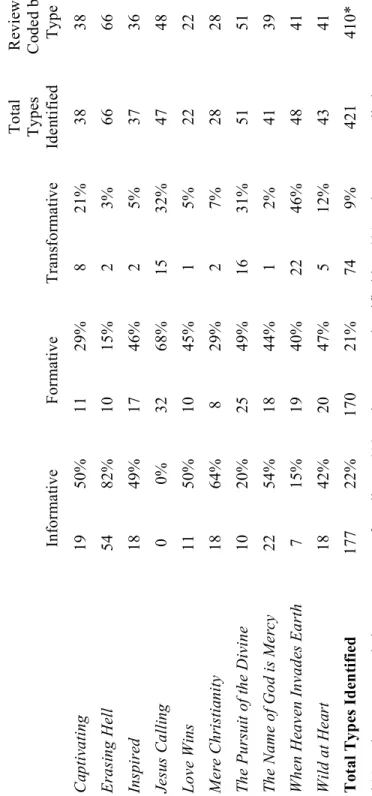
Spiritual Responses to the Text. Many reviewers did indeed describe spiritual changes as a response to their reading, whether an encounter with God, a transformation of their understanding of God or their faith, or a change in their heart as a result of their reading. These reviews were also coded as transformative for the type of reading; there were 74 total (9% of all reviews). The high correlation between type of reading and five and four star ratings indicates that such a response commended the text to them. Of all the reviews classified as transformative, 74% were rated with four or five stars.
Reviewers describe how the text was relevant to their current spiritual state. Some describe their expectations of spiritual transformation or unmet spiritual needs in approaching the book and the way in which the text spoke to their spiritual
circumstances. One reviewer of When Heaven Invades Earth, for example, cites a prior “growing hunger in my heart to see God’s power at work in the lives of people who are in desperate need of miracles” while another explains that they read the text and plan to apply the ideas therein out of a desire to see more of God. Prior beliefs are at play here as well, as the reviewer’s are articulating their spirituality through their beliefs about God and the experience of the Christian faith.
theological reasons, arguing, “people who are slamming this book, how do you explain the Spirit working in these situations if the theology is as messed up as you say it is?” The reviewer states that by implementing Johnson’s ideas, she or he has “already seen three healings in people I have prayed for.” For this reviewer, prior beliefs structure his or her weighting of those measures that confirms truth; this reviewer may not deny the importance of theology as a cognitive authority by which to assess information but states here that empirical verification of the information (as achieved through the power of the Holy Spirit, a person of the Trinity) is all that is needed for personal confirmation of its truth. Witnessing the three healings is enough to trust the ideas in When Heaven Invades Earth and also enough to discredit, point blank, the theological refutations of the text presented by other reviewers.
In more muted tones, a reviewer of Mere Christianity writes how the spiritual relevance, as opposed to the spiritual application, of the text commends it. One particular portion, “with its emphasis on forgetting your self and giving yourself up completely to Christ, spoke deeply to the current state of my soul and recent spiritual journey in the most profoundly beautiful way.” The reviewer’s spiritual response to the text, it is suggested, confirms its truth. For one Jesus Calling reviewer, this kind of spiritual relevance seems to underlie his or her acceptance of the author’s claim of divine inspiration. She or he writes that she or he had been searching for a devotional “that would help me see Christ up close and personal” and that through Jesus Calling, “Christ speaks to each part of me: Spirit, soul and body.” The spiritual power of the text suggests that it is a communication from God; the author is a mere conduit to the divine.
Some reviewers believe that a text has spiritual importance as a message from God because they encounter similar themes from other sources. The text appears to be simply one channel among many that God is using to speak to them. For example, one Erasing Hell reader recounts how the circumstances of reading in relation to his or her church prompted the reader to consider what God was prompting him/her to do: “I bought this book last week, and this Sunday the pastor preached about hell. It seems that there is a message here. I love it when God does that timing thing when the same topic keeps coming up. Obviously when that happens it is time to stop and take note.” The alignment of the message of the text with personal circumstances can feel for some reviewers as a divine response to their emotional state, as was common in reviews for Jesus Calling. Many reviewers stated that the devotions seemed completely and
to them to express His care. Multiple reviewers, in reviewing Jesus Calling, as well as Inspired, Mere Christianity, The Name of God is Mercy, The Pursuit of God, Erasing Hell, Captivating, and When Heaven Invades Earth claim that the timing of their read vis-à-vis their spiritual circumstances was central to its impact upon them.
Many reviewers also describe engaging spiritually with the text in relying upon God to guide their thinking. This leads to a transformative spiritual experience, beyond simply feeling that God has communicated discerning wisdom on the text at hand. Through the practice of relying on God in seeking spiritual wisdom and growth, a reader can engage with a text one might consider more doctrinally informative than
transformative, such as Love Wins or Erasing Hell, for transformative ends. One Erasing Hell reader describes how she or he struggled to accept Chan’s message and the beliefs about God therein. It was only “after a lot of reflection and prayer that I was able to let go of the desire to put this book down indefinitely and take myself out of what I was
have shielded myself from challenges like this and I was selling myself and the Word short. God doesn’t need defended and neither does the truth.” What both these reviewers gained spiritually from the book encompasses more than just a new perspective on hell but rather a transformed understanding of God and truth.
Indeed, many Love Wins reviewers appreciate Bell for articulating questions that they feel are important and often go unasked, expressing a sense that questioning one’s beliefs, engaging with new and challenging ideas, and accepting uncertainty is essential for one’s faith. In this, reviewers are grappling with the nature of Christian truth and what it means to know this truth. For some reviewers, the fact of uncertainty inclines a
Christian to trust God for what he or she cannot understand and such trust is a good and morally formative product of questioning what one believes. For others, it encourages self-reflection and personal change. One reviewer describes how “this kind of
questioning can be beneficial to the Christian” because it can point to areas “in my faith-life that can be shaken, it should be firmed up or removed altogether. With brothers like Rob Bell we will more frequently find those shakable areas. Once identified, we have the choice to become more like Christ or to walk away from Christ altogether. Do we want to be safe but shakable, or more firm in our faith because we have struggled with tough questions?” Others echo this theme, commending an exploration of the ideas in conjunction with the Spirit’s guidance, thoughtful consideration, and Bible study, believing that this process of challenging one’s beliefs will not only strengthen one’s faith but also the church more broadly.
opportunities for spiritual verification through one’s manner of engagement with a text. Additionally, these reviews attest to a common expectation that spiritual benefits can be found by engaging with a text even though one does not agree that the information within is true. Spiritual growth is achieved through the individual’s act of comparing the text to other cognitive authorities of the Christian tradition and seeking God’s truth through these mediums.
Past Spiritual Experiences. Past spiritual experiences also influence reviewers’ evaluation of spiritual truth. Sharing a similar trajectory in spiritual journey as the author often led to a favorable response to the book. Such was particularly common in the reviews for Inspired, as many reviewers describe struggling with their conservative Christian upbringing, as author Rachel Held Evans did, and take encouragement from Held Evans’ insights as one who has faced the same struggles and re-embraced her faith. Some reviewers, even if they disagree with her conclusions, rate her highly because the book inspired them to find meaning as Evans did, albeit in different beliefs. Basing approbation of a book on the basis of a shared spiritual background of the author emphasizes the sociological and interpersonal aspects of worldview, in that similar spiritual experiences create a social solidarity and reinforce belonging within that worldview. Inspired can function as a cognitive authority within the worldview of many post-evangelical readers because it speaks to their shared background.
Tozer’s anti-intellectualism on the basis of his or her own spiritual experiences: “I get that sterile intellectual analysis doesn’t necessarily lead to a changed heart, but the vast majority of my spiritual maturation in the last several years has come from wrestling with those deep questions.” Another reviewer, of The Name of God is Mercy, echoes a similar theme in relating how his dissatisfied response to the text is dictated by his prior beliefs, as shaped by experience. The reviewer describes his Catholic upbringing and his desire to become a priest before “my own faith issues and the church’s own blockages regarding gay people.” He finds that the messages in The Name of God is Mercy oppose the conclusions he has come to and the spiritual place he has reached: “The Pope repeatedly insists that shame is a good thing. And after all the work I’ve done in my life undoing the shame that has kept me from living a fulfilling life! Maybe he’s using the word
differently.”
Like several of the aforementioned reviewers, this individual chose to read The Name of God is Mercy with the hope that he would experience spiritual change, in response to “this year's recurrence of the inner movement to start going to church again, to revisit my faith again.” Yet unlike the reviewer of When Heaven Invades Earth who read for spiritual application and ignored signs of theological error, the beliefs he
the desire to become a priest), the reviewer rejects some of Pope Francis’s arguments for himself, though interestingly, not for everyone. Certain beliefs are simply too different from personal spiritual experience and convictions to accept.
Author’s Expertise
To return to Wilson’s description of empirical verification, a performer who produces exceptional results is deemed to possess a “special competence” that is the basis for their cognitive authority. Notably, the “special competence” that enables spiritual verification is not attributed to the author but rather to the author’s relation to God, as indicated in the language of authorial assessment in reviews. Reviewers often discussed the author’s character and spirituality as a way of evaluating the text.
Assessment of Authorial Character. The language used to describe authors is overwhelmingly, particularly in the cases of Erasing Hell and Love Wins, character-centric. Many reviewers comment upon the character of the author in evaluating his or her trustworthiness, comments that reflect both the importance of character as well as the reviewer’s own beliefs. Francis Chan, one of the authors of Erasing Hell, is admired for a variety of characteristics based on the tone in which he presents his message. Reviewers describe this tone as loving, empathetic, humble, urgent, well-intentioned, sincere, bold, sensitive, and spiritually earnest. Not all reviewers feel this way. Some criticize Chan for unfairly attacking Bell and one reviewer argues that it “falls short on grace…unbecoming to its author.”
Its place in an evaluation of a text suggests not only the importance of that particular virtue but also the reviewer’s belief in the importance of character in determining trustworthiness, which could be attributed to a Christian worldview that upholds a holistic life commitment to Christian tenets. The authenticity of Chan’s faith, one might argue, is demonstrated in his modeling of Christian principles in his writing. The more authentic the author’s faith, the more trustworthy the author is as an individual who knows God and truth.
Reviews of Love Wins contain similar authorial assessments. Admirers commend Bell’s faith, “desire to share the love of Christ,” love for Jesus, determination to ask questions and find answers, courage, pastoral motives, and honesty. Detractors claim that Bell is “very masterbatory and self aggrandizing,” self-promoting, conceited, lacking in humility (such a phrase appears several times in addition to arrogant), arrogant, and idolatrous in his arrogance. This last description further emphasizes how tone might indicate an author’s spirituality.
Several reviewers relate Bell’s use of evidence and writing style to his character, beyond simply his tone. One argues that Bell’s approach “seems to be targeted for an emotional response and this seems deceptive and irresponsible” while another contests that “it is almost arrogant of Bell to think he can cover this topic in less than 200 pages.” An even stronger example, one reviewer writes that,
creative. I call it disingenuous. To pretend that he falls squarely into the fold of evangelicalism so as not to freak out his contingency is simply deceptive.” Here, the reviewer critiques the information that Bell presents based on his or her understanding of how the stylistic and editorial framework of his argument contradicts those values that the reviewer holds and expects Bell to also hold, presumably as a fellow Christian. Clearly, the reviewer has expectations regarding the character of spiritual leaders and these expectations belie a belief in the power that spiritual leaders hold. Writing of subpar quality, for the reviewer, is a manifestation of improper regard for this power and signals that Bell’s character and perhaps faith, is flawed.
In contrast, two reviewers, perhaps aware of popular condemnation of Bell, acknowledge that though Bell seems arrogant, the tone of the book is not necessarily an indication of his character and therefore readers should not judge him. One reviewer is very explicit in asserting this, writing with clear respect that, “I also do not know Rob Bell and do not claim to understand the type of believer, pastor, writer, husband, father, or man that he is. Not one part of my review is to diminish how anyone would think of him as a human being because I really am no authority on that.” These reviews were, however, in the minority of reviewers of Love Wins.
Assessment of Authorial Spirituality. As discussed, prior beliefs inform a reviewer’s understanding of character and the basis upon which to evaluate that
influences. A few negative reviews of Love Wins illustrate this connection and the degree to which, for some reviewers, an author’s beliefs are tightly tied to his or her spirituality.
One Love Wins reviewer writes that Bell “supposedly is teaching what the Bible says” but fails to consider biblical evidence that might counter his argument, such as Jesus’s calls for repentance. “Anyone who claims to speak for Jesus and denies that warning [to repent or be punished] and that urgency must be treated as a false
teacher/prophet. Jesus loves us more than anyone else, and to deny and leave out what he has clearly said is to oppose him. What ‘Love Wins’ does is give false comfort to those who have not turned from all sin and let Christ take his rightful hold on their lives (Psalm 2:10-12, Hebrews 5:9). The same type of false comfort the Serpent gave Eve in the garden.” This reviewer considers those who claim allegiance to the Bible and to Jesus while diverging from what she or he believes about Bible and Jesus teaches to be in opposition to God. Bell, in her or his estimation, falls into that category, and she or he thus condemns his Christian practice. By likening Bell to the Serpent in giving false comfort to readers, the reviewer indirectly implies that Love Wins is evil.
the teachings of the Bible.” Again, while the devil is not mentioned, Bell is described in terms of evil, of leading those who believe him into a kind of hell. This is the spiritual consequence of believing the information contained within the text.
These reviews represent a more rigid commitment to biblicism and church doctrine than the many reviewers who praise Bell for his authenticity and love for Jesus even while also disagreeing with his conclusions. Here Andrew Todd’s (2005)
description of the “canonical repertoire” and “contingent repertoire” is especially relevant, with the former reviewers abiding by the authority of the Bible above all else. The author’s alignment with these reviewers’ understanding of the Bible dictates the extent to which they will accept that person’s faith as genuine, and, by extension, the information they provide. They attribute a higher weight towards alignment with (their interpretation of) the Bible and see this as evidence of true faith in Jesus as opposed to those who see faith in Jesus exemplified in Bell’s apparent care for others. The reviewers who praise Bell for his authenticity are aptly described as practicing Todd’s “contingent repertoire.” They might allow that Bell’s own personal weighting of various beliefs within the Christian worldview is what guides him to false conclusions whereas the three former reviewers clearly see evil influences at work in a person that does not truly know God.
commends him as a spiritual man, as several reviews indicate, not only suggesting again the importance of a holistic commitment to Christian tenets but also the importance of witnessing an author’s spiritual impact. As one reviewer says, “He is a humble, humble man who God is using to revolutionize powerless and formulaic Western Christianity. His ministry looks like Jesus' ministry and if I judge the tree by it's fruit... the tree is in full bloom.” Reviewing The Name of God is Mercy, one reader declares that “There is no doubt that Pope Francis understands the heart of God and seeks to restore the Church to living out the mercy of God in every area of life,” another commendation of the author based on what the author is spiritually striving for.
A reviewer of The Pursuit of God explains the relationship between God, the Bible, and Christian authors. Before commending Tozer, he or she explains that “Nothing replaces the Bible; however, there are authors who have written what God has laid on their heart to share with others in the hopes of drawing them near to Him.” In
Intrinsic Plausibility
Coding for Intrinsic Plausibility prompted the consideration of the variety of inextricable combinations of prior beliefs and intrinsic plausibility. It is again helpful to turn to Wilson’s (1983) explanation of assessments of cognitive authority in describing the concepts involved. Wilson writes that
“The test of intrinsic plausibility is not available for many spheres of interest. What a specialist has to say may be so remote from my own experience and so distant from any of my established beliefs about the world that it is neither plausible nor implausibility. The closer the specialist comes to talking of matters on which I already have a stock of beliefs and convictions, the more likely it is that the plausibility test will be available and will discriminate among opposing views. Our prior beliefs set limits to what we can accept as new beliefs and guide us in the acceptance of others as cognitive authorities. What we cannot believe and what we find it easy to believe among the new things we are told depend heavily on what we already believed” (p. 25).
Thus it is when reviewers feel they understand the subject under discussion that they can most robustly evaluate the text’s argument. In reviews, readers relied upon an analysis of plausibility in relation to Christian beliefs and values as well as an analysis based on logical cogency, as one might apply to any argument. The former was not devoid of logic, but logic was applied within a Christian belief system whereas in the latter analysis, logic was analyzed within the text, for self-contradictory arguments or logical fallacies. As it involves worldview and appeals to cognitive authorities and shared beliefs within that worldview, the former type of analysis is therefore of greater interest to the study.
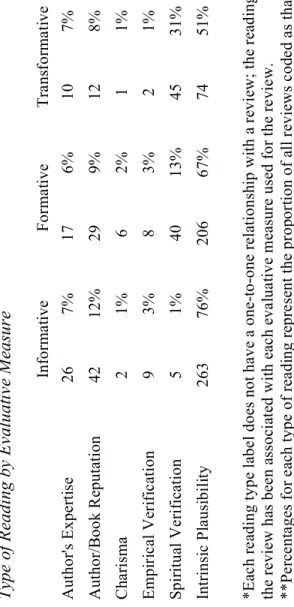
but they also attributed different weights to shared cognitive authorities. Reviewers were often appealing to the same cognitive authorities but referring to these as standards for evaluation in different ways. 272 reviews were coded for at least one reference to a cognitive authority (33% of all reviews) and of these, there were 401 individual references to a cognitive authority. The three primary cognitive authorities referenced were the Bible (39% of all cognitive authorities referenced and referenced in 19% of all reviews), God (including the person of Jesus and the Holy Spirit; 21% of all cognitive authorities referenced and referenced in 10% of all reviews), and theology (including doctrine, orthodoxy; 16% of all cognitive authorities referenced and referenced in 8% of all reviews).
The Bible as a Cognitive Authority. References to the Bible were present in reviews for every book. In most cases, if the text presented information that did not agree with what the reviewer believed the Bible stated, the reviewer did not trust the
information. Some reviewers simply labeled a book as either biblical or not biblical but many analyzed the extent to which the argument was biblical and commented on the author’s exegetical methods.
This variance in approach was evident in that reviewers’ arguments referencing the Bible sometimes opposed each other. One reviewer, for example, describes When Heaven Invades Earth as “grounded-in-scripture” while another writes that Johnson “manipulated scripture for his own purposes” and yet another critiques Johnson for basing his arguments on opinion instead of the Bible. The discrepancies between assessments of the biblical foundations of the book can be explained by different
be conducted. For example, reviewers dispute the biblicism of Jesus Calling in their reviews, relying on different understandings of a text’s relationship to the Bible and its truth value. For a few reviewers, it is enough that the book is not “antithetical to the teachings of Jesus.” Others find that the Jesus portrayed in the text does not resemble the Jesus portrayed in the Bible and known in their own. Because the text does not explicitly align with what the Bible says, it is dangerous, a false representation of God claiming to be true. Another reviewer makes the leap between a dangerous text and an evil one, writing that because the messages in Jesus Calling are not all biblical, Young “is either lying about receiving these messages… or she is receiving the messages from someone other than Jesus.”
Other differences in reviewers’ treatment of the Bible can be attributed to differing weights given to the incorporation of biblical passages and theological beliefs. Thus, some reviews of Love Wins applaud Bell for rooting his argument in the Bible and in theology about Jesus while others decry Bell as heretical. The former weight the Bible or beliefs about Jesus more highly while the latter attribute a higher weight to church tradition and credal orthodoxy. Bell’s belief in salvation through Jesus is not enough to merit acceptance of his argument, as there are other theologies that are at stake in his argument that they value and wish to defend. The weight given to biblical interpretation is thus balanced against other cognitive authorities and forms of revelation.
decision to rely exclusively on interpretations of scripture to make his argument… I think the primary argument first needs to be over the inerrancy (or lack thereof) of scripture.” A reviewer for Erasing Hell also writes that “the biggest reason Chan gets stuck with this crappy doctrine is that he adheres to biblical inerrancy (which in itself is inherently, irreconcilably flawed).” These reviewers recognize that the author’s beliefs are rooted in their deference to biblical authority and that as such, their worldviews are predicated upon different foundations and therefore incompatible. Similarly, after reading Love Wins with an atheist in his or her book group, another reviewer recognized that attributing authority to the Bible in an argument limits the argument’s appeal. This reviewer writes that, “I think Bell wanted this book to be for atheists, agnostics, and those who’ve left the church. But it’s not. It is definitely an internal debate within Christianity. You can’t argue from the Bible with those who believe the Bible is a bunch of hogwash. You can’t talk about the symbolism and meaning found in the parable of the prodigal son to someone who hasn’t heard the parable.” Interestingly, one Love Wins reviewer identifies as a non-Christian but references the Bible in his or her evaluation of the text, using it as a standard in much the same way as many self-identified Christian reviewers. This reviewer is evaluating the argument within the context of its worldview despite not holding to that worldview him or herself, though it is unclear the extent to which this reviewer would ever apply the information evaluated through such a lens.
knowledge of the subject matter imparts. In believing they share a worldview with the author, these reviewers assume the right to hold the author to those theological beliefs that they accept as central to the worldview. Thus it is that readers of Love Wins imply that Rob Bell is betraying Christian tenets by his argument. Two reviewers writes, for example, that “never have I read a book of theology where the writer seems more in love with his own ideas then the ones written by the God he claims to follow in scripture” and that, "Rob Bell rejects the God who is and substitutes a god more to his liking and of his own imagination, which the truest form of idolatry." Both reviews indicate that Bell ought to conform to their beliefs about God but fails to do so and is objectively wrong. A When Heaven Invades Earth reviewer uses similarly strong language in wholly
condemning the text as “trash.” For this reviewer, a lack of “understanding of basic credal orthodoxy and any sense of godly discernment” invalidates any value the text might offer. He or she decries the heresy inherent in its argument that “undermines the most basic teaching of Christianity and is itself sub-Christian.” For this reviewer, credal orthodoxy is the set of theological beliefs by which he or she evaluates Johnson’s text.
consideration is given to what “the church has traditionally accepted” and what “can be well defended biblically and historically.” The reviewer finds that of the five positions the church has accepted, one is, the reviewer believes, unbiblical. In this, the reviewer is acknowledging shared beliefs with the broader Christian community and allowing for the truth of these shared beliefs (except for the one that cannot be defended biblically) while also delineating her or his own personal beliefs.
The reviewer develops her or his argument by contesting Bell’s biblicism and hermeneutical approach and examining Bell’s evidence regarding the teaching of the historical church, implying that these are the standards by which beliefs should be measured, beyond one’s own personal conviction. In concluding, the reviewer declares that she or he is “not going to proclaim Bell a heretic. I believe that his view on world religions inclusivism is heretical and represents a serious error, but I'm not going to say he should be wholly rejected as a teacher because of it. I'd rate his view on postmortem evangelism as heterodoxical. It's not as serious as outright heresy but it goes beyond biblical orthodoxy.” The reviewer thus positions Bell in relation to orthodoxy and, in her or his upholding of orthodoxy, to herself/himself. The standards the reviewer considers as supporting orthodox belief (evidence from the Bible and Christian tradition) are those the reviewer applies to the text. As another review states, “I can't stand with him in his conclusions. I can stand with him as a brother in Christ.” There is a broader worldview that unites them and these reviewers accept that their divergences in belief do not negate that broader unity.
Bell’s argument in Love Wins is predicated upon an idea of who God is; he argues against a doctrine of eternal hell from the basis of the idea that God is loving above all else. Some reviewers say this conclusion is justified given that Bell’s presupposition is true while others claim that this “version” of God does not represent the God that they know.
In his dissection of the theological cogency and implications of Erasing Hell, one reviewer asserts his conviction that belief in the character of God is the most important foundation for any theological argument. He declares that certain Christian theological understandings of God (Universalism, Calvinism, and Arminianism) all maintain a consistent understanding of who God is. This, the reviewer finds, is missing in Chan and Sprinkle’s argument and such is problematic because “holding to the character of God is more important than holding even to the character of the Bible, in logical order.” The reviewer has identified what lies at the root of his or her disagreement with the authors: an attribution of the highest authority to different theological principles.
A reviewer of Mere Christianity attributes authority to the Bible with an explanation that this is because it communicates God’s voice to readers. This reviewer quotes the Christian author Brennan Manning in support of his or her point. Manning commends praying and meditating on the Word of God, for “we must never allow the authority of books, institutions, or leaders to replace the authority of knowing Jesus Christ personally and directly. When the religious views of others interpose between us and the primary experience of Jesus as the Christ, we become unconvicted and
unpersuasive travel agents handing out brochures to places we have never visited.” The Bible is referenced as an authority but truly it is the experience of Jesus that it provides that is the highest authority. This quote is also interesting in how it speaks to the evaluative measures applied to cognitive authority. Spiritual verification, through the application and personal experience of the text, in communion with God, is the most trustworthy way to verify truth. Formative practices such as Bible study and prayer are valued not as cognitive authorities in and of themselves but for their access to God.
Interestingly, not all reviewers who suggest seeking divine guidance, through whatever channel, suggest that this guidance will lead to the same answer or the same truth. One reader of Jesus Calling expresses a belief that each individual must assess whether or not Young’s style, of speaking from the point of view of Jesus, is acceptable “with the conscious and prayer as guide,” thus opposing the idea that anything
universally applicable can be said. This reviewer may have come to an answer with her or his own conscience and through prayer but does not share her or his opinion as the
acknowledges that other women have different experiences and that these are also valid. She recognizes that personal experience is varied and that God’s perspective
encompasses these multiplicities of personal experience.
Acknowledgment of Worldview. Coding for worldview was largely inductive, as statements expressing a reviewer’s worldview or their acknowledgement of the author’s worldview were often implicit, baked into their evaluation of the text. Some reviewers self-identified with a religious or ideological framework (as a Christian, Mormon, Catholic, atheist, etc.) but these reviewers were in the minority. Additionally, such self-identification did not necessarily provide information about the shape and structure of their worldview and belief system, even if associating it with a larger framework. As Burnett (2009) suggests and the study’s findings support, there is too great a diversity of values and weights given to those values that a broad identification with a certain belief system fails to say much about an individual’s personal convictions. These explicit declarations of a relationship to a worldview did not necessarily, therefore, shed light on the reviewer’s evaluative thought process. It was largely by analyzing references to cognitive authorities as evaluative standards and the values underlying judgment of the text that elements of the reviewer’s worldview became clear, even if there was no explicit identification with a framework of belief. Indeed, worldview is such a nebulous concept that it is reasonable to operationalize through measures of specific references to cognitive authorities, as the mileposts of the reviewer’s information
One reviewer, coming from “more post-liberal/progressive strains of Christianity,” clearly positions himself in relation to the ideological background of Erasing Hell. He or she explains what differences in presupposition and attitude underlie his or her and the author’s worldview and limit his or her acceptance of the argument. The reviewer writes that “if anything, there's really nothing wrong with the book considering its targeted audience -- largely evangelical Christianity, in my opinion. If you'd really like to narrow down the problem here, it's me. I've personally drifted into more post-liberal/progressive strains of Christianity […] Therefore, the issues I have with this book are not really specific to this book as much as they are specific to the broader assumptions of evangelical Christianity. So in some sense, this review is a little unfair.”
This reviewer’s statement that the review is “unfair” is especially notable, as it suggests that the information’s truth value is restricted to a particular worldview. Later in the review, the reviewer elaborates that he or she dislikes that Francis Chan does not “critically analyze” the assumptions he brings to his argument, “but that is not within the intended scope of the book, so again, it is unfair for me to really criticize it for that.” The reviewer concludes by stating that, “I wouldn't really recommend this book unless you identify as an evangelical Christian, in which case I feel this may be an accessible
introduction for the subject and may challenge some assumptions made by evangelical
Christianity in a productive way.” There are no references to other cognitive authorities
in this review, only references to the lenses with which one approaches a subject,
suggesting that these are what defines truth for an individual.
Comments regarding the “right audience” for a book were common, particularly