Jiaming Qu. A Medical Literature Search System for Identifying Effective Treatments in Precision Medicine. A Master’s Paper for the M.S. in I.S degree. April, 2019. 58 pages. Advisor: Yue Wang
The Precision Medicine Initiative states that treatments for a patient should take into account not only the patient’s disease, but his/her specific genetic variation as well. The vast biomedical literature holds the potential for physicians to identify effective treatment options for a cancer patient. However, the complexity and ambiguity of medical terms can result in vocabulary mismatch between the physician’s query and the literature. The physician’s search intent (finding treatments instead of other types of studies) is difficult to explicitly formulate in a query. Therefore, simple ad hoc retrieval approach will suffer from low recall and precision.
In this paper, we propose a new retrieval system that helps physicians identify effective treatments in precision medicine. Given a cancer patient with a specific disease, genetic variation, and demographic information, the system aims to identify biomedical
publications that report effective treatments. We approach this goal from two directions. First, we expand the original disease and gene terms using biomedical knowledge bases to improve recall of the initial retrieval. We then improve precision by promoting treatment-related publications to the top using a machine learning reranker trained on 2017 Text Retrieval Conference Precision Medicine (PM) track corpus. Batch evaluation results on 2018 PM track corpus show that the proposed approach effectively improves both recall and precision, achieving performance comparable to the top entries on the leaderboard of 2018 PM track.
Headings:
Information retrieval Medical informatics Search algorithms
A MEDICAL LITERATURE SEARCH SYSTEM FOR IDENTIFYING EFFECTIVE TREATMENTS IN PRECISION MEDICINE
by Jiaming Qu
A Master’s paper submitted to the faculty of the School of Information and Library Science of the University of North Carolina at Chapel Hill
in partial fulfillment of the requirements for the degree of Master of Science in
Information Science.
Chapel Hill, North Carolina April 2019
Approved by
CONTENTS
INTRODUCTION ... 2
LITERATURE REVIEW ... 8
Query Expansion ... 8
Learning-to-rank ... 10
Medical Information Retrieval ... 12
METHOD ... 15
Retrieval Architecture ... 15
Indexing ... 16
Training and testing ... 18
Query Expansion ... 19
Diseases ... 19
Genes ... 21
Re-ranking ... 22
A Heuristic Approach ... 23
Learning to Rank ... 24
Ranker Construction ... 26
EXPERIMENT ... 29
Dataset Overview ... 29
Query Structure ... 30
Result and Implications ... 30
Case Studies ... 34
Other Trails ... 40
CONCLUSION ... 45
NOTES ... 47
APPENDIX A: Full Text of Articles ... 48
INTRODUCTION
Mr. H is a 35-year-old man who has had a cough for a couple of months. After having an x-ray and CT scan, he was diagnosed as having non–small cell lung cancer. However, he has always kept a healthy lifestyle and never smoked. One possible answer could be that his disease is caused by some gene mutations. Had his cancer been
diagnosed in the past, his physician might have treated him just like other patients with lung cancers caused by smoking. But if his disease is diagnosed recently, his biopsy tissue could be analyzed for a panel of genetic variants that can reliably predict what treatment would be most effective for him (Mirnezami, Nicholson, & Darzi, 2012).
This scenario reveals the core idea of precision medicine: based on genetic, biomarker and demographic data, finding a personalized treatment which is different from treatments for other patients with similar clinical symptoms for a specific patient. According to the Precision Medicine Initiative launched by the former President Barack Obama in 2015, precision medicine is an approach for disease treatment and prevention that takes into account individual variability in genes, environment, and lifestyle for each person. This approach will allow physicians to conduct treatments more accurately. It is in contrast to the one-size-fits-all approach, in which treatments are developed for all the people with the same disease, with less consideration for the differences between
study supports that in 96% of undiagnosed primary tumors, a genomic alteration could be identified and that in 85% of these cases, it is potentially treatable by a known drug (Ashley, 2015).
The origin of precision medicine could date back to the fact that a person who needs a blood transfusion is not given blood from a randomly selected donor, but it was impossible to fulfill this goal in the past. The reduced cost of sequencing a human
genome ($22 million ten years ago versus $1,000 to $5,000 now) and time of sequencing (2 years ten years ago versus 1 day now) has made the precision medicine idea more possible today (Hudson, Lifton, & Patrick-Lake, 2015). Also, the adoption of Electronic Health Record (EHR) systems in hospitals has grown from below 30% to over 90%. These systems can help physicians to find relevant and useful information about a patient to inspire and support their decisions. Such information is helpful in evidence-based analysis. In early days, physicians would input patient’s demographic data and
symptoms, searching for information in a EHR system to conduct disease diagnosis. They analyze the data to determine the pathophysiologic explanation, or to find potential treatment by referring to previous treatments for patients with similar symptoms (Musen, Middleton, & Greenes, 2014).
huge volume of academic articles which keeps growing rapidly, it is not easy to build an effective Information Retrieval (IR) system for searching medical literature. Clinicians can easily be overwhelmed by the great number and be inhibited to determine the best possible treatment because hardly do they have enough time to go through each paper they find. It would be much more difficult if a clinician wants to find some papers which exactly match the genetic, disease and demographic information of his patient. This is one of the biggest obstacles on our way towards precision medicine. If physicians could be provided with an effective IR system to easily retrieve relevant medical literature when making decisions, the gap between theoretical setting and real-world clinical setting could be fixed.
For many years, people have been studying how to make medical literature retrieval systems more effective. In the Interactive Information Retrieval research area, according to a survey by Lu (2011), some approaches have been proposed to improve the retrieval system for better usability, e.g., changing the searching interface which helps users to discover and identify potentially relevant documents. Steinbrook (2006) uses the information seeking and information behavior theory to propose better literature
demographic information, how could the IR system help him to retrieve relevant medical literature for conducting treatments?
concept could even happen among researchers with comparable level of knowledge on the subject. It is almost impossible for a physician to input all the relevant terms into the query by looking up the term in a thesaurus or an ontology when he attempts to do retrieval. Apart from previous difficulties, even if a physician could formulate a well-structure query and retrieve more relevant documents than he used to, a powerful ranking algorithm is also necessary, considering a physician’s limited time to read only several documents appearing at the top.
In this paper, we propose a new retrieval architecture. We use query expansion to tackle the vocabulary problem by automatically looking up the original disease and gene terms in knowledge bases and adding expansion terms into the query. We aim to retrieve more potentially relevant documents which do not explicitly mention the target disease or gene terms to optimize recall. After this step, we train a Logistic Regression classifier and apply it to the retrieved result to predict the probability of how relevant a document is to the PM track, and we aim to use the probability to re-rank the result to optimize
precision. It should be noted that the term classifier and reranker are used
interchangeably in this paper. The dataset provided by the PM track which consists of 26.8 million MEDLINE articles and 70,026 ASCO/AACR conference articles serves as our corpus. For training the classifier and tuning parameters, we use the 30 topics from the 2017 track as our training set, and all the retrieval tasks for testing use the 50 topics from the 2018 track.
LITERATURE REVIEW
In this section, we review relevant literature to provide an overview of the research background and related works mainly from three aspects: query expansion and learning-to-rank in IR systems, applications of knowledge bases in IR systems, and different approaches to improve medical literature IR systems so far.
Query Expansion
Different people may use quite different words to describe a same object.
Therefore, traditional IR systems which only use keywords in the query to match terms in documents are not effective in some cases because the information about a same issue can be expressed in different words that may not be exactly the same. A document could still be relevant without the exact terms from the query, as long as it has other words with the same meaning.
Query expansion enhances the original query with other words which are most likely to capture user’s desired information. The core idea is to generate an alternative or expanded query for the user. One intuitive way is to add into the query some synonyms or relevant terms of each keyword by looking up in a thesaurus or discovering term relations like their co-occurrences in documents (Manning, Raghavan, & Schütze, 2010). Basically, there are two approaches of query expansion: the corpus-based approach which generates expansion terms from documents ranking at the top with the assumption that the most frequent terms appearing in these documents are highly correlated to the original query, and the resource-based approach which leverages external resources like domain-specific dictionaries, ontologies, or knowledge bases to add expansion terms into the original query. In other words, the first approach depends on the searching process and uses relevance feedback in iteration of searching to identify expansion terms, while the second approach is independent of the searching process and additional expansion terms are derived from a knowledge structure.
In the corpus-based expansion approach, relevance feedback is a representative technique that is widely used to improve retrieval performances. The relevance feedback process usually happens after a retrieval is done, and the original query is reformulated according to the retrieval result. Relevance feedback could further be split into two methods which are implicit and explicit. The explicit method asks users to mark
that of non-relevant documents to the original query in a vector space model. Apart from the explicit method with manual input, Pseudo Relevance Feedback (PRF), also known as blind relevance feedback, is also widely used. It automates the manual part so that the user gets improved retrieval performance without an extended interaction. This approach runs a query to find an initial set of most relevant documents, then makes the assumption that the top K documents are all relevant and revise the query under this assumption.
In the resource-based expansion approach, there are well-structured knowledge resources developed by domain experts in some specific domains, which provide expansion terms based on relations between entries. Expansion terms with certain relations to the original query terms are generated from these knowledge bases.
However, although query expansion helps to capture user’s real information needs, the additional terms may cause the drift of the focus of a search topic caused by improper expansion and may hurt the retrieval performance in both precision and recall (Mitra, Singhal, & Buckley, 1998). Therefore, apart from generating expansion terms arbitrarily, a lot of studies show that the quality of added terms and weights assigned to these expansion terms could largely affect the result of retrieval. In the medical IR area, Xu et al. used PRF to generate expansion terms which are mapped into MeSH, and refined the candidate expansion terms by training term-ranking models to select the most relevant ones for query expansion (Xu, Lin, & Lin, 2018).
Learning-to-rank
The goal of ranking in IR is to generate a ranked list of retrieval results according to their relevance to the original query. Usually a ranking model computes a score
ranked in a descending order by the score. Basic IR models like Boolean retrieval could only tell whether a document is relevant or not, but could not tell how relevant a
document is. Therefore, the vector space model, language model and other models are introduced to compute the relevance scores. For example, in the vector space model, documents and queries are represented by vectors with TF-IDF weights. Then the relevance score is computed by the cosine similarity between two vectors. In the language model, a maximum likelihood method is used to compute the probability to measure the relevance. These ranking models have been widely used in a lot of studies as well as some industry-level applications.
However, one drawback of these traditional ranking models is that there are some parameters which need to be tuned in a heuristic way to get a reasonable result. Apart from the fact that parameter tuning is a time-consuming and trivial task, a model tuned on the validation set sometimes performs very poorly on unseen test queries (Liu, 2009). Recently years, machine learning has been demonstrating its power in various areas on a lot of tasks. In IR, we could also leverage machine learning techniques on ranking models to do automatically parameter tuning and avoid the overfitting problem.
learning-to-rank methods, which are the pointwise approach, the pairwise approach and the listwise approach. And these three methods model takes a single document, a pair of documents and a list of documents as instances for learning respectively (Liu, 2009). In training the model, since the document-query are represented in multi-dimensional feature vectors, the selection of features plays an important role regarding to the ranking performance.
Medical Information Retrieval
The quantity of medical articles keeps increasing rapidly, which puts much pressure on medical specialists who need to be aware of up-to-date studies, and physicians who need academic papers as references to diagnose diseases and find treatments. The current retrieval systems for medical literatures, however, are not efficient and the searching task is still time-consuming.
There are a lot of studies proposing different methods to improve medical literature searching systems. Lu (2011) did a survey of 28 medical literature searching systems which were built between 1999 to 2010, and sixteen of them were implemented based on the PubMed system with minor adjustments. These improvements are
Borujerdi used the MeSH knowledge base and proposed a query expansion method to match concept pairs between queries and documents. They also pointed out that gene knowledge bases are another source for expansion (Jalali, & Borujerdi, 2008).
Since 2017, the precision medicine track has been added to the Text Retrieval Conference (TREC), and a lot of approaches to improve IR systems for medical literature searching have been proposed by teams participating in the track. Wang et al. explored the simplest approach that the NCI thesaurus and COSMIC are used to expand disease and gene terms with synonyms, and the retrieval result proved that the simplest method already significantly improved the retrieval performance (Wang, Wen, Liu, & Liu, 2018). Liu et al. explored an iterative approach to construct the query which starts from the strictest situation with exact matching of diseases and genes, i.e., terms must match, to relaxed matching, i.e., some terms may and some terms may not match, and finally to lenient match, i.e., terms may or may not match. The ranked retrieval list is then
produced based on the iteration of these queries (Liu et al., 2018). Zheng et al. explored assigning different weights for different parts in the query and proposed that the weight for disease, gene, gene mutation and general disease term should be in a descending order (Zheng, Li, He, & Xu, 2018). Zhou et al. construct a knowledge graph which contains the relations between gene, cancer and drug pairs from several knowledge bases via
METHOD
In this section, we first give an overview of our proposed retrieval architecture with two parts of indexing and searching. We then introduce the core techniques to improve retrieval which consists of two consecutive steps: the query expansion step which aims at improving recall and the re-ranking step which aims at improving precision. In the re-ranking section, we discuss how the classifier is trained and how features are generated. Our goal is to retrieve as many relevant documents as possible at the first step, and then re-rank the retrieved results using the reranker to push the most relevant documents to the top. In other words, in the final retrieval result, we expect a higher-precision and higher-recall performance than the baseline strategy.
Retrieval Architecture
FIGURE I
An overview of the retrieval architecture
Indexing
TABLE I
Five fields indexed for each scientific paper
Fields Analyzed Stored
Title True True
Abstract True True
ID False True
Publication Type False True
MeSH heading False True
For each paper in the corpus, we index five fields which are document ID, title, content, publication type and MeSH headings (see Table I). It is important to note that the corpus only contain the abstract part of a paper instead of its full text, which is referred as the content in this paper. Only the title and content field are analyzed with the built-in standard analyzer, which mean that these two fields are tokenized and used to match the query for relevance measurement. Also, there are 599 documents with slightly different abstract but the same document ID, for a paper is added into the corpus every time after it is revised. We simply index a document at the first hit and ignore the later versions to prevent duplicate document IDs in the retrieved result. Throughout the whole
architecture, we use the Okapi BM255 scoring algorithm which has been widely used in various industry-level applications. Compared to the traditional TF-IDF scoring function, BM25 has more reasonable scoring functions and more flexible parameters to be tuned. In this paper, we use the default parameter settings of 1.25 and 0.75 for all the retrieval task.
Given a query Q, containing keywords q1,...,qn, the BM25 score of a document D
score 𝐷, 𝑄 = 𝐼𝐷𝐹 𝑞. ∗ 0 1 0 12 ,3 ∗(5678) 2 ,3 756∗(8:;7;∗ >?@AB|=| ) C
.D8 (1)
where the 𝑓 𝑞. , 𝐷 is query term 𝑞.’s term frequency in the document D, |𝐷| is the length of document D (total count of words), 𝑎𝑣𝑔𝑑𝑙 is the average document length in the corpus, 𝑘8 and 𝑏 are free parameters. 𝐼𝐷𝐹 𝑞. is the inverse document frequency (IDF) weight of query term 𝑞. , which is usually computed as:
𝐼𝐷𝐹 𝑞. = logO:C 12 7P.R
C 12 7P.R (2)
where 𝑁 is the total number of documents in the collection and 𝑛 𝑞. is the number of
documents which contain the query term 𝑞..
Training and testing
All the training and parameter tuning tasks are done on the 2017 topics, with the released relevance judgement file which contains the true relevance scores of some documents in the corpus. In both training and testing processes, the queries are first expanded using the same knowledge bases which are introduced in the query expansion section, and the initial weight for each expansion term is set to 0.3 to ensure the
expansion terms do not shift the focus of the original query too much.
Since the standard number of retrieved documents for each topic is 1000, we use the metric of Recall@1000 to evaluate the retrieval after query expansion, which is calculated as the number of relevant documents in the retrieved 1000 results divided by the total number of relevant documents in the corpus. Then we tune the weight
train a linear classifier which predicts the probability of a document’s being relevant to the PM track. After generating high-level features from the text, we train a Logistic Regression model for binary classification in which labels are only relevant or non-relevant. This process is introduced in detail in the re-ranking section. After getting a set of weight parameters optimizing R@1000 and a trained Logistic Regression classifier, we apply the same process on the 2018 topics for testing.
Query Expansion
The goal of query expansion is to use external knowledge bases to expand the original term which helps the query to match more documents which do not contain that term. Since both disease and gene information are given regarding to a patient, we expand both two fields in knowledge bases separately.
Diseases
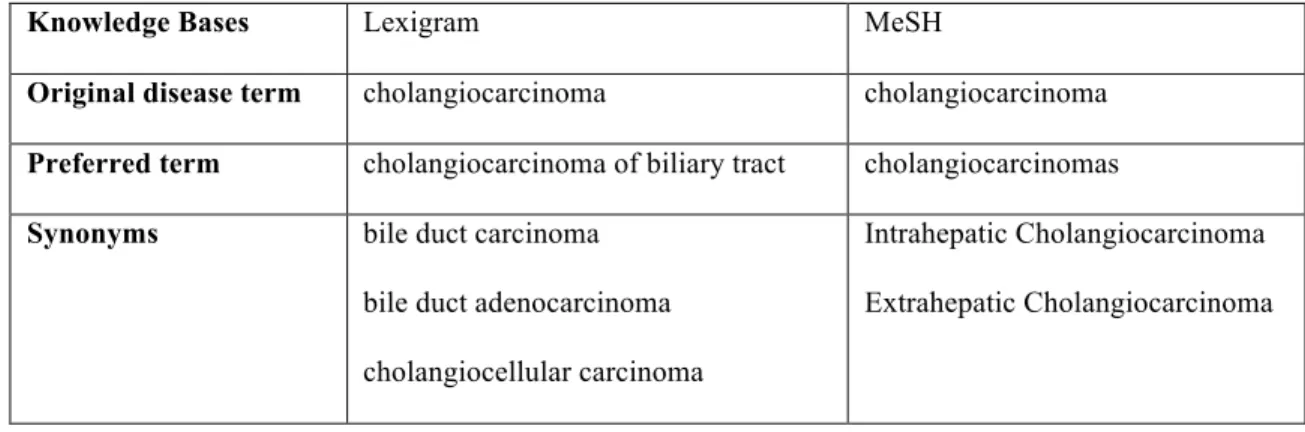
In selecting an appropriate query expansion structure, at first we include all these expansion terms, but we find the parent and children expansion terms bring too many noises into the original query. It makes the retrieved documents either too broad or too specific, and the result is low in both recall and precision. Therefore, in the final query expansion for diseases, parent and children disease terms are discarded. The table below illustrates how expansion terms for a disease term are different in two medical knowledge bases (see Table II).
Another edge of using the Lexigram knowledge base is that it can recognize disease terms from input text and automatically generate expansion terms. However, if using the MeSH knowledge base, we need to look up the disease in MeSH first to get a unique identifier, and then retrieve expansion terms according to that identifier. This brings a problem that when the disease in the query topic is a rare disease or do not match the standard disease name in MeSH, the identifier is hard to be found and no results could be retrieved from the ontology.
TABLE II
Example of disease expansion terms in two different knowledge bases
Knowledge Bases Lexigram MeSH
Original disease term cholangiocarcinoma cholangiocarcinoma
Preferred term cholangiocarcinoma of biliary tract cholangiocarcinomas
Synonyms bile duct carcinoma
bile duct adenocarcinoma
cholangiocellular carcinoma
Intrahepatic Cholangiocarcinoma
Apart from the preferred term and synonyms, acronyms are also used as expansion terms in this paper. Consider such a snippet in a paper’s abstract which is relevant to lung cancer:
“Microarray analyses have revealed significantly elevated expression of the proto-oncogene ROS1 receptor tyrosine kinase in 20-30% of non-small cell lung
carcinomas (NSCLC). Selective and potent ROS1 kinase inhibitors have recently been developed and oncogenic rearrangement of ROS1 in NSCLC identified. We performed immunohistochemical evaluation of expression of ROS1 kinase and its downstream molecules in 399 NSCLC cases. ROS1 expression in primary and recurring lesions of 92 recurrent NSCLC cases was additionally analyzed.” In this text, we can clearly see that the disease non-small cell lung carcinomas is only written in its full name when it appears in the paragraph for the first time. Then it is written in its acronym form NSCLC afterwards for simplicity. This is very common in biomedical scientific papers that people use short acronyms instead of full names because of the length. Therefore, if the query does not include the acronym of a disease, some relevant papers could not be matched or not rank in the top because of the low term frequency of the original disease terms. However, to best of our knowledge, there does not exist a publicly available acronym dictionary or API which automatically maps a disease term to its acronym. For this paper, we simply use such a regular expression
“Disease Name \([A-Z]+\)” in the corpus to match a pattern that a disease name is followed by a capitalized term in parentheses to retrieve acronyms for each disease.
Genes
TABLE III
Example of gene expansion terms in the NCBI gene list
Knowledge Base NCBI gene list
Original gene term KRAS
Aliases C-K-RAS|CFC2|K-RAS2A|K-RAS2B|K-RAS4A|K-RAS4B|K-Ras
KI-RAS|KRAS1|KRAS2|NS|NS3|RALD|RASK2|c-Ki-ras2
To summarize, for each query topic the disease term is expanded to its preferred term, acronym and synonyms, and the gene term is expanded to its aliases. This process assists to enrich the information in the original query and thus match those potentially relevant documents which do not mention the original disease or gene term but terms referring to the same disease or gene. In common practice, the expansion terms usually have a lower weight than the original term, in case they introduce too many noises and shift the focus of the original query. Following a heuristic approach, we give the highest priority to the original disease and gene term with a weight of 1, and give a weight between 0 and 1 to decrease the importance of expansion terms. This is supposed to help to improve R@1000 and not to hurt precision at the same time. We then tune these weight parameters on the 2017 topics and the result is in the experiment section.
Re-ranking
by P@10 and R-precision, which calls for a high precision of the retrieval. In this section, we discuss our work of re-ranking to optimize P@10, which is calculated as the number of relevant documents in the top 10 results divided by 10. We present a heuristic
approach first, followed by the learning-to-rank approach.
A Heuristic Approach
Before starting training the reranker which helps to judge how relevant a
document is relevant or how much a document is relevant to the PM topics, we explore a heuristic approach to re-ranking the retrieved results.
First we print out the title and content of retrieved results after the query
expansion and examine the top 10 articles for each topic to investigate the most intuitive characteristics of relevant and non-relevant documents. We notice that on the average of 30 topics, almost all the relevant articles have the disease term in the title and most of the non-relevant articles do not. Therefore, we hypothesize that a relevant article should have the disease term in the title and it is an important characteristic, otherwise it shall be penalized to a lower relevance score. Based on this idea, we explore a heuristic approach of punishing those articles without the disease term by multiplying their original scores with a penalty factor between 0 to 1.
To select an approximate penalty factor, we investigate how to push a relevant document which has the disease term in its title and the highest ranking outside the top 10, i.e., ranking at 11, 12, etc., to the top 10. Thus, our goal is to find the gap between such a relevant article and a non-relevant document which does not have the disease term in its title and the highest ranking in the top 10. In other words, we push relevant
Finally, we find scores of such relevant documents are around 0.6 of scores of such non-relevant documents on the average of 30 topics. We thus set the penalty factor to 0.6, and the performance of this retrieval shown in the experiment section proves that simple as this heuristic approach is, it does help to push relevant documents upwards and to improve Precision@10.
Learning to Rank
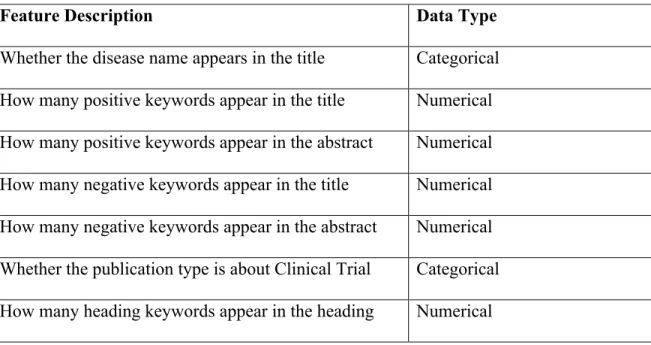
The heuristic approach is the starting point of re-ranking the retrieved result to enhance P@10. However, this approach is based on human efforts of reading and examining the results, and such method may not be robust. Therefore, apart from this approach, we aim to leverage the pointwise learning-to-rank idea and machine learning techniques to learn a ranker which can automatically tell whether a paper is relevant to the PM track or not. The feature of whether the disease term appears in the article title shows its usefulness above. Table IV lists query-document features and document-specific features used in the ranker. We choose high-level features instead of pure word features from the bag-of-words model because such features would be too sparse to have a good performance.
genetics, and etc. It is similar to keywords in other scientific papers but uses the MeSH thesaurus. We hypothesize that an article with certain headings should be more likely to be a relevant one.
The features of whether the disease term appears in the title and whether the publication type is clinical trial are categorical, i.e., 0 or 1, and all the other features are numerical because we simply count the term frequency of each keywords.
TABLE IV Features in the classifier
Feature Description Data Type
Whether the disease name appears in the title Categorical How many positive keywords appear in the title Numerical How many positive keywords appear in the abstract Numerical How many negative keywords appear in the title Numerical How many negative keywords appear in the abstract Numerical Whether the publication type is about Clinical Trial Categorical How many heading keywords appear in the heading Numerical
TABLE V
Positive, negative and heading keywords
Positive keywords treatment, survival, prognostic, clinical, prognosis, therapy, outcome, resistance, targets, therapeutic, immunotherapy
Heading keywords Humans, Mutation, genetics, drug therapy, metabolism, drug therapy, pharmacology, antagonists & inhibitors, drug effects, therapeutic use, immunology
The next step is to generate the positive keywords, negative keywords and heading keywords for counting. Oleynik et al. use the Latent Dirichlet Allocation (LDA) model to do Topic Modeling (TM) among the relevant articles and non-relevant articles to find positive and negative keywords which are strongly correlated to these two corpuses (Oleynik et al., 2018). Besides the LDA model, we also explore the simple TF-IDF weights of keywords in these two types of corpuses, and the heading keywords are generated in this way as well. These keywords are supposed to have the biggest
correlations to the certain corpus. The lists of positive, negative and heading keywords are shown in Table V above.
Ranker Construction
We train a Logistic Regression model to predict the probability that a document is relevant to the PM track. All the hyperparameter settings are as default in the Python scikit-learn11 library. For each retrieved article, the feature vector is generated based on the feature table above and the probability of a positive (relevant) label is predicted using the logistic regression model.
We use both the predicted probability of how relevant an article is to the PM track and the original BM25 score for re-ranking, as the experiment result confirms our
original BM25 score could be as large as 70, we should keep them at the same scale. Therefore, we do the min-max transformation on the original BM25 score and it is thus scaled to a number between 0 to 1, which makes it more reasonable to add the probability to the original score. Then for each article, a new score is generated by adding up the raw BM25 score and the probability from the classifier, finally the re-ranking is based on new scores.
However, in experiments we find that applying the reranker to all the 1000 results do not improve the precision, but hurt the performance instead. We suppose that it is because the positive instances in the training set merely come from past teams’ top retrieved results, which are much fewer than the negative instances. In other words, since there are 26.8 million articles in the corpus, it is impossible for people to manually label each document as relevant or non-relevant. Thus, the ad-hoc relevance judgement by experts are only applied on documents which rank at top in each team’s submitted results, which leads to a different distribution of instances in the training and testing set.
Therefore, instead of applying the reranker on all the 1000 retrieved documents to do re-ranking, we only re-rank the top 50 documents, after testing different top K documents to re-rank by optimizing P@10 on the 2017 topics.
EXPERIMENT
In this section, we discuss the performances of different retrieval strategies and methods. We first introduce the dataset which is used in this paper, and then show how a query is generated for each topic. We then compare retrieval performances in the result section followed by three case studies and some other approaches which fail to show improvements but may work in the future.
Dataset Overview
As is discussed in previous sections, we use the dataset which consists of 26.8 million MEDLINE articles and 70,026 ASCO/AACR conference articles as corpus, and all these articles only contain the abstract part instead of the full text which is referred to as the content field in this paper. The indexing process takes about 8 hours on a research computing node with 16 core CPU and 100 gigabytes RAM, and the file size of indexes is about 18 gigabytes.
There are 30 topics in the 2017 track and 50 topics in the 2018 track, both are in the XML format and each node represents a patient with disease, gene and demographic information (see Figure II).
Query Structure
For each topic, we generate the query using the disease and gene information, and the demographic information is not used in this paper. After these two fields are
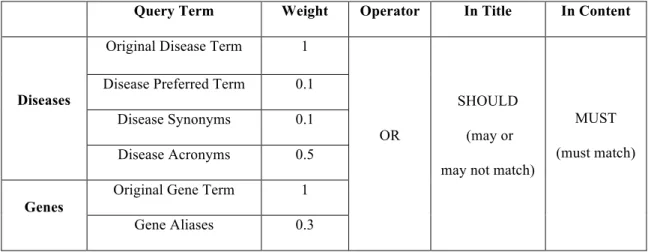
expanded in knowledge bases, weights are assigned to each term. We use the OR operator between all the terms, because it is impossible for a paper to contain all the query terms after expansion. We use the SHOULD operator for the title field and the MUST operator for the content field, which means it is not required for a document to match the query in its title but required to match the query in its content.
Result and Implications
Our final query structure and weights for each expansion part are shown in Table VI. We keep weights of the original disease and gene terms always as 1, and we set weights of all the expansion terms to 0.3 initially. To optimize Recall@1000, we control the weight of other expansion terms in the query as the same and tune one part to an optimized recall.
The final weights are in accord with our expectations. A disease has 3 or 4
acronyms is 0.5 because it is highly related or even equivalent to the original disease. The weight for gene aliases is fairly 0.3.
TABLE VI
Weights for each term which optimizes R@1000
Query Term Weight Operator In Title In Content
Diseases
Original Disease Term 1
OR
SHOULD
(may or
may not match)
MUST
(must match) Disease Preferred Term 0.1
Disease Synonyms 0.1
Disease Acronyms 0.5
Genes
Original Gene Term 1
Gene Aliases 0.3
TABLE VII
Comparison between retrieval strategies
Retrieval Strategy R@1000 P@10 R-precision
Baseline 0.686 0.544 0.317
Retrieval I 0.695 0.554 0.299
Retrieval II 0.702 0.568 0.320
Retrieval III 0.702 0.618 0.322
Retrieval IV 0.702 0.646 0.336
hpi-dhc - 0.7060 0.3658
Cat Garfield - 0.6680 0.3257
The comparison between different retrieval strategies is shown in Table VII. We run five retrievals in total and we describe the settings for each retrieval below. To be more specific, Retrieval I & II are used to test the hypothesis that query expansion is useful, and these two retrievals are different in the structure of expansion terms. And based on Retrieval II which optimizes Recall@1000, Retrieval III & IV are used to test the hypothesis that ranking is effective, and these two retrievals are different in the re-ranking method, with the heuristic and learning-to-rank approach separately. In Baseline
and Retrieval I & II & III & IV strategies, a same setting is used that terms are connected using the OR operator, and the operators for the title and content field are SHOULD and MUST separately.
Baseline: This serves as the most basic strategy in our approaches. In this retrieval, we use only the original disease and gene terms in the topic without query expansion and re-ranking.
Retrieval I: In this retrieval, the disease term is expanded to its preferred term and synonyms, and the gene term is expanded to its aliases, with weights assigned shown in Table VI.
Retrieval II: Compared to previous retrieval, acronyms of diseases are added into the expansion terms, with weights assigned shown in Table VI.
Retrieval III: Compared to Retrieval II, the re-ranking step is added after the first retrieval with the heuristic approach.
In summary, Retrieval I & II prove that adding expansion terms into the original query for diseases and genes is helpful, as they improve Recall@1000 from 0.686 to 0.695 and 0.702 separately, which means more potentially relevant documents are being matched because of these expansion terms. The higher recall in Retrieval II over that in
Retrieval I illustrates that acronyms are important in expansion. Also, with a wise
selection of weight parameters in the query expansion step, P@10 is not hurt and, instead, improved from 0.544 to 0.554 and 0.568 separately. This result supports that high-quality expansion terms could help to improve both recall and precision.
Based on Retrieval II which optimized Recall@1000, Retrieval III & IV prove that the re-ranking step improves precision by pushing the most relevant documents to the top. Retrieval III shows that the heuristic approach which penalizes documents without disease term in the title already works well, as P@10 increases from 0.568 to 0.618, considering its simplicity. Retrieval IV proves that a Logistic Regression reranker further helps to improve the precision, as the precision is 0.1 higher than the baseline approach and 0.026 higher than the heuristic approach.
both query expansion and re-ranking. Also, they train a CNN classifier for re-ranking, which is more complicated but has a better performance than our linear classifier (Zhou, Chen, Song, Zhao, & Wu, 2018). Unfortunately, team SIBTextMinining does not provide a report of their work. It is highlighted that with query expansion in a publicly available knowledge base and a linear classifier for re-ranking, the Precision@10 in this paper already ranks at the third place among all the teams.
Case Studies
To further demonstrate how query expansion and re-ranking help to improve the retrieval performance clearly, in this section we present case studies with examples to illustrate how these two steps enhance retrieval in Case I & II. We also give an error analysis case to discuss why our retrieval architecture fails to handle some tough and ambiguous situations in Case III. Considering the length of full texts, we only provide snippets in this section and full abstracts could be found at Appendix A.
Case I: The contribution of query expansion.
As is discussed in previous sections, the motivation of query expansion is to enrich query information by adding into the query alternative or relevant terms of the original keywords, and it is expected to match some potentially relevant documents which do not contain those original keywords. Hereby we show the contribution of query expansion with an article which is not retrieved in the baseline model but is retrieved after the query expansion technique is used.
(PubMed ID: 14981584) which is relevant to this topic. It demonstrates how expanding disease and gene terms helps to retrieve more relevant documents.
FIGURE III A query topic example
“Title: The role of HER2/neu expression and trastuzumab in non-small cell lung cancer.
Abstract: … The HER2/neu receptor… HER2/neu is overexpressed in 16% to 57% of patients with non-small cell lung cancer (NSCLC) and studies have shown that HER2/neu overexpression imparts a poor prognosis in both resected and advanced NSCLC, as it does in … the HER2/neu protein receptor, has been … with HER2/neu-positive metastatic breast cancer. In NSCLC preclinical studies, marked synergistic … in HER2/neu-expressing cell lines. However, to date, clinical studies with trastuzumab in patients with NSCLC have not shown a demonstrable advantage ... ”
low term frequency of the disease term lung cancer. By query expansion, recall@1000 for this topic is thus improved from 0.19 in the baseline approach to 0.48.
Case II: The contribution of re-ranking.
As is discussed in previous sections, the motivation of re-ranking is to push a relevant document with a low raw score and low ranking to the top, and also to lower the rankings of non-relevant documents. It is expected to increase precision at the top, e.g., Precision@10 used in this paper. In this case, we show the contribution of the re-ranking step with one example that is not in the top 10 results initially but does appear in the top 10 list after re-ranking, and with another example which is punished to a rank after 10. We use the same topic as in the previous case, i.e., lung cancer and the ERBB2 gene. It shall be highlighted that the original Precision@10 for topic No.36 is 0.2, and the new Precision@10 for this topic is increased to 0.5 after re-ranking.
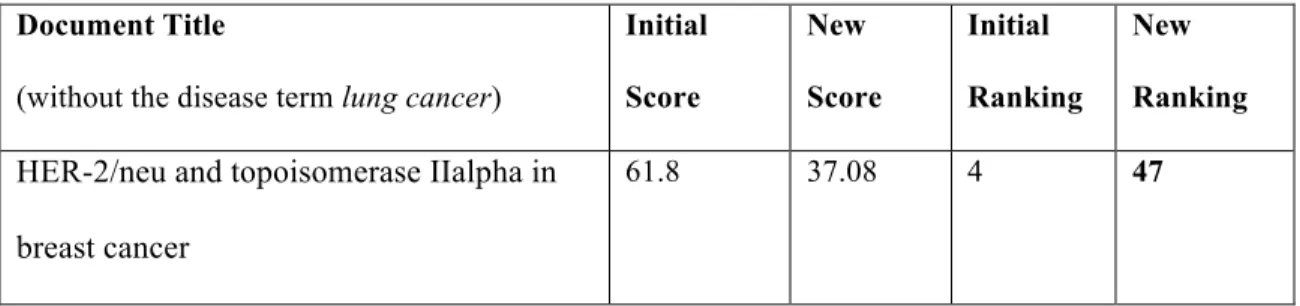
In the re-ranking section, we propose two methods which are a heuristic approach and a learning-to-rank approach, and examples are given for both methods. We first show how the heuristic approach decreases scores of non-relevant documents which do not mention the disease term in the title. There are 8 non-relevant documents in the initial top 10 list, and none of them appears in the new list after re-ranking. For the sake of simplicity, we give only one example below (see table VIII).
TABLE VIII
An example of punishing non-relevant documents
Document Title
(without the disease term lung cancer)
Initial Score New Score Initial Ranking New Ranking
HER-2/neu and topoisomerase IIalpha in breast cancer
As is shown in the table, a top-ranking article (PubMed ID: 12755489) is now going down to 47 although it ranks as high as 4 initially, because the topic disease lung cancer does not appear in its title.
It is not hard to tell from the title that this article is not about lung cancer at all, it should all about breast cancer instead. But why could this obviously non-relevant article be retrieved? From the snippet of its abstract below, it is revealed that the high-ranking raw score purely comes from the extremely high term frequency of the gene HER-2/neu. Simple as the heuristic approach is, it still helps to refine the top results.
“Abstract: … The HER-2 (also known as ErbB2/c-erbB2/HER-2/neu)
oncogene is the most frequently … HER-2 is also a target for … HER-2 receptor.
HER-2 has also been implicated … by the HER-2 … of the HER-2 amplified primary breast tumors … of HER-2 amplification also ... HER-2 is an oncogene that … other than HER-2, such as … HER-2 status still … importance of HER-2 … ”
The heuristic approach proves its usefulness in punishing non-relevant documents above, and we give another example of how a relevant document (PubMed ID:
15312350) is boosted to top 10 after re-ranking using the learning-to-rank approach. As is shown below, this document is not punished because it mentions the topic disease lung cancer in its title. Also, from the snippet of its abstract, we could see that it is boosted because of the high term frequency of positive keywords prognostic and survival in both its title and content, which indicates that this paper focus on treatments and is in accord with the PM track. Its actual rankings go with our expectations: its raw score ranks at 16; its probability ranks at 6 and its final score after adding two up ranks at 7.
Abstract: To evaluate the prognostic value of expression of fatty acid synthase (FASE), …. The 5-year survival rate was lower in HER-2/neu and FASE positive patients than in negative patients, which showed that HER-2/neu and FASE expression were associated with significantly poor survival … with a 5-year
survival rate of 78.2% … prognostic factors for survival. HER-2/neu and FASE are independent prognostic factor in stage I non-small cell lung cancer …”
Case III: Error analysis
Although retrieval results in two previous sections have proven that both query expansion and re-ranking are useful in improving the retrieval performance, there are two situations that our proposed retrieval architecture fail to handle. One is that a non-relevant document is retrieved and ranked among the top 10 list, and another is that a relevant document is not retrieved or does not rank in the top 10 list, which could be recognized as cases of false positive and false negative, respectively. Hereby we do an error analysis of these two situations with two examples, from which we investigate the flaw of our retrieval architecture for future improvements. And we still use topic No.36 which is about lung cancer and the ERBB2 gene as above.
that it focuses on predicting cancer patients’ survival rather than developing or evaluating cancer treatments. This makes it non-relevant to the central goal of PM track.
“ Title: HER-2/neu oncogene and estrogen receptor expression in non small cell lung cancer patients
Abstract: ... The prognosis is usually … parameters and clinical stage, but additional prognosticsurvival factors … of HER-2/neu and estrogen receptors in nonsmall cell lung cancers and their relation to survival of patients with non-small cell lung cancers and to traditional prognostic factors … resected patient tissues of non-small cell lung cancers, and the following parameters were examined: HER-2/neu and estrogen receptor expression, as well as the related
clinical and pathological features … Our findings indicate that the expression of
HER-2/neu … the survival of patients with non-small cell lung cancers.
Apart from the false positive situation, we give another example of the false negative cases, which means that the document below (PubMed ID: 11153605) is relevant to the topic but does not rank among the final top 10 results. Its raw score ranks at 9, which is much higher than the non-relevant document above. It is not only because the high term frequency of disease and gene terms, but more importantly, the gene mentioned in this paper is the original term ERBB2, which has a higher weight than the expansion term HER-2/neu, i.e., the weight 1 comparing to the weight 0.3. However, it ranks at 14 if sorted by the probability from the reranker, for there are only 3 positive keywords and also two negative keywords case. Therefore, after adding the raw score and the probability up, this article ranks at 13 in the final result. We hypothesize that the selection of negative keywords.
“ Title: Ploidy, expression of erbB1, erbB2, P53 and amplification of erbB1,
erbB2 and erbB3 in non-small cell lung cancer.
Abstract: … assess the prognostic value of … erbB2 … in non-small cell lung cancer (NSCLC). Consecutive patients with NSCLC who underwent
expression … stage … erbB2 … not prognostic parameters in non-small cell lung cancer ..”
From these two errors, together with the retrieval compassion in Table VII, we can see that although adding the probability helps to improve precision, it could still make mistakes, especially when a non-relevant document has more positive keywords, or a relevant document has more negative keywords. This implies that the features of simply counting positive or negative keywords in title or abstract are not robust or may not work in some cases. Also, these two errors also suggest that simply adding the raw BM25 score and the probability may not work, as we can see the non-relevant document ranks higher largely because of its high probability, and the relevant document ranks lower because of low probability. Therefore, a more reasonable weighting should be investigated.
Other Trails
Apart from the retrievals discussed above which give the expected performances, we also try other approaches both in the query expansion step and the re-ranking step. Unfortunately, all these approaches do not show improvements of the retrieval result, some of which even lead to a worse performance than the baseline approach. Hereby we present these trials with the intuition behind and error analysis, which could be used for future work references.
these low-quality expansion terms shows that R@1000 is slightly improved and P@10 is hurt because all the disease expansion terms contain almost same words, which lead to an implicit boost of these duplicate words and shift the focus of the original query. Even though we remove duplicate words in the expanded query by using unique terms, the result still shows that R@1000 is still slightly improved. Therefore, we choose the Lexigram knowledge base for query expansion.
Trail II: We add parent, children and siblings of a disease as expansion terms when using the MeSH knowledge base, for MeSH is an ontology in a tree structure. We hypothesize that some relevant articles may not talk about the disease, but about the parent of the disease in the tree which are broader or the children which are more specific. We even consider the siblings of a disease in the tree structure. However, even we do a lot of work on parameter tuning, the results show that adding these expansion terms hurts both R@1000 and P@10. It is probably because these expansion terms are too broad or specific to be relevant, which adds noises to the query. We then hypothesize that the presence of parent, children or sibling diseases could be feature in re-ranking, and we generate the feature by counting how many these terms occur in the text. However, the result proves that the reranker without this feature works better. After reading about 30 relevant articles, we found only 2 of them contain these parent or children disease terms.
re-ranking part. However, the results show that both P@10 are not improved, and because of the strict criterion, there are much fewer results retrieved.
Trail IV: We boost the title field with weight 2, comparing to the content field having weight 1 without boosting. We hypothesize that the title field should be more important than the content filed, with the intuition that if an article mentions the disease or gene terms in the title, it might be more relevant to the topic. However, the results show that it hurts both R@1000 and P@10. When reading some articles in the corpus, we find some irrelevant articles also contain the disease or gene terms in the title, and these irrelevant articles are pushed to the top after we boost the title field.
Trail V: We return the abstract text in the retrieved result and then use the Pubtator15 application to do Named Entity Recognition in text to recognize disease and gene terms. Inspired by the bag-of-words model, we use the bag-of-concepts model along with the PRF method to do re-ranking by running a query in the retrieved articles. The vector space model and the TF-IDF weighting representation of concepts are used in this step.
adding them up. Although we spend a lot of time tuning these parameters, the optimal results in this strategy are still not as good as expected, which shows only a slight improvement of P@10.
Trail VI: We add positive and negative keywords in the query and give these terms a boost or a penalty. We hypothesize that articles which focus on treatment, clinical study and patients should be more relevant that articles which focus on laboratory
experiments. Therefore, we added some keywords suggest by Oleynik et al. (2018) into the query to boost documents with positive keywords and penalize documents with negative keywords. However, Lucene does not support negative boost for a query term. Therefore, we use these keywords as our features to train the Logistic Regression classifier in the re-ranking step.
Trail VII: We leverage the disease-gene connections for query expansion and add other variations of a gene. Although the Lexigram knowledge base and the gene database has proved that it works well in the query expansion step and provide comprehensive expansion terms, the expansion is still based on the disease or gene itself. In other words, we are still starting from a disease or a gene and investigating what relevant terms are, e.g., preferred terms and synonyms.
to a matrix of diseases and genes with each element in the matrix representing the
probability that a gene and a disease are correlated. Thus, each disease and gene could be represented by a vector and pairwise cosine similarities between vectors could be
calculated.
Given a disease or a gene, the relevant terms are generated by sorting the similarities in a descending order. Then we add the top K relevant terms in the query as expansion terms. However, the results show that it does not help to improve R@1000. After examining the expansion terms, we find most expansion terms generated which even rank at the top 5 still have poor similarities, which means they share few diseases or genes information in common. We view this as a potential approach to generate
CONCLUSION
Medical literature search has long been suffering from the problems of vocabulary mismatch between queries and documents and ineffective ranking methods as well, which makes the traditional Boolean retrieval deliver both low recall and precision. In this paper, we use external knowledge bases in the medical domain to expand the query automatically, which enriches the information in the original query without manual input. This helps the query to match documents without terms from the original query. After the first retrieval, we use a ranker which is trained on the 2017 track topics to predict the probability of how relevant the retrieved document is. Then the retrieved results are ranked by the probability. The experiment results prove that both these two steps help to improve the retrieval performance, and the final model outperforms the baseline model in both recall and precision. The future work could be in the directions discussed below.
Secondly, since the reranker is trained on the 2017 topics, it could be trained again on both 2017 and 2018 topics together when it is applied to the 2019 PM track. With more training data and better feature generation and selection, we expect the
reranker to have a better performance and avoid mistakes in the case study section, which is expected to improve the precision further. Also, in training the reranker we are on the level of the whole corpus, and predicting whether an article is relevant to the general PM track rather than to the topic. We hypothesize that there are some features representing the connection between the article and the topic, which makes the classification more specific to each topic. And the case study of error analysis reminds us that the new scoring schema is also a direction of improvement, which could be changed from simply adding the probability and the raw BM25 score to a weighted sum because either the raw score or the probability may be more important than another, or merging two ranks could also work.
Third, as there are both gene and disease information in the topics, we could leverage the connections between diseases and genes (e.g. how strongly a disease and a gene are connected to each other) for relevance judgement by using a knowledge graph. This is a failed trial in this paper, but it still gives us some inspirations.
NOTES
1. https://www.ncbi.nlm.nih.gov/pubmed/ 2. https://en.wikipedia.org/wiki/PubMed 3. https://en.wikipedia.org/wiki/BRAF_(gene) 4. http://lucene.apache.org/
5. https://en.wikipedia.org/wiki/Okapi_BM25 6. https://www.wikipedia.org/
7. https://wiki.dbpedia.org/
8. https://www.ncbi.nlm.nih.gov/mesh 9. https://www.lexigram.io/
10. ftp://ftp.ncbi.nlm.nih.gov/gene/DATA/ 11. https://scikit-learn.org/
12. https://www.orpha.net/consor/cgi-bin/index.php 13. http://disease-ontology.org/
14. https://www.wikidata.org/wiki/Wikidata:Main_Page
APPENDIX A: Full Text of Articles
Case I: A paper which is retrieved after query expansion
PubMed ID: 14981584
Title: The role of HER2/neu expression and trastuzumab in non-small cell lung cancer Abstract: Research over the past decade has led to an increased understanding of the pathophysiology of lung cancer. The HER2/neu receptor is a member of the ErbB family of signaling-transduction receptors and appears to play a major role in the development of lung cancer as well as many other solid tumors. HER2/neu is overexpressed in 16% to 57% of patients with non-small cell lung cancer (NSCLC) and studies have shown that HER2/neu overexpression imparts a poor prognosis in both resected and advanced NSCLC, as it does in breast cancer. Trastuzumab, a humanized monoclonal antibody that recognizes the HER2/neu protein receptor, has been approved by the US Food and Drug Administration for patients with HER2/neu-positive metastatic breast cancer. In NSCLC preclinical studies, marked synergistic growth inhibition occurred when standard
cytotoxic chemotherapy was combined with trastuzumab in HER2/neu-expressing cell lines. In the clinical setting, trastuzumab has proven safe and feasible in combination with cytotoxic chemotherapy in both single-institution and multi-institutional cooperative group studies. Unlike the experience in advanced breast cancer, cardiac toxicity is a marginal concern in this population. However, to date, clinical studies with trastuzumab in patients with NSCLC have not shown a demonstrable advantage for the majority of patients.
Case II: A non-relevant paper which is punished in re-ranking
PubMed ID: 12755489
Title: HER-2/neu and topoisomerase IIalpha in breast cancer
breast cancer cells to different forms of conventional cytotoxic chemotherapy, particularly of topoII-inhibitors (e.g., anthracyclines). Topoisomerase IIalpha gene is located just by the HER-2 oncogene at the chromosome 17q12-q21 and is amplified or deleted in almost 90% of the HER-2 amplified primary breast tumors. Recent data suggests that amplification and deletion of topoisomerase IIalpha may account for both relative chemosensitivity and resistance to anthracycline therapy, depending on the specific genetic defect at the topoIIalpha locus. Expanding our understanding of HER-2 amplification also changes its role in the pathogenesis of breast cancer. HER-2 is an oncogene that clearly can drive tumor induction and growth and is also a target for a new kind of chemotherapy, but its function as a marker for chemoselection may be due to associated genetic changes, of which topoisomerase IIalpha is a good example.
Moreover, despite potential evidence that genes other than HER-2, such as topoisomerase IIalpha, may be more important predictors of therapeutic response in breast cancer, HER-2 status still has a very significant role in therapeutic selection, mainly as the major criterion for administering trastuzumab in treating breast cancer. Thus, the clinical and therapeutic importance of the HER-2 and topoisomerase IIalpha status to breast cancer management should only increase in the next few years.
Case II: A relevant paper which is boosted in re-ranking
PubMed ID: 12755489
Title: Prognostic value of expression of FASE, HER-2/neu, bcl-2 and p53 in stage I non-small cell lung cancer
Abstract: To evaluate the prognostic value of expression of fatty acid synthase (FASE), HER-2/neu, bcl-2 and p53 in stage I non-small cell lung cancer (NSCLC). Expression of FASE, HER-2/neu, bcl-2 and p53 protein was detected by immunohistochemical staining in 84 patients with stage I NSCLC who underwent surgery. Multiple clinical parameters and survival were analyzed. The expression of FASE, HER-2/neu, bcl-2 and p53 was 29.8%, 40.5%, 33.3% and 39.3%, respectively. The local recurrence and bone-metastasis rate were higher in FASE positive patients than in negative patients (28.0% vs 10.2%, P = 0.05; 61.5% vs 23.9%, P = 0.017, respectively). The 5-year survival rate was lower in HER-2/neu and FASE positive patients than in negative patients (37.7% vs 67.7%, P = 0.0083; 35.1% vs 66.1%, P = 0.0079, respectively), which showed that HER-2/neu and FASE expression were associated with significantly poor survival. Patients whose tumors were both HER-2/neu and FASE negative had better outcome, with a 5-year survival rate of 78.2%, compared with 36.3% in those whose tumors were positive for either one (P = 0.002). However, bcl-2 and p53 were not independent prognostic factors for survival. HER-2/neu and FASE are independent prognostic factor in stage I non-small cell lung cancer patients who expressed one or both markers.
Case III: A non-relevant paper which ranks among top 10
Title: HER-2/neu oncogene and estrogen receptor expression in non small cell lung cancer patients.
Abstract: Non-small cell lung cancers are among the leading causes of cancer morbidity and mortality worldwide. The prognosis is usually based on traditional pathohistological parameters and clinical stage, but additional prognostic survival factors have also been sought. The aim of this retrospective study was to explore the membranous expression of HER-2/neu and estrogen receptors in nonsmall cell lung cancers and their relation to survival of patients with non-small cell lung cancers and to traditional prognostic factors. The sample consisted of 132 consecutive, surgically resected patient tissues of non-small cell lung cancers, and the following parameters were examined: HER-2/neu and estrogen receptor expression, as well as the related clinical and pathological features: tumor, nodes, and metastases stage, level of tumor necrosis, histological and nuclear grade, lymphocytic infiltrate, and number of mitoses. HER-2/neu was positive in 28.8% of tumor samples, and estrogen receptor expression was positive in 29.5% of tumors, but neither was significantly associated with the outcome of non-small cell lung cancers. There was a significant association between HER-2/neu and nuclear grade (P=0.01). In addition, the association between estrogen receptor expression and histological type of tumor (P=0.04) and mitotic rate (P=0.008) was found. Kaplan-Meier analysis showed a significant association of patients' overall survival with the tumor node metastasis stage (P<0.001) and the degree of tumor necrosis (P=0.02). Cox proportional hazard regression analysis showed that male gender (P=0.01), histological type (P=0.03), high degree of necrosis (P=0.006), and higher histological grade (P=0.037) were associated with the patients' survival. Our findings indicate that the expression of HER-2/neu and estrogen receptor is less reliable than traditional histological parameters in predicting the survival of patients with non-small cell lung cancers.
Case III: A relevant paper which does not rank among top 10
PubMed ID: 11153605
Title: Ploidy, expression of erbB1, erbB2, P53 and amplification of erbB1, erbB2 and erbB3 in non-small cell lung cancer.
REFERENCES
Ashley, E. A. (2015). The precision medicine initiative: a new national effort. Jama, 313(21), 2119-2120.
Collins, F. S., & Varmus, H. (2015). A new initiative on precision medicine. New England Journal of Medicine, 372(9), 793-795.
Goeuriot, L., Bedrick, S., Jones, G. J., Krithara, A., Müller, H., & Paliouras, G. (2017, February). Report on the SIGIR 2016 Workshop on Medical Information Retrieval (MedIR). In ACM SIGIR Forum (Vol. 50, No. 2, pp. 76-81). ACM.
Griffon, N., Chebil, W., Rollin, L., Kerdelhue, G., Thirion, B., Gehanno, J. F., & Darmoni, S. J. (2012). Performance evaluation of unified medical language system®'s synonyms expansion to query PubMed. BMC medical informatics and decision making, 12(1), 12.
Hudson, K., Lifton, R., & Patrick-Lake, B. (2015). The precision medicine initiative cohort program—Building a Research Foundation for 21st Century
Jalali, V., & Borujerdi, M. R. M. (2008, December). The effect of using domain specific ontologies in query expansion in medical field. In 2008 International Conference on Innovations in Information Technology (pp. 277-281). IEEE.
Koopman, B., Zuccon, G., Bruza, P., Sitbon, L., & Lawley, M. (2016). Information retrieval as semantic inference: a Graph Inference model applied to medical search. Information Retrieval Journal, 19(1-2), 6-37.
Liu, J., Kronk, C., Su, W. C., Wu, D. T., & Vydiswaran, V. V. (2018). Retrieving
scientific abstracts iteratively: MedIER at TREC 2018 Precision Medicine Track. Unpublished manuscript.
Liu, T. Y. (2009). Learning to rank for information retrieval. Foundations and Trends® in Information Retrieval, 3(3), 225-331.
Lu, Z. (2011). PubMed and beyond: a survey of web tools for searching biomedical literature. Database, 2011.
Mao, J., Lu, K., Mu, X., & Li, G. (2015). Mining document, concept, and term associations for effective biomedical retrieval: Introducing mesh-enhanced retrieval models. Information Retrieval Journal, 18(5), 413-444.
Martinez, D., Otegi, A., Soroa, A., & Agirre, E. (2014). Improving search over Electronic Health Records using UMLS-based query expansion through random walks. Journal of biomedical informatics, 51, 100-106.
Mirnezami, R., Nicholson, J., & Darzi, A. (2012). Preparing for precision medicine. New England Journal of Medicine, 366(6), 489-491.
Mitra, M., Singhal, A., & Buckley, C. (1998, August). Improving automatic query expansion. In SIGIR (Vol. 98, pp. 206-214).
Musen, M. A., Middleton, B., & Greenes, R. A. (2014). Clinical decision-support systems. In Biomedical informatics (pp. 643-674). Springer, London.
Oleynik, M., Faessler, E., Sasso, A.M., Kappattanavar, A., Bergner, B., Cruz, H.F. Sachs, J.P., Datta, S., & Bottinger, E. (2018) HPI-DHC at TREC 2018 Precision
Medicine Track. Unpublished manuscript.
Poikonen, T., & Vakkari, P. (2009). Lay persons' and professionals' nutrition-related vocabularies and their matching to a general and a specific thesaurus. Journal of Information Science, 35(2), 232-243
Qin, T., Liu, T. Y., Xu, J., & Li, H. (2010). LETOR: A benchmark collection for research on learning to rank for information retrieval. Information Retrieval, 13(4), 346-374.
Rocchio, J. J. (1971). Relevance feedback in information retrieval. The SMART retrieval system: experiments in automatic document processing, 313-323.
Steinbrook, R. (2006). Searching for the right search—reaching the medical literature. New England Journal of Medicine, 354(1), 4-7.
Wang, Y., Wen, A., Liu, S., & Liu, H. (2018). MayoNLPTeam at the TREC 2018 Precision Medicine Track: Simple Information Retrieval Approach Is the Best. Unpublished manuscript.
Zheng, Z., Li, C., He, B. & Xu, J. (2018) UCAS at TREC-2018 Precision Medicine Track. Unpublished manuscript.