Dye-sensitized electron transfer from TiO
2
to
oxidized triphenylamines that follows
fi
rst-order
kinetics
Brian N. DiMarco, Ludovic Troian-Gautier, Renato N. Sampaio and Gerald J. Meyer *
Two sensitizers, [Ru(bpy)2(dcb)]2+(RuC) and [Ru(bpy)2(dpb)]2+(RuP), where bpy is 2,20-bipyridine, dcb is 4,40-dicarboxylic acid-2,20-bipyridine and dpb is 4,40-diphosphonic acid-2,20-bipyridine, were anchored to mesoporous TiO2 thinfilms and utilized to sensitize the reaction of TiO2 electrons with oxidized triphenylamines, TiO2(e) + TPA+/TiO2+ TPA, to visible light in CH3CN electrolytes. A family of four symmetrically substituted triphenylamines (TPAs) with formal Eo(TPA+/0) reduction potentials that spanned a 0.5 eV range was investigated. Surprisingly, the reaction followedfirst-order kinetics for two TPAs that provided the largest thermodynamic driving force. Suchfirst-order reactivity indicates a strong Coulombic interaction between TPA+and TiO2that enables the injected electron to tunnel back in one concerted step. The kinetics for the other TPA derivatives were non-exponential and were modelled with the Kohlrausch–William–Watts (KWW) function. A Perrin-like reaction sphere model is proposed to rationalize the kinetic data. The activation energies were the same for all of the TPAs, within experimental error. The average rate constants were found to increase with the thermodynamic driving force, consistent with electron transfer in the Marcus normal region.
Introduction
Motivation for the study of electron transfer reactions at semi-conductor interfaces originates from both applications and the need to enhance fundamental knowledge.1–3 In dye-sensitized
solar cells (DSSCs), mesoporous thin lms of anatase TiO2
nanocrystallites are functionalized with molecular chromo-phores, or “sensitizers”, that extend the spectral response of these materials into the visible region. In the accepted mecha-nism for power generation with DSSCs, light absorption induces electron“injection”from the sensitizer's excited state to the metal oxide acceptor states.4 A donor present in the
electrolyte solution then reduces the oxidized sensitizer, a process oen termed “dye regeneration”.5 Competition
between the collection of the injected electron and back elec-tron transfer, or “charge recombination”, to the oxidized sensitizer or the oxidized donor oen lowers the efficiency of DSSCs. This paper seeks to better understand the unwanted charge recombination reaction of the injected electrons with the oxidized donor through the use of four symmetrically substituted triphenylamines whose formal reduction potentials span a range of 0.5 eV (Scheme 1).
When compared to the wealth of literature reports focused on electron transfer from TiO2to the oxidized sensitizer, there
are a remarkably small number of systematic studies that seek to understand the factors that inuence charge recombination to oxidized donors present in the electrolyte.6–13This is likely
Scheme 1 Mechanism for the photoinitiation of the desired reaction. Visible light absorption by the ruthenium sensitizer induced rapid excited-state electron injection to the acceptor state of TiO2,kinj> 108 s1. The oxidized sensitizer is then regenerated by triphenylamine (TPA) with a rate constantkreg. This sequence provides the reactants for the desired charge recombination reaction of the injected electron with the oxidized triphenylamine redox mediator (krec) that was quantified over a 0.5 eV change in driving force.
Department of Chemistry, University of North Carolina at Chapel Hill, Chapel Hill, North Carolina, 27599-3290, USA. E-mail: [email protected]
Cite this:Chem. Sci., 2018,9, 940
Received 1st September 2017 Accepted 16th November 2017
DOI: 10.1039/c7sc03839a
rsc.li/chemical-science
Science
EDGE ARTICLE
Open Access Article. Published on 17 November 2017. Downloaded on 29/03/2018 11:23:07.
This article is licensed under a
Creative Commons Attribution-NonCommercial 3.0 Unported Licence.
View Article Online
due to the dominance of I/I3 as the prototypical redox
mediator employed in DSSCs that is not easily amenable to systematic studies.14,15 However, alternative redox mediators,
such as Co(III/II) polypyridyl complexes,16–23triphenylamine or
phenothiazine,24,25 have provided new opportunities to gain
fundamental information on how sensitive charge recombina-tion is to the electrolyte composirecombina-tion,6,26molecular structure,12,27
or the thermodynamic driving force.7–9
The inuence of the reaction driving force on recombination has been previously studied by several groups7,8,10,28and data
consistent with the Marcus normal kinetic region has been re-ported.29,30 Recall that in the Marcus normal region the total
reorganization energylfor electron transfer is greater than the absolute value of the Gibbs free energy change,l> |DG|. Under normal conditions, an increase in the driving force results in an increase in the rate of electron transfer. In a study of recombi-nation to a series of substituted ferroceniums, Huppet al.noted that normal region behavior was peculiar given the small reor-ganization energies and the large reaction driving forces8that
should have placed the reaction in the Marcus inverted region,l > |DG|. Hamannet al. have suggested that electron transfer from different electronic states in TiO2 may mask inverted
behavior similar to the case for metallic donors.31 Further
complicating the analysis is the considerable literature that indicates that the observed rate constants abstracted from transient spectroscopic and/or electrochemical data report mainly on the diffusion of the injected TiO2 electron and/or
acceptor.32–38It is possible that diffusion does rate limit
inter-facial electron transfer in some cases, however this does not explain the reported driving force dependencies or the recent observation of specic interfacial electron transfer pathways at sensitized TiO2interfaces.39,40
Nevertheless, an experimental challenge is to abstract the actual interfacial electron transfer rate constant from the tran-sient data that are usually highly non-exponential.32,33,41Atting
function that has been phenomenally successful is the so-called
Kohlrausch–Williams–Watts (KWW) function that was
proposed empirically by Kohlrausch, and later popularized by Williams and Watts.42This function wasrst derived by Scher
and Montroll based on a random walk model and has since become a paradigm for charge transport in disordered media.43
In particular the work of Nelson and coworkers has extended the KWW model to the trapping/detrapping electron transport in dye sensitized mesoporous TiO2 thin lms that are
commonly used in DSSCs.32,37,44–46 It should be emphasized,
however, that a quality t to the KWW function does not necessarily indicate that an underlying transport mechanism is operative. For example, Anderson has derived the KWW func-tion based on serially linked rate constants that are not neces-sarily associated with charge transport in disordered solids.47
In this study, a series of four symmetrically substituted tri-phenylamines (TPAs) were utilized to establish a correlation between the reaction kinetics and driving force, Fig. 1. The TPA molecules were substituted at the para-position of each phenyl ring with electron donating/withdrawing functional groups that allowed the TPA+/0reduction potential to be varied by0.5 V. A keynding was that the interfacial electron transfer became
rst-order when the reaction driving force was large. Such rst-order behavior has not been previously reported and was maintained for the two different ruthenium sensitizers as well as the two different acetonitrile electrolytes. A Perrin-like model is proposed to rationalize this kinetic behavior. Additionally, an increase in driving force resulted in an increase in the rate of interfacial electron transfer, consistent with the reaction occurring in the Marcus normal region.
Results
Mesoporous nanocrystalline TiO2thinlms were sensitized to
visible light with [Ru(bpy)2(dcb)]2+ (RuC) or [Ru(bpy)2(dpb)]2+
(RuP) (bpy¼2,20-bipyridine, dcb ¼4,40-dicarboxylic acid-2,20 -bipyridine and dpb¼4,40-diphosphonic acid-2,20-bipyridine) by immersion into concentrated sensitizer CH3CN solutions.
Theselms were soaked for a minimum of 24 hours to ensure that saturation surface coverages (108 mol cm2) were ob-tained, as determined by a previously reported spectral method.48 The sensitized lms, abbreviated TiO
2|RuC and
TiO2|RuP, immersed in neat acetonitrile displayed a broad
absorption band in the visible region characteristic of a metal-to-ligand charge transfer (MLCT) feature. A bathochromic shiof the absorption spectrum was observed upon the addi-tion of 0.1 M NaClO4 or LiClO4 to the acetonitrile that
sur-rounded the thinlm. Such spectral shis have previously been assigned to a change in the local electric eld upon cation adsorption to the TiO2surface.6,49,50 The TPAs did not
appre-ciably absorb visible light in their neutral forms, however the one electron oxidized forms exhibited strong absorption between 600–800 nm, Fig. 2b. The peak position and the molar absorption coefficient for these absorbances are reported in Table 1.
The TPA+/0reduction potentials were determined by cyclic voltammetry in 0.1 M NaClO4acetonitrile, Fig. 2a. The half-wave
potentials were taken as an estimate for the formal reduction potentials that varied between 0.72 V (MeO-TPA) and 1.25 Vvs. NHE (Br-TPA), Table 1.
Nanosecond transient absorption spectroscopy was used to quantify the recombination reaction. Experiments were per-formed in 0.1 M NaClO4 acetonitrile electrolyte for TiO2|RuC
and in 0.1 M LiClO4acetonitrile electrolyte for TiO2|RuP. The
Fig. 1 Ruthenium sensitizers (RuP and RuC) and triphenylamines (TPAs) used in this study.
Open Access Article. Published on 17 November 2017. Downloaded on 29/03/2018 11:23:07.
This article is licensed under a
Lewis acidic Na+ or Li+ cations were present in the external electrolyte to improve the excited state injection yield.49,52,53It is
worth noting that no specic interaction between the cations and the TPA is expected based on previous literature6but these
cations have been shown to inuence the rate for recombina-tion from TiO2(e) to Me-TPA+, with rate constants following the
trend Na+$Li+> Mg2+> Ca2+.6Such a trend was also observed
for the recombination to I3.26In a typical experiment, pulsed
532 nm light excitation of the sensitized TiO2 thin lms
submerged in argon purged 0.1 M NaClO4 or 0.1 M LiClO4
acetonitrile electrolytes with 8 mM of a selected TPA derivative formed the initial charge separated state, TiO2(e)|RuC+ or
TiO2(e)|RuP+. The subsequent absorption changes were
monitored on a 10 ns or longer time scale. Absorption changes associated with the oxidized sensitizer were observed within the instrument response time consistent with rapid excited state injection (kinj > 108 s1).2,4Under all conditions studied, the
transient spectra were simulated with a linear combination of standard spectra comprised of: (1) TiO2|RuCand the oxidized
form of the sensitizer, abbreviated TiO2|RuC+; (2) TPA+; and/or
(3) the Stark effect.49,54,55 The Stark effect results from local
electricelds generated by cation adsorption and/or the injec-ted electron which are themselves well simulainjec-ted by a rst derivative of the ground state sensitizer absorption. In prin-ciple, the injected electron also contributes to the transient
spectra, however its weak absorption was obscured by the more intense absorption associated with TPA+.
Fig. 3 shows representative absorption difference spectra measured aer pulsed light excitation of TiO2|RuCimmersed in
0.1 M NaClO4acetonitrile solution with 8 mMMeO-TPA (Fig. 3a)
or 8 mMCl-TPA (Fig. 3b). Contributions to the spectra from the oxidized sensitizer were absent aer 1ms withMeO-TPA (or Me-TPA) and the relative amplitudes were consistent with quanti-tative regeneration of the oxidized sensitizer. This was true for either sensitizer in both electrolytes and enabled the desired reaction, TiO2(e) + TPA+/TiO2+ TPA, to be quantied on
a microsecond or longer timescale without contributions from slow regeneration and the oxidized sensitizer. In contrast, regeneration byCl-TPA (orBr-TPA) was not quantitative on any time scale and contributions from the oxidized sensitizer were evident on all delay times.
The time dependent concentration of TPA+ was biphasic, consisting of an initial rise followed by a decay, Fig. 4. For transient absorption data acquired with MeO-and Me-TPA, a sum of two Kohlrausch–William–Watts (KWW) functions adequately modelled the kinetic data,n¼2, as shown in eqn (1). The regeneration of the oxidized sensitizer was quantied independently from single wavelength absorption data moni-tored at 402 nm, which represented an isosbestic point for the Stark effect, that wast to a single KWW function; the obtained
Fig. 2 Cyclic voltammograms (a) and TPA+absorption spectra (b) of the indicated TPA measured in 0.1 M NaClO4acetonitrile electrolyte.
Table 1 Electrochemical and spectroscopic properties of the Ru sensitizers and the triphenylamines
Oxidation potentiala(Vvs.NHE)
TPA+peak absorbance (nm)
TPA+extinction coefficient (M1cm1)
MeO-TPA 0.720.01 7171 2.8104300
Me-TPA 0.930.01 6681 2.4104300
Cl-TPA 1.240.01 6851 2.7104300
Br-TPA 1.250.01 7021 2.6104300
RuP 1.54b
RuC 1.48c
aMeasured in 0.1 M NaClO
4CH3CN electrolyte unless otherwise noted.bRef. 51, measured in 0.1 M LiClO4CH3CN electrolyte on nanoITO.cRef 48,
measured in 0.1 M LiClO4CH3CN electrolyte on nanocrystaline TiO2.
Open Access Article. Published on 17 November 2017. Downloaded on 29/03/2018 11:23:07.
This article is licensed under a
values forbandk were used to constraints to the bi-KWW function used to model the TPA+ kinetics as b
1 and k1. An
“average”rate constant,kkww, was then calculated as therst
moment of this distribution using eqn (2), where G is the Gamma function.
DA¼n¼X1 or 2
i¼1
DAneðkntÞ
bn
(1)
kkww¼ Gðk1i=bbÞ (2)
Fits of the recombination data for electron transfer from TiO2(e) toCl- orBr-TPA+using a single KWW function revealed
abvalue of 1, while the corresponding data obtained for MeO-TPA andMe-TPA requiredbvalues ranging between 0.62 and 0.85. Abvalue of unity corresponds to the single exponential behavior expected for arst-order kinetic reaction. The kinetics were independent of the excitation irradiance and hence the initial concentrations, resulting in normalizable kinetics that allowed a single rate constant to model the desired reaction. A summary of thetting parameters is given in Table 2. Note that the rate constants for recombination from TiO2(e) to all TPA+
derivatives were larger in Na+ than in Li+ consistent with
previous report.6
Kinetic data acquired as a function of temperature were modeled using the procedure described for the room temper-ature data, Fig. 5a. The Arrhenius plot of therst-order rate constant (Cl-TPA orBr-TPA) or the average rate constants (kkww)
is shown in Fig. 5b, and revealed a common activation energy Ea¼0.130.01 eV for all TPA+acceptors. The Eavalues
ob-tained for the recombination toBr-TPA+in 0.1 M MgClO4and
0.1 M TBAClO4 CH3CN electrolytes were the same within
experimental error (Fig. 5c). The recombination toBr-TPA+in 0.1 M MgClO4 was slower than that in LiClO4 or NaClO4.
Interestingly, even though the identity of the cation changed the rate of charge recombination, the activation energy remained the same.
Discussion
The intent of this study was to quantify the driving force dependence of the interfacial charge recombination reaction photogenerated electrons in dye-sensitized TiO2, TiO2(e)s,
with oxidized triphenylamines to yield ground state products, eqn (3).
Fig. 3 Transient absorption spectra measured at indicated delay times after pulsed 532 nm excitation of TiO2|RuC submerged in 0.1 M NaClO4acetonitrile electrolyte with 8 mMMeO-TPA (a) or 8 mMCl -TPA (b). Overlaid as solid lines are the simulated spectra.
Fig. 4 Single wavelength absorption changes measured after pulsed 532 nm laser excitation of TiO2|RuP in 0.1 M LiClO4 acetonitrile electrolyte (a) and TiO2|RuCin 0.1 M NaClO4acetonitrile electrolyte (b) with 8 mM of the indicated TPA mediator. Kinetics were monitored at the TPA+absorption peak. Fits to the KWW model are overlaid on the data as solid yellow lines.
Open Access Article. Published on 17 November 2017. Downloaded on 29/03/2018 11:23:07.
This article is licensed under a
TiO2(e) + TPA+/TiO2+ TPA (3)
If one assumes that the reducing power of the TiO2(e) is
insensitive to the TPA derivative used, the Gibbs free energy change was varied by over 500 meV. The reactants were produced by pulsed laser excitation of the sensitizers (RuCor RuP) that initiated rapid excited state injection,kinj> 108s1,
into TiO2 followed by diffusional‘regeneration’ through TPA
oxidation in an acetonitrile electrolyte. The time required for regeneration of the oxidized sensitizer by TPA was about 1 microsecond and occurred quantitatively for the more easily oxidized TPA derivatives.
The data provide new insights into the origin(s) of the non-exponential kinetics that are oen reported for interfacial charge recombination reactions in dye-sensitized TiO2
mate-rials. Specically, the observation of arst-order reaction indi-cates a strong coulombic attraction between TiO2(e) and TPA+
that provides a pathway for charge recombination. Consistent with previous reports, the kinetic data indicates that eqn (3) occurs in the Marcus normal kinetic region, despite the large expected driving forces. Below we discuss in more detail a kinetic reaction sphere model for charge recombination fol-lowed by a description of the driving force dependence.
Kinetic model
The spectroscopic approach described provided equal numbers of injected electrons and oxidized TPA compounds. A rate law
that isrst-order in TPA+andrst-order in TiO2(e) and hence
second-order overall might be expected, eqn (4).
Rate¼k[TPA+][TiO
2(e)]k[TPA+]nb (4)
The order in TiO2(e) has been quantied by many groups,
through transient photovoltage spectroscopy, and is mysteri-ously oen reported to be non-integral56,57although under some
conditions it is indeed unity.58Since the molar concentrations
asserted by the brackets in eqn (4) are ill-dened in the meso-porous TiO2thinlms, the total number of injected electrons,
n, is oen raised to the exponentbas an approximation to the [TiO2(e)].2
A striking result from this study was that when charge recombination was highly exothermic, the kinetic data were most accurately modelled as a rst-order kinetic model and displayed single exponential kinetics even when the initial concentration was varied by over a factor ofve. Such data is inconsistent with the rate law implied by eqn (4). Instead, rst-order recombination is expected for a unimolecular electron transfer like that observed in covalently linked Donor–Acceptor (D–A) compounds. Therefore, electron transfer is to the surface adsorbed TPA+proximate to the injected electron, eqn (5).
TiO2(e)|TPA+/TiO2|TPA (5)
Hence, diffusional regeneration of the oxidized dye yields TPA+that adsorbs to the TiO2surface prior to charge
recombi-nation. It is likely that the coulombic attraction between the
Table 2 Charge recombination rate constants abstracted from the KWW modela
k(105s1),bbTiO
2|RuC kkww(105s1)bTiO2|RuC k(105s1),cbTiO2|RuP kkww(105s1)cTiO2|RuP
MeO-TPA 0.420.05,0.67 0.470.04 0.270.03,0.62 0.190.02 Me-TPA 1.50.1,0.74 1.70.1 0.740.07,0.85 0.680.02
Cl-TPA 12.00.3,1 120.1 3.10.1,1 3.10.1
Br-TPA 9.70.1, 1 9.70.1 3.30.1, 1 3.30.1
aRate constants (k
rec) for electron transfer from TiO2(e) to TPA+, wherekrepresents the rate constant extracted fromts to eqn (1) andkkww
represents the average rate constant calculated with eqn (2). Note that forCl-TPA andBr-TPA, the recombination wasrst-order such thatb¼1 andkcrandkkwware equivalent.bMeasured in 0.1 M NaClO4CH3CN electrolyte.cMeasured in 0.1 M LiClO4CH3CN electrolyte.
Fig. 5 Single wavelength absorption changes measured after pulsed 532 nm laser excitation of TiO2|RuPin 0.1 M LiClO4with 8 mM ofBr-TPA at indicated temperatures (a). Kinetics were monitored at the TPA+absorption peak. Arrhenius plots for the recombination from TiO2|RuPto the indicated TPAs in 0.1 M LiClO4(b) and from TiO2|RuPtoBr-TPA in the indicated 0.1 M CH3CN electrolytes (c).
Open Access Article. Published on 17 November 2017. Downloaded on 29/03/2018 11:23:07.
This article is licensed under a
injected electron and TPA+ stabilizes the proposed adduct. Indeed, the electriceld produced by excited state injection has been estimated to be 2 MV cm1 under one-sun illumina-tion.49,50Theeld is sufficiently large to electrostatically bind
the cationic TPA+and the injected electron is suitably close to
afford the electronic coupling necessary for electron transfer. In order to rationalize why the reaction becomes non-exponential at smaller driving forces, a “reaction sphere” model is proposed that shares some similarities with those of Perrin and Onsager (Scheme 2).59,60In this model, it is assumed
that the injected electrons reside in localized trap states as Ti(III) species that can either hop to a Ti(IV) site or reduce surface adsorbed TPA+. Such Ti(IV/III) hopping is conceptually equiva-lent to previously reported trapping/detrapping mecha-nisms46,61 and is expected to be independent of the TPA+
derivative. A key aspect of this model is that the TiO2(e) reacts
with any TPA+within a sphere whose radiusr increases with driving force. Recombination within the reaction sphere gives rise torst-order kinetics; recombination to TPA+outside the
sphere requires Ti(IV/III) hopping, manifested as dispersive kinetics andb< 1 in the KWW function, until the rate constant for electron transfer to TPA+is sufficiently large to compete with
transfer to another Ti(IV) site.
Asrst derived by Scher and Montroll,43electron transport in
disordered media naturally gives rise to dispersive kinetics that follow the Kohlrausch–Williams–Watts model, eqn (6).
A(t)¼A0exp(kt)b (6)
wherebis inversely related to the width of the underlying L´evy distribution of rate constants, 0 <b< 1,A0is the initial
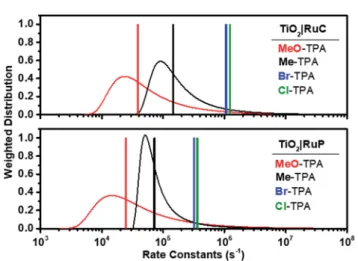
absor-bance, andkis the characteristic rate constant. When b¼ 1, arst-order reaction is recovered. The inverse Laplace trans-form of eqn (6) is known analytically for certainbvalues and has been determined by saddle-point approximation for others. Fig. 6 shows the distributions for charge recombination to the TPA+ derivatives under study as well as their average rate
constants (eqn (2)) and therst-order rate constants forCl- and Br-TPA+. While inverse Laplace transforms are ill-conditioned
and should be viewed with caution, the highly dispersive kinetics that span at least three orders of magnitude in time likely reect the heterogeneous Ti(IV/III) hopping transport in the mesoporous thinlms. When the injected electron is within the reaction sphere, electron transfer to TPA+ kinetically outcompetes hopping to another Ti(IV) site. When the injected electron is outside the reaction sphere, a wide range of rate constants is possible due to the weak coupling and hence small electron transfer rate constants to TPA+. We emphasize that this model, like those of Perrin’s and Onsager’s, is an approxima-tion. Electron transfer to TPA+likely occurs at a distribution of distances that are not marked by a sharp turn on/offat radiusr. It is interesting to note that theEavalue of 0.130.01 eV was
independent of the identity of the TPA+ acceptor. A similar
activation energy of 0.13 eV was reported for electron transport within mesoporous TiO2 (ref. 45) as well as for Li+ hops in
a Li10SnP2S12-based composite.62Cation hopping was excluded
since the same activation energy was measured in 0.1 M MgClO4
and 0.1 M TBAClO4 electrolytes for recombination toBr-TPA+
(Fig. 5c). Since the observed rate constant is the true rate constant for recombination toCl- andBr-TPA+, the activation energy must reect the barrier for the interfacial electron transfer reaction. For the other TPA+derivatives, the same Ea
Scheme 2 A reaction sphere model for interfacial charge recombi-nation. Schematic representation of a proposed Perrin-like model. When the driving force for recombination is large, as seen forBr- and Cl-TPA, electron transfer occurs over relatively large distances (blue sphere). With smaller driving force, the electron must hop closer to the TPA+acceptor before electron transfer can occur (red sphere), leading to a decreasedbvalue infits to the KWW function.
Fig. 6 Calculated L´evy distribution of the charge recombination rate constants abstracted from transient data for electron transfer from TiO2(e)|RuC(top) and TiO2(e)|RuP(bottom) toMeO-TPA+(red) or to Me-TPA+(black). An average rate constant based on eqn (2) is shown as a vertical line. Also shown as vertical lines are thefirst-order rate constants for recombination toBr-TPA+(blue) andCl-TPA+(green).
Open Access Article. Published on 17 November 2017. Downloaded on 29/03/2018 11:23:07.
This article is licensed under a
value should be taken as the average of a distribution of acti-vation energies as it was extracted from rate constants based on L´evy distributions. The fact that these average activation ener-gies are the same within experimental error indicates that the barrier for Ti(IV/III) hopping must be very similar to that for electron transfer to the oxidized TPA+, a conclusion that is in
agreement with a recent publication.45
Marcus normal electron transfer
Regardless of how the time resolved data is analyzed, the data clearly show that the recombination rate becomes larger as the Eo(TPA+/0) potential increases, consistent with Marcus normal kinetic behavior. There was no evidence for activationless or Marcus inverted kinetic behaviors even when the mediator potentials were tuned to the most positive values. Indeed, the electron transfer was clearly activated, Ea ¼ 0.13 0.01 eV.
Normal kinetic behavior has also been reported for Co(III) complexes and for ferrocenium acceptors.7,8,28While a precise
value of the formal EoTi(IV/III) reduction potential is unknown, the onset for spectroscopic changes attributed to TiO2(e) is
around 0 V vs. NHE in 0.1 M LiClO4.6,49 Hence, the
spec-troelectrochemical studies suggest that the driving force for recombination to X-TPA+ acceptors, where X ¼ Cl or Br, is greater than 1.2 eV. We emphasize however that the true free energy change for charge recombination is unknown and may be complicated by the time dependent electriceld26,63or the
exponential density of donor states that are oen invoked to model such data.49,64Nevertheless, the data is fully consistent
with Marcus normal electron transfer and suggests that either the reorganization energy must exceed this value or, as has been previously described, that recombination occurs through lower energy “trap” states with a signicantly smaller driving force.10,31
The total reorganization energy for this interfacial recombi-nation reaction includes contributions from TiO2, the
triphe-nylamine acceptors, and the electrolyte solution. Theoretical calculations indicate thatltot¼0.15–0.25 eV for TPA+/0which is
consistent with the rapid self-exchange in this class of compound.65The reorganization energy change associated with
Ti(IV/III) hopping is unknown. In molecular compounds, the d0/ d1redox chemistry is subject to a large Jahn–Teller distortion and reported reorganization energies are quite large.66–68While
molecular Ti compounds and TiO2 are quite different, the
spectroscopic properties of Ti(III) in the solid state oen show clear evidence of Jahn–Teller distortions.69,70Hence, a signi
-cant inner sphere contribution to the reorganization energy is expected.66–68The dielectric continuum theory provides
outer-sphere reorganization of 1 eV in acetonitrile.71,72 Recently,
reorganization energies near 1.2 eV for electron hopping have been calculated using the DFT + U method.73Hence it is not
unreasonable to suggest that the total reorganization energy is greater than 1.2 eV. Alternatively, and as has previously been discussed,28,31a lower driving force for the reaction would be
expected if the energetic position of the TiO2donor states that
participate in charge recombination is at much more positive potentials than the spectroelectrochemical data indicates. This
would allow for the observation of normal behavior when the total reorganization energy is less than 1.2 eV.
In the present study, therst-order recombination observed for the halogenated TPAs rules out diffusion or transport of the injected electrons as being a rate limiting process. Furthermore, recent studies have shown that charge recombination to oxidized dyes is sensitive to the bridge that separates them from the surface or the orientation of the surface linker.39,40Indeed,
specic bridge mediated pathways to oxidized dyes have been identied.37 Taken together, these ndings indicate that the
observed rate constants do, at least partially, report upon the interfacial electron transfer rate constant(s). Even when |DG| was as large as that reported here there was no evidence for rst-order kinetics or rate constants that were highly sensitive to the sensitizer Eo(S+/0) reduction potentials. This very different behavior for electron transfer to oxidized sensitizers versus redox mediators is not fully understood. A working hypothesis is that the anionic phosphonate (or carboxylate) binding groups preclude close-encounters of the injected electrons with the oxidized sensitizers resulting in more dispersive kinetics with longer distance interfacial electron transfer.
Conclusion
Electron transfer from TiO2 to a series of symmetrically
substituted oxidized triphenylamines was quantied over a driving force range of 0.5 eV. The rates increased with the thermodynamic driving force, consistent with the reaction occurring in the Marcus normal region. This conclusion was robust and occurred for two different CH3CN electrolytes
(LiClO4and NaClO4) and when sensitized to visible light by two
different sensitizers (RuC and RuP). An unprecedented rst-order electron transfer from TiO2 to Cl-or Br-TPA+ indicated
a coulombic interaction that provided sufficient coupling for unimolecular-like recombination. A reaction sphere model was proposed to account for this behavior and the dispersive kinetics observed for the other TPA+ acceptors wherein the recombination radius is related to the Gibbs free energy change.
Experimental
MaterialsThe following reagents and solvents were purchased from the listed commercial sources and used without further puri ca-tion: acetonitrile (Burdick and Jackson, spectrophotometric grade), methanol (Fischer, ACS Reagent grade), sodium perchlorate (NaClO4, Sigma-Aldrich, 99%), argon gas (Airgas,
>99.998%), [Ru(bpy)2(dcb)]2+(PF6)2(Solaronix), tri-p-tolyl-amine
(Me-TPA, Sigma-Aldrich, 97%), and tris(4-bromophenyl)amine (Br-TPA, Sigma-Aldrich, 98%). [Ru(bpy)2(dpb)]2+(PF6)2,77 tri-p
-anisylamine (MeO-TPA)74 and tris (4-chlorophenyl)amine
(Cl-TPA)75were prepared according to previously reported methods.
Materials preparation
Anatase TiO2nanocrystallites were prepared through a
previ-ously described sol–gel method.76The sols were cast as thin
Open Access Article. Published on 17 November 2017. Downloaded on 29/03/2018 11:23:07.
This article is licensed under a
lms by doctor blading onto methanol cleaned glass substrates. Scotch tape (10 mm) was used as a spacer and aided in achieving a uniformlm thickness. Thelms were allowed to stand covered for 30 min before being transferred to a tube furnace. The furnace wasrst purged with pure O2, then heated
at 450C for 30 min. Aer annealing, thelms were either kept in a 70 C oven for later use, or immediately submerged in concentrated acetonitrile solution ofRuCorRuP.
Electrochemistry
All electrochemical experiments were performed in acetonitrile solution containing 0.1 M NaClO4as the supporting electrolyte.
Potentials were applied against a self-contained Ag wire pseudo reference electrode containing the same electrolyte solution. The reference electrode was calibrated externally against the Fc+/0reduction potential (0.31 Vvs.SCE) where SCE is 0.241 V positive of NHE.78 Cyclic voltammetry employed Pt disk
elec-trodes (BASi, 1.6 mm diameter) as both working and auxiliary electrodes. Spectroelectrochemical studies were performed using a gold Honeycomb Spectroelectrochemical Cell (Pine Research Instrumentation), and allowed absorption changes to be quantied aer application of an electrochemical bias.
Absorption spectra
Ground state absorption spectra were obtained from a Varian Cary 50 spectrophotometer. Serial dilution of stock solution was used to determine the extinction coefficient of each compound. Molar absorption coefficient for the one electron oxidized TPAs were determined by internal comparison to the ground state TPA spectra.
Transient absorption
Nanosecond transient absorption measurements were per-formed on a previously described apparatus.79A pulsed (1 Hz)
150 W xenon arc lamp (Applied Photophysics) was used as the probe beam. Appropriatelters were placed before the sample to prevent direct band gap excitation of TiO2. Aer passing
through the sample, the probe beam was focused into a Spex monochromator coupled to a R928 Hamamatsu photo-multiplier tube. A pulsed (1 Hz) Nd:YAG laser (Quantel USA Brilliant B; 5–6 ns full width at half-maximum, spot size0.8 cm2) provided sample excitation. Excitation power was measured at the sample using a thermopile power meter (Molectron), with typical excitation powers varying between 500
mJ and 5 mJ per pulse. Typically, 30 pump-probe measurements were averaged over the range of 400–800 nm. Data generated for kinetic modeling were typically averaged between 150–210 measurements in order to improve signal to noise. Full spectra were generated at a set time aer laser excitation by averaging 3–21 data points around the timepoint of interest.
Data modeling
Kinetic modeling was performed with OriginPro 9, which utilizes a Levenberg–Marquardt iteration method. A custom Mathematica 9 script was used to model the spectral signatures
observed in transient absorption. Fitting was achieved through standard addition of steady state absorption spectra.
Con
fl
icts of interest
There are no conicts to declare.
Acknowledgements
The authors acknowledge support by a grant from the Division of Chemical Sciences, Office of Basic Energy Sciences, Office of Energy Research, U.S. Department of Energy (Grant DE-SC0013461). L. T.-G. would like to acknowledge the Belgian American Educational Foundation (BAEF) as well as the Bourse d’Excellence Wallonie-Bruxelles (WBI World) for generous support.
References
1 N. S. Lewis,J. Phys. Chem. B, 1998,102, 4843–4855. 2 S. Ardo and G. J. Meyer,Chem. Soc. Rev., 2009,38, 115–164. 3 T. Hisatomi, J. Kubota and K. Domen,Chem. Soc. Rev., 2014,
43, 7520–7535.
4 D. F. Zigler, Z. A. Morseth, L. Wang, D. L. Ashford, M. K. Brennaman, E. M. Grumstrup, E. C. Brigham, M. K. Gish, R. J. Dillon, L. Alibabaei, G. J. Meyer, T. J. Meyer and J. M. Papanikolas,J. Am. Chem. Soc., 2016, 138, 4426–4438.
5 A. Listorti, B. O’Regan and J. R. Durrant,Chem. Mater., 2011, 23, 3381–3399.
6 B. N. DiMarco, R. M. O’Donnell and G. J. Meyer, J. Phys. Chem. C, 2015,119, 21599–21604.
7 T. W. Hamann, O. K. Farha and J. T. Hupp,J. Phys. Chem. C, 2008,112, 19756–19764.
8 M. J. DeVries, M. J. Pellin and J. T. Hupp,Langmuir, 2010,26, 9082–9087.
9 S. M. Feldt, G. Wang, G. Boschloo and A. Hagfeldt,J. Phys. Chem. C, 2011,115, 21500–21507.
10 S. M. Feldt, P. W. Lohse, F. Kessler, M. K. Nazeeruddin, M. Gr¨atzel, G. Boschloo and A. Hagfeldt, Phys. Chem. Chem. Phys., 2013,15, 7087.
11 B. M. Klahr and T. W. Hamann,J. Phys. Chem. C, 2009,113, 14040–14045.
12 Y. Xie, J. Baillargeon and T. W. Hamann,J. Phys. Chem. C, 2015,119, 28155–28166.
13 Y. Xie and T. W. Hamann,J. Phys. Chem. Lett., 2013,4, 328– 332.
14 J. G. Rowley, S. Ardo, Y. Sun, F. N. Castellano and G. J. Meyer, J. Phys. Chem. C, 2011,115, 20316–20325.
15 J. G. Rowley, B. H. Farnum, S. Ardo and G. J. Meyer,J. Phys. Chem. Lett., 2010,1, 3132–3140.
16 J.-H. Yum, E. Baranoff, F. Kessler, T. Moehl, S. Ahmad, T. Bessho, A. Marchioro, E. Ghadiri, J.-E. Moser, C. Yi, M. K. Nazeeruddin and M. Gr¨atzel,Nat. Commun., 2012,3, 631.
17 T. W. Hamann,Dalton Trans., 2012,41, 3111.
Open Access Article. Published on 17 November 2017. Downloaded on 29/03/2018 11:23:07.
This article is licensed under a
18 E. Mosconi, J.-H. Yum, F. Kessler, C. J. G´omez Garc´ıa, C. Zuccaccia, A. Cinti, M. K. Nazeeruddin, M. Gr¨atzel and F. De Angelis,J. Am. Chem. Soc., 2012,134, 19438–19453. 19 S. M. Feldt, E. a. Gibson, E. Gabrielsson, L. Sun, G. Boschloo
and A. Hagfeldt,J. Am. Chem. Soc., 2010,132, 16714–16724. 20 T. Daeneke, A. J. Mozer, T.-H. Kwon, N. W. Duffy, A. B. Holmes, U. Bach and L. Spiccia, Energy Environ. Sci., 2012,5, 7090.
21 T. Daeneke, T.-H. Kwon, A. B. Holmes, N. W. Duffy, U. Bach and L. Spiccia,Nat. Chem., 2011,3, 211–215.
22 Y. Saygili, M. S¨oderberg, N. Pellet, F. Giordano, Y. Cao, A. B. Munoz-Garc´˜ ıa, S. M. Zakeeruddin, N. Vlachopoulos, M. Pavone, G. Boschloo, L. Kavan, J.-E. Moser, M. Gr¨atzel, A. Hagfeldt and M. Freitag, J. Am. Chem. Soc., 2016, 138, 15087–15096.
23 M. Freitag, F. Giordano, W. Yang, M. Pazoki, Y. Hao, B. Zietz, M. Gr¨atzel, A. Hagfeldt and G. Boschloo, J. Phys. Chem. C, 2016,120, 9595–9603.
24 Y. Hao, W. Yang, L. Zhang, R. Jiang, E. Mijangos, Y. Saygili, L. Hammarstr¨om, A. Hagfeldt and G. Boschloo, Nat. Commun., 2016,7, 13934.
25 S. Cazzanti, S. Caramori, R. Argazzi, C. M. Elliott and C. A. Bignozzi,J. Am. Chem. Soc., 2006,128, 9996–9997. 26 R. N. Sampaio, R. M. O’Donnell, T. J. Barr and G. J. Meyer,J.
Phys. Chem. Lett., 2014,5, 3265–3268.
27 S. A. Sapp, C. M. Elliott, C. Contado, S. Caramori and C. A. Bignozzi,J. Am. Chem. Soc., 2002,124, 11215–11222. 28 S. M. Feldt, P. W. Lohse, F. Kessler, M. K. Nazeeruddin,
M. Gratzel, G. Boschloo and A. Hagfeldt, Phys. Chem. Chem. Phys., 2013,15, 7087–7097.
29 N. Sutin,Acc. Chem. Res., 1982,15, 275–282.
30 P. F. Barbara, T. J. Meyer and M. a. Ratner,J. Phys. Chem., 1996,100, 13148–13168.
31 J. W. Ondersma and T. W. Hamann,J. Am. Chem. Soc., 2011, 133, 8264–8271.
32 M. Ansari-Rad, J. A. Anta and J. Bisquert,J. Phys. Chem. C, 2013,117, 16275–16289.
33 M. Ansari-Rad, Y. Abdi and E. Arzi,J. Phys. Chem. C, 2012, 116, 3212–3218.
34 J. Bisquert, A. Zaban and P. Salvador,J. Phys. Chem. B, 2002, 106, 8774–8782.
35 S. A. Haque, Y. Tachibana, D. R. Klug and J. R. Durrant,J. Phys. Chem. B, 1998,102, 1745–1749.
36 A. V. Barzykin and M. Tachiya,J. Phys. Chem. B, 2002,106, 4356–4363.
37 R. Katoh, A. Furube, A. V. Barzykin, H. Arakawa and M. Tachiya,Coord. Chem. Rev., 2004,248, 1195–1213. 38 R. Katoh and A. Furube,J. Phys. Chem. Lett., 2011,2, 1888–
1891.
39 K. Hu, A. D. Blair, E. J. Piechota, P. A. Schauer, R. N. Sampaio, F. G. L. Parlane, G. J. Meyer and C. P. Berlinguette,Nat. Chem., 2016,8, 853–859.
40 K. E. Spettel and N. H. Damrauer,J. Phys. Chem. C, 2016,120, 10815–10829.
41 A. N. M. Green, E. Palomares, S. A. Haque, J. M. Kroon and J. R. Durrant,J. Phys. Chem. B, 2005,109, 12525–12533.
42 G. Williams and D. C. Watts,Trans. Faraday Soc., 1970,66, 80.
43 H. Scher and E. W. Montroll,Phys. Rev. B, 1975,12, 2455– 2477.
44 J. Bisquert, F. Fabregat-Santiago, I. Mora-Ser´o, G. Garcia-Belmonte and S. Gim´enez, J. Phys. Chem. C, 2009, 113, 17278–17290.
45 G. Boschloo and A. Hagfeldt,J. Phys. Chem. B, 2005,109, 12093–12098.
46 J. Nelson, S. A. Haque, D. R. Klug and J. R. Durrant,Phys. Rev. B, 2001,63, 205321.
47 R. G. Palmer, D. L. Stein, E. Abrahams and P. W. Anderson, Phys. Rev. Lett., 1984,53, 958–961.
48 B. N. DiMarco, T. C. Motley, R. S. Balok, G. Li, M. A. Siegler, R. M. O’Donnell, K. Hu and G. J. Meyer,J. Phys. Chem. C, 2016,120, 14226–14235.
49 R. M. O’Donnell, R. N. Sampaio, T. J. Barr and G. J. Meyer,J. Phys. Chem. C, 2014,118, 16976–16986.
50 C. L. Ward, R. M. O’Donnell, B. N. DiMarco and G. J. Meyer,J. Phys. Chem. C, 2015,119, 25273–25281.
51 B. H. Farnum, Z. A. Morseth, M. K. Brennaman, J. M. Papanikolas and T. J. Meyer,J. Am. Chem. Soc., 2014, 136, 15869–15872.
52 C. A. Kelly, F. Farzad, D. W. Thompson, J. M. Stipkala and G. J. Meyer,Langmuir, 1999,15, 7047–7054.
53 D. F. Watson and G. J. Meyer,Coord. Chem. Rev., 2004,248, 1391–1406.
54 S. Ardo, Y. Sun, A. Staniszewski, F. N. Castellano and G. J. Meyer,J. Am. Chem. Soc., 2010,132, 6696–6709. 55 U. B. Cappel, S. M. Feldt, J. Sch€oneboom, A. Hagfeldt and
G. Boschloo,J. Am. Chem. Soc., 2010,132, 9096–9101. 56 E. C. Brigham and G. J. Meyer,J. Phys. Chem. C, 2014,118,
7886–7893.
57 P. R. F. Barnes, K. Miettunen, X. Li, A. Y. Anderson, T. Bessho, M. Gratzel and B. C. O’Regan,Adv. Mater., 2013, 25, 1881–1922.
58 T. J. Barr and G. J. Meyer,ACS Energy Lett., 2017,2, 2335– 2340.
59 F. Perrin,Ann. Phys., 1929,10, 169–275.
60 L. Onsager,J. Am. Chem. Soc., 1936,58, 1486–1493. 61 J. Nelson,Phys. Rev. B, 1999,59, 15374–15380.
62 M. Kaus, H. St¨offler, M. Yavuz, T. Zinkevich, M. Knapp, H. Ehrenberg and S. Indris, J. Phys. Chem. C, 2017, 121, 23370–23376.
63 R. M. O’Donnell, S. Ardo and G. J. Meyer,J. Phys. Chem. Lett., 2013,4, 2817–2821.
64 B. C. O’Regan and J. R. Durrant,Acc. Chem. Res., 2009,42, 1799–1808.
65 P. Cias, C. Slugovc and G. Gescheidt,J. Phys. Chem. A, 2011, 115, 14519–14525.
66 E. A. Robinson and J. E. Earley,Inorg. Chem., 1999,38, 4128– 4131.
67 O. Olubuyide, K. Lu, A. O. Oyetunji and J. E. Earley,Inorg. Chem., 1986,25, 4798–4799.
68 C. Creutz and M. H. Chou,Inorg. Chem., 2008,47, 3509–3514. 69 W. R. Entley, C. R. Treadway, S. R. Wilson and G. S. Girolami,
J. Am. Chem. Soc., 1997,119, 6251–6258.
Open Access Article. Published on 17 November 2017. Downloaded on 29/03/2018 11:23:07.
This article is licensed under a
70 R. Ameis, D. Reinen and S. Kremer,Inorg. Chem., 1985,24, 2751–2754.
71 E. H. Yonemoto, G. B. Saupe, R. H. Schmehl, S. M. Hubig, R. L. Riley, B. L. Iverson and T. E. Mallouk, J. Am. Chem. Soc., 1994,116, 4786–4795.
72 Y.-P. Liu and M. D. Newton,J. Phys. Chem., 1994,98, 7162– 7169.
73 N. A. Deskins and M. Dupuis,Phys. Rev. B, 2007,75, 195212. 74 C. Quinton, V. Alain-Rizzo, C. Dumas-Verdes, F. Miomandre,
G. Clavier and P. Audebert,RSC Adv., 2014,4, 34332. 75 A. P. Davis and A. J. Fry, J. Electrochem. Soc., 2013, 160,
G3091–G3096.
76 T. A. Heimer, S. T. D’Arcangelis, F. Farzad, J. M. Stipkala and G. J. Meyer,Inorg. Chem., 1996,35, 5319–5324.
77 M. R. Norris, J. J. Concepcion, C. R. K. Glasson, Z. Fang, A. M. Lapides, D. L. Ashford, J. L. Templeton and T. J. Meyer,Inorg. Chem., 2013,52, 12492–12501.
78 A. J. Bard and L. R. Faulkner, Electrochemical Methods: Fundementals and Applications, Wiley, New York, 2nd edn, 2001.
79 R. Argazzi, C. A. Bignozzi, T. A. Heimer, F. N. Castellano and G. J. Meyer,Inorg. Chem., 1994,33, 5741–5749.
Open Access Article. Published on 17 November 2017. Downloaded on 29/03/2018 11:23:07.
This article is licensed under a