INVESTIGATION OF GOLD-VINYL INTERMEDIATES OPENS NEW AVENUES
IN GOLD CATALYSIS
Dieter Weber
A dissertation submitted to the faculty of the University of North Carolina at Chapel Hill in
partial fulfillment of the requirements for the Degree of Doctor of Philosophy in the
Department of Chemistry.
Chapel Hill
2012
Approved by
Professor Michel R. Gagné
Professor Cynthia K. Schauer
Professor Maurice S. Brookhart
Professor Jeffrey S. Johnson
ii
© 2012
Dieter Weber
iii
ABSTRACT
DIETER WEBER: Investigation of Gold-Vinyl Intermediates Opens New Avenues in Gold
Catalysis
(Under the direction of Professor Michel R. Gagné)
The mechanism of gold(I)-catalyzed intramolecular hydroarylation of allenes was studied
in detail. While monitoring the reaction by NMR, an unexpected dinuclear gold-vinyl
intermediate was observed, that was proposed to contain a geminally diaurated carbon center
stabilized by an aurophilic interaction. Isolation of this intermediate was achieved by
inhibiting catalytic turnover with a base. Addition of suitable ligands abstracted one gold unit
and yielded a monogold-vinyl complex, which was structurally confirmed by X-ray
diffraction analysis. The reactivity of both intermediates was studied.
To better understand the formation of digold-vinyl intermediates, a variety of arylgold(I)
model complexes were synthesized. A mixture of mono- and digold-aryl complexes revealed
averaged proton signals by NMR. The chemical shift of these resonances could be used to
determine the percentage of monogold bound as digold, which allowed for quantification of
anion and ligand effects on digold formation. In addition, it was observed that Brønsted acids
affected the coordinating ability of anions through homoconjugate acid/base pairs.
iv
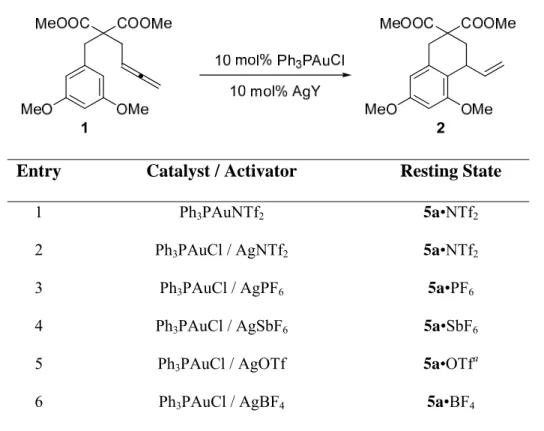
digold intermediate operated off cycle and acted as an inactive catalyst reservoir, which
seemed inhibitory for efficient catalysis. Further mechanistic studies revealed that digold
formation altered kinetic data as well, which complicated the interpretation of Hammett
studies and the development of rate laws.
v
vi
ACKNOWLEDGEMENT
“The things you do for yourself are gone when you are gone,
but the things you do for others remain as your legacy” – Kalu Kalu
vii
TABLE OF CONTENTS
LIST OF TABLES ... xi
LIST OF SCHEMES... xii
LIST OF FIGURES ... xvi
LIST OF ABBREVIATIONS AND SYMBOLS ... xxi
Chapter 1. The Element Gold and Gold Catalysis – an Introduction
...1
1.1 General Properties of the Element Gold ...1
1.2 Gold in Organometallic Chemistry ...7
1.3 Gold in Homogenous Catalysis ...19
1.4 Enantioselective Gold Catalysis ...30
1.5 Observation of Intermediates in Gold Catalysis ...35
Chapter 2. Previous Work in the Gagné Research Group
...41
2.1 The Development of New Gold-Catalyzed Reactions ...41
2.2 Proposed Mechanisms ...44
viii
Chapter 3. Gold-Vinyl Intermediates in the Intramolecular Hydroarylation
...48
3.1 Introduction ...48
3.2 Monitoring Catalysis by
31P NMR ...50
3.3 Isolation and Characterization of Intermediates ...52
3.4 Reactivity of Intermediates ...62
3.5 Variation of Anions ...65
3.6 Protodemetallation and Competition Experiments ...66
3.7 Variation of Phosphine Ligands ...68
3.8 X-ray Crystal Structure of Digold Intermediate ...73
3.9 Probing Different Allenes for Digold Intermediates ...77
3.10 Experimental Data ...80
Chapter 4. Gold-Vinyl Intermediates in the Hydroalkoxylation of Allenes
...82
4.1 Introduction ...82
4.2 Results with JohnPhos (Widenhoefer Group) ...82
4.3 Results with Ph
3P (Gagné Group)...85
ix
Chapter 5. Model Complexes Lead to a Better Understanding of Digold Formation
...92
5.1 Introduction ...92
5.2 Studies with Gold-Vinyl Model Complexes ...94
5.3 Studies with Gold-Aryl Model Complexes...97
5.4 Experimental Data ...109
Chapter 6. Mechanistic Role of Digold Intermediates in Gold Catalysis
...110
6.1 Introduction ...110
6.2 Mechanistic Models ...111
6.3 Kinetic Isotope Effect Studies and Isotope Labeling Experiments ...113
6.4 Theoretical Discussion ...118
6.5 Kinetic Data ...124
6.6 Hammett Studies ...136
6.7 Experimental Data ...144
Chapter 7. Silver Effect in the Intramolecular Hydroarylation of Allenes
...146
7.1 Introduction ...146
7.2 The Observation and Isolation of a Gold-Silver Resting State ...147
7.3 Structural Proposals ...150
x
7.5 Relevance for Catalysis ...153
7.6 Experimental Data ...155
Chapter 8. Dual Gold/Palladium Catalysis
...156
8.1 Introduction ...156
8.2 Palladium-Catalyzed RedOx Driven Homocoupling ...158
8.3 Experimental Data ...165
Chapter 9. New Avenues in Gold Catalysis
...166
9.1 Introduction ...166
9.2 Origin of Chiral Induction in Gold Catalysis ...166
9.3 Lewis Acid Mediated Catalyst Activation ...168
9.4 Enantioselective Cope-Rearrangement ...169
xi
LIST OF TABLES
Table 1-1.
Comparison of ionization potentials (in eV) of gold and silver. ...6
Table 3-1.
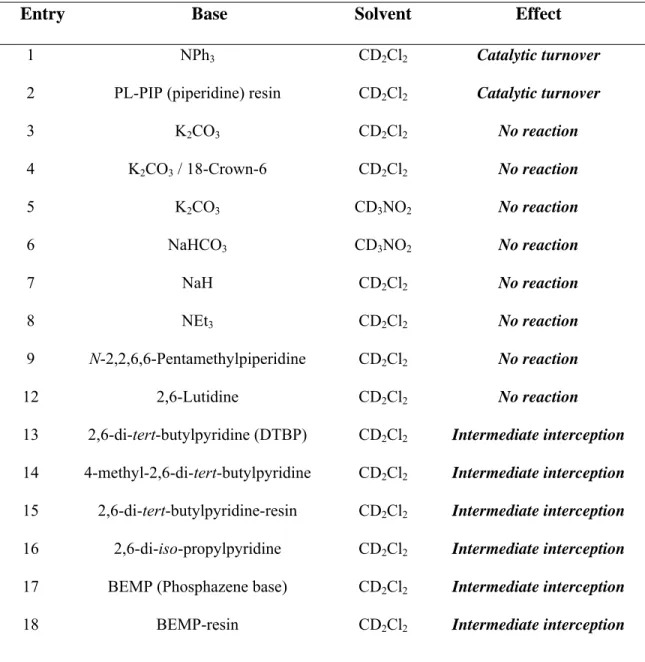
Base screen in the catalytic reaction of
1
with 10 mol%
4a
•NTf
2to inhibit
catalytic turnover via protodemetallation. ...53
Table 3-2.
Comparison of chemical shifts in
1H NMR. ...61
Table 3-3.
Resting state analysis of the reaction of
1
with in situ activated
Ph
3PAuCl/AgY catalyst by
31P NMR. ...66
Table 5-1.
Digold equilibrium percentages determined by the averaged proton signal
method as a function of counterion and aryl ligand. ...103
Table 5-2.
Rate of protodemetallation of
19a
with AcOH in the presence of different
Ph
3PAuY (
4a
•Y) complexes. ...107
Table 6-1.
Rate comparison with catalysts
4g
•NTf
2and
4m
•NTf
2, for the conversion of
1
.
...133
Table 6-2.
Rate comparison with catalysts
4d
•NTf
2and
4n
•NTf
2for the conversion of
1
. .135
Table 6-3.
Rate comparison with catalysts
4b
•NTf
2,
4c
•NTf
2, and
4d
•NTf
2for the
conversion of
1
. ...136
xii
LIST OF SCHEMES
Scheme 1-1.
Synthesis of (sulfide)Au(I)Cl precursors...9
Scheme 1-2.
Representative examples for the synthesis of LAuCl species with L = PPh
3and 1,3-bis-(2,6-di-
iso
-propylphenyl)imidazol-2-ylidine (IPr). ...9
Scheme 1-3.
Observation of geminally diaurated gold complex [Fc(AuPPh
3)
2]
+[BF
4]
–. ...11
Scheme 1-4.
Synthetic pathways for [Fc(AuPPh
3)
2]
+[BF
4]
–via alternative generations of
[Ph
3PAu]
+[BF
4]
–. ...12
Scheme 1-5.
Characteristic reactivity of digold complexes with abstracting ligands L. ...14
Scheme 1-6.
Donor strength of ligands measured by competitive [Ph
3PAu]
+exchange. ...14
Scheme 1-7.
Typical mechanisms for traditional palladium cross-coupling chemistry. ...20
Scheme 1-8.
In situ generation of cationic active gold catalyst [LAu]
+[Y]
–from LAuCl
and AgY. ...22
Scheme 1-9.
Nucleophilic functionalization of C–C multiple bonds. ...24
Scheme 1-10.
Representative examples of hydrofunctionalization reactions catalyzed by
gold(I). ...24
Scheme 1-11.
Mechanistically simple (top) and complex (bottom) cycloisomerization
reactions. ...26
Scheme 1-12.
Ligand-controlled selectivity for [4+2] vs. [4+3] cycloaddition of a
diene-allene. ...27
Scheme 1-13.
Claisen rearrangement (top) with propargyl-vinyl ether and different
reaction mode with propargyl esters (bottom). ...27
Scheme 1-14.
C–H functionalization of electron rich arenes. ...28
Scheme 1-15.
Oxidative coupling reactions with gold(I) and Selectfluor. ...29
Scheme 1-16.
Plausible mechanistic model for oxidative Au(I)/Au(III) cross-coupling
chemistry. ...30
xiii
Scheme 1-18.
First enantioselective gold-catalyzed reaction using chiral bidentate
ligands. ...31
Scheme 1-19.
Enantioselective hydroalkoxylation of allenes. ...32
Scheme 1-20.
High
ee
’s with a phosphoramidite ligand in the enantioselective [2+2]
cycloaddition. ...33
Scheme 1-21.
A new NAC ligand design led to high
ee
’s in the alkynylbenzaldehyde
cyclization. ...34
Scheme 1-22.
Enantioselective hydroalkoxylation using bulky chiral phosphate anions. ...34
Scheme 1-23.
Mechanistic studies on the Hashmi phenol synthesis...35
Scheme 1-24.
Observation of an intermediary alkylidene-oxazoline by
1H NMR. ...36
Scheme 1-25.
Observation of an allenic ester intermediate in the rearrangement of
propargyl esters. ...37
Scheme 1-26.
Observation of an enamine intermediate in the intermolecular tandem
hydroamination/hydroarylation of indole and phenylacetylene. ...38
Scheme 1-27.
Observation of a yne-allyl amine intermediate in the tandem
amination/hydroamination reaction. ...38
Scheme 1-28.
Observation of cyclobutenes as intermediates in the gold-catalyzed enyne
cycloisomerizations. ...39
Scheme 1-29.
Isolation of key intermediates in the gold-catalyzed cyclization of
alleneoates. ...39
Scheme 2-1.
Enantionselective cycloisomerization of 1,6-ene-allenes to
vinylcyclohexenes. ...42
Scheme 2-2.
Gold-catalyzed intramolecular hydroarylation of allenes. ...43
Scheme 2-3.
Intermolecular hydroarylation of allenes. ...43
Scheme 2-4.
Cascade cyclization of epoxy-allenes to polycyclic ethers. ...44
Scheme 2-5.
Proposed mechanism of the gold(I)-catalyzed intramolecular hydroarylation
of allenes. ...45
xiv
Scheme 2-7.
Synthesis of gold-vinyl model complex. ...47
Scheme 3-1.
Proposed mechanism of the gold(I)-catalyzed intramolecular hydroarylation
of allenes. ...49
Scheme 3-2.
Decomposition of
5a
•NTf
2on chromatographic media to
2
and
3a
. ...58
Scheme 3-3.
Reactivity of
3a
with Brønsted acids and Gagosz catalyst
4a
•NTf
2. ...63
Scheme 3-4.
Characteristic digold reactivity of intermediate
5a
•NTf
2....64
Scheme 3-5.
Starting the catalytic cycle with intermediates
3a
or
5a
•NTf
2and HNTf
2. ...64
Scheme 3-6.
Protodemetallation studies of
3a
with AcOH and DTBP•HNTf
2indicate a
strong anion effect. ...67
Scheme 3-7.
Competition experiment between protodemetallation and digold formation. ....68
Scheme 3-8.
Synthesis of digold
5n
•NTf
2. ...73
Scheme 4-1.
Synthesis of gold-vinyl intermediate
13o
. ...83
Scheme 4-2.
Enriched sample of
14a
•NTf
2(top) revealed characteristic digold reactivity
(bottom)...85
Scheme 5-1.
Monogold and digold complexes as intermediates in the
hydrofunctionalization of allenes. ...93
Scheme 5-2.
Decomposition of
17a
•NTf
2to 1,3-butadiene. ...96
Scheme 5-3.
Decomposition of
18a
•NTf
2to 2,3-dimethyl-1,3-butadiene. ...96
Scheme 5-4.
Decomposition of a 1:1 mixture of
17a
•NTf
2and
18a
•NTf
2to
2,3-butadiene, isoprene, and 2,3-dimethyl-1,3-butadiene. ...97
Scheme 5-5.
Proposed homoconjugate acid/base pair inducing lower coordination ability
of acetate. ...106
Scheme 6-1.
Proposed off cycle mechanism for an intramolecular hydrofunctionalization
of allenes. ...111
Scheme 6-2.
Proposed on cycle mechanism for an intramolecular hydrofunctionalization
of allenes. ...112
xv
Scheme 6-4.
Stoichiometric kinetic isotope study with
13o
/AcOX and
14o
•OTs/TsOX
under pseudo-first order conditions; L = P(
tBu)
2(
o
-biphenyl), X = H or D. ...114
Scheme 6-5.
Kinetic isotope effect in catalysis. ...114
Scheme 6-6.
Expected detectable species for the catalytic conversion of
10-CD2
at –45°C
after in situ generation of catalytically active mixture of
14o
•OTs and HOTs
at –78°C by reaction of
10
and 2 equiv of
4o
•OTs (top box). ...115
Scheme 6-7.
Off cycle mechanism for the intramolecular hydroalkoxylation of allene
10
. .119
Scheme 6-8.
Hypothesis for the effect of bridging phosphines on catalytic processes. ...134
Scheme 6-9.
Mechanistic model for a hydrofunctionalization reaction that proceeded
only via a monogold resting state. ...141
Scheme 6-10.
Mechanistic model for hydrofunctionalization reactions that proceeded via
a digold intermediate. ...142
Scheme 7-1.
Reactivity of gold-silver complex
26a
•NTf
2. ...152
Scheme 8-1.
Palladium-catalyzed coupling reaction of
27a
. ...159
Scheme 8-2.
Mechanistic schemes for cross- and homo-coupling of
27a
. ...160
Scheme 8-3.
Hg(0)/Au(I) RedOx reaction observed by Grandberg. ...164
Scheme 8-4.
Proposed mechanism for the homo-coupling of
27a
. ...165
Scheme 9-1.
Dynamic kinetic resolution of in situ formed gold-vinyl intermediates and
chiral Brønsted acids (bottom) as an alternative proposal for the close ion
pair model (top) in enantioselective gold catalysis. ...167
Scheme 9-2.
Lewis acid mediated activation of Ph
3PAuOAc. ...168
Scheme 9-3.
Proof of principle for a Lewis acid mediated activation of
4a
•OAc using the
intramolecular hydroarylation of
1
as a model reaction. ...169
Scheme 9-4.
Lewis acid mediated activation of gold catalysts with coordinating anions. ...169
xvi
LIST OF FIGURES
Figure 1-1.
Structure of the pharmaceutical Auranofin. ...2
Figure 1-2.
Different oxidation states of gold in selected examples. ...3
Figure 1-3.
Effects of relativity and lanthanide contraction on outer-shell orbitals of
gold. ...5
Figure 1-4.
Crystal structure of [Fc(AuPPh
3)
2]
+. ...13
Figure 1-5.
Synthesis of [(Ph
3PAu)
6C]
2+[MeOBF
3]
2–(left); crystal structure of the
dication (right). ...15
Figure 1-6.
X-ray crystallographic data of thiophenyl (left) and furanyl (right) monogold
and digold structures. H atoms and anions are omitted for clarity. ...16
Figure 1-7.
ORTEP view of two molecules of 4-MeO-C
6H
4-AuPPh
3. Ellipsoids are
drawn at the 50% probability level. H atoms are omitted for clarity. ...17
Figure 1-8.
ORTEP view of one of the independent molecules of
cis
-1,2-dimethylvinyl-AuPPh
3. Ellipsoids show 30% probability levels; phenyl H atoms are omitted
for clarity. ...18
Figure 1-9.
Examples of isolable silver free gold catalysts. ...23
Figure 3-1.
Monitoring the reaction of
1
by
31P NMR. ...50
Figure 3-2.
Monitoring the reaction of
1
to
2
by
1H NMR. ...51
Figure 3-3.
Crude
31P NMR (left) and
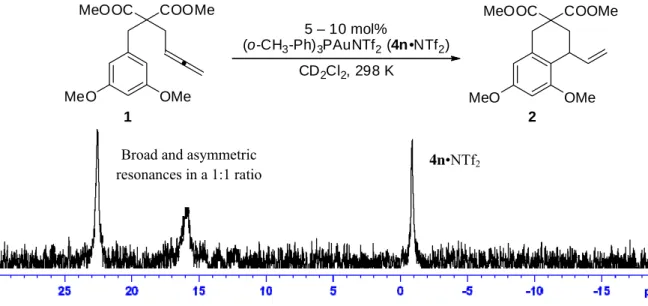
1H NMR (right) of the stoichiometric reaction of
1
and 2 equiv of
4a
•NTf
2in the presence of DTBP. ...54
Figure 3-4.
Proposed structure of digold intermediate
5a
•NTf
2. ...55
Figure 3-5.
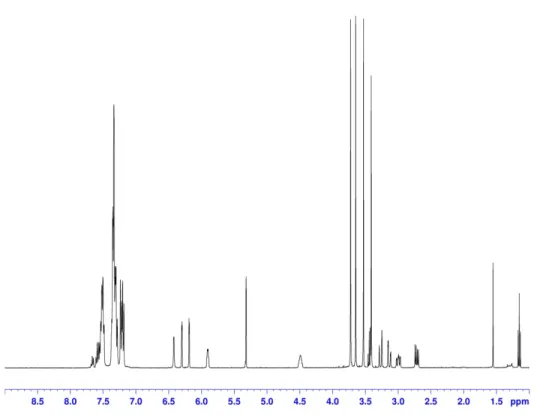
1H NMR of purified
5a
•NTf
2. Residues of water (1.56 ppm) and diethyl
ether (3.48 ppm and 1.21 ppm) were visible. Signals corresponding to DTBP
were removed. ...57
Figure 3-6.
Single crystals obtained from samples of
5a
•NTf
2. ...57
xvii
Figure 3-8.
NMR data of purified intermediate
3a
. ...60
Figure 3-9.
Structurally characterized vinylic digold complexes reported by Fürstner. ...68
Figure 3-10.
Observation of digold intermediates by
31P NMR in the reaction of
1
with
catalysts
4b
•NTf
2,
4c
•NTf
2, and
4d
•NTf
2. ...70
Figure 3-11.
Detected digold intermediates by
31P NMR for the catalysis of
1
with the
bridging
4g
•NTf
2and monodentate
4m
•NTf
2as catalysts. ...71
Figure 3-12.
Observation of digold intermediate by
31P NMR in the reaction of
1
with
bulky
4n
•NTf
2....72
Figure 3-13.
31P and
1H NMR data after addition of aliquots of
4n
•NTf
2to
1
in the
presence of excess DTBP. ...74
Figure 3-14.
ORTEP diagram of
5n
•NTf
2with 50% probability ellipsoids; most
hydrogen atoms omitted for clarity.
Key bond lengths [Å] include: Au1-Au2
[3.13563(18)], Au2-C2 [2.059(3)], Au1-C1 [2.275(3)], Au1-C2 [2.287(3)],
and C1-C2 [1.369(5)]. ...75
Figure 3-15.
31P NMR signals at
δ
= 36.9 ppm and 36.5 ppm indicated a digold
intermediate for the cycloisomerization of ene-allene
6
. ...78
Figure 3-16.
31P NMR signals at
δ
= 37.1 ppm and 35.7 ppm indicated a digold
intermediate for the cycloisomerization of epoxy-allene
8
. ...79
Figure 3-17.
31P NMR signals at
δ
= 37.8 ppm and 35.7 ppm indicated a digold
intermediate for the hydroxyalkoxylation of allene
10
. ...79
Figure 4-1.
ORTEP diagram of complex
13o
. Ellipsoids are shown at 50% probability.
Hydrogen atoms have been omitted for clarity. Selected bond lengths (Å) and
angles (°): Au1–C2 [2.048(7)], Au1–P1 [2.3163], C1–C2 [1.333(11)], C2–C3
[1.518], C2–Au1–P1 [174.3(2)], C1–C2–Au1 [120.5(6)}, C3–C2–Au1
[122.4(5)], C1–C2–C3 [117.0(7)]. ...83
Figure 4-2.
Comparison of
1H (top) and
31P NMR (bottom) data. (a) Reaction of
10
with
4o
•OTs (1:1) at –80°C in CD
2Cl
2; (b) In situ generated digold
14o
•OTs
generated from
13o
and
4o
•OTs in CD
2Cl
2at 0ºC; (c) Isolated
13o
in CD
2Cl
2at 25°C. ...84
Figure 4-3.
Following the reaction of
10
with 1-2 mol%
4a
•NTf
2by
1H (left) and
31P
(right) NMR in CD
2Cl
2.. ...87
xviii
Figure 4-5.
Monitoring the reaction of
10
with 2 mol%
4a
•OTs in the presence of excess
DTBP by
31P NMR. Signal at
43 ppm corresponds to
13a
. ...88
Figure 4-6.
Following the reaction of
10
with 10 mol%
4a
•OONB by
1H (left) and
31P
(right) NMR in CD
2Cl
2. ...89
Figure 5-1.
Synthesis and structure of gold-vinyl complexes
15a
and
16a
. Key bond
lengths [Å] in
15a
: Au1-C1 [2.048(4)], C1-C2 [1.298(7)]. Key bond lengths
[Å] in
16a
: Au1-C1 [2.041(4)], C1-C2 [1.353(7)], C1-C3 [1.486(7)]. ...94
Figure 5-2.
Synthesis of gold-aryl complexes with two structurally characterized
examples. ORTEP diagrams of two Ph
3PAuAr complexes (Ar = 2,5-(OMe)
2-C
6H
3and 3-Me-C
6H
4) with 50% probability ellipsoids; hydrogen atoms,
second molecule in unit cell for Ar = 2,5-(OMe)
2-C
6H
3are omitted for
clarity. Key bond lengths [Å] in Ar = 2,5-(OMe)
2-C
6H
3: Au-C(
ipso
)
[2.044(3)] and [2.045(3)]. Key bond lengths [Å] in Ar = 3-Me-C
6H
4:
Au-C(
ipso
) [2.049(4)] and [2.061(4)], Au–Au [3.0580(2)]. ...98
Figure 5-3.
Synthesis of digold-aryl complexes with two structurally characterized
examples. ORTEP diagrams of digold aryl cations (Ar = 2,5-(OMe)
2-C
6H
3and 2-Me-C
6H
4) with 50% probability ellipsoids; hydrogen atoms and anion
omitted for clarity. Both structures suffered from twinning and disorder; only
atom connectivity was considered reliable. ...99
Figure 5-4.
Mononuclear and dinuclear arylgold(I) model complexes used to mimic
catalytic gold-vinyl intermediates. ...100
Figure 5-5.
Addition of aliquots of
4a
•NTf
2to a solution of
19a
caused a linear
downfield shifting of the time averaged
1H signals of
19a
and
20a
•NTf
2. ...102
Figure 5-6.
Dilution of a 1:1 solution of
19a
and
4a
•OTs with aliquots of CD
2Cl
2. ...104
Figure 5-7.
Growth in calculated percentage of
19a
bound as digold
20a
•OAc over the
course of the protodemetallation of
19a
with 4 equiv of AcOH (
). The
round data points (
●
) correspond to the experiment with an additional
equivalent of Ph
3PAuOAc (
4a
•OAc). ...105
Figure 6-1.
Measured concentration of components during catalysis from 2.3%
conversion (t = 0 min) to 7.3% conversion (t = 195 min) at –45°C:. ...116
Figure 6-2.
Dependence of formulas for reaction rates of protodemetallation (
3) and
digold formation (
2) on a decreasing number of active catalyst [LAu]
+molecules as a result of digold formation. ...122
xix
Figure 6-4.
Monitoring the reaction of
1
with 5 mol%
4a
•NTf
2by
31P NMR. The digold
signals at 36 ppm decreased as the reaction progressed and a second signal
marked with X grew in. ...126
Figure 6-5.
Order in substrate (top) and catalyst (bottom) using a least square fit for the
hydroarylation of allene
1
in CD
2Cl
2. ...127
Figure 6-6.
Zero order (top) and first order (bottom) plot of the hydroalkoxylation of
allenes. ...129
Figure 6-7.
Order in substrate (top) and catalyst (bottom) using a least square fit for the
hydroalkoxylation of allene
10
. ...130
Figure 6-8.
Order in substrate (top) and catalyst (bottom) using a least square fit for the
hydroalkoxylation of allene
10
.. ...131
Figure 6-9.
Order in substrate (top) and catalyst (bottom) using a least square fit for the
hydroalkoxylation of allene
10
. ...132
Figure 6-10.
Hammett plot of initial rate constants with catalysts
4a-f
•NTf
2. ...137
Figure 6-11.
Hammett plot of initial rate constants with catalysts
4a
•OTs,
4b
•OTs,
4d
•OTs,
4e
•OTs. ...137
Figure 6-12.
Hammett plot of initial rate constants with catalysts
4a
•OONB,
4b
•OONB,
4c
•OONB,
4d
•OONB,
4e
•OONB.. ...138
Figure 6-13.
Hammett plot of initial rate constants with catalysts
4a-f
•OTs in th presence
of excess DTBP.. ...139
Figure 6-14.
Energy diagrams of allene activation / nucleophilic attack (left) and
protodemetallation of monogold (right) with qualitatively estimated
transition state energy spreads depending on the electronic nature of the
catalyst. ...141
Figure 6-15.
Energy diagram of competing digold formation and protodemetallation of
monogold with qualitatively estimated transition state energy spreads
depending on the electronic nature of the catalyst. ...143
Figure 7-1.
Comparison of
1H (top) and
31P NMR (bottom) data; a) Catalysis of
1
with 5
mol%
4a
•NTf
2in the presence of 20 mol% AgNTf
2in CD
2Cl
2; b) Compound
26a
•NTf
2trapped with DTBP in CD
2Cl
2; c) Isolated
5a
•NTf
2in CD
2Cl
2; d)
Isolated
3a
in CDCl
3. ...149
xx
Figure 7-3.
Change in catalyst resting state from
26a
•NTf
2(
) to
5a
•NTf
2(
) upon
additions of Ph
3PAuCl to a solution of 0.1 mmol of
1
and 25 mol% AgNTf
2in CD
2Cl
2. ...153
Figure 7-4.
Change in catalyst resting state from
26a
•NTf
2(
) to
5a
•NTf
2(
) upon
additions of
4a
•NTf
2to a solution of 0.1 mmol 1 and 15.5 mol% AgNTf
2in
CD
2Cl
2. ...154
Figure 7-5.
ln [
1
] versus time [s] for the conversion to
2
by
1H NMR; 0.1 mmol 1, 5
mol% Ph
3PAuNTf
2(
4a
•NTf
2), and 0.05 mmol hexamethyl benzene (internal
standard) in 0.5 mL CD
2Cl
2; 6.2 mg (16 mol%) AgNTf
2was added as a
solid. ...154
xxi
LIST OF ABBREVIATIONS AND SYMBOLS
angle
Pauling electronegativity
chemical shift in NMR sprectrocopy
hapticity
reaction rate
cone angle theta
Hammett reaction constant
difference in Pauling electronegativity
difference in chemical shift
-bond
chemical bond with
symmetry
-bond
chemical bond with sigma symmetry
pHammett
para
-substituent constant
° degrees
°C degrees
Celsius
µ micro
(10
-6)
3c-2e bond
three-center-two-electron bond
9-Br-BBN
9-bromo-9-borabicyclo[3.3.1]nonane
Å ångstrom
(10
–10m)
Ar aryl
xxii
BINAP
2,2'-bis(diphenylphosphino)-1,1'-binaphthyl
Bn benzyl
Bz benzoyl
C
2point group after Schoenflies notation
C
3point group after Schoenflies notation
Cbz carbobenzyloxy
d doublet
dba dibenzylideneacetone
DCE 1,2-dichloroethane
DCM dichloromethane
dd
doublet of doublets
ddd
doublet of doublets of doublets
DMS dimethyl
sulfide
DMSO dimethyl
sulfoxide
dppm
1,1-bis(diphenylphosphino)methane
DTBM-MeO-BIPHEP 2,2'-bis[di(3,5-di-
tert
-butylphenyl)phosphino]-6,6'-dimethoxy-1,1'-biphenyl
DTBP 2,6-di-
tert
-butyl pyridine
dt
doublet of triplets
E
0standard
reduction
/ oxidation potential
ee
enantioenrichement
Et
2O diethyl
ether
xxiii
eV electron
volt
Fc ferrocenyl
GC gas
chromatography
h hour
Hz Hertz
HTFA triflic
acid
IR infrared
I nuclear
spin
IMes 1,3-dimesitylimidazol-2-ylidine
IPr 1,3-bis-(2,6-diisopropylphenyl)imidazol-2-ylidine
i
Pr isopropyl
J
coupling constant in Hz
JohnPhos
(2-biphenyl)di-
tert
-butylphosphine
K Kelvin
k rate
constant
kcal
kilocalorie (4.18 kJ)
KIE
kinetic isotope effect
kJ kilojoule
k
obsobserved rate constant
k
relrelative rate constant
L liter
LA Lewis
acid
xxiv
m multiplet
M molar
(mol/L)
Me methyl
MeO methoxy
MeO-BIPHEP
2,2'-bis(diphenylphosphino)-6,6’-dimethoxy-1,1’-biphenyl
Mes mesityl
MS mass
spectrometry
NAC
nitrogen acylic carbene
n
Bu
n
-butyl
NHC
nitrogen heterocylic carbene
NMR nuclear
magnetic
resonance
NTf
2bis(trifluoromethane)sulfonimide
Nu nucleophile
OAc acetate
OBz benzoate
OONB
ortho
-nitrobenzoate
OPE binolphosphate
OPNB
para
-nitrobenzoate
OTf trifluoromethanesulfonate
OTs
para
-toluenesulfonate
Ph phenyl
Piv pivaloyl
xxv
ppb
parts per billion
ppm
parts per million
R organic
group
RedOx
reduction / oxidation
RT room
temperature
s singlet
t
triplet
T
temperature
TADDOL
α
,
α
,
α
,
α
-tetraaryl-1,3-dioxolane-4,5-dimethanol
t
Bu
tert
-butyl
td
triplet of doublets
TFA trifluoroacetate
THF tetrahydrofuran
tht tetrahydrothiophene
TLC
thin layer chromatography
Tol tolyl
Ts
para
-toluenesulfonyl
V volume
(variable)
V volt
(unit)
X
halogen atom unless otherwise defined
Xyl xylyl
xxvi
Xyl-PHANEPHOS
4,12-bis(dixylylphosphino)[2.2]paracyclophane
Y anion
Chapter 1.
The Element Gold and Gold Catalysis – an Introduction
Properties of the element gold are introduced. The novelty of gold in organometallic
chemistry is highlighted. The principle behind the application of cationic gold complexes in
electrophilic catalysis is explained. Strategies for asymmetric gold catalysis are discussed.
Representative examples are given. Observed intermediates in gold-catalyzed reactions are
summarized.
1.1 General Properties of the Element Gold
Gold is a precious metal that can be found in nature in its elemental form as gold nuggets,
in gold veins, or as gold grains because of its chemical inertness towards oxidation in air or
water. In its pure form, gold has a bright yellow color and is a dense, soft, malleable, and
ductile metal. It is also a very good conductor of heat and electricity. In contrast to most
other heavy metals, gold is non-toxic in its elemental form. Because of these properties,
metallic gold is often used in jewelry, currency, electrical wiring, and as fillings in dentistry.
2
much more reactive and toxic. Depending on the ligand environment, such complexes have
found use in organic synthesis as homogenous catalysts and also in medicine. For example,
Auranofin, a neutral gold(I) glucosylthiolate complex, was found to be active for the
treatment of rheumatoid arthritis (Figure 1-1).
1Other gold complexes are currently being
investigated as potential chemotherapeutic drugs.
2Figure 1-1. Structure of the pharmaceutical Auranofin.
In contrast to the chemical properties of many other metals, only one isotope of gold
exists:
197Au. As a result, mass spectrometric analysis of gold compounds lack a
characteristic isotope pattern.
197Au has a nuclear spin I = 3/2 and therefore is NMR active.
Due to its low NMR sensitivity and quadrupolar moment, only few gold NMR spectra are
known.
3The NMR activity of gold does not affect
1H,
13C, or
31P NMR spectra, and because
of the diamagnetic character of most oxidation states, catalyzed reactions and
gold-containing compounds can be analyzed by NMR.
Gold is very stable in its elemental state and gold(0) can be viewed as a thermodynamic
sink. Because gold is a noble metal, it has high RedOx energy barriers, which means that
1 W. F. Kean, L. Hart, W. W. Buchanan, Br. J. Rheum.
1997, 36, 560.
2 (a) K. P. Bhabak, B. J. Bhuyan, G. Mugesh, Dalton Trans.
2011, 40, 2099; (b) S. Tian, F.-M. Siu, S. C. F. Kui,
C.-N. Lok, C.-M. Che, Chem. Commun.2011, 47, 9318; (c) T. J. Siciliano, M. C. Deblock, K. M. Hindi, S.
Durmus, M. J. Panzner, C. A. Tessier, W. J. Youngs, J. Organomet. Chem.2011, 696, 1066; (d) K. Yun, C.-N.
Lok, K. Bierla, C.-M. Che, Chem. Commun.2010, 46, 7691.
3 A. Narath, Phys. Rev.
3
strong oxidants are required to oxidize gold(0) to gold(I) (E
0= 1.67 V) and gold(0) to
gold(III) (E
0= 1.498 V).
4In organic or aqueous solution, gold(I) ions slowly
disproportionate to gold(0) and gold(III), with the formation of gold(0) driving the reaction.
This process can typically be observed by the formation of a gold mirror on the glass wall.
However, gold(I) species can be stabilized by suitable ligands, such as phosphines,
N-heterocyclic carbenes (NHC’s), or chloride. These ligands are commonly found in catalysis.
The electron configuration of gold(0) is [Xe]6s
25d
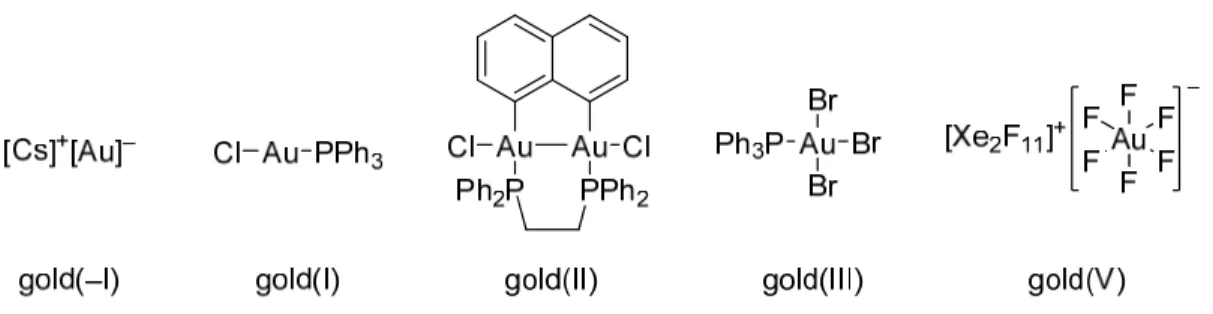
9. Six stable oxidation states of gold are
known: gold(–I), gold(0), gold(I), gold(II), gold(III), and gold(V); an oxidation pattern that
greatly differs from the other coinage metals (silver and copper). The coordination number of
these compounds ranges from two to six (Figure 1-2).
Figure 1-2. Different oxidation states of gold in selected examples.
The electron affinity of gold (2.039 eV) is much higher than that of silver (1.202 eV).
5This allows access to the negative oxidation state gold(–I) with an electron configuration of
[Xe]6s
25d
10as seen in semiconductor CsAu.
6The existence of gold(–I) was further supported
by the solid state structure of a related compound [(NMe)
4]
+[Au]
–.
74 N. P. Finkelstein, R. D. Hancock, Gold Bull.
1974, 7, 72.
5 H. Hotop, R. A. Bennet, W. C. Lineberger, J. Chem. Phys.
1973, 58, 2373.
6 W. E. Spicer, A. H. Sommer, J. G. White, Phys. Rev.
4
Gold(I) complexes have the electronic configuration of [Xe]6s
05d
10. They are generally
two-coordinate with a linear geometry, but higher coordination numbers are also known.
8In
gold catalysis, gold(I) is the most prevalent oxidation state.
Examples of gold(II) compounds ([Xe]6s
05d
9) consist mostly of binuclear species with a
Au–Au bond, a coordination number of four, and a square planar geometry.
9Alternatively to
gold(II), these compounds can also be viewed as complexes with a mixed oxidation state of a
Au(III)–Au(I) pair. There are a few examples of “real” mononuclear gold(II) complexes,
which are paramagnetic and EPR active compounds and validate that the oxidation state
gold(II) is truly accessible.
10Gold(III) complexes have the electron configuration of ([Xe]6s
05d
8) and display the
expected d
8square planar geometry with a coordination number of four.
11This oxidation
state is also common in gold catalysis.
Gold(V) compounds ([Xe]6s
05d
6) are extremely rare and appear in octahedral geometry
with a coordination number of six.
12The high oxidation state gold(V) can be obtained by
reaction of [AuF
4]
–with sunlight-dissociated F
2to produce [AuF
6]
–. Interestingly, this
reaction proceeds more easily with gold(III) than with the corresponding silver(III) complex.
Even using the most potent oxidant KrF
2, [AgF
4]
–could not be converted to silver(V)
7 P. D. C. Dietzel, M. Jansen, Chem. Commun.
2001, 2208.
8 M. C. Gimeno, A. Laguna, Chem. Rev.
1997, 97, 511.
9 N. Meyer, C. W. Lehmann, T. K.-M. Lee, J. Rust, V. W.-W. Yam, F. Mohr, Organometallics
2009, 28, 2931.
10 (a) A. J. Blake, J. A. Greig, A. J. Holder, T. I. Hyde, A. Taylor, M. Schröder, Angew. Chem. Int. Ed.
1990, 29, 197; (b) J. L. Shaw, J. Wolowska, D. Collison, J. A. K. Howard, E. J. L. McInnes, J. McMaster, A. J. Blake, C. Wilson, M. Schröder, J. Am. Chem. Soc.2006, 128, 13827; (c) S. Seidel, K. Seppelt, Science2000, 290, 117.
11 S. Attar, J. H. Nelson, W. H. Bearden, N. W. Alcock, L. Solucic, E. B. Milosavljevic, Polyhedron
1991, 10,
1939.
12 K. Leary, A. Zalkin, N. Bartlett, J. Chem. Soc., Chem. Commun.
5
[AgF
6]
–.
13This non-periodic oxidation behavior can largely be attributed to the impact of a
large relativistic effect and lanthanide contraction.
The relativistic effect originates in the periodically increasing atomic nuclear charge (Z),
which raises the average velocity of the nucleus penetrating electrons (s electrons and to a
lesser extent p electrons).
14According to Einstein’s relativity theory, the increase in velocity
(higher kinetic energy) results in a higher mass of these electrons, which causes them to
occupy a smaller space (orbitals) than without the relativistic effect. Therefore, the s
electrons are closer and stronger bound and shield the nuclear charge, so that d and f
electrons are weaker bound (to fulfill the law of energy conservation), which increases the
size of the d and f orbitals (Figure 1-3).
Figure 1-3. Effects of relativity and lanthanide contraction on outer-shell orbitals of gold.
The relativistic effect reaches a maximum in gold because it is the first element with a
fully occupied 5d and 4f shell (lanthanide contraction). Both the relativistic effect and the
lanthanide contraction synergistically decrease the size of the gold atom to that of the silver
13 K. Lutar, A. Jesih, I. Leban, B. Zemva, N. Bartlett, Inorg. Chem. 1989, 28, 1335.
14 N. Bartlett, Gold Bull.
6
atom, which strongly affects its physical and chemical properties. In fact, Schmidbaur was
able to demonstrate that the gold(I) ion was smaller than the silver(I) ion.
15The strong
relativistic effect and the lanthanide contraction explain the accessibility of the extreme
oxidation states gold(–I) and gold(V), the high Pauling electronegativity of
= 2.540 [similar
to carbon (
= 2.550), sulfur (
= 2.580), and iodine (
= 2.660)], the initial resistance of
gold towards oxidation, and relatively lower energy barrier of further oxidation once
oxidized. The latter periodic anomaly is revealed by the first and second ionization potentials
of gold in comparison to silver (Table 1-1).
Table 1-1. Comparison of ionization potentials (in eV) of gold and silver.16
M(0) M(I)++ e–
M(I)+ M(II)2+
+ e–
M = Au M = Ag
9.225 7.576
20.5 21.49
1st:
2nd:
The consequences of a large relativistic effect particularly influence the reactivity of
gold(I) complexes,
17which form unique weak metal-metal interactions in their solid state and
in solution. There are three different bonding interactions between metals:
18(1)
metallic bonding between atoms described by electron gas models, band
structures, or Fermi surface concepts;
15 A. Bayler, A. Schier, G. A. Bowmaker, F. Schmidbaur, J. Am. Chem. Soc.
1996, 118, 7006.
16 (a) C. M. Brown, M. L. Ginter, J. Opt. Soc. Am. 1978, 68, 243; (b) M. Rosberg, J.-F. Wyart, Phys. Scr.
1997, 55, 690.
17 (a) P. Pyykkö, Chem. Rev.
1997, 97, 597; (b) P. Pyykkö, Angew. Chem. Int. Ed.2004, 43, 4412; (c) P.
Pyykkö, Inorg. Chim. Acta2005, 358, 4113; (d) P. Pyykkö, Chem. Soc. Rev.2008, 37, 1967.
18 L. H. Doerrer, Comm. Inorg. Chem.
7
(2)
covalent bonding between oxidized metal atoms with open subshells as
exemplified by the quadruple bond in [Re
2Cl
8]
2–;
(3)
non-covalent bonding between metal atoms with closed subshells, such as d
10or s
2subshells.
Most examples of this third category were originally observed while studying the
reactivity of organogold(I) complexes. Because of the many examples with Au–Au contacts,
Schmidbaur proposed the special terms
aurophilicity
and
aurophilic bonding
. Aurophilic
interactions between two gold atoms are placed into the category of
weak forces
, comparable
to hydrogen bonding (5–10 kcal mol
–1). Aurophilic bonding is indicated by a Au–Au distance
of 2.8–3.5 Å in X-ray crystal structures, a wide range, because the mutual approach of two
gold centers reveals a relatively flat energy profile.
19Because other closed shell metals have
revealed similar behavior, the general terms
metallophilicity
and
metallophilic bonding
were
also introduced.
1.2 Gold in Organometallic Chemistry
Long before gold complexes were identified as promising sources for homogenous
catalysts (early 1990’s), a variety of Au(I) and Au(III) organogold compounds were
synthesized and studied. Since this dissertation focuses on gold in its +1 oxidation state, only
those are discussed.
The
Nesmeyanov Institute of Organoelement Compounds and Institute of Common and
Inorganic Chemistry
at Moscow State University began its studies on “univalent”
organogold(I) complexes in 1970 and published more than 100 articles in Russian chemistry
19 (a) H. Schmidbaur, Chem. Soc. Rev.
1995, 24, 391; (b) H. Schmidbaur, A. Schier, Chem. Soc. Rev.2008, 37,
8
journals.
20The synthesis of alkyl-, alkenyl-, alkynyl-, cyclopropyl-, benzyl-, allyl-, aryl-,
cyclopentadienyl-, cymantrenyl-, and ferrocenylgold(I)-complexes was described and their
reactivity studied. These seminal studies were carried out by Nesmeyanov, Grandberg, and
Baukova.
21Other main contributors to this research field were the research groups of
contemporaries such as Puddephatt,
22Schmidbaur,
23and Kochi,
24and shortly thereafter by
Gimeno,
25Laguna,
26and many others.
27The key findings of these studies that are relevant
for this dissertation are summarized in this section.
An important basis for the synthesis of organogold(I)-complexes is the preparation of
(sulfide)Au(I)Cl precursors. These complexes are prepared by the addition of a sulfide,
typically dimethyl sulfide (DMS)
28or tetrahydrothiophene (tht),
29to an aqueous solution of
chloroauric acid (HAuCl
4) (Scheme 1-1). (DMS)AuCl is commercially available.
20 K. I. Grandberg, V. P. Dyadchenko, J. Organomet. Chem.
1994, 474, 1.
21 (a) A. N. Nesmeyanov, E. G. Perevalova, K. I. Grandberg, D. A. Lemenovskii, Izv. Akad. Nauk SSSR, Ser.
Khim. 1974, 5, 1124; (b) K. I. Grandberg, Russ. Chem. Rev.1982, 51, 249; (c) T. V. Baukova, V. P.
Dyadchenko, N. A. Oleinikova, D. A. Lemenovskii, L. G. Kuzmina, Russ. Chem. Bull.1994, 43, 1063.
22 (a) R. J. Puddephatt, The Chemistry of Gold
1978, Elsevier, Amsterdam; (b) R. J. Puddephatt, Gold Bull. 1977, 10, 108; (c) R. J. Puddephatt, Chem. Soc. Rev.2008, 37, 2012; and references therein.
23 (a) Gold: Progress in Chemistry, Biochemistry and Technology
1999, ed. H. Schmidbaur, Wiley, Chichester;
(b) H. Schmidbaur, Chem. Soc. Rev.2008, 37, 1931; and references therein.
24 (a) A. Tamaki, J. K. Kochi, J. Organomet. Chem.
1972, 40, C81; (b) A. Tamaki, J. K. Kochi, J. Chem. Soc., Dalton Trans.1973, 2620; (c) A. Tamaki, J. K. Kochi, J. Am. Chem. Soc.1973, 95, 6487; (d) A. Tamaki, J. K.
Kochi, J. Organomet. Chem.1973, 61, 441; (e) A. Tamaki, S. A. Magennis, J. K. Kochi, J. Am. Chem. Soc. 1974, 96, 6140; (f) A. Tamaki, J. K. Kochi, J. Organomet. Chem.1974, 64, 411.
25 M. C. Gimeno, Chapter 1, Modern Supramolecular Gold Chemistry: Gold-Metal Interactions and
Applications2008, ed. A. Laguna, Wiley, Weinheim.
26 M. Bardají, A Laguna, Eur. J. Inorg. Chem.
2003, 3069; and references therein.
27 (a) M. Melník, R. V. Parish, Coord. Chem. Rev.
1986, 70, 157; (b) P. G. Jones, Gold Bull.1986, 19, 46; and
references therein; (c) E. W. Abel, C. R. Jenkins, J. Organomet. Chem.1968, 14, 285.
28 (a) M.-C. Brandys, M. C. Jennings, R. J. Puddephatt, J. Chem. Soc., Dalton Trans.
2000, 4601; (b) A.
9 Scheme 1-1. Synthesis of (sulfide)Au(I)Cl precursors.
The coordinating sulfide in these gold(I) precursors is readily replaced by any stronger
coordinating ligand, such as phosphines, phosphites, or NHC’s. Examples of representative
formations are shown in Scheme 1-2.
Scheme 1-2. Representative examples for the synthesis of LAuCl species with L = PPh3 and
1,3-bis-(2,6-di-iso-propylphenyl)imidazol-2-ylidine (IPr).30
There are several methods to synthesize organogold(I)-complexes of the structure LAuR
(R is any organic group) from LAuCl complexes. Most common synthetic methods
transmetallate an R-group from organolithium (RLi)
31or Grignard reagents (RMgBr),
32but
29 (a) A. S. K. Hashmi, I. Braun, M. Rudolph, F. Rominger, Organometallics
2012, 31, 644; (b) R. Uson, A.
Laguna, M. Laguna, D. A. Briggs, H. H. Murray, J. P. Fackler, Inorg. Synth.1989, 26, 81.
30 (a) M. Bouhrara, E. Jeanneau, L. Veyre, C. Copéret, C. Thieuleux, Dalton Trans.
2011, 40, 2995; (b) X.
Bantreil, S. P. Nolan, Nature Protocols2011, 6, 69.
31 (a) O. Schuster, R.-Y. Liau, A. Schier, H. Schmidbaur, Inorg. Chim. Acta
2005, 358, 1429; (b) K. A. Porter,
A. Schier, H. Schmidbaur, Organometallics2003, 22, 4922.
32 (a) K. I. Grandberg, V. P. Dyadchenko, J. Organomet. Chem.
10
organoboron (RB(OH)
2)
33and organomercury compounds (R
2Hg)
34have also been used. The
direct auration of C–H bonds with [O(AuPPh
3)
3]
+[BF
4]
–,
35IPrAuOH,
36or
tBu
3PAuCl
37(in
combination with Ag
2O) offers an alternative pathway for the synthesis of
organogold(I)-complexes. A third synthetic route, the isolation of organogold(I)-intermediates from
catalytic reactions, is discussed later in this dissertation (see section 1.5 and chapter 3).
Organogold(I)-complexes differ in their chemical properties from other late transition
metal complexes. For example, most organogold(I)-compounds are insensitive to air and
water, tolerate a neutral or basic aqueous workup, are soluble in diethyl ether (sometimes
also in boiling hexanes), and, in certain cases, can even be purified by flash column
chromatography on silica. This organic molecule-like behavior of organogold(I)-complexes
can probably be attributed to the high RedOx potential, low oxophilicity, and non-polar
character of the carbon–gold
-bond (
of 0.01),
38which is less polar than a carbon–
hydrogen
-bond (
= 0.35).
39In the course of this work, it was found that the ligand on
gold strongly influences the stability of organogold(I)-complexes. For example, bulky NHC’s
or Buchwald phosphines (e.g. JohnPhos) seem to have a stabilizing effect in comparison to
PPh
3.
33 (a) A. S. K. Hashmi, T. D. Ramamurthi, F. Rominger, J. Organomet. Chem.
2009, 694, 592; (b) D. V.
Partyka, M. Zeller, A. D. Hunter, T. G. Gray, Angew. Chem. Int. Ed.2006, 45, 8188.
34 (a) K. I. Grandberg, V. P. Dyadchenko, J. Organomet. Chem.
1994, 474, 1; (b) K. I. Grandberg, Russ. Chem. Rev.1982, 51, 249.
35 (a) A. N. Nesmeyanov, E. G. Perevalova, Y. T. Struchkov, M. Y, Antipin, K. I. Grandberg, V. P. Dyadchenko, J. Organomet. Chem.1980, 201, 343; (b) K. I. Grandberg, V. P. Dyadchenko, J. Organomet. Chem.1994, 474, 1; (c) K. I. Grandberg, Russ. Chem. Rev.1982, 51, 249.
36 S. Gaillard, A. M. Z. Slawin, S. P. Nolan, Chem. Commun.
2010, 46, 2742.
37 P. Lu, T. C. Boorman, A. M. Z. Slawin, I. Larrosa, J. Am. Chem. Soc.
2010, 132, 5580.
38 I. Krossing, Angew. Chem. Int. Ed.
2011, 50, 11576; and references therein.
11
Due to the large relativistic effect gold has a carbophilic character that is visible in
organogold(I)-complexes. When isostructural carbon–metal bonds C–M (M = Cu(I), Ag(I),
and Au(I)) were compared in crystallographic studies, the length of the C–Au
-bond
(2.268(5) Å) was between the C–Cu
-bond (2.147(8) Å) and the C–Ag
-bond (2.396(5)
Å).
40Organogold(I)-complexes also have a tendency to form multinuclear aggregates in their
solid state and in solution, caused by aurophilic bonding. After first observations were
highlighted by Puddephatt
41and Schmidbaur,
42dinuclear compounds with aurophilic
interactions were investigated in detail by Nesmeyanov and Grandberg. While studying the
reactivity of the ferrocenylgold(I)-complex (FcAuPPh
3) with the Brønsted acid HBF
4, the
formation of geminally diaurated complex [Fc(AuPPh
3)
2]
+[BF
4]
–was observed. This
compound could be obtained as a white precipitate in a 95% yield (Scheme 1-3).
43
Scheme 1-3. Observation of geminally diaurated gold complex [Fc(AuPPh3)2]+[BF4]–.
40 H. V. R. Dias, M. Fianchini, T. R. Cundari, C. F. Campana, Angew. Chem. Int. Ed.
2008, 47, 556.
41 R. J. Puddephatt, The Chemistry of Gold
1978, Elsevier, Amsterdam.
42 H. Schmidbaur, Acc. Chem. Res.
1975, 8, 62.
12
Later studies by the same group showed that [Ph
3PAu]
+[BF
4]
–was the reactive cationic
gold species to form dinuclear gold complexes. Therefore, digold [Fc(AuPPh
3)
2]
+[BF
4]
–could alternatively be synthesized from ferrocene or FcAuPPh
3(Scheme 1-4).
Scheme 1-4. Synthetic pathways for [Fc(AuPPh3)2]+[BF4]– via alternative generations of
[Ph3PAu]+[BF4]–.
Ferrocene could be converted to the digold species by direct auration with a mixture of
[O(AuPPh
3)
3]
+[BF
4]
–and HBF
4.
44Other pathways included the reaction of FcAuPPh
3with in
situ generated [Ph
3PAu]
+[BF
4]
–(by the metathesis of Ph
3PAuCl and AgBF
4) and the addition
of a different digold [R(AuPPh
3)
2]
+[BF
4]
–that bound [Ph
3PAu]
+less strongly than FcAuPPh
3(e.g. [4-Me-C
6H
4-(AuPPh
3)
2]
+[BF
4]
–).
44 A. N. Nesmeyanov, E. G. Perevalova, Y. T. Struchkov, M. Y. Antipin, K. I. Grandberg, V. P. Dyadchenko, J.
13
Figure 1-4. Crystal structure of [Fc(AuPPh3)2]+.45
The structure of [Fc(AuPPh
3)
2]
+[BF
4]
–was confirmed by X-ray diffraction analysis
(Figure 1-4), and revealed a hyperconjugated C(sp
2) atom with a Au
2C-three-center-two-electron (3c-2e) bond. The connectivity was stabilized by an aurophilic interaction between
the two gold(I) atoms and a second metallophilic bond between one gold(I) atom and the low
spin iron(II) center of ferrocene.
1H NMR signals were shifted downfield (relative to the
monogold complex) and the diastereotopic phosphine ligands revealed two resonances at
=
36.4 and
= 38.2 ppm by
31P NMR.
13C NMR data were not reported.
An alternative method to identify diaurated gold complexes was their characteristic
reactivity. Nesmeyanov and Grandberg illustrated in studies with the digoldaryl model
system [4-Me-C
6H
4-(AuPPh
3)
2]
+[BF
4]
–that one [Ph
3PAu]
+unit could be abstracted by a
45 (a) A. N. Nesmeyanov, E. G. Perevalova, K. I. Grandberg, D. A. Lemenovskii, Izv. Akad. Nauk SSSR, Ser.
Khim. 1974, 5, 1124; (b) K. I. Grandberg, Russ. Chem. Rev.1982, 51, 249; (c) T. V. Baukova, V. P.
14
variety of ligands L to efficiently form the corresponding monogoldaryl species (Scheme
1-5).
Scheme 1-5. Characteristic reactivity of digold complexes with abstracting ligands L.
Scheme 1-6. Donor strength of ligands measured by competitive [Ph3PAu]+ exchange.
The competitive transfer of a [Ph
3PAu]
+unit from digold [L–AuPPh
3]
+to another ligand
L’ was used to determine the donor strength of ligands (Scheme 1-6); these studies showed
that more basic C–Au
-bonds had a stronger affinity for cationic gold. Interestingly, C–Au
-bonds competed with the ligating ability of morpholine, a secondary amine.
15
[(Ph
3PAu)
6C]
2+[MeOBF
3]
2–, which revealed an octahedral coordination of the carbon center
by six [Ph
3PAu]
+units (Figure 1-5).
46
Figure 1-5. Synthesis of [(Ph3PAu)6C]2+[MeOBF3]2– (left); crystal structure of the dication (right).
Schmidbaur also studied the properties of dinuclear gold complexes. Mono- and digold
complexes of the heteroaromatics furan and thiophene were synthesized and structurally
characterized (Figure 1-6).
471H NMR data showed downfield shifted resonances and
31P
NMR revealed one signal at
δ
36 ppm for both enantiotopic phosphine ligands. While
13C
NMR spectra showed a characteristic doublet for the
ipso
-carbon of monogold species, the
same carbon could not be detected in digold complexes, probably due to the quadrupolar
moment of gold. These data confirmed the findings of Grandberg and Nesmeyanov.
46 F. Scherbaum, A. Grohmann, B. Huber, C. Krüger, H. Schmidbaur, Angew. Chem. Int. Ed.
1988, 27, 1544.
47 K. A. Porter, A. Schier, H. Schmidbaur, Organometallics
16
Figure 1-6. X-ray crystallographic data of thiophenyl (left) and furanyl (right) monogold and digold structures. H atoms and anions are omitted for clarity.
Due to their accessibility and stability, the organometallic chemistry of gold mainly
focused on the synthesis of organogold(I)-aryl complexes. In an interesting example,
Thibonnet synthesized organogold(I)-aryl complexes as monomers for new organometallic
polymers.
48While characterizing a variety of Ph
3PAu-aryl complexes, several interesting
characteristics were noted. The proton decoupled
13C{
1H} NMR data revealed a
characteristic doublet for the
ipso
-carbon bound to gold with a large coupling constant (
2J
PC48 C. Croix, A. Balland-Longeau, H. Allouchi, M. Giorgi, A. Duchene, J. Thibonnet, J. Organomet. Chem.
17
= 110 Hz), which typically had a chemical shift between
δ
= 160 and 180 ppm. When the
structure of each complex was verified by X-ray analysis, some gold-aryl compounds
revealed aurophilic bonds between two molecules (Figure 1-7). These unsupported aurophilic
interactions were only present in the solid state.
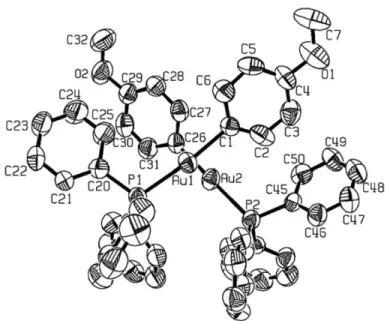
Figure 1-7. ORTEP view of two molecules of 4-MeO-C6H4-AuPPh3. Ellipsoids are drawn at the 50%
probability level. H atoms are omitted for clarity.
Similar to arylgold(I)-complexes, gold-vinyls also contain a C(sp
2)-Au
-bond, but only
few examples of structurally characterized organogold(I)-vinyl complexes existed when the
work contained in this thesis was initiated. The first synthesis of a gold-vinyl species was
reported by Nesmeyanov and Grandberg in 1972, who synthesized the parent vinyl CH
2CH-AuPPh
3from Ph
3PAuCl and vinylmagnesium bromide.
49In a later study, when the reactivity
of CH
2CH-AuPPh
3with HBF
4•Et
2O was investigated, the formation of the digold-vinyl
49 A. N. Nesmeyanov, E. G. Perevalova, V. V. Krivykh, A. N. Kosina, K. I. Grandberg, E. I. Smyslova, Russ.
18
[CH
2CH-(AuPPh
3)
2]
+[BF
4]
–was proposed based on its reactivity,
50but no crystallographic
evidence was provided for either the monogold nor the digold complex.
Much later, in 2006, Laguna was able to verify the proposed connectivity of the
monogold-vinyl complex by X-ray analysis of single crystals of
cis
-1,2-dimethylvinyl-AuPPh
3(Figure 1-8).
51This study was especially important as it represented at the time the
closest structural example to proposed gold-vinyl intermediates in catalysis.
Figure 1-8. ORTEP view of one of the independent molecules of cis-1,2-dimethylvinyl-AuPPh3.
Ellipsoids show 30% probability levels; phenyl H atoms are omitted for clarity.
Seminal work by Kochi in 1973 pointed towards another novelty of organogold(I)
chemistry. While the isolation of late transition metal-alkyl complexes is typically
challenging due to rapid
-hydride-elimination to give an olefin and a metal-hydride species,
Kochi reported the synthesis of several primary, secondary, and even tertiary gold-alkyl
complexes. These compounds were stable at room temperature and showed no indication of
50 K. I. Grandberg, E. I. Smyslova, A. N. Kosina, Izv. Akad. Nauk SSSR, Ser. Khim. 1973, 12, 2787.
51 F. Mohr, L. R. Falvallo, M. Laguna, Eur. J. Inorg. Chem.