COMPLEXITY-BUILDING REACTION DEVELOPMENT
AND THETOTAL SYNTHESIS OF PACTAMYCIN
Justin Thomas Malinowski
A dissertation submitted to the faculty of the University of North Carolina at Chapel Hill in partial fulfillment of the requirements for the degree of Doctor of Philosophy in the Department of Chemistry.
Chapel Hill 2013
Approved by:
Jeffrey S. Johnson
David A. Nicewicz
Michel R. Gagné
Simon J. Meek
© 2013
ABSTRACT
JUSTIN THOMAS MALINOWSKI: Complexity-Building Reaction Development and the Total Synthesis of Pactamycin
(Under the direction of Professor Jeffrey S. Johnson)
I. Tandem Reformatsky/Quaternary Claisen Condensation of Silyl Glyoxylates and -Lactones - Application to Leustroducsin B
The diastereoselective synthesis of -hydroxy ketones via quaternary Claisen
condensation is described. This was accomplished via three-component coupling technology
incorporating a Reformatsky reagent, silyl glyoxylates, and enantioenriched -lactones. An
unusual case of 1,4-stereoinduction was observed, transmitting the -lactone stereochemistry
to the developing fully-substituted stereocenter. The product scaffold was designed for quick
access to the common leustroducsin family core subunit and applied to the formal synthesis of
leustroducsin B.
II. Synthetic Studies Toward the Pactamycin Core
Several approaches for the construction of the pactamycin core are presented. A
pendant ketone functional handle for nucleophilic addition. Highly diastereoselective additions
were permitted by the use of cerium trichloride, leading to a chelation-controlled
stereochemical hypothesis. Four of the five core stereocenters were completed, but a
challenging C2 amination could not be completed. The results of various strategies for the
amino incorporation are discussed, and an optimized route to an advanced intermediate is
described.
III. -Amination of Keto-Nitrones via Multihetero-Cope Rearrangement
The amination problem faced in the pactamycin core synthesis led to the invention and
development of a novel -amination protocol employing nitrones and imidoyl chlorides. Upon
combination of the two reaction partners, spontaneous [3,3]-rearrangement occurred
generating -carbamoyl enamides, or enediamide products based upon the availability of
enolizable protons. Treatment of the products with sodium phenylthiolate induced hydrolysis
IV. Total Synthesis of Pactamycin
The enantioselective total synthesis of pactamycin is detailed. A de novo approach to
this target was pursued using an asymmetric Mannich addition to install the C2 amino
functionality early in the route. A symmetry-breaking diketone monoreduction occurred with
high selectivity allowing for rapid core construction. Several unanticipated stereochemical
complexities allowing for the ultimate target completion were discovered ex post facto leading
to a serendipitous, concise route to pactamycin. The molecule was completed in fifteen steps,
less than half that of the single reported synthesis known to date. The flexibility and efficiency
afforded by this route allow for derivatization toward analogue synthesis. These structural
manipulations may attenuate pactamycin’s cytotoxicity which currently precludes its
ACKNOWLEDGEMENTS
I would first like to express my gratitude to my research advisor Jeffrey Johnson. Jeff’s
emphatic love for chemistry has led to a research program and work environment driven by
creativity, excitement, and passion for improving scientific knowledge. I am fortunate to have
been a part of this experience and recognize that an advisor that “does things for the right
reason” is hard to come by these days. Jeff’s humble demeanor is something that I strive to
replicate, although this may not always be evident. Jeff is an ever-encouraging advisor.
Countless times, when it seems that all ideas have failed and I’m feeling the pain of chemical
research, a short trip to Jeff’s office fosters constructive conversation and produces, infallibly,
an excited graduate student with a long list of reactions to run. Additionally, the freedom Jeff
affords to explore our own desires and plan our own experiments is refreshing and has greatly
contributed to my development. It was a privilege to work in the Johnson group.
I would like to thank Professors Michel Gagné, Simon Meek, and Joseph Templeton
for serving on my final defense committee, as well as David Lawrence, Marcey Waters, and
Maurice Brookhart for serving on past committees and for reference writing. I am especially
thankful to Prof. David Nicewicz for his committee service, work with silyl glyoxylates,
I cannot say enough about my coworkers and friends at UNC. Through the years, the
work environment has been encouraging, intellectual, and fun. Saturday morning Dunkin’
Donuts with Andrew Parsons, Austin Smith, and Andy Brus(c)oe rank among my favorite
memories of grad school. I specifically thank Andrew for motivation, early mornings, and his
contagious work ethic. Andy Satterfield, Chris Tarr, and Steve Greszler all had a major role in
my early development and taught me how to “do chemistry.” Working side-by-side with Steve
(not running columns together…FYI), not only allowed for the development of my skills, but
was a lot of fun. I learned what a “Greszler-approved” method was, and “if the reaction fails,
double the scale!” I was fortunate to spend several years with Dan Schmitt, Mike Slade, Greg
Boyce, Austin, and Kim Steward where we existed as a tight-knit group and I really enjoyed
the camaraderie. Austin, I wouldn’t be putting oats in my protein if it wasn’t for you; oh, you’re
supposed to grind them. You have had a big influence on me and taught me everything I know
about ordering. I’m looking forward to joining you at “emeritus status” as I pass on the duties
to Guy Goodman, a worthy successor. The current roster has continued to exude Johnson
Group excellence and has been a pleasure to work with: Michael Corbett, Dung Do, Scott
Krabbe, Ericka Malow, Rani Ulrich, Ryan Carris, Robert Sharpe, Guy Goodman, Will
Mackay, and Sam Bartlett. I owe thanks to my peer and former roommate Andy Brusoe for
continually stimulating conversation, good times, and countless nights studying sophomore
organic for orals. He has consistently been there for me since we roomed together at the
Carolina Inn for visitation. This is a high-quality group of people with whom I look forward to
maintaining relationships with in the years to come.
I am thankful to those that I have worked closely with on research projects: Steve
undergraduate mentee), and Robert Sharpe (pacta). Each collaboration was unique, fulfilling,
and effective. I am grateful to all of you for putting up with me.
Next I would like to thank my friends and family from home. My college buddies Allen
Parker (reeeesearch!) and Matt Lentner (silver platter) have kept in touch over the years and
provide much-needed breaks from grad school every once in a while. Scott George, now a
fellow scientist, has been an excellent friend and supporter since 7th grade and a welcome
distraction from work. We will all be life-long friends. I would like to express my gratitude to
my in-laws: Jim and Kathy Beswick, Matt, Veronica and the kids. These guys have accepted
me into their family as one of their own and have shown support and interest in all of my
endeavors (for God’s sake, Jim managed to invoke the pactamycin synthesis during his speech
at our wedding!). I have enjoyed becoming a part of the family and look forward to living
closer and spending more time together. I am thankful to all of my siblings who have endured
me as a nerdy older brother: Jared, Amy, Ethan, and Caleb all showed support and interest in
my career, even when they found out I don’t make sunscreen at work every day. Last, but not
least, my parents Tom and Lisa have been exceptional sources of support and encouragement
at every step of my life. They have had to deal with a lot from me, from hysterically crying
whenever I had to part with my mom for preschool (Justin…lets go look at the fish tank) to
leaving the family in New York for good to pursue my graduate studies in North Carolina.
They have always had my best interests at heart, and for that I am grateful.
Finally, I would like to acknowledge my wife Theresa for her love over the last ten
years. Theresa is one seriously bold woman. First, she decides to pursue her ex-boyfriend’s
best friend (don’t worry, I asked Scott for his blessing). She then allows proximity to my
fifteen minutes away from me. Lastly, after my move to North Carolina, she leaves her
“spectacular” job in balmy Albany, NY, taking a leap of faith, and moving to the south with
no solid employment in order for us to be together. The support and devotion she has shown
throughout the years cannot be described with words. She is selfless, patient, understanding,
and caring. She has to deal with a tired, dirty, and moody husband every night after her own
To my family and
in honor of my grandparents, Carmela and August Franze
TABLE OF CONTENTS
LIST OF TABLES ...xv
LIST OF FIGURES AND SCHEMES ... xvi
LIST OF ABBREVIATIONS AND SYMBOLS ... xxi
CHAPTER 1 TANDEM REFORMATSKY/QUATERNARY CLAISEN CONDENSATION OF SILYL GLYOXYLATES AND -LACTONES - APPLICATION TO LEUSTRODUCSIN B 1.1 Introduction ...1
1.2 Background ...2
1.2.1 Shortcomings of the Claisen Condensation ...2
1.2.2 Silyl Glyoxylate Reactivity Profile ...4
1.2.3 Reformatsky Reagents: Uniquely-Effective Silyl Glyoxylate Cascade Promoters ...7
1.2.4 β-Lactones Present an Opportunity for Asymmetric Induction ...9
1.3 Results and Discussion ...10
1.3.1 Mechanistic Proposal ...10
1.3.2 Synthesis of β-Lactone Coupling Partners ...12
1.3.3 Development of Reaction Conditions ...15
1.3.4 Stereochemical Analysis ...17
1.3.5 Reaction Scope...18
1.3.6 Origin of Diastereoselectivity ...21
1.3.7 Subsequent Transformations of β-Hydroxyketone Products ...22
1.3.8 Application to Leustroducsin B ...23
1.5 Experimental Details ...32
1.6 References ...83
CHAPTER 2 SYNTHETIC STUDIES TOWARD THE PACTAMYCIN CORE 2.1 Introduction ...86
2.2 Background ...87
2.2.1 Biological Activity and Biosynthetic Proposal for Pactamycin Synthesis ...87
2.2.2 Prior Syntheses of Pactamycin...89
2.3 Results and Discussion ...98
2.3.1 Preliminary Retrosynthetic Analysis ...98
2.3.2 Construction of the Northeast Quadrant – C1/C7 Stereocenters ...100
2.3.3 Progress Toward a C5 Ketone Electrophile ...102
2.3.4 Intermolecular C5 Nucleophilic Addition Approaches ...104
2.3.5 Intramolecular C5 Nucleophilic Addition Approaches ...105
2.3.6 Key Discoveries Enabling Nucleophile Introduction ...110
2.3.7 Revised Retrosynthetic Strategy – RCM Approach ...112
2.3.8 Screening of Vinyl Nucleophiles and Stereochemical Model ...113
2.3.9 Construction of Cyclopentene Core via RCM Approach ...116
2.3.10 Proposal for C2/C3/C4 Functionalization ...118
2.3.11 Alkene Oxidation Studies ...119
2.3.12 Protecting Group Strategies and Acquisition of Crystal Structure ...123
2.3.13 Electrophilic Ketone -Functionalization Studies ...125
2.3.14 Manipulation of C3 Ketone ...127
2.3.15 C2 Allylic Functionalization ...128
2.4 Conclusion ...130
2.5 Experimental Details ...131
CHAPTER 3 -AMINATION OF KETO-NITRONES VIA MULTIHETERO-COPE
REARRANGEMENT
3.1 Introduction ...156
3.2 Background ...157
3.2.1 Pactamycin C2 Amination Problem...157
3.2.2 Extant Methods for Ketone -Amination ...158
3.2.3 -Oxidation by Rearrangement ...159
3.2.4 Preliminary Reports of -Amination by Multihetero- Cope Rearrangement. ...161
3.3 Results and Discussion ...163
3.3.1 Mechanistic Proposal ...163
3.3.2 Synthesis of Original Imidoyl Chloride Reagent ...164
3.3.3 Nitrone Synthetic Studies ...167
3.3.4 Scope of Benzylhydroxylamine Condensation - Nitrone Synthesis ...168
3.3.5 Initial [3,3]-Rearrangement Results ...170
3.3.6 Second Generation Imidoyl Chloride ...171
3.3.7 Development of the Multihetero-Cope -Amination ...172
3.3.8 Scope of the -Amination Methodology ...173
3.3.9 Secondary Transformations of Diamido Products ...176
3.3.10 Application to Pactamycin C3 -Amination Problem ...181
3.4 Conclusion ...182
3.5 Experimental Details ...183
3.6 References ...205
CHAPTER 4 TOTAL SYNTHESIS OF PACTAMYCIN 4.1 Introduction ...207
4.2 Background ...208
4.2.1 Summary/Analysis of the Hanessian Total Synthesis ...208
4.2.3 Flexibility for Analogue Synthesis ...211
4.2.4 Note on Stereochemistry ...212
4.3 Results and Discussion ...212
4.3.1 Retrosynthesis – Early C2 Amino Introduction ...212
4.3.2 Synthesis of Mannich Precursors ...214
4.3.3 Development of an Asymmetric Mannich Reaction ...216
4.3.4 Discovery of a Symmetry-Breaking Diketone Monoreduction ...222
4.3.5 Testing Nucleophilic Addition to the C5 Methyl Ketone ...226
4.3.6 C5 Enolate Additions ...228
4.3.7 Cyclization Studies ...229
4.3.8 Completion of Core Stereochemical Functionalization ...237
4.3.9 Pactamycin Endgame ...243
4.3.10 Stereochemical Analysis ...247
4.4 Conclusion ...252
4.5 Experimental Details ...253
LIST OF TABLES
Table 1-1 Synthesis of β-Lactone Library ...14
Table 1-2 Substrate Scope ...20
Table 2-1 Diketone Monoreduction Screen ...104
Table 2-2 Nucleophilic Additions to the Methyl Ketone Electrophile ...105
Table 2-3 Conjugate Reduction/Cyclization Strategy ...109
Table 2-4 Epoxidation Studies ...120
Table 2-5 Dihydroxylation Studies ...121
Table 2-6 Rh-Catalyzed C–H Amination Attempts ...123
Table 3-1 Thermodynamic Analysis ...164
Table 3-2 Oxime [3,3]-Rearrangement Trials ...166
Table 3-3 Nitrone Scope...169
Table 3-4 Initial [3,3]-Rearrangement Results ...170
Table 3-5 Substrate Scope – Aliphatic Nitrones ...174
Table 3-6 Substrate Scope – Aryl Nitrones ...176
Table 3-7 Hydrolysis of Enamide Products ...177
Table 3-8 Hydrogenation/Reduction of Enamide Products ...179
Table 3-9 -Functionalization of Enamide Products ...180
Table 4-1 Screening of Mannich Conditions ...219
Table 4-2 -Halogenation Studies ...231
Table 4-3 Aldol Cyclization of the -Ketoester ...232
Table 4-4 C5 Methyl Additions...240
Table 4-5 Aniline Introduction via Ring-Opening ...244
LIST OF FIGURES AND SCHEMES
Figure 1-1 “Normal” vs. “Quaternary” Claisen Reaction ...3
Figure 1-2 Current Solutions to the Quaternary Claisen Problem ...3
Figure 1-3 Reactivity of Silyl Glyoxylate ...5
Figure 1-4 Selected Products Obtained by Silyl Glyoxylate Cascades ...6
Scheme 1-1 Greszler Double Reformatsky -Butyrolactone Synthesis...7
Figure 1-5 Double Reformatsky Proposed Mechanism...9
Figure 1-6 Proposed 1,4-Transfer of Chirality ...10
Figure 1-7 Three-Component Coupling Chemoselectivity Challenges...11
Scheme 1-2 Nelson’s Asymmetric β-Lactone Synthesis ...12
Scheme 1-3 Synthesis of Aluminum Triflamide Catalyst ...12
Scheme 1-4 Disubstituted β-Lactone and β-Lactam Synthesis ...15
Scheme 1-5 Three-Component Coupling Reaction ...16
Figure 1-8 Subsequent Ketone Reduction/StereochemicalAnalysis ...18
Figure 1-9 Competing Transition State Models ...22
Scheme 1-6 Diester Functionalization ...23
Figure 1-10 Leustroducsin and Related Natural Products ...24
Figure 1-11 Retrosynthetic Analysis ...25
Scheme 1-7 Synthesis of Dihydropyrone Precursor ...26
Scheme 1-8 Dihydropyrone Installation ...28
Scheme 1-9 Completion of Formal Synthesis ...30
Figure 2-1 Structure of Pactamycin ...87
Scheme 2-1 Biosynthetic Synthesis of Pactamycin ...89
Scheme 2-2 Isobe Pactamycin Core Approach ...90
Scheme 2-3 Knapp Pactamycin Core Approach ...91
Scheme 2-5 Hanessian Core Completion ...93
Scheme 2-6 Hanessian Endgame ...94
Scheme 2-7 Looper Pactamycin Core Approach ...95
Scheme 2-8 Epoxide-Opening Cascade ...96
Scheme 2-9 Isobe’s Alternate Cyclization Strategy ...97
Figure 2-2 Mahmud Bioengineering Synthesis ...97
Figure 2-3 Retrosynthetic Analysis – Aldol Cascade Approach ...99
Scheme 2-10 Construction of Allylation Precursor ...100
Scheme 2-11 Asymmetric Allylation...101
Scheme 2-12 Methylation Attempts ...102
Scheme 2-13 Diketone Strategy...103
Figure 2-4 Intramolecular Addition Approaches ...106
Figure 2-5 Hydroxyl Tethered Additions ...107
Figure 2-6 Olefin Tethered Additions ...108
Figure 2-7 Two Important Discoveries ...110
Figure 2-8 Ethyl Diazoacetate Addition - Revisited...112
Figure 2-9 Modified Retrosynthetic Approach – RCM Strategy ...113
Scheme 2-14 Nucleophilic Addition to C5 Ketone Model Study...114
Scheme 2-15 Reversed Nucleophilic Addition at C5 ...115
Figure 2-10 Stereochemical Selectivity Model ...116
Figure 2-11 Functionalized Vinyl Addition ...117
Scheme 2-16 Synthesis of Pactamycin Cyclopentene Core ...118
Figure 2-12 Proposed Core Completion ...119
Figure 2-13 Potential Mechanism for Isocyanate Formation ...120
Scheme 2-17 Ketone and Protecting Group Schemes ...124
Figure 2-14 Diacetonide Crystal Structure ...124
Scheme 2-18 Non-Amine C2 Functionalizations ...126
Scheme 2-19 Neber Rearrangement ...127
Scheme 2-20 Pd-Catalyzed Aniline Coupling ...128
Figure 2-16 Allylic Functionalization ...129
Figure 2-17 Summary ...130
Figure 3-1 Failed C2 Amination ...157
Figure 3-2 Azodicarboxylates as Electrophilic Amination Reagents ...158
Scheme 3-1 House and Richey -Acetoxylation ...160
Scheme 3-2 Cummins and Coates -Acetoxylation ...160
Scheme 3-3 Single Step -Acetoxylation ...161
Figure 3-3 -Oxidation and -Amination by [3,3]-Rearrangement ...161
Figure 3-4 Aryl vs. Alkyl -Amination by [3,3]-Rearrangement ...162
Figure 3-5 Substrate Scope of Extant -Amination Reports ...162
Figure 3-6 Proposed Mechanism of -Amination ...163
Scheme 3-4 Phthalimido Imidoyl Chloride ...165
Figure 3-7 Possible Imidoyl Chloride Surrogates ...165
Scheme 3-5 Synthesis of an Oxime Test Substrate ...166
Figure 3-8 Commercial Hydroxylamine Results ...167
Scheme 3-6 Synthesis of a Benzyl-Hydroxylamine Series...167
Scheme 3-7 Initial Nitrone Result...168
Figure 3-9 Incompatible Ketones for Nitrone Formation ...170
Scheme 3-8 Second Generation Imidoyl Chloride Synthesis ...172
Scheme 3-9 Initial Result ...172
Figure 3-10 Proposed Mechanism for Enamide Formation ...173
Figure 3-11 Enediamide Formation from Aryl Nitrones ...173
Figure 3-12 Plausible Mechanism for -Chloro Product Formation ...175
Figure 3-14 Bromination Cascade ...181
Scheme 3-10 Application to Pactamycin ...182
Figure 4-1 Structure of Pactamycin ...207
Figure 4-2 Abridged Hanessian Synthesis ...208
Figure 4-3 Our Previous Failed Route ...210
Figure 4-4 Pactamycin Retrosynthesis ...213
Scheme 4-1 Synthesis of Urea Pronucleophile ...214
Scheme 4-2 Synthesis of Imine Electrophile ...215
Figure 4-5 Schaus Organocatalyzed Mannich Additions ...216
Scheme 4-3 Mannich Reaction Initial Result ...217
Figure 4-6 Chiral Catalysts Screened for Enantioselective Mannich Addition ...220
Scheme 4-4 Optimized Mannich Addition ...222
Figure 4-7 Stereochemical Possibilities for Monoreduction ...223
Figure 4-8 Selective Oxidations Shed Light on Stereochemical Problem ...224
Scheme 4-5 Reduction/Protection Sequence ...225
Figure 4-9 Grignard Additions to the Diketone ...226
Figure 4-10 Alternative Diketone Additions ...227
Scheme 4-6 C5 Enolate Nucleophilic Additions ...228
Figure 4-11 Aldol Cyclization Strategy ...230
Figure 4-12 Surprising Epoxidation Result ...234
Figure 4-13 Failed Subsequent Enone Transformations ...235
Figure 4-14 Aldol Cyclization of Other Ketones ...236
Figure 4-15 Requirements to Complete Core ...237
Figure 4-16 Diastereoselective Epoxidation ...239
Scheme 4-7 Route to a Crystalline Derivative ...242
Figure 4-17 Racemic Crystal Structure Revealing Six Correct Stereocenters ...242
Scheme 4-9 Salicylate Installation ...245
Figure 4-18 Presumed Transfer of Stereochemistry Through Synthesis ...248
Figure 4-19 Deuterium Incorporation Studies ...249
Scheme 4-10 Route to Crystalline Lactol Benzoate ...249
Figure 4-20 Reduction Product Absolute Crystal Structure ...250
LIST OF ABBREVIATIONS AND SYMBOLS
2D-NMR two-dimensional nuclear magnetic resonance
p-ABSA para-acetamidobenzenesulfonyl azide
Ac acetate
Ar aryl
aq aqueous
atm atmospheres
Bn benzyl
BOC benzyloxycarbonyl
br broad
br s broad singlet
nBu normal-butyl
tBu tert-butyl
Bz benzoyl
CSA camphorsulfonic acid
13C NMR carbon nuclear magnetic resonance spectroscopy
C–C carbon-carbon bond
cat catalytic amount or catalyst
conv conversion
COSY correlated spectroscopy
m-CPBA meta-chloroperoxybenzoic acid
d doublet or days
DCC N,Nʹ-dicyclohexylcarbodiimide
dd doublet of doublet
ddt doublet of doublet of triplets
DEAD diethylazodicarboxylate
DIAD diisopropylazodicarboxylate
DIBAL-H diisobutylaluminum hydride
DIPEA ethyldiisopropylamine
dq doublet of quartet
DMAP 4-N,N-dimethylaminopyridine
DME dimethoxyethane
DMF N,N-dimethylformamide
DMSO dimethyl sulfoxide
d.r. diastereomeric ratio
dt doublet of triplet
E+ or El electrophile
eq equation
equiv equivalents
e.r. enantiomeric ratio
ESI electrospray ionization
Et ethyl
Et2O diethyl ether
EtOAc ethyl acetate
FID flame ionization detector
G2 Grubbs’ second generation catalyst
h hour
1H NMR proton nuclear magnetic resonance spectroscopy
HOAc acetic acid
HMDS hexamethyldisilazane
HPLC high performance liquid chromatography
HRMS high resolution mass spectroscopy
Hz hertz
IR infrared spectroscopy
J coupling constant
kcal kilocalorie
L liter or ligand
LA Lewis acid
LAH lithium aluminum hydride
LDA lithium diisopropylamide
LiHMDS lithium hexamethyldisilazide
LRMS low resolution mass spectroscopy
M metal or molarity
m multiplet
Me methyl
MeCN acetonitrile
MeOH methanol
mg milligram
MHz megahertz
min minutes
mL milliliter
mmol millimole
mp melting point
n number of atoms or counterions
NBS N-bromosuccinimide
NIS N-iodosuccinimide
nd not determined
NHK Nozaki-Hiyama-Kishi
NMP N-methylpyrrolidone
nOe nuclear Overhauser enhancement
NOESY nuclear Overhauser enhancement spectroscopy
NR no reaction
Nu nucleophile
PCC pyridinium chlorochromate
PG protecting group
Ph phenyl
ppm parts per million
iPr iso-propyl
R substituent
Rf retention factor
rac racemic
RCHO aldehyde
RCM ring-closing metathesis
rt room temperature
s singlet
SFC supercritical fluid chromatography
SN2 bimolecular nucleophilic substitution
T temperature
t triplet
tr retention time
TBAF tetrabutylammonium fluoride
TBS tert-butyldimethylsilyl
TBDPS tert-butyldiphenylsilyl
TBSOTf tert-butyldimethylsilyl trifluoromethanesulfonate
TEA triethylamine
TEMPO tetramethylpiperidine-N-oxide
TES triethylsilyl
TMS trimethylsilyl
Tf trifluoromethanesulfonyl
THF tetrahydrofuran
TMS trimethylsilyl
Tr trityl or triphenylmethyl
triflate trifluoromethanesulfonate
Ts para-toluenesulfonyl
UV ultraviolet
X anionic ligand, halide, substituent, or number
[] optical rotation
δ chemical shift or partial charge
CHAPTER ONE
TANDEM REFORMATSKY/QUATERNARY CLAISEN CONDENSATION OF SILYL
GLYOXYLATES AND
-LACTONES - APPLICATION TO LEUSTRODUCSIN B
*1.1 Introduction
The -ketoester moiety is a fundamental building block in organic chemistry,
displaying a useful ambiphilic reactivity profile and multiple nucleophilic sites to launch
synthetic endeavors. Formation of complex fully-substituted -ketoesters by means of C–
acylation is, however, a largely unsolved problem. The prototypical -ketoester synthesis, the
Claisen condensation, fails to provide a means for fully-substituted carbon synthesis except in
rare cases of highly-regulated, limited systems1 largely due to thermodynamic constraints
disfavoring productive reactivity. A general method enabling quaternary Claisen reactivity
would provide machinery for rapid assembly of complexity as well as multiple functional
handles for subsequent manipulation, a circumstance especially beneficial in natural product
synthetic applications. In this chapter, we disclose a diastereoselective, multicomponent
quaternary Claisen reaction, incorporating silyl glyoxylates as key conjunctive reagents. This
Reformatsky-initiated cascade provides highly-functionalized -ketoester scaffolds when
* Reprinted in part with permission from Greszler, S. N.; Malinowski, J. T.; Johnson, J. S. J.
terminated with -lactone electrophiles and displays an unusual stereochemical 1,4-induction
mode. The utility of this method is demonstrated by subsequent rapid access to the
leustroducsin natural product family.
1.2 Background
1.2.1 Shortcomings of the Claisen Condensation
Discovered in 1887,2 the Claisen condensation is a fundamental reaction in organic
chemistry. At first glance the reaction appears simple: enolization of a pronucleophile followed
by attack on a carbonyl electrophile to form an important C–C bond. Upon detailed
examination, the reaction is complicated by the fact that it is entirely governed by
thermodynamics and is fully-reversible, leading to issues with -center stereocontrol, and
more relevant in this context, quaternary center formation. Figure 1-1 illustrates two
mechanistic features which disqualify quaternary Claisen reactivity under standard conditions.
First, the fully-substituted enolate is more thermodynamically stable and less reactive than the
corresponding tri-substituted species. This dictates a reactants-favored equilibrium resulting in
little product formation. Second, as the Claisen condensation is fully-reversible, the drive to
completion is only accomplished by an -deprotonation of the highly-acidic -ketoester
product. This stabilized, tetrasubstituted enolate pushes equilibrium towards product
formation. However, in the quaternary case, deprotonation of an ,-disubstituted product is
Figure 1-1. “Normal” vs. “Quaternary” Claisen Reaction
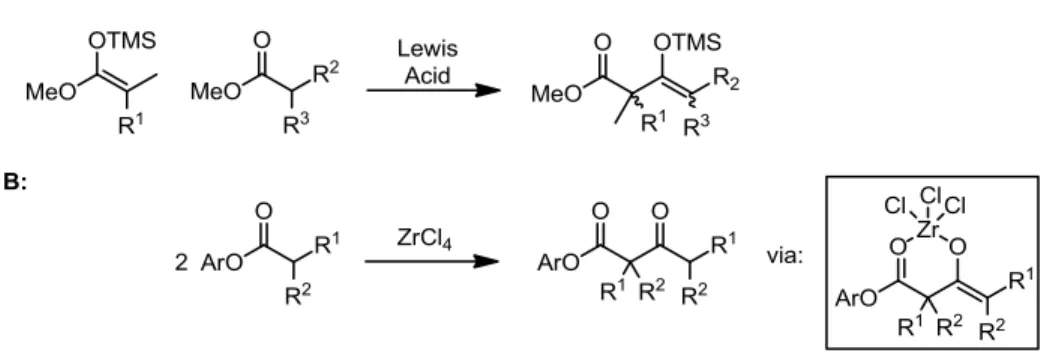
Two isolated approaches to this problem have been reported in the literature. The first
uses highly activated, pre-formed silyl ketene acetal nucleophiles under Lewis acidic
conditions to effect the desired transformation (Figure 1-2, A).1a-c The reaction presumably
proceeds to completion via the formation of a stabilized enolsilane product. The second
approach exploits an unusually strong Zr chelate effect that stabilizes the -ketoester product,
driving the reaction to completion (Figure 2-1, B).1d
Figure 1-2. Current Solutions to the Quaternary Claisen Problem
While these creative approaches enable formation of quaternary centers in specific
cases, they are limited to specific substitution patterns, prefunctionalization of components
condensation from which molecular complexity could be generated in a general sense is
particularly attractive and remains elusive to researchers.
1.2.2 Silyl Glyoxylate Reactivity Profile
The title reaction features a key conjunctive reagent based upon the -silyl--ketoester
scaffold, termed “silyl glyoxylate” (1.1).3 These reagents have been developed by the Johnson
research group as linchpins for the coupling of nucleophilic reagents with electrophiles at a
glycolic acid junction, and have provided numerous complexity-building, diastereoselective
coupling methodologies since the seminal work reported by Nicewicz in 2005.4 The unique
reactivity pattern displayed by these reagents is facilitated by the [1,2]-Brook rearrangement
(C O silyl migration).5 As shown in Figure 1-3, nucleophilic attack on silyl glyoxylate
provides initial adduct 1.2 which undergoes facile silyl migration (driven by an increased Si–
O bond strength of ~ 40 kcal/mol and the resonance stabilization of the developing negative
charge by the ester moiety) to provide a nucleophilic glycolate enolate species (1.3). Addition
of a “secondary” electrophile then provides the three-component coupled product 1.4. The
electron-withdrawing vicinal ester renders silyl glyoxylates exceptionally electrophilic, a
circumstance which permits chemoselective attack in the presence of other electrophiles
Figure 1-3. Reactivity of Silyl Glyoxylate
C-Si C=O
Extant coupling reactions featuring silyl glyoxylates are initiated by metal acetylides3
Grignard reagents,6 hydride donors,7 and enolates.8 Compatible secondary electrophilic
partners include: aldehydes, ketones, nitroalkenes, and enones. Permutations of these coupling
partners have opened access to a wide range of stereodefined complex building blocks and
Figure 1-4. Selected Products Obtained by Silyl Glyoxylate Cascades
In this chapter, we discuss our work on the development and application of a highly
diastereoselective quaternary Claisen coupling reaction enabled by silyl glyoxylate
technology. The Reformatsky initiation of this cascade is analogous to chemistry developed
previously in the group, but differs in the secondary electrophile selection and corresponding
product scaffold.8b Our hypothesis for the successful execution of a quaternary Claisen
pathway was that ring-strain relief could drive the reaction to completion. To test this proposal,
we chose -lactones as terminating electrophiles. We speculated that inherent ring-strain, as
well as irreversible ring-opening might allow for a terminating C–C bond construction
1.2.3 Reformatsky Reagents: Uniquely-Effective Silyl Glyoxylate Cascade Promoters
In early optimization studies, Greszler identified Reformatsky reagents as capable
nucleophiles for the initiation of a double Reformatsky -butyrolactone synthesis (Scheme
1-1).8b Lithium and magnesium enolates showed high reactivity and low selectivity, typically
giving complex product mixtures, but the tempered nucleophilicity of the Reformatsky enolate
allowed for successful execution of the cascade under carefully controlled conditions.
Although this reaction proceeded with modest yields, the complexity generated and unusually
high diastereoselectivity is noteworthy.
Scheme 1-1. Greszler Double Reformatsky -Butyrolactone Synthesis
The Reformatsky reaction, formally an oxidative addition of Zn0 into an -haloester
followed by electrophilic trapping, has enjoyed myriad applications since its discovery in the
late nineteenth century.9 Its benefits include the generation of reactive enolate species under
neutral conditions, use of inexpensive reagents, and typically good chemoselectivities in
complex systems. Reproducibility is sometimes problematic in this reaction and is typically
attributed to generation of the Reformatsky reagent. Commercial zinc dust has been shown
effective in this reaction, provided that a successful activation protocol is employed. The
purpose of this activation is to remove the Zn-oxide coating on the dust, allowing for
chloride,10 dibromoethane,11 and bromine,12 and the method of choice is critical and sometimes
empirical in nature (vide infra).
In solution, Reformatsky reagents typically exist as dimeric complexes as the C–Zn
metalated species, a feature pertinent to mechanistic considerations.13 A reversible C O zinc
migration is facile and gives the reactive zinc enolate, which participates in the C–C bond
forming event. This stability of the C–Zn metalated species and low barrier for C–O migrations
are invoked to explain the highly diastereoselectivity observed in the Greszler system (Figure
1-5). The mechanism begins with nucleophilic attack on silyl glyoxylate and subsequent Brook
rearrangement, providing the proposed five-membered zinc chelate (1.5). This species can
undergo O C zinc migration to give the acyclic C-metalated species 1.6, which allows for
isomerization to the more stable (E)-enolate, proposed to exist as a seven-membered chelate
after a second C O zinc migration (1.7). High levels of diastereoselectivity were observed
only when an -alkyl substituent was placed on the Reformatsky reagent. This directing group
was imperative as facial approach of the ketone comes opposite that of the -alkyl substituent
with the larger aryl substituent occupying a pseudo-equatorial conformation (1.8), providing
Figure 1-5. Double Reformatsky Proposed Mechanism
1.2.4 β-Lactones Present an Opportunity for Asymmetric Induction
β-Lactones display a variety of unique properties which render them attractive for this
coupling reaction. The built-in ring strain of a four-membered ring both increases
electrophilicity at the carbonyl for nucleophilic attack and could lead to an irreversible Claisen
pathway upon its release. Additionally, a plausible means for asymmetric induction is available
through substrate control. While most of the known silyl glyoxylate coupling reactions are
highly diastereoselective, they lack absolute stereocontrol and provide racemic products.
While an enantioselective protocol has been elusive, use of an asymmetric starting material
could in principle provide transfer of stereochemical information to the products. β-Lactones
were especially attractive to us due to the breadth of asymmetric methods for their synthesis.14
The challenge we faced was the distance of the developing stereocenter from the β-lactone
the literature. Shown in Figure 1-6, the initial glycolate enolate adduct 1.9 (formed by
Reformatsky attack on silyl glyoxylate, followed by Brook rearrangement) could attack a chiral
β-lactone (1.10) giving β-hydroxyketone product 1.11. The question we sought to explore was
the stereochemical outcome at the developing fully-substituted center. Transfer of chiral
information from the distal hydroxyl stereocenter would provide a diastereoselective
quaternary Claisen condensation, with desired absolute stereocontrol achieved by judicious
β-lactone selection.
Figure 1-6. Proposed 1,4-Transfer of Chirality
1.3 Results and Discussion
1.3.1 Mechanistic Proposal
The purpose of this investigation was to address the quaternary Claisen condensation
problem through an expansion of the silyl glyoxylate three-component coupling research
program. Additionally, the predicted products accessed by this methodology could be highly
relevant in natural product applications (vide infra). The anticipated chemoselectivity
Figure 1-7. Three-Component Coupling Chemoselectivity Challenges
The Reformatsky reagent will be in solution with two electrophilic species, silyl
glyoxylate (1.1) and the β-lactone (1.10). The first mandate requires chemoselective
nucleophilic attack on silyl glyoxylate (path b) to give glycolate enolate 1.9. Direct attack on
the β-lactone would provide β-hydroxyketone 1.13, an unproductive pathway (path a). Next,
the glycolate enolate must show preference for the β-lactone over another equivalent of silyl
glyoxylate to provide the desired product 1.11 (path d). Incorporation of a second equivalent
of silyl glyoxylate could lead to an undesired oligimerization pathway (path c).
Silyl glyoxylate chemoselectivity challenges have been overcome with temperature
control, stoichiometry, and order of addition. For instance, in the related Greszler
-butyrolactone synthesis,8b excess Refomatsky reagent was added to silyl glyoxylate at -20 °C
and allowed to run until the glyoxylate was fully consumed. The secondary electrophile was
then added, and the reaction was warmed to effect Brook rearrangement and the subsequent,
terminating nucleophilic attack. Ideally, we hoped to develop a protocol in which the three
1.3.2 Synthesis of β-Lactone Coupling Partners
The ketene-aldehyde coupling reported by Nelson14a,b proved most effective for rapid
generation of an enantioenriched β-lactone library for screening. The parent reaction is shown
in Scheme 1-2 and involves generation of ketene followed by a formal [2 + 2] cycloaddition
with an aldehyde catalyzed by a chiral aluminum triflamide complex.
Scheme 1-2. Nelson’s Asymmetric β-Lactone Synthesis
Catalyst 1.15 was prepared on multigram scale by the following three-step sequence
from the chiral pool (Scheme 1-3).15 L-Valinol was first converted to the chiral aziridine 1.17
upon treatment with excess triflic anhydride. Subsequent bis-ring opening by benzylamine
(neat) at elevated temperatures afforded bis(triflamide) 1.18. Ensuing treatment with
trimethylaluminum provided the desired catalyst 1.15 in excellent yield (>4 g per sequence).
Scheme 1-3. Synthesis of Aluminum Triflamide Catalyst
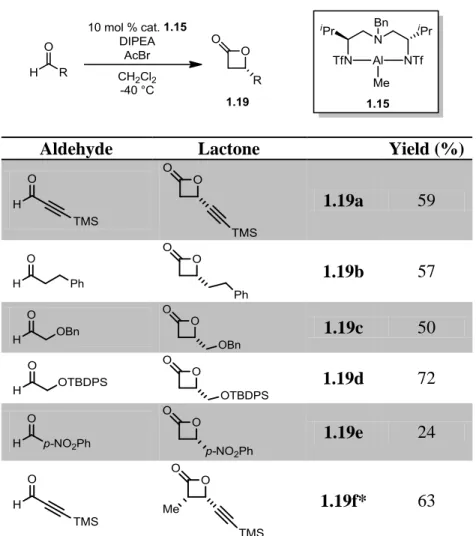
Aldehydes were purchased or independently synthesized and subjected to the reaction
conditions to provide the corresponding β-lactones 1.19a – 1.19f (Table 1-1). We were
outcome of the reaction, so cis and trans β-lactones 1.19g16 and 1.19h17 were prepared (Scheme
1-4). In addition, we questioned whether β-lactams would be sufficiently electrophilic to
participate in the title reaction. To this end, lactams 1.20a – 1.20c were prepared with nitrogen
protecting groups with varied electronic properties via known methods.18
The enantioselectivity of the Nelson Al-catalyzed formal [2 + 2] cycloaddition was
assayed for model lactone 1.19a by supercritical fluid chromatography (SFC) analysis of the
corresponding β-hydroxyketone product (vide infra). The ee value was determined to be 83%,
Table 1-1. Synthesis of β-Lactone Library
Aldehyde Lactone Yield (%)
1.19a 59
1.19b 57
1.19c 50
1.19d 72
1.19e 24
1.19f* 63
Scheme 1-4. Disubstituted β-Lactone and β-Lactam Synthesis
1.3.3 Development of Reaction Conditions
Reaction optimization was initially focused upon efficient, reproducible generation of
the Reformatsky reagent. As we had aspirations for natural product synthesis applications,
scalability was also a requirement for the title reaction. Ethyl bromoacetate was selected as the
reagent precursor and was added dropwise to an activated suspension of zinc dust refluxing in
diethyl ether. The reaction was maintained at reflux for several hours to ensure completion and
titrated with iodine to assess active reagent concentration. For small-scale screening purposes,
TMSCl activation10 of the zinc dust was sufficient; however, upon scale-up (multigram), this
method typically failed or gave widely-varied Reformatsky reagent concentrations. For these
large scale applications, the bromine activation method12 was employed, typically giving
typically prepared immediately prior to use, but could be stored for up to one week in the
freezer without significant deterioration.
Initial reaction screening was performed with β-lactone 1.19a and silyl glyoxylate 1.21.
Mirroring the method used for the previous double Reformatsky reaction, silyl glyoxylate 1.21
was added dropwise to a cooled solution of Reformatsky reagent. Upon full conversion (TLC
analysis or disappearance of characteristic bright yellow color of the silyl glyoxylate), a
solution of lactone 1.19a was introduced and the reaction was warmed until judged complete
by TLC. Initial reaction trials proceeded to form the desired β-hydroxyketone product 1.22
with excellent diastereoselectivity. A minor enone byproduct was observed (1.23) presumably
resulting from elimination of the intermediate zinc alkoxide. We were pleased to note that
addition of a solution of both silyl glyoxylate and β-lactone to the Reformatsky reagent
proceeded with complete chemoselectivity and identical yield, simplifying the experimental
protocol. Temperature studies revealed -30 °C as optimal for the initial Reformatsky attack on
silyl glyoxylate, and slow warming typically resulted in Brook rearrangement and reaction
completion upon reaching 0 °C.
1.3.4 Stereochemical Analysis
Prior to exploration of the reaction scope we endeavored to analyze the high level of
1,4-stereoinduction observed in the three component coupling reaction. To this end, the TBS
derivative of coupling product 1.23 (1.24) was subjected to two diastereoselective directed
reductions (Figure 1-8). The Evan’s anti reduction19 proceeded with excellent
diastereoselection, affording 1,3-anti-diol 1.25. The Prasad syn reduction20 cleanly gave
1,3-syn-diol 1.26. Both diols were subjected to acid-catalyzed lactonizations in order to obtain
rotation-restricted compounds for 2D NMR analysis. Cyclization of diol 1.25 gave the
corresponding mono(lactone) 1.27, while the syn-diol 1.26 gave a bis(lactone) (1.28). This
divergence in reactivity can be rationalized by the relatively-high energy barrier for formation
of a trans-fused bicycle in the anti diol case. We used nOesy analysis of each lactone to provide
conclusive evidence for the assignment of the relative configuration of the fully-substituted
Figure 1-8. Subsequent Ketone Reduction/StereochemicalAnalysis
1.3.5 Reaction Scope
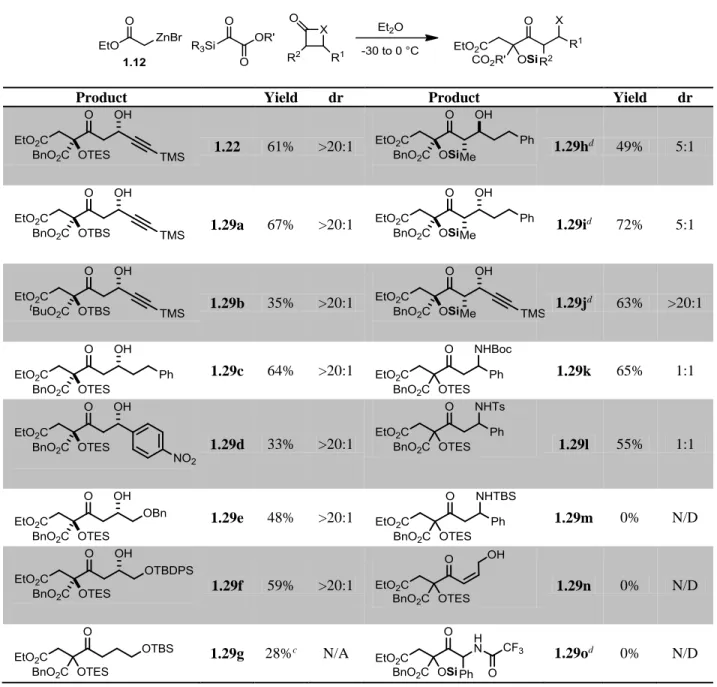
With a highly-diastereoselective method in hand for a quaternary
Claisen/β-hydroxyketone synthesis, we set out to investigate the reaction scope (Table 1-2). First, three
silyl glyoxylates were tested with β-lactone 1.19a. While the TBS/Bn and TES/Bn showed
similar efficiencies (61%/67% yield; 1.22, 1.29a), the TBS/tBu case showed a highly
diminished yield (35%; 1.29b). This may be attributed to the added steric bulk proximal to the
reactive centers, hindering both the initial nucleophilic attack by the Reformatsky reagent and
second C–C bond formation with the β-lactone. Next, a series of β-substituted-β-lactones
(1.19b – 1.19e) were screened. The reaction proved tolerant of alkyl, aryl, and protected
hydroxyl functionalities with yields ranging from 33-64% and complete diastereoselection in
all cases. Disubstituted β-lactones also performed well, with the cis and trans hydrocinnamyl
dr). A disubstituted alkynyl β-lactone, however, maintained complete diastereoselection
(1.29j).
Protecting group identity on the β-lactam substrates proved important. While the
electron deficient Boc and Tosyl groups showed analogous reactivity to the β-lactones, albeit
with no diastereocontrol, the TBS-protected lactam failed to react. Presumably this is an
electronic effect, although steric encumbrance cannot be ruled out. Additional five-membered
ring electrophiles were tested with varying results. -Butyrolactone reacted smoothly under the
reaction conditions (1.29g), but gave an unstable product that required immediate silyl
protection due to a dominant retro-Claisen pathway. A furanone (1.29n) and oxazolinone
(1.29o) were tested; each would provide useful functional handles. Unfortunately, neither
Table 1-2. Substrate Scopea,b
Product Yield dr Product Yield dr
1.22 61% >20:1 1.29hd 49% 5:1
1.29a 67% >20:1 1.29id 72% 5:1
1.29b 35% >20:1 1.29jd 63% >20:1
1.29c 64% >20:1 1.29k 65% 1:1
1.29d 33% >20:1 1.29l 55% 1:1
1.29e 48% >20:1 1.29m 0% N/D
1.29f 59% >20:1 1.29n 0% N/D
1.29g 28%c N/A 1.29od 0% N/D
a. All reactions: 2.3 equiv 1.12, 1.0 equiv silyl glyoxylate, 1.6 equiv lactone/lactam, [silyl
glyoxylate]0 = 0.5M. b. See section 1.5 Experimental Details for more information. c. Yield reported over two steps. d.Si = TES.
The effect of lithium chloride was tested during the course of this investigation.
Reported by Knochel, Reformatsky reagents can often exhibit enhanced reactivity due to the
formation of a zincate complex.21 This additive had a minor effect on yield for some substrates,
addition of this salt (See section 1.5 Experimental Details). A final perturbation of the title
reaction tested was the initiation via allylzinc bromide. In this experiment, the zinc nucleophile
reacted without discrimination, yielding a complex mixture.
1.3.6 Origin of Diastereoselectivity
The impressive stereochemical outcome of this reaction may be explained by the
borrowing of some key features from the initial Greszler double Reformatsky reaction (1.8,
Figure 1-5). After Reformatsky attack on silyl glyoxylate and subsequent Brook
rearrangement, isomerization to the seven-membered (E)-glycolate enolate chelate structure
occurs to give the second, active nucleophilic species. In this event, diastereofacial approach
of the β-lactone will dictate the stereochemical outcome of the emerging fully-substituted
center. Here, we deviate from the previous model wherein the -methyl substituent of the
Reformatsky reagent dictated approach of the ketone electrophiles. In the present case, it seems
plausible that the β-lactone will approach with its β-substituent pointing away from the enolate,
but a second controlling element must be at play to distinguish between transition structures
Figure 1-9. Competing Transition State Models
We propose a subtle, electrostatic effect governs the complete diastereoselection of the
title reaction. As depicted in Figure 1-9, a lone pair repulsion between the β-lactone ring
oxygen, and the benzyloxy substituent on the glycolate enolate might provide enough of a
barrier to encourage reactivity through 1.30, providing the observed diastereomer. More
experimentation would be necessary to confirm this or alternative models of
diastereoselectivity. With the lack of diasterocontrol observed for the β-lactam substrates, it is
apparent they are poorly differentiated in our working model or react through an orthogonal
transition state.
1.3.7 Subsequent Transformations of β-Hydroxyketone Products
The β-hydroxyketone product scaffold obtained from the title reaction provides unique
opportunities for subsequent manipulation. Functionality present includes: two differentiated
esters, a highly-substituted ketone, β-hydroxyl group, and the moiety provided by the β-lactone
substrate selection. In addition to the derivations described in Figure 1-8 (directed ketone
reductions/cyclizations to form mono or bis(lactones)), we have shown selective manipulation
of the ester functionality (Scheme 1-6). A two-step sequence beginning with Prasad reduction
ethyl ester was achieved upon treatment with DIBAL-H to provide monoalcohol 1.33.
Alternatively, subjection of the diester to lithium triethylborohydride (Super-Hydride)
afforded diol 1.34 for further transformation.
Scheme 1-6. Diester Functionalization
1.3.8 Application to Leustroducsin B†
Background. The three-component coupling reaction was designed with application to
targeted natural product synthesis in mind. Specifically, we were interested in the core structure
of the phoslactomycin22 and leustroducsin23 natural product families (Figure 1-10). Isolated in
1993 by Kohama et al., these natural products have been shown to exhibit interesting biological
activities across multiple phyla. We were particularly interested in the array of congested
functionality that comprises the common core of these targets.
†
Figure 1-10. Leustroducsin and Related Natural Products
Each natural product boasts a stereodefined tertiary alcohol (C8) with flanking
dihydropyrone and phosphate functionality. Distal amino and allylic alcohol functionalities
complete the core structure. The individual members of these families are distinguished by the
ester substituents stemming from C18, with leustroducsin B among the most complex with a
6-methyl octanoate subunit. Additionally, leustroducsin B possesses the most intriguing
biological activity and was therefore chosen as our target for synthesis. Although three extant
syntheses have been reported: Fukuyama (2003, 47 steps),24 Imanishi (2006, 32 steps),25 and
Cossy (2008, formal – 27 steps),26 we identified the congested core as a central challenge and
believed our methodology could provide unprecedented, rapid access.
Retrosynthetic analysis. The products derived from our three-component coupling
required. As shown in Figure 1-11, the fully-substituted C8 stereocenter is fully-assembled
with the C9 ketone in place, poised for directed reduction by the C11 hydroxyl. The ethyl ester
can be converted into amino functionality, and the alkyne functionality can be downstream
functionalized to reveal the (Z,Z)-diene. The only obvious discrepancy is the incorrect
stereochemistry at C11. This was not considered problematic in our analysis, as we anticipated
using this feature for our reported syn directed reduction. A Mitsunobu inversion could be
employed late-stage to correct the hydroxyl center.
Figure 1-11. Retrosynthetic Analysis
Our general strategy for assembly of leustroducsin B was to first manipulate
β-hydroxyketone 1.22 in order to generate an intermediate adequately protected and in the correct
oxidation state. Next, the dihydropyrone element would be installed using a method inspired
by the efficient route in the Cossy synthesis. This would be followed by manipulation of the
protected alkyne to reveal an appropriate coupling partner to participate in an organometallic
cross-coupling reaction to install the eastern fragment. This convergent approach would ideally
Synthetic endeavors. Synthesis from three-component coupling product 1.22 began
with the syn reduction/acetonide protection outlined in Scheme 1-6. This provided diester 1.32,
which was subjected to excess Super-Hydride to furnish the corresponding diol (1.34, Scheme
1-7). Selective silyl protection of the less-hindered primary alcohol followed by Dess-Martin
periodinane oxidation provided aldehyde 1.35 as a functional handle from which to install the
(E)-alkene bridge to the dihydropyrone moiety. A two-carbon homologation sequence was
performed beginning with a Horner-Wadsworth-Emmons olefination to install an unsaturated
nitrile. Subsequent reduction and hydrolysis provided acrolein 1.36 in excellent yield, giving
an appropriate electrophile from which to begin dihydropyrone synthesis.
Scheme 1-7. Synthesis of Dihydropyrone Precursor
After numerous failed alternatives, we turned to the sequence reported by Cossy27a to
install the important dihydropyrone moiety. We began with an asymmetric Brown-type
pentenylation (1.37). This occurred in excellent yield with high enantioselectivity, and allowed
for enantioenrichment after diastereomeric removal of the minor enantiomer (present from
acryloyl chloride setting up a ring-closing metathesis (RCM) to close the six-membered ring.
Unfortunately, conditions to effect this transformation were never realized due to
complications we attributed to the alkyne. Indeed, upon investigation of the literature,
numerous research groups had encountered similar issues with failed metathesis reactions.27
Further experiments revealed that a silyl deprotection of the alkyne must precede the allylic
alcohol esterification. Only through this sequence was terminal alkyne 1.38 obtained cleanly.
A dicobalt-hexacarbonyl protection of the alkyne was pursued in order to accomplish the
ring-closing metathesis and was ultimately successful (1.39 1.40). Although two
protection/deprotection steps were added to our route to accomplish the RCM, it is important
to note each occurs in near-quantitative yield. The installation of the dihydropyrone took six
Scheme 1-8. Dihydropyrone Installation
At this stage of the synthesis, three challenges remained: (1) introduction of the western
amino functionality; (2) epimerization of the C11 hydroxyl; and (3) conversion of the alkyne
to the requisite (Z,Z)-diene. Numerous proceeding studies and attempts to complete any of
these goals were met with failure as the current protecting group scheme proved intractable.
The decision was made to swap the central dioxane (six-membered) for a dioxolane
(five-membered) protected diol. Additionally, TBS protecting groups on the exterior alcohols were
significantly easier to manipulate.
To this end, dioxane 1.40 was globally deprotected with CSA in methanol, providing
the unstable tetraol 1.41 (Scheme 1-9). Selective TBS protection of the primary and
propargylic alcohols was accomplished followed by acetonide formation, giving the desired,
fully-protected tetraol 1.42. Due to numerous constraints, we looked to the Imanishi synthesis
for an endgame strategy and determined that a late-stage intermediate was within reach,
orthogonal, robust protecting moiety on the western hydroxyl which would permit
manipulations at the propargylic site. For this task we selected the triphenylmethane (trityl)
group and began its introduction with a two-step deprotection/protection sequence. Both TBS
protecting groups were removed upon treatment with HF-pyr, revealing an intermediate diol.
The primary alcohol showed significantly higher reactivity, allowing for selective protection
employing trityl chloride (1.43) in an excellent yield over the two step sequence. Next, we
focused on the inversion of the incorrect propargyl stereocenter. At this stage, this was the sole
unprotected alcohol providing a suitable substrate for Mitsunobu inversion. This
transformation was accomplished with chloroacetic acid providing the leustroducsin core with
full stereochemical integrity (1.44).
The Imanishi intermediate we were pursuing featured a TBS ether at the propargylic
site, so a two-step deprotection/silylation sequence was developed to accomplish this
requirement. Clean saponification of the chloroacetate proved challenging until ammonium
hydroxide/methanolic conditions were discovered to effect this transformation. The
deacylation was followed by silyl ether formation, uneventfully providing alkyne 1.45 for final
manipulations. The last task entailed conversion of the alkyne functionality to a (Z)-vinyl
iodide. First, we performed an iodination of the alkyne using N-iodosuccinimide/silver nitrate,
which was followed by a diimide reduction of the alkyne using o
-nitrobenzenesulfonylhydrazide (NBSH).28 This syn reduction was selective for the Z geometry
of the vinyl iodide moiety. Finally, deprotection of the trityl group with boron trichloride
proceeded cleanly, with our advanced intermediate displaying a high level of structural
integrity. This deprotection provided vinyl iodide intermediate 1.46, intercepting Imanishi’s
1.4 Conclusion
We have developed a highly-diastereoselective three-component coupling silyl
glyoxylate cascade. This methodology is a formal solution to the quaternary Claisen reaction,
as a fully-substituted β-ketoester is established with high efficiency. The advantageous
selection of enantioenriched β-lactones as secondary electrophiles resulted in a unique
1,4-transfer of stereochemical information to the emerging -stereocenter. The yields for this
transformation are generally moderate but may be justified by the level of complexity
generated. Two C–C bonds are formed with high fidelity at a quaternary center; additionally,
ketone, hydroxyl, and two differentiated ester functional handles are obtained for subsequent
manipulation. Extension to alternate terminating electrophiles was met with mixed results, but
β-lactam and -butyrolactone substrates showed promise. The applicability of this research was
demonstrated by numerous secondary transformations, including 1,3-syn- and anti-diol
syntheses as well as selective ester manipulation and was showcased in a formal synthesis of
1.5 Experimental Details
Methods: General. Infrared (IR) spectra were obtained using a Jasco 460 Plus Fourier
transform infrared spectrometer. Proton and carbon magnetic resonance spectra (1H NMR and
13C NMR) were recorded on a Bruker model Avance 400 (1H NMR at 400 MHz and 13C at 100
MHz) or a Bruker model Avance 500 (1H NMR at 500 MHz and 13C NMR at 125 MHz)
spectrometer with solvent resonance as the internal standard (1H NMR: CDCl3 at 7.26 ppm;
13C NMR: CDCl3 at 77.0 ppm). 1H NMR data are reported as follows: chemical shift,
multiplicity (s = singlet, br s = broad singlet, d = doublet, t = triplet, br t = broad triplet, q =
quartet, m = multiplet), coupling constants (Hz), and integration. Mass spectra were obtained
using a Bruker BioTOF II spectrometer with electrospray ionization calibrated with CsOAc.
All samples were prepared in methanol. Analytical thin layer chromatography (TLC) was
performed on Sorbent Technologies 0.20 mm Silica G TLC plates. Visualization was
accomplished with UV light and/or aqueous ceric ammonium nitrate solution followed by
heating. Purification of the reaction products was carried out by flash chromatography using
Siliaflash-P60 silica gel (40-63μm) purchased from Silicycle. Purification via HPLC was
performed on a Varian Prepstar SD-1 Solvent Delivery System equipped with a Cyano 60 Å
6u column from Berger Instruments. Specific parameters used in the separation of compounds
are detailed under applicable entries. Unless otherwise noted, all reactions were carried out
under an atmosphere of dry nitrogen in oven-dried glassware with magnetic stirring. Yield
refers to isolated yield of analytically pure material unless otherwise noted. Yields are reported
for a specific experiment and as a result may differ slightly from those found in the tables,
Materials: General. Tetrahydrofuran, diethyl ether, dichloromethane, and toluene were dried
by passage through a column of neutral alumina under nitrogen prior to use. Zinc metal was
washed with 1 M HCl, water, acetone, and diethyl ether and then dried under vacuum at 60 °C
for 16 h prior to storage in a nitrogen-filled glove box. Lithium chloride was dried and stored
in a 100 °C oven. Diisopropylethylamine and triethylamine were freshly distilled from calcium
hydride prior to use. Propionyl chloride, propionyl bromide, acetyl bromide, and
hydrocinnimaldehyde were distilled under nitrogen immediately before use. β-Lactones and
lactams were obtained using known procedures.29-35 Silyl glyoxylates were prepared according
to the published procedures.29,30 All other reagents were purchased from commercial sources
and were used as received unless otherwise noted.
Preparation of 1.19a:
(S)-4-((trimethylsilyl)ethynyl)oxetan-2-one (1.19a):
The title compound was prepared according to the procedure described by Nelson1 with the
following modifications:
1. Instead of purification via Kugelrohr distillation, the crude -lactone was purified via flash
chromatography (92.5:7.5 to 85:15 hexanes:ethyl acetate), affording the title compound (67%
2. The enantiomeric excess of the prepared lactone was assayed via supercritical fluid
chromatographic (SFC) analysis of the corresponding -hydroxyketone 1.22 (vide infra).
Enantiomeric excesses ranged from 78-83% using this method. CSP-SFC analysis of a sample
of 1.22 showed that the product was enriched to 78% ee (Chiralpak OD column, 3.0% MeOH,
1.0 mL/min, 150 psi, 24 °C, 210 nm, tr-major enantiomer: 12.9 min, tr-minor enantiomer: 25.9
min; CSP-SFC traces for a mixture of enantiomers and of the enantioenriched product are
attached below:
Preparation of Reformatsky Reagent (1.12):
An oven-dried 100-mL round-bottomed flask equipped with a magnetic stir bar was charged
with zinc dust (1.41 g, 21.6 mmol, 2 equiv) and diethyl ether (25 mL). The flask was fitted
with a condenser and purged with nitrogen. Br2 (0.07 mL, 1.4 mmol, 0.13 equiv) was added
dropwise over 5 min with stirring (exotherm observed). The suspension was heated to reflux,
and ethylbromoacetate (1.2 mL, 10.8 mmol, 1.0 equiv) was added dropwise over 15 min. The
solution was stirred at this temperature for 4 h then cooled to RT. An aliquot was titrated with
I2, typically reflecting concentrations of active reagent of 0.35-0.43 M (81-100% yield). The
solution was stored under nitrogen at 0 °C for up to one week and titrated immediately prior