INFORMATION IN FORMATION:
POWER AND AGENCY IN CONTEMPORARY INFORMATIC
ASSEMBLAGES
Bryan G. Behrenshausen
A dissertation submitted to the faculty of the University of North Carolina at Chapel Hill in partial fulfillment of the requirements for the degree of Doctor of
Philosophy in the Department of Communication in the College of Arts and Sciences.
Chapel Hill 2016
Approved by:
Lawrence Grossberg Jennifer Daryl Slack John Pickles
© 2016
ABSTRACT
Bryan G. Behrenshausen: Information in Formation: Power and Agency in Contemporary Informatic Assemblages
(Under the direction of Lawrence Grossberg)
This dissertation critically examines the concept of "information" in an effort to understand the ways it participates in contemporary relations of power. Chapter 1 surveys the contemporary social, political, and economic conditions under which information operates today, and elaborates four "grammars" of information prominent in popular discourse. It also unpacks various assumptions implicit in these discourses, and explains the limitations of such popular accounts for theorizing information's role in various social
formations. Chapter 2 performs an historical genealogy of information, tracing the concept's articulation in the American context, especially during the
postwar period. This chapter discusses the work of Claude Shannon and Norbert Wiener, who formalized and mathematized the notion of information during this time, their reasons for and aims in doing so, and these theories' implications for conceptualizing information today. Chapter 3 builds on this analysis in order to pinpoint the particular problematic an historical account of information discloses: namely, that of "agency." This chapter traces this
offers a schematic for assessing accounts of agency that problematize accounts of the phenomenon inherited from the Enlightenment. Chapter 4 offers a
ACKNOWLEDGEMENTS
I am forever indebted to my inimitable advisor, mentor, and friend, Dr. Lawrence Grossberg, who taught me how to ask questions. Larry's boundless generosity of spirit and infectious passion for intellectual work both catalyzed and motorized this project. Conversations with him helped me make and break the necessary articulations.
Committee members Drs. Jennifer Daryl Slack, John Pickles, Sarah Sharma, and Neal Thomas all offered insight, wisdom, and guidance on this dissertation during various stages of its development. Classes with them
inspired my very best work. Seeds of this project germinated in an independent study Dr. Thomas graciously agreed to facilitate during his first semester on the faculty.
My fellow PhD students in the Department of Communication at the University of North Carolina, Chapel Hill—particularly Kiely Flanigan, Julia O'Grady, and Jessica Rich—were a constant reminder that dialogue and community are essential to scholarly activity. I thank them all for helping me learn. I also owe specific thanks to Carey Hardin, who patiently guided me through Claude Shannon's equations.
The Department of Communication, where I worked as a teaching
not only to specific archival materials integral to my research, but also to a place I could read and write about those materials: study carrel #6301. Institutions in the Triangle Research Libraries Network supplied necessary archival pieces in rare cases where Davis Library could not.
Dr. Gregory J. Seigworth of Millersville University introduced me to
cultural studies as an undergraduate student in the spring of 2002. More than a decade later (and across many long-distance telephone calls) he continues to teach me.
The Global Awareness team at Red Hat in Raleigh offered much-needed camaraderie during summer breaks. In 2010, Jeff Mackanic took a chance on a doe-eyed humanities postgrad. I think Ruth Suehle talked him into it. Jason Baker, Rikki Endsley, Ginny Hamilton, Jen Wike Huger, Carla Rudder, Alex Sanchez, and Nano Serwich made me a better writer. So did Jason Hibbets, who prepared the salsa.
Numerous open source software applications facilitated my writing, and I am grateful to the communities of programmers who continue to make them available. Special thanks to the teams behind gedit, pandoc, RedNotebook, Firefox, LibreOffice, Xfce, Debian, and Linux Mint.
PREFACE
The information is ravenous The ticker tape feeds the mind ... When the information comes We'll know what we're made from —Beck, "The Information"
This dissertation's title, Information in Formation, encapsulates twin impulses that guide the project's approach to something that (for the last half-century and especially in the global West) many have called "information."
The first of these impulses is an effort to locate information in formation, amidst the field of multiple, overlapping processes, discourses, and practices, which grant information some definition or effectivity. This "field" is
information's context, and, apart from this context (this loosely-coordinated formation of determinations), information has no definition, no self-evident identity. The current project asserts that (as Stuart Hall might say) information as such doesn't exist, that one can apprehend only "a diversity of practices and historical situations" through which some-thing called "information" is
constitute it. This project traces the links or the connections—the articulations —between these relations, in order to specify the manner(s) in which they shape certain conditions for thought and action.
These connections are never stable, never final. Indeed, this is the second impulse guiding the present work: an appreciation for information in formation, in the ongoing and dynamic (de- and re-) articulations that continually modify, shift, or reify the particular ways information is always taking shape, even today. Such a focus reveals something additional: to say (cheekily) that
information doesn't exist is actually to insist that it doesn't exist necessarily— that its particular taking-shape at a given moment (and nothing more) is
precisely what defines its capacity to influence the field in which it's embedded. In this way, information "exists" only as a distribution of pressures and
discontinuities, a heterogeneous collection of relations between material
technologies, embodied conducts, popular and technical discourses, and certain knowledges—in Foucault's (1972) terms, a system of dispersion. For Foucault, such systems function according to particular rules, the "rules of formation" (p. 38, emphasis in original), which an analyst can track to better understand the role something like information, "a blank, indifferent space, lacking in both interiority and promise," (p. 39) plays in organizing everyday practices. Crucial here is not so much what information is (for as we've already seen, it isn't anything apart from its various and varied articulations), but what it does: the way it participates in the field of relations that constitute it, reinforcing some, deflecting others, and modifying still more. For information is always in
noteworthy ways. This dissertation assumes that information traffics in certain regimes of power, and that a focus on the conditions of information's
emergence, on the never-settled field of which it is indelibly a part, might reveal something about the way such power operates today. Yes, information is both the product of and a motor for various relations—but the nature, valence, scope, and effect of the particular relations it mobilizes are never
predetermined, and the shape of their (temporary) settlement(s) are important. They are especially important with regard to one thorny and ambiguous concept in contemporary critical social and cultural theory: agency. Construed as some ability to act genuinely or authentically—or perhaps more modestly (though just as problematically) as simply some ability to have an effect —"agency" is intimately bound to the problem of information, and has been since information's postwar American theorizers first grappled with the implications of a "new science" that seemed to challenge tenets of liberal humanism. Though they never used the term, "agency" preoccupied these thinkers; it both vexed and fascinated them, and their responses to it had repercussions in multiple fields (include continental philosophy) for years to come. Today, those responses have something to teach us about the ways popular struggles over "information" get articulated and framed.
information as something that belies a milieu the complexity of which is beyond the static frame of any single term: a certain formation always and already in formation. Generating knowledge about such a thing is not only an effort to better comprehend it―but also an attempt to intervene in its constant
TABLE OF CONTENTS
List of Figures... xv
Chapter 1: The Informational Resource...1
The Grammars of Information...1
The 'Resource Doctrine' of Information...9
The Problem(-Space) of Information...14
On the Agency of the Informatic...17
Approaching Information...21
Toward a Cultural Studies of Information...26
Chapter 2: The Formation of Information...30
Articulating Information...30
A Mathematical Theory of Communication...33
A New Theory of Entropy, Again...37
A Model 'Suitably Idealized'...39
Inform-ative Events...41
Signal and Noise...44
The Meaning of/in Weaver's Shannon...46
A New Science of Communication and Control...55
Another Theory of Entropy...60
Control and/is Communication...63
A Contingent Universe...72
The Minus Sign... 74
The Problem of Information...77
Information is Non-Substantial...77
Information is Non-Semantic and Non-Representational...79
Information is a Matter of Organization...86
Toward a New Problematic...88
Chapter 3: How to Think About Machines...91
The Cybernetic Problematic...91
The Purpose of Purpose...93
A Cybernetics of Cybernetics...97
Autopoiesis and Machinic Autonomy...103
Machinic Desire and Ecological Subjectivity...111
Toward a Machinic Ontology...120
Agency Without Reductionism...126
Chapter 4: Mapping Information (Theory)...137
Plotting a Course...137
Problem-Spaces of Control...140
The Governance of Power, the Power of Governance...146
From Epoch to Conjuncture...153
From Model to Meta-Model...165
Actor-Network Theory...166
Vital Materialism...170
Charting Ontologies (Three Agential Territories)...181
Actor-Network Theory...181
Vital Materialism...183
Agential Realism...185
Relationality, or Power's Cardinal Directions...187
An Orientation Toward Power...188
Two Mathematicians, Two Maps...193
Wiener's Abstract Machine...194
Shannon's Expressive Ensemble...196
Conclusion: A Cartographic Theory of Communication...199
Chapter 5: On Information Politics...207
Grammars and Modalities (or, Some Redundancy)...207
Semiotization Without Signification...214
Information—...224
—About Reality...225
—For Reality...228
—As Reality... 232
On the Agency of the Informatic (Once More)...236
On the Agency of the Signifying...236
On the Agency of the A-signifying...239
Interlude: Against the Resource Doctrine of Information...240
On the Agency of the A-semiotic...246
Agency Beyond Subjectivity (or, Some Entropy)...248
LIST OF FIGURES
Illustration 1: Shannon's equation for information...36
Illustration 2: Shannon's communication model...40
Illustration 3: Guattari's mixed semiotics, as conceived in 1973...217
CHAPTER 1: THE INFORMATIONAL RESOURCE
The Grammars of Information
Much writing on information begins in frustration over the difficulty of definition. The task appears simple. "After all," Terranova (2004a) writes, "information has become such a common word and is used so freely and with such ease that we should have no problem at all defining it" (p. 6). Today, fewer words are as familiar as "information." But fewer words are also as elusive. Perhaps this is because information appears in so many discourses—what Day (2001) calls information's multiple "grammars"—and, he adds, "today the grammars of this term are extremely diverse" (p. 84). What follows is another attempt at definition, albeit one that does not seek to arrive at information's singular meaning. For what Raymond Williams (1983) writes of another complicated word, "culture," is also true of information: it "is a record of a number of important and continuing reactions to [...] changes in our social, economic, and political life, and may be seen, in itself, as a special kind of map by means of which the nature of the changes can be explored" (p. xvii).
Tracking information's multiple, heterogeneous grammars is key to
understanding what's at stake in the various social and political scenes in which information appears today, scenes disclosing struggles that populate the
***
Scene 1: To quell an uprising of users concerned by recent changes to Facebook's terms of service—changes specifically to the language regarding the company's right to users' "information" after those users have terminated their accounts—public relations representative Kathy Chan takes to the blogosphere. "Our philosophy," she writes (2009), "is that people own their information and control who they share it with" (n.p.). The company's pseudo-apology, "On Facebook, People Own and Control Their Information," continues:
People want full ownership and control of their information so they can turn off access to it at any time. At the same time, people also want to be able to bring the information others have shared with them—like email addresses, phone numbers, photos and so on—to other services and grant those services access to those people's information. These two positions are at odds with each other. (Chan, 2009)
Call this information's political economic grammar, one in which
information is a commodity of post-Fordist social formations. Here, information is a bounded and discrete object, something that can be bought, sold, and traded on a market. And it is quite valuable. As Verizon Wireless executive Bill Diggins notes when reports indicate that the mobile phone provider routinely gathers "information" (McCullagh, 2012) about its customers' usage habits and sells those details to marketers: "Data is [sic] the new oil" (n.p.). "Information" becomes "data" to the extent that it can be packaged, controlled, and
can occupy two locations at once; it can transfer between parties without any essential loss. But it nevertheless "bears the stamp of society and history in its very core" (Schiller, 2007, p. 8), for it is, after all, an expression of certain configurations of capital, labor, and the state (Beniger, 1986). It is the principal stuff of "information societies" (Lash, 2002; Webster, 2006), where it appears as both input and output for a particular mode of production.
***
Scene 2: John Perry Barlow (2008), co-founder of the Electronic Frontier Foundation and author of the provocative treatise "A Declaration of the
Call this information's cultural grammar, in which information enjoys a distinct relationship with "meaning." Indeed, here the terms frequently slide into one another (as Barlow so easily demonstrates). Information is formless meaning, the result of human creative practices. It is the intangible and amorphous stuff that might be made to inhere in various "containers" but is never completely controlled or determined by them. Information-as-meaning becomes information-as-commodity through the incorporeal transformations of intellectual property law. But it exists then only as an impure, bastardized version of itself—something not quite in harmony with its essence as the free-floating semantic. Popular writing in this grammar (like Barlow's) often celebrates information's uncontainability, its power to supersede constraints. More critical writing tackles the relationship of information and meaning head-on. It might construe information as progenitor of particular cultural logics— say, increasing skepticism of authoritative narratives and "expert" accounts (Andrejevic, 2013), the decline of representation as a singular locus of power relations (Terranova, 2004a, 2004b), or the fetishization of dematerialization (Hayles, 1999).
***
(Obama, 2009, p. 1). President Obama hopes to "usher in a new era of open Government" (p. 1) characterized by transparency and accountability. The formula is simple: "A democracy requires accountability, and accountability requires transparency" (p. 1). And both of these require information. Obama instructs the Director of the Office of Management and Budget to "improve information dissemination to the public, including through the use of new technologies" (p. 1). A year later, Julian Assange disseminates information— leaked military documents—to the public using new technologies. Obama calls the act "deplorable" ("Obama lashes out"). Assange claims he's simply carrying out the government's quest for total information awareness, conceptualizing the government the same way the government conceptualizes terrorist
organizations: as a set of networked nodes. "We extend this understanding of terrorist organizations and turn it on the likes of its creators where it becomes a knife to dissect the power conspiracies used to maintain authoritarian
government," he writes (n.p.). Information is key to targetting those conspiracies, which Assange imagines as homeostatic systems capable of sustaining themselves through themselves. "Conspiracies take information about the world in which they operate (the conspiratorial environment), pass it around the conspirators and then act on the result," he says. "We can see conspiracies as a type of device that has inputs (information about the environment) and outputs (actions intending to change or maintain the
"Information is power. But like all power, there are those who want to keep it for themselves" (n.p.). The best way to fight an authoritarian conspiracy? Disrupt its information flows.
Call this information's documentational grammar, wherein information is the stuff of record, both a thing and a process of recording and retrieval (Buckland, 1991). While in the political economic grammar data emerge from information, the documentational grammar positions information between data (sensory stimuli) and knowledge (propositions that orient one in the world) (see Tweedale et al., 2014, pp. 2–4). Information bridges sensing and believing (Buckland, 1991). It operates on and reconfigures user's "knowledge
structures" (Day, 2011; see also Day 2001). Information is what reveals; like a light, it shines on ignorance and dispels uncertainty. In theory, it brings one closer to the truth. Indeed, in civil societies, it is what free subjects require in order to be most free. Information is the mechanism of liberation.
***
Scene 4: Cryptologist Kristin Lauter of Microsoft Research wonders about the potential of the human genome. Using sample data, she computes a
patient's risk of heart attack in two tenths of a second. She and her colleagues are working on a practical method for securing, through encryption, the
"genetic information" (Sumner, 2014, n.p.) that will unlock the secrets of human composition. Costs associated with sequencing the human genome are
expert at Sage Bionetworks in Seattle, is one of those people. He imagines a world in which even the slightest physical interaction might disclose a person's deepest biological secrets:
In 50 years the cost of genome sequencing is expected to be very low. If there's a copy of your genome out there that's heavily encrypted, it would just be better for me to shake hands with you and take some of your genetic material. The more we increase the penalty for getting an existing copy of a genome, the more the incentive is to just make a new copy. (cited in Sumner, 2014, n.p.)
Call this information's metaphysical grammar, where information is a universal substrate, the raw material for the universe's potentially infinite (re)configurations. Learning to manipulate this information gives humans control of the shape of the cosmos itself. This grammar leans heavily on a distinction (one Wilbanks' account activates) between two realms: the
informatic, where patterns (and copies of patterns) proliferate endlessly, and the material, where those patterns get instantiated (even stolen). Black (2014) characterizes it as a relationship of "the perfect, eternal, and transcendent originators and determinants of messy, flawed, contingent matter" (p. 109)—an odd kind of neo-Platonism. It is an idea "already well established in the
The concept of information, as an abstract means of describing material phenomena, is credited with an objective reality independent of material phenomena and so, because all material phenomena can be described in terms of information, information is reasoned to be a universal animating principle behind all material phenomena. (p. 115)
It is a tendency pronounced not only in genetic discourses but also those of quantum computing. For example, Davies (2014) elaborates "a view in which information is regarded as the primary entity from which physical reality is built" (p. 95, emphasis in original). Indeed, for scientists like Lloyd (2014), the universe is "a machine that processes information [...] a giant quantum
computer" (p. 131). This is indisputable. "This is simply a mathematical fact" (p. 131); "the universe computes" (p. 123). Information is the expression of an infinite generativity. "It is the ongoing computation of the universe itself that gave rise naturally to subsequent information-processing revolutions such as life, sex, brains, language, and electronic computers" (p. 123). To discover information's natural dynamics is therefore to unlock not only the secrets of life itself but also the keys to the organization of the entire cosmos—why things are the way they are and not some other way, or what Emeritus Regius Professor of Divinity at Oxford University, Keith Ward (2014), calls "the supreme
informational principle for constructing universes" (p. 370):
[...] the ultimate ontological reality is indeed information, but that
information is ultimately held in the mind of God, and such a hypothesis expresses one of the most coherent and plausible accounts of the nature of ultimate reality that is available to us in the modern scientific age. (p. 378)
***
Four grammars of information. Four figures of information present in contemporary discourses. Four ways this thing called "information" gets invoked, policed, and mobilized. Each is not as tightly bounded as these descriptions might make it seem; boundaries bleed and overlap. Yet each is more than a definition. Each is a site: a site of contestation, a site of struggle. These struggles—over objects, over meanings, over truths, over a universal substrate—not only depend on certain notions of information, but also perpetuate them. These notions are neither fixed nor eternal; they are contextual, pieced together from contingent resources available in specific social and historical contexts. But this does not make them any less real, or their study any less pressing. Defining information may be difficult, but mapping its activities is even more so.
The 'Resource Doctrine' of Information
The point of elaborating information's grammars is not to reconcile them, to somehow synthesize them into a single definition that elides the particular nuances of each. Indeed, retaining information's very multiplicity—its ambiguity and polysemy—is important for any analysis of the multiple ways the concept of "information" is able to productively function. Today, however, information has been effectively naturalized. So ostensibly ubiquitous is this thing called
"information" that it seems propelled by its own internal and essential
secure, or monetize it. Byfield (2008) suggests contemporary discourses of information herald it as both a "cudgel," a "relentless, inevitable almost malevolent historical force that threatens institutions and forces adaptation," and a "carrot," "an enticing, endless, immaterial garden of delights in which instantaneous access to timeless knowledge promises the opportunity of transformation for individuals and for the globe as a whole" (p. 129). But information's apparent naturalness is of course part and parcel of its very historical construction. Information, as Day (2001) notes, continues to be rather effective at eliding its own history, one that "must be forgotten within any 'metaphysics' or ideology of information, because information in modernity connotes a factuality and pragmatic presence [...] that erases or radically reduces ambiguity and the problems of reading, interpreting, and constructing history" (p. 3, emphasis in original). Tensions exist not only between divergent notions of information—how can information be both amorphous and a
commodity?—but also within seemingly coherent colloquial and institutional definitions of it. Such tensions invite exploration of the ways in which those definitions hang together, how they efface their own fissures and fractures while performing important work in the world.
Many popular definitions of information do, however, share one commonality: they treat information as a resource. This is to say that they interlock to form a particular epistemic formation, a way of knowing
information Balnaves and Willson (2011) call the "resource doctrine of
information "carries with it explicit assumptions about rationality" (p. 43)—that is, it presupposes a certain mode of subjectivity that engages with informational resources. As a resource that pre-exists certain engagements with it,
information becomes disembedded from the relations that in fact constitute it. Popular discourses tend to treat it as either a motor of social and cultural change or some outcome or symptom of personal, cultural, juridical, scientific, or economic processes. Additionally, struggles over information are often likewise contests over resources, the informational objects or contents so central in contemporary debates concerning often disparate or divergent issues: privacy, creativity, ownership, communication, control, truth-telling, and/or liberation. Despite apparent disagreements between forces or factions struggling to define information's utility or limits, information's status as a resource remains unchanged, and it serves a powerful framing function. And because struggles over information often fail to displace this frame, it continues to orient even the most seemingly radical interventions into these struggles. If we are to understand what is at stake when powerful forces deploy
"information" as part of their discursive and material strategies or tactics, we must understand the ways in which a resource doctrine of information enables and constrains those repertoires.
Materials for doing this are already at our disposal. Interestingly, a "resource" view of information diverges considerably from those of information's mid-twentieth century theorizers—the mathematicians and
information was not an object—not something to be bartered, shared, disclosed, or revealed—but a measure of relations, a particular manner of addressing contingency. Postwar theories of information responded to growing concerns about reality's ability to hold itself together, and suggested a desire to predict and control a world whose stability and coherence could no longer be taken for granted. "The beginning of the twentieth century marked more than the end of one hundred-year period and the start of another," writes polymath Norbert Wiener (1954) in the introduction to The Human Use of Human Beings, his bestselling book on "cybernetics," the science of self-regulating systems (p. 7). Indeed, Wiener's book expresses the anxiety of the age quite forcefully. It opens on the image of a chaotic cosmos, a universe that persistently tends toward disorganization. Newtonianism—with its assurances that every element of the universe operates with wholly predictable and incontrovertible behaviors (see Hacking, 1990, 2006)—is under attack, both in the sciences and in
mathematics. For Wiener, it is the dawn of a new epoch, one inaugurated by the waning influence of strictly deterministic scientific imaginaries. The ascendancy of probabilistic theory is part of an unavoidable "recognition of [...] an
irrationality in the world," a "fundamental element of chance in the texture of the universe itself" (p. 11). The title of his book's preface names the source of so much trepidation: "The Idea of a Contingent Universe."
For Wiener and his fellow cyberneticists, the universe's absolute
[sic]" Wiener later writes in his memoirs, "not one of a final dead equilibrium to which Process leads nor one determined in advance of all happenings, by a pre-established harmony" (Wiener, 1956, p. 328). And so, drawing on available resources from physics, calculus, and engineering, Wiener names that process. He develops a concept meant to assist in measuring the probabilities of the world's various arrangements, and calls it "information":
The needs and the complexity of modern life make greater demands on this process of information than ever before, and our press, our
museums, our scientific laboratories, our universities, our libraries and textbooks, are obliged to meet the needs of this process or fail in their purpose. (Wiener, 1954, p. 18)
Articulated more than half a century ago, this definition of information diverges sharply from those circulating in contemporary discourses. But as this dissertation will argue, it is integral to understanding something about the way power operates today. To be sure, Wiener's writings (as well as those of Claude Shannon and others whose work this dissertation will examine) disclose
but rather suggests that renewed attention to the concerns motivating postwar information theories might disclose additional key dimensions of the
contemporary political terrain.
The Problem(-Space) of Information
More appropriately, then, one might refer to the problem of information as the problem-space of information. As Scott (2004) argues, problem-spaces are historical conjunctures, conceptual-ideological thickets that pose genuinely new questions to cultural analysts. Problem-spaces are those material and discursive regimes in which the "meaning" of a particular object of inquiry might be
disclosed through what Grossberg (2010) calls a "conversation between analyst and context" (p. 48), a conversation that both generates the problem-space and orients the critical inquiry going on in and around it. The idea of information as problem-space underscores the contested nature of the term (its status as multivalenced and overdetermined). It also highlights the fact that it points not to a single referent, but to an entire constellation of ideas, practices,
discourses, effects, signs, and knowledges. This is to say that information is a problem-space insofar as what it discloses is not a singular object but rather a configuration of elements aligned to organize the activities that can and should take place in that space. This dissertation argues that the central problematic disclosed through investigations of information's effectivity today is that of agency.
Though the term does not often appear explicitly in them, agency becomes central to information theories and informatic discourses—for empirical,
scientists, mathematicians, and engineers who theorized the nature and function of both information and informatic technologies. Cyberneticists in particular grappled with agential concerns, especially when confronted with the radically antihumanist implications of their work, which seemed to posit a certain symmetry between human and nonhuman actors, both of which, cybernetics claimed, embody the same behavioral propensities (see Hayles, 1999). Indeed, in a world that constantly tended toward chaotic dissolution, "agency" was for the cyberneticists a matter of maintenance or stability, a capacity to remain coherent in light of this thoroughly contingent cosmos. Furthermore, many popularizations of Shannonian information theories (such as that of well-known collaborator Warren Weaver, for example) stressed
information's indispensability for asserting influence over the actions of others; they rendered information a matter of exerting influence through the
deliberate, rational selection and transmission of messages. While information theorists might not have claimed to be developing theories of agency, their work is rife with concepts and themes—choice, will, efficacy, possession, determination, change—that have traditionally clustered around this notoriously thorny problem.
An interest in nonhuman actors' agential capacities links cybernetics (and the information theories it mobilized) with some trends in critical social,
cultural, and political theory, where nonhumanistic theories of agency have proliferated in recent years (see, for example, Barad, 2007; Bennett, 2010; Coole, 2005; Coole & Frost, 2010; Latour, 2005; Passoth et al., 2012;
the sole or ultimate wellspring of agency" (Bennett, 2010, p. 30), and they attempt to account for the dynamic effectivity of myriad entities (human and nonhuman, organic and inorganic) not only producing particular social
formations but also maintaining, subverting, or recomposing them in ways that determine the activities those formations might afford. This work also embodies key cybernetic impulses, like an emphasis on the relational complexity between heterogeneous actors and a tendency to think "machinically" about systems' behaviors. In fact, this dissertation demonstrates the historical, discursive linkages between ongoing work in cybernetics and a growing body of work that, while intellectually indebted to it, nevertheless (and occasionally vociferously) rebukes it. For instance, the "machinic ontology" of Deleuze and Guattari owes much to the thinking of second-order cyberneticists, even as these two thinkers are at pains to distance themselves from any association with what they
consider "information theory" (see Chapter 3). Cybernetics helped set the stage for decades of social, cultural, and political theorizing by clearing a discursive space in which the solitary, autonomous, efficacious subject—icon of
delimiting this agency. Interestingly, while this Enlightenment notion of agency has recently undergone rigorous critique in the academy, it continues to exert powerful pressures in popular politics. The resource doctrine of information elides the question of agency, and the Enlightenment subject (reappearing now in its neoliberal re-figuration) remains the taken-for-granted locus of agency in discussions regarding struggles over information-things. Information's
reification into a resource one might possess or use—with which one might truck, barter, and trade—involves the concomitant naturalization of this subject as agent in constant tension with the structures of a given social formation.
On the Agency of the Informatic
This view of agency tends to promote linear and reductionist models of the otherwise complex relationship between information technologies and social formations. As Slack and Wise (2005) note, popular narratives regarding ways in which technology and society "interact" invoke specific notions of
determinism often expressed through arguments about causality (see also Slack, 1984); these determinisms are themselves predicated on a dualistic model that separates humans activities and material technologies. As Williams (1974) suggests, in popular accounts of "technological change," two
predominant forms of determinism prevail. The first is technological
process that is otherwise determined" (p. 13). In these accounts, then, either technologies or human actors impinge on the other from a place somehow outside their interrelationship(s); implicit in them is an agent/structure dualism that imagines technology either as a useful resource for or an unfortunate impediment to human activities. The result is a zero-sum, linear relation of influence between people and things, "a stand-off between a person and a machine" from which critics must "determine on which side lies the central point of agency, the fulcrum of power on which the social rocks" (Wise, 1998, p. 424). Posing questions about the nature and function of technology (including information technology) becomes a simple matter of choosing which of these "sides" to consider and analyze, which to narrate as the active subject that impinges on an otherwise passive object. Moreover, such linear thinking
frequently rests upon a humanist bias that frames research projects in advance of actual investigation, encouraging researchers to either bemoan the
"detrimental" effects of technology on already-existing social arrangements or celebrate ways in which technology augments some essential human capability. More useful instead are descriptions of relations among information,
information technologies, and social formations that do not easily collapse into linear narratives featuring diametrically opposed forces whose nature and valence are prefigured in advance of research.
• Information is meaningful content; that is, information is the "stuff" of
creative activity, the substance of some exchange between entities that makes sense to those entities because it can be "read" against some experiential horizon. Information is what is transfered as part of social interactions. But it is an odd kind of content, one that often refuses to obey certain physical laws. It replicates easily (for some, too easily), and needn't remain a single entity's exclusive property. What is more,
information-content typically takes a specific form: amorphousness. As the content of transfer, this formless and ephemeral yet meaningful substance might inhere temporarily in or on various media, those storage devices that attempt to contain it (books, hard drives, the brain). And yet one must never confuse the "meaning" of information with any specific material instantiation of information, as information's "natural"
ephemerality complicates these attempts to contain it. Information operates primarily in semantic registers as both precondition for and outcome of some meaningful exchange. Indeed, struggles over
information-as-content are typically struggles over enclosure. They comprise a political project aimed at either access (availability of information) or control (restriction of information).
• Information is representational; that is, information discloses something
"transparent" way. Information is a vehicle of objectivity, providing some knowledge (unsullied by ideology) of a state of affairs. Information can disclose truths. Indeed, information cannot be "false," for then it would be "misinformation." Information represents to a conscious mind
something essential or enduring. Struggles over
information-as-representational are therefore struggles over these representations or misrepresentations. They comprise a political project aimed at either demystification (dispelling "misinformation") or resignification
(circulating "different information"), and spark never-ending debates regarding information's (in)ability to (in)adequately account for the traits or conditions it supposedly represents (debates over identity and
verisimilitude). Indeed, information's "facticity" makes it a public resource, the lifeblood of democracy. Information that accurately
portrays a given state of affairs is exactly what "free" citizens require to make rational decisions and, consequently, to remain free.
Each of information's many grammars registers the effects of these qualities to varying extents, but all seem to converge on them—and with
important consequences, as we will see. What motivates this dissertation is the sense that popular struggles over what is commonly known as "information" are often misdirected, for they do not adequately apprehend the complexity of the object they claim to contest. Certain philosophical commitments (commitments bound up in and presupposed by commonsense notions of information)
This work attempts not only to gain insight into the cultural, political, and economic dynamics that animate struggles over information today, but also to develop methods and conceptual tools better suited for intervening effectively in these struggles.
Approaching Information
This dissertation returns to a specific body of writing on information: that which emerged in American scientific, engineering, and mathematical
literatures during and after the Second World War, a time of intensifying interest in the emerging field of information science and the communication and control technologies that might embody and demonstrate its important contributions. As Wiener indicates in the quotations above, this is also a moment that presents itself as the beginning of a new conjuncture, a novel, if temporary, settlement in the social forces aligned to produce and secure the conditions of everyday life. Undoing Newtonianism's assurances—dissolving the certainty with which one could speak about the determinacy of events, of
into the problem-space of agency it disclosed—is through the question of the politics of information, which the scientific and engineering literatures under investigation here inaugurate.
This is, admittedly, not a popular brand of theory today. Many groups of communication scholars have for decades lodged their critiques of these
models, rejecting them as unduly simplistic, tired, even politically and ethically dubious. Many critics paint the models with a broadly negative brush, insisting they imagine communication scenarios as largely disembodied,
decontextualized, and dematerialized affairs (in other words, everything against which contemporary theory rails). This dissertation does not dismiss these criticisms, but it does embrace their critical spirit in order to refute them. It reads American information theory closely—historically and critically—and it argues for recuperating what this body of work has to offer contemporary interventions into informatic politics. For the American information theorists thought and spoke about information in ways that frequently run counter to what we take for granted about information today; the figure of information they articulated during and after World War II in some respects differs quite dramatically from those that animate our everyday understanding of the
concept. In particular, this dissertation argues that they understood information as nonsubstantial, non-semantic, and non-representational. For them,
We tend to forget this definition's purchase when we fail to question the resource doctrine of information, and consequently our conceptualization of the cultural politics of information suffers a kind of myopia. Framing information as a resource entrenches the view that what's at stake in struggles over
information is only something like ownership or access—in other words, something a sovereign subject either has or doesn't have, something an agent can or can't do in the face of the social institutions or structures that restrict it. The result is a cultural politics of information aimed solely at assessing an individual's ability to act in the world, to "own" or "protect" the information that represents it, to "disclose," "circulate," or "tap into" the information that tells it something about the world. These are not unimportant political considerations, but they do not exhaust the scope or significance of informatic politics today (see Chapter 5). A return to the mid-twentieth century American literature on information helps make this point.
For the American information theorists were adamant: information is no substantial content-thing. Against contemporary images of information as a stable, unified, and self-evident object, these mathematicians and engineers posited something more processual. For Shannon, "information" names
through relations of bodies more or less organized. For them, information functions as a force of stability in a rapidly changing world; it ensures survival, salvation from a universe moving inexorably toward annihilation. In fact,
Wiener (1961) thought information occupies its own ontological category. "Information is information" he writes, "not matter or energy" (p. 132). In the postwar American context, information functions not as discrete and bounded object-resource, but as a matter of relationality; it resists reification and retains a significant degree of processuality.
Nevertheless, for American theorists information was not ephemeral, not some rarefied stuff that floats free of otherwise weighty and worldly concerns. As both a tool for measuring the relative organization of a given field and a process of taking shape against forces of disarray, information is for these thinkers incorporeal—while it might lack a physical body, it "is certainly not immaterial; it takes effect, becomes effect, always on the level of materiality" (Foucault, 1972, p. 231). Real as the forces that shape it, information
participates in the very formations that give rise to it and is capable of affecting those formations to a significant degree. Indeed, for the American engineers, therein lied its very utility. Conceived otherwise, it simply could not have addressed the problem its postwar progenitors wanted it to: the radical contingency of material relations.
semiological sense; it does not traffic in economies of signification as a signifier of something outside or beyond itself. Upon committing his now-famous
mathematical theory of information to writing, Shannon (1948) was quick to note that while popular discourses of communication tend to conceive
informational messages as things that "refer to or are correlated according to some system with certain physical or conceptual entities," the "semantic aspects of communication are irrelevant to the engineering problem" (p. 379) his work addressed. The relationship of information to its referent is not one of re-presentation (see Chapter 2).
Posing the question of information in a decidedly non-representational register therefore complicates discussions of informatic "accuracy" or fidelity, as information that does not re-present anything to consciousness cannot be deemed true or false. Put another way, one might say that information in its American formulation operates outside an economy of verisimilitude; its ability to transparently reflect or transmit "facts," then, is in this sense questionable. For the American theorists, information was instead a matter of configuration, of arranging bodies in such a way as to modulate their potentials to function in specific ways (see Chapter 2). Precisely how it does so, of course, differs
depending on the particular information theory in question.
This emphasis on ongoing configuration meant that American information theories embraced a specific nonlinear understanding of causality. Early
from traditional scientific and engineering pursuits. Feedback relations are those in which a process' output becomes its input, those in which the distinction between "cause" and "effect" is blurry indeed. In this way, then, feedback complicates linear understandings of the relationship between singular actors and/in social formations, and poses rather dramatically the question of action and efficacy in complex constellations of human and nonhuman entities. Moreover, feedback relations' particular temporal
orientation toward a future that might be otherwise puts the cyberneticists in conversation with continental philosophers and social theorists who framed the question of power as something machinic, as something that inheres in a field of forces to control current and future actions. Somewhat curiously, however, these thinkers (such as Deleuze, Guattari, and Foucault) tended to uncritically adopt received notions of information—information as a resource, as the
content-stuff of a unidirectional transmission from one mind to another—and for this reason often failed to glimpse all they held in common with their American forebearers (see Chapter 4).
Toward a Cultural Studies of Information
Pieced together from disparate resources in statistical mechanics, electrical engineering, calculus, and neuroscience (among other fields),
This dissertation is a work of cultural studies, a politically-motivated intellectual project concerned with providing useful analyses of ways in which social and historical contexts are produced and maintained as unequal relations of power. This project seeks a better understanding of the specific ways
theories of information—those both historical and contemporary, scientific and popular—couple with particular technological apparatuses to naturalize and/or transform specific contexts.
To do this, it addresses the way these contingent resources get articulated. Articulation involves forging non-necessary (but nevertheless real and effective) connections that define the capacities of the elements thus connected (see Grossberg, 1992, 2010; Hall, 1986; Slack, 1996), and articulations are the contingent linkages between activities, signs, experiences, affects,
Moreover, information itself consists of nothing but articulations, and
conceptualizing informatic theories, practices, techniques, and technologies as articulations means grappling with their irreducible contingency.
To say that cultural studies is concerned with (re)constituting context(s) is to say that it seeks to map those relations (or articulations) that define the contours of possibility in a given social formation. Cultural studies treats a context as "a structured field, a configuration of practices" that map conditions of existence (Grossberg, 1992, p. 60). As Grossberg (2010) explains, "context" is the object of cultural studies in a dual sense. First, it is the object of inquiry for cultural studies. A context is a field of forces out of which elements are
produced through various (and changing) articulations, and these elements cannot be thought apart from the relations that constitute and reconstitute them. Cultural studies is in this way radically contextualist; it considers context not as the background for but rather the complex actuality of any social
formation. For Grossberg (2010), "the identity, significance, and effects of any practice or event (...) are defined only by the complex set of relations that surround, interpenetrate, and shape it" (p. 20). Cultural studies thus sets itself the task of mapping these relations in an attempt to generate some insight into their effects. In this second way, then, context is also the goal of cultural
In light of this relationship between contexts and their articulation(s), Slack (1996) argues that articulation is indeed the method of cultural studies, a way of addressing and intervening in the complex and contradictory relations researchers encounter when confronted with a particular problem-space. Articulation, she suggests provides not only a way of avoiding "the twin traps of reductionism and essentialism" (p. 113) that often plague studies of culture and technology, but also an ethos of engagement with a context, one that stresses the importance of intervening in contexts in order to reshape them. This dissertation embraces thinking and working with articulation as a way of maintaining cultural studies' ongoing commitment to foregrounding relations and connections in thought and in practice, and as a way of producing the kind of politically useful knowledge characteristic of cultural studies. It attempts to do what Grossberg (2010) insists is the aim of any cultural studies project: to tell stories that permit the possibility of transformation and change.
To begin, then, this dissertation reconstitutes the postwar American context in which scientists, engineers, and mathematicians articulated
information for the purpose of confronting contingency. It aims to partially and provisionally reconstruct the field of forces in which "information" (and
information theories) took shape. It seeks to track the multiple, overlapping, and frequently contradictory articulations of information, and understand their deployments in certain fields of power. That is to say, it seeks to understand how information accumulates a certain capacity for authorizing and
CHAPTER 2: THE FORMATION OF INFORMATION
Articulating Information
This chapter historicizes "information" by tracing its articulation in an American context. More specifically, it unpacks the scientific, mathematical, and engineering literature that circulated through and across multiple, overlapping spaces and institutions—universities, think tanks, governmental organizations, and popular culture—during and immediately after the Second World War, a time of intensifying interest in potential applications of electronic computing technologies for both military and civilian ends.
Forged from curiously disparate intellectual, social, and historical resources gathered amid a rapidly shifting social, political, cultural, and
economic wartime landscape, information is never easily or cleanly dissociated from the context of its production (on this, see Beniger, 1986; Edwards, 1996; Mindell, 2002; Schiller, 2007). And yet many popular and academic attempts to address "information"—its characteristics, say, or its uses—tend to ignore critical aspects of this context. They instead speak unproblematically of
"information" as a coherent, stable, and bounded object of study. But like other terms that comprise a vocabulary for thinking and speaking about
introduction to his Keywords, onto an entire formation, a complex and
overdetermined series of practices, discourses, artifacts, and moods: "ways not only of discussing but of seeing many of our central experiences" (p. 13). Words like "information," Williams stresses, are important not for the singular
meanings they clarify, but rather for the problems they disclose; they cannot "really be thought through [...], cannot even be focused until we are conscious of the words as elements of problems" (p. 14) that prompt their construction, takeup, and circulation.
For this reason, Williams (1976) says, studies of word-problems must be in some way historical, aimed at recognizing what Grossberg (2010) calls the problematics that seem to define the particular field of forces in which they act. This chapter concerns what Geoghegan (2008a) calls "official histories" (p. 68) of information, those technical accounts of information the work of which constituted information and rendered it intelligible in the wartime and postwar conjuncture. These accounts, along with their attendant narrations (see Ashby, 1956; Aspray, 1985; Cherry, 1951; Pierce, 1973, 1980), depict information as an object awaiting scientific and mathematical discovery, particularly by Claude Shannon and Norbert Wiener, two figures widely considered the intellectual fathers of information. Their accounts of information—published in technical journals, scientific monographs, and popular books alike—have become "benchmark documents of information and communication theory" (Edwards, 1996, p. 180), undeniably responsible for constituting modern information and positioning its uptake in the mid-20th century. Popular narratives to the
2001, n.p.) in "complete form" (Waldrop, 2001, n.p.), but were instead the result of painstaking and rigorous articulatory work that instantiated information as a natural phenomenon available for scientific inquiry and mathematical
explication.
The information theories of Shannon and Wiener are in fact especially illustrative of the fractures and inconsistencies that characterize the concept of information; indeed, exploring the patchy and frequently tenuous connections these theories marshal and sustain makes "the flat, two-dimensional
information 'birthed' in 1948 [become] promiscuous, lively—even schizophrenic" (Geoghegan, 2008a, p. 75). This chapter does not offer something like a definitive or comprehensive account of information in the postwar period. Rather, it concerns the present, explicates those particularities of information that have been elided or misconstrued in many accounts of both Shannon's and Wiener's work, and reconstitutes where necessary and
appropriate the contexts surrounding them in order to expose their motivating questions and concerns. These concerns indicate ways in which information might be more than some thing over which people struggle today, and they suggest that a renewed focus on these literatures might disclose additional dimensions of the contemporary political terrain in which information seems to be playing an increasingly significant role.
So this chapter does not advocate a return to some "original" and
problems its various uses disclose). But it does suggest that mathematical and technical literatures offer valuable resources for potentially assessing and intervening in these formations—resources those who readily dismiss these histories risk ignoring. The following reading of early American information theory does run against the grain of popular interpretations of this literature in certain strands of contemporary communication studies, which tend to brush off informatic and cybernetic models of communication as ostensibly too linear, too reductive, too mechanistic, or too decontextual. Instead, this chapter joins Genosko (2012) in "refusing to rehearse well-known criticisms that would leave [these texts] behind for the sake of a critical communication and cultural
studies, whether it is explained in terms of signification, media, political ecology, or poetics" (p. 31). It offers an unabashedly materialist reading of information that attempts to dissociate information from various connotations it has accrued in recent decades—and recuperates a means of conceptualizing information that in fact gestures toward theoretico-political problem-spaces (Grossberg, 2010) occluded by its more popular narrations. In short, these literatures express a profound concern with the ways in which seemingly unpredictable, heterogeneous collections of elements might be organized and their capacities for current and future action productively modulated—a problem one might call agency.
A Mathematical Theory of Communication
mathematics and electrical engineering (he earned a bachelor's in each), twin interests that would occupy him for practically his entire life. In 1936, Shannon began a master's program at MIT, where he assisted Vannevar Bush with work on the differential analyzer—an analog computer that was, at the time, the world's most powerful (Nahin, 2013). During WWII, Bush served as chairman of the National Defense Research Committee (NDRC) under President Roosevelt, and his work with the analyzer was directly related to anti-ballistics research. Shannon's advisor indelibly linked him to the war effort.
Shannon's master's thesis, "A Symbolic Analysis of Relay and Switching Circuits," married Boolean algebra with the science of electrical switching circuits (Nahin, 2013). In a 1939 letter to Bush, Shannon concedes that he had "made some progress in various outskirts of the problem" of performing
mathematical operations with machines, but was "still pretty much in the woods" (Shannon, 1993e, p. 456). While he toiled away on that effort, however, Shannon idly experimented with another interest—one sparked by an
undergraduate encounter with engineer Ralph Hartley's work on signal transmission (e.g., Hartley, 1928): "an analysis of some of the fundamental properties of general systems for the transmission of intelligence," something he felt had "not been rigorously proved" nor "thoroughly investigated"
After a brief fellowship at the Institute for Advanced Study in Princeton, Shannon began his career at Bell Labs, where he would produce the theory that made him a household name. But Shannon's initial work at Bell in 1940 did not concern the theory of signal transmission for which he became famous.
Shannon published that work only after eight years in the lab. Cryptography was for Shannon the more immediate pursuit, and his efforts here placed him in productive conversation with British mathematician Alan Turing (Gleick, 2011). In this arena, Shannon composed a paper that would eventually bear the title "Communication Theory of Secrecy Systems" when published in The Bell Systems Technical Journal in 1949. But the title Shannon initially gave to the piece—classified upon completion and released only in 1945—resonates with Shannon's later contributions: "A Mathematical Theory of Cryptography."
In 1948, Shannon published (in two installments) the document that brought him widespread acclaim: "A Mathematical Theory of Communication." The essay addresses the seemingly straightforward problem of efficiently encoding a message into a signal for transmission through a channel with minimal interference from noise and therefore maximal chance of reproduction by a receiving entity. The problem was not "new" to Shannon; the first pages of his essay explain Shannon's debt to fellow Bell Labs researchers Hartley and Harry Nyquist, whose work on information predated Shannon's by decades (see Sterne, 2012, for an explanation of the extent of these contributions,
functions. With resources from statistical mechanics (resources that had also assisted his cryptographic analyses), Shannon explained information with the following equation:
Here, H is the "amount of information," which is equal to the sum of the logarithms of the probabilities of the occurrence of a particular message from a set of possible messages. Shannon writes "pi log pi" to indicate the relative
likelihood of one event over others (as we will see presently, information is intimately related to the certainty with which one might assess this likelihood). Summing the logarithms of these probabilities (the role of big sigma in this equation) produces a negative value between 0 and 1. K is for Shannon simply "a choice of a unit of measure" (Shannon & Weaver, 1963, p. 50)—and the minus sign that precedes it is significant indeed (as we will soon see). Quantities that take this form, Shannon writes, "play a central role in
information theory as measures of information, choice and uncertainty" (p. 50). Shannon preferred a single word to describe the relationship between choice and uncertainty that "information" was to measure: "entropy."
A New Theory of Entropy, Again
Shannon's mathematical theory of communication articulates information in physical terms. For Shannon (1993b), information "can be treated very much like a physical quantity such as mass or energy" (p. 190). This is to say
"information" describes some property of an ensemble, situation, or state; like "mass" or "energy," it names an abstract characteristic available for
measurement. Just as "mass" refers to the degree of gravitational pull on a body and "energy" to the relation between force and distance, "information"
measures the relative amount of entropy in a closed system.
By designating "entropy" his operative term, Shannon reinforces links between information, physical science, statistical mechanics, and probabilistic logic. As Wicken (1987) explains, the concept of entropy "has had a long and interesting history" (p. 177), one that spans more than a century and traverses disparate disciplines. In particular, Shannon's mathematical formula for
calculating an amount of information strikingly resembles those of Austrian physicist Ludwig Boltzmann (see Wicken, 1987; Johnston, 2008), whose work attempted to describe the relative distribution of particles in a closed system by calculating the probabilities of various arrangements of those particles (with results that correspond to one's degree of certainty about those distributions). Yet while Shannon recognizes his debt to Boltzmann (Shannon, 1993a, 1993b), his eventual adoption of the term may owe more to a conversation with
entropy really is, and if you use the word entropy in an argument, you will win every time" (cited in Floridi, 2010, p. 46, emphasis in original). Shannon would later dispute this alleged conversation (in Price, 1985).
Nevertheless, as Wicken (1987) notes, Shannon's use of the term ushers his work into the "enormously broad connotative field" in which entropy traffics, for while Shannon's equation is "symbolically isomorphic" with Boltzmann's equation from statistical mechanics, "the meanings of the symbols in the respective equations bear little in common" (p. 179-180). Exploiting this
ambiguity was, however, critical in the eventual uptake of Shannon's work—and the popularization of the concept of information itself.
Physical scientists will describe entropy as disorder (the relative level of dispersion among elements in a closed system); Shannon will instead speak of uncertainty. For Shannon, information is "closely associated with uncertainty" (Shannon, 1993a, p. 173) insofar as an increase in the former indicates an increase of the latter. In other words, information is directly proportional to uncertainty and therefore synonymous with entropy. The concept is therefore useful for predictively calculating the probability that a certain event—and not others—will occur. The greater the likelihood of this occurrence (the greater the certainty that it will occur), the less information present in that situation.
Shannon (1993a) offers the following explanatory example:
Information is a matter of novelty and unpredictability—both of which are closely associated with uncertainty.
Placing Shannon's theory of information into an engineering context better illuminates its particularities. Doing so is especially important as Shannon conceived his theory here, and often noted its limited applicability elsewhere (Shannon, 1993c). The principal task motivating Shannon's articulation of a theory of information was the construction of technical apparatuses capable of reliably (that is to say, predictably) transmitting signals across channels in ways that protected them from forces threatening to render them unintelligible—or replicating "at one point either exactly or approximately a message selected at another point" (Shannon & Weaver, 1963, p. 31). Closer examination of
Shannon's model for these apparatuses indicates critical subtleties popular glosses of the schema frequently elide.
A Model 'Suitably Idealized'
Shannon's schematic for modeling a communication system is by now quite familiar, and has become undeniably entrenched in Western popular imaginaries of communication. Despite Shannon's (1993c) skepticism
concerning over-extensions and universalizations of his work (as if, he wrote, "a few exciting words like information, entropy, redundancy [could] solve all our problems" [p. 462]), his model continues to inform contemporary
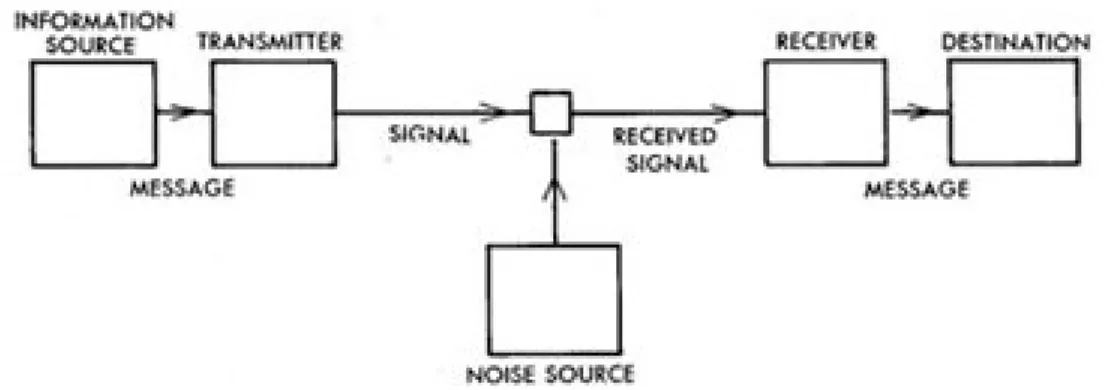
1963) thought it "first necessary to represent the various elements involved as mathematical entities, suitably idealized from their physical counterparts" (p. 34). He illustrates his model this way:
Famously, Shannon's (Shannon & Weaver, 1963) model "consists of
essentially five parts" (p. 33): an information source which selects a message to be encoded via a transmitter, or that which transforms the message into a signal for its distribution through a channel and its eventual reception by a receiver, which operates on the signal to produce a message for a destination. Information figures prominently in Shannon's elaborations of the model but not in the way most popular accounts assume.
Proponents and critics alike often refer to Shannon's schema as a model of "message transmission." But doing so is wholly incorrect. In Shannon's account, no message is ever transmitted; only signals are. For Shannon, the problem of the message is therefore not a problem of transmission but rather one of selection. Recall Shannon's (Shannon & Weaver, 1963) definition of "the fundamental problem of communication": "that of reproducing at one point