CAROLINA POPULATION CENTER | CAROLINA SQUARE - SUITE 210 | 123 WEST FRANKLIN STREET | CHAPEL HILL, NC 27516
Add Health Wave V Documentation
2019
Add Health is supported by grant P01-HD31921 from the Eunice Kennedy Shriver National Institute of Child Health and Human Development, with cooperative funding from 23 other federal agencies and foundations.
Sampling and
Mixed-Mode Survey
Design
Report prepared byKathleen Mullan Harris Carolyn Tucker Halpern Paul Biemer
This document summarizes the Wave V sampling and mixed-mode survey design. Whenever possible, data collection and methods in Wave V mirrored those of Wave IV to ensure
comparability of data between waves. This document is one in a set of Wave V user guides available from http://www.cpc.unc.edu/projects/addhealth/documentation/guides/.
This research uses data from Add Health, a program project directed by Kathleen Mullan Harris and designed by J. Richard Udry, Peter S. Bearman, and Kathleen Mullan Harris at the
University of North Carolina at Chapel Hill, and funded by grant P01-HD31921 from the Eunice Kennedy Shriver National Institute of Child Health and Human Development, with cooperative funding from 23 other federal agencies and foundations. We gratefully acknowledge Eric A. Whitsel, Nancy Dole, Joyce Tabor, and Kathryn Carrier for their dedication to the quality of the Add Health data in this document. Information on how to obtain the Add Health data files is available on the Add Health website (http://www.cpc.unc.edu/addhealth).
Citations of this Add Health User Guide should use the following format:
Harris KM, Halpern CT, Biemer P, Liao D, Dean SC. Add Health Wave V Documentation: Sampling and Mixed-Mode Survey Design, 2019; Available from:
1. Introduction
The National Longitudinal Study of Adolescent to Adult Health (Add Health) is a longitudinal survey of a nationally representative sample of U.S. adolescents in grades 7-12 during the 1994-95 school year. The Add Health cohort has been followed into young adulthood with five in-home interviews. Add Health traced, located, and reinterviewed cohort members in a Wave V follow-up during the period 2016-2019 to collect social, environmental, behavioral, and
biological data with which to track the emergence of chronic disease as the cohort aged into their 30s and early 40s. For the first time, Wave V data collection employed a mixed mode survey design, including an embedded subsample to evaluate mode effects. In addition, several
experiments were embedded in early phases of the Wave V data collection to test for differential response rates according to various treatments. This document describes the sampling design, survey modes and instrumentation for Wave V.
2. Overview of the Sample Design
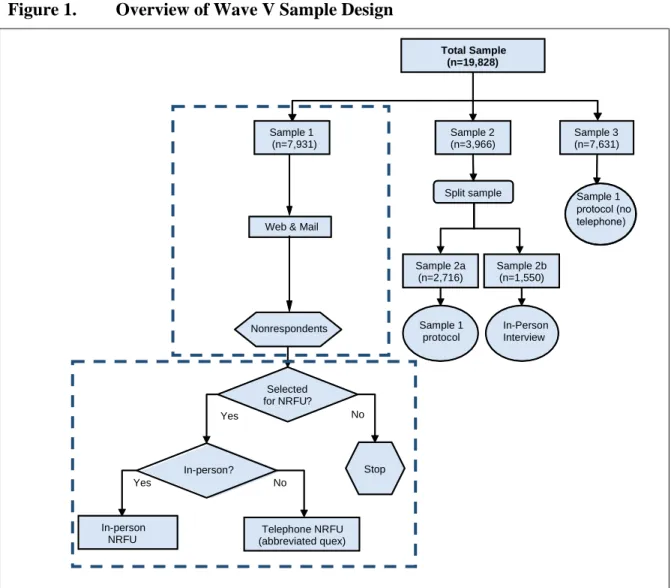
All Add Health Wave I respondents who were still living at the time of Wave V data collection were eligible for the Wave V survey, yielding a pool of 19,828 persons. As shown in Figure 1, the pool of eligible respondents was split into three stratified random samples which were surveyed during three consecutive time periods. Sample 2 was further randomly split into two subsamples, Samples 2a and 2b, to evaluate the effects of the Wave V mixed-mode survey design on Wave V estimates (more on this below). Samples 1, 2a, 2b, and 3 are all random samples of the entire Wave V sample and each is representative of the Wave V target population. Thus, each sample is “stand-alone” in that it can support unbiased estimation of the target
population and the full range of the Add Health cohort ages are represented in each sample.
All respondents selected for Sample 1 were asked to complete either a web-based or paper and pencil (e.g., mail) questionnaire via email and/or mail-based recruitment contacts. Multiple recruitment contacts were sent over the course of several months to respondents who had not yet completed a questionnaire. After all the recruitment contacts were delivered, nonrespondents who had not completed a web or mail questionnaire were then eligible to be sampled for the Non-Response Follow-Up (NRFU) phase.
A random subsample of approximately 50% of the web and mail nonrespondents were selected to complete an in-person NRFU questionnaire. In-person NRFU data collection procedure required field interviewers to ask nonrespondents to complete the full web questionnaire on a laptop provided by the interviewer. In addition, a random sample of Sample 1 nonrespondents not selected for in-person NRFU was contacted by telephone to conduct an abbreviated
(approximately 5-10 minute) telephone NRFU interview on non-sensitive topics that informed estimates of the nonresponse bias and updated contact information. Those data were also used in a nonresponse weighting adjustment.
Sample 2a and Sample 3 respondents were asked to complete the web or mail questionnaire in a protocol similar to the one described for respondents in Sample 1. The Sample 2a and Sample 3 NRFU protocol differed from the Sample 1 protocol (see Section 6.1 below). Sample 2b
interviewer. The interview contained computer-assisted self-interview (CASI) sections for sensitive questions.
Splitting Sample 2 as shown in Figure 1provided a means for estimating the nonsampling error design effects for the mixed-mode design relative to the in-person interview design utilized in all prior waves. This design component is essential to appropriately account for Wave V design effects in the estimation of temporal change between the current and prior Add Health waves.
Two experiments were embedded in the Sample 1 questionnaire administration to test for differential response patterns to variations in protocol. The more effective protocol would be implemented in the administration of Samples 2 and 3. One experiment varied incentive payments based on a propensity model predicting the respondent’s likelihood of responding to the Wave V questionnaire request. A second experiment tested a sequential modular
questionnaire design featuring two modules vs. a content-equivalent, single questionnaire design. The modular questionnaire design was intended to minimize the impact of the interview length on the response rate and to assess respondent preference regarding completing the questionnaire in a single versus multiple sessions. The singular instrument consisted of a single, long
Figure 1. Overview of Wave V Sample Design
Sample 2 (n=3,966) Sample 1
(n=7,931)
Sample 3 (n=7,631)
Web & Mail
In-person NRFU
Selected for NRFU?
No Yes
Sample 1 protocol Nonrespondents
Split sample
Sample 2a (n=2,716)
Sample 2b (n=1,550)
In-Person Interview Total Sample
(n=19,828)
In-person?
Telephone NRFU (abbreviated quex)
Stop
Yes No
Sample 1
3. Systematic Sampling Scheme to Select Samples
To ensure that Samples 1, 2 and 3 are random samples of the entire Wave V sample and each is representative of the Wave V target population, a systematic sampling scheme was implemented to randomly select the four Samples.First, the sampling frame of 19,828 eligible Wave I
respondents was sorted by key stratification variables so that the three samples are approximately balanced with respect to the sorting variables and the proportions of the sample in each implicit stratum are approximately the same for each sample. The sorting variables were used in the following order: LBG indicator variable in Wave IV (to facilitate the Add Health study “Sexual Orientation/Gender Identity, Socioeconomic Status, and Health across the Life Course”; see press release to learn more about this study), region, state, gender, race and age.
To compensate for item missingness in the geographic and demographic characteristics in Wave IV, the information reported in the most recent wave completed by each frame member was used. As an example, if state of residence is known for a frame member based upon information collected for Wave IV, then that information was used in sorting. Otherwise, the most recent information available on state of residence was used.
After sorting the sampling frame, sampling proceeded by beginning at a randomly chosen respondent in the sorted frame, then sequentially labelling each respondent in the list according to the following pattern, 1-2-3-1-3, until the end of the file was reached, and then continued at the beginning of the file until the starting point was again reached. We then assigned all units with a “1” to Sample 1, “2” to Sample 2, and “3” to Sample 3. This sampling scheme resulted in assigning about 40% of cases to Sample 1, 20% of cases to Sample 2, and 40% of cases to Sample 3.
Next, random assignment for splitting Sample 2 required 31.5% of the 4,266 cases in Sample 2 be assigned to Sample 2b, with the remainder being assigned to Sample 2a. Maintaining the same sort for Sample 2 as in the original frame, we assigned the number m = k×0.315 to the kth case in the file for k = 1, …, 4266 (i.e., the size of Sample 2). We then assigned to Sample 2b all cases labeled [m,1], [m,2], …[m,1250] where [m,b] denotes a unit whose value of m is nearest to the integer b for b = 1, …, 1550. Sample 2a then consisted of the remaining cases in Sample 2.
4. Subsampling for Secondary Objectives
After the four samples were selected, additional sample selections were performed to conduct a pilot study and the two embedded experiments. This section addresses the technical details in these sample selections.
Pilot Study
For the purposes of quality control and to test the complex mixed-mode instrumentation, procedures and protocols for Wave V, a Pilot Study proceeded the main data collection for Sample 1. This Pilot Study consisted of approximately 300 sample members selected from the 7,931 sample members in Sample 1. The Pilot Sample was clustered and located in 3
(MSAs) as locations. The density of cluster was defined by the number of sample members in that area. The Pilot Study selected 3 geographical locations from this list.
Sample Allocation for the Experimental Design
As noted previously, two experiments were conducted in Sample 1 that tested two factors referred to as Factors A and B. Factor A is response propensity factor consisting of two levels: A1, the standard approach (control condition) and A2, a model-directed approach. Factor B is the questionnaire factor described above that consists of two levels: B1, two modular (short)
questionnaires (i.e., Modules A and B) and B2, a single (long) questionnaire. The following summarizes the levels of each factor.
A1: Standard incentive treatment. Sample members in this group were offered the “standard” incentive package only, as described below.
A2: Model-directed incentive treatment. This approach used a combination of propensity models to determine which of two incentive packages a respondent was offered. Sample members who were classified by the models as “low response propensity” were assigned to the “high incentive package” group while sample members who were classified as “high response propensity” were assigned to the “low incentive package” group.
B1: Modular questionnaire treatment. Sample members assigned to this treatment were asked to complete two questionnaires sequentially: questionnaire module A followed by questionnaire module B. Module A web respondents were given a choice to either immediately proceed to Module B (in the same sitting) or to defer completion of Module B until some later time.
B2: Single questionnaire treatment. Sample members assigned to this treatment were asked to complete a single, long questionnaire that is the equivalent of questionnaire modules A and B combined.
The assignment of Sample 1 sample members to each of the four treatment conditions was done randomly as follows. First, the Sample 1 file was subdivided into two strata corresponding to the Pilot Sample and the Main Sample. Cases in each of these two strata were sorted by the same sorting variables used to select the original samples except that, within the last sort variable, sample members were sorted by the product of the internet access and response propensities derived based on the Add Health Wave V Propensity Modeling Plan.
After stratifying and sorting sample 1, the sample members were assigned to each of the four treatment combinations defined by factors A and B as follows. First, we randomly assigned the four treatments – A1B1, A1B2, A2B1 and A2B2 to the numbers 1, 2, 3 and 4. To balance the explicit and implicit stratification variables across the treatment combinations, the sample
Selecting Nonresponse Follow-up for Phase 2 NRFU
A nonresponse follow-up (NRFU) phase was implemented for Sample 1 using a dual-mode (in-person and telephone) NRFU protocol. For this design, a random sample of the nonrespondents were followed up in person after an initial phase of data collection by either web, mail, or both. In addition, the remaining sample of the nonrespondents cases (i.e., those not selected for in-person NRFU) were contacted by telephone to conduct an abbreviated (approximately 5-15 minute) telephone NRFU interview on non-sensitive topics to inform estimates of the
nonresponse bias and update contact information. These data were also used in a nonresponse weighting adjustment. The NRFU phase was implemented for Samples 2A and 3 using only the in-person NRFU protocol.
5. Sampling Results
After applying the sampling scheme described in Section 3, the percentage distributions of key characteristics for all four Samples are displayed in Table 1. These results are based on the eligible starting sample of 19,828 persons.
Table 1. Percentage Distributions for Key Characteristics in Add Health Wave V Based on the Estimated Starting Sample of 19,828 Persons
Domain Total N Sample 1 Sample 2a Sample 2b Sample 3
Total 100.00% 100.00% 100.00% 100.00% 100.00%
Gendera
Male 48.81% 48.87% 48.71% 48.80% 48.78%
Female 51.19% 51.13% 51.29% 51.20% 51.22%
Race/Ethnicitya
Hispanic, All Races 17.10% 17.20% 17.30% 16.64% 17.01%
Black or African American, Non-Hispanic
22.14% 22.07% 22.02% 22.00% 22.28%
Asian, Non-Hispanic 7.21% 7.21% 7.29% 6.56% 7.28%
Native American 1.78% 1.82% 1.55% 2.24% 1.75%
Other 1.07% 1.08% 1.03% 1.52% 1.01%
White 50.70% 50.62% 50.81% 51.04% 50.67%
Regiona
Northeast 10.55% 10.54% 10.57% 10.56% 10.54%
Mideast 18.68% 18.69% 18.70% 18.56% 18.67%
South 32.76% 32.74% 32.73% 32.88% 32.77%
West 20.98% 20.98% 20.99% 20.96% 20.98%
Missing 17.04% 17.05% 17.01% 17.04% 17.03%
Non-genetic Sampleb 82.70% 82.42% 82.70% 84.48% 82.69%
Genetic Samples
Twinsc 7.67% 7.99% 7.03% 6.96% 7.67%
Full Siblingsd 5.92% 5.77% 6.11% 5.44% 6.06%
Unrelated Pairs in Same HHf 2.04% 2.06% 2.21% 1.84% 2.00%
LGB Sampleg
Sexual Minority 11.57% 11.47% 11.82% 11.20% 11.64%
NOT Sexual Minority 88.43% 88.53% 88.18% 88.80% 88.36%
a: This variable is the sorting variable in the systematic sample selection.
b: If a case had 0 value in all the genetic-sample indicator variables including SMP07, SMP 08, SMP 09 and SMP
12, then the case was defined as belonging to the non-genetic sample. c: Variable SMP07 was used for creation of this category.
d: Variable SMP08 was used for creation of this category. e: Variable SMP09 was used for creation of this category. f: Variable SMP10 was used for creation of this category.
g: “Sexual Minority” was identified as “mostly heterosexual”, or “bisexual”, or “mostly homosexual”, or “100%
homosexual”; “NOT Sexual Minority” was identified as “100% heterosexual”, “not attracted to either sex” and missing in the related variables. Variable H4SE31in Wave IV was used for creation of LGB groups. If this variable was missing, variable H3SE13 in Wave III was used. If both variables were missing, the respondent was coded as “NOT Sexual Minority”.
6. Mixed-Mode Survey
Wave V data collection involved the introduction of a new mixed-mode survey design. Prior Add Health questionnaires were administered to respondents by an interviewer who conducted the interview in the respondent’s home (or other private location). While an in-person interview was utilized for Sample 2b (and later, the NRFU phase of Sample 2a and Sample 3), the
respondents in Samples 1, 2a, and 3 were offered the opportunity to complete either a web or mail questionnaire. The design team developed both modular and singular versions of the web and mail questionnaires while the in-person interview was only offered as a singular instrument to mimic earlier waves. As a backup mode, a telephone interview – also only offered as a singular instrument - was conducted with a small subset of 2b and NRFU respondents who were unable to complete the interview in-person.
This mixed-mode survey design required the development of four different questionnaires as mode restrictions prevented perfect duplication of content across all modes. While questionnaire differences were minimized to the extent possible, the following is a brief summary of the major differences:
(1) Web/in-person/telephone questionnaires randomized the order of biological sex and gender questions, but this was not done on the static mail questionnaire as only one version was printed and mailed to respondents.
(2) In order to significantly minimize the page length and weight of the mail questionnaire (reducing perceived respondent burden/increasing the likelihood that respondents would complete the full questionnaire), several questions which appear sequentially within the web/in-person/telephone questionnaires are combined into a table format within the mail questionnaire. For example, the household roster, health condition, and criminal justice system question series are presented as tables within the mail questionnaire.
Google pinpoint of entered address was accurate, and - if the pinpoint was not accurate - drag the pin and drop it on the correct address. This application required an internet connection and therefore could not be replicated within the off-line in-person/telephone/ mail questionnaires.
(4) Field interviewers conducing in-person interviews collected latitude and longitude readings of respondent residential addresses using Garmin GPS devices.
(5) The mail questionnaire was designed to minimize skip patterns when possible to avoid respondent skip pattern error. This means that sometimes questions which were
programmed to appear on separate web/in-person/telephone screens appeared as one question on the mail questionnaire. A key example of this is the race/ethnicity question. Please refer to the Wave V questionnaires (questionnaires for all four modes will be posted on the Add Health website in early 2020) to view how the question appears
across the web/in-person/telephone and mail questionnaires.
(6) The interviewer-administered in-person and telephone questionnaires included
interviewer-administered cognitive tests (word recall, digits backwards) that could not be duplicated on the self-administered web and mail questionnaires.
(7) The in-person and telephone questionnaires were longer instruments and as such permitted the inclusion of family health history questions which were too time-consuming to include in the shorter web and mail questionnaires (family health history data file will be made available in the near future).
(8) The in-person interview included sections containing sensitive questions which were self-administered by respondents without assistance from the interviewer (See Table 2. Section Content below). However, the interviewer conducting the telephone interview had to administer those sensitive questions to the respondents over the phone.
(9) Certain programming/database tools enabled content within the
web/in-person/telephone questionnaires that was not possible to duplicate within the mail questionnaire. For example, a series of questions related to fitness trackers/wearable devices was included within the web/in-person/telephone questionnaires. The question series used several fills based on prior responses that could not be duplicated within the mail questionnaire. Another example is the programmed medications database included within the web/in-person/telephone questionnaires that could not be duplicated within the mail questionnaire.
wished (if a respondent skipped several questions in a row, they received a pop-up box which briefly detailed the importance of answering the questions). All Wave V questionnaires
permitted respondents to skip a question without providing a specific ‘Don’t Know’ or ‘Refuse’ reason. As a result, the Wave V data have more (.) missing values than previous waves.
6.1 Web Questionnaire
The web questionnaire was programmed and administered using the Hatteras survey engine, which is an internal product of the Research Triangle Institute International. The Hatteras survey engine was selected due to its responsive nature. It was expected that a significant percentage of respondents would choose to complete the web questionnaire on a mobile device – whether tablet or mobile phone – so it was critical that the survey questions appeared in a suitably designed format for such devices.
As noted previously, both modular and singular versions of the questionnaire were designed and implemented during Sample 1 to test whether the Add Health respondents would be willing to take a 50-minute web questionnaire in one sitting. Prior survey research literature showed that respondents would not complete such a long questionnaire on the web. However, the Add Health respondents are unique in that they have become accustomed to a much longer 90-minute in-person interview, have a long history with the study, and are invested in participating, so there was optimism that the respondents would complete the singular questionnaire. Given this optimism, the web questionnaire was designed so that respondents in the modular group could choose at the halfway point whether to continue and complete the second module or take a break and complete the second module later. Therefore, respondents in the modular group were
essentially allowed to opt for the singular questionnaire. Respondents were randomly assigned to either the modular or singular design. The response rate in Sample 1 was slightly higher for the singular design group and the majority of respondents in the modular group opted to continue and complete the questionnaire in one sitting. Given these results, the respondents in Samples 2a and 3 were offered only the singular version of the questionnaire.
All respondents in Samples 1, 2a, and 3 were offered the opportunity to complete the web questionnaire on a device of their choice (there were no restrictions as to what type of device could be used to complete the web questionnaire). Respondents were provided with a unique password in order to access and complete the questionnaire; respondent identity checks were run based on certain identifiers provided within the questionnaire. Once a respondent completed and submitted the web questionnaire, their password was locked, and they were not allowed to re-enter.
As discussed in Section 1, Phase 1 of the data collection for each sample involved recruiting respondents to complete the web (or mail) questionnaire. The Phase 2/NRFU effort for Sample 1 utilized an in-person laptop administered web questionnaire. The web questionnaire was
transferred to static laptops, which field interviewers took into the respondents’ homes. Interviewers went to respondent homes to ask respondents to complete the interview, but the respondent did so on their own without the interviewer administering any questions. Thus, the Sample 1 Phase 2 respondents essentially completed the web questionnaire and their responses
are coded as the web mode within the Wave V data files. The laptop instrument was
programmed to allow respondents who began but did not complete the web questionnaire online
questionnaire was nearly identical to the web questionnaire utilized during Phase 1. Only the Google Maps application had to be removed since the application required a wireless connection and that could not be guaranteed in a respondent’s home. Instead, Garmin GPS devices similar to those used during Wave IV data collection were used to obtain latitude and longitude coordinates of residences for respondents who consented to GPS readings.
Wave V data collection was continuous over the course of three years. During the data collection timeframe, adjustments were made to the instruments as necessary to improve data quality. While recruitment began sequentially for respondents in Samples 1, 2a, and 3, the web survey remained open throughout data collection. This means that respondents in Sample 1 were able to complete the web survey at any time over a period of 2-3 years. Given that there were slight adjustments to the web survey over the course of continuous interviewing, respondents in
Sample 1 completed slightly different versions of the web survey depending on when they chose to complete it. Within the Wave V data files, reserve codes of 95, 995, and 9995 indicate when a question was not asked of the respondent.
6.2 In-Person Interview
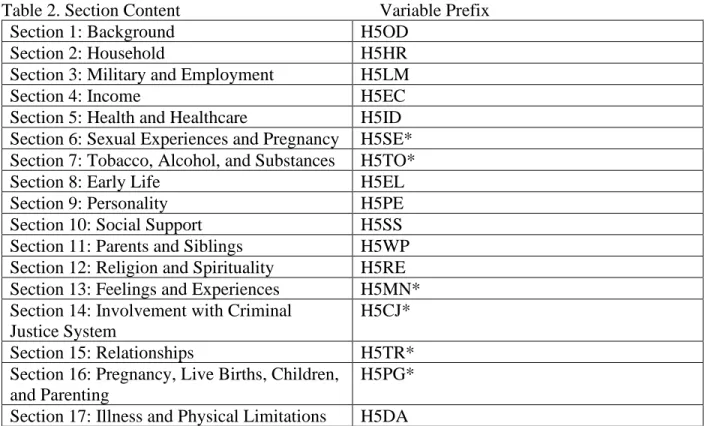
The in-person interview was administered via the Hatteras survey engine so that the questions included within both web and in-person instruments would appear identically across the modes, reducing any potential mode effects due to appearance on the screen. As in previous waves of Add Health, sensitive sections of the questionnaire (drug use, sexual history, criminal history, suicidality, etc.) were self-administered by respondents and the interviewers did not see the respondents’ answers to sensitive questions. The following table details which sections of the disseminated data files were self-administered via CASI.
Table 2. Section Content Variable Prefix
Section 1: Background H5OD
Section 2: Household H5HR
Section 3: Military and Employment H5LM
Section 4: Income H5EC
Section 5: Health and Healthcare H5ID
Section 6: Sexual Experiences and Pregnancy H5SE* Section 7: Tobacco, Alcohol, and Substances H5TO*
Section 8: Early Life H5EL
Section 9: Personality H5PE
Section 10: Social Support H5SS
Section 11: Parents and Siblings H5WP
Section 12: Religion and Spirituality H5RE
Section 13: Feelings and Experiences H5MN*
Section 14: Involvement with Criminal Justice System
H5CJ*
Section 15: Relationships H5TR*
Section 16: Pregnancy, Live Births, Children, and Parenting
H5PG*
Section 17: Illness and Physical Limitations H5DA
The in-person interview mode offered more flexibility than the web survey in terms of
instrument length, as previous waves demonstrated that respondents were willing to complete a 90-minute in-person interview. Therefore, the Sample 2b and Sample 2a/3 Phase 2/NRFU instrument contained more content than the web survey. However, all web survey content – with the exception of the Google Maps application – was included within the in-person instrument.
The increased length of the in-person interview permitted the inclusion of questions that were
included in the Add Health Parent Study (2015-2017) – specifically, a family health history
battery. Finally, the Wave IV cognitive measures (word recall, digits backwards), which could not be included in a self-administered web survey, were included in the in-person interview. Garmin GPS devices similar to those used during Wave IV data collection were selected to obtain latitude and longitude coordinates of residence for respondents who consented to GPS readings.
A note on sampling and Phase 2/NRFU: while respondents in Sample 1 Phase 2/NRFU were asked to complete the web survey on their own, respondents in Sample 2a/3 Phase 2/NRFU completed the interviewer administered in-person interview. This protocol change was made because Sample 2b and Sample 2a/3 Phase 2/NRFU fieldwork occurred simultaneously and it was logistically more efficient to administer the same instrument across the samples.
6.3 Telephone Interview
The telephone interview was utilized when respondents sampled for the in-person interview (Sample 2b, Sample 2a/3 Phase 2/NRFU) were unable to complete the in-person interview. As such, the telephone interview content matches the in-person interview content. The only difference is that all content, including sensitive questions, was administered by the telephone interviewer; there were no self-administered sections. Furthermore, no Google Maps application data or Garmin GPS data were obtained from telephone respondents. Note that this full telephone interview is not the abbreviated telephone instrument used during Sample 1 telephone NRFU.
6.4 Mail Questionnaire