J
OURNAL OF
C
LINICAL
O
NCOLOGY
O R I G I N A L
R E P O R T
Accrual of Older Patients With Breast Cancer to Alliance
Systemic Therapy Trials Over Time: Protocol A151527
Rachel A. Freedman, Jared C. Foster, Drew K. Seisler, Jacqueline M. Lafky, Hyman B. Muss, Harvey J. Cohen,
Jeanne Mandelblatt, Eric P. Winer, Clifford A. Hudis, Ann H. Partridge, Lisa A. Carey, Constance Cirrincione,
Alvaro Moreno-Aspitia, Gretchen Kimmick, Aminah Jatoi, and Arti Hurria
A B S T R A C T
Purpose
Despite increasing awareness of accrual challenges, it is unknown if accrual of older patients to
breast cancer treatment trials is improving.
Methods
We examined accrual of older patients to Alliance for Clinical Trials in Oncology systemic therapy
breast cancer trials during 1985-2012 and compared disease characteristics and reasons for therapy
cessation for older (age
$
65 years and
$
70 years) versus younger (age
,
65 years and
,
70 years)
participants. To examine accrual trends, we modeled age as a function of time, using logistic
regression.
Results
Overall, 17% of study participants were
$
65 years of age. Approximately 15%, 24%, and 24% of
participants in adjuvant, neoadjuvant, and metastatic trials were age
$
65 years, and 7%, 15%, and
13% were age
$
70 years, respectively. The odds of a patient age
$
65 years enrolling signi
fi
cantly
increased over time for adjuvant trials (odds ratio [OR] per year, 1.04; 95% CI, 1.04 to 1.05) but
decreased signi
fi
cantly for neoadjuvant and metastatic trials (OR, 0.62; 95% CI, 0.58 to 0.67 and OR,
0.98, 95% CI, 0.97 to 1.00). Similar trends were seen for those age
$
70 years but these were
statistically signi
fi
cant for adjuvant and neoadjuvant trials only (OR, 1.05, 95% CI, 1.04 to 1.07; and
OR, 0.57, 95% CI, 0.52 to 0.62). In general, those age
$
65 years (
v
those
,
65 years) in adjuvant
studies had a higher mean number of lymph nodes involved and more hormone receptor-negative
tumors, although tumor sizes were similar. Early protocol treatment cessation was also more
frequent in those age
$
65 years (50%) versus
,
65 years (35.9%) across trials.
Conclusion
Older patients with breast cancer remain largely underrepresented in cooperative group therapeutic
trials. We observed some improvement in accrual to adjuvant trials but worsening of accrual for
neoadjuvant/metastatic trials. Novel strategies to increase accrual of older patients are critical to
meaningfully change the evidence base for this growing patient population.
J Clin Oncol 35:421-431. © 2016 by American Society of Clinical Oncology
INTRODUCTION
Breast cancer is a disease of aging and nearly
72,000 breast cancers occur annually in US women
$
70 years of age.
1,2Although most breast cancers in
older women are lower-risk tumors and most older
patients with breast cancer die of other causes,
3-5approximately 19,000 breast cancer deaths occur
yearly in US women
$
70 years of age, accounting
for 47% of breast cancer deaths.
6Although most cancers occur in older patients,
accrual of older patients to cancer clinical trials has
been a persistent challenge. Consequently, the
availability of prospective data for older patients
with breast cancer is limited. Although some
ev-idence suggests that older patients are just as likely
to enroll in clinical trials as younger patients if one
is offered,
7multiple barriers to accrual have been
identi
fi
ed, including comorbidity, physician/patient
preferences, socioeconomic factors, insurance,
concerns about loss of continuity with primary
on-cologists, lack of knowledge about clinical trials, and
age itself.
7-18In addition, others have cited time and
travel considerations and trial phase as barriers for
all patients.
16,19Thus far, speci
fi
c efforts to improve
enrollment of older patients with cancer to clinical
trials within the cooperative group setting have
Author affiliations appear at the end of this article.
Published atascopubs.org/journal/jcoon December 19, 2016.
Support information appears at the end of this article.
Presented as a poster at the American Society of Clinical Oncology Annual
Meeting, Chicago, IL, June 2-6, 2016.
Corresponding author: Rachel A. Freedman, MD, MPH, Dana-Farber
Cancer Institute, 450 Brookline Ave, Boston, MA 02215; e-mail: rafreedman@
partners.org.
© 2016 by American Society of Clinical
Oncology
0732-183X/17/3504w-421w/$20.00
ASSOCIATED CONTENT
Appendix
DOI: 10.1200/JCO.2016.69.4182
Table 1. Alliance for Clinical Trials in Oncology
Trial Agents Administered Key Eligibility*
Total Patients in Study, No.
Age$65 Years, No. (% total
accrual)
Age$70 years, No. (% total
accrual) Dates of Accrual
All trials combined — — 19,507 3,308 (17) 1,672 (9) 1985-2012
Adjuvant trials (overall) 15,297 2,277 (15) 1099 (7) 1985-2010
CALGB 4010132,33
A+CvT (4v6 cycles)
•
0-3 nodes involved 3,871 468 (12) 177 (5) 6/2002-7/2010•
No locally advanced disease•
ECOG PS not specified CALGB 49907†24A+C/C+M+Fvcapecitabine
•
Age$65 years 633 633 (100) 415 (66) 6/2002-12/2006•
Tumor.1 cm•
Life expectancy.5 years•
ECOG PS 0-2 NCCTG N983134A+C+TvA+C+T+H
•
HER2 positive 3,505 301 (9) 126 (4) 5/2000-4/2005•
Node positive or higher risk node negative•
ECOG PS not specified CALGB 974135 A+C+T q2wvA+C+T q3wvsequential A+T+C q2w
•
T0-T3, N1/2, M0 disease 2,005 162 (8) 54 (3) 10/1997-3/1999•
ECOG PS not specified CALGB 934436A+C with 3 different doses of A (60, 75, 90 mg/m2
)3 4 cycles6T
•
Node positive 3,170 182 (6) 55 (2) 5/1994-4/1997•
ECOG PS not specifiedNCCTG 89-30-52‡37
Tamoxifen6fluoxymesterone
•
Postmenopausal 541 381 (70) 225 (42) 1/1991-4/1995•
Estrogen-receptor positive•
T1 or T2•
If node negative, any age allowed•
If node positive, required to be age$65 years•
ECOG PS not specified CALGB 854138C+A+F dosing (3 dose levels
examined)
•
Stage II (T1N0M0 or T2N1M0)
1,572 150 (10) 47 (3) 1/1985-3/1991
•
ECOG PS 0-1Neoadjuvant trials (overall) 1,663 407 (24) 252 (15) 2006-2012
CALGB 4060339
A+C+T6carboplatin6
bevacizumab
•
Triple negative 454 40 (9) 10 (2) 7/2009-8/2012
•
Clinical stage II-III•
ECOG PS not specified CALGB 4060140T+HvT+H+LvT+L
•
HER2 positive 305 25 (8) 10 (3) 2/2009-2/2012•
Clinical stage II-III•
ECOG PS not specified ACOSOG Z104141 Preoperative F+E+C→T+HvT+H→F+E+C+H
•
HER2 positive 282 18 (6) 8 (3) 9/2007-12/2011
•
T2 or node positive•
ECOG PS 0-1 ACOSOG Z1031‡42Preoperative exemestanev letrozolevanastrozole
•
Postmenopausal 622 324 (52) 224 (36) 01/2006-01/2009
•
HR positive•
HER2 negative•
Clinical T2-T4c, N0-3, M0•
ECOG PS 0-2Metastatic trials (overall) 2,547 624 (24) 321 (13) 1994-2011
CALGB 4050243 Weekly paclitaxelv
nab-paclitaxelvixabepilone
•
HER2 negative 799 166 (21) 81 (10) 11/2008-11/2011
•
Stage IIIC or IV•
First-line chemotherapy•
ECOG PS 0-1 CALGB 4050344Letrozole/tamoxifen6 bevacizumab
•
HR positive 394 98 (25) 53 (13) 9/2008-11/2011•
Metastatic•
First-line patients only•
ECOG PS 0-1 CALGB 40302‡45Fulvestrant6lapatinib
•
HR positive 295 84 (28) 47 (16) 12/2006-07/2010•
Postmenopausal•
Noncurative stage III or stage IV•
1-2 prior endocrine therapies allowed•
ECOG PS 0-2 CALGB 934246Paclitaxel dosing
•
#1 prior line of chemotherapy474 149 (31) 87 (18) 9/1998-11/2003
•
Metastatic diseaseincluded educational interventions,
20focused committees, policy
statements,
21-23and the development of a limited number of trials
dedicated to older patients.
24-26Additional attempts to improve
accrual across all ages have examined strategies to improve the
consent process and the methods for opting in/out of enrollment.
27-29Because of keen awareness of accrual challenges for older
patients, designing clinical trials speci
fi
c to older patients with
cancer has been a priority.
22,23,30We have seen some successes with
Cancer and Leukemia Group B (CALGB) trials 9343 and 49907,
24-26though there is concern that we continue to struggle with enrollment
of older patients.
22The Alliance for Clinical Trials in Oncology
(
“
Alliance
”
; formed by the merger of legacy groups CALGB,
American College of Surgeons Oncology Group [ACOSOG], and
North Central Cancer Treatment Group [NCCTG]) has a national
therapeutic protocol program in breast cancer
31and has completed
many practice-changing, large-scale systemic trials to date. However, it
is not known if accrual of older patients to these trials has improved. In
this retrospective analysis (A151527), we examined whether
enroll-ment of older patients with breast cancer to Alliance systemic therapy
clinical trials has improved over time. We also examined disease
characteristics and the reasons for study treatment cessation for those
age
$
65 years and
$
70 years versus younger patients.
METHODS
Data Source
We reviewed the Alliance portfolio of accrued systemic therapy trials
in neoadjuvant, adjuvant, and metastatic breast cancer therapeutic settings
during 1985-2012. Because of speci
fi
c concerns about the lack of
en-rollment of older patients in systemic treatment trials in particular, we
focused our analysis on therapeutic systemic trials only and did not include
local or supportive therapy protocols.
Table 1
lists the trials included.
Variables of Interest
Our primary end point was the proportion of older patients enrolled
in studies over time, using the date of protocol registration for each patient.
We determined whether the probability of an older patient enrolling in
a study changed signi
fi
cantly over time. We examined both the overall time
trend for all studies and the time trends speci
fi
c to trial type (separately) for
adjuvant, neoadjuvant, and metastatic trials. Our secondary goal was to
better understand whether disease characteristics for trial participants
differed by age by examining tumor size, number of nodes involved,
hormone receptor status, and human epidermal growth factor 2 (HER2)
receptor status (when available) for older versus younger women in each
adjuvant study. We limited comparisons of disease characteristics to
adjuvant trials because neoadjuvant and metastatic trials primarily
en-rolled patients with homogeneous staging and tumor subtypes. When
available, we also examined baseline Eastern Cooperative Oncology
Group (ECOG) performance status (PS)
48and reasons for protocol therapy
cessation by age.
Statistical Analysis
To determine whether the proportion of older patients enrolling in
trials changed over time, we modeled age as a function of time, using
logistic regression, both for age
$
65 years (
v
,
65 years) and age
$
70
years (
v
,
70 years). This was done separately for adjuvant, neoadjuvant,
and metastatic trials, using data pooled across all available studies for each
trial setting. Of note, CALGB 49907, NCCTG 89-30-52, and ACOSOG
Z1031 primarily targeted postmenopausal and/or older women, enrolling
patients age
$
65 years at rates of 100%, 70%, and 52%, respectively.
Therefore, in a sensitivity analysis, we repeated analyses with these trials
excluded.
To assess the degree to which disease characteristics differed with age
for each adjuvant study, we compared subtype (estrogen receptor [ER],
progesterone receptor [PR], and HER2 receptor status), tumor size, and
the number of nodes involved for patients (when data were available) in
each adjuvant study, using
x
2tests for comparisons of receptor status and
tumor size and paired
t
tests for comparison of nodes. We also examined
differences in ECOG PS and reasons for protocol therapy cessation (overall
and for each trial type separately) by age, using
x
2tests.
Because this study used preexisting data, we received exemption from
the Dana-Farber Cancer Institute Of
fi
ce for Human Research Studies for
these analyses. Data collection and statistical analyses were conducted by
the Alliance Statistics and Data Center.
RESULTS
Accrual Over Time
We included 16 Alliance protocols, which enrolled 19,507
patients. The proportion of patients age
$
65 years and
$
70 years
enrolled in each study, agents administered, key eligibility, and
Table 1.Alliance for Clinical Trials in Oncology (continued)
Trial Agents Administered Key Eligibility*
Total Patients in Study, No.
Age$65 Years, No. (% total
accrual)
Age$70 years, No. (% total
accrual) Dates of Accrual
CALGB 984047
Paclitaxel schedules (weeklyv q3w + trastuzumab if HER2 positive
•
HER2 positive or negative 585 127 (22) 53 (9) 2/1994-7/1997•
#1 prior line of chemotherapy for metastatic disease or locally advanced•
ECOS PS not specifiedNOTE. Adjuvant, neoadjuvant, and metastatic studies included (most recent to oldest). Dashes indicate not applicable.
Abbreviations: A, doxorubicin; ACOSOG, American College of Surgeons Oncology Group; CALGB, Cancer and Leukemia Group B; C, cyclophosphamide; E, epirubicin; ECOG PS, Eastern Cooperative Oncology Group performance status; ER, estrogen receptor; F, 5-fluorouracil; H, trastuzumab; HER2, human epidermal growth factor receptor 2; HR, hormone receptor; L, lapatinib; M, methotrexate; NCCTG, North Central Cancer Treatment Group; q2w, every 2 weeks; q3w, every 3 weeks; T, paclitaxel. *Only key and relevant eligibility criteria are listed; this is not complete.“ECOG PS not specified”indicates this was not described in the publication, but it is possible this was on the list of exclusions/inclusions in protocol documents.
dates of accrual are listed in
Table 1
. No trial had an upper limit for
age as part of eligibility requirements. Overall, 3,308 (17%) of the
19,507 trial participants registered during 1985-2012 were age
$
65
years and 1,672 (9%) were age
$
70 years.
Among the 15,297 women who enrolled in adjuvant trials,
15% were age
$
65 years and 7% were
$
70 years. For the 1,663
women enrolled in neoadjuvant studies, 24% were age
$
65 years
and 15% of participants were
$
70 years. Of the 2,547 participants
in metastatic protocols, 24% were age
$
65 years and 13% were
$
70 years.
Figure 1
displays the proportion of older women
enrolled by trial. Distinct peaks in enrollment for older patients are
visible for CALGB 49907 (adjuvant chemotherapy for patients
age
$
65 years), NCCTG 89-30-52, and ACOSOG Z1031
(hor-monal therapy-based trials for postmenopausal women).
The absolute numbers of patients age
$
65 years and age
$
70
years increased somewhat over the study period (Appendix
Fig A1
,
online only), although this was not consistent over time. For
ex-ample, the years with the lowest absolute numbers of enrolled
patients age
$
65 years were 1991 (n = 7), 2012 (n = 15), and 1985
(n = 31), whereas the highest numbers of enrolled older patients
occurred during 2000 (n = 467), 2010 (n = 282), and 2009 (n = 246).
Figure 2
displays the trends in overall accrual over time by age
(
Fig 2A
), trends in accrual by trial type for age
$
65 years (
Fig 2B
)
and
$
70 years (
Fig 2C
), and trends by ages
$
65 years and
$
70
years after excluding CALGB 49907/NCCTG 89-30-52/ACOSOG
Z1031 (
Fig 2D
). To further illustrate potential trends in each of
these plots, we included locally weighted scatterplot smoothing
lines (a type of nonparametric regression).
Results from our logistic regression model indicate that the
odds of a patient age
$
65 years enrolling slightly increased with
each year in adjuvant trials, with an odds ratio (OR) for enrollment
of 1.04 per year (95% CI, 1.04 to 1.05;
P
,
.001). Thus, over 5 years,
this translates into a 20% increase in the odds of enrolling patients
age
$
65 years. In contrast, the odds of a patient age
$
65 years
enrolling decreased signi
fi
cantly by year in neoadjuvant and
metastatic trials (OR, 0.62; 95% CI, 0.58 to 0.67;
P
,
.001; and OR,
0.98, 95% CI, 0.97 to 1.00,
P
= .03, respectively). Similar trends
were seen for patients age
$
70 years, but these were statistically
signi
fi
cant for adjuvant and neoadjuvant trials only (OR, 1.05; 95%
CI, 1.04 to 1.07; and OR, 0.57; 95% CI, 0.52 to 0.62, respectively).
After exclusion of patients enrolled in CALGB 49907/NCCTG
89-30-52/ACOSOG Z1031, results were unchanged for adjuvant
and metastatic trials, but no signi
fi
cant time trend was found for
neoadjuvant trials.
Disease Characteristics and ECOG PS by Age
Disease characteristics by age for adjuvant trials CALGB
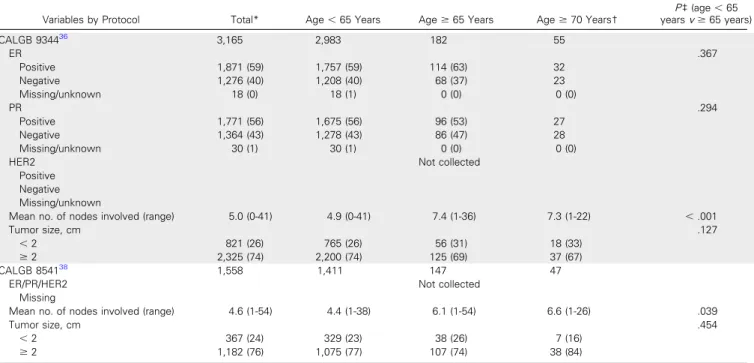
40101, 49907, 9344, 9741, 9344, 8541, and N9831 are listed in
Table 2
(detailed characteristics for NCCTG 89-30-52 were not
available). In general, across adjuvant trials, the proportion of
10 70
8 9
100
12
52 66
6 5
3 2 3 4 5
36
6 8
9
3 3 2
25 27
28 25
21
15
11 16
13 10
Percentage
0 10 20 30 40 50 60 70 80 90 100
Age ≥ 65 years
Age ≥ 70 years
Adjuvant Trials
Neoadjuvant Trials
Metastatic Trials
CALGB 8541 NCCTG 89-30-52
CALGB 9344CALGB 9741
NCCTG N9831CALGB 49907CALGB 40101
ACOSOG Z1031ACOSOG Z1041CALGB 40601CALGB 40603
CALGB 9840CALGB 9342CALGB 40302CALGB 40503CALGB 40502
women with ER-negative and PR-negative tumors was signi
fi
cantly
higher for older versus younger women. Comparisons by HER2
status were limited because these data were not routinely collected
in older studies and because all patients in N9831 had
HER2-positive disease. For CALGB studies 40101, 8541, 9344, and 9741,
the mean number of nodes in women age
$
65 years was higher
than in younger patients. Mean tumor sizes were similar by age for
all adjuvant studies (
P
.
.05 for all
fi
ve protocols), although when
categorized as
,
2 cm or
$
2 cm, CALGB 40101 had a higher
proportion of patients age
$
65 years with tumors
$
2 cm
compared with those age
,
65 years (49%
v
44%, respectively;
P
= .019). Results for age
$
70 years were similar to those with
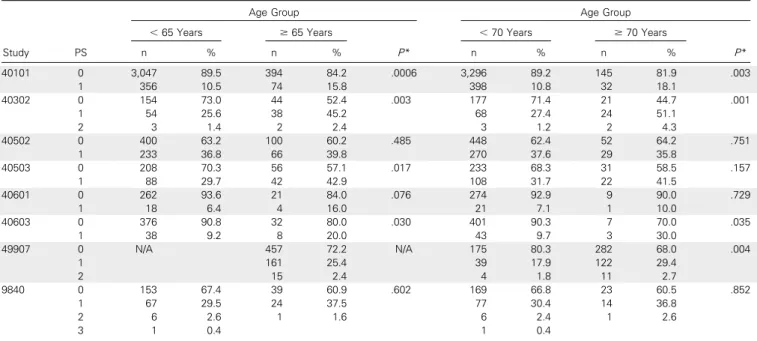
a cutoff age of 65 years (data not shown). Patients age
$
65 years
and
$
70 years had signi
fi
cantly higher proportions of participants
with ECOG PS 1 (
v
0) in CALGB studies 40101, 40302, and 40603
compared with younger women. ECOG PS was similar by age in
CALGB 40502 and 9840 (
Table 3
).
Reasons for Protocol Treatment Cessation
Table 4
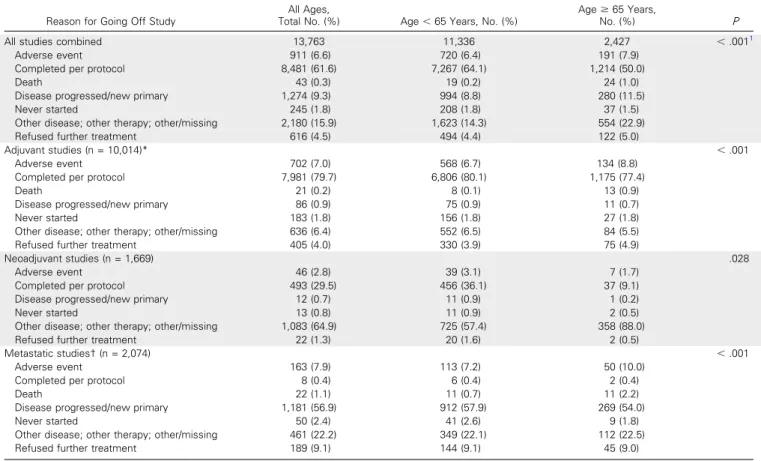
lists the reasons for stopping protocol treatment
(based on trials with this information available). Overall, reasons
for going off treatment differed signi
fi
cantly for women age
$
65
1985 1990 1995 2000 2005 2010
0.0 0.2 0.4 0.6 0.8 1.0
Year
Proportion of Elderly Enrollment
A
0.0 0.2 0.4 0.6 0.8 1.0
1985 1990 1995 2000 2005 2010
Year
Proportion of Enrollment (age
≥
70 years)
Adjuvant Neoadjuvant Metastatic
C
Adjuvant Neoadjuvant Metastatic
0.0 0.2 0.4 0.6 0.8 1.0
1985 1990 1995 2000 2005 2010
Year
Proportion of Enrollment (age
≥
65 years)
B
0.0 0.2 0.4 0.6 0.8 1.0
Age ≥ 65 years
Age ≥ 70 years
Age ≥ 70 years
Age ≥ 65 years
1985 1990 1995 2000 2005 2010
Year
Proportion of Elderly Enrollment
D
Table 2.Disease Characteristics by Adjuvant Trial for Older Versus Younger Women*
Variables by Protocol Total* Age,65 Years Age$65 Years Age$70 Years†
P‡(age,65 yearsv$65 years)
CALGB 4010132,33
3,864 3,396 468 177
ER .024
Positive 2,564 (66) 2,275 (67) 289 (62) 103 (58)
Negative 1,298 (34) 1,119 (33) 179 (38) 74 (42)
Missing/unknown 2 (0) 2 (0) 0 (0) 0 (0)
PR .011
Positive 2,175 (56) 1,937 (57) 238 (51) 87 (49)
Negative 1,681 (44) 1,452 (43) 229 (49) 90 (51)
Missing/unknown 8 (0) 7 (0) 1 (0) 0 (0)
HER2 .140
Positive 719 (19) 620 (18) 99 (21) 32 (18)
Negative 3,017 (78) 2,662 (78) 355 (76) 138 (78)
Missing/unknown 128 (3) 114 (3) 14 (3) 7 (4)
Mean no. of nodes involved (range) 0.2 (0-17) 0.2 (0-17) 0.4 (0-8) 0.6 (0-8) ,.001
Tumor size, cm .019
,2 2,152 (56) 1,915 (56) 237 (51) 80 (68)
$2 1,712 (44) 1,481 (44) 231 (49) 97 (32)
CALGB 49907 633 — 633 415
ER N/A N/A
Positive 417 (66) 417 (66) 260 (63)
Negative 214 (34) 214 (34) 155 (24)
Missing/unknown 2 (0) 2 (0) 0 (0)
PR N/A N/A
Positive 333 (53) 333 (53) 199 (48)
Negative 296 (47) 296 (47) 214 (52)
Missing/unknown 4 (1) 4 (1) 2 (0)
HER2 N/A N/A
Positive 76 (12) 76 (12) 48 (12)
Negative 529 (84) 529 (84) 349 (84)
Missing/unknown 28 (4) 28 (4) 18 (4)
Mean no. of nodes involved (range) 2.0 (0-20) N/A 2.0 (0-20) 2.3 (0-20) N/A
Tumor size, cm N/A N/A
,2 229 (36) 229 (36) 135 (33)
$2 401 (64) 401 (64) 279 (67)
NCCTG N983134
3,505 3,204 301 126
ER .014
Positive 1,841 (53) 1,707 (53) 134 (45) 55 (44)
Negative 1,663 (47) 1,496 (47) 167 (55) 71 (56)
Missing/unknown 0 (0) 1 (0) 0 (0) 0 (0)
PR .002
Positive 1,400 (40) 1,312 (41) 88 (29) 36 (29)
Negative 2,096 (60) 1,883 (59) 213 (71) 90 (71)
Missing/unknown 9 (0) 9 (0) 0 (0) 0 (0)
HER2-positive 3,505 (100) 3,204 (100) 301 (100) 126 (100) N/A§
Mean no. of nodes involved (range) 4.3 (0-41) 4.3 (0-41) 4.9 (0-39) 5.2 (0-39) .053
Tumor size, cm .621
,2 1,143 (33) 1,041 (32) 102 (34) 45 (36)
$2 2,362 (67) 2,163 (68) 199 (66) 82 (64)
CALGB 974135
1,985 1,825 160 52
ER .127
Positive 1,283 (65) 1,026 (56) 114 (71) 37
Negative 668 (34) 757 (41) 46 (29) 15
Missing/unknown 34 (2) 34 (2) 0 (0) 0
PR .818
Positive 1,116 (56) 1,026 (56) 90 (56) 29
Negative 826 (42) 757 (41) 69 (43) 23
Missing/unknown 43 (2) 42 (2) 1 (1) 0 (0)
HER2 Not reliably collected
Positive Negative Missing/unknown
Mean no. of nodes involved (range) 4.3 (0-34) 4.1 (0-30) 6.7 (1-34) 6.8 (1-26) ,.001
Tumor size, cm .968
,2 633 (33) 581 (33) 52 (33) 16 (31)
$2 1,311 (67) 1,204 (67) 107 (67) 36 (69)
years versus those age
,
65 years (overall
P
,
.0001), and early
protocol treatment cessation was more frequent in those age
$
65
years (50%) versus
,
65 years (35.9%) across trials. For those
treated in adjuvant trials (
Table 4
), small differences by age were
seen in the percentage of women who went off protocol treatment
because they completed therapy, with 80.1% of women age
,
65
years completing therapy as planned versus 77.4% of women age
$
65 years (overall
P
,
.0001). For neoadjuvant trials,
compar-isons were limited because 65% of patients did not have clearly
documented reasons for stopping study therapy. Overall, deaths
during a study were uncommon (1% of women age
$
65 years
v
0.2% for those age
,
65 years). Cessation of therapy because of
adverse events occurred more frequently for those age
$
65 years
compared with those
,
65 years (7.9%
v
6.4% overall;
P
,
.0001),
though differences were small.
DISCUSSION
The US population is aging and the number of older patients with
breast cancer is expected to rise signi
fi
cantly in the coming
de-cades.
49-53Currently, the median age at diagnosis is 62 years and
approximately 42% of all new breast cancer cases annually are
diagnosed in women age
$
65 years.
1On average, an 80-year-old
woman currently living in the United States will live another
9 years
54and will bene
fi
t from optimized systemic therapy for her
breast cancer. Furthermore, nearly 10% of older patients present
with stage III-IV disease,
55and even more have node-positive/
earlier-stage disease with a high probability of recurrence, where
chemotherapy can provide bene
fi
t.
56-58Improving the availability
of prospective evidence for this growing number of patients is
crucial to inform decision-making and to optimally serve patients
’
medical, emotional, and functional needs.
30In this analysis of Alliance systemic therapy studies during
1985-2012, we observed small increases in accrual of older patients
to adjuvant trials but a signi
fi
cant decrease in accrual to trials in the
neoadjuvant and metastatic disease settings. In general, with the
exception of selected trials dedicated to older patients, the
pro-portion of patients enrolling to clinical trials who were age
$
65
years and, in particular,
$
70 years remained low throughout the
study period, with less than 20% of participants age
$
65 years and
less than 10% of participants age
$
70 years. The absolute numbers
of older patients enrolled over time also remained low, though
some years saw higher accrual than others.
Of note, despite a trend for decreased accrual for metastatic
and neoadjuvant trials for older patients, overall, numerically
higher proportions of older patients enrolled in these trials
compared with adjuvant studies, with approximately 24% of
participants aged
$
65 years in both metastatic and neoadjuvant
studies (
v
15% on adjuvant trials). The reasons for this
fi
nding are
not clear from the data available but may be related to a lower
threshold for treatment in the neoadjuvant/metastatic settings
Table 2.Disease Characteristics by Adjuvant Trial for Older Versus Younger Women* (continued)
Variables by Protocol Total* Age,65 Years Age$65 Years Age$70 Years†
P‡(age,65 yearsv$65 years)
CALGB 934436
3,165 2,983 182 55
ER .367
Positive 1,871 (59) 1,757 (59) 114 (63) 32
Negative 1,276 (40) 1,208 (40) 68 (37) 23
Missing/unknown 18 (0) 18 (1) 0 (0) 0 (0)
PR .294
Positive 1,771 (56) 1,675 (56) 96 (53) 27
Negative 1,364 (43) 1,278 (43) 86 (47) 28
Missing/unknown 30 (1) 30 (1) 0 (0) 0 (0)
HER2 Not collected
Positive Negative Missing/unknown
Mean no. of nodes involved (range) 5.0 (0-41) 4.9 (0-41) 7.4 (1-36) 7.3 (1-22) ,.001
Tumor size, cm .127
,2 821 (26) 765 (26) 56 (31) 18 (33)
$2 2,325 (74) 2,200 (74) 125 (69) 37 (67)
CALGB 854138
1,558 1,411 147 47
ER/PR/HER2 Not collected
Missing
Mean no. of nodes involved (range) 4.6 (1-54) 4.4 (1-38) 6.1 (1-54) 6.6 (1-26) .039
Tumor size, cm .454
,2 367 (24) 329 (23) 38 (26) 7 (16)
$2 1,182 (76) 1,075 (77) 107 (74) 38 (84)
NOTE. Data are given as no. (%) unless otherwise indicated. Dashes indicate no data available.
Abbreviations: CALGB, Cancer and Leukemia Group B; ER, estrogen receptor; HER2, human epidermal growth factor receptor 2; N/A, not applicable; NCCTG, North Central Cancer Treatment Group; PR, progesterone receptor.
*Detailed tumor characteristics for NCCTG 89-30-52 were not available; some sample sizes are smaller than the overall protocol sample because of missing data on some patients. Comparisons were made among those with known tumor characteristics listed.
†Pvalue not shown for age#70 yearsv$70 years. ‡Values are forx2
because of symptomatic or higher burden of disease. Furthermore,
all the patients with metastatic disease in the trials included in this
analysis received single-agent chemotherapy, which may be more
appealing for providers and older patients than doublet treatment.
Although there were some differences noted by age in PS for trial
participants, essentially all patients across studies had ECOG PS of
0-1 and met trial eligibility criteria. It is possible that some older
patients who would have otherwise participated in protocols were
disproportionately not eligible because of poor PS, but we do not
have information on patients not enrolled in studies. However,
given that most older patients with cancer have life expectancies
of
.
16 years at age 70,
54and that approximately half of older
patients with breast cancer having three or fewer comorbid
conditions,
4it is unlikely that the majority of older patients not
enrolled in trials were truly ineligible.
Not surprisingly, trials administering endocrine therapies also
enrolled higher proportions of older participants, though results
for accrual of older patients were similar even after excluding these
trials. In contrast, in the adjuvant setting, there may be a higher
threshold to treat older patients with chemotherapy in general,
thus leading to fewer older patients enrolled in adjuvant studies.
Consistent with this, we observed more nodal involvement and
more hormone receptor-negative cancers for older (
v
younger)
women enrolled in adjuvant studies. Although it is often
appro-priate to withhold adjuvant systemic therapy in older patients with
signi
fi
cant comorbidity and/or low-to-intermediate risk tumors,
there are likely many cases in which older women are being
undertreated,
56,57,9-64possibly re
fl
ected by their disproportionately
low enrollment in adjuvant trials. For example, in CALGB 9344, an
adjuvant trial for women with node-positive cancers, only 6% of
trial participants were age
$
65 years and 2% were age
$
70 years.
On average, older women on this trial had more than seven positive
lymph nodes compared with an average of more than
fi
ve nodes for
patients age
,
65 years, suggesting a higher threshold to treat
despite similar mortality bene
fi
ts from adjuvant chemotherapy for
older and younger women.
55,57,58However, we do not have
in-formation on whether older women received treatment off-study.
Reassuringly, we observed small differences in the proportion of
patients who stopped therapy for adverse events by age, and
#
10%
of all patients stopped therapy for this reason, regardless of age.
Consistent with this, Muss et al
24reported that 92% of patients age
$
65 years receiving anthracycline-based therapy on CALGB 49907
completed treatment. Deaths while participating in a study in our
analysis were more common for older patients overall (1% for age
$
65 years
v
0.2% for age
,
65 years), but nearly half of deaths in
older patients occurred in the metastatic setting and were likely
re-lated to disease progression. Less than 1% of older patients on adjuvant
trials had death as the documented reason for therapy cessation.
Our results suggest that current strategies to increase enrollment
of older adults to Alliance trials have had limited effectiveness.
Al-though chemotherapy-based clinical trials targeting older women,
such as CALGB 49907 and the local therapy trial CALGB 9343
(tamoxifen with or without radiation therapy for women undergoing
breast conservation) have demonstrated the ability to accrue patients
to large-scale, practice-changing trials on a national level, protocols
dedicated to older patients remain few. Consequently, there has been
new momentum to reassess how we approach accrual challenges
across the cancer spectrum. Recently proposed, overarching strategies
to improve prospective evidence have outlined strong
recommen-dations for the following: (1) leverage trial designs by including
Table 3. Eastern Cooperative Oncology Group Performance Status for Patients in Included Studies, by Age and Trial
Study PS
Age Group Age Group
,65 Years $65 Years
P*
,70 Years $70 Years
P*
n % n % n % n %
40101 0 3,047 89.5 394 84.2 .0006 3,296 89.2 145 81.9 .003
1 356 10.5 74 15.8 398 10.8 32 18.1
40302 0 154 73.0 44 52.4 .003 177 71.4 21 44.7 .001
1 54 25.6 38 45.2 68 27.4 24 51.1
2 3 1.4 2 2.4 3 1.2 2 4.3
40502 0 400 63.2 100 60.2 .485 448 62.4 52 64.2 .751
1 233 36.8 66 39.8 270 37.6 29 35.8
40503 0 208 70.3 56 57.1 .017 233 68.3 31 58.5 .157
1 88 29.7 42 42.9 108 31.7 22 41.5
40601 0 262 93.6 21 84.0 .076 274 92.9 9 90.0 .729
1 18 6.4 4 16.0 21 7.1 1 10.0
40603 0 376 90.8 32 80.0 .030 401 90.3 7 70.0 .035
1 38 9.2 8 20.0 43 9.7 3 30.0
49907 0 N/A 457 72.2 N/A 175 80.3 282 68.0 .004
1 161 25.4 39 17.9 122 29.4
2 15 2.4 4 1.8 11 2.7
9840 0 153 67.4 39 60.9 .602 169 66.8 23 60.5 .852
1 67 29.5 24 37.5 77 30.4 14 36.8
2 6 2.6 1 1.6 6 2.4 1 2.6
3 1 0.4 1 0.4
NOTE. Eastern Cooperative Oncology Group performance status (ECOG PS) for the protocols where this information available. ECOG PS 0 = full active, able to carry on all predisease performance without restriction; ECOG PS 1 = restricted in physically strenuous activity but ambulatory and able to carry out work of a light or sedentary nature; ECOG PS 2 = ambulatory and capable of all self-care but unable to carry out any work activities.48
Up and about more than 50% of waking hours. Abbreviation: N/A, not applicable.
speci
fi
c analyses of outcomes for older patients and (2) improve the
research environment for enrollment (eg, nationally based incentives
for enrolling older patients, improving the information collected for
older patients).
23,30Additional ways to incorporate older patients
22could include
strategies that either mandate enrollment of a prespeci
fi
ed
pro-portion or number of older patients in National Institutes of
Health-supported studies or a dedicated
“
expansion cohort
”
of
older patients where toxicity, functional decline, and outcomes can
be closely monitored. An alternative strategy could require that all
new National Clinical Trials Network (NCTN) protocols undergo
review to ensure speci
fi
c considerations and outcomes are included
for older adults. Third, ensuring that clinical trials are extended
to community sites rather than academic institutions will likely
improve the appeal of clinical trials for older patients. With any of
these approaches, we may not need to rely on dedicated clinical
trials for older patients to gain prospective data. This would also
reduce the need to pool clinical trial data from heterogeneous
groups of patients to answer questions about the experiences,
toxicities, and disease outcomes for older patients.
58,65We recognize several important limitations. We did not have
information on the numbers of women approached or not
approached, the characteristics of providers and practices, trial
burden or requirements, or why patients did not enroll. Second,
because the focus of our analysis was limited to Alliance systemic
therapy trials, our results cannot be extrapolated across all breast
cancer studies. Furthermore, we do not have information on how
our results compare with those from other cooperative group
settings or clinical trials in general, because of the lack of previously
published data. Third, we did not have complete information on
PS, reasons for therapy cessation, and tumor characteristics for
some trials. Also, some tumor characteristics may be misclassi
fi
ed
in some cases because they relied on previously collected data.
Finally, interpretation of results from neoadjuvant trials may be
limited by the smaller number of patients enrolled overall and the
fact that two of these trials (CALGB 40603 and 40601) targeted
patients with tumor subtypes that occur less frequently in older
(
v
younger) patients.
66Despite these limitations, we were able to examine breast cancer
systemic treatment trials over time on a national scale, further
highlighting previous
fi
ndings across all cancers
22,23and identifying
areas in urgent need of improvement within breast cancer NCTN
trials. Our
fi
ndings serve as an urgent call to action: Novel strategies
for accrual of older patients to clinical trials are critical to
mean-ingfully change the evidence-base for this growing group. The
NCTN has the power to effect meaningful change on a national
level with regard to the care of older patients with cancer and should
seize this opportunity to forge a new path in clinical trial strategy.
Table 4.Reasons for Study Therapy Cessation by Age for All Studies and by Trial Type
Reason for Going Off Study
All Ages,
Total No. (%) Age,65 Years, No. (%)
Age$65 Years,
No. (%) P
All studies combined 13,763 11,336 2,427 ,.0011
Adverse event 911 (6.6) 720 (6.4) 191 (7.9)
Completed per protocol 8,481 (61.6) 7,267 (64.1) 1,214 (50.0)
Death 43 (0.3) 19 (0.2) 24 (1.0)
Disease progressed/new primary 1,274 (9.3) 994 (8.8) 280 (11.5)
Never started 245 (1.8) 208 (1.8) 37 (1.5)
Other disease; other therapy; other/missing 2,180 (15.9) 1,623 (14.3) 554 (22.9)
Refused further treatment 616 (4.5) 494 (4.4) 122 (5.0)
Adjuvant studies (n = 10,014)* ,.001
Adverse event 702 (7.0) 568 (6.7) 134 (8.8)
Completed per protocol 7,981 (79.7) 6,806 (80.1) 1,175 (77.4)
Death 21 (0.2) 8 (0.1) 13 (0.9)
Disease progressed/new primary 86 (0.9) 75 (0.9) 11 (0.7)
Never started 183 (1.8) 156 (1.8) 27 (1.8)
Other disease; other therapy; other/missing 636 (6.4) 552 (6.5) 84 (5.5)
Refused further treatment 405 (4.0) 330 (3.9) 75 (4.9)
Neoadjuvant studies (n = 1,669) .028
Adverse event 46 (2.8) 39 (3.1) 7 (1.7)
Completed per protocol 493 (29.5) 456 (36.1) 37 (9.1)
Disease progressed/new primary 12 (0.7) 11 (0.9) 1 (0.2)
Never started 13 (0.8) 11 (0.9) 2 (0.5)
Other disease; other therapy; other/missing 1,083 (64.9) 725 (57.4) 358 (88.0)
Refused further treatment 22 (1.3) 20 (1.6) 2 (0.5)
Metastatic studies†(n = 2,074) ,.001
Adverse event 163 (7.9) 113 (7.2) 50 (10.0)
Completed per protocol 8 (0.4) 6 (0.4) 2 (0.4)
Death 22 (1.1) 11 (0.7) 11 (2.2)
Disease progressed/new primary 1,181 (56.9) 912 (57.9) 269 (54.0)
Never started 50 (2.4) 41 (2.6) 9 (1.8)
Other disease; other therapy; other/missing 461 (22.2) 349 (22.1) 112 (22.5)
Refused further treatment 189 (9.1) 144 (9.1) 45 (9.0)
*Excluding North Central Cancer Treatment Group (NCCTG) 89-30-52, Cancer and Leukemia Group B (CALGB) 8541, CALGB 9344, and CALGB 9342, for which this information was not available.
AUTHORS
’
DISCLOSURES OF POTENTIAL CONFLICTS
OF INTEREST
Disclosures provided by the authors are available with this article at
ascopubs.org/journal/jco.
AUTHOR CONTRIBUTIONS
Conception and design:
Rachel A. Freedman, Jacqueline M. Lafky, Hyman
B. Muss, Harvey J. Cohen, Eric P. Winer, Clifford A. Hudis, Alvaro
Moreno-Aspitia, Arti Hurria
Administrative support:
Rachel A. Freedman, Jacqueline M. Lafky
Collection and assembly of data:
Rachel A. Freedman, Jared C.
Foster, Drew K. Seisler, Jacqueline M. Lafky, Constance
Cirrincione
Data analysis and interpretation:
Rachel A. Freedman, Jared C. Foster,
Drew K. Seisler, Jacqueline M. Lafky, Hyman B. Muss, Harvey J. Cohen,
Jeanne Mandelblatt, Ann H. Partridge, Lisa A. Carey, Constance Cirrincione,
Alvaro Moreno-Aspitia, Gretchen Kimmick, Aminah Jatoi, Arti Hurria
Manuscript writing:
All authors
Final approval of manuscript:
All authors
Accountable for all aspects of the work:
All authors
REFERENCES
1. National Cancer Institute, Surveillance, Epi-demiology and End Results Program: SEER Stat Fact Sheets: Female breast cancer. http://seer.cancer. gov/statfacts/html/breast.html
2. American Cancer Society: Breast cancer facts andfigures 2015-2016.http://www.cancer.org/acs/ groups/content/@research/documents/document/ acspc-046381.pdf
3. Satariano WA, Ragland DR: The effect of comorbidity on 3-year survival of women with primary breast cancer. Ann Intern Med 120:104-110, 1994
4. Yancik R, Wesley MN, Ries LA, et al: Effect of age and comorbidity in postmenopausal breast cancer patients aged 55 years and older. JAMA 285: 885-892, 2001
5. Schonberg MA, Marcantonio ER, Li D, et al: Breast cancer among the oldest old: Tumor charac-teristics, treatment choices, and survival. J Clin Oncol 28:2038-2045, 2010
6. American Cancer Society: Homepage.http:// www.cancer.org/
7. Kemeny MM, Peterson BL, Kornblith AB, et al: Barriers to clinical trial participation by older women with breast cancer. J Clin Oncol 21: 2268-2275, 2003
8. Kornblith AB, Kemeny M, Peterson BL, et al: Survey of oncologists’ perceptions of barriers to accrual of older patients with breast carcinoma to clinical trials. Cancer 95:989-996, 2002
9. Javid SH, Unger JM, Gralow JR, et al: A prospective analysis of the influence of older age on physician and patient decision-making when con-sidering enrollment in breast cancer clinical trials (SWOG S0316). Oncologist 17:1180-1190, 2012
10. Lara PN, Jr., Higdon R, Lim N, et al: Pro-spective evaluation of cancer clinical trial accrual patterns: Identifying potential barriers to enrollment. J Clin Oncol 19:1728-1733, 2001
11. Lewis JH, Kilgore ML, Goldman DP, et al: Participation of patients 65 years of age or older in cancer clinical trials. J Clin Oncol 21:1383-1389, 2003 12. Hutchins LF, Unger JM, Crowley JJ, et al: Underrepresentation of patients 65 years of age or older in cancer-treatment trials. N Engl J Med 341: 2061-2067, 1999
13. Simon MS, Du W, Flaherty L, et al: Factors associated with breast cancer clinical trials partici-pation and enrollment at a large academic medical center. J Clin Oncol 22:2046-2052, 2004
14. Gross CP, Filardo G, Mayne ST, et al: The impact of socioeconomic status and race on trial participation for older women with breast cancer. Cancer 103:483-491, 2005
15. Unger JM, Hershman DL, Albain KS, et al: Patient income level and cancer clinical trial partici-pation. J Clin Oncol 31:536-542, 2013
16. Basche M, Bar ´on AE, Eckhardt SG, et al: Barriers to enrollment of elderly adults in early-phase cancer clinical trials. J Oncol Pract 4: 162-168, 2008
17. Kimmick G: Clinical trial accrual in older cancer patients: The most important steps are thefirst ones. J Geriatr Oncol 7:158-161, 2016
18. Ayodele O, Akhtar M, Konenko A, et al: Comparing attitudes of younger and older patients towards cancer clinical trials. J Geriatr Oncol 7: 162-168, 2016
19. Avis NE, Smith KW, Link CL, et al: Factors associated with participation in breast cancer treat-ment clinical trials. J Clin Oncol 24:1860-1867, 2006 20. Kimmick GG, Peterson BL, Kornblith AB, et al: Improving accrual of older persons to cancer treat-ment trials: A randomized trial comparing an edu-cational intervention with standard information: CALGB 360001. J Clin Oncol 23:2201-2207, 2005
21. Hurria A, Cohen HJ, Extermann M: Geriatric oncology research in the cooperative groups: A re-port of a SIOG special meeting. J Geriatr Oncol 1: 40-44, 2010
22. Hurria A, Dale W, Mooney M, et al: Designing therapeutic clinical trials for older and frail adults with cancer: U13 conference recommendations. J Clin Oncol 32:2587-2594, 2014
23. Hurria A, Levit LA, Dale W, et al: Improving the evidence base for treating older adults with cancer: American Society of Clinical Oncology statement. J Clin Oncol 33:3826-3833, 2015
24. Muss HB, Berry DA, Cirrincione CT, et al: Adjuvant chemotherapy in older women with early-stage breast cancer. N Engl J Med 360:2055-2065, 2009
25. Hughes KS, Schnaper LA, Bellon JR, et al: Lumpectomy plus tamoxifen with or without irradi-ation in women age 70 years or older with early breast cancer: Long-term follow-up of CALGB 9343. J Clin Oncol 31:2382-2387, 2013
26. Hughes KS, Schnaper LA, Berry D, et al: Lumpectomy plus tamoxifen with or without irradi-ation in women 70 years of age or older with early breast cancer. N Engl J Med 351:971-977, 2004
27. Coyne CA, Xu R, Raich P, et al: Randomized, controlled trial of an easy-to-read informed consent statement for clinical trial participation: A study of the Eastern Cooperative Oncology Group. J Clin Oncol 21:836-842, 2003
28. Treweek S, Lockhart P, Pitkethly M, et al: Methods to improve recruitment to randomised controlled trials: Cochrane systematic review and meta-analysis. BMJ Open 3:e002360, 2013
29. Treweek S, Pitkethly M, Cook J, et al: Strat-egies to improve recruitment to randomised con-trolled trials. Cochrane Database Syst Rev 4: MR000013, 2010
30. Hurria A, Naylor M, Cohen HJ: Improving the quality of cancer care in an aging population: Rec-ommendations from an IOM report. JAMA 310: 1795-1796, 2013
31. Alliance for Clinical Trials in Oncology: Homepage.
https://www.allianceforclinicaltrialsinoncology.org/ main/public/index.xhtml
32. Shulman LN, Berry DA, Cirrincione CT, et al: Comparison of doxorubicin and cyclophosphamide versus single-agent paclitaxel as adjuvant therapy for breast cancer in women with 0 to 3 positive axillary nodes: CALGB 40101 (Alliance). J Clin Oncol 32: 2311-2317, 2014
33. Shulman LN, Cirrincione CT, Berry DA, et al: Six cycles of doxorubicin and cyclophosphamide or Paclitaxel are not superior to four cycles as adjuvant chemotherapy for breast cancer in women with zero to three positive axillary nodes: Cancer and Leukemia Group B 40101. J Clin Oncol 30:4071-4076, 2012
34. Perez EA, Romond EH, Suman VJ, et al: Four-year follow-up of trastuzumab plus adjuvant che-motherapy for operable human epidermal growth factor receptor 2-positive breast cancer: Joint anal-ysis of data from NCCTG N9831 and NSABP B-31. J Clin Oncol 29:3366-3373, 2011
35. Citron ML, Berry DA, Cirrincione C, et al: Randomized trial of dose-dense versus convention-ally scheduled and sequential versus concurrent combination chemotherapy as postoperative adju-vant treatment of node-positive primary breast can-cer: First report of Intergroup Trial C9741/Cancer and Leukemia Group B Trial 9741. J Clin Oncol 21: 1431-1439, 2003
36. Henderson IC, Berry DA, Demetri GD, et al: Improved outcomes from adding sequential Pacli-taxel but not from escalating Doxorubicin dose in an adjuvant chemotherapy regimen for patients with node-positive primary breast cancer. J Clin Oncol 21: 976-983, 2003
37. Ingle JN, Suman VJ, Mailliard JA, et al: Ran-domized trial of tamoxifen alone or combined with fluoxymesterone as adjuvant therapy in postmenopausal women with resected estrogen receptor positive breast cancer. North Central Cancer Treatment Group Trial 89-30-52. Breast Cancer Res Treat 98:217-222, 2006
38. Wood WC, Budman DR, Korzun AH, et al: Dose and dose intensity of adjuvant chemotherapy for stage II, node-positive breast carcinoma. N Engl J Med 330:1253-1259, 1994
neoadjuvant once-per-week paclitaxel followed by dose-dense doxorubicin and cyclophosphamide on pathologic complete response rates in stage II to III triple-negative breast cancer: CALGB 40603 (Alli-ance). J Clin Oncol 33:13-21, 2015
40. Carey LA, Berry DA, Cirrincione CT, et al: Molecular heterogeneity and response to neo-adjuvant human epidermal growth factor receptor 2 targeting in CALGB 40601, a randomized phase III trial of paclitaxel plus trastuzumab with or without lapatinib. J Clin Oncol 34:542-549, 2016
41. Buzdar AU, Suman VJ, Meric-Bernstam F, et al: Fluorouracil, epirubicin, and cyclophosphamide (FEC-75) followed by paclitaxel plus trastuzumab versus paclitaxel plus trastuzumab followed by FEC-75 plus trastuzumab as neoadjuvant treatment for patients with HER2-positive breast cancer (Z1041): A randomised, controlled, phase 3 trial. Lancet Oncol 14:1317-1325, 2013
42. Ellis MJ, Suman VJ, Hoog J, et al: Randomized phase II neoadjuvant comparison between letrozole, anastrozole, and exemestane for postmenopausal women with estrogen receptor-rich stage 2 to 3 breast cancer: Clinical and biomarker outcomes and predictive value of the baseline PAM50-based in-trinsic subtype–ACOSOG Z1031. J Clin Oncol 29: 2342-2349, 2011
43. Rugo HS, Campone M, Amadori D, et al: A randomized, phase II, three-arm study of two schedules of ixabepilone or paclitaxel plus bev-acizumab asfirst-line therapy for metastatic breast cancer. Breast Cancer Res Treat 139:411-419, 2013 44. Dickler MN, Barry WT, Cirrincione CT, et al: Phase III trial evaluating letrozole asfirst-line endocrine therapy with or without bevacizumab for the treatment of postmenopausal women with hormone receptor-positive advanced-stage breast cancer: CALGB 40503 (Alliance). J Clin Oncol 34:2602-2609, 2016
45. Burstein HJ, Cirrincione CT, Barry WT, et al: Endocrine therapy with or without inhibition of epi-dermal growth factor receptor and human epiepi-dermal growth factor receptor 2: A randomized, double-blind, placebo-controlled phase III trial of fulvestrant with or without lapatinib for postmenopausal women with hormone receptor-positive advanced breast
cancer-CALGB 40302 (Alliance). J Clin Oncol 32:3959-3966, 2014
46. Winer EP, Berry DA, Woolf S, et al: Failure of higher-dose paclitaxel to improve outcome in pa-tients with metastatic breast cancer: Cancer and leukemia group B trial 9342. J Clin Oncol 22: 2061-2068, 2004
47. Seidman AD, Berry D, Cirrincione C, et al: Randomized phase III trial of weekly compared with every-3-weeks paclitaxel for metastatic breast can-cer, with trastuzumab for all HER-2 overexpressors and random assignment to trastuzumab or not in HER-2 nonoverexpressors: Final results of Cancer and Leukemia Group B protocol 9840. J Clin Oncol 26:1642-1649, 2008
48. Oken MM, Creech RH, Tormey DC, et al: Toxicity and response criteria of the Eastern Cooperative On-cology Group. Am J Clin Oncol 5:649-655, 1982
49. Edwards BK, Howe HL, Ries LA, et al: Annual report to the nation on the status of cancer, 1973-1999, featuring implications of age and aging on U.S. cancer burden. Cancer 94:2766-2792, 2002
50. Yancik R, Ries LA: Cancer in older persons: An international issue in an aging world. Semin Oncol 31: 128-136, 2004
51. Smith BD, Smith GL, Hurria A, et al: Future of cancer incidence in the United States: Burdens upon an aging, changing nation. J Clin Oncol 27:2758-2765, 2009 52. Yancik R: Population aging and cancer: A cross-national concern. Cancer J 11:437-441, 2005
53. Bluethmann SM, Mariotto AB, Rowland JH: Anticipating the“Silver Tsunami”: Prevalence tra-jectories and comorbidity burden among older cancer survivors in the United States. Cancer Epidemiol Biomarkers Prev 25:1029-1036, 2016
54. Walter LC, Schonberg MA: Screening mam-mography in older women: A review. JAMA 311: 1336-1347, 2014
55. Schonberg MA, Marcantonio ER, Ngo L, et al: Causes of death and relative survival of older women after a breast cancer diagnosis. J Clin Oncol 29: 1570-1577, 2011
56. Giordano SH, Duan Z, Kuo YF, et al: Use and outcomes of adjuvant chemotherapy in older women with breast cancer. J Clin Oncol 24:2750-2756, 2006
57. Elkin EB, Hurria A, Mitra N, et al: Adjuvant chemotherapy and survival in older women with hormone receptor-negative breast cancer: Assessing outcome in a population-based, observational cohort. J Clin Oncol 24:2757-2764, 2006
58. Muss HB, Woolf S, Berry D, et al: Adjuvant chemotherapy in older and younger women with lymph node-positive breast cancer. JAMA 293: 1073-1081, 2005
59. Bouchardy C, Rapiti E, Fioretta G, et al: Undertreatment strongly decreases prognosis of breast cancer in elderly women. J Clin Oncol 21: 3580-3587, 2003
60. Freedman RA, Hughes ME, Ottesen RA, et al: Use of adjuvant trastuzumab in women with human epidermal growth factor receptor 2 (HER2)-positive breast cancer by race/ethnicity and education within the National Comprehensive Cancer Network. Can-cer 119:839-846, 2013
61. Freedman RA, He Y, Winer EP, et al: Trends in racial and age disparities in definitive local therapy of early-stage breast cancer. J Clin Oncol 27:713-719, 2009
62. Freedman RA, Vaz-Luis I, Barry WT, et al: Patterns of chemotherapy, toxicity, and short-term out-comes for older women receiving adjuvant trastuzumab-based therapy. Breast Cancer Res Treat 145:491-501, 2014
63. Griggs JJ, Hawley ST, Graff JJ, et al: Factors associated with receipt of breast cancer adjuvant chemotherapy in a diverse population-based sample. J Clin Oncol 30:3058-3064, 2012
64. Griggs JJ, Culakova E, Sorbero ME, et al: Social and racial differences in selection of breast cancer adjuvant chemotherapy regimens. J Clin Oncol 25:2522-2527, 2007
65. Muss HB, Berry DA, Cirrincione C, et al: Toxicity of older and younger patients treated with adjuvant chemotherapy for node-positive breast can-cer: The Cancer and Leukemia Group B Experience. J Clin Oncol 25:3699-3704, 2007
66. Howlader N, Altekruse SF, Li CI, et al: US incidence of breast cancer subtypes defined by joint hormone receptor and HER2 status. J Natl Cancer Inst 106(5), 2014
Affiliations
Rachel A. Freedman
,
Eric P. Winer
, and
Ann H. Partridge
, Dana-Farber Cancer Institute, Boston, MA;
Jared C. Foster
,
Drew K.
Seisler
,
Jacqueline M. Lafky
, and
Aminah Jatoi
, Mayo Clinic;
Jared C. Foster
and
Drew K. Seisler
, Mayo Cancer Center, Rochester, MN;
Hyman B. Muss
and
Lisa A. Carey
, University of North Carolina, Chapel Hill, NC;
Harvey J. Cohen
,
Constance Cirrincione
, and
Gretchen Kimmick
, Duke University, Durham, NC;
Jeanne Mandelblatt
, Georgetown University, Washington, DC;
Clifford A. Hudis
,
Memorial Sloan-Kettering Cancer Center, New York, NY;
Alvaro Moreno-Aspitia
, Mayo Clinic, Jacksonville, FL; and
Arti Hurria
, City of
Hope, Duarte, CA.
Support
Supported by the National Cancer Institute under Awards No. UG1CA189823 (Alliance for Clinical Trials in Oncology NCORP
Grant), U10CA032291, U10CA047559, U10CA047577, U10CA077597, U10CA077651, U10CA180790, U10CA180791, U10CA180838,
U10CA180857, and U10CA180867. R.A.F. also receives funding from the Susan G. Komen Foundation and American Cancer Society. The
content is solely the responsibility of the authors and does not necessarily represent the of
fi
cial views of the National Institutes of Health.
AUTHORS’DISCLOSURES OF POTENTIAL CONFLICTS OF INTEREST
Accrual of Older Patients With Breast Cancer to Alliance Systemic Therapy Trials Over Time: Protocol A151527
The following represents disclosure information provided by authors of this manuscript. All relationships are considered compensated. Relationships are
self-held unless noted. I = Immediate Family Member, Inst = My Institution. Relationships may not relate to the subject matter of this manuscript. For more
information about ASCO
’
s con
fl
ict of interest policy, please refer to
www.asco.org/rwc
or
ascopubs.org/jco/site/ifc
.
Rachel A. Freedman
Research Funding:
Puma Biotechnology (Inst), Genentech (Inst), Eisai
(Inst)
Jared C. Foster
No relationship to disclose
Drew K. Seisler
No relationship to disclose
Jacqueline M. Lafky
No relationship to disclose
Hyman B. Muss
Consulting or Advisory Role:
P
fi
zer
Harvey J. Cohen
No relationship to disclose
Jeanne Mandelblatt
No relationship to disclose
Eric P. Winer
No relationship to disclose
Clifford A. Hudis
Consulting or Advisory Role:
P
fi
zer, Roche, Novartis, Lilly
Ann H. Partridge
Consulting or Advisory Role:
P
fi
zer
Lisa A. Carey
Research Funding:
GlaxoSmithKline, Genentech
Constance Cirrincione
No relationship to disclose
Alvaro Moreno-Aspitia
No relationship to disclose
Gretchen Kimmick
Research Funding:
Roche (Inst), Genentech (Inst), Abraxis BioScience
(Inst), Bristol-Myers Squibb (Inst), Puma Biotechnology (Inst), Wyeth
(Inst), Novartis (Inst), GlaxoSmithKline (Inst), Johnson & Johnson (Inst)
Travel, Accommodations, Expenses:
Genomic Health
Aminah Jatoi
Research Funding:
Entera Health, Boston Biologics
Arti Hurria
Acknowledgment
We thank all patients who have been enrolled in Alliance trials and the individual Alliance study teams for their prior data collection,
analyses, and collaboration. We also thank Vera Suman, PhD, Alliance statistician, for her assistance with data analysis.
Appendix
1985 1990 1995 2000 2005 2010
0 50 100 150 200 250 300 350
Year
Absolute Enrollment
A
0 50 100 150 200 250 300 350
1985 1990 1995 2000 2005 2010
Year
Proportion of Enrollment (age
≥
70 years)
C
0 50 100 150 200 250 300 350
1985 1990 1995 2000 2005 2010
Year
Absolute Enrollment (age
≥
65 years)
Adjuvant Neoadjuvant Metastatic
Adjuvant Neoadjuvant Metastatic
B
0 50 100 150 200 250 300 350
1985 1990 1995 2000 2005 2010
Year
Absolute Enrollment
D
Age ≥ 65 years
Age ≥ 70 years
Age ≥ 65 years
Age ≥ 70 years