CHAPTER 5
ASPHALT-SHINGLE ROOFING
Section I. DESCRIPTION AND GENERAL DISCUSSION
5.1.1 References double-coverage shingles provide two layers over
Specifications for shingles and allied materials are listed in the appendix. For a complete description of asphalt shingles, including manufacturing methods and methods of application, it is urged that the following publication be obtained: "Manufacture, Selection and Application of Asphalt
Roofing and Siding Products," published by, and Weight is another important consideration in the available on request from, the Asphalt Roofing selection of asphalt shingles. Shingles should weigh Manufacturers Association, 757 Third Avenue, a minimum of about 230 pounds (Type 235)
New York, N.Y. 10017. pounds per square (100 square feet) when applied.
5.1.2 General Description 5.1.5 Headlap
Asphalt-shingle roofing is manufactured in single or Headlap is important in determining the water-multiple units of roofing felt saturated and coated proofness of shingles. Headlap may be defined as on both sides with asphalt and surfaced on the the distance water must travel upward from the weather side with mineral granules. The asphalt outside to the inside of a roof, assuming there are coating may or may not contain fine mineral no breaks in the fabric. With square butt strip stabilizer. The surfacing materials on asphalt shingles, headlap is the distance a shingle in any shingles serve the same functions as those of built- course overlaps a shingle in the second course up roofs and, in addition, provide a choice of colors below it. The greater the head-lap, the better the and color blends. The surfacing materials (granules) waterproofness.
are either natural products such as slate or trap
rock or other mineral products with a ceramic 5.1.6 Exposure
coating. Opaqueness to solar radiation is a most important requirement for roofing granules. Shingles are available in a wide range of colors. Shingles surfaced with light colored granules have good light reflectance and should be used on air conditioned buildings. Asphalt shingles are available in a number of forms or shapes, the most common being the square-butt, strip type. Other types are hexagonal strip, individual shingles laid by the American, Dutch lap or hexagonal methods and lock-down shingles of various types.
5.1.3 Coverage
One of the most important considerations in the selection of asphalt shingles is "coverage," the term used to describe the number of layers of roofing furnished by a particular type of shingle in place.
most of the roof area; triple coverage, three layers, etc. The better the coverage, other considerations being equal, the better the service that may be ex-pected.
5.1.4 Weight
The exposure of a shingle is defined as the maximum distance the shingle is exposed to the weather, disregarding the space between individual shingles and the cut-out sections of square-tab strip shingles. Coverage, headlap and exposure are interdependent; as the exposure is increased, the headlap and coverage are decreased correspondingly. As the exposure is increased, the possibility of wind damage is increased.
5.1.7 Fire Resistance
Asphalt shingles for military use should meet the requirement of Underwriters Laboratories, Inc. publication UL 55B, "Class C Asphalt Organic-Felt Sheet Roofing and Shingles." Class C indicates that they are effective against light fire exposures. Several proprietary strip shingles are available with
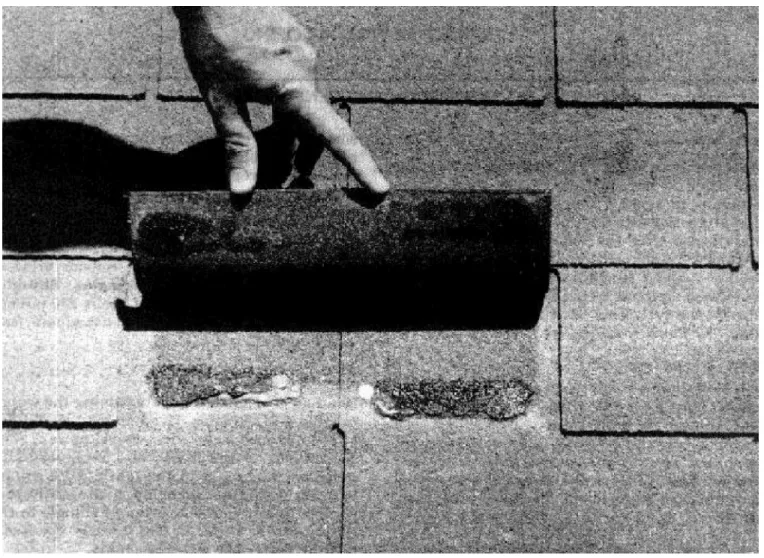
Figure 22. Wind-resistant asphalt strip shingles with factory applied spots of adhesive.
indicating that they are effective against storage, weathering characteristics, and methods of increasingly severe fire exposure. Class C shingles maintenance and repair apply almost equally to all are normally specified for military facilities. types of asphalt shingles.
5.1.8 Square-Butt Strip Shingles 5.1.9 Wind-Resistant Shingles
Shingles covering wide ranges of weight and Wind-resistant shingles are available which have coverage are available. However, the organic-fiber spots or strips of adhesive factory applied to each felted square butt-strip shingle, 12 by .36 inches in tab (fig. 22). The adhesive is activated as the size, with an exposure of .5 inches and weighing shingle is applied on the roof. Wind-resistant approximately 2.30 pounds per square applied shingles should always be specified. As an option to (Type 235), is the accepted asphalt shingle for using shingles with factory applied adhesive, tabs of roofs on military structures. Shingles may be shingles may be fastened down with field applied uniform thickness or thick-butt type; however, the spots of bituminous cement as described in uniform thickness type is preferred. Other types of paragraph 5.5.1. This procedure is generally the shingles may be used only for spot repair to match more expensive choice. Class C, wind-resistant existing roofing. Subsequent sections will therefore shingles should meet the requirements of UL 55B deal primarily with square-tab strip shingles, and UL 79D, "Guide Test Method for Wind-although kinds of decks, methods of handling and Resistant Shingles."
Section II. ROOF DECKS FOR ASPHALT-SHINGLE ROOFS
Wood decks for asphalt-shingle roofs should be of asphalt-saturated felt prior to laying the shingles. well-seasoned sheathing lumber, nominal I inch in Coated felts should not be used as an underlayment thickness, not more than 6 inches wide and for shingles since they constitute a good vapor preferably tongued and grooved, or of plywood barrier and might cause condensation or frost to with exterior glue, not less than ½ inch thick. form at the roof deck. Attic spaces under asphalt Sheathing boards should be fastened to each rafter shingled roofs should be vented in accordance with with two nails to provide a smooth, even surface. accepted practice. Where the underside of the roof Any knot holes, resinous areas or loose knots rafters is lined to form an exposed ceiling, continu-should be covered with sheet metal. The deck ous vents should be provided at both the eave and should be covered with an underlayment of type 15 the ridge for effective venting.
Section III. STORAGE AND HANDLING OF ASPHALT SHINGLES
5.3.1 Handling Shingles of shingles should not be more than 3½ feet high. Asphalt shingles should be handled carefully at all
times to prevent damage. Particular care should be exercised during extremes of temperatures. When hot they may be torn rather easily and when cold, the asphalt coating becomes brittle and may be cracked if the shingle is bent. Bundles should be lifted by placing the hands underneath, not by the wires. They should not be thrown or dropped and hooks should not be used.
5.3.2 Storage of Shingles
Shingle bundles stored in warehouses or on the job should not be piled so high that the bottom shingles will be damaged. Bundles should be stored not more than 5 to 8 bundles deep. In any case, stacks
Shingles with factory-applied spots of adhesive should not be stored in the sun or in warm areas as the heat may cause the shingles to stick together and prevent separation of the shingles at time of application. Shingles should not be stacked directly on the floor of a warehouse or on the ground. They should be stacked on planks spaced so that the shingles do not sag. Shingles stored on the job must be protected from the weather. If water comes in contact with the nonweather surface of the shingles, the thin asphalt coating on the back surface may permit some water to be absorbed by the felt base and blistered shingles will result. Contact with oils or solvents must be avoided.
Section IV. DETERMINING TREATMENT FOR ASPHALT-SHINGLE ROOFS
5.4.1 Weathering at the cut-out area. However, without the
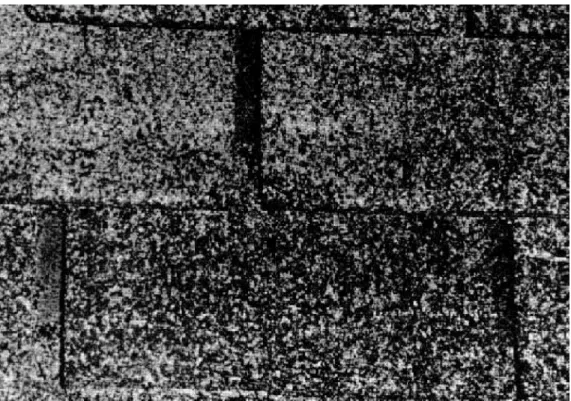
Asphalt-shingle roofs that are applied properly usually require no special maintenance or repair treatments. Shingles normally last from 10 to 20 years depending on the climate with very little change in appearance. The first indication of normal weathering is the loss of mineral surfacing granules, slight at first, but accelerating as the loss of granules expose more of the asphalt coating to the weather (fig. 23). No definite periods can be ascribed for the various phases of weathering because they will vary with the direction of exposure, the climate and the slope of the roof. Weathering is more rapid in hot, humid climates; on southern and western exposures and on low pitched roofs (fig. 24). Asphalt-shingle roofs with at least double coverage will usually not leak, even if most
surfacing, weathering proceeds rapidly, the shingles become brittle and more vulnerable to wind damage, so that large bare areas are an indication that the roof will soon need attention (fig. 25).
5.4.2 Clawed Shingles
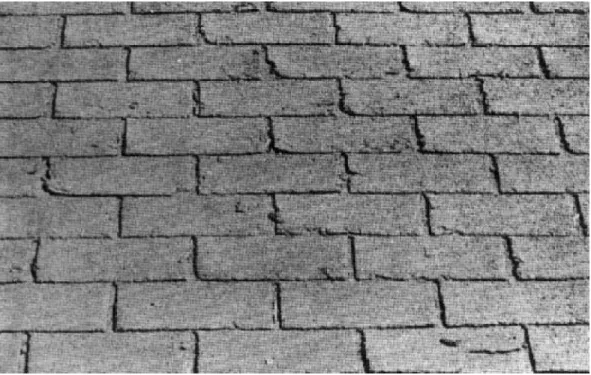
Some asphalt shingles, particularly those man-ufactured during the approximate period 1950-62, after being on the roof for a number of years exhibit a phenomena which has been termed "clawing" (fig. 26). The clawing phenomena is attributed primarily to a lack of sufficient asphalt coating on the underside of the shingle. Shingle specifications were revised in 1962 to reduce the incidence of the clawing condition. At this time
Figure 24. Difference in weathering of ashphalt shingles on southern and eastern exposures. Figure 23. Loss of mineral surfacing granules due to normal weathering.
Clawed shingles should not be replaced merely for the sake of appearance. Although the shingles may be severely clawed, in all probability the roof will not leak and replacement is not required until such time as the shingles become deteriorated. However, clawing does shorten the useful life considerably.
5.4.3 Recoating
The recoating of weathered asphalt shingles is not recommended for the following reasons:
(1) Shingles that have weathered to the stage that recoating would seem to be indicated are probably so brittle that they are likely to be
Figure 27. Recoated asphalt shingles — note damage resulting from brittleness.
damaged severely by the recoating operation (fig. taken to cement tightly all three edges of all
27). exposed tabs.
(2) Further, the unequal weathering of the (3) Experience has shown that the cost of exposed tabs will result in an unequal absorp- recoating and sealing the edges of the shingle tabs tion of the coating material, thereby causing is such that reroofing is the more economical the coated tabs to curl unless great care is procedure.
Section V. MAINTENANCE AND REPAIR METHODS FOR ASPHALT-SHINGLE ROOFS
In asphalt-shingle roofs no sharp distinction can be proper locations since the bending required may drawn between maintenance and repair work. damage the shingle tabs.
Maintenance and repair methods for asphalt-shingle roofs are therefore combined.
5.5.1 Maintaining Roofs Having Improperly Nailed Shingles
The defect that is found most frequently in the without factory applied adhesive that are nailed application of square-tab strip shingles is the correctly but are located in areas where strong improper placement of nails, that is, nailing too winds are prevalent.
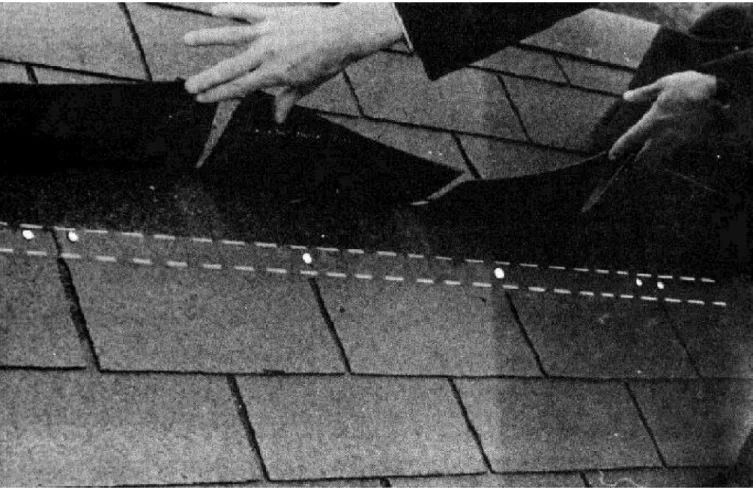
near the top of the shingle rather than ½ to¾ inch above the top of the cut-out portions (fig. 28). Too-high nailing of shingles should be corrected by placing a spot of quick setting asphalt plastic cement under the center of each tab (two spots for each tab of 2-tab shingles) and pressing the tab down firmly. The spot of cement should be not less than 1 square inch in area when pressed flat (fig. 29). Asphalt plastic cements are readily obtainable and are satisfactory for this purpose. Approx-imately ½ gallon of cement is required per square of shingles. The shingle tabs should not be bent up farther than necessary to place the cement. No attempt should be made to renail shingles in the
5.5.2 Maintaining Asphalt-Shingle Roofs in Areas of Strong Winds
The cement treatment described above should also be used to prevent wind damage to shingles
5.5.3 Maintaining Asphalt-Shingle Roofs Damaged by Hail
Severe hail storms may damage asphalt-shingle roofs beyond repair, particularly if the shingles have been exposed for a number of years (fig. 30). With such damage, both layers of shingles are broken, the roof will leak severely and reroofing is mandatory. Severe damage such as shown in figure 31, where the asphalt coating and surfacing granules have been removed from numerous small areas, but where the shingles are not broken, will not cause the roof to leak. However, the life of a roof so damaged will be shortened materially. Maintenance is not practicable since the cost would
Figure 28. Proper method of nailing asphalt shingles.
probably equal that of a new roof. Minor hail damage, where only occasional areas from which the coating and surfacing granules have been loosened may be repaired by covering the bare areas with asphalt-base roof coating, plastic cement, or clay type asphalt emulsion. (See para 4.5.3.3.2 for description.)
5.5.4 Renewing Rotted Eaves Boards
frequently rotted before the roof shows any signs of deterioration, because of failure to provide a proper drip edge. In such cases the first three or four courses of shingles should be removed and deteriorated sheathing replaced.
In replacing the shingles, the starter strip and first course of shingles should project at least ¾ inch beyond the eave line to form a drip, or in lieu thereof, a metal drip edge should be provided. Particular care should be taken not to damage the old shingles when removing nails to join the new roof section with the old one.
5.5.5 Installing Drip Edge at Rake
Cases where shingles have been applied without a proper overhang of ¼ to d inch at the rake and where no metal drip edge has been applied may be corrected, before the roof sheathing has deteriorated, by removing carefully any nails holding the shingles at the rake and applying a metal drip edge. The shingles should then be renailed and all of the shingle tabs adjoining the
Figure 30. Hail damage showing broken shingles — reroofing mandatory.
Section VI. REROOFING WITH ASPHALT SHINGLES
5.6.1 General (7) Sweep all loose debris from the roof
Asphalt shingles may be used for reroofing over asphalt-shingle roofs and over smooth and mineral-surfaced asphalt roll roofing. However, the better practice is to remove the existing roof covering. Among the reasons for removal are: an opportunity is given to correct deficiencies in the roof deck, such as warped or rotted framing and sheathing; better nailing is provided; shingles applied on a smooth surface generally render better service than on an uneven surface; moisture in the old roofing will enter the new shingles and cause small surface blisters, and the appearance of the reroofing job is better. In cases where asphalt shingles have been applied over an existing roof, and reroofing is again necessary, the two roofs should be removed without question. The reasons for removal given previously apply with even greater force in such cases. No attempt should be made to apply asphalt-shingle roofing over existing metal, slate or asbestos-cement roofs because of difficulties in nailing. Asphalt shingles can be applied over old wood shingles. However, the amount of labor and material involved in the preparation normally does not warrant leaving the wood shingles in place.
5.6.2 Preparing Deck for Reroofing With Asphalt Shingles
5.6.2.1 When Existing Roofing Is Removed. To
restore the roof deck to as nearly "new" condition as possible —
(1) Remove all protruding nails and renail sound sheathing where necessary.
(2) Remove rotted or warped sheathing boards or delaminated plywood and install new decking.
(3) Cover all large cracks, knot holes and resinous areas with sheet metal.
(4) Repaint ferrous metal drip edges and other flashings that are in good condition or remove badly corroded metal flashings and install new ones of nonferrous metal.
(5) Remove old roll roofing flashings. In-stall new base flashings of nonferrous metal or roll roofing, and new nonferrous metal counter flashings.
(6) Fill in with wood strips of the same thickness as the existing sheathing the spaces between spaced sheathing to which a wood shingle, slate or tile roof had been applied. An alternate method which might be more economical,
deck.
5.6.2.2 When Existing Roofing Remains.
(1) When Reroofing Over Asphalt Roll Roofing:
(a) Remove all loose and protruding nails. (b) Cut all wrinkles and buckles and nail cut edges securely to the roof deck.
(c) Repaint ferrous metal drip edges and counter flashings that are in good condition.
(d) Install new nonferrous metal or roll roofing base flashings and new metal counter flashings in accordance with new construction specifications where necessary.
(e) Install new nonferrous metal or roll roofing valley flashings.
(f) Sweep all loose debris from the roof deck.
(2) When Roofing Over Asphalt Shingles:
(a) Remove all loose or protruding nails. (b) Nail down or, preferably, cut away the butts of all curled or lifted shingles.
(c) Treat flashings as described in (1) above.
(d) Sweep all loose debris from the roof deck.
(e) Cut away the butts on clawed shingles. (3) When Reroofing Over Wood Shingles:
(a) Remove all loose and protruding nails. (b) Nail down or cut off corners of warped shingles.
(c) Replace decayed or missing shingles with new ones.
(d) Cut back shingles at eaves and rake far enough to apply 1 inch by 4 inch wood strips securely nailed.
(e) Apply beveled wood strips approxi-mately four inches wide over each course of wood shingles. The thick side of the strips should be as thick as the butts of the wood shingles, with the other side feathered to negligible thickness.
(f) Treat flashings as described in (1) above.
(g) Sweep all loose debris from the roof deck.
5.6.3 Applying Asphalt-Shingle Roof 5.6.3.1 General. Apply asphalt shingles in
ac-cordance with current specifications for new construction except that when an asphalt-shingle roof is applied over an existing asphalt-shingle or roll-roofing roof, nails must be of sufficient length to penetrate the sheathing at least ¾ inch to
5.6.3.2 Low Slope Roofs. For roofs having a localities where there is a possibility of heavy con-slope of less than 4 inches per foot, special centrations of ice forming along the eaves to the application methods are used. The entire roof extent that the roof may be damaged, a sheet-metal should have an underlayment consisting of two- eaves flashing should be provided; in this instance, layers of asphalt saturated felt (type 15). That the gutter is omitted.
portion of the felt underlayment which extends from the eave up the roof to a point 24 inches from the inside face of the exterior wall should be cemented together with a continuous layer of plastic bituminous cement applied at a rate of about two gallons per 100 square feet. The purpose of this procedure is to prevent leakage from ice dams which might form along the eaves causing a backup of water. Shingles for low slope roofs should be of the wind-resist- ant type with factory applied spots of adhesive.
5.6.3.3 Eaves Flashing. Eaves flashing should
be provided in low temperature zones regardless of roof slope. Eaves flashing may consist of a double layer of felt underlayment with a solid coating of bituminous cement applied between the layers as described in paragraph 5.6.3.2, above, or for roof slopes exceeding 4 inches per foot, it may consist of roll-roofing with all laps fully cemented. In
5.6.3.4 Valley Flashings. Valley flashing may
be open sheet metal type, open roll roofing type, or closed woven type. These types are described in detail in current guide specifications and in the publication "Manufacture, Selection, and Application of Asphalt Roofing and Siding Products" which is referenced in paragraph 5.1.1. Since drainage concentrates at the valleys, this is a vulnerable area for leakage. Careful attention must be given to the design and installation of valley flashing so that a smooth unobstructed path is provided to quickly drain away the water. For further discussion of valley flashings, see paragraph 12.3.
5.6.3.5 Windy Areas. Wind-resistant shingles
must be specified for use in localities subject to high winds. The use of wind-resistant shingles is encouraged in all localities. See paragraph 5.1.9.