Research Article
Support Vector Machine Based on Adaptive Acceleration
Particle Swarm Optimization
Mohammed Hasan Abdulameer,
1,2Siti Norul Huda Sheikh Abdullah,
1and Zulaiha Ali Othman
31Pattern Recognition Research Group, Centre for Artificial Intelligence Technology, Faculty of Information Science and Technology, Universiti Kebangsaan Malaysia, 43600 Bandar Baru Bangi, Malaysia
2Department of Computer Science, Faculty of Education for Women, University of Kufa, Iraq
3Data Mining and Optimization Group, Centre for Artificial Intelligence Technology, Faculty of Information Science and Technology, Universiti Kebangsaan Malaysia, 43600 Bandar Baru Bangi, Malaysia
Correspondence should be addressed to Mohammed Hasan Abdulameer; moh [email protected] Received 1 December 2013; Accepted 20 February 2014; Published 25 March 2014
Academic Editors: S.-F. Chien, T. O. Ting, and X.-S. Yang
Copyright © 2014 Mohammed Hasan Abdulameer et al. This is an open access article distributed under the Creative Commons Attribution License, which permits unrestricted use, distribution, and reproduction in any medium, provided the original work is properly cited.
Existing face recognition methods utilize particle swarm optimizer (PSO) and opposition based particle swarm optimizer (OPSO) to optimize the parameters of SVM. However, the utilization of random values in the velocity calculation decreases the performance of these techniques; that is, during the velocity computation, we normally use random values for the acceleration coefficients and this creates randomness in the solution. To address this problem, an adaptive acceleration particle swarm optimization (AAPSO) technique is proposed. To evaluate our proposed method, we employ both face and iris recognition based on AAPSO with SVM (AAPSO-SVM). In the face and iris recognition systems, performance is evaluated using two human face databases, YALE and CASIA, and the UBiris dataset. In this method, we initially perform feature extraction and then recognition on the extracted features. In the recognition process, the extracted features are used for SVM training and testing. During the training and testing, the SVM parameters are optimized with the AAPSO technique, and in AAPSO, the acceleration coefficients are computed using the particle fitness values. The parameters in SVM, which are optimized by AAPSO, perform efficiently for both face and iris recognition. A comparative analysis between our proposed AAPSO-SVM and the PSO-SVM technique is presented.
1. Introduction
Support vector machine (SVM) is a machine-learning method based on the structure risk minimization principle. SVM can find global optimum solutions for problems with small training samples, high dimensions, and nonlinearity. SVM has attracted much attention during the past decade as a modern machine-learning approach in several domains, such as pattern recognition, bioinformatics, and other nonlinear problems with small sample sizes. SVM has strong theoretical foundations and a good generalization capability. From the implementation point of view, training an SVM in classifica-tion is equivalent to solving a linearly constrained quadratic programming (QP) problem, which consumes large amounts
of memory and computation time when the number of samples increases. Another issue in SVM is that the selection of the training parameters impacts its performance. Some of the SVM-based methods are utilized with face applications [1–15]. Li, Lijuan & Weiguo have proposed a multi-class SVM for face recognition [2]. They utilized the generalized two-dimensional Fisher’s linear discriminant (G-2DFLD) method for feature extraction and used multiclass support vector machines as the classifier for face recognition. They proposed a multiobjective uniform design (MOUD) search method as an SVM model selection tool and then applied an optimized SVM classifier to face recognition. In their proposed method, LDA has been used for feature extraction. However, LDA is computationally high and suffers from the so-called small size
Volume 2014, Article ID 835607, 8 pages http://dx.doi.org/10.1155/2014/835607
Face/iris images
Feature extraction
(PCA) databaseFeature
Training
Testing
AAPSO-SVM Results
Figure 1: Structure of the proposed recognition technique based on AAPSO-SVM.
problem (SSS) problem [13]. Additionally, a new classification model based on SVM named as (SVM + NDA) has been proposed by Khan et al. [12]. In addition, they proposed a kernel extension of the model KSVM + KNDA to deal with nonlinear problems. However, it is obvious to notice that the SVM + NDA in linear case took more computational time than the LDA, NDA, HLDA, and SVM + LDA. On the other hand, the KSVM + KNDA required greater number of iterations than KNDA and KFD in nonlinear case.
Recently, existing face recognition methods utilize PSO and OPSO methods to optimize the parameters of SVM. Ref-erence [3] presented a face recognition method based on sup-port vector machine and particle swarm optimization (PSO-SVM). In PSO-SVM method, the parameters optimization problem in SVM is solved by particle swarm optimization. Nevertheless, this method lacks the initial phase of the PSO technique. In PSO, the populations are generated in a random manner. Due to this random process, the population results may also be in a random manner. Therefore, it is not certain that this method will produce a precise result when it is used with SVM. Later, and to avoid this drawback, a modified face recognition method based on opposition particle swarm optimization (OPSO) and SVM (OPSO-SVM) has been proposed by Hasan, Abdullah and Othman [13]. In OPSO-SVM, opposition particle swarm optimization (OPSO) [14] has been used instead of PSO to find the optimal parameters in SVM. In OPSO, the populations are generated in two ways: one is random population the same as the standard PSO technique and the other is opposition population, which is based on the random population values. The optimized parameters in SVM by OPSO efficiently perform the face recognition process. Accelerated PSO with SVM (APSO-SVM) has been introduced by Yang, Deb and Fong [15]. In APSO-SVM, APSO is used to find the best kernel parameters in SVM. Then, the kernel parameters are used to construct the support vector machines to solve the problem of interest. In APSO, the algorithm used the global best only and excluded the individual best and it does not use velocities or inertia parameter. Though, the PSO performance degrades by the utilization of random values in the velocity calculation and this will influence the parameter selection in SVM. In this paper, to address this problem, an adaptive acceleration par-ticle swarm optimization (AAPSO) technique is proposed.
The rest of this paper is structured as follows.Section 2
describes the proposed model in relation to PSO and SVM.
Section 3explains the experimental results. Finally, we end
our paper with conclusions and potential future studies in
Section 4.
2. The Proposed Model
The standard PSO method has been utilized in many research works to obtain optimal problem solutions. To obtain a more accurate optimal result, the drawbacks which are present in the PSO method must be addressed by making modifications or enhancements to the PSO model. The major drawback of the PSO is the random value selection during new particle generation; that is, in the velocity computation, the acceleration coefficients are generated randomly. The random value selection in the velocity process means that the generated particles will also be random. Random populations do not produce more accurate results. Hence, to acquire a more accurate result and to reduce this PSO drawback, we propose an adaptive acceleration particle swarm optimization (AAPSO). To obtain more accurate classification results, the SVM parameters will be optimized by our AAPSO. The utilization of AAPSO in the SVM parameter optimization will reduce the PSO drawback and improve the classification result accuracy. In this research, our intent is to develop a face and iris recognition system for accurate recognition of face images from the databases. The proposed face recognition technique is performed in three phases, feature extraction by PCA, adaptive acceleration particle swarm optimization (AAPSO), and parameters selection for SVM with AAPSO. These three phases are performed repeatedly on the input database face images, and thus the face images are recognized more effectively. The three phases are discussed in Sections
2.1, 2.2, and 2.3. The basic structure of our proposed face recognition technique is shown inFigure 1.
2.1. Feature Extraction Using PCA. The purpose of the feature extraction is to extract the information that represents the face. Principal component analysis (PCA) is used for this purpose [9]. We apply PCA on the training and testing database face images and obtain the unique dimensional feature vectors.
2.2. The Proposed Adaptive Acceleration Particle Swarm Opti-mization (AAPSO). Particle swarm optimization (PSO) is a computational intelligence oriented, stochastic, population based global optimization technique proposed by Kennedy and Eberhart [4,11]. It is inspired by the social behaviour of biological creatures, such as fishes and birds, which have the ability to group together to work as a whole to locate desirable positions in a certain area, for example, fish searching for a food source. This type of search behaviour is equivalent to
0 0.5 1 1.5 2 2.5 3 3.5 4 4.5
1 2 3 4 6
fmin
min
/fav
g
c1
Figure 2:𝑐1minbehavior.
searching for solutions of equations in a real-valued search space [10]. PSO emulates the swarm behaviour of individuals who represent potential solutions in a D-dimensional search space. Particle 𝑖 is often composed of four vectors: 𝑋𝑖 =
(𝑥1
𝑖, 𝑥2𝑖, . . . , 𝑥𝐷𝑖 ), where𝑥𝐷𝑖 is its position in the𝑑th dimension;
𝑃𝑏𝑒𝑠𝑡𝑖 = (𝑃𝑏𝑒𝑠𝑡1𝑖, 𝑃𝑏𝑒𝑠𝑡2𝑖, . . . , 𝑃𝑏𝑒𝑠𝑡𝐷𝑖 ), where𝑃𝑏𝑒𝑠𝑡𝐷𝑖 is the
best position in the𝑑th dimension that particle𝑖has found on its own;𝑉𝑖 = (V1𝑖,V2𝑖, . . . ,V𝐷𝑖 ), whereV𝐷𝑖 is the velocity in the𝑑th dimension; and𝑔𝑏𝑒𝑠𝑡𝑖= (𝑔𝑏𝑒𝑠𝑡1𝑖, 𝑔𝑏𝑒𝑠𝑡𝑖2, . . . , 𝑔𝑏𝑒𝑠𝑡𝐷𝑖), where𝑔𝑏𝑒𝑠𝑡𝐷𝑖 is the global best position in the𝑑th dimension that all particles have found. Particles in a swarm move through the search space as follows:
𝑉𝑖𝑑= 𝑉𝑖𝑑+ 𝑐1𝑟1⋅ (𝑃𝑏𝑒𝑠𝑡𝑑𝑖 − 𝑥𝑑𝑖) + 𝑐2𝑟2⋅ (𝑔𝑏𝑒𝑠𝑡𝑑𝑖 − 𝑥𝑑𝑖) ,
(1)
𝑥𝑑
𝑖 = 𝑥𝑑𝑖 + 𝛿𝑉𝑖𝑑, (2)
where𝑐1and𝑐2are two constants, often with the value of 2.0,
𝑟1 and𝑟2are two independent random numbers uniformly generated in the range[0.1]at each updating iteration from
𝑑 = 1to𝐷,𝑉𝑖𝑑is the velocity of the𝑖th particle,𝑥𝑖𝑑is the
current position of the particle𝑖, 𝑃𝑏𝑒𝑠𝑡𝑑𝑖 is the position of the best fitness value of the particle at the current iteration,
and𝑔𝑏𝑒𝑠𝑡𝑑𝑖 is the position of the particle with the best fitness
value in the swarm. The random values of 𝑐1 and 𝑐2 in the velocity computation do not select the optimal SVM parameters so that the result of the recognition results will be random or inaccurate. Therefore, we have proposed an adaptive acceleration particle swarm optimization (AAPSO) method that selects the acceleration coefficients using particle fitness values. The AASPO method selects the optimal SVM parameters and formulates the SVM to provide a more accurate face recognition result. The AAPSO’s acceleration coefficients are determined as follows:
𝑛𝑐1= 2
3(𝑐1max− 𝑐1min) (
𝑓min
𝑓avg
+𝑓min
2𝑓max) + 𝑐1min,
𝑛𝑐2= 2
3(𝑐2max− 𝑐2min) (
𝑓min
𝑓avg
+𝑓min
2𝑓max) + 𝑐2min,
(3)
where𝑐1maxand𝑐1minrepresent the minimum and maximum values of𝑐1;𝑓min,𝑓avg, and𝑓max are the particle minimum,
average, and maximum fitness values of the entire population; and𝑐2max and𝑐2min represent the minimum and maximum
values of𝑐2. By applying𝑛𝑐1and𝑛𝑐2in the velocity equation (1), the equation is updated as follows:
𝑉𝑖𝑑= 𝑉𝑖𝑑+ 𝑛𝑐1𝑟1⋅ (𝑃𝑏𝑒𝑠𝑡𝑑𝑖 − 𝑥𝑖𝑑)
+ 𝑛𝑐2𝑟2⋅ (𝑔𝑏𝑒𝑠𝑡𝑖𝑑− 𝑥𝑑𝑖) . (4)
Utilizing the above equations, the velocity function accel-eration coefficients are computed in AAPSO. The evaluation of the coefficients using the AAPSO equations enables the SVM to provide more accurate results.
Example 1. Assume that the population pool has five parti-cles/individuals,𝑃𝑛 (for simplicity), and their fitness values are as follows:𝑃1= 0.5,𝑃2 = 0.4,𝑃3= 0.2,𝑃4= 0.7,𝑃5= 0.6, and𝑓min = 𝑃3.
As a special case,𝑓avg is equal to𝑓min (i.e.,𝑓min = 𝑓avg)
only if each member of the population has the same fitness value (i.e.,𝑃1 = 𝑃2 = 𝑃3 = 𝑃4 = 𝑃5). Otherwise,𝑓min <
𝑓avg. Naturally, the probability of𝑓min/𝑓avgwill be between
0 and 1. Assume that the probability of𝑓min/𝑓avg = 1 and
the probability of𝑓min/𝑓max= 1; then the sum((𝑓min/𝑓avg) + (𝑓min/2𝑓max)) is 3/2. Therefore, we only restrict the value
within 1, and (3) and (4) are multiplied by 2/3. As a result, this calculation will produce a maximum value of 1 instead of 3/2. If𝑓min,𝑓avg, and𝑓maxare equal, the acceleration will
be constant at 1; that is,𝑐1 approaches𝑐1max. If𝑐1increases, then the neighbourhood search space diverges using PSO. Otherwise, the neighbourhood search space converges. That is, 𝑐1 is linearly proportional to its neighbourhood search space. The data in Figure 2show that 𝑐1min varies linearly with𝑓min/𝑓avg.
The acceleration constant, 𝑐1, accelerates the neighbor-hood search; that is, it determines the nearest or farthest one. If𝑐1is small, the updated solutions will be near to the current solution, whereas if𝑐1is high, the updated solution will be far from the current solution. In our adaptive method, instead of fixing a constant𝑐1, we increase or decrease𝑐1 at every iteration. Therefore, the updated solutions may be far, near, or near-far.
Example 2. Assume a range of 10 and initial acceleration of 0; that is, the acceleration constant can vary within[0, 9]. For example, if a vehicle starts at 0 km/h and its maximum speed is 100 km/h, according to the traffic, it will accelerate between 0 and 100 km/h. Thus, the range of the speed is100 − 0 =
100 (𝑐1max − 𝑐1min). In (3), we add 𝑐1min to calculate the speed from the initial condition. The conventional method fixes the acceleration constant at one value; thus, the velocity of the particles is updated without considering the relation to population fitness. By making this constant adaptive, we increase or decrease the velocity based on the population fitness.
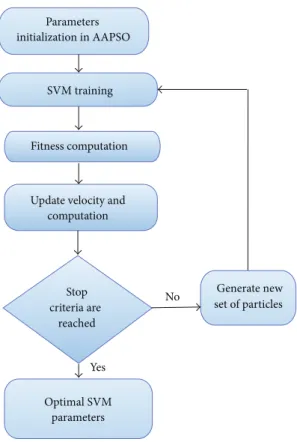
2.3. Parameter Selection for SVM with AAPSO. To obtain more precise recognition, the SVM parameters are optimized using the AASPO method. The process is shown inFigure 3. The process of optimal parameter selection by AAPSO in SVM is shown as follows.
Yes
No Parameters
initialization in AAPSO
Update velocity and computation Fitness computation
Stop criteria are
reached
Optimal SVM parameters
Generate new set of particles SVM training
Figure 3: SVM parameter optimization using AAPSO.
Step 1. Initially, the particles are generated randomly within the interval[𝑥, 𝑦]. The generated particles are composed of SVM parameters𝑃𝑖. Then, the parameters of each particle are initiated, including position and velocity.
Step 2. The fitness value of every particle is calculated using (5). The particles that have the minimum fitness values are selected as the best particles as follows:
min 1
2𝑃𝑖2+ 𝐶
𝑁 ∑ 𝑖=1
𝜉𝑖 (5)
Such that
𝑁 ∑ 𝑖=1
𝑃𝑖𝑥𝑖≥ (1 − 𝜉𝑖
𝑦𝑖 ) − 𝑏,
𝑖 = 1, 2, . . . , 𝑁, 𝜉𝑖≥ 0, 𝑖 = 1, 2, . . . , 𝑁,
(6)
where𝑁is the size of the training dataset and𝐶is a positive regularization constant or cost function, which defines the tradeoff between a large margin and a misclassification error.
Step 3. The𝑃𝑏𝑒𝑠𝑡𝑖of each particle is updated and𝑔𝑏𝑒𝑠𝑡𝑖for the domain is updated. Based on these values, the velocity and position of every particle are updated using (4) and (2).
Step 4. Stop if the current optimization solution is good enough or if the stopping criterion is satisfied.
3. Experimental Results
We divide our experiment into two sections, face recognition evaluation and then iris recognition evaluation. The proposed face recognition technique is implemented using MATLAB (version 7.12) on an Intel core i5 processor that uses Win-dows 7 operating system and that has 3.20 GHz CPU speed and 4 GB of RAM. The performance of the proposed face recognition technique is evaluated using the face databases YALE [5] and CASIA [6]. The images are obtained from both databases and the feature extraction is computed using PCA, while recognition process is computed using the proposed AAPSO-SVM technique. Sample face images from the YALE and CASIA databases are shown inFigure 4.
The performance of our proposed method is analyzed in three evaluation steps: (i) evaluate the optimization using three standard functions, (ii) evaluate the classification results with the UBiris dataset [7], and (iii) evaluate the classification results with the face datasets. These three evaluation steps are explained below.
(i) Evaluate the Optimization Using Three Standard Functions. To accomplish the performance analysis, we performed 10 rounds of experiments using the AAPSO and PSO methods. Moreover, our proposed AAPSO method performance is evaluated using the standard functions [8]: sphere, Rosen-brock, and Rastrigin. These standard functions are computed using the following equations:
𝑓0(𝑥) =∑𝑛
𝑖=1
𝑥2𝑖,
𝑓1(𝑥) =∑𝑛
𝑖=1
(100(𝑥𝑖+1− 𝑥2𝑖)2+ (𝑥𝑖− 1)2) ,
𝑓2(𝑥) =∑𝑛
𝑖=1
(𝑥2𝑖 − 10cos(2Π𝑥𝑖) + 10) .
(7)
The performance of our proposed AAPSO and the standard PSO methods on these standard functions, in terms of their fitness values for different numbers of iterations, is shown in
Figure 5.
The results inFigure 5show that our proposed AAPSO method yields more accurate particles that have lower fitness values than those generated by the PSO method. The results in Figures5(a),5(b), and5(c)show that our proposed AAPSO method has obtained accurate fitness values for all of the three standard functions. The high performance result shows that our AAPSO method is able to determine the more accurate SVM parameters. Additionally, the performance of our pro-posed AAPSO method is compared to the performance of the PSO method using (5) inFigure 6.
In Figure 6, the proposed AAPSO technique obtained
more accurate particles that have minimum fitness values smaller than those obtained with the PSO method. Therefore, our AAPSO technique has yielded more accurate SVM parameters.Figure 6(a)shows the fitness value performance for particles used on the YALE database face images. For all iterations, the fitness values of the particles of our proposed
(a)
(b)
Figure 4: Sample face images from (a) YALE [5] and (b) CASIA [6] databases.
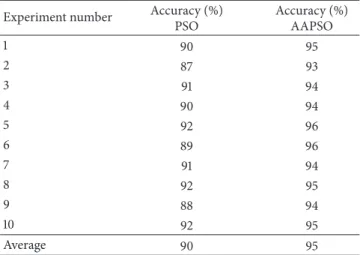
Table 1: The accuracy of PSO and AAPSO based on SVM classifica-tion performance results for the UBiris dataset.
Experiment number Accuracy (%) PSO
Accuracy (%) AAPSO
1 90 95
2 87 93
3 91 94
4 90 94
5 92 96
6 89 96
7 91 94
8 92 95
9 88 94
10 92 95
Average 90 95
AAPSO method are lower than those of the PSO method. However, when applied to the CASIA database, the PSO method particles have lower fitness values than the AAPSO particles for iterations 5, 8, and 9. In the remaining iterations, the AAPSO particles have the same or lower fitness values in comparison to the PSO particles.
(ii) Evaluate Classification Results with the UBiris Dataset. In this section, the classification performance is evaluated with the UBiris dataset. The classification accuracy results that are obtained for the UBiris dataset are given inTable 1. To analyze the classification performance, 10 experiments are conducted on the iris dataset. Sample iris dataset images are shown in
Figure 7.
In 10 experiments, our proposed AAPSO method attained higher iris image classification accuracy than the standard PSO-SVM. The average classification accuracy is 95%.
(iii) Evaluate Classification Results with Face Datasets. In this section, the classification results are evaluated with two databases, Yale and CASIA. Moreover, the performance of our proposed technique is compared with the PSO-SVM method using based on accuracy rate. In the experiment, the face images are evaluated for four conditions: (i) same pose, same illumination, and different expression; (ii) same pose, same expression, and different illumination; (iii) same expression, same illumination, and different pose; and (iv) different expression, pose, or illumination. The accuracy results for the proposed AASVM and the existing PSO-SVM face recognition techniques, applied to the YALE and CASIA databases, with the different conditions, are shown
in Table 2 and Figure 8. The computational times for our
proposed AAPSO and for the PSO methods are shown in
1 10 100
1 2 3 4 5 6 7 8 9 10
Fi
tness
Iterations
(a)
1 10 100 1000 10000 100000 1000000 10000000
1 2 3 4 5 6 7 8 9 10
Fi
tness
Iterations
(b)
1 10 100 1000 10000
1 2 3 4 5 6 7 8 9 10
Fi
tness
Iterations PSO
AAPSO
(c)
Figure 5: Performance of AAPSO and PSO methods with (a) sphere, (b) Rosenbrock, and (c) Rastrigin.
1 10 100 1000 10000 100000 1000000 10000000 100000000
1 2 3 4 5 6 7 8 9 10
Fi
tn
ess
Iterations PSO
AAPSO
(a)
0 200000 400000 600000 800000 1000000 1200000 1400000
1 2 3 4 5 6 7 8 9 10
Fi
tness
Iterations PSO
AAPSO
(b)
Table 2: Accuracy values of the proposed AAPSO-SVM and the PSO-SVM techniques with face datasets.
Conditions Condition description Yale dataset CASIA dataset
Method Accuracy Method Accuracy
1 Same pose, same illumination, and different expression
PSO-SVM 73 PSO-SVM 76
AAPSO-SVM 86 AAPSO-SVM 85
2 Same pose, same expression, and different illumination
PSO-SVM 80 PSO-SVM 82
AAPSO-SVM 95 AAPSO-SVM 96
3 Same expression, same
illumination, and different pose
PSO-SVM 83 PSO-SVM 81
AAPSO-SVM 94 AAPSO-SVM 93
4 Different expression, pose, or illumination
PSO-SVM 70 PSO-SVM 75
AAPSO-SVM 82 AAPSO-SVM 84
Figure 7: Sample images from the iris dataset.
1 2 3 4
PSO-SVM 73 80 83 70
AAPSO-SVM 86 95 94 82
0 20 40 60 80 100 120
PSO-SVM versus AAPSO-SVM with YALE database
A
cc
u
rac
y (%)
(a)
1 2 3 4
PSO-SVM 73 80 83 70
AAPSO-SVM 86 95 94 82
0 20 40 60 80 100 120
A
cc
urac
y (%)
PSO-SVM versus AAPSO-SVM with CASIA database
(b)
Figure 8: Performance accuracy of theAAPSO and PSO recognition methods from (a) YALE [5] database and (b) CASIA [6] database.
As shown inFigure 8, the recognition results of AAPSO-SVM have higher face recognition accuracy than the results of the PSO-SVM in all of the four conditions for both the Yale and CASIA databases. We measured the 𝑡-test values for the accuracy between AAPSO-SVM and PSO-SVM face recognition techniques. There was not much variation in the 𝑡-test results; however, the𝑡-test result shows that the proposed AAPSO-SVM is statistically significant and that it outperforms the PSO-SVM with the 𝑡-test result 𝑃 <
0.05; 𝑃 = 0.0265 for the Yale database and 𝑃 = 0.0186
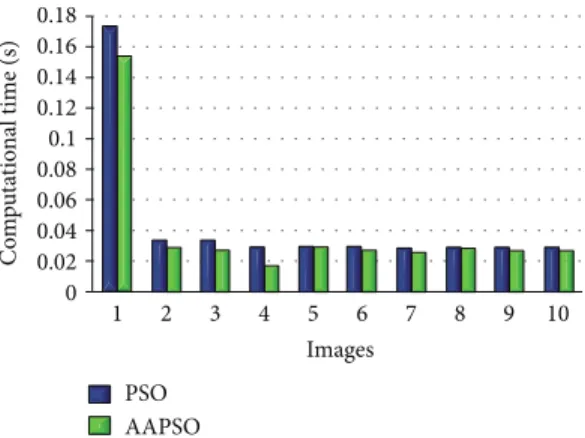
for the CASIA database. Furthermore, Figure 9 shows the computational time used by our proposed AAPSO method and the conventional PSO to determine the optimal SVM parameters. It was shown that AAPSO optimized the SVM when compared with conventional PSO.
Figure 9shows the computational time used by our
pro-posed AAPSO method and the conventional PSO to deter-mine the optimal SVM parameters. It was shown that AAPSO optimized the SVM, when compared with conventional PSO. The results in the table demonstrate the computational efficiency of AAPSO. That is, AAPSO uses less computational time to perform the optimization process compared with the conventional PSO. On average, AAPSO used 12% of the computational time to optimize the parameters and PSO used 21% of the computational time to optimize the parameters.
4. Conclusions
In this paper, we introduced AAPSO based on SVM to address the limitation of the standard PSO method that uses
0 0.02 0.04 0.06 0.08 0.1 0.12 0.14 0.16 0.18
1 2 3 4 5 6 7 8 9 10
C
o
m
p
u
ta
tio
nal time (s)
Images PSO
AAPSO
Figure 9: The computation time of AAPSO-SVM and PSO-SVM.
random selection of the coefficient factor for velocity. This may lead to performance instability. The optimized SVM, using the AAPSO technique, shows effective face recogni-tion performance. Two human face databases, YALE and CASIA, were utilized to analyze the performance of our pro-posed AAPSO-SVM face recognition technique. The UBiris database was also used to illustrate the performance of our proposed technique in other domains. The performance and comparative analysis results show that our proposed AAPSO-SVM technique yields higher face recognition performance results than the PSO-SVM face recognition methods. In 10 experiments, our proposed AAPSO method attained a high iris image average classification accuracy of 95%, which is more than the standard PSO-SVM, which attained 90% in the same experiments. In addition, the SVM parameters for the YALE and CASIA databases are more optimal when obtained from AAPSO than from the conventional PSO. AAPSO also takes less computational time to perform the optimization process than the conventional PSO. On average, AAPSO used 12% of the computational time to optimize the parameters and PSO used 21% of the computational time to optimize the parameters. Hence, our proposed AAPSO with SVM technique is more robust and more precisely recognizes the face and iris images. Our proposed method can be made more robust if we test it with domains other than biometrics, such as bioinformatics and text categorization.
Conflict of Interests
The authors declare that there is no conflict of interests regarding the publication of this paper.
Acknowledgments
This research is funded by the Ministry of Science, technology and Innovation (MOSTI) through ERGS/1/20 IISTG/UKM/2/48 (TK) under the title of 2D-3D Hybrid Face Matching via Fuzzy Bees Algorithm for Forensic Identifica-tion. The research also would like to thank CyberSecurity Malaysia and Royal Police of Malaysia’s Forensics Lab for their support of the research.
References
[1] C. Shiladitya, K. S. Jamuna, K. B. Dipak, and N. Mita, “Face recognition by generalized two-dimensional FLD method and multi-class support vector machines,”Applied Soft Computing, vol. 11, no. 7, pp. 4282–4292, 2011.
[2] W. Li, L. Lijuan, and G. Weiguo, “Multi-objective uniform design as a SVM model selection tool for face recognition,” Expert Systems with Applications, vol. 38, no. 6, pp. 6689–6695, 2011.
[3] W. Jin, J. Zhang, and X. Zhang, “Face recognition method based on support vector machine and particle swarm optimization,” Expert Systems with Applications, vol. 38, no. 4, pp. 4390–4393, 2011.
[4] J. Kennedy and R. C. Eberhart, “Particle swarm optimization,” inProceedings of the IEEE International Conference on Neural Networks, pp. 1942–1948, Piscataway, NJ, USA, December 1995. [5] P. N. Belhumeur, J. Hespanha, and D. Kriegman, “Eigenfaces vs. Fisherfaces: recognition using class specific linear projection,” IEEE Transactions on Pattern Analysis and Machine Intelligence, vol. 19, no. 7, pp. 711–720, 1997.
[6] Chinese Academy of Sciences, “CASIA face database,” 2007,
http://biometrics.idealtest.org/.
[7] H. Proenc and L. Alexandre, “Ubiris iris image database,” 2004,
http://iris.di.ubi.pt.
[8] K. James, R. C. Eberhart, and Y. Shi,Swarm Intelligence, Morgan Kaufmann, Burlington, Mass, USA, 1st edition, 2001.
[9] S. Vaseghi and H. Jetelova, “Principal and independent com-ponent analysis in image processing,” in Proceedings of the 14th ACM International Conference on Mobile Computing and Networking, pp. 1–5, San Francisco, Calif, USA, 2006.
[10] W. Chen, J. Zhang, S. H. Henry, Z. Wen-Liang, W. We-Gang, and S. Yu-Hui, “A novel set-based particle swarm optimization method for discrete optimization problems,”IEEE Transactions on Evolutionary Computation, vol. 14, no. 2, pp. 278–300, 2010. [11] R. Eberhart and J. Kennedy, “A new optimizer using particle
swarm theory,” inProceedings of the 6th International Sympo-sium on Micro Machine and Human Science, pp. 39–43, IEEE Service Center Piscataway, Nagoya, Japan, October 1995. [12] N. M. Khan, R. Ksantini, I. S. Ahmad, and B. Boufama, “A novel
SVM+NDA model for classification with an application to face recognition,”Pattern Recognition, vol. 45, no. 1, pp. 66–79, 2012. [13] M. Hasan, S. H. S. Abdullah, and Z. A. Othman, “Face recognition based on opposition particle swarm optimization and support vector machine,” inProceedings of the IEEE Inter-national Conference on Signal and Irnage Processing Applications (ICSIPA ’13), pp. 417–424, Malaka, Malaysia, 2013.
[14] H. Jabeen, Z. Jalil, and A. R. Baig, “Opposition based initializa-tion in particle swarm optimizainitializa-tion (O-PSO),” inProceedings of the 11th Annual Conference Companion on Genetic and Evolutionary Computation Conference: Late Breaking Papers, Companion (GECCO ’09), pp. 2047–2052, Material, Canada, July 2009.
[15] X. S. Yang, S. Deb, and S. Fong, “Accelerated particle swarm optimization and support vector machine for business opti-mization and applications,” inNetworked Digital Technologies, vol. 136 of Communications in Computer and Information Science, pp. 53–66, Springer, Berlin, Germany, 2011.
Submit your manuscripts at
http://www.hindawi.com
Computer Games Technology
International Journal of
Hindawi Publishing Corporation
http://www.hindawi.com Volume 2014
Hindawi Publishing Corporation
http://www.hindawi.com Volume 2014 Distributed
Sensor Networks
International Journal of
Advances in
Fuzzy
Systems
Hindawi Publishing Corporation
http://www.hindawi.com Volume 2014
International Journal of
Reconfigurable Computing
Hindawi Publishing Corporation
http://www.hindawi.com Volume 2014
Hindawi Publishing Corporation
http://www.hindawi.com Volume 2014
Applied
Computational
Intelligence and Soft
Computing
Advances in
Artificial
Intelligence
Hindawi Publishing Corporation
http://www.hindawi.com Volume 2014
Advances in
Software Engineering Hindawi Publishing Corporation
http://www.hindawi.com Volume 2014
Hindawi Publishing Corporation
http://www.hindawi.com Volume 2014 Electrical and Computer Engineering
Journal of
Journal of
Computer Networks and Communications
Hindawi Publishing Corporation
http://www.hindawi.com Volume 2014
Hindawi Publishing Corporation
http://www.hindawi.com Volume 2014
Multimedia
International Journal of
Biomedical Imaging
Hindawi Publishing Corporation
http://www.hindawi.com Volume 2014
Artificial
Neural Systems
Advances in
Hindawi Publishing Corporation
http://www.hindawi.com Volume 2014
Robotics
Journal ofHindawi Publishing Corporation
http://www.hindawi.com Volume 2014 Hindawi Publishing Corporationhttp://www.hindawi.com Volume 2014
Computational Intelligence and Neuroscience
Hindawi Publishing Corporation
http://www.hindawi.com Volume 2014
Modelling & Simulation in Engineering
Hindawi Publishing Corporation
http://www.hindawi.com Volume 2014
The Scientific
World Journal
Hindawi Publishing Corporation
http://www.hindawi.com Volume 2014
Hindawi Publishing Corporation
http://www.hindawi.com Volume 2014
Human-Computer Interaction
Advances in
Computer EngineeringAdvances in
Hindawi Publishing Corporation

![Figure 6: Performance of AAPSO and PSO methods from (a) YALE [5] database and (b) CASIA [6] database.](https://thumb-us.123doks.com/thumbv2/123dok_us/8525889.2291159/6.900.127.789.775.1070/figure-performance-aapso-methods-yale-database-casia-database.webp)
![Figure 8: Performance accuracy of theAAPSO and PSO recognition methods from (a) YALE [5] database and (b) CASIA [6] database.](https://thumb-us.123doks.com/thumbv2/123dok_us/8525889.2291159/7.900.109.808.603.790/figure-performance-accuracy-theaapso-recognition-methods-database-database.webp)