
Euclidean Number Fields 2 Hendrik W. Lenstra, Jr.*
A Method of Hurwitz
The problem we considered in the previous section (this Journal, vol. 2, pp. 6) may be immediately generalised to
more general number fields. Let
(3) a0+«i7 + ...+«„_! Jn l a0,a1,.. .,a„_i integers. be an irreducible polynomial with rational coefficients;
let γ be a zero of g, and let K be the field generated by γ.
Each element | of K is uniquely representable by an ex-pression of the shape
(D P
Ρο,Ρι,·· ·,Ρη-ι rational.
The norm Ν(ξ) of ξ is defined to be the absolute value of the product of the numbers (1) äs γ runs through the com-plex zeros of g. Obviously we have Ν(ξη) = Ν(ξ)Ν(η) for all ξ and η in K, and it can be shown that./v"(i;) is a rational number which is zero only if ξ = 0.
In K we shall consider rings R which, roughly speaking, are to be to K äs the ring of integers is to the field of rational numbers. More precisely, R is to satisfy two con-ditions. Firstly, each element ξ of K must have some multi-ple ηιξ in R, where m is a positive integer. Secondly, there should be elements Θ0, öt,..., Bd_ L in K such that an ele-ment 'ξ in K is in R if and only if it can be expressed in the form
(2) | = 0000+Μι +···+αα-ιθ<ι~ι, a0,al,.. .,«d_i integers.
it can be shown that if such Θ0,. . ., 0^-1 exist
can be chosen so that d = n; if so, the representation (2) is unique. In order that R be a ring the 0,· must have the property that all the products Bßj are again of the shape (2). Moreover, we shall always suppose that l belongs to R.
We can readily find rings./? that satisfy the conditions just described. Suppose, for example, that the coefficients
* Translated by Alf van der Poorten.
cii ofg are integers — this can always be arranged by replac-ing γ by some multiple my - then we may take d = n, θ i = j'. The elements of R now look exactly like the num-bers (1) of the previous section:
It can be shown that the union R0 of all rings that satisfy our conditions is itself a ring with those properties. The ring R0 is called the ring oialgebraic integers oiK.
The ring R is said to be euclidean with respect to the norm, or, more briefly, norm-euclidean if for every pair of elements α and ß of R, with β Φ 0, it is possible to find a quotient κ. and a remainder p, both belonging to R, so that
α = κβ + p N(p)<N(ß).
Here we observe that N(ß) is always an integer if ß belongs to R. Indeed, if ß is in R, and is not zero, one can inter-pret N(ß) äs the number of residue classes ofR modulo ß. Here two elements p and p' ofR are said to be in the same residue class modulo ß if p — p' is divisible in R by ß.
We call the field K euclidean if R0 is norm-euclidean. Actually it turns out that RQ is the only R that can be norm-euclidean.
The principal motive for this definition is the same äs in the previous section:
(4) if R is norm-euclidean then the theorem of unique factorisation into prime factors holds in R, Once again this can be demonstrated by Euclid's argu-ments.
The case n = 32 of the previous section showed us that the converse does not hold. We get a simpler example by considering the numbers a + b \/Ϊ4 with a and b integers, or the numbers |(« + b \/^Λ9) with a and b integers and u — b even.
How are we to decide whether R is norm-euclidean? If we write ξ = a/ß then the definition implies:
We can use this to give a geometnc formulation to the problem.
The polynormal g has n complex zeros, r of which, say 7i,. ., jr are real. The remammg n — r zeros can be arranged mto s complex conjugate parrs Choose one zero from each pair, this gives s additional zeros δ j,. , δ^ and we have r + 2s = n. We embed the field K m the «-dimen-sional real vector space JR.r χ Cs by mappmg the expres-8ΐοη/(γ)=ρ0+Ρι7 + + Pn-i7n~l, äs m (1), to
(/(7i),.. ,/(T,),/(«i),-..,/(«,)). Then K is dense m Rr χ €" Now
W(7)) - l Π /(γ,) Π /(δ,)/(δ;)|,
so we can extend the domam of defmition of the norm N to the whole space IR' χ €s by
r s N(XI,. ,xr,y\, •-,ys)= Π χ,· Π yjjtjl,
1=1 /=! with the x, real and the yf complex
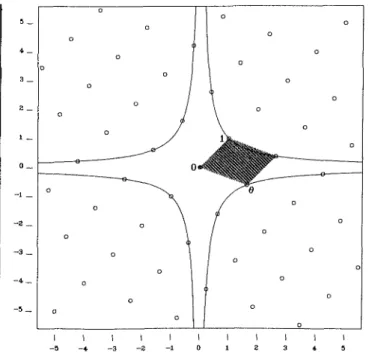
The embeddmg m R/" χ <£s makes R a lattic'e, that is to
., u n α rmi· /PJ ü i bolae bound the region V consisting of points of norm less than say,thereisabasisfl0,...,9»-i ofR xC overthereals one Theelementsof/?iyingon the hyperbolae are theumtsof
the nng The shaded region is the parallelepiped (7). The small part of this parallelepiped not contamed m Kis easily seen to be contamed in l + V It follows from this that the ring R is norm-f$\ ,. α i „ a _L _,_„ a euchdean
so that the numbers m R become exactly the vectors of the shape
We see that·
(6) R is norm-euchdean rf each element ξ of Rr χ Cs can be expressed äs the sum of an element κ in R and an element that belongs to the set
In the case r = 0,s = l the set V is an open disc with centre 0. If r = 2, s = 0 then V is an unbounded set m the plane, bordered by hyperbolae Generally Fis an open set
con-tammg 0 and is bounded only rf r + s = l By virtue of thls Wlth an unProved conjecture of Barnes and Swmner-(6) the question now is whether the translates ton-Dyer [l, p 313].
If we assume the converse ot (6) then the question κ + V, κ. m R
together cover the whole space Li order to see whether | belongs to one of these translates it is plam that we may
freely add elements of R to ξ; seemg that these elements are not saüsfied are of the shape (5) it follows that we need only consider
those ξ that he in the parallelepiped
pinÄwith7V(p)<7V(j3„); (7)
l,...,0 <<?„_!<!}.
-5 -4 -3 -2 -i 0 l Z 3 4 5
Figure 1. This Illustration shows a portion of the ring R = {a + be a and b mtegers}, with Θ 2 - Θ - 1 = 0, embedded in IR xIR by mappmg a + b to (a + b(\ + \/5)/2, β + 6(1 - V!")/2) The
hyper-'. -,an_i mtegers
This is a bounded set, and it is not difficult to see that // it is covered by some infinite set of translates κ. + V, then it is already covered by some fmite subset thereof
Should we happen to succeed in covermg the parallel-epiped (7) then we would have proved more than is strict-ly necessary: to prove that .R is norm-euchdean we need · = fv · M v)< l T consider only those vectors ξ which he m K; these
cor-respondtoratowa/^o,^!,. . ,q„_1 m(7) Were the converse of (6) to hold then the two questions would be equivalent, however, this converse has not been proved, nor is a counterexample known One should compare
whether R is euchdean with respect to the norm is decid-able. Indeed, let ß1, j32, ß3,... be a hst of all non-zero elements of R. Then one can check sequentially for n = 1,2,3,... whether the followmg conditions are or
/„: There is an α in R such that α ^ p mod ßn for all
If one or other of the conditions is satisfied then stop: if In holds then R is not norm-euclidean, and if//„ holds then R is norm-euclidean. Suppose that this decision pro-cedure fails to terminate. Then both /„ and //„ are false for all«, so R is norm-euclidean though the translates κ + V with κ. in R fail to cover the space JRr χ Cs. This contradicts our assumption of the converse of (6). We add that it is decidable for any fixed « whether /„ and //„ are satisfied.
It is indicative of the lack of general results in the
the-ory that even the decidability of the question whether R " * ~ K> is norm-euclidean cannot be established unconditionally.
The only thing in which the theory is rieh is in examples,
but even the most clearcut question concerning the extent euclidean if and only if we can take m = 2. of these riches:
are there, up to isomorphism, infinitely many euclidean ΚΊ
remains unanswered. The most significant result of this nature is a theorem of Davenport, see [2], which states that, up to isomorphism, there are only finitely many euclidean fields with r + s < 2. His methods have been used to determine all euclidean K with n < 2. Finally there is a finiteness theorem of Heilbronn which applies to certain classes of abelian fields, see [5].
Up to isomorphism, 334 different euclidean fields are known. The table below, derived from that in [7] and including new fields found by Cioffari, Leutbecher, Mar-tinet, Mestre and myself, indicates the distribution of these fields relative to n and r + s.
r + s
(10) (| + (7)*, (2ξ + U)*,. .., (m% + U) l
2 3 4 5 6 total
l 2 3 4 5 6 7 8 9 1 0
5
16 52 34
57 11 12 28
9 10 30 27 27 l 7 1 2 0 2
2 0 0 0 0 l 21 109 54 23 67 28 29 0 2
total
6 102 108 103 13 2 334
For references to some of the immense volume of the literature on these matters see [7].
Quite diverse rnethods have been applied to determine these fields. For some elementary proofs in the quadratic case (« = 2) one should consult Hardy and Wright [4, § 14.7/8]. Most of the cubic examples (n = 3) have been found with the aid of electronic Computers; the
tech-niques used can be viewed äs refinements of the decision procedure we sketched above.
We shall describe a method that harks back to an idea of Hurwitz. He bases a now unfashionable approach to ideal theory on the following variant of the euclidean division algorithm which is valid for all K and R: (8) there is an integer m > l, so that for each ξ in K
there is a κ. in R and an integer /, 0 < j < m, with
Here m is dependent on R. It is plain that R is norm-We shall sketch a proof of (8). Because the set V is open we can choose a neighbourhood U of 0 in Rr χ Cs so that U — U is contained in V; that is
(9) N(u-u')<\, for all u, u in U.
Now let ξ be an element of K and consider all the trans-lates
Ιξ+U, i =1,2,..., m
of U, where m is an integer greater than l which we fix later. We adjust each element of ίξ + U by subtracting that element of R which brings the adjusted number into the parallelepiped (7). This process yields a set, say (ζ'ξ + U)*, contained in (7), and of the same volume äs z£ + U. Were this not so then there would be two distinct points of K, + U that are adjusted to the same point of (7), thus points that have their difference in R', but this is impos-sible because of (9).
If we note that ϊξ + U and U plaimy have the same volume then we can conclude that we have m sets
contained in (7), each with a volume equal to that of U. Suppose that we now choose m so that m times the vol-ume of U is larger than the, plainly finite, volvol-ume of the parallelepiped (7). This is a choice that does not depend on ξ. Then the sets (10) cannot be disjoint and thus there are integers/ and ί',Κι < i' <m, elements u and u of U, and λ, λ' in R so that
ζξ + « - λ = i'ξ + u' - λ'. With κ. = λ' — λ and / = /' - z we have
In order to make this proof yield äs small a value of m äs possible one must of course attempt to choose U äs large äs possible. Even then one obtains the desired m = 2 only in a few cases. Much more can be achieved by making a small modification to Hurwitz' s theorem. If, in place of the sets £ + U, 2ξ + U, . . ., m£ + U, we were to consider the setsaji! + U, ω2£ + U, . . ., wm£ + Z/withoj!, co2, . . ., com arbitrary elements of K, then in an entirely analo-gous way we would find that
(11) there is an integer m > l, so that for Άαω1,ω2, _. .. ., c«jm and ξ in K there is a κ in R so that r(·™
(12) N(((*)j — ω;·)| — κ)< 1 for some i,f, l </</<m. Suppose now that the ωί , ω2 , . . ., com can be so chosen that all their differences ω,· — ω/ (i =£/) are unzft, that is, they have an inverse in R. Then-W(co,· — ω;·) = l, and (12) implies that
Since κ · (ω,· - ω,·)"1 is an element of R we conclude that R is norm-euclidean. In other words
(13) if R has sufficiently many elements all differences of which are units, then R is euclidean with respect to the norm.
As an example we consider the field K generated by a zeroTof^ = ArS -Z3 + X2 ~X~ l, which has/· = 3, s = l ; for R we take the set of numbers (3). It turns out that if U is well chosen in the above proof, then one can take m = 5. So R is norm-euclidean if it is possible to find five elements with all their differences units. We assert that the five elements
0,1,7,
will do for our purpose. It is quite easy to see that this is equivalent to the claim that all three of the elements 7, γ — l and γ — γ + l are units. But from
7S - 73 + 72 - 7 - l = g(7) ~ 0 it follows that
7-(74-72+7-l)=l (7 - 1) · (74 + 73 + 7) = l (72-7+1)·(73+72-7-1) = 7· We conclude that K is euclidean.
For further examples we refer the reader to [7]. The present method also allows us to deal with a number of the rings mentioned in the previous section.
Hurwitz's theorem can also be used to prove a charm-ing result of O'Meara [9]:
(14) there is a non-zero element δ in R, so that the ring T = R[S~1], generated by R and the inverse of δ, is euclidean with respect to the function NT defined by
NT(ß) - number of residue classes of T modulo ß, β in T, β Φ 0.
Here we say that T is euclidean with respect to N γ if for all a and β in T, β Φ 0, one can find κ and p in Γ so that α = κ/3 + p and NT(p) < NT(ß). It turns out that to prove O'Meara's theorem it is sufficient to take δ äs the product of all the numbers ω,· — ω;·, l < i < f < m, with m äs above and ωί,ω2,. . ., u*m arbitrary distinct ele-ments of R.
Actually, it is much easier to find a δ so that the unique factorisation theorem holds inR[5"1 ]. In the case R=R0 one can even choose δ to be relatively prime to any arbi-trarily nominated e in R; that is, so that λδ + με = 1 for
1.11- 0.11- UU-
0.01-1.10. 010. 1.00-
some λ, μ in R. Whether one has the same freedom of choice m (14) is an unsolved problem.
The rings T = R\b ~l ], with δ in R, δ non-zero, have properties which in many respects are analogous to those of the ring R itself. Much of what we have said in this sec-tion can, with some modificasec-tions, also be said of the rings T. Then p-adic fields take their place next to that of IR and (D, äs can be seen in figure 2. In any event, O'Meara's theorem shows that in this wider class of rings there is no lack of exarnples of euclidean rings. We refer to [8] for the proper generalisation of the theorem of Davenport that we mentioned above.
The author is indebted to A. K. Lenstra for preparing the drawings.
References to § 2
1. E. S. Barnes, H. P. F. Swmnerton-Dyer, The mhomogeneous mmima of bmary quadratic forms (II), ActaMath. 88 (1952), 279-316
2. J. W. S. Cassels, The mhomogeneoui, mimmurn of bmary quadiatic, ternary cubic and quaternary quartic forms, Proc. Cambridge Philos. Soc. 48 (1952), 72-86, 519-520 3. H. J. Godwm, Computations relating to cubic fields, pp.
225-229, m: A. O. L. Atkm, B. J. Birch (eds), Computers in nUmber theory, Academic Press, London 1971
4. G. H. Hardy, E. M. Wnght, An introduction to the theory of numbers, fourth edition, Oxford Umversity Press, Oxford 1960
5. H. Heilbronn, On Euclid's algonthm in cychc fields, Canad. J. Math. 3 (1951), 257-268
6. A. Hurwitz, Mathematische Werke, Zweiter Band, Birkhauser, Basel 1933
7. H. W. Lenstra, Jr., Euclidean number fields of large degree, Invent. Math. 38 (1977), 237-254
8. H. W. Lenstra, Jr., Euclidean ideal classes, Journees Anthme-tiques de Lummy,Asterisque 61 (1979), 121-131
9. O. T. O'Meara, On the finite generation of linear groups over Hasse domams, /. Reine Angew. Math. 217 (1965), 79-108
H. W. Lenstra, Jr. Mathematisch Instituut
Universiteit van Amsterdam Roetersstraat 15
1018 WB Amsterdam Netherlands A. J. van der Poorten
School of Mathematics and Physics Macquarie University
![Figure 2. The analogue of figure l for the ring T = Z [i ] = {«/&:](https://thumb-us.123doks.com/thumbv2/123dok_us/8179598.2168208/4.864.453.797.588.815/figure-analogue-figure-l-ring-t-z-amp.webp)
