Copyright © 2005 Pearson Education, Inc. publishing as Benjamin Cummings
• Overview: How Eukaryotic Genomes Work and Evolve
• In eukaryotes, the DNA-protein complex, called
chromatin
– Is ordered into higher structural levels than the
DNA-protein complex in prokaryotes
Copyright © 2005 Pearson Education, Inc. publishing as Benjamin Cummings
•
Both prokaryotes and eukaryotes
– Must alter their patterns of gene expression in
•
Concept 19.1: Chromatin structure is based on
successive levels of DNA packing
•
Eukaryotic DNA
– Is precisely combined with a large amount of
protein
•
Eukaryotic chromosomes
– Contain an enormous amount of DNA relative
Copyright © 2005 Pearson Education, Inc. publishing as Benjamin Cummings
Nucleosomes, or “Beads on a String”
•
Proteins called histones
– Are responsible for the first level of DNA
packing in chromatin
– Bind tightly to DNA
•
The association of DNA and histones
– Seems to remain intact throughout the cell
• In electron micrographs
– Unfolded chromatin has the appearance of beads
on a string
• Each “bead” is a nucleosome
– The basic unit of DNA packing
Figure 19.2 a
2 nm
10 nm DNA double helix
Histone tails
His-tones
Linker DNA (“string”)
Nucleosome (“bad”)
Histone H1
Copyright © 2005 Pearson Education, Inc. publishing as Benjamin Cummings
Nucleosome
30 nm
(b) 30-nm fiber
Higher Levels of DNA Packing
•
The next level of packing
– Forms the 30-nm chromatin fiber
•
The 30-nm fiber, in turn
– Forms looped domains, making up a 300-nm
fiber
Figure 19.2 c
Protein scaffold
300 nm
(c) Looped domains (300-nm fiber)
Loops
Copyright © 2005 Pearson Education, Inc. publishing as Benjamin Cummings
•
In a mitotic chromosome
– The looped domains themselves coil and fold
forming the characteristic metaphase chromosome
Figure 19.2 d
700 nm
1,400 nm
•
In interphase cells
– Most chromatin is in the highly extended form
Copyright © 2005 Pearson Education, Inc. publishing as Benjamin Cummings
•
Concept 19.2: Gene expression can be
regulated at any stage, but the key step is
transcription
•
All organisms
– Must regulate which genes are expressed at
any given time
•
During development of a multicellular organism
– Its cells undergo a process of specialization in
Differential Gene Expression
•
Each cell of a multicellular eukaryote
– Expresses only a fraction of its genes
•
In each type of differentiated cell
Copyright © 2005 Pearson Education, Inc. publishing as Benjamin Cummings
•
Many key stages of gene expression
– Can be regulated in eukaryotic cells
Figure 19.3
Signal
NUCLEUS Chromatin Chromatin modification: DNA unpacking involving histone acetylation and
DNA demethlation Gene DNA Gene available for transcription RNA Exon Transcription Primary transcript RNA processing
Transport to cytoplasm Intron
Cap mRNA in nucleus Tail
CYTOPLASM mRNA in cytoplasm Degradation of mRNA Translation Polypetide Cleavage Chemical modification
Transport to cellular destination Active protein
Regulation of Chromatin Structure
•
Genes within highly packed heterochromatin
Copyright © 2005 Pearson Education, Inc. publishing as Benjamin Cummings
Histone Modification
•
Chemical modification of histone tails
– Can affect the configuration of chromatin and
thus gene expression
Figure 19.4a (a) Histone tails protrude outward from a nucleosome
•
Histone acetylation
– Seems to loosen chromatin structure and
thereby enhance transcription
Figure 19.4 b (b) Acetylation of histone tails promotes loose chromatin structure that permits transcription
Copyright © 2005 Pearson Education, Inc. publishing as Benjamin Cummings
DNA Methylation
•
Addition of methyl groups to certain bases
in DNA
– Is associated with reduced transcription in
Epigenetic Inheritance
•
Epigenetic inheritance
– Is the inheritance of traits transmitted by
Copyright © 2005 Pearson Education, Inc. publishing as Benjamin Cummings
Regulation of Transcription Initiation
•
Chromatin-modifying enzymes provide initial
control of gene expression
– By making a region of DNA either more or less
Organization of a Typical Eukaryotic Gene
• Associated with most eukaryotic genes are
multiple control elements
– Segments of noncoding DNA that help regulate
transcription by binding certain proteins
Figure 19.5
Enhancer (distal control elements)
Proximal control elements
DNA
Upstream
Promoter
Exon Intron Exon Intron
Poly-A signal sequence Exon Termination region Transcription Downstream Poly-A signal Exon Intron Exon Intron Exon Primary RNA transcript (pre-mRNA) 5 Intron RNA RNA processing:
Cap and tail added; introns excised and exons spliced together
Coding segment
P P P G
mRNA
5 Cap 5 UTR
(untranslated region)
Start codon
Stop
codon (untranslated3 UTR region) Poly-A tail Chromatin changes Transcription RNA processing mRNA degradation Translation Protein processing and degradation
Cleared 3 end
Copyright © 2005 Pearson Education, Inc. publishing as Benjamin Cummings
The Roles of Transcription Factors
•
To initiate transcription
– Eukaryotic RNA polymerase requires the
Enhancers and Specific Transcription Factors
•
Proximal control elements
– Are located close to the promoter
•
Distal control elements, groups of which are
called enhancers
– May be far away from a gene or even in
Copyright © 2005 Pearson Education, Inc. publishing as Benjamin Cummings Distal control element Activators Enhancer Promoter Gene TATA box General transcription factors DNA-bending protein Group of Mediator proteins RNA Polymerase II RNA Polymerase II RNA synthesis Transcription Initiation complex Chromatin changes Transcription RNA processing mRNA degradation Translation Protein processing and degradation
A DNA-bending protein brings the bound activators closer to the promoter. Other transcription factors, mediator proteins, and RNA polymerase are nearby.
2
Activator proteins bind to distal control elements grouped as an enhancer in the DNA. This enhancer has three binding sites.
1
The activators bind to certain general transcription factors and mediator proteins, helping them form an active transcription initiation complex on the promoter.
3
•
An activator
– Is a protein that binds to an enhancer and
stimulates transcription of a gene
•
Some specific transcription factors function as
repressors
– To inhibit expression of a particular gene
•
Some activators and repressors
– Act indirectly by influencing chromatin
Copyright © 2005 Pearson Education, Inc. publishing as Benjamin Cummings
Coordinately Controlled Genes
•
Unlike the genes of a prokaryotic operon
– Coordinately controlled eukaryotic genes each
have a promoter and control elements
•
The same regulatory sequences
– Are common to all the genes of a group,
Mechanisms of Post-Transcriptional Regulation
•
An increasing number of examples
– Are being found of regulatory mechanisms that
Copyright © 2005 Pearson Education, Inc. publishing as Benjamin Cummings
RNA Processing
• In alternative RNA splicing
– Different mRNA molecules are produced from the
same primary transcript, depending on which RNA segments are treated as exons and which as
introns Figure 19.8 Chromatin changes Transcription RNA processing mRNA degradation Translation Protein processing and degradation Exons DNA Primary RNA transcript mRNA
mRNA Degradation
•
The life span of mRNA molecules in the
cytoplasm
– Is an important factor in determining the
protein synthesis in a cell
– Is determined in part by sequences in the
Copyright © 2005 Pearson Education, Inc. publishing as Benjamin Cummings
• RNA interference by single-stranded microRNAs
(miRNAs)
– Can lead to degradation of an mRNA or block its
translation Figure 19.9 5 Chromatin changes Transcription RNA processing mRNA degradation Translation Protein processing and degradation
Degradation of mRNA OR
Blockage of translation Target mRNA miRNA Protein complex Dicer Hydrogen bond The micro-RNA (mimicro-RNA) precursor folds back on itself, held together by hydrogen bonds. 1 2 An enzyme called Dicer moves along the double-stranded RNA, cutting it into shorter segments.
2 One strand of
each short double-stranded RNA is degraded; the other strand (miRNA) then associates with a complex of proteins.
3 The bound miRNA can base-pair with any target mRNA that contains the complementary sequence.
4 The miRNA-protein
complex prevents gene expression either by degrading the target mRNA or by blocking its translation.
Initiation of Translation
•
The initiation of translation of selected
mRNAs
– Can be blocked by regulatory proteins that
bind to specific sequences or structures of the mRNA
•
Alternatively, translation of all the mRNAs
in a cell
Copyright © 2005 Pearson Education, Inc. publishing as Benjamin Cummings
Protein Processing and Degradation
•
After translation
– Various types of protein processing, including
• Proteasomes
– Are giant protein complexes that bind protein
molecules and degrade them
Figure 19.10 Chromatin changes Transcription RNA processing mRNA degradation Translation Protein processing and degradation Ubiquitin Protein to be degraded Ubiquinated protein Proteasome Proteasome and ubiquitin to be recycled
Protein fragments (peptides) Protein entering a
proteasome
Multiple ubiquitin mol-ecules are attached to a protein by enzymes in the cytosol.
1 The ubiquitin-tagged proteinis recognized by a proteasome, which unfolds the protein and sequesters it within a central cavity.
2
Enzymatic components of the proteasome cut the protein into small peptides, which can be further degraded by other enzymes in the cytosol.
Copyright © 2005 Pearson Education, Inc. publishing as Benjamin Cummings
•
Concept 19.3: Cancer results from genetic
changes that affect cell cycle control
•
The gene regulation systems that go wrong
during cancer
– Turn out to be the very same systems that play
Types of Genes Associated with Cancer
•
The genes that normally regulate cell growth
and division during the cell cycle
– Include genes for growth factors, their
Copyright © 2005 Pearson Education, Inc. publishing as Benjamin Cummings
Oncogenes and Proto-Oncogenes
•
Oncogenes
– Are cancer-causing genes
•
Proto-oncogenes
– Are normal cellular genes that code for
• A DNA change that makes a proto-oncogene excessively active
– Converts it to an oncogene, which may promote
excessive cell division and cancer
Figure 19.11
Proto-oncogene
DNA
Translocation or transposition: gene moved to new locus, under new controls
Gene amplification: multiple copies of the gene
Point mutation within a control element
Point mutation within the gene
Oncogene Oncogene
Normal growth-stimulating
protein in excess Hyperactive or degradation-resistant protein Normal growth-stimulating
protein in excess Normal growth-stimulating
protein in excess New
Copyright © 2005 Pearson Education, Inc. publishing as Benjamin Cummings
Tumor-Suppressor Genes
•
Tumor-suppressor genes
– Encode proteins that inhibit abnormal cell
Interference with Normal Cell-Signaling Pathways
•
Many proto-oncogenes and tumor suppressor
genes
– Encode components of growth-stimulating and
Copyright © 2005 Pearson Education, Inc. publishing as Benjamin Cummings
Figure 19.12a
(a) Cell cycle–stimulating pathway. This pathway is triggered by a growth factor that binds to its receptor in the plasma membrane. The signal is relayed to a G protein called Ras. Like all G proteins, Ras is active when GTP is bound to it. Ras passes the signal to a series of protein kinases. The last kinase activates a transcription activator that turns on one or more genes for proteins that stimulate the cell cycle. If a mutation makes Ras or any other pathway component abnormally active, excessive cell division and cancer may result.
1 2 4 3 5 GTP Ras Ras GTP Hyperactive Ras protein (product of oncogene) issues signals on its own
NUCLEUS
Gene expression
Protein that stimulates the cell cycle
P P P P MUTATION P DNA P
•
The Ras protein, encoded by the
ras
gene
– Is a G protein that relays a signal from a
growth factor receptor on the plasma
membrane to a cascade of protein kinases
2 Receptor Transcription factor (activator) 5 G protein 3 Protein kinases (phosphorylation cascade) 4
1 Growth
• The p53 gene encodes a tumor-suppressor protein
– That is a specific transcription factor that
promotes the synthesis of cell cycle–inhibiting proteins Figure 19.12b UV light DNA Defective or missing transcription factor, such as p53, cannot activate transcription MUTATION Protein that inhibits the cell cycle pathway, DNA damage is an intracellular
signal that is passed via protein kinases and leads to activation of p53. Activated p53 promotes transcription of the gene for a protein that inhibits the cell cycle. The resulting suppression of cell division ensures that the damaged DNA is not replicated. Mutations causing deficiencies in any pathway component can contribute to the development of cancer.
(b) Cell cycle–inhibiting pathway. In this
Copyright © 2005 Pearson Education, Inc. publishing as Benjamin Cummings
•
Mutations that knock out the
p53
gene
– Can lead to excessive cell growth and cancer
Figure 19.12c
EFFECTS OF MUTATIONS
Protein overexpressed
Cell cycle
overstimulated Increased celldivision
Cell cycle not inhibited Protein absent Effects of mutations. Increased
cell division, possibly leading to cancer, can result if the cell cycle is overstimulated, as in (a), or not inhibited when it normally would be, as in (b).
The Multistep Model of Cancer Development
•
Normal cells are converted to cancer cells
– By the accumulation of multiple mutations
Copyright © 2005 Pearson Education, Inc. publishing as Benjamin Cummings
•
A multistep model for the development of
colorectal cancer
Figure 19.13 Colon Colon wall Normal colon epithelial cells Small benign growth (polyp) Larger benign growth (adenoma) Malignant tumor (carcinoma)2 Activation of
ras oncogene
3 Loss of tumor-suppressor gene DCC
4 Loss of
tumor-suppressor gene p53
5 Additional mutations
•
Certain viruses
– Promote cancer by integration of viral DNA into
Copyright © 2005 Pearson Education, Inc. publishing as Benjamin Cummings
Inherited Predisposition to Cancer
•
Individuals who inherit a mutant oncogene or
tumor-suppressor allele
– Have an increased risk of developing certain
•
Concept 19.4: Eukaryotic genomes can have
many noncoding DNA sequences in addition to
genes
•
The bulk of most eukaryotic genomes
– Consists of noncoding DNA sequences, often
described in the past as “junk DNA”
•
However, much evidence is accumulating
– That noncoding DNA plays important roles in
Copyright © 2005 Pearson Education, Inc. publishing as Benjamin Cummings
The Relationship Between Genomic Composition
and Organismal Complexity
•
Compared with prokaryotic genomes, the
genomes of eukaryotes
– Generally are larger
– Have longer genes
– Contain a much greater amount of noncoding
• Now that the complete sequence of the human genome is available
– We know what makes up most of the 98.5% that
does not code for proteins, rRNAs, or tRNAs
Figure 19.14
Exons (regions of genes coding for protein, rRNA, tRNA) (1.5%)
Repetitive DNA that includes transposable elements and related sequences (44%) Introns and regulatory sequences (24%) Unique noncoding DNA (15%) Repetitive DNA unrelated to transposable elements (about 15%)
Alu elements (10%)
Simple sequence
Copyright © 2005 Pearson Education, Inc. publishing as Benjamin Cummings
Transposable Elements and Related Sequences
•
The first evidence for wandering DNA
segments
– Came from geneticist Barbara McClintock’s
breeding experiments with Indian corn
Transposon
New copy of transposon
Transposon is copied DNA of genome
Insertion
Mobile transposon
(a) Transposon movement (“copy-and-paste” mechanism)
Retrotransposon
New copy of retrotransposon
DNA of genome
RNA Reverse
transcriptase
(b) Retrotransposon movement
Insertion
Movement of Transposons and Retrotransposons
• Eukaryotic transposable elements are of two types
– Transposons, which move within a genome by
means of a DNA intermediate
– Retrotransposons, which move by means of an
RNA intermediate
Copyright © 2005 Pearson Education, Inc. publishing as Benjamin Cummings
Sequences Related to Transposable Elements
•
Multiple copies of transposable elements and
sequences related to them
– Are scattered throughout the eukaryotic
genome
•
In humans and other primates
– A large portion of transposable element–
related DNA consists of a family of similar
Other Repetitive DNA, Including Simple Sequence DNA
•
Simple sequence DNA
– Contains many copies of tandemly repeated
short sequences
– Is common in centromeres and telomeres,
Copyright © 2005 Pearson Education, Inc. publishing as Benjamin Cummings
Genes and Multigene Families
•
Most eukaryotic genes
– Are present in one copy per haploid set of
chromosomes
•
The rest of the genome
– Occurs in multigene families, collections of
DNA RNA transcripts
Non-transcribed
spacer Transcription unit
DNA
18S 5.8S 28S
rRNA
5.8S 28S
18S
•
Some multigene families
– Consist of identical DNA sequences, usually
clustered tandemly, such as those that code for RNA products
Copyright © 2005 Pearson Education, Inc. publishing as Benjamin Cummings
•
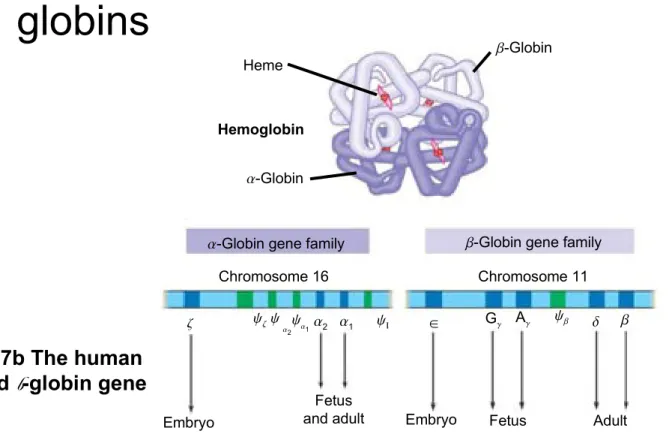
The classic examples of multigene families of
nonidentical genes
– Are two related families of genes that encode
globins
Figure 19.17b The human -globin and -globin gene
families -Globin Heme Hemoglobin -Globin
-Globin gene family -Globin gene family Chromosome 16 Chromosome 11
Embryo
Fetus
and adult Embryo Fetus Adult
G A
2
•
Concept 19.5: Duplications, rearrangements,
and mutations of DNA contribute to genome
evolution
•
The basis of change at the genomic level is
mutation
Copyright © 2005 Pearson Education, Inc. publishing as Benjamin Cummings
Duplication of Chromosome Sets
•
Accidents in cell division
– Can lead to extra copies of all or part of a
Duplication and Divergence of DNA Segments
• Unequal crossing over during prophase I of
meiosis
– Can result in one chromosome with a deletion and
another with a duplication of a particular gene
Figure 19.18
Nonsister chromatids
Transposable
element Gene
Incorrect pairing of two homologues during meiosis
Crossover
Copyright © 2005 Pearson Education, Inc. publishing as Benjamin Cummings
Evolution of Genes with Related Functions: The
Human Globin Genes
• The genes encoding the various globin proteins
– Evolved from one common ancestral globin gene,
which duplicated and diverged
Figure 19.19
Ancestral globin gene
2 1 2 1 G A -Globin gene family
on chromosome 16 on chromosome 11-Globin gene family
•
Subsequent duplications of these genes and
random mutations
– Gave rise to the present globin genes, all of
Copyright © 2005 Pearson Education, Inc. publishing as Benjamin Cummings
• The similarity in the amino acid sequences of the
various globin proteins
– Supports this model of gene duplication and
mutation
Evolution of Genes with Novel Functions
•
The copies of some duplicated genes
– Have diverged so much during evolutionary
Copyright © 2005 Pearson Education, Inc. publishing as Benjamin Cummings
Rearrangements of Parts of Genes: Exon
Duplication and Exon Shuffling
•
A particular exon within a gene
– Could be duplicated on one chromosome and
• In exon shuffling
– Errors in meiotic recombination lead to the
occasional mixing and matching of different exons either within a gene or between two nonallelic
genes
Figure 19.20
EGF EGF EGF EGF
Epidermal growth factor gene with multiple EGF exons (green)
F F F F
Fibronectin gene with multiple “finger” exons (orange)
Exon
shuffling Exonduplication
Exon shuffling
K
F EGF K K
Plasminogen gene with a “kfingle” exon (blue)
Copyright © 2005 Pearson Education, Inc. publishing as Benjamin Cummings
How Transposable Elements Contribute to Genome Evolution
•
Movement of transposable elements or
recombination between copies of the same
element
– Occasionally generates new sequence
combinations that are beneficial to the organism
•
Some mechanisms
– Can alter the functions of genes or their