Chapter 19
Chapter 19
Chapter Overview Questions
Chapter Overview Questions
What layers are found in the atmosphere?What layers are found in the atmosphere? What are the major outdoor air pollutants, What are the major outdoor air pollutants,
and where do they come from? and where do they come from?
What are two types of smog?What are two types of smog?
What is acid deposition, and how can it be What is acid deposition, and how can it be
reduced? reduced?
What are the harmful effects of air pollutants?What are the harmful effects of air pollutants? How can we prevent and control air How can we prevent and control air
Updates Online
Updates Online
The latest references for topics covered in this section can be found at
The latest references for topics covered in this section can be found at
the book companion website. Log in to the book’s e-resources page at
the book companion website. Log in to the book’s e-resources page at
www.thomsonedu.com to access InfoTrac articles.
www.thomsonedu.com to access InfoTrac articles.
InfoTrac: Indoor air pollution. Eva Rehfuess, Carlos Corvalan, Maria InfoTrac: Indoor air pollution. Eva Rehfuess, Carlos Corvalan, Maria
Neira.
Neira. Bulletin of the World Health Organization,Bulletin of the World Health Organization, July 2006 v84 i7 July 2006 v84 i7 p508(1).
p508(1).
InfoTrac: Risks of cleaning house disclosed. InfoTrac: Risks of cleaning house disclosed. San Jose Mercury NewsSan Jose Mercury News
(San Jose, CA), May 23, 2006.
(San Jose, CA), May 23, 2006.
InfoTrac: Pollution From Chinese Coal Casts Shadow Around Globe. InfoTrac: Pollution From Chinese Coal Casts Shadow Around Globe.
Keith Bradsher, David Barboza.
Keith Bradsher, David Barboza. The New York Times,The New York Times, June 11, 2006 June 11, 2006 pA1(L).
pA1(L).
American Industrial Hygiene Association: Do I Work in a Sick Building?American Industrial Hygiene Association: Do I Work in a Sick Building? PBS: Deadly SmogPBS: Deadly Smog
Video: Air Pollution
Video: Air Pollution
This video clip is available in CNN Today This video clip is available in CNN Today
Videos for Environmental Science, 2004, Videos for Environmental Science, 2004,
Volume VII. Instructors, contact your local Volume VII. Instructors, contact your local sales representative to order this volume, sales representative to order this volume,
Video: Smog Pollution
Video: Smog Pollution
This video clip is available in CNN Today This video clip is available in CNN Today
Videos for Environmental Science, 2004, Videos for Environmental Science, 2004,
Volume VII. Instructors, contact your local Volume VII. Instructors, contact your local sales representative to order this volume, sales representative to order this volume,
Core Case Study:
Core Case Study:
When Is a Lichen Like a Canary?
When Is a Lichen Like a Canary?
Lichens can warn Lichens can warn
us of bad air us of bad air
because they because they absorb it as a absorb it as a
source of source of
nourishment. nourishment.
Figure 19-1
Core Case Study:
Core Case Study:
When Is a Lichen Like a Canary?
When Is a Lichen Like a Canary?
Some lichen species are sensitive to specific Some lichen species are sensitive to specific
air-polluting chemicals. air-polluting chemicals.
After Chernobyl, more than 70,000 reindeer After Chernobyl, more than 70,000 reindeer
had to be killed because they ate highly had to be killed because they ate highly
radioactive lichens. radioactive lichens.
Because lichens are widespread, long-lived, Because lichens are widespread, long-lived,
and anchored in place, they can help track and anchored in place, they can help track
STRUCTURE AND SCIENCE OF
STRUCTURE AND SCIENCE OF
THE ATMOSPHERE
THE ATMOSPHERE
The atmosphere The atmosphere
consists of several consists of several
layers with different layers with different
temperatures, temperatures,
pressures, and pressures, and
compositions. compositions.
Figure 19-2
Fig. 19-2, p. 440 Atmospheric pressure (millibars)
Temperature
Thermosphere
Pressure
Mesopause
Heating via ozone
Mesosphere Stratopause A lt it u d e (k il o m et er s)
Stratosphere Altit
u d e (m il es ) Tropopause Ozone “layer”
Heating from the earth
Heating from the earth
Troposphere
Temperature (˚C)
Pressure = 1,000 millibars at ground level
STRUCTURE AND SCIENCE OF
STRUCTURE AND SCIENCE OF
THE ATMOSPHERE
THE ATMOSPHERE
The atmosphere’s innermost layer The atmosphere’s innermost layer
(troposphere) is made up mostly of nitrogen (troposphere) is made up mostly of nitrogen
and oxygen, with smaller amounts of water and oxygen, with smaller amounts of water
vapor and CO vapor and CO22..
Ozone in the atmosphere’s second layer Ozone in the atmosphere’s second layer
(stratosphere) filters out most of the sun’s (stratosphere) filters out most of the sun’s
UV radiation that is harmful to us and most UV radiation that is harmful to us and most
AIR POLLUTION
AIR POLLUTION
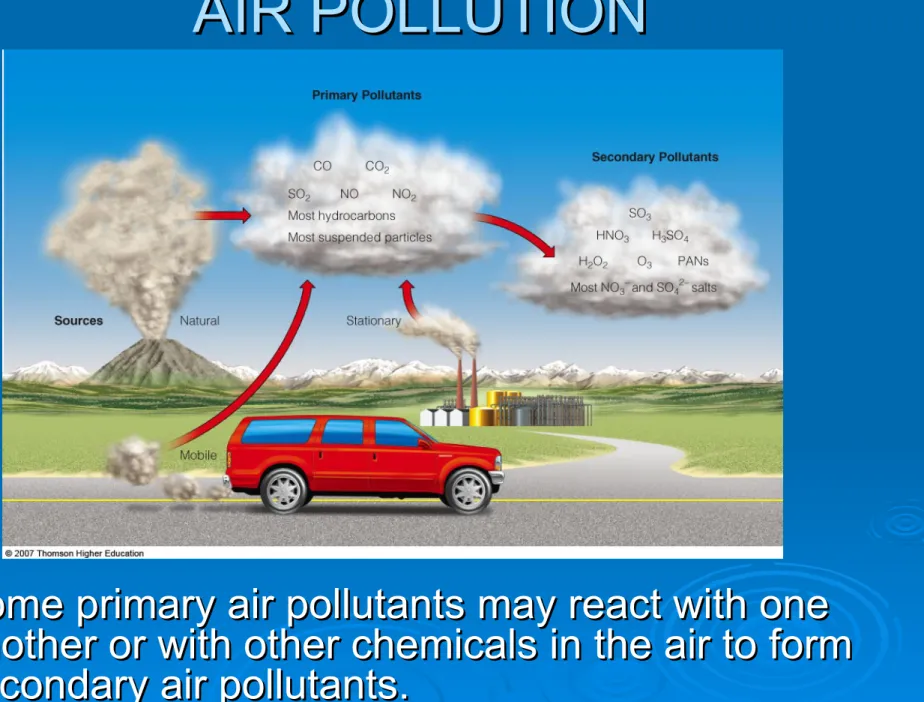
Some primary air pollutants may react with one Some primary air pollutants may react with one
another or with other chemicals in the air to form another or with other chemicals in the air to form
secondary air pollutants. secondary air pollutants.
Figure 19-3
Fig. 19-3, p. 442 Primary Pollutants
CO CO2 Secondary Pollutants SO2 NO NO2
Most hydrocarbons SO3
Most suspended particles HNO3
H2O2 O3 PANs Most NO3– and SO
42– salts
Sources Natural Stationary
Mobile
Major Air Pollutants
Major Air Pollutants
Carbon oxidesCarbon oxides: :
Carbon monoxide (CO) is a highly toxic gas that Carbon monoxide (CO) is a highly toxic gas that
forms during the incomplete combustion of forms during the incomplete combustion of
carbon-containing materials. carbon-containing materials.
93% of carbon dioxide (CO93% of carbon dioxide (CO 2
2) in the troposphere ) in the troposphere
occurs as a result of the carbon cycle. occurs as a result of the carbon cycle.
7% of CO7% of CO 2
2 in the troposphere occurs as a result in the troposphere occurs as a result
of human activities (mostly burning fossil fuels). of human activities (mostly burning fossil fuels).
• It is not regulated as a pollutant under the U.S. Clean It is not regulated as a pollutant under the U.S. Clean
Air Act
How Would You Vote?
How Would You Vote?
To conduct an instant in-class survey using a classroom response
To conduct an instant in-class survey using a classroom response
system, access “JoinIn Clicker Content” from the PowerLecture main
system, access “JoinIn Clicker Content” from the PowerLecture main
menu for Living in the Environment.
menu for Living in the Environment.
Should carbon dioxide be regulated as an air Should carbon dioxide be regulated as an air
pollutant? pollutant?
a. No. Because funds are limited, they should be a. No. Because funds are limited, they should be
spent on regulating and reducing more toxic air spent on regulating and reducing more toxic air
pollutants, such as mercury. pollutants, such as mercury.
b. Yes. Carbon dioxide is a serious greenhouse b. Yes. Carbon dioxide is a serious greenhouse
gas and its emissions must be regulated and gas and its emissions must be regulated and
Major Air Pollutants
Major Air Pollutants
Nitrogen oxides Nitrogen oxides andand nitric acid nitric acid: :
Nitrogen oxide (NO) forms when nitrogen and Nitrogen oxide (NO) forms when nitrogen and
oxygen gas in air react at the high-combustion oxygen gas in air react at the high-combustion
temperatures in automobile engines and temperatures in automobile engines and
coal-burning plants. NO can also form from lightening burning plants. NO can also form from lightening
and certain soil bacteria. and certain soil bacteria.
• NO reacts with air to form NONO reacts with air to form NO22..
• NONO2 2 reacts with water vapor in the air to form nitric acid reacts with water vapor in the air to form nitric acid
(HNO
(HNO33) and nitrate salts (NO) and nitrate salts (NO33--) which are components ) which are components
Major Air Pollutants
Major Air Pollutants
Sulfur dioxide (SOSulfur dioxide (SO22)) andand sulfuric acidsulfuric acid::
About one-third of SOAbout one-third of SO 2
2 in the troposphere occurs in the troposphere occurs
naturally through the sulfur cycle.
naturally through the sulfur cycle.
Two-thirds come from human sources, mostly Two-thirds come from human sources, mostly
combustion (S+ O
combustion (S+ O22 SO SO22) of sulfur-containing ) of sulfur-containing coal and from oil refining and smelting of sulfide
coal and from oil refining and smelting of sulfide
ores.
ores.
SOSO 2
2 in the atmosphere can be converted to sulfuric in the atmosphere can be converted to sulfuric
acid (H
acid (H22SOSO44) and sulfate salts (SO) and sulfate salts (SO442-2-) that return to ) that return to
earth as a component of acid deposition.
Major Air Pollutants
Major Air Pollutants
Suspended particulate matter (SPM)Suspended particulate matter (SPM)::
Consists of a variety of solid particles and liquid Consists of a variety of solid particles and liquid
droplets small and light enough to remain droplets small and light enough to remain
suspended in the air. suspended in the air.
The most harmful forms of SPM are fine particles The most harmful forms of SPM are fine particles
(PM-10, with an average diameter < 10 (PM-10, with an average diameter < 10
micrometers) and ultrafine particles (PM-2.5). micrometers) and ultrafine particles (PM-2.5).
According to the EPA, SPM is responsible for According to the EPA, SPM is responsible for
about 60,000 premature deaths a year in the about 60,000 premature deaths a year in the
Major Air Pollutants
Major Air Pollutants
Ozone (OOzone (O33))::
Is a highly reactive gas that is a major Is a highly reactive gas that is a major
component of photochemical smog. component of photochemical smog.
It can It can
• Cause and aggravate respiratory illness.Cause and aggravate respiratory illness.
• Can aggravate heart disease.Can aggravate heart disease.
Major Air Pollutants
Major Air Pollutants
Volatile organic compounds (VOCs)Volatile organic compounds (VOCs)::
Most are hydorcarbons emitted by the leaves of Most are hydorcarbons emitted by the leaves of
many plants and methane. many plants and methane.
About two thirds of global methane emissions About two thirds of global methane emissions
comes from human sources. comes from human sources.
Other VOCs include industrial solvents such as Other VOCs include industrial solvents such as
trichlorethylene (TCE), benzene, and vinyl trichlorethylene (TCE), benzene, and vinyl
chloride. chloride.
• Long-term exposure to benzene can cause cancer, Long-term exposure to benzene can cause cancer,
Major Air Pollutants
Major Air Pollutants
Radon (Rn)Radon (Rn)::
Is a naturally occurring radioactive gas found in Is a naturally occurring radioactive gas found in
some types of soil and rock. some types of soil and rock.
It can seep into homes and buildings sitting It can seep into homes and buildings sitting
URBAN OUTDOOR AIR POLLUTION
URBAN OUTDOOR AIR POLLUTION
Industrial smog is a mixture of sulfur dioxide, Industrial smog is a mixture of sulfur dioxide,
droplets of sulfuric acid, and a variety of droplets of sulfuric acid, and a variety of
suspended solid particles emitted mostly by suspended solid particles emitted mostly by
burning coal. burning coal.
In most developed countries where coal and In most developed countries where coal and
heavy oil is burned, industrial smog is not a heavy oil is burned, industrial smog is not a
problem due to reasonably good pollution control problem due to reasonably good pollution control or with tall smokestacks that transfer the pollutant or with tall smokestacks that transfer the pollutant
Case Study:
Case Study:
South Asia’s Massive Brown Cloud
South Asia’s Massive Brown Cloud
A huge dark brown cloud of industrial smog, A huge dark brown cloud of industrial smog,
caused by coal-burning in countries such as caused by coal-burning in countries such as
China and India, stretches over much of China and India, stretches over much of
southeastern Asia. southeastern Asia.
In areas beneath the cloud, photosynthesis is In areas beneath the cloud, photosynthesis is
reduced interfering with crop development. reduced interfering with crop development.
Fine particles and droplets in the cloud appear to Fine particles and droplets in the cloud appear to
be changing regional climates (including rainfall). be changing regional climates (including rainfall).
• May have contributed to floods in 2002 and 2005 May have contributed to floods in 2002 and 2005
Sunlight plus Cars Equals
Sunlight plus Cars Equals
Photochemical Smog
Photochemical Smog
Photochemical smog is a mixture of air Photochemical smog is a mixture of air
pollutants formed by the reaction of nitrogen pollutants formed by the reaction of nitrogen
oxides and volatile organic hydrocarbons oxides and volatile organic hydrocarbons
Sunlight plus Cars Equals
Sunlight plus Cars Equals
Photochemical Smog
Photochemical Smog
Mexico City is one Mexico City is one
of the many cities of the many cities
in sunny, warm, dry in sunny, warm, dry climates with many climates with many motor vehicles that motor vehicles that
suffer from suffer from
photochemical photochemical
smog. smog.
Figure 19-4
Factors Influencing Levels of
Factors Influencing Levels of
Outdoor Air Pollution
Outdoor Air Pollution
Outdoor air pollution can be reduced by:Outdoor air pollution can be reduced by:
settling out, precipitation, sea spray, winds, and settling out, precipitation, sea spray, winds, and
chemical reactions. chemical reactions.
Outdoor air pollution can be increased by:Outdoor air pollution can be increased by:
urban buildings (slow wind dispersal of urban buildings (slow wind dispersal of
pollutants), mountains (promote temperature pollutants), mountains (promote temperature inversions), and high temperatures (promote inversions), and high temperatures (promote
Temperature Inversions
Temperature Inversions
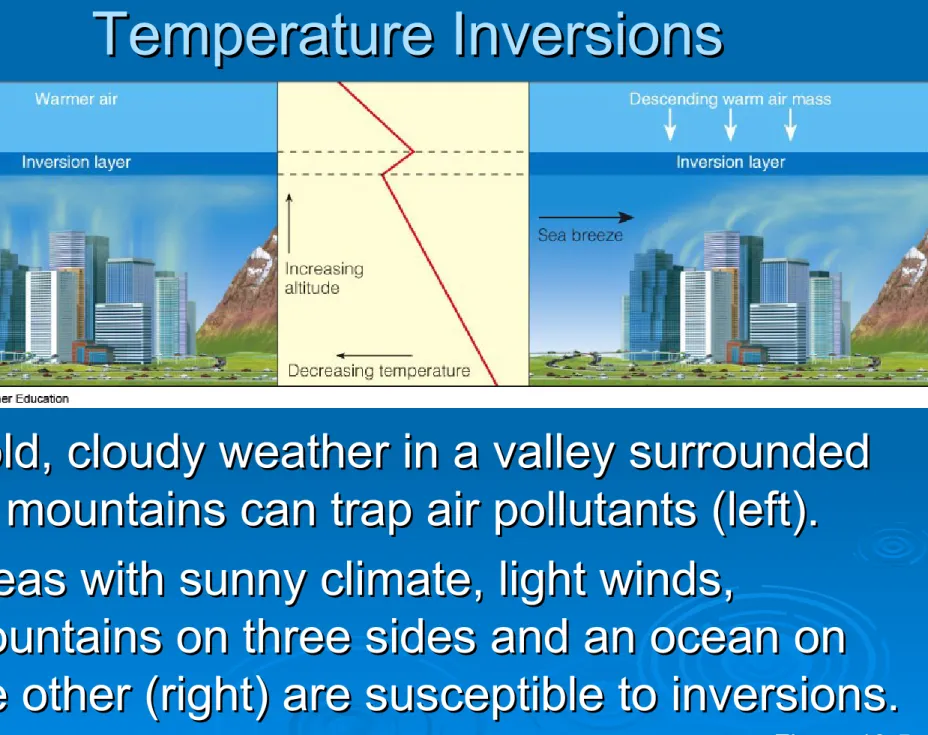
Cold, cloudy weather in a valley surrounded Cold, cloudy weather in a valley surrounded
by mountains can trap air pollutants (left). by mountains can trap air pollutants (left).
Areas with sunny climate, light winds, Areas with sunny climate, light winds,
mountains on three sides and an ocean on mountains on three sides and an ocean on
the other (right) are susceptible to inversions. the other (right) are susceptible to inversions.
Figure 19-5
Fig. 19-5, p. 447
Warmer air Descending warm air mass
Inversion layer Inversion layer
Sea breeze Increasing
altitude
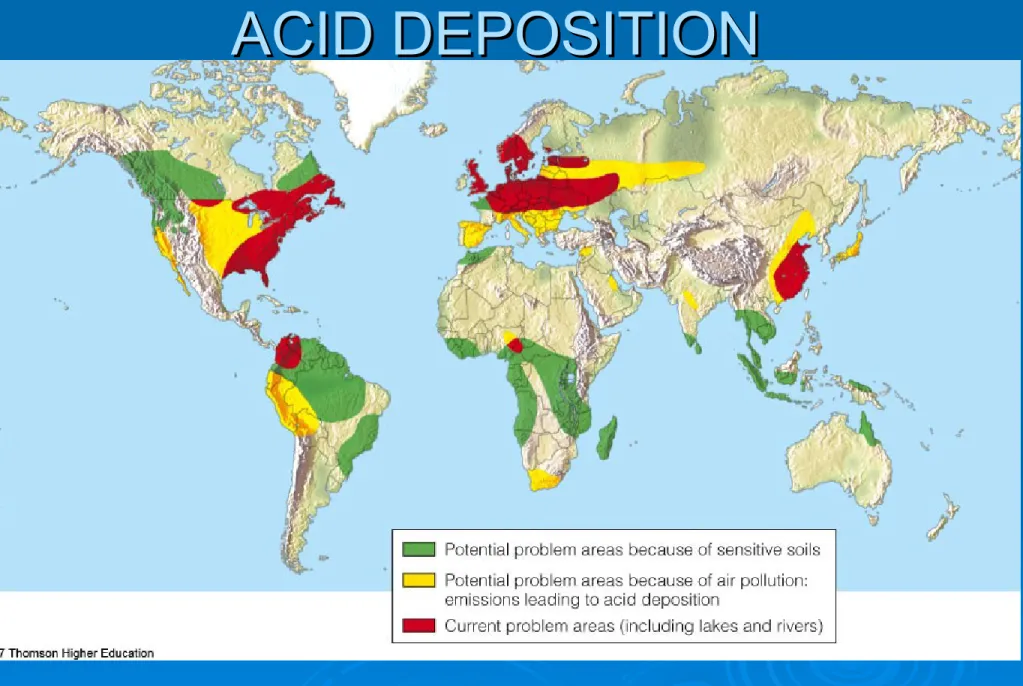
ACID DEPOSITION
ACID DEPOSITION
Sulfur dioxides, nitrogen oxides, and Sulfur dioxides, nitrogen oxides, and
particulates can react in the atmosphere to particulates can react in the atmosphere to
produce acidic chemicals that can travel long produce acidic chemicals that can travel long
distances before returning to the earth’s distances before returning to the earth’s
surface. surface.
Tall smokestacks reduce local air pollution but Tall smokestacks reduce local air pollution but
ACID DEPOSITION
ACID DEPOSITION
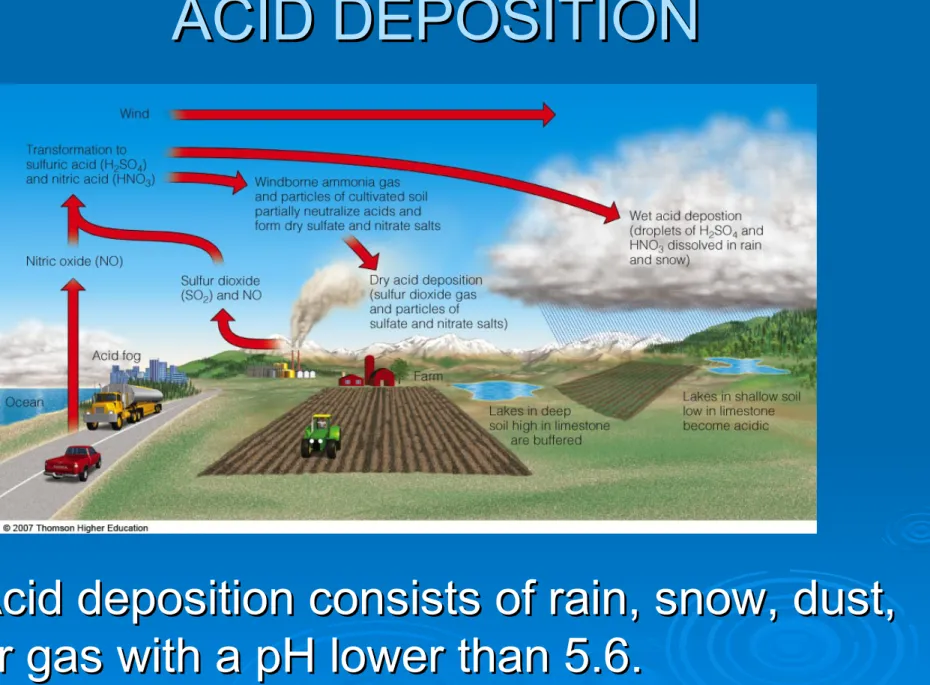
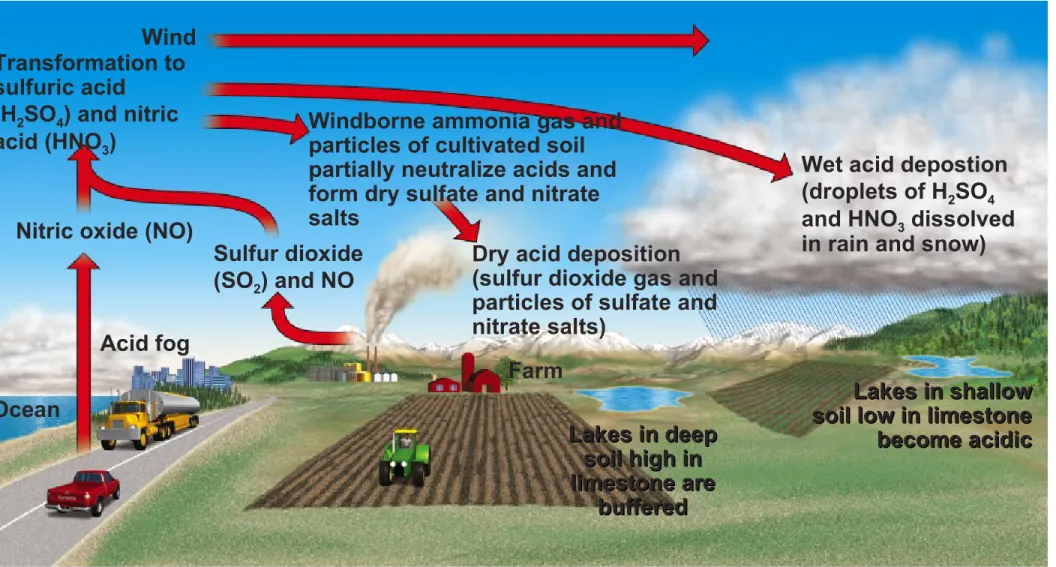
Acid deposition consists of rain, snow, dust, Acid deposition consists of rain, snow, dust,
or gas with a pH lower than 5.6. or gas with a pH lower than 5.6.
Figure 19-6
Fig. 19-6, p. 448
Wind Transformation to sulfuric acid
(H2SO4) and nitric
acid (HNO3) Windborne ammonia gas and particles of cultivated soil partially neutralize acids and form dry sulfate and nitrate salts
Wet acid depostion (droplets of H2SO4 and HNO3 dissolved in rain and snow) Nitric oxide (NO)
Sulfur dioxide (SO2) and NO
Dry acid deposition (sulfur dioxide gas and particles of sulfate and nitrate salts)
Acid fog
Farm Ocean
Lakes in deep Lakes in deep
soil high in soil high in limestone are limestone are
buffered buffered
ACID DEPOSITION
ACID DEPOSITION
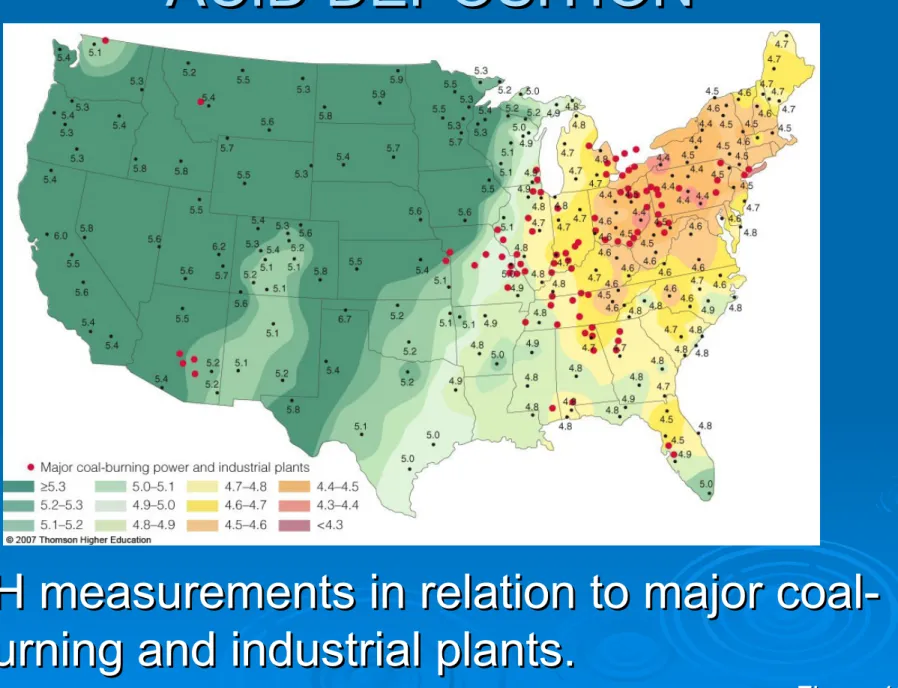
pH measurements in relation to major coal-pH measurements in relation to major
coal-burning and industrial plants. burning and industrial plants.
Figure 19-7
ACID DEPOSITION
ACID DEPOSITION
Acid deposition contributes to chronic Acid deposition contributes to chronic
respiratory disease and can leach toxic respiratory disease and can leach toxic
metals (such as lead and mercury) from soils metals (such as lead and mercury) from soils
and rocks into acidic lakes used as sources and rocks into acidic lakes used as sources
ACID DEPOSITION
ACID DEPOSITION
Figure 19-8
ACID DEPOSITION
ACID DEPOSITION
Air pollution is Air pollution is
one of several one of several
interacting interacting
stresses that can stresses that can
damage, damage,
weaken, or kill weaken, or kill
trees and pollute trees and pollute
surface and surface and
groundwater. groundwater.
Figure 19-9
Fig. 19-9, p. 451 Emissions
SO2 NO
x
Acid
deposition H2O2 OOthers3
Direct damage to leaves & bark
Reduced photo-synthesis and growth Susceptibility to drought, extreme cold, insects, mosses, & disease organisms Soil acidification Tree death Leaching of soil nutrients Release of toxic metal ions Root damage Reduced nutrient & water uptake Acids
Lake
Groundwater
Fig. 19-10, p. 452
Solutions
Acid Deposition
Prevention Cleanup
Reduce air pollution by improving
energy efficiency
Add lime to neutralize acidified lakes
Reduce coal use
Add phosphate fertilizer to neutralize acidified lakes Increase natural gas use
Increase use of renewable energy resources
Burn low-sulfur coal
Remove SO2
particulates & NOx from smokestack gases
Remove NOx from motor vehicular exhaust
INDOOR AIR POLLUTION
INDOOR AIR POLLUTION
Indoor air pollution usually is a greater threat Indoor air pollution usually is a greater threat
to human health than outdoor air pollution. to human health than outdoor air pollution.
According to the EPA, the four most According to the EPA, the four most
dangerous indoor air pollutants in developed dangerous indoor air pollutants in developed
countries are: countries are:
Tobacco smoke.Tobacco smoke.
Formaldehyde.Formaldehyde.
Radioactive radon-222 gas.Radioactive radon-222 gas.
Chloroform
Benzo--pyrene Styrene
Radon-222
Methylene Chloride Tobacco
Smoke
Carbon Monoxide Asbestos
Nitrogen Oxides
1, 1,
1-Trichloroethane
Particulates
Formaldehyde Tetrachloroethylene
Para-dichlorobenzene
INDOOR AIR POLLUTION
INDOOR AIR POLLUTION
Household dust mites Household dust mites
that feed on human skin that feed on human skin
and dust, live in and dust, live in
materials such as materials such as
bedding and furniture bedding and furniture
fabrics. fabrics.
Can cause asthma Can cause asthma
attacks and allergic attacks and allergic
reactions in some reactions in some
people. people.
Figure 19-12
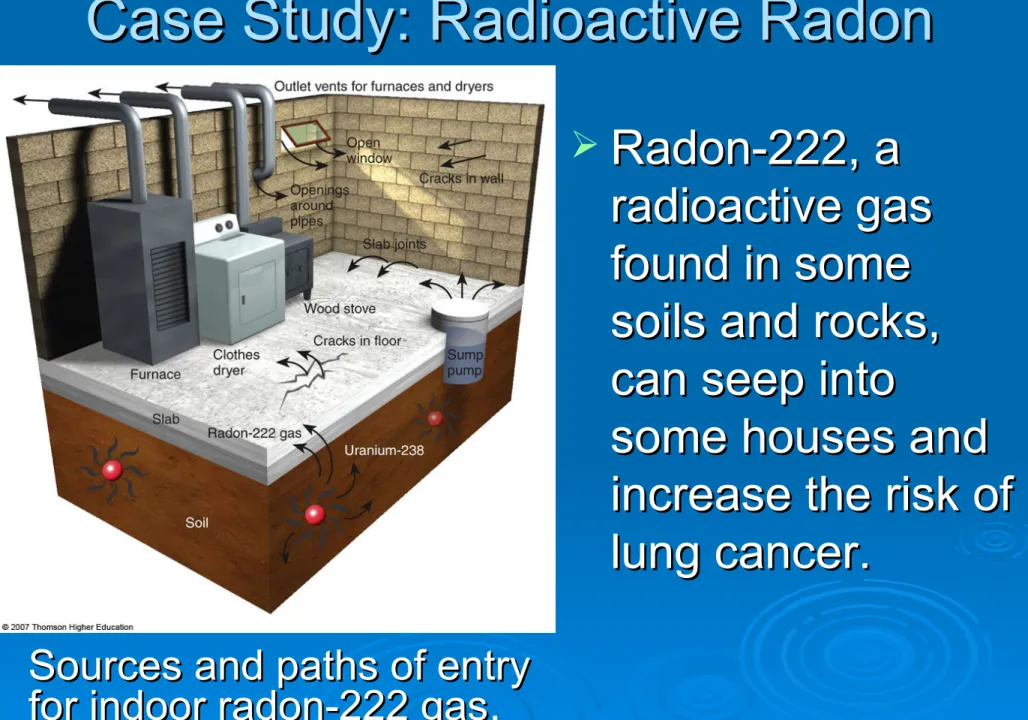
Case Study: Radioactive Radon
Case Study: Radioactive Radon
Radon-222, a Radon-222, a
radioactive gas radioactive gas
found in some found in some
soils and rocks, soils and rocks,
can seep into can seep into
some houses and some houses and
increase the risk of increase the risk of
lung cancer. lung cancer.
Sources and paths of entry Sources and paths of entry
for indoor radon-222 gas for indoor radon-222 gas.
Figure 19-13
Fig. 19-13, p. 454 Outlet vents for furnaces and dryers
Open window Openings
around pipes
Cracks in wall Slab joints
Wood stove Cracks in floor Clothes
dryer Sump pumpSump pump
Furnace
Slab Radon-222
gas Uranium-238
HEALTH EFFECTS OF AIR
HEALTH EFFECTS OF AIR
POLLUTION
POLLUTION
Your respiratory system can help protect you Your respiratory system can help protect you
from air pollution, but some air pollutants can from air pollution, but some air pollutants can
overcome these defenses.
Fig. 19-14, p. 455 Epithelial cell
Cilia
Nasal cavity Oral cavity
Goblet cell (secreting mucus)
Pharynx (throat)
Mucus Trachea (windpipe)
Bronchus Bronchioles
Right lung
Bronchioles
Alveolar sac (sectioned)
Alveoli Alveolar
HEALTH EFFECTS OF AIR
HEALTH EFFECTS OF AIR
POLLUTION
POLLUTION
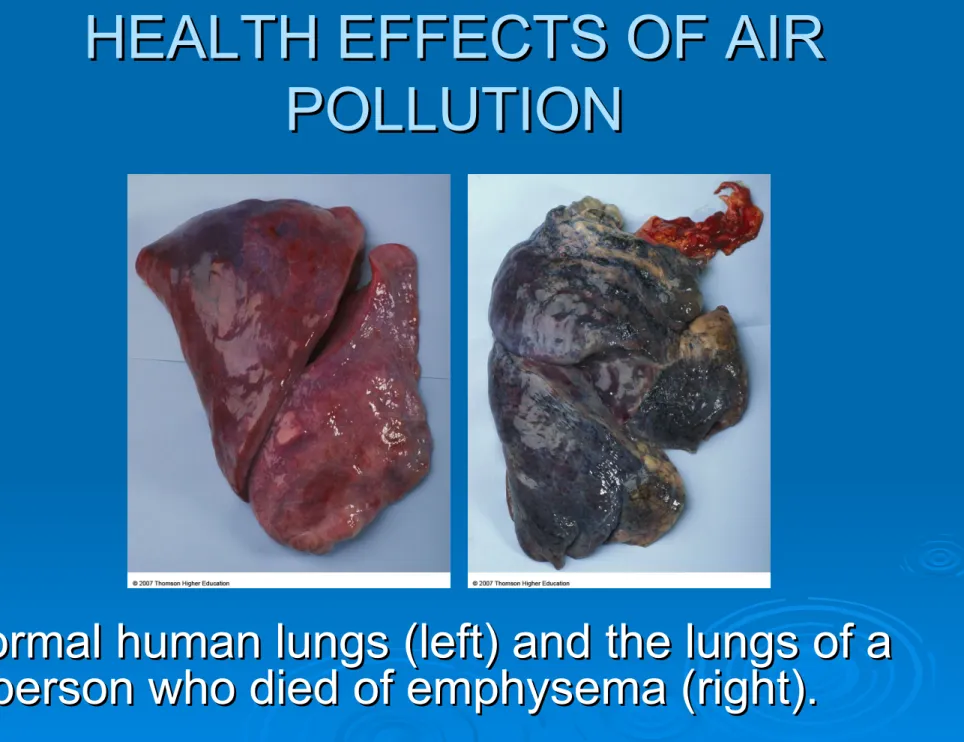
Normal human lungs (left) and the lungs of a Normal human lungs (left) and the lungs of a
person who died of emphysema (right). person who died of emphysema (right).
Figure 19-15
Air Pollution is a Big Killer
Air Pollution is a Big Killer
Each year, air pollution prematurely kills Each year, air pollution prematurely kills
about 3 million people, mostly from indoor air about 3 million people, mostly from indoor air
pollution in developing countries. pollution in developing countries.
In the U.S., the EPA estimates that annual In the U.S., the EPA estimates that annual
deaths related to indoor and outdoor air pollution deaths related to indoor and outdoor air pollution
range from 150,000 to 350,000. range from 150,000 to 350,000.
According to the EPA, each year more than According to the EPA, each year more than
125,000 Americans get cancer from breathing 125,000 Americans get cancer from breathing
Air Pollution is a Big Killer
Air Pollution is a Big Killer
Spatial distribution of premature deaths from Spatial distribution of premature deaths from
air pollution in the United States. air pollution in the United States.
Figure 19-16
PREVENTING AND REDUCING AIR
PREVENTING AND REDUCING AIR
POLLUTION
POLLUTION
The Clean Air Acts in the United States have The Clean Air Acts in the United States have
greatly reduced outdoor air pollution from six greatly reduced outdoor air pollution from six
major pollutants: major pollutants:
Carbon monoxideCarbon monoxide
Nitrogen oxidesNitrogen oxides
Sulfur dioxidesSulfur dioxides
PREVENTING AND REDUCING AIR
PREVENTING AND REDUCING AIR
POLLUTION
POLLUTION
Environmental scientists point out several Environmental scientists point out several
deficiencies in the Clean Air Act: deficiencies in the Clean Air Act:
The U.S. continues to rely on cleanup rather than The U.S. continues to rely on cleanup rather than
prevention. prevention.
The U.S. Congress has failed to increase fuel-The U.S. Congress has failed to increase
fuel-efficiency standards for automobiles. efficiency standards for automobiles.
Regulation of emissions from motorcycles and Regulation of emissions from motorcycles and
two-cycle engines remains inadequate. two-cycle engines remains inadequate.
There is little or no regulation of air pollution from There is little or no regulation of air pollution from
PREVENTING AND REDUCING AIR
PREVENTING AND REDUCING AIR
POLLUTION
POLLUTION
Airports are exempt from many air pollution Airports are exempt from many air pollution
regulations. regulations.
The Act does not regulate the greenhouse gas The Act does not regulate the greenhouse gas
CO CO22..
The Act has failed to deal seriously with indoor The Act has failed to deal seriously with indoor
air pollution. air pollution.
There is a need for better enforcement of the There is a need for better enforcement of the
PREVENTING AND REDUCING AIR
PREVENTING AND REDUCING AIR
POLLUTION
POLLUTION
Executives of companies claim that Executives of companies claim that
correcting these deficiencies would cost too correcting these deficiencies would cost too
How Would You Vote?
How Would You Vote?
To conduct an instant in-class survey using a classroom response
To conduct an instant in-class survey using a classroom response
system, access the “Polls Clicker Questions” from the PowerLecture
system, access the “Polls Clicker Questions” from the PowerLecture
main menu.
main menu.
Should the 1990 U.S. Clean Air Act be Should the 1990 U.S. Clean Air Act be
strengthened? strengthened?
a. No. Strengthening the Act would be too a. No. Strengthening the Act would be too
expensive and would harm the economy. expensive and would harm the economy.
b. Yes. Strengthening the Act would improve the b. Yes. Strengthening the Act would improve the
environment and people's health, save energy, environment and people's health, save energy,
Using the Marketplace to Reduce
Using the Marketplace to Reduce
Outdoor Air Pollution
Outdoor Air Pollution
To help reduce SOTo help reduce SO22 emissions, the Clean Air emissions, the Clean Air
Act authorized and emission trading Act authorized and emission trading
(cap-and-trade) program. and-trade) program.
Enables the 110 most polluting power plants to Enables the 110 most polluting power plants to
buy and sell SO
buy and sell SO22 pollution rights. pollution rights.
Between 1990-2002, the emission trading system Between 1990-2002, the emission trading system
reduced emissions. reduced emissions.
In 2002, the EPA reported the cap-and-trade In 2002, the EPA reported the cap-and-trade
system produced less emission reductions than system produced less emission reductions than
How Would You Vote?
How Would You Vote?
To conduct an instant in-class survey using a classroom response
To conduct an instant in-class survey using a classroom response
system, access the “Polls Clicker Questions” from the PowerLecture
system, access the “Polls Clicker Questions” from the PowerLecture
main menu.
main menu.
Should emissions trading be used to help Should emissions trading be used to help
control emissions of all major air pollutants? control emissions of all major air pollutants?
a. No. Emissions trading has no system for a. No. Emissions trading has no system for
verifying compliance and eliminating "hot spots" verifying compliance and eliminating "hot spots"
of air pollution. of air pollution.
b. Yes. Emissions trading is an efficient and b. Yes. Emissions trading is an efficient and
Solutions:
Solutions:
Reducing Outdoor Air Pollution
Reducing Outdoor Air Pollution
There are a of ways to prevent and control air There are a of ways to prevent and control air
pollution from coal-burning facilities. pollution from coal-burning facilities.
Electrostatic precipitatorElectrostatic precipitator: are used to attract : are used to attract
negatively charged particles in a smokestack into negatively charged particles in a smokestack into
a collector. a collector.
Wet scrubberWet scrubber: fine mists of water vapor trap : fine mists of water vapor trap
particulates and convert them to a sludge that is particulates and convert them to a sludge that is
Electrostatic Precipitator
Electrostatic Precipitator
Can remove 99% of Can remove 99% of
particulate matter
particulate matter
Does not remove Does not remove
hazardous ultrafine
hazardous ultrafine
particles.
particles.
Produces toxic dust Produces toxic dust
that must be safely
that must be safely
disposed of.
disposed of.
Uses large amounts Uses large amounts
of electricity
of electricity
Figure 19-18
Fig. 19-18a, p. 460 Clean gas out
Negatively charged electrode
Positively charged precipitator wall
Dirty gas (smoke) in
Dust falls off into collector
Wet Scrubber
Wet Scrubber
Can remove 98% of Can remove 98% of
SO
SO22 and particulate and particulate matter.
matter.
Not very effective in Not very effective in
removing hazardous removing hazardous
fine and ultrafine fine and ultrafine
particles. particles.
Figure 19-18
Fig. 19-18b, p. 460 Clean gas out
Separator
Liquid water in
Dirty gas (smoke) in
Fig. 19-17, p. 459
Solutions
Stationary Source Air Pollution
Prevention
Burn low-sulfur coal
Disperse emissions above thermal
inversion layer with tall smokestacks Remove sulfur
from coal
Convert coal to a liquid or gaseous fuel
Remove pollutants after combustion
Shift to less polluting fuels
Tax each unit of pollution produced
Solutions:
Solutions:
Reducing Outdoor Air Pollution
Reducing Outdoor Air Pollution
In 2003, fourteen states and a number of In 2003, fourteen states and a number of
U.S. cities sued the EPA to block new rules U.S. cities sued the EPA to block new rules
that would allow older coal-burning power that would allow older coal-burning power
plants to modernize without having to install plants to modernize without having to install
How Would You Vote?
How Would You Vote?
To conduct an instant in-class survey using a classroom response
To conduct an instant in-class survey using a classroom response
system, access “JoinIn Clicker Content” from the PowerLecture main
system, access “JoinIn Clicker Content” from the PowerLecture main
menu for Living in the Environment.
menu for Living in the Environment.
Should older coal-burning power and industrial plants have to meet the Should older coal-burning power and industrial plants have to meet the
same air pollution standards as new facilities?
same air pollution standards as new facilities?
a. No. The private sector should not have to upgrade existing facilities every a. No. The private sector should not have to upgrade existing facilities every
time the regulations change.
time the regulations change.
b. Yes. All facilities should comply with current regulations so that the b. Yes. All facilities should comply with current regulations so that the
environment and human health are effectively protected.
Solutions:
Solutions:
Reducing Outdoor Air Pollution
Reducing Outdoor Air Pollution
There are a of ways to prevent and control air There are a of ways to prevent and control air
pollution from motor vehicles. pollution from motor vehicles.
Because of the Clean Air Act, a new car today in Because of the Clean Air Act, a new car today in
the U.S. emits 75% less pollution than did the U.S. emits 75% less pollution than did
pre-1970 cars. 1970 cars.
There is and increase in motor vehicle use in There is and increase in motor vehicle use in
developing countries and many have no pollution developing countries and many have no pollution
Fig. 19-19, p. 460
Solutions
Motor Vehicle Air Pollution
Prevention Cleanup
Emission control devices Mass transit Bicycles and walking Less polluting engines
Less polluting fuels
Improve fuel efficiency
Car exhaust inspections twice a year
Get older, polluting cars off the road
Indoor Air Pollution
Indoor Air Pollution
Little effort has been devoted to reducing Little effort has been devoted to reducing
indoor air pollution even though it poses a indoor air pollution even though it poses a much greater threat to human health than much greater threat to human health than
outdoor air pollution. outdoor air pollution.
Environmental and health scientists call for Environmental and health scientists call for
us to focus on preventing air pollution us to focus on preventing air pollution
Fig. 19-20, p. 461
Solutions
Indoor Air Pollution
Prevention
Cover ceiling tiles & lining of AC ducts to prevent release of mineral fibers
Use adjustable fresh air vents for work spaces
Increase intake of outside air Ban smoking or limit it to well
ventilated areas
Change air more frequently Set stricter formaldehyde
emissions standards for carpet, furniture, and building materials
Circulate a building’s air
through rooftop green houses
Prevent radon infiltration Use exhaust hoods for stoves and appliances burning
natural gas Use office machines in well
ventilated areas
Use less polluting substitutes for harmful cleaning agents, paints, and other products
Install efficient chimneys for wood-burning stoves
Fig. 19-21, p. 461 What Can You Do?
Indoor Air Pollution
• Test for radon and formaldehyde inside your home and take corrective measures as needed.
• Do not buy furniture and other products containing formaldehyde. • Remove your shoes before entering your house to reduce inputs
of dust, lead, and pesticides.
• Test your house or workplace for asbestos fiber levels and for any crumbling asbestos materials if it was built before 1980. • Don't live in a pre-1980 house without having its indoor air
tested for asbestos and lead.
• Do not store gasoline, solvents, or other volatile hazardous chemicals inside a home or attached garage.
• If you smoke, do it outside or in a closed room vented to the outside. • Make sure that wood-burning stoves, fireplaces, and kerosene-
and gas-burning heaters are properly installed, vented, and maintained.
Fig. 19-22, p. 462
Solutions Air Pollution
Outdoor Indoor
Improve energy efficiency to reduce fossil fuel use
Reduce poverty
Rely more on lower-polluting natural gas
Distribute cheap &
efficient cookstoves or solar cookers to poor families in developing countries
Rely more on renewable energy (especially solar cells, wind, &
solar-produced hydrogen) Reduce or ban indoor smoking
Transfer technologies for latest energy efficiency,
renewable energy, & pollution prevention to developing
countries