A ROBUST AND EFFICIENT CHANNEL ESTIMATION SCHEME
FOR OFDM SYSTEMS IN FREQUENCY SELECTIVE FADING
CHANNELS
Gadda Archana Devi1, MoparthyGurunadhaBabu2
1.INTRODUCTION
In orthogonal frequency division multiplexing (OFDM) systems [1], a frequency selective (FS) channel is commuted into an accumulation of flat fading channels, which can be indemnified by simply using an equalizer of one-tap. Therefore, OFDM can greatly alter the design of equalizer while enabling rather higher data rates, which leads that it is used as a vital physical layer in many commercial systems. It’s a modish technology in the era of wireless communications. it provides higher mobility, high robustness versus multipath fading and has capability of high rate transmission. The higher requirements for improved reliability and high data rates in today’s wireless communication have made OFDMasoneofthekeysolutionsforfuture generationwirelesscommunicationduetoitspotentiality to multipath exploitation while actualizing enhanced performance in spatial multiplexing, array gain andpower. In case of fast time varying OFDM systems, channel equalization must be done effectively to remove Inter Symbol Interference (ISI) which usually occurs in frequency selective channels, so OFDM is used for this purpose [2]. OFDM systems canboost the rate of datatransmission whiledealing frequency-selective(FS)fading.It also has a capability of gratifying the next-generation wireless networks requirements such as Wireless Local Area Networks (WLANs) [3], Wireless Fidelity (Wi-Fi), and World-wide interoperability for Microwave Access (Wi-MAX), Cognitive Radio, 3rd Generation Partnership Project (3GPP) and LTE [4]. However, these sorts of systems should be capable to gain exact channel information to grantand enable high mobility practicability and for recovery of symbols in highspeedwhilehandling co-channel interference (CCI) and timeselective(TS)fading. To do so, we need to estimate the channel in an effective manner by mitigating the mean square error (MSE). There are many CE algorithms presented in the literature for enhanced wireless communication system.However, the works implemented for CE in the past has lot of drawbacks which will be discussed in section II briefly. Here, we implemented OP-ML-CE algorithm which is arobust and effective CE algorithm for OFDM systems in FS fading channels.The novelty of our proposed work lies in the use of a filter that is matched to the preface, to acquire perfect estimated channel over conventional CE algorithms. Our CE model does not require any knowledge of the channel and noise statistics. Rest of the paper as follows: section 2 describes the related work already done in the field of channel estimation, section 3 explains the description of problem, system model has been described in section 4, simulation analysis in section 5 followed by conclusion in section 6 with references.
2.RELATEDWORK
In orthogonal frequency division multiplexing (OFDM) systems, a frequency selective (FS) channel is commuted into an accumulation of flat fading channels, which can be indemnified by simply using an equalizer of one-tap [5]. Therefore, OFDM can greatly alter the design of equalizer while enabling rather higher data rates, which leads that it is used as a vital physical layer in many commercial systems. Various early attempts have successfully made for estimating the channel in
1
Ph D Scholar, Shri JagadishprasadJhabarmalTibrewalaUniversity, Rajasthan, India 2
Professor & Head of Department, Department of ECE, CMR Institute of Technology, Hyderabad, Telangana, India
Abstract- Due to the requirement of high speed data transmission, orthogonal frequency division multiplexing (OFDM) is becoming a vital in wireless communication systems like 3G, 4G and even in 5G networks. OFDMis capable to provide higher mobility, higherthroughput, maximum possible efficiency versus multipath fading and has a capability of ultra-rate transmission.Nevertheless,these systems should be capable to acquireperfect channel estimation for enabling and permitting of higher mobility practicability for symbol recovery in ultra-speed while handling the co-channel interference (CCI). To address this issue, we introduced a robust and efficient model for channel estimation (CE) for OFDM systems under frequency selective (FS) fading channels. Optimal preface based maximum likelihood (OP-ML) scheme is utilized for estimating the channel perfectly. Simulation results show
that for a sufficiently long preface, the ML estimator performs as good as the situation when the channel is known perfectly at the receiver when compared to the conventional CE algorithms with respect to mean square error (MSE). Our proposed system model well suited for digital video broadcasting and optical communications applications.
Keywords-Orthogonal frequency division multiplexing, Channel Estimation, Frequency Selective Fading Channels, Co-channel Interference (CCI), Maximum Likelihood Estimator (MLE) and Mean Square Error (MSE).
Moreover, the transmission of data at higher speeds results in a thin multipath channel. The signal subspace attribute of the correlation matrix can be effectively mitigated when the construction of correlation matrix of a channel based on the parametric channel model [10].The authors in [11] and [12], proposes a least squares (LS) approach and Minimum Mean Square Error (MMSE) which are categorized under no prior information of channel. Among those, LS estimator is a simplest method and it has lower computational complexity when we compared with the MMSE estimator. But, however the results of MMSE are better than the LS estimator. Different interpolation methods are given in [12] and [13]. Compared with the existing methods, transformation-based methods will perform excellent with moderate complexity increase.In [14], the author explained DFT based CE method. It can improve the system efficiency by reducing the computational complexity by exploiting the fast Fourier transform (FFT) algorithm. However, it can’t provide an excellent performance when a sample spaced path delay will be existed by the multi path fading channels. To overcome this drawback, windowed DFT-CE method has been proposed in [15] to improve the performance of the system. But, it reduces the utilization of frequency band. Then after to improve the performance of the system more accurately, the DCT basedCE methods have been proposed in [16], [17] and [18]. These methods have got excellent performance at high SNR region, but at low SNR values it gives very poor performance. Expectation maximization (EM)-based joint channel estimation and exploitation of the diversity gain from IQ imbalances is addressed in [19].Recently, author in [20] proposed an algorithm for CE by path diversity exploitation in both domains i.e., angle and power.The CE algorithms proposed in [22] shown that the robustness of transformations-based CE approaches such as discrete Fourier transform (DFT), discrete cosine transform (DCT) under various channel distributions. The experimental analysis given in [22] discloses that the comparison to the expurgated-DCT (E-DCT) with the conventional channel estimation algorithms such as the algorithm given in [25] like LS estimator, DFT and mirror-weighted DCT (MW-DCT). As per the author’s concern the navigate symbol assisted E-DCT has performed superior over above mentioned conventional algorithms. Author in [24], presented a new trending CE algorithm for OFDM systems which utilized LS based DFT. The performance of MSE is quite better over classical LS and DFT individually.In general, the constriction to trust on sufficiently higher order polynomial model leading in complicated algorithms, showing an impractical solvent for real time CE where the pilot optimality finally reckons on the CE speed. To overcome all the above-mentioned issues and to improve the robustness and reliability of CE algorithms in OFDM systems, this article proposes a robust OP-ML-CE scheme which have been invented to actualize practical communications in FS channels.
2.1. LS Scheme
The general OFDM system model has given in fig1. Firstly, the binary data has given as an input to the M-QAM/QPSK modulator. After mapping and grouping the input data the comb-pilot insertion will be done to split the transmitted data into low rate modulated symbols , where = 0,1,2, ……, -1. Then the time domain signal can be written as a frequency domain signal after performing the IFFT:
(1) Where N is the number sub carriers
(2)
Where is the cyclic prefix (CP) length which reduces the ISI and as well as inter carrier interference (ICI). If the length of the channel is less than the CP, then the received signal can be expressed as follows:
(3)
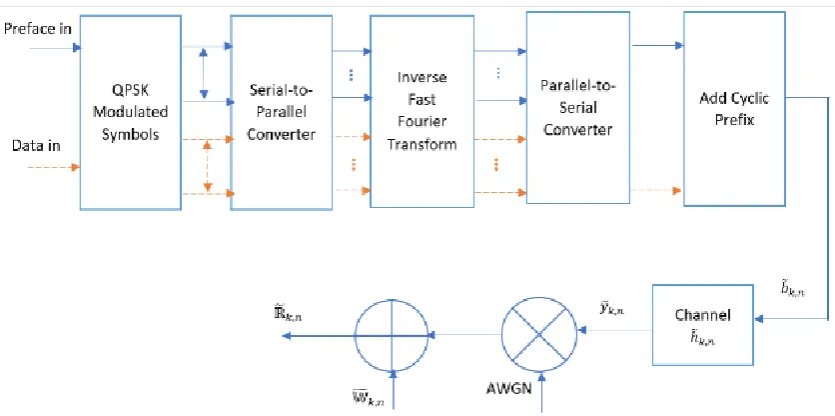
Figure 1. General model of OFDM block diagram
After applying discrete Fourier transform (DFT)
(4) (5)
Where = transfer function of channel in frequency domain, is
known as AWGN noise samples.LS is very simple and flexible approach, the channel estimation can be done by multiplying the sub symbols of received pilot carriers with the inverse of the sub symbols of reference pilot carriers, which can be described as follows:
= (6)
Where = reference pilot carrier sub symbols = received pilot carrier sub symbols and are the set of sub carriers which will be used to carry sub symbols of pilot. Then after, it estimates the channel by interpolating , which are obtained at positions of pilot, where , over the entire band to get the .
3.DESIGNOFPROPOSEDSYSTEM
It is assumed that the data to be transmitted is organized into blocks, as depicted in Figure 2, which consists of QPSK modulated block in which the input data and preface data eq. (7) and (8) will be modulated, and the obtained results allowed by serial-to-parallel converter that converts the modulated data symbol streams into parallel data. There by inverse fast fourier transform (IFFT) utilized for the conversion of frequency domain data into time domain with less number of computations. Then after parallel-to-serial conversion is done by adding of cyclic prefix (CP). Our proposedmodelconsists of a known preface of length symbols, a cyclic prefix of length , followed by length of the data symbols. Thus, the total length of the block is . Let us assume a channel traverse is equal to . The channel traverse assumed by the receiver is . The length of the cyclic prefix is .The output obtained after CP block has been sent over the channel that has to estimate by using eq. (18).
Note that,
(7)
(8) It is assumed that . Since
(9) In other words, preface’s average power must be equivalent to input data average power. The received signal for the block
can be written as :
(10) Where “ ” denotes convolution and based on channel output equation the convolution part in the first term can be written as:
(11) The received sample set can be denoted as a vector:
Figure 2. System model of proposed P-ML-CE algorithm
Let us assume that for the block, there is a known channel impulse response (CIR) at the receiver end. The length of the channel is such that the first coefficients are identical to the coefficients of the channel and the remaining coefficients are zeros. Define the received vector as:
(13) Where
The steady state part of the preface of the transmitted signal appearing at the output of the channel can be represented by a vector:
(14)
Define
(15) The steady-state part of the preface of the received signal for the block can be written as:
(16) Where,
vector
vector
vector
matrix
where we assumed the channel length as at the receiver end. Then the OP-ML-CE is as follows: find , which is an estimate of such that the below term is minimized.
(17) Differentiating with respect to and setting the output to zero yields
(18)
(19)
4.RESULTSANDDISCUSSION
The results of the proposed P-ML-CE studied using the parameters set in Table 1 below and the mean squared error (MSE) of the channel estimates as compared to the original channels.The work presented in [21], shown that the analysis of both least square (LS) and minimum mean square error (MMSE) channel estimation algorithms. When SNR is 12 dB the LS estimator has a MSE of 10-1, which is higher than that of the MMSE estimator. In addition, the MMSE estimator can achieve the same MSE of 10-1 but at lower SNR of 8 dB.Thus, the higher the SNR, the better the MMSE estimator performs in comparison to the LS estimator.
Table 1. Simulation parameters
Symbol Parameter Value
Number of blocks 103
Length of Channel 10-tap channel Assumed channel span 10
Length of cyclic prefix
Length of optimal preface 128, 256, 512
FFT/IFFT size 1024
Signal-to-noise Ratio 0:5:40 dB Length of fade of the CIR 0.5 dB
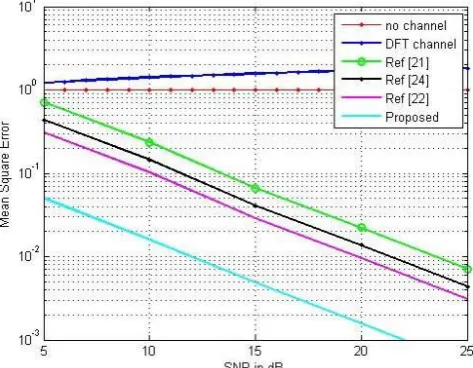
Figure 3 demonstrates that the performance of MSE with the SNR values for the value of . It shown that obtained results of proposed P-ML based CE algorithm out performs excellent over the conventional CE algorithms presented in [21], [22] and [24]. Algorithm presented in [22] achieved MSE of 10-2 at the value of SNR around 20 dB whereas the same has achieved by [24] at a SNR of 22dB. Our proposed model obtained the same at just 12 dB of SNR which shows that the robustness and efficiency of the proposed CE model. Ideally, for any communication system should get better performance at lower SNR region. Our CE model has got an excellent performance at very lower SNR region as compared to the algorithms provided in the literature.
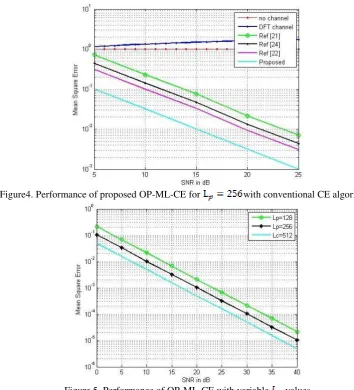
Figure4. Performance of proposed OP-ML-CE for with conventional CE algorithms
Figure 5. Performance of OP-ML-CE with variable values
Figure 4 show that the performance of proposed CE model has get reduced when the length of preface got reduced to 256. Achievement of MSE value of 10-2 is at around 15 dB of SNR, where the value of SNR got enhanced which indicates that the performance of overall system gets change while changing the value of . Performance of proposed model with variable disclosed in figure 5 where the MSE gets reducing while enhancing the value of .
Figure 6. Performance of bit error rate with varying of
5.CONCLUSIONS
In this, a robust and efficient scheme for estimating the channel in OFDM systems over frequency selective Rayleigh fading channels was proposed. Channel estimation has been done by utilizing the optimal preface based maximum likelihood (OP-ML)methodology. Length of optimal preface was a vital parameter while handling the FS channels and quite impressive in enhancing the overall performance.Comparative analysis also provided with various CE algorithms from the literature. Extensive simulation results show that the performance of proposed OP-ML-CE model is quite superior to the conventional CE models.
6.REFERENCES
[1] Wu Y., W. Y. Zou, “Orthogonal frequency division multiplexing: A multi-carrier modulation scheme,” IEEE Transactions on Consumer Electronics,
vol. 41, no. 3, pp.392–399, Aug. 1995.
[2] Van Nee R., Prasad R., OFDM for wireless Multimedia Communications, Artech House, 2003.
[3] Hiperlan2, “Broadband Radio Access Networks (BRAN), HIPERLAN Type 2; Physical (PHY) layer”, ETSI, Tech. Rep., 1999.
[4] Haohong Wang, LisimachosKondi, Ajay Luthra and Song Ci, “4G Wireless Communications Networking”, Edition 1, Willey Publishers, pp. 1-420,
2009.
[5] Yinsheng Liu, Zhenhui Tan, Hongjie Hu, Leonard J. Cimini, Jr. and Geoffrey Ye Li, “Channel Estimation for OFDM”, IEEE Communication Surveys
& Tutorials, Vol. 16, No. 4, Fourth Quarter 2014.
[6] S. E. Bensley and B. Aazhang, “Subspace-based channel estimation for code division multiple access communication systems”, IEEE Trans.
Commun., Vol. 44, No. 8, pp. 1009–1020, 1996.
[7] B. Muquet, M. De Courville, and P. Duhamel, “Subspace-based blind and semi-blind channel estimation for OFDM systems”, IEEE Trans. Signal
Process., Vol. 50, No. 7, pp. 1699–1712, 2002.
[8] R. O. Schmidt, “Multiple emitter location and signal parameter estimation,” IEEE Trans. Antennas Propag., Vol. 34, No. 3, pp. 276–280, 1986.
[9] R. Roy and T. Kailath, “ESPRIT-estimation of signal parameters via rotational invariance techniques”, IEEE Trans. Acous., Speech, Signal Process.,
Vol. 37, No. 7, pp. 984–995, 1989.
[10] B. Yang, K. Letaief, R. S. Cheng, and Z. Cao, “Channel estimation for OFDM transmission in multipath fading channels based on parametric channel
modeling”, IEEE Trans. Commun., Vol. 49, No. 3, pp. 467–479, 2001.
[11] SinemColeri, Mustafa Ergen, Anuj Puri, and Ahmad Bahai, “Channel Estimation Techniques Based on Pilot Arrangement in OFDM Systems,” IEEE
transactions on broadcasting, vol. 48, no. 3, September 2002.
[12] SinemColeri, Mustafa Ergen,AnujPuri, Ahmad Bahai, “A Study of Channel Estimation in OFDM Systems,” Vehicular Technology Conference, 2002.
Proceedings. VTC 2002-Fall. 2002 IEEE 56th, Page(s): 894 – 898 vol.2.
[13] Xiaodai Dong, Wu-Sheng Lu, Anthony C. K. “Linear Interpolation in Pilot Symbol Assisted Channel Estimation for OFDM” IEEE transactions on
wireless communications, VOL. 6, NO. 5, MAY 2007.
[14] Zhang Jie, Huang Liqun, “An Improved DFT-based Channel Estimation Algorithm for MIMO-OFDM Systems,” Consumer Electronics,
Communications and Networks (CECNet), 2011 International Conference on Page(s):3929 – 3932.
[15] Saqib Saleem, Qamar-ul-Islam, “On Comparison of DFT-Based and DCT-Based Channel Estimation for OFDM System,” IJCSI International Journal
of Computer Science Issues, Vol. 8, Issue 3, No. 2, May 2011.
[16] Moussa Diallo, RodrigueRabineau, Laurent Cariou, MarylineHélard. “Transform Domain based Channel Estimation for 3GPP/LTE Systems”
Communications and Networking September 2010.
[17] Y. Wang, L. Li, P. Zhang and Z. Liu, “Channel estimation for OFDM systems in non-sample-spaced multipath channels,” Electronics Letters, vol. 45,
January. 2009.
[18] H. Kobayaki and k. Mori. “Proposal of OFDM channelestimation methodusingdiscretecosinetransform”. Personal, Indoor and Mobile Radio
Communications, 2004. Vol.3, Page(s):1797 – 1801.
[19] M. Marey, M. Samir, and O. A. Dobre, “EM-Based Joint Channel Estimation and IQ Imbalances for OFDM Systems,” IEEE Trans. on Broadcasting,
vol. 58, no. 1, pp. 106–113, Mar. 2012.
[20] H. Yin, L. Cottatellucci, D. Gesbert, R. R. Muller, and G. He, “Robust pilot decontamination based on joint angle and power domain discrimination”,
IEEE Trans. Signal Process., Vol. 64, No. 11, pp. 2990–3003, 2016.
[21] YaseeinSoubhi Hussein, Mohamad Yusoff Alias, Ayad AtiyahAbdulkafi, “On Performance Analysis of LS and MMSE for Channel Estimation in VLC
Systems”, 12th International Colloquium on Signal Processing & its Applications (CSPA2016), Malacca City, Malaysia, pp. 204-209, 2016.
[22] Dr. Raja Murali Prasad, “Navigate Symbol Assisted Channel Estimation Algorithms Under Various Channel Distribution”, International Journal of Advanced Engineering Research and Science, Vol. 3, No. 9, pp. 172-178, 2016
[23] Fernando Cruz-Roldán, María Elena Domínguez-Jiménez, Gabriela Sansigre-Vidal, David Luengo and Marc Moonen, “DCT-based Channel
Estimation for Single-and Multicarrier Communications”, Signal Processing, Vol. 128, pp. 332-339, 2016.
[24] Narayanarao P., Varma J.S., Krishna K.M., “New Training Pattern for DFT-Based Channel Estimation in OFDM System”,In: Proc. of 2nd