Dynamic Material Flow Analysis to Support
Sustainable Built Environment Development
with Case Studies on Chinese Housing Stock Dynamics
1900 1950 2000 2050 2100
i
Dynamic Material Flow Analysis to Support Sustainable
Built Environment Development
with Case Studies on Chinese Housing Stock Dynamics
Proefschrift
ter verkrijging van
de graad van Doctor aan de Universiteit Leiden,
op gezag van Rector Magnificus prof. mr. P.F. van der Heijden, volgens besluit van het College voor Promoties
te verdedigen op dinsdag 18 mei 2010 klokke 11.15 uur
door
Mingming Hu
ii
Promotiecommissie:
Promotors: Prof. dr. Sjoerd M. Verduyn Lunel
Prof. dr. ir. Michiel Haas (Delft University of Technology) Co-promotors: Dr. Ester Van der Voet
Dr. Gjalt Huppes
Overige Leden: Prof. dr. Daniel B. Müller (Norwegian University of Science and Technology) Prof. dr. ir. Hong Ren (Chongqing University, China)
iv
The work described in this thesis was facilitated in part by Chongqing University (China) and Delft University of Technology. It was made possible by the financial support from the Asia-Link project “Human Resources Development for the improvement and protection of Environment in Asia (ProtEA)” of European Union (No. CN/ASIA-LINK (110-744)) and the China Exchange Programme “Innovative Methodologies for Sustainable Waste Management (InnoMan)” of the Dutch Academy of Art and Science (No. 09CDP009).
--- Dynamic Material Flow Analysis to Support Sustainable Built Environment Development, with Case Studies on Chinese Housing Stock Dynamics
© 2010 by Mingming Hu,
except for the chapters from 2 to 4. Copyrights of these chapters belong to the publishers as noted at the beginning of each chapter.
Institute of Environmental Sciences (CML) Leiden University
PO Box 9518, 2300 RA Leiden, The Netherlands
E-mail: [email protected]
v
Contents
Proefschrift...i
Promotiecommissie: ...ii
Contents...v
Summary ...ix
Chapter 1 Introduction ...1
1.1 Sustainability challenges in built environment development... 2
1.2 The need for a long-term systems perspective of sustainable built environment development ... 4
1.3 Metabolism metaphor as a basis for a long-term systems perspective of sustainable built environment development ... 6
1.4 Material flow analysis as a tool to analyze metabolism of the built environment ... 8
1.5 Dynamic material flow analysis as a tool to analyze long-term metabolism of the built environment... 10
1.6 Research questions... 12
1.7 Thesis outline ... 14
Reference to Chapter 1... 16
Chapter 2 Case I: Dynamic Material Flow Analysis for Strategic Construction and Demolition Waste Management in Beijing...25
Abstract ... 25
2.1 Introduction... 26
2.2 Methodology and data... 29
2.2.1 Stock dynamics model ... 29
2.2.2 Data and modeling parameters... 31
2.3 Scenario analysis... 41
2.4 Strategic suggestions for CDW management ... 45
2.4.1 Strategy for prolonging the lifetime of buildings ... 45
2.4.2 Recycling strategy... 45
2.5 Conclusions and discussions... 46
vi
Chapter 3 Case II: Dynamics of Urban and Rural Housing Stocks in China ...53
Abstract ... 53
3.1 Introduction... 54
3.2 Urbanization and housing in China... 55
3.3 Method ... 57
3.3.1 System definition ... 58
3.3.2 Mathematical model formulation... 59
3.3.3 Calibration ... 60
3.3.4 Validation... 65
3.4 Stocks and flows of housing in China... 66
3.4.1 Medium scenario results ... 67
3.4.2 Sensitivity analysis ... 69
3.5 Discussions... 74
3.6 Conclusions... 76
Reference to Chapter 3 ... 77
Appendices to Chapter 3 ... 81
Chapter 4 Case III: Iron and Steel in Chinese Residential Buildings: a Dynamic Analysis ...89
Abstract ... 89
4.1 Introduction... 90
4.2 Methods... 92
4.2.1 System definition ... 92
4.2.2 Model parameter quantification... 94
4.3 Results and discussion ... 97
4.3.1 Simulation results ... 97
4.3.2 Sensitivity analysis ... 99
4.3.3 Implications for steel industry ... 102
4.3.4 Environmental consequences... 104
4.4 Conclusions and outlook... 107
Reference to Chapter 4 ... 109
vii
Chapter 5 Discussion, Conclusions and Recommendations ...115
5.1 Introduction... 116
5.2 Discussion and evaluation of the case studies... 116
5.2.1 Hypotheses... 116
5.2.2 Limitations of stock dynamics model and its uncertainties ... 118
5.2.3 Evaluation of the case studies... 119
5.3 Conclusions... 122
5.3.1 Methodology... 122
5.3.2 Housing service units... 123
5.3.3 Construction materials ... 124
5.4 Recommendations... 125
5.4.1 Technical and policy recommendations... 125
5.4.2 Recommendations for the development and use of dynamic material flow analysis models to support construction strategies... 125
Reference to Chapter 5... 127
Publications in this thesis...129
Samenvatting ...131
Acknowledgement ...137
Curriculum Vitae...139
viii
ix
Summary
This thesis describes the development of a stock-driven dynamic material flow analysis model that can be used to analyze the long-term metabolism of the built environment stocks in rapidly urbanizing emerging regions.
Introduction
Many of the sustainability challenges raised by developments in the built environment are related to the significant mobilization of materials, which leads to two types of problems. On the inflow side these include resource depletion and emission problems due to materials production, while on the outflow side they include problems of construction and demolition waste (CDW). The challenges are especially severe for the emerging countries, where nearly all of the additional world population in the next half century is expected to be absorbed by their urban areas. Meanwhile, theory for ‘sustainable built environment development’ is still being developed. Although the concepts and goals are not yet well-defined, the need for a long-term systems perspective to support the development of a sustainable built environment seems clear. A visionary perspective can only be achieved if we understand the long-term metabolism of the built environment stocks, by applying dynamic material flow analysis. Previously, a stock-dynamics-driven approach has been successfully used for dynamic material flow analysis in several housing stock studies in developed countries. This approach has, however, never been applied to newly emerging countries, where the combined influences of very rapid economic development and urbanization have to be considered.
Research design
x
addition, Chapter 1 presents a general introduction, and Chapter 5 provides a discussion, conclusions and recommendations on using the dynamic MFA approach to support sustainable development of the built environment.
• Case I (Chapter 2) examines the long-term impacts of Beijing’s economic
growth on its demand for construction materials and on demolition waste generation, using a stock dynamics model.
• Case II (Chapter 3) investigates the long-term impacts of China’s urbanization
on its urban and rural floor area demand for housing, using a two-sub-systems model of floor area dynamics.
• Case III (Chapter 4) investigates the long-term dynamics of the iron and steel
used in China’s residential buildings, in view of the ongoing urbanization, using an extension of the two-sub-systems model to the level of materials.
Case studies
The models we developed were used to answer four research questions, viz. ‘What
are the Trends for inflow?’; ‘What are the Trends for outflow?’, ‘What are the
Environmental impacts?’ and ‘What are the Implications for industry?’; all of which relate to the future development of Chinese housing stocks.
Case I: Dynamic material flow analysis for strategic construction and demolition
waste management in Beijing
This study developed a per capita GDP driven dynamic MFA model to examine the concrete diffusion in Beijing’s urban housing system. It first identifies a strong correlation between per capita floor area and local per capita GDP, through international comparison. Based on the historical correlation, the model can then assess the effect of GDP growth on future housing stock changes. This study focused
on understanding ‘Trends for outflow’, as
0 20 40 60 80
1950 1975 2000 2025 2050
0 400 800 1200 1600
Mt/yr Mt
Construction
Demolition Stock Concrete (Beijing)
xi
its purpose was to support CDW management. The outcome of the model suggests that the amounts of concrete released by residential demolition in Beijing will rise dramatically over the next 50 years. It also indicates that the volume of CDW generated in the near future depends very much on the lifetime of the buildings; a high growth of per capita floor area resulting from continuing GDP increases will raise the volume of CDW, especially in the long run. A strategy to reduce demolition waste should therefore concentrate its efforts on extending the service lifetime of the buildings. This could be achieved by renovation activities and high building quality standards for new construction. However, all the scenario calculations imply that the rise in the volume of CDW generated is unavoidable. A long-term strategy should therefore emphasize recycling to limit the pressure on landfills in the future and reduce the demand for primary materials.
Case II: Dynamics of urban and rural housing stocks in China
This study developed a two-sub-systems dynamic MFA model including the driving force of urbanization, for the investigation of floor area dynamics in the entire Chinese urban and rural housing stocks. It uses the urbanization rate, dividing the population of China into rural and urban, to derive the housing floor area stocks in the two systems. This study focused on understanding
‘Trends for inflow’. The modeling results indicate a substantial oscillation in the demand for new urban housing construction in the coming decades. This study offers an early warning for the changing trends in China’s demand for housing construction. Even in view of the ongoing urbanization, China’s present high level of urban housing construction will not continue. The turning point of the trend may well be right now or in the near future. The sensitivity analysis shows that the oscillation phenomenon in new construction is mainly dependent on the lifespan of the buildings. Only the extremely short lifetime scenario (less than 30 years) results in a
0 300 600 900 1200 1500
1900 1950 2000 2050 2100
0 10 20 30 40 50 x109 m2 x106 m2/yr
Construction
Demolition Stock
Floor Area (Urban Housing)
xii
very limited oscillation in the simulation result. A better understanding of the lifespan of buildings is essential for anticipating future housing stock dynamics.
Case III: Iron and steel in Chinese residential buildings: a dynamic analysis
This study extended the two-sub-systems dynamic MFA model of floor area developed in the study on Chinese urban and rural housing stock dynamics, to analyze changes in the amounts of iron and steel used in Chinese residential stocks. To this end, it investigated the historical evolution and potential future developments in steel intensity in Chinese residential construction. The study focused on
understanding ‘Environmental
impacts’ and ‘Implications for industry’. The results obtained with the model indicate that the oscillation phenomenon identified at the housing production level also occurs at the materials level, as regards the demand for residential iron and steel. The longer the lifespan of buildings and the lower the floor area stock, the stronger the proportional oscillation will be. In contrast to most projections, this study indicates that the coming decades will see a significant reduction in steel demand from China’s residential sector, which currently accounts for 20% of the country’s steel consumption. The use of dynamic MFA makes it possible to include stock ageing, which is not included in more trend-oriented forecasts. This is of primary importance. The expected reduction in steel demand has obvious benefits both from an environmental point of view and from a resource conservation point of view. In
the long run, the longer the lifespan of the buildings, the lower the CO2 emissions
from construction activities, and the lower the use of potentially scarce resources. However, if the current Chinese steel production were to continue, the reduction of residential steel demand in China implies that a serious overcapacity would develop in the Chinese steel industry. Given its substantial size, this is likely to exert a substantial impact on the global markets involved.
0 20 40 60 80
1900 1950 2000 2050 2100
Mt/yr
0 600 1200 1800 2400
Construction
Demolition Stock
Mt
Steel (Urban Housing)
xiii
Main conclusions
1. Stock dynamics models are suitable for investigating the long-term metabolism of
the built environment stocks; this is also true for a rapidly developing economy in the process of ongoing urbanization.
2. The lifespan of buildings, which determines the patterns of future construction
and demolition demand, is the most crucial factor in forecasting the long-term dynamics of the housing stock metabolism.
3. Demolition activity in China will inevitably rise in the course of the 21st century.
In terms of reducing environmental impacts, we conclude that in the near future, the shorter the lifespan of buildings, the more critical recycling secondary materials from CDW will be.
4. A shrinking demand for new residential construction may be expected over the
next few decades. If the current level of steel production continues, a severe overcapacity in Chinese steel industry may be foreseen. The effect on the global market will be substantial: a decrease in global steel consumption of up to 10%.
Recommendations for further research
Some interesting subjects for the future development and use of dynamic material flow analysis to support sustainable construction strategies are:
- understanding the factors that determine the lifespan of buildings;
- combining dynamic MFA models with economic models;
- analyzing the dynamics of other built environment subsystems (e.g.
non-residential buildings and urban infrastructures);
- using dynamic MFA in combination with LCA;
- translating the systems knowledge obtained by dynamic MFA into practical
Chapter 1 Introduction
1900 2100
Urbanization
Urb
an
iza
tion
70% 70% 100% 100%
Population Population
GDPGD
Chapter 1: Introduction
2
1.1Sustainability challenges in built environment development
The notion of ‘built environment’ is relatively recent1. In common use, the built
environment refers to the:
man-made surroundings that provide the setting for human activity, ranging in scale from personal shelter to neighborhoods to the large-scale civic surroundings2.
It is generally accepted that the built environment is a key factor in the move towards a more sustainable future (Jones et al. 2007). Buildings and transport infrastructures have enabled mankind to thrive in numbers and to a standard not possible in less organized communities. However growing populations and the extravagant lifestyles of the most successful people threaten the natural resources of the earth (Carpenter 2001). For example, the building related activities, constituting approximately 44% of the total material use and 30 – 40% of the society’s total energy demand, as well
as roughly 1/3 of the total CO2 emission (Erlandsson and Borg 2003; Li 2006).
Many of the sustainability challenges are related to the extensive mobilization of materials caused by built environment development. People’s will to urbanize and to enlarge the built environment drives the major flux of solid materials in the world (Baccini and Brunner 1991) and leads to one of the greatest transformations of the landscape on the Earth (Douglas and Lawson 2002; Moffatt and Kohler 2008), by depositing in urban areas the large stocks of materials brought from other places. On one side, raw materials are extracted from lithosphere to build up the built environment, which leaves huge pits and waste heaps on the mining sites, leads to resource depletion and causes emission problems due to extensive energy consumption in metals (e.g. iron and steel) and cement production. For instance, in
1 In common use in the literature since the mid-1970s. The origin is clearly in anthropological and
behavioral studies concerning the influence of form and space on the individual and social behavior (Rapoport 1976). The concept has evolved in anthropology and in more recent research the built environment is understood as the result of a process of social construction (Lawrence and Low 1990, p. 455).
2 A quotation from Wikipedia (January 2010), as one typical example of conventional usage of the
Dynamic MFA to Support Built Environment Development
3
the year of 2000 about 45% of global iron entering use is devoted to construction
(Wang et al. 2007), for the last 25 years of the 20th century, the structural steelwork
and build/civil engineering have been consistently the largest application for iron and steel in an already well developed country like the UK (Davis et al. 2007) and steel has been identified as having globally the highest environmental impact of all mined metals (Staal 2009). On the other side, the maintenance, refurbishment of the existing built environment stock and the replacement of the obsolete part of it generate a big amount of construction and demolition waste (CDW) which leads to waste management pressure. CDW is by far the largest solid waste fraction (Kourmpanis et al. 2008; Wang et al. 2004), accounting for at least 50% of total generated solid waste in industrialized countries (Schachermayer et al. 2000). Sustainably managing CDW – the quantitatively vast solid waste fraction is considered a priority in waste management in densely populated countries, because of the shortage of landfill capacities for final disposal (Duran et al. 2006).
Some other sustainable challenges are related to the use of the built environment stock. For instance, the energy used to heat, cool, ventilate and light buildings represents over 30% of Canada’s national energy use (Cole and Kernan 1996). In China, building operation energy is estimated to account for 17 – 27% of China’s total energy use (Yang and Kohler 2008; Yao 2005). It is widely recognized considerable energy savings can be achieved by upgrading the existing building stock but currently there is little incentive to do so in the UK (Jones et al. 2007), and it has been found in Germany that the issues of energy upgrading are not crucial for maintaining or demolishing decisions (Kohler 2006). European Union (2002) points out that if the built environment is to be made more sustainable and if targeted carbon dioxide reductions in the medium term of two decades are to be realized, the problem of how to improve the existing built environment must be addressed.
Chapter 1: Introduction
4
Historical figures show that in emerging countries, the rapid industrialization and population migration of the last 30 years have led to fast growing urbanization and doubling the building and partially the infrastructure stocks in 20 – 30 years (Yang 2006; Yang and Kohler 2008). China has the largest building stock in the world, the amount of which has been growing unprecedentedly through last three decades (Kohler and Yang 2007; Yang and Kohler 2008). Should it continue, Kohler and Yang state that, a shortage of available building materials, and at the same time a continuously high level of resulting environmental impacts might be expected.
Taking into account the depleting scarce resources on our planet, the alarming global warming problem, the limited local dumping capacities and the ongoing urbanization in developing regions, considering the significant resource extraction, high life cycle energy consumption and enormous solid waste generation of the built structures, it is
crucial to orient the development of built environment in the 21st century to a more
sustainable direction.
1.2The need for a long-term systems perspective of sustainable built
environment development
Yet, the concept of ‘sustainable built environment development’ is developing. Twenty years ago, the influential Brundtland Report (WCED 1987) envisaged ‘sustainable development’ as a means by which the global system would satisfy:
the needs of the present without compromising the ability of future generations to meet their own needs (WCED 1987, pp.43).
Dynamic MFA to Support Built Environment Development
5
critical dimensions (economic, social and environmental) should be concerned in sustainable development is so far widely accepted. Recently there is an emerging body of literature on sustainability of the built environment, or the construction sector. The late David Pearce (Pearce 2003; Pearce et al. 2006; Pearce 2006, pp. 202) suggested defining sustainability as rising per capita well-being. The capability of an individual to generate its well-being can be observed by wealth – the sum of available man-made, human, natural and social capitals. Built environment stocks are the dominant part of man-made capital. In the light of these definitions, “the contribution of the construction industry to sustainable development can be gauged by assessing its role in contributing to the capital stocks” (Pearce 2003, pp. x). This proposal has been considered by many other researchers (e.g. Kohler 2006; Atkinson 2008; Brattebø et al. 2009) can be useful to assess the sustainability of the construction sector or activities affecting the built environment because it may allow for an integrated perspective. However, Moffatt and Kohler (2008) argue that in complex situations like building and urban design, there is no simple optimum. Also, how to substitute the losses from one capital stock (e.g. resource depletion in lithosphere) with the gains in another capital stock (e.g. enlarged city and better educated farmer-construction worker) is very debatable, as there is not one single method to justify the value of different capitals, and not even one for a specific capital good. Theory-searching for sustainable built environment development has
just started3. Concepts and goals are not yet well defined. Nevertheless, the precious
searches on defining sustainable built environment development give the direction to look into, which has at least two implications.
First of all, there is a need for a broad systems perspective. This is because based on all proposed sustainability definitions, (a) understanding sustainability needs a global perspective, (b) analyzing sustainability needs a multi-dimension perspective to embrace concerns of environmental, economic and social dimensions, (c) assessing options for sustainable built environment development needs an integrated
3 Theory-building in built environment tends to be fragmented, under-resourced and explored from
Chapter 1: Introduction
6
perspective to allow effects on all man-made, natural, human and cultural capitals be counted; based on the character of built environment, (d) only in a broader ‘systems’ perspective, dynamic relationships existing between a greater number of built elements can be examined. And the trade-offs can be explored between, for example, building design and infrastructure requirements, or urban form and resource efficiency (Moffatt and Kohler 2008).
Secondly, there is a need for a long-term perspective. This is because (a) based on the ever proposed sustainability definitions, understanding sustainability needs an intergeneration long-term view, for instance, Parkin (2000) suggests 2050 – 2100 or beyond, and (b) based on the character of built environment elements, Brattebø and colleagues (2009) point out that due to the long service life of built structures and their significant mobilization of physical land monetary flows – such as materials, energy, land use, emissions, wastes and costs – a systems approach to the built environment must apply wider borders not only in space but also in time. Only from a long-term perspective, the dynamics of the built environment stocks in service can be examined, and based on it the overall sustainability of a built environment development, including construction, renovation and demolition will be allowed for analysis.
In order to gain a broad systems and long-term perspective of sustainable built environment development, pioneering attempts show that, the ‘metabolism’ of built environment stocks should be first understood.
1.3Metabolism metaphor as a basis for a long-term systems perspective of
sustainable built environment development
Dynamic MFA to Support Built Environment Development
7
Labor is, first of all, a process between man and nature, a process by which man, through his own actions, mediates, regulates and controls the metabolism between himself and nature. (Marx 1976[1867], pp. 283)
The notion of metabolism was expanded from a biological concept to include energy flows and material flows in society, as well as across nature and society. As acknowledged by many researchers (e.g. Jelinski et al. 1992; Erkman 1997; Graedel and Allenby 2003) that metabolic metaphor is the most essential concept, on which
the new, sustainability oriented field – industrial ecology is based. Industrial ecology
emerges at a time when it is becoming increasingly clear that the traditional de-pollution approach (end-of-pipe) is insufficient (Erkman 1997). The notion of industrial ecology is to tackle the environmental problems based on a systems
analysis of (parts of) the technosphere, the physical link between economy and
environment, in order to avoid sub-optimization and problem shifting. The core
concept enabling such systems analysis is industrial metabolism. Defined by Ayres
(1989), the concept industrial metabolism argues the analogy between the economy
and environment on a material level: the economy’s ‘metabolism’ in terms mobilization, use and excretion of materials and energy to create ‘technomass’ is compared to the use of materials in the biosphere to create biomass. This concept has enlightened the economy-environment relationship and been fruitfully applied in many studies. One of the first applications was identified as supporting a regional material management (Baccini and Brunner 1991; Brunner and Baccini 1992;
Baccini 1996, 1997). The authors called this the metabolism of theanthroposphere.
With much of the world’s population moving to urban areas, interest in sustainable cities is entering the industrial ecology sphere (Brattebø et al. 2005). Since the late 1960s and early 1970s, with the environmental movement and the first oil crisis,
industrial ecology and its application to urban metabolism (Wolman 1965;
Duvigneaud and Denaeyer-De Smet 1977; Baccini and Brunner 1991) are followed by the establishment of a new field of research into urban ecology (Moffatt and
Kohler 2008). Fischer-Kowalski and Weisz (1999) propose the concepts
Chapter 1: Introduction
8
of organized social interventions for the purpose of improving their utility for society” (Weisz et al. 2001, pp. 124). Moffatt and Kohler (2008) acknowledge the socio-economic metabolism as a central concept to understand the relation between the built environment and the ecosystem upon a broader systems perspective. They point out that ‘metabolic profile’ developed for built environment on scales of global, a country, a region, a town, and for flows of energy, aggregates, water, people, organic matter, information, or money can reveal (1) the ‘ecological efficiency’ for the built environment as a system, (2) the extent of interdependencies within this system, and (3) by creating a time-series material flow analysis, can help to identify trends in resource use. For example, there may be a tendency in advanced economies for dematerialization of certain processes over time, and the replacement of mass flows by information flows (Kohler 1998).
Although emphases of observation vary from production-focused industrial
metabolism, human-activity-focused metabolism of the anthroposphere, city-focused
urban metabolism to culture-processes-involved socio-economic metabolism, the core is the same. That is, using metabolism metaphor to obtain a broad systems, long-term comprehension and physical understanding of the processes occurring in our societies. In the light of metabolism metaphor, the physical links between the socio-economic, the built environment and the ecologic systems might be constructed and the changes of their interactions over time might be understood. Thus, further debate on sustainable built environment development can be based on the analysis of the long-term metabolism of the built environment from a broad systems perspective.
1.4Material flow analysis as a tool to analyze metabolism of the built
environment
Application of the metabolic viewpoint involves detailed accounting of the flows of materials and energy through society (Ausubel et al. 1989). The analytical tool employed for calculating and displaying a balanced set of flows through the built environment is called MFA (Material/Mass Flow Accounting/Analysis) in general, which refers to the analysis of the throughput of materials of a region, based on accounts in physical units (Bringezu and Moriguchi 2002). The subjects of the
Dynamic MFA to Support Built Environment Development
9
(1998), sand and gravel in Bergstedt and Linder (1999), window frame materials in
Kandelaars and van den Bergh (1997), mass flows through an economic system (e.g.
Adriaanse et al. 1997; Mathews et al. 2000) or chemically defined substances (e.g.
Van der Voet et al. 1994). In some context, the analysis of flows at the substance level is defined as SFA (Substance Flow Analysis) (Van der Voet 1996), while MFA
refers to only mass and bulk flow studies4, in a narrow sense. SFA and MFA may
differ in the applications5, but the methodology is similar. For all materials flow
studies, the materials balance principle derived from Lavoisier’s Law of Mass
Preservation is the common basis (Van der Voet 1996). The general framework for conducting the analysis comprises the three-step procedure: (i) definition of the system, (ii) quantification of the overview of stocks and flows, and (iii) interpretation
of the results (Van der Voet 2002). Definition step defines the system with regard to
the space, function, time and materials. Quantification step involves identifying and
collecting the relevant data on the one hand, and modeling the system by either (a) bookkeeping, (b) static modeling or (c) dynamic modeling, on the other hand.
Interpretation step includes evaluating the robustness of the overview quantification, and translating the overview into policy-relevant terms (Van der Voet et al. 1999,
2000). Dynamic MFA/SFA refers to the analysis based on dynamic modeling for
Quantification.
The method of MFA/SFA was for the first time applied to study the metabolism or physiology of cities by Wolman (1965), followed by Newcombe and colleagues
(1978)6. It then has been applied in developed countries to understand densely
populated regions (Brunner and Baccini 1992), to trace pollutants through watersheds or urban regions (Bergbäck et al. 1994; Van der Voet et al. 1994; Kleijn et al. 1994), and in developing countries to understand the environmental impact of human activities (Binder 1996), to support water resource management (Binder et al. 1997) and planning (Erkman and Ramaswamy 2003). These studies have determined
4 MFA studies on bulk and mass flow are also referred to as “bulk-MFA” (Kleijn 2001) or at a
national level as “economy-wide MFA” (Eurostat 2001).
5 SFA studies can be related to specific environmental problems and thus provide input for a
pollutants policy (Van der voet 2002), while MFA studies provide macroeconomic indicators (Adriaanse et al. 1997).
6 For a review on MFA history see Brunner and Rechberger (2004), Fischer-Kowalski (1998),
Chapter 1: Introduction
10
anthropogenic contribution to various natural resources and pollutants, which are all useful for sustainable built environment development. They, however, provide only a static snapshot, either over a one-year time period or averaged over a few years and do not depict the temporal dynamics of stocks and flows in the built environment development. Previous researches show that MFA is useful to investigate optimizing opportunities of sustainable built environment practices from a static systems perspective, while dynamic MFA is essential to capture the optimizing opportunities along temporal dimension, from a long-term perspective.
1.5Dynamic material flow analysis as a tool to analyze long-term metabolism of
the built environment
Dynamic MFA to Support Built Environment Development
11
Dynamic MFA/SFA differs from static analysis on that it includes the investigation for stocks in society (Elshkaki 2007) and so is possible to explore future flows of emissions and wastes, based on past and future inflows and stock characteristics (Kleijn et al. 2000). There are basically two types of techniques in modeling
dynamics of stocks and flows. One is flow dynamics driving, as applied in Zeltner
and colleagues (1999), Kleijn and colleagues (2000), Kohler and Hassler (2002), van der Voet and colleagues (2002), Elshkaki and colleagues (2004, 2005), Bergsdal and colleagues (2007b), Bohne and colleagues (2007), Bradley and Kohler (2007) and Hashimoto and colleagues (2007). It assumes that the material stock is driven by its inflow and outflow. The future inflow is either assumed (Kleijn et al. 2000) or estimated based on socio-economic variables using different techniques, such as intensity of use (Tilton 1990), demand function (Fisher et al. 1972), production function (Kopp and Smith 1980), Input Output Analysis (IAO) (Leontief et al. 1983; Myers 1986) and regression analysis (Elshkaki et al. 2004). While the outflow is determined either by a leaching or delay process (van der Voet et al. 2002). The
other type of modeling approaches is stock dynamics driving, as applied in Binder
and colleagues (2001), Johnstone (2001a, b), Müller (2004, 2006), Yang (2006), Bergsdal and colleagues (2007a), Sartori and colleagues (2008) and Yang and Kohler (2008). It assumes that the stock of service units is the driver for the material flows. The stock can be estimated by an assigned ‘development pattern’ (Binder et al. 2001), ‘stock expansion rate’ (Johnstone 2001a, b) or can be defined as a function of population and its lifestyle (Müller 2006; Yang 2006; Yang and Kohler 2008). The outflow of materials, coupled with the obsolete service units is determined by delay process, while the inflow of materials, coupled with the new add-in service units is introduced to maintain the development pattern of stock in use. The question as to
whether flow dynamicsdriving or stock dynamicsdriving should be used depends on
whether the focus of the question is short- or long-term (Müller 2006). For long residence-time goods, stock dynamics approach, using stock in service instead of production (inflow) to stimulate the system evolution, reflects better the understanding that consumption behavior of people is “stock oriented” (Binder et al. 2001).
Chapter 1: Introduction
12
intensity and service lifetime of dwellings. This approach was then applied by Bergsdal and colleagues (2007a) for analyzing the dynamics of concrete and wood in the Norwegian dwelling stock for the same two centuries’ time and followed by Sartori and colleagues (2008) for projecting the future activity levels of construction, renovation and demolition in the Norwegian residential sector. Results of these studies support the hypothesis that service stocks in use play a prominent role in understanding long-term changes of societal metabolism. The limit of this stock dynamics driving dynamic MFA model is that it analyzes only one subsystem – housing stock of the built environment stock. However, this narrowed boundary allows this model investigate more deeply the causal relations between material consequences of housing development, people’s demand for housing service, and industries’ improvement potential. The limited number of variables involved in the model is also a big merit for sensitivity analysis to test the robustness of the results. Theoretically, this model should have strength on capturing the long-term trends of housing demand for recently expanding stock. However their approach has never been applied to any newly emerging country. And it is also a new topic for this approach to include the urbanization effects in the analysis. In the following chapters of this thesis, this approach has then been adapted and further developed for investigating the long-term stock dynamics and material consequences of the housing systems in the fast developing and urbanizing country – China.
1.6Research questions
This PhD work aims to contribute to systems analysis of sustainable built environment development in an expanding economy. The hypotheses underlying the study are:
(1) the metabolism metaphor is a useful one for assessing the options of
sustainable building and construction;
(2) the dynamic material flow analysis is essential for understanding the
long-term metabolism of the built environment stocks;
(3) the stock dynamics driving dynamic MFA approach is suitable for examining
Dynamic MFA to Support Built Environment Development
13
Based on the hypotheses, three dynamic MFA models for Chinese housing stocks are constructed. In response to the sustainability challenges, especially those related to material mobilization of the built environment development, four main research questions are investigated in the thesis:
Q1. Trends for inflow
How will the demand for housing floor area and related construction materials in China develop over the next decades, in view of the ongoing income rise and urbanization? Is it probable that the present steep increase in demand continues?
Q2. Trends for outflow
Will there be problems in China related to the generation and handling of construction and demolition waste? If there are problems in the supply of (specific) construction materials in China, can we expect recycling to help prevent supply problems from arising to a substantial degree?
Q3. Environmental impacts
What will be environmental impacts, especially related to energy use and greenhouse gas emissions for the production of construction materials? What is the influence of recycling on these environmental problems?
Q4. Implications for industry
What is the influence of the development in the demand and supply of construction materials on the stability of the material supply and construction sectors in China?
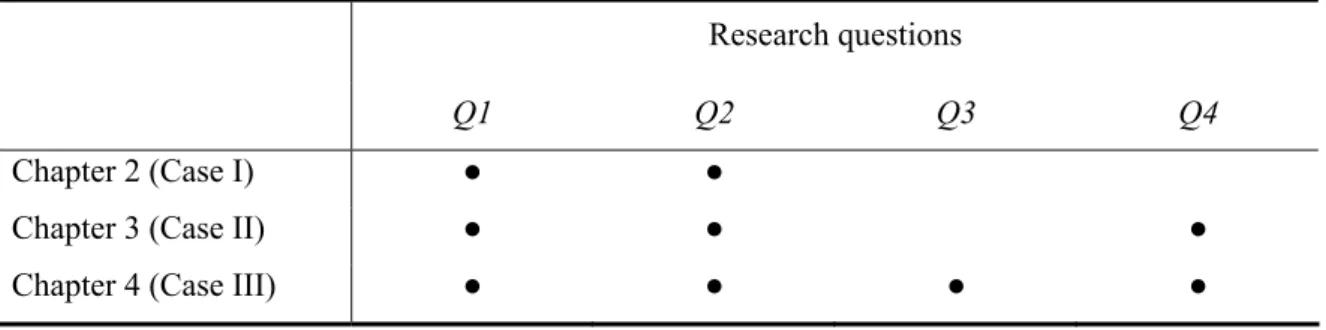
Facilitated by the dynamic MFA models, these questions are examined during the case studies (Case I ~ Case III) and addressed from Chapter 2 to 4, as indicated in Table 1.1.
Table 1.1 Overview of research questions addressed in each chapter of this thesis
Research questions
Q1 Q2 Q3 Q4
Chapter 2 (Case I) ● ●
Chapter 3 (Case II) ● ● ●
Chapter 1: Introduction
14
1.7Thesis outline
Chapter 2 investigates the construction and demolition waste
(CDW) issues of the built environment development, in the context of a fast developing economy, by conducting a dynamic MFA for the future waste concrete generation in Beijing’s urban housing sector (Case I). In this study, the effect of economic growth on the demand for housing floor area has been explored by introducing the factor of GDP into the stock dynamics model, and the relationship between the GDP growth and the PCFA (per capita floor area) have been identified by international comparison. Three scenarios, representing the current trend extension, high GDP growth and lengthening lifetime of buildings are analyzed. The results of analysis provide a better understanding of the effectiveness and limitations of the prolonging lifetime strategy and recycling strategy for the CDW management in the built environment development from a long-term perspective.
Chapter 3 explores the impacts of urbanization for the built environment
development, by conducting a dynamic MFA for the floor area of the urban and rural residential buildings in China (Case II). In this study a two-sub-systems stock dynamics model is developed from the generic stock dynamics model (Müller 2006). It involves urbanization rate as a driver to project the future demand for new construction and replacement of the urban and rural residential buildings in China. A wide range of possible development paths for population, urbanization, PCFA and dwelling lifetime have been investigated. The results signal out a dramatic change in the future demand for urban residential construction, which has strong implications for the construction industries.
Dynamic MFA to Support Built Environment Development
15
are identified. Environmental consequences of different development scenarios for no recycling and 100% recycling of scrap are assessed by calculating the
accumulated net steel use and the net CO2 equivalent emission. This study provides
highly relevant projections for iron and steel industry and profound information for further sustainability debates like “to what extent can the demand for steel in construction be met by secondary materials, and what are limiting factors?”, “what are trade-offs between recycling and durability?”, “how can we stabilize markets with the least possible environmental and resource impacts?”.
Chapter 1: Introduction
16
Reference to Chapter 1
Adriaanse, A. et al. 1997. Resource flows : The material basis of industrial economies. World Resources Instititute, Washington, DC.
Atkinson, G. 2008. Sustainability, the capital approach and the built environment. Building Research & Information 36(3):241 – 247.
Ausubel, J.H. et al. 1989. Technology and environment: an overview. In: Ausubel, J.H. and Sladovich, H.E. (Ed.) 1989. Technology and Environment. Nathional Academy Press, Washington. D.C. pp. 1-20.
Ayres, R.U. 1989. Industrial metabolism. In: Ausubel and Sladovich (eds): Technology and environmental. National Academy Press. Washington DC. pp. 23-49.
Baccini, P. 1996. Understanding regional metabolism for a sustainable development of urban systems. Environmental Science and Pollution Research 3(2): 108 – 111.
Baccini, P. 1997. A city’s metabolism: towards the sustainable development of urban systems. Journal of Urban Technology, 4(2): 27 – 39.
Baccini, P. and P.H. Brunner. 1991. Metabolism of the anthroposphere. Springer-Verlag, Berlin Heidelberg.
Bergsdal, H. et al. 2007a. Dynamic material flow analysis for Norway’s dwelling stock, Building Research & Information, 35(5): 557 – 570.
Bergsdal, H. et al. 2007b. Projection of construction and demolition waste in Norway, Journal of Industrial Ecology 11(3): 27 – 39.
Binder, C. 1996. The early recognition of environmental impacts of human activities in developing countries. Ph.D. dissertation 11748, Swiss Federal Institute of Technology Zurich, Switzerland.
Dynamic MFA to Support Built Environment Development
17
Binder, C. et al. 2001. Dynamic models for managing durables using a stratified approach: the case of Tunja, Colombia, Ecological Economics 38: 191 – 207.
Bohne, R.A. et al. 2007. Dynamic eco-efficiency projections for C&D waste recycling strategies at the city level, Journal of Industrial Ecology 11(4).
Bradley, P.E. and N. Kohler. 2007. Methodology for the survival analysis of urban building, Building Research & Information 35(5): 529 – 542
Bringezu, S. and Y. Moriguchi. 2002. Material flow analysis. In: Ayres R.U. and L.W. Ayres (ed.) A Handbook of Industrial Ecology, Edward Elgar Publishing Limited.
Bringezu, S. and H. Schutz, 1997. Material flow accounts. Part II: Construction materials, packaging, indicators. Wuppertal Institute. Wuppertal, Germany.
Brattebø, H., J. Ehrenfeld and K. Røine. 2005. Framing industrial ecology. In: Textbook in Industrial Ecology.
Brattebø, H., H. Bergsdal, N.H. Sandberg, J. Hammervold and D.B. Müller. 2009. Esploring built environment stock metabolism and sustainability by systems analysis approaches. Building Research & Information 37(5-6): 569 – 582.
Brunner, P.H. 1999. In search of the final sink. Environmental Science and Pollution Research 6(1): 1.
Brunner, P.H. 2004. Material flow analysis and the ultimate sink. Journal of Industrial Ecology 8(3): 4 – 7.
Brunner, P.H. and P. Baccini. 1992. Regional material management and environmental protection. Waste Management & Research 10: 203 – 212.
Brunner, P.H. and H. Rechberger 2004. Practical Handbook of Material flow analysis. Lewis, New York.
Chapter 1: Introduction
18
Cole, R.J. and P.C. Kernan. 1996. Life-cycle energy use in office buildings. Building and Environment 31(4):307 – 317.
Davis, J. et al. 2007. Time-dependent material flow analysis of iron and steel in the UK, Part 2. Scrap generation and recycling. Resource, Conservation and Recycling 51: 118 – 140.
Doughty, M.R.C. and G.P. Hammond. 2004. Sustainability and the built environment at and beyond the city scale. Building and Environment 39:1223 – 1233.
Douglas, I. and N. Lawson, 2002. Material flows due to mining and urbanization. In: Ayres R.U. and L.W. Ayres (ed.) A Handbook of Industrial Ecology. Edward Elgar Publishing Limited.
Duran, X. et al. 2006. A model for assessing the economic viability of construction and demolition waste recycling – the case of Ireland. Resource, Conservation and Recycling. 46: 302 – 320.
Elshkaki, A., et al. 2004. The environmental and economic consequences of the developments of lead stocks in the Dutch economic system, Resources, Conservation and Recycling 42: 133 – 154.
Elshkaki, A., et al. 2005. Dynamic stock modeling: A method for the identification and estimation of future waste streams and emissions based on past production and product stock characteristics, Energy 30: 1353 – 1363.
Elshkaki, A. 2007. Systems analysis of stock buffering: Development of a dynamic substance flow-stock model for the identification and estimation of future resources, waste streams and emissions. Thesis, Leiden, The Netherlands.
Erkman, S. 1997. Industrial ecology: an historical view. Journal of Cleaner Production 5(1-2): 1 – 10.
Erkman, S. and R. Ramaswamy. 2003. Applied industrial ecology: a new platform for planning sustainable societies. Aicra Publishing, Bangalore, India.
Dynamic MFA to Support Built Environment Development
19
European Union. 2002. Directive 2002/91/EC of the European Parliament and of the Council on Energy Performance of Buildings. December 2002.
Eurostat. 2001. Economy-wide Material Flow Accounts and Derived Indicators: A Methodological Guide. Eurostat, Luxembourg.
Fischer-Kowalski, M. 1998. Society’s metabolism: the intellectual history of material flow analysis, Part I, 1860-1970. Journal of Industrial Ecology 2(1): 61 – 78.
Fischer-Kowalski, M. 2002. Exploring the history of industrial metabolism. In: Ayres R.U. and L.W. Ayres (ed.) A Handbook of Industrial Ecology, Edward Elgar Publishing Limited.
Fischer-Kowalski, M. and W. Hüttler. 1999. Society’s metabolism: the intellectual history of material flow analysis, Part II, 1970-1998. Journal of Industrial Ecology 2(4): 107 – 37.
Fischer-Kowalski, M. and H. Weisz. 1999. Society as hybrid between material and symbolic realms: towards a theoretical framework of society-nature interaction. Advances in Human Ecology (8): 215 – 251.
Global Reporting Initiative. 1999. Sustainability Reporting Guidelines, Coalition for Environmentally Responsible Economies, Boston, MA.
Graedel, T.E. and B.R. Allenby. 2003. Industrial Ecology, Second Edition. Englewood Cliffs, N.J: Prentic Hall.
Hammond, G.P. 2000. Energy, environment and sustainable development: a UK perspective. Trans IChemE Part B: Process Safety and Environmental Protection 78:304 – 323.
Hashimoto, S. et al. 2007. Where will large amounts of materials accumulated within the economy go? – A material flow analysis of construction minerals for Japan. Waste Management 27(12): 1725-1738.
Jelinski, L.W. et al. 1992. Industrial ecology: concepts and approaches. Proc. Natl. Acad. Sci. USA, vol. 89, pp 171-182.
Chapter 1: Introduction
20
Johnstone, I. 2001b. Energy and mass flows of housing: estimating mortality. Building & Environment 36(1): 43 – 51.
Jones, P., J. Patterson and S. Lannon. 2007. Modelling the built environment at an urban scale – Energy and health impacts in relation to housing. Landscape and Urban Planning 83:39 – 49.
Kapur, A. et al. 2008. Dynamic modeling of in-use cement stocks in the United States. Journal of Industrial Ecology 12 (4), 539 – 556.
Kandelaars, P. and J. van den Bergh. 1997. Materials-product chain analysis of window frames, Ecological Economics 22: 41 – 61.
Kelly, T. 1998. Crushed cement concrete substitution for construction aggregates: a material flow analysis. US Geological Survey Circular 1177. US Geological Survey, USA.
Kleijn, R., E. van der Voet and H.A. Udo de Haes. 1994. Controlling substance flows: the case of chlorine. Environmental Management (8): 523 – 542.
Kleijn, R., R. Huele and E. van der Voet. 2000. Dynamic substance flow analysis: the delaying mechanism of stocks, with the case of PVC in Sweden. Ecological Economics 32 (2): 241 – 254.
Kleijn, R. 2001. Adding it all up – The sense and non-sense of bulk-MFA. Journal of Industrial Ecology 4(2): 7 – 8.
Kohler, N. 1998. Sustainability of new work practices and building concepts. In: Streitz, N., S. Konomi and H.J. Burkhardt (eds.) Cooperative Buildings – Integrating Information, Organization, and Architecture. Lecture Notes in Computer Science. Springer, Heidelberg, pp. 154 – 162.
Kohler, N. 2006. A European perspective on the Pearce report: policy and research. Building Research &Information 34(3): 287 – 294.
Kohler, N. and U. Hassler. 2002. The building stock as a research object, Building Research & Information 30(4): 226 – 236.
Dynamic MFA to Support Built Environment Development
21
Koskela, L. and P. Roberts. (eds.) 2007. Towards the foundation of theory for the built environment. International Symposium towards the Formation of Theory for the Built Environment, Digital World Centre, Salford, UK.
Koskela, L. 2008. Is a theory of the built environment needed? Building Research & Information 36(3): 211 – 215.
Kourmpanis, B. et al. 2008. Preliminary study for the management of construction and demolition waste. Waste Management Research 26: 267 – 275.
Lawrence, D.L. and S.M. Low. 1990. The built environment and spatial form. Annual Review of Anthropology 19: 453 – 505.
Li, Z. 2006. A new life cycle impact assessment approach for buildings. Building and Environment 41:1414 – 1422.
Mathews, E. et al. 2000. The Weight of Nations: Material Outflows from Industrial Economies. World Resources Institute (WRI), Washington DC. USA.
Marx, K. 1976(1867). Capital I, New York: Vintage.
Moffatt, S. and N. Kohler. 2008. Conceptualizing the built environment as a social-ecological system. Building Research & Information 36(3): 248 – 268.
Müller, D.B. et al. 2004. Long-term coordination of timber production and consumption using a dynamic material and energy flow analysis, Journal of Industrial Ecology 8(3).
Müller, D.B. 2006. Stock dynamics for forecasting material flows – case study for housing in The Netherlands. Ecological Economics 59: 142 – 156.
Newcombe, K. et al. 1978. The metabolism of a city: the case of Hong Kong. Ambil 7: 3 – 15.
Parkin, S. 2000. Sustainable development: the concept and the practical challenge. Proceedings of the Institution of Civil Engineers, Civil Engineering 138:3 – 8.
Chapter 1: Introduction
22
Pearce, D.W. 2006. Is the construction sector sustainable?: definitions and reflections. Building Research & Information 34(3): 201 – 207.
Pearce, D.W., G. Atkinson and S. Mourato. 2006. Cost-Benefit Analysis and the Environment: Recent Developments, OECD publication, Paris.
Rapoport, A. (ed.) 1976. The Mutual Interaction of People and Their Built Environment: a Cross-cultural Perspective, Aldine, Chicago, pp. 7 – 35.
Sartori, I. et al. 2008. Towards modeling of construction, renovation and demolition activities: Norway’s dwelling stock, 1900 – 2100, Building Research & Information 36(5): 412 – 425.
Schachermayer, E. et al. 2000. Assessment of two different separation techniques for building wastes. Waste Management & Research 18: 16 – 24.
Staal, Y. 2009. Prioritisation of metals regarding their environmental impact. Master thesis, Leiden university, Leiden, The Netherlands.
United Nations Population Division (UNPD). 2007. World urbanization prospects: the 2005 revision. United Nations, available on http://www.un.org/esa/population/publications/WUP2005/2005WUPHighligh ts_Exec_Sum.pdf, retrieved on: 2009-10-16.
UNPD. 2009. World population prospects: the 2008 revision. United Nations, available on http://esa.un.org/unpd/wpp2008/pdf/WPP2008_Executive-Summary_Edited_6-Oct-2009.pdf, retrieved on: 2009-10-16.
Van der Voet, E. et al. 1994. Cadmium in the European Community – a policy oriented analysis. Waste Management & Research 12: 507 – 526.
Van der Voet, E. 1996. Substance from cradle to grave: development of a methodology for the analysis of substance flows through the economy and the environment of a region. Ph.D. Thesis, Leiden, The Netherlands.
Dynamic MFA to Support Built Environment Development
23
Van der Voet, E. et al. (eds.), 2000. Heavy metals: a problem solved? Methods and models to evaluate policy strategies for heavy metals. Kluwer Academic Press, series Environment & Policy.
Van der Voet, E. 2002. Substance flow analysis methodology. In: Ayres R.U. and L.W. Ayres (ed.) A Handbook of Industrial Ecology. Edward Elgar Publishing Limited.
Van der Voet, E. et al. 2002. Predicting future emissions based on characteristics of stocks. Ecological Economics 41:223 – 234.
Wang, J.Y. et al., 2004. A systems analysis tool for construction and demolition wastes management. Waste Management 24: 989 – 997.
Wang, T. et al. 2007. Forging the anthropogenic iron cycle. Environmental Science & Technology 41(14): 5120 – 5129.
Weisz, H., M. Fischer-Kowalski, C.M. Grünbühel, H. Haberl, F. Krausmann, V. Winiwarter. 2001. Global environmental change and historical transitions. Innovation 14(2): 117 – 142.
Wittmer, D. and T. Lichtensteiger. 2007. Exploration of urban deposits: long-term prospects for resource and waste management. Waste Management & Research 25: 220 – 226.
Wolman, A. 1965. The metabolism of cities. Scientific American, 213 – 179.
World Commission on Environment and Development (WCED). 1987. Our common future. Oxford: Oxford University Press.
Yang, W. 2006. Modeling the Evolution of the Chinese Building Stock in a Sustainable Perspective, PhD Thesis, Tianjin University, Tianjin, China (in Chinese).
Yang, W. and N. Kohler. 2008. Simulation of the evolution of the Chinese building and infrastructure stock, Building Research & Information 36(1): 1-19.
Chapter 1: Introduction
24
Chapter 2 Case I: Dynamic Material Flow Analysis for Strategic
Construction and Demolition Waste Management in Beijing
*Abstract
Of all materials extracted from the earth’s crust, the construction sector uses 50%, producing huge amounts of Construction and Demolition Waste (CDW). In Beijing, presently 35 Mt/yr of CDW is generated. This amount is expected to grow significantly when the first round of mass buildings erected in the 1990s will start to be demolished. In this study, a dynamic Material Flow Analysis (MFA) is conducted for Beijing’s urban housing system, taking the demand for the stock of housing floor area as the driver. The subsequent effects on construction and demolition flows of housing floor area and the concurrent consumption and waste streams of concrete are investigated for Beijing from 1949 and projected through 2050. The per capita floor area (PCFA) is a key factor shaping the material stock of housing. Observations in Beijing, the Netherlands and Norway indicate PCFA has a strong correlation with the local GDP. The lifetime of dwellings is one of the most important variables influencing future CDW generation. Three scenarios, representing the current trend extension, high GDP growth and lengthening lifetime are analyzed. The simulation results show CDW will rise, unavoidably. A higher growth rate of GDP and the consequent PCFA will worsen the situation in the distant future. Prolonging the lifetime of dwellings can postpone the arrival of the peak of CDW. From a systematic view, recycling is highly recommended for long-term sustainable CDW management.
Keywords: dynamic modeling, waste projection, per capita floor area, GDP,
concrete, dwelling.
*Reprinted from “Hu, M., E. van der Voet and G. Huppes. 2010. Dynamic material flow analysis for
Chapter 2: Case I
26
2.1Introduction
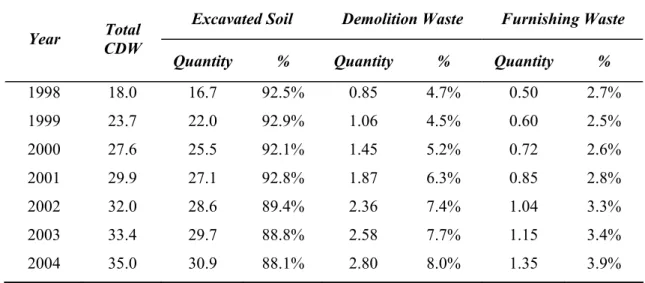
The solid waste generated by the construction sector is called Construction and Demolition waste (CDW). In Beijing, three types of CDW are distinguished and monitored: excavated soil, demolition waste and furnishing waste (Chen 2004). Together, these three form a waste stream even larger than Municipal Solid Waste. Records of the Beijing Solid Waste Administration Department (BSWAD; see Table 2.1) show that the total CDW has almost doubled from 1998 to 2004, while the demolition waste has more than tripled to reach 2.8 Mt/yr in 2004 (BSWAD 2007). Previous studies in several industrialized countries and regions indicate that the magnitude of CDW may increase even more substantially in the next few decades, as the result of the combination of socio-economic, demographic changes, and an ageing building stock (Fatta et al. 2003; Poon et al. 2004a,b; Müller 2006; Bergsdal et al. 2007a,b).
Table 2.1 Annual construction and demolition waste (CDW) generation in Beijing in 1998 - 2004
Excavated Soil Demolition Waste Furnishing Waste
Year Total
CDW
Quantity % Quantity % Quantity %
1998 18.0 16.7 92.5% 0.85 4.7% 0.50 2.7% 1999 23.7 22.0 92.9% 1.06 4.5% 0.60 2.5% 2000 27.6 25.5 92.1% 1.45 5.2% 0.72 2.6% 2001 29.9 27.1 92.8% 1.87 6.3% 0.85 2.8% 2002 32.0 28.6 89.4% 2.36 7.4% 1.04 3.3% 2003 33.4 29.7 88.8% 2.58 7.7% 1.15 3.4% 2004 35.0 30.9 88.1% 2.80 8.0% 1.35 3.9% Note: CDW is reported in million metric tons per year (Mt/yr). Source: BSWAD (2007).
Dynamic MFA to Support Sustainable Built Environment Development
27
• How the amount of future waste concrete will develop in Beijing’s urban
housing sector;
• If the trend found in housing sector applies to the whole built environment,
where the challenges and opportunities are for future CDW management in Beijing;
• And what strategies should be preferred accordingly.
Future waste flows can be modeled either directly as a function of socio-economic factors, or through mass balance relating to the inflows and/or stocks of the materials, which are determined by socio-economic factors. The former approach assumes that the volume of waste streams is directly related to demographic and socio-economic development (e.g., Grossman et al. 1974; Chang et al. 1993, 1997; Chen and Chang 2000). Because it avoids the complexity in analyzing the underlying dynamic systems, this approach is commonly used to characterize the future waste flows from long-lifespan goods (Binder et al. 2001). While it has some value on a general level, the approach clearly leads to dubious outcomes when looking at waste streams of specific materials (Elshkaki 2007) and it has been shown, that this analysis is very data intensive (Bossel 1994).
Chapter 2: Case I
28
There are two main types of dynamic MFA models that have been applied to estimate future waste streams. One is flow dynamics driving, as applied in Zeltner and colleagues (1999), Kleijn and colleagues (2000), Kohler and Hassler (2002), Van der Voet and colleagues (2002), Elshkaki and colleagues (2004, 2005), Bergsdal and colleagues (2007b), Bohne and colleagues (2007), Bradley and Kohler (2007), Hashimoto and colleagues (2007) and Kohler and Yang (2007). It assumes that the material stock is driven by its inflow and outflow; the inflow is predicted as a function of socio-economic factors, while the outflow is determined either by a leaching or delay process (Van der Voet et al. 2002). The other type of dynamic MFA is stock dynamics driving, as applied in Binder and colleagues (2001), Johnstone (2001a,b), Müller (2004, 2006), Yang (2006), Bergsdal and colleagues (2007a), Sartori and colleagues (2008) and Yang and Kohler (2008). It assumes that the stock of service units is the driver for the material flows. The stock can be estimated by an assigned ‘development pattern’ (Binder et al. 2001), ‘stock expansion rate’ (Johnstone 2001a,b) or can be defined as a function of population and its lifestyle (e.g. Müller 2006). The outflow of materials, coupled with the obsolete service units is determined by delay process, while the inflow of materials, coupled with the new add-in service units is introduced to maintain the stock in use. This approach, using stock of service instead of consumption (inflow) to stimulate the system evolution, reflects better the understanding that consumption behavior of people is “stock oriented” (Binder et al. 2001). This study uses stock dynamics model to analyze the future concrete diffusion in Beijing’s urban housing to generate insights for future CDW generation in Beijing.
Dynamic MFA to Support Sustainable Built Environment Development
29
2.2Methodology and data
2.2.1 Stock dynamics model
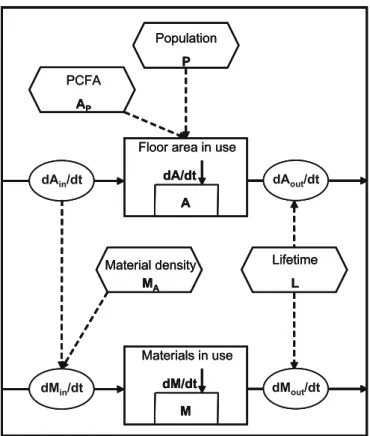
The model presented herein represents a material flow analysis (MFA) for the floor area and selected construction material (concrete) in Beijing’s residential building stock. It is based on the stock dynamics approach. The conceptual outline of the model was first presented by Müller (2006) for concrete in Dutch dwelling stock and was then applied by Bergsdal and colleagues (2007a) for concrete/wood in Norwegian dwelling stock. Its main aspects are illustrated in Figure 2.1. Processes are represented by rectangles, flows by ovals, and drivers and determinants by hexagons. Dashed lines represent influences between variables. Stocks of floor area
A dA/dt Population P PCFA AP
Floor area in use
dAin/dt dAout/dt
M dM/dt Lifetime L Material density MA
Materials in use
dMin/dt dMout/dt
A dA/dt Population P PCFA AP
Floor area in use
dAin/dt dAout/dt
M dM/dt Lifetime L Material density MA
Materials in use
dMin/dt dMout/dt
A dA/dt Population P PCFA AP
Floor area in use
dAin/dt dAout/dt
M dM/dt Lifetime L Material density MA
Materials in use
dMin/dt dMout/dt
Figure 2.1 Conceptual outline of the stock dynamics model. PCFA = per capita floor area. Rectangles represent processes, ovals depict flows, and hexagons illustrate determinants or drivers. Dashed lines represent influences between variables: A = floor area stock; M = materials stock;
dA/dt = net stock accumulation of floor area; dM/dt = net stock accumulation of materials; Ain/dt =
input flow of floor area; dMin/dt = input flow of materials; Aout/dt = output flow of floor area; Mout/dt
= output flow of materials. Determinants are denoted as P for Population, AP for per capita floor
Chapter 2: Case I
30
and materials are denoted by A and M, respectively, and the net stock accumulation
by dA/dt and dM/dt. Input flows to stock are given by Ain/dt and dMin/dt, while
output flows are represented correspondingly as Aout/dt and Mout/dt. Determinants are
denoted as P for Population, AP for PCFA, L for dwelling Lifetime and MA for
Material density. The stock dynamics model can be described mathematically with seven equations. ) ( ) ( )
(t P t A t
A = ⋅ P (1)
0 ( ) ( ') ( , ') ' t out in t
dA t dA t
L t t dt
dt =
∫
⋅ dt (2)2 2 2 ) ' ( 2 1 ) ' , ( σ τ π σ − − − ⋅ = t t e t t L
( 3 )
( ) ( ) ( )
in out
dA t dA t dA t
dt = dt + dt (4)
( ) ( )
( )
in in
A
dM t dA t
M t
dt = dt ⋅ (5)
0 ( ) ( ') ( , ') ' t out in t
dM t dM t
L t t dt
dt =
∫
⋅ dt (6)( ) ( )
( ) dM tin dMout t dM t
dt = dt − dt (7)
Equation (1) describes the driving forces of the model. The floor area of housing stock is driven by the population and its lifestyle (here PCFA), representing the engine for the system to evolve. Equation (2) describes the delay character of the floor area stock in use. The outflow of floor area is determined by the previous inflow by delaying it by a certain service lifetime. Since dwellings may have different service lifetimes before they are demolished, a lifetime distribution L(t, t’) is used in equation (2), representing the probability that the housing units entering service at the time t’ are going to be removed from the stock at the time t. Equation (3) provides a default lifetime distribution L(t, t’) for the model, which is estimated