THE EFFECT OF THE LADY HEALTH WORKER PROGRAM ON MATERNAL HEALTH AND FAMILY PLANNING SERVICES IN RURAL
PAKISTAN
Layla M. Lavasani
A dissertation submitted to the faculty of the University of North Carolina at Chapel Hill in partial fulfillment of the requirements for the degree of Doctor of Philosophy in the
Gillings School of Global Public Health (Maternal and Child Health).
Chapel Hill 2012
Approved by:
Kavita Singh, Ph.D.
Siân Curtis, Ph.D.
Herbert Peterson, M.D.
Chirayath Suchindran, Ph.D.
iii ABSTRACT
LAYLA M. LAVASANI: The Effect of the Lady Health Worker Program on Maternal Health and Family Planning Services in Rural Pakistan
(Under the direction of Dr. Kavita Singh)
The Lady Health Worker Program (LHWP) is a national program introduced in
1994 by the Pakistani Ministry of Health with the aim of improving access to Maternal
and Child Health (MCH) and family planning services in urban slums and rural areas.
Utilizing the 2006-2007 Pakistan Demographic Health Survey and the 2006 Pakistan
Community-level Rural Survey, this dissertation examines the effect of the LHWP on use
of reversible contraceptives and MCH services (tetanus toxoid immunizations/antenatal
care) in rural Pakistan. In order to control for non-random program placement, this study
uses an instrumental variable approach with a novel set of valid geographic exclusion
restrictions; availability of a middle school and telephone lines in a community.
The first paper in this dissertation examines the effect of the LHWP on the use of
reversible contraceptive methods among rural ever-married woman 15-49 years while
examining determinants of LHW placement in rural communities. Results from a logistic
regression indicate that communities with developed infrastructures are more likely to
have a LHW. In the bivariate probit model which takes into account non-random
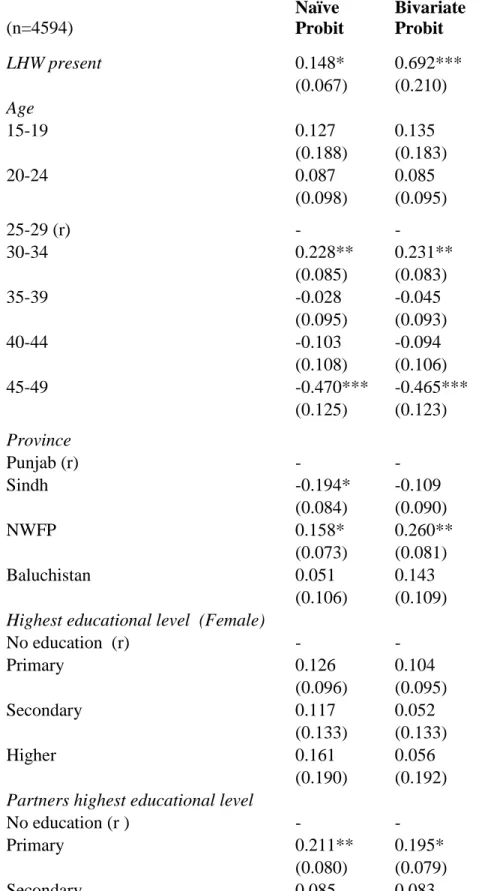
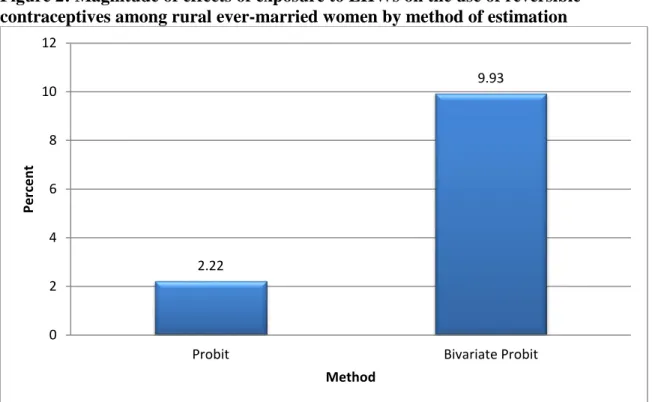
program placement, access to a LHW increases the probability of utilizing reversible
contraceptives by 9.9 percentage points. The naïve probit marginal effect estimates were
iv
significantly increase access to reversible contraceptives in rural communities despite
being located in more advantaged areas. In terms of methodology, naïve estimation
procedures which ignore non-random program placement would substantially
underestimate the impact of the program.
The second paper examines the effect of the LHWP on the use maternal health
services among rural ever-married woman. Results from the bivariate probit model
indicate that LHWs increase the probability of receipt of tetanus toxoid injections by 42
percentage points. However, the LHW program does not have a statistically significant
effect on the uptake of antenatal care services. Programmatically, these results suggest
that in rural areas of Pakistan, LHWs are effective at providing a service for which they
are directly responsible but ineffective in increasing use of antenatal care services
v
vi
ACKNOWLEDGEMENTS
First and foremost, I would like to thank my adviser, Dr. Kavita Singh, for her
continual support and guidance throughout the dissertation process. I would also like to
acknowledge my committee members, Drs Siân Curtis, Herbert Peterson, Chirayath
Suchindran, and Dean Harris, for their thoughtful comments and feedback which has only
helped to strengthen this work.
I am thankful to my dear friends and family who have tirelessly supported me in
my academic pursuits. Without all of you – this dissertation would not have been
vii
TABLE OF CONTENTS
LIST OF TABLES ... ix
LIST OF FIGURES ... x
Chapter 1: Introduction ... 1
Specific Aims ... 3
Background ... 3
Conceptual Framework ... 17
Chapter 2: The Effect of the Lady Health Worker Program on Reversible Contraceptive Use in Rural Pakistan ... 20
Introduction ... 20
Background ... 22
Data ... 27
Estimation Strategy ... 30
Results ... 33
Discussion ... 37
Chapter 3: The Effect of the Lady Health Worker Program on use of Maternal Health Services in Rural Pakistan ... 51
Introduction ... 51
Data ... 56
Model ... 59
viii
Discussion ... 65
Chapter 4: Conclusion... 78
Programmatic Implications ... 78
Methodological Implications... 80
ix
LIST OF TABLES
Table 1: Weighted descriptive statistics of ever-married women by area ... 43
Table 2: Family Planning Characteristics for ever-married women by area ... 45
Table 3: Logit estimates of determinants of LHW placement in rural communities ... 46
Table 4: Bivariate and naïve probit coefficient estimates of the effect of the LHWP on the use of reversible contraceptive methods ... 47
Table 5: Weighted descriptive statistics of ever-married women by area ... 71
x
LIST OF FIGURES
Figure 1: Conceptual Model ... 19
Figure 2: Magnitude of effects of exposure to LHWs on the use of reversible
contraceptives among rural ever-married women by method of estimation .... 50
xi
LIST OF ABBREVIATIONS
ANC Antenatal Care
BHU Basic Health Unit
CHWs Community Health Workers
DHS Demographic and Health Survey
FANA Federally Administered Northern Areas
FATA Federally Administered Tribal Areas
GoP Government of Pakistan
IV Instrumental Variable
LHWs Lady Health Workers
LHWP Lady Health Worker Program
MDGs Millennium Development Goals
MCH Maternal and Child Health
NIPS National Institute of Population Studies
NGOs Nongovernmental organizations
PDHS Pakistan Demographic and Health Survey
PHC Primary Health Care
TT Tetanus Toxoid
RHU Rural Health Centers
SBAs Skilled Birth Attendants
CHAPTER 1: INTRODUCTION
Pakistan’s maternal and child health indicators are among the worst in the world
(USAID 2008). In 2007, the Pakistan Demographic and Health Survey showed little
change in morality over time with a maternal mortality ratio of 276 per 100,000 and an
under-five mortality rate of 94 per 1000 live births (USAID 2008; National Institute of
Population Studies 2008). Furthermore, the low contraceptive prevalence rate (22%) and
high fertility rates (4.5 children per woman) in rural areas constrain the attainment of the
Millennium Development Goals (MDGs) (Shadoul 2010; USAID 2008). Therefore,
improving the health of mothers and children in Pakistan is an immense priority. Recent
evidence in other developing countries has shown that maternal deaths can be reduced by
promoting the availability and use of maternal care services (Kerber et al. 2007).
However, these services are often underutilized by those in greatest in need.
In order to improve access to and utilization of maternal health and family
planning services, the Government of Pakistan (GoP) launched the Lady Health Worker
Program in 1994 (Ministry of Health Pakistan 2011). Key objectives of the LHW
program were to improve uptake of Maternal and Child Health (MCH) services in urban
slum/rural communities and provide information concerning the adoption and
continuation of family planning methods, including the distribution of some forms of
2
program on the receipt of tetanus toxoid injections and contraceptive use, selective
program placement of LHWs in communities has been ignored. Targeting programs to
specific communities will not complicate evaluation efforts when characteristics are
observed and controlled for in statistical models (Frankenberg et al. 2005; Angeles et al.
1998). However, a growing body of literature suggests that when purposive program
placement is based on unobserved characteristics (social capital, cultural norms, decision
maker’s preferences etc.) and those characteristics are correlated to the outcome of
interest, the effect of the program will be biased(Frankenberg and Duncan 2001; Angeles
et al. 1998; Gertler and Molyneaux 1994; Rosenzweig et al. 1986). The effects of the
program may be overestimated or underestimated when potential sources of confounding
are not controlled (Rosenzweig 1986; Gertler and Molyneaux 1994; Angeles et al. 1998;
Guilkey and Hutchinson 2011).
Therefore, the purpose of this dissertation is to examine the impact of the LHW
program in rural areas on maternal service and family planning use, while examining
potential selective program placement concerns. An instrumental Variable (IV) technique
was used to test and correct for endogeneity with a novel set of geographic instruments
(availability of a middle school and telephone lines). These geographic characteristics
are reflective of factors that may influence program placement due to recruiting and
placement requirements, while not affecting health outcomes directly. Data from the
2006-2007 Pakistan Demographic and Health Survey and Community-level Rural Survey
3 SPECIFIC AIMS
Aim 1: Examine determinants of community level placement of Lady Health Workers
Hypothesis 1A: Rural communities that are more structurally developed will be more
likely to have a Lady Health Worker.
Aim 2: To estimate the effects of living in a community with a Lady Health Worker
on reversible contraceptive use
Hypothesis 2 A: Women living in communities with a Lady Health Worker will be more
likely to utilize contraceptives.
Aim 3: To estimate the effects of living in a community with a Lady Health Worker on use of maternal health services (antenatal care and receipt of tetanus toxoid
injections)
Hypothesis 3 A: Women living in communities with a Lady Health Worker will be more
likely to utilize maternal health services.
BACKGROUND
Maternal health indicators in Pakistan are among the worst in the world:
Despite progress towards meeting the Millennium Development Goals (MDG),
Pakistan’s maternal health indicators are some of the worst in the world (USAID 2008;
National Institute of Population Studies 2008). Globally, over 7.6 million children under
five die annually (UN Inter-agency Group 2011). Pakistan in particular, has one of the
highest maternal mortality ratios (MMR) in South Asia at 276 per 100,000 live births and
is only exceeded by countries like Afghanistan and Nepal (Khan et al. 2009). Under five
mortality is 87 deaths per 1,000 live births, with rates significantly higher in rural areas
4
Health Survey (PDHS), only one-third of women had an antenatal visit by their fourth
month of pregnancy as recommended by WHO while over 35% received no prenatal care
at all. The most commonly cited reason for the lack of a visit was due to the fact that
women believed it was not necessary. Skilled Birth Attendants (SBAs) assisted only 39%
of births, with significant disparities by urban-rural residence. Approximately 34% of
births took place within a facility and 66% were home based. Of the home based
deliveries, only 7.6% were assisted by a skilled birth attendant a (National Institute of
Population Studies 2008).
Fertility levels remain high in Pakistan:
In 2009, Pakistan had an estimated population of 170 million and is continuing to
grow at a rate of 1.9 percent per year (Ministry of Finance Pakistan 2009). Based on UN
projections, Pakistan will be the third most populous country by the year 2050 (Pakistan
Ministry of Finance 2009). The rapid increase in population is mainly due to consistently
high fertility levels, which have seen little change in the past decade (World Bank 2010).
Pakistan’s Total Fertility Rate (TFR) of 4.1 children per women is one of the highest in
South Asia (National Institute of Population Studies 2008). Fertility is considerably
higher in rural areas (4.5 children per woman) compared to urban areas (3.3 children per
woman) (National Institute of Population Studies 2008). The urban-rural fertility rate
disparity also increases with women’s age. Theses differentials between urban and rural
women have been attributed to factors associated with urbanization, higher levels of
education, status of women, improved access to health and family planning services, and
5
Modern contraceptive use in Pakistan lags behind its neighbors:
In Pakistan, only 22% of currently married women are using a modern method
compared to India (49%) and Bangladesh (47%) where the rates are much higher
(National Institute of Population Studies 2008). According to the 2007 PDHS,
approximately three-fourths of current users are using a modern method while one-fourth
is using traditional methods. The most commonly used method is female sterilization
(8%), condoms (7%), withdrawal (4%), and the rhythm method (4%). The use of IUDs,
injectibles and pills are each around 2% for married women (National Institute of
Population Studies 2008). Although there has been a substantial increase in
contraceptive use since the 80’s, modern contraceptive use has reached a plateau in recent
years. The lack of progress on increasing contraceptive use may be due to a number of
factors including: decentralization of the family planning program from central control
leading to a lack of ownership of the program at district levels, the lack of support from
within the health sector, and the disconnect between community and facility level
services ((National Institute of Population Studies 2008; Ali et al. 2008; Casterline et al.
2001; Harel 1997).
Access to and utilization of maternal health and family planning services is essential for maternal survival and health:
Most maternal deaths can be prevented by reducing the delays in decision-making
to seek medical care (often due to the lack of awareness of obstetric danger signs),
utilizing a skilled attendant at labor and delivery, ensuring availability of emergency
obstetric care, and referral to quality health services (Campbell et al. 2006; Goodburn et
al. 2001). During the antepartum period, focused antenatal care (ANC) provides an
6
infant, although research suggests that the effect of ANC on maternal mortality is limited
(Corroli et al. 2001; Bergsjø 2001; Rooney 1992; McDonagh 1996). Nonetheless,
routine ANC exposes women to key information about birth preparedness, dangers signs,
and where to seek care for pregnancy complications which is particularly important in
rural areas where there are low levels of education (WHO and UNICEF 2003). ANC has
been found to be an important determinant of safe delivery (Bloom et al. 1999) and is
positively associated with the uptake of postnatal health care services (Chakraborty et al.
2002) potentially contributing indirectly to maternal mortality reduction. Antenatal care
visits also provide opportunities for the provision of other preventative health services
that can improve maternal health and perinatal survival including: immunizations against
neonatal tetanus, prophylactic treatment of malaria, and HIV counseling and testing
(WHO and UNICEF 2003). In particular, immunizing pregnant women against tetanus is
one of the most effective methods of reducing neonatal tetanus mortality rates and the
incidence of maternal tetanus (Blencowe et al. 2010, Gay et al. 2003). In 2008,
approximately 59,000 newborns died worldwide due to neonatal tetanus with 508 cases
reported in Pakistan alone (Black et al. 2010, WHO 2011).
Likewise, family planning services are a key component to the continuum of care
to improve the health and wellbeing of mothers and children (Kerber et al. 2007). By
reducing unintended pregnancies, improving reproductive behaviors of men and women,
family planning interventions can help to reduce child mortality and improve maternal
health (Family Health International 2011). However, the lack of access to family
planning clinics and contraceptives remain a significant issue in Pakistan (World Bank
7
Factors affecting family planning and maternal service use:
There are multiple levels which can influence health service use, including
individual and community-level effects. Many studies of maternal health service
utilization have focused primarily on individual level factors, with little attention to
community influences (Adamu and Salihu 2002; Bloom et al. 2001; Van den Broek et al.
2003). However in countries such as Pakistan where mobility and security are limited,
contextual level factors are an essential component in understanding the influences on
family planning and maternal service use. The following variables are common factors
which may influence uptake of maternal health and family planning services.
Socio-cultural factors
A review of the literature suggests at the individual-level, there are a number of
factors which use of maternal health and family planning services including
socio-cultural factors such as maternal age, husband’s attitudes, and mother’s education
(Gabrysch and Campbell 2009; Gage 2007; Elo 1992; Mekonnen and Mekonnen 2003).
These factors are especially relevant to the Pakistani context where female autonomy and
decision making are severely limited (Shaikh 2004). Younger Pakistani women often
lack the autonomy to leave their home without permission from a male caregiver, limiting
access and use of health care and family planning methods (Mumtaz and Salway 2005;
Khan 1999). Women who are older may potentially be more confident and influential in
decision-making compared to younger women in Pakistan (Shaikh 2004; Mumtaz and
Salway 2005; Khan 1999). Husband’s opposition to health service use and family
planning methods has been shown to be a significant factor in a wide variety of places
8
Sathar and Kazi 1997). In many cases, husband’s disapproval may reflect fertility
preferences or cultural beliefs concerning the use of health facilities (Mumtaz and Salway
2005).
Furthermore, maternal education and literacy have also been shown to be
positively correlated with utilization of maternity care services (Gabrysch and Campbell
2009). Increased knowledge of the benefits of preventive health care and awareness of
health services may explain the ability to demand and use services (Mekonnen and
Mekonnen 2003). Low levels of female literacy and education in Pakistan may serve as
barriers to recognizing birth-related complications, utilizing modern contraceptives as
well as seeking appropriate health care (Shaikh and Hatcher 2007; Shaikh et al. 2008).
Furthermore, the widespread restrictions on education and employment of women can
limit the number of trained female health providers and reduce women's resources to
access care(Shaikh 2004).In Pakistan, where there are considerable cultural restrictions
within communities; this can drastically affect health service use and the recruitment of
LHWs (Shaikh 2004). Such beliefs and cultural practices may lead women to self-care,
utilize home remedies, and consult with traditional healers in rural communities (Shaikh
2004). In other cases, gender discrimination can affect health seeking behavior and use
of contraceptives (Casterline et al. 2001; Mahmood and Ringheim 1996). In Pakistan,
often the early contraceptive adopters are generally those with relatively high parity and
already have a sufficient number of sons (Mahmood and Ringheim 1996).
Women’s mobility and autonomy
Women’s mobility and autonomy in decision making regarding health service use
9
and decide when and if women should seek care. Women are generally not allowed to
visit a health facility alone and often encouraged to remain secluded from public places to
maintain family honor (izzat) and to ensure separation of the sexes (purdah) (Khan 1999;
Fikree et al. 2001). In particular, pregnancy an obvious product of sexual activity, may be
associated with notions of shame (sharam), therefore women may be more likely to avoid
leaving the home to access services (Mumtaz and Salway 2005). One study in rural
Punjab found only 23% of mothers were able to travel unescorted to a health facility
(Sathar and Kazi 1997). A separate study in Pakistan found that women who were
accompanied outside of the home by an adult were more likely to access antenatal
services (Mumtaz and Salway 2005).
Community-level
A number of community level characteristics have been found to exert an
influence on women’s decision to utilize reproductive services in developing countries
including: presence of a community health worker, poor road conditions, high mean
number of children per woman in the community, distance to medical care, and lack of
access to a main road (Glei et al. 2003; Stephenson et al. 2006; Gabrysch and Campbell
2009). In Pakistan, with over 65% of the population living in rural areas, the lack of
infrastructure, poor road conditions, absence of railways, and mountainous terrain may
reduce women’s access to services (National Institute of Population Studies 2008;
Government of Pakistan 2000).
Health Care Delivery in Pakistan:
Health care is primarily provided by the provincial governments, except in the
10
for planning and formulating national health policies with the Ministry of Health
responsible for the implementation of a number of vertical program including: Lady
Health Worker Program, Malaria Control Program, Tuberculosis and HIV/AIDS Control
Program, National Maternal and Child Health Program, the Expanded Program on
Immunization, Cancer Treatment Program, and Food and Nutrition Program
(Government of Pakistan 1993).
Overall, the healthcare system is comprised of public and private health facilities.
The public sector has more than 10,000 health facilities ranging from Basic Health Units
(BHUs) to tertiary centers (Government of Pakistan 2001). The BHUs serve between
10,000-20,000 people and rural health centers (RHUs) serve approximately
30,000-45,000 people (Ghaffer et al. 2000). The Primary Health Care (PHC) units comprise of
both the BHUs and RHCs. The next level of health facilities are the lauka/tehsil hospitals
which serve 500,000-1,000,000 people, and the tertiary level which serves 1-2 million
(Ghaffer et al. 2000). There are approximately 22 tertiary care facilities which are mostly
located in the larger cities (EMRO 2003).
Although healthcare provision is comprised of a relatively large network of
facilities, approximately 30% of the population utilizes PHC facilities. In addition, some
studies suggest that on average an individual utilizes the PHC facility less than once a
year (Government of Pakistan 1993). Underutilization of health facilities in Pakistan is
often due to the lack of health care professionals who are women, the high rates of
absenteeism, poor quality of services, and often inconvenient location of PHC units
11
operation and approximately only 25% of BHUs and RHCs have qualified female health
providers (Islam and Tahir 2002).
In the private sector accredited hospitals are available, but also many unregulated
hospitals, general practitioners, healers, bonesetters, and quacks (Shaikh 2004).
Non-Governmental Organizations (NGOs) provide health care in a number of regions. In
Pakistan most people initially seek curative care in the private sector. For example,
approximately 50% of diarrhea cases are initially seen by private practitioners and about
70% of the private sector services are based in urban areas (Federal Bureau of Statistics
2002). In urban areas, a number of public-private partnerships exist within private health
facilities (Nishtar and Amjad 2009). Many of these initiatives are successful in raising
the level of awareness of positive health behaviors among the population (Nishtar and
Amjad 2009). However, improvements in health practices within rural areas have not
been as successful (Bile 2009).
Provision of Family Planning and Maternal Health Care Services in Pakistan: Lady Health Workers
In order to improve access to maternal and family planning services to rural and poor
communities, the Government of Pakistan (GOP) launched the National Program for
Family Planning and Primary Health Care, also known as The Lady Health Worker
Program (LHWP) in 1994 (Ministry of Public Health Pakistan 2011). The goals of the
program included (Development Fund 2011):
Achieve universal health coverage by addressing primary health care problems in
the community
12
Bring about community participation through creation of awareness, changing of
attitude, organization and mobilization support
Improve the utilization of health facilities by bridging the communication gap
between the community and health services
Serve in un-served and underserved areas of Pakistan where access is limited
Scope of Work
In this program, LHW’s are expected to provide a range of services to
communities including: delivery of family planning services, immunizations, treatment of
common diseases, health promotion and education. They also provide referrals for
women to obtain safe motherhood services including referrals for antenatal care, safe
delivery, and postnatal care (Gupta et al. 2007). LHWs work closely with the nearest
primary health care facility, traditional birth attendant or other skilled health workers. In
terms of family planning services, the program relies on the LHW as a change agent, to
encourage married couples to utilize family planning methods by providing education,
access to condoms, oral pills, and referrals for IUD insertions, contraceptive surgery, and
injectables (Hafeez et al. 2011).
Recruitment and Training
In order to serve as a LHW, women must be a resident of the area to which she is
recruited, preferably married between 18-45 years, and have a minimum of a middle
school education (Ministry of Health Pakistan 2011). Training of LHWs is conducted in
two phases totaling 15 months, coupled with continued training and refresher courses.
The first phase of training includes 3 months of structured class room work and the
13
phase, LHWs return every four weeks for a one week formal training session. The
training is conducted at the health facility with a medical officer, a Lady Health Visitor
(who is considered a skilled birth attendant) and a health technician (Ministry of Health
Pakistan 2011).
Coverage
LHWs are considered contract workers and are associated with a government
health facility where they are trained and receive medical supplies. They receive a small
stipend each month and are paid during training. LHWs are assigned to health facility
catchment areas and each worker serves approximately 1,000 residents. In areas where
the population is scattered, LHWs may serve less individuals. LHWs serve in clusters
which consist of approximately 100 to 200 households, and should be able to reach the
farthest household within one hour of walking. Generally the LHW makes on average 5-7
home-visits a day. In addition, the LHW residence is considered a health house, where
the community may go to access services in emergencies. The working hours of the
LHW are relatively flexible and they do not actually report to duty. They are expected to
visit the local health facility once a month to collect supplies, continued educational
sessions, and to submit monthly reports. The services and supplies provided to the
community are free of cost(Ministry of Health Pakistan 2011).
Phase 1 of the implementation strategy, only 37,838 LHWs were trained, less
than 50% of the original 100,000 planned during this period (Oxford Policy Management
2002). By July 2002, Pakistan launched a new population policy with goals to increase
14
2005). At the end of 2010, there were approximately 90,000 LHWs nationwide serving
rural and urban slum areas (Oxford Policy Management 2009).
Evaluations of maternal health and family planning programs:
Methodological concerns arise in the evaluation of health programs when
programs are selectively assigned to areas where health outcomes are poor, or where
programs can easily be rolled out through the existing health infrastructure. Targeting
programs to specific communities will not complicate evaluation efforts when
characteristics are observed and controlled for in statistical models (Frankenberg et al.
2005; Angeles et al. 1998). A growing body of literature suggests that when purposive
program placement is based on unobserved characteristics (social capital, cultural norms,
decision maker’s preferences etc.) and those characteristics are correlated to the outcome
of interest, the effect of the program will be biased(Frankenberg and Duncan 2001;
Angeles et al. 1998; Gertler and Molyneaux 1994; Rosenzweig et al. 1986). The effects
of the program may be overestimated or underestimated when potential sources of
endogeneity (unobserved factors) are not controlled (Rosenzweig et al. 1986; Gertler and
Molyneaux 1994; Angeles et al. 1998; Guilkey and Hutchinson 2011).
Angeles, Guilkey and Mroz provide a basic example of this point. Suppose a
government focuses on reduction of fertility in high fertility areas by opening clinics in
these locations. After the implementation of the program, the high level of fertility
declines. It is possible that the fertility levels of where the clinic was placed may
potentially still be above the level of fertility in places where the clinic was not placed
(Angeles et al. 1998). This may be due to the shear fact the places where the clinics have
15
the program was less effective than it actually had been. Thus, without taking into
account that the program was purposively placed, impact estimates may be biased
(Angeles et al. 1998).
Prior Evaluations of the LHWP and limitations in estimation methods:
Prior evaluations have examined the impact of the LHWP on health outcomes. In
2008, a nationally representative population based survey was commissioned by the
Ministry of Health in Pakistan to gather information on clinical knowledge/support of
LHWs, work patterns, health indictors of populations served by LHW, and overall impact
of the program for a wide variety of indicators (Oxford Policy Management 2009). The
survey covered 5,278 households in both urban slums and rural areas and 554 LHWs.
The survey found that households served by LHWs tend to be more advantaged than
national populations; LHW households are more likely to be salaried, own their own
home, have better facilities at home, and are literate. A propensity score matching
approach was used to compare outcomes for served and un-served households. The
results of the analysis found that the LHWP had a positive impact on family planning and
antenatal care. Women living in served areas were 11 percentage points more likely to be
using modern family planning methods and 5.4 percentage points more likely to use
reversible contraceptives. Women who had a birth in the 3 years before the survey were
13 percentage points more likely to have had tetanus toxoid during their pregnancy, and
neo-natal check-ups are 15 percentage points more likely to have occurred (Oxford
Policy Management 2009). However, one of the key limitations of the propensity score
method is that it can only adjust for observed covariates and is unable to adjust for
16
1997; Yanovitzky 2005). In addition, this method does not allow for a test of endogeneity
(examining whether unobservable factors affect both exposure and program placement)
(Hutchinson and Wheeler 2006). If selective program placement is an issue, naïve and
matching estimators will produce biased estimates of the impact of the program
(Hutchinson and Wheeler 2006). Finally, this study did not estimate the effects of the
program on contraceptive use separately for urban slum and rural areas.
An earlier evaluation conducted in 2000-2001 which was funded by the
Department of International Development United Kingdom examined program
management systems and the impact of the program on a number of health outcomes
between LHW areas and comparison areas. The survey covered a total of 5,161
households and interviewed all ever-married women between 15-49 years (Oxford Policy
Management 2002). A sub-sample of women was used to examine the impact of the
program on use of reversible contraceptives in rural areas among currently married
women (Douthwaite 2005). A total of 4,277 women were included in the analysis, 931 in
comparison areas and 3346 in LHW areas. Bivariate results found that LHW areas were
more advantaged than comparison areas on many socio-economic indicators including
literacy, mobility, and wealth. Logistic regression results indicate that current use of
reversible modern methods was 1.5 times higher in rural program areas compared to
comparison areas (Douthwaite 2005). However, there are several limitations to this study
including the lack of community and health facility characteristics controlled for within
the model. Likewise, this evaluation occurred prior to the expansion of the program in
2002 and no statistical method was used to control for non-random program placement
17
Finally, a separate study conducted by the World Bank using nationally
representative data from the Pakistan Integrated Household Survey 2001-02 examined
determinants of LHW placement and the impact of the program on reproductive and child
health outcomes (Gupta et al. 2007). A total of 7,850 women were included in the
analysis, 2,276 in LHW areas and 5,574 in comparison areas. The results from probit
estimations indicate that women living in areas with a LHW were 3 percentage points
more likely to utilize contraceptives compared to women living in comparison areas. In
addition, women living in a community with a LHW were 6 percentage points more
likely have tetanus toxoid injections compared to their counterparts in comparison areas.
This study also found that more developed areas with a girl’s middle school and a basic
health unit in the community were more likely to have a LHW (Gupta et al. 2007).
Similar to the prior studies cited, this study did not take into account non-random
program placement which may significantly bias estimated effects. In addition, the study
results presented occurred prior to the expansion of the program in 2002.
CONCEPTUAL FRAMEWORK
Figure 1 depicts the conceptual model used in this study. The Anderson
behavioral model and its modifications are commonly used to examine health service
utilization in a number of developing countries (Anderson 1968; Fosu 1994; Amin et al.
2010). The model supposes that the use of health services is a function of three key sets
of characteristics: predisposing, enabling, and need (Anderson and Newman 1973). For
the purposes of this study, the behavioral model has been slightly modified to incorporate
the relationship between LHW and health service utilization. The model further suggests
18
exogenous, and where some enabling resources are necessary but may not be sufficient to
the use of services. Predisposing factors include demographic/social factors such as age,
province, women’s highest level of education, number of living children, fertility
preference, knowledge of contraception, literacy, heard family planning messages on
radio, heard family planning messages on TV, and partner’s education. These factors
underscore the idea that some individuals have a greater propensity to utilize services
than others based on demographic and attitudinal factors. Health beliefs and women’s
autonomy are also considered a part of predisposing factors which may influence health
service use; however questions related to empowerment were not available in the PDHS.
Enabling factors incorporate family/community level factors which may include family
resources or other sources which help to use or receive health services. Enabling factors
in this dissertation include; wealth, type of road, availability of basic health unit/family
planning center/maternal health center and private provider with 5km, private. These
factors reflect the fact that some factors may promote or hinder the used of services. The
presence of predisposing and enabling factors may not be enough to seek care. According
to Anderson and Newman, the need factor reflects the perceived health status by the
severity of the morbidity conditions or the number of the morbidities (Anderson and
Newman 1973). For the purpose of this study the need component is integrated by the
fact that the sample are women who are ever-married 15-49 years of age who have
already given birth. In this model, it is hypothesized that community level factors may
have affected the placement of lady health worker in communities. Therefore, exposure
to a lady health worker may be endogenous. An instrumental variable method described
19 Figure 1: Conceptual Model
Given the gap in the existing literature, this dissertation makes three key
contributions. To the author’s knowledge, this is the first study to test and control for
non-random placement of LHW’s in communities due to unobserved confounding using
a novel set of geographic exclusion criteria. Second, this study focuses on the effect of
the LHW program on maternal health and family planning services specifically in rural
areas of Pakistan where there are high levels of unmet need and a lack of adequate
service provision. Third, this study will provide greater insight into the determinants of
LHW program placement in rural areas of Pakistan.
Predisposing Factors
Sociodemographic
Enabling Factors
Family Resources
Community Infrastructure
Lady Health Worker Program
Utilization of MCH Services
CHAPTER 2: THE EFFECT OF THE LADY HEALTH WORKER PROGRAM ON REVERSIBLE CONTRACEPTIVE USE IN RURAL PAKISTAN
INTRODUCTION
Family planning programs have been implemented widely in developing countries
in order to increase contraceptive use, lower fertility, and reduce population growth rates.
The benefits of such programs on the health of mothers and children are widely
documented. Family planning allows for women to prevent unintended pregnancies and
reduce the number of unsafe abortions thereby reducing maternal deaths (PRB 2009;
Cleland et al. 2006). Likewise, the use of family planning also results in wider intervals
between births resulting in a reduced risk of fetal death, low birth weight, and infant
mortality (Cleland et al. 2006; Rutstein 2005; PRB 2009).
One of the most commonly used approaches to family planning has been
community-based programs which attempt to improve access and demand for services
often in rural areas (Prata et al. 2005). This strategy utilizes village-level volunteer
workers to provide contraceptives and information on family planning. The Lady Health
Worker Program (LHWP) in Pakistan is one such example of a successful community
health worker program tasked with providing access to maternal health and family
planning services. However, these community health workers and programs are often
assigned to areas with high fertility rates, where health outcomes are poor, or where
21
et al. 2005; Angeles et al. 1998). Targeting programs to specific communities will not
complicate evaluation efforts when characteristics are observed and controlled for in
statistical models (Frankenberg et al. 2005; Angeles et al. 1998). A growing body of
literature suggests that when purposive program placement is based on unobserved
characteristics (social capital, cultural norms, decision maker’s preferences etc.) and
those characteristics are correlated to the outcome of interest, the effect of the program
will be biased(Frankenberg and Duncan 2001; Angeles et al. 1998; Gertler and
Molyneaux 1994; Rosenzweig et al. 1986). The effects of the program may be
overestimated or underestimated when potential sources of confounding are not
controlled (Rosenzweig et al. 1986; Gerler and Molyneaux 1994; Angeles et al. 1998;
Guilkey and Hutchinson 2011).
A number of family planning evaluations have attempted to take into account the
non-random program placement problem using advanced statistical techniques including
instrumental variables and fixed effects estimators. Angeles (1998) utilized a two-stage
least squares model to examine fertility levels by using variables that influenced program
placement but that were unrelated to individual fertility. This study found that in
Tanzania the effect of access to family planning hospitals on births was overstated while
the impact of access to health centers was underestimated when non-random program
placement is ignored. Gertler and Molyneaux (1994) used a fixed effect estimation
procedure to examine the impact of family planning programs on fertility in Indonesia
while controlling for endogenous program placement. Results indicate that the effects of
the program on fertility were marginal and naïve estimation procedures would lead to
22
approach to examine the impact of a village midwife program on children’s health status.
Results indicate that that the nutritional status of a child exposed to a midwife was better
compared to children in communities without a midwife after controlling for non-random
program placement. Thomas and Maluccio (1996) found that mobile family planning
clinics resulted in a significant increase in contraceptive use in Zimbabwe while
accounting for endogeneity. A separate study by Schwartz (2000) utilized an
instrumental variable (IV) approach to examine the effects of health expenditures on
contraceptive use and immunizations in the Philippines. Results suggested the
municipal-level expenditures were endogenous and naive estimation procedures would
underestimate their impact on health outcomes. Finally, an evaluation of a family
planning media campaign on modern contraceptive use found that naïve estimation
procedures underestimated the effect of the program by 49% compared to models that
account for endogeneity (Guilkey and Hutchinson 2011).
Given that non-random placement of family planning programs can significantly
bias program effect estimates, this study utilizes an instrumental variable approach to
examine the effectiveness of a national family planning program, the Lady Health
Worker Program (LHWP) in rural Pakistan on the use of reversible contraceptive
methods among ever-married woman 15-49 years. In addition, this study will also
explore determinants of LHW placement in rural Pakistani communities.
BACKGROUND
Although Pakistan was one of the first countries in South Asia to introduce a
national family planning policy, progress over the last four decades has been slow.
23
in South Asia (National Institute of Population Studies 2008; Carton and Agha 2011). In
2009, Pakistan had an estimated population of 170 million and is continuing to grow at a
rate of 1.9 percent per year (Pakistan Ministry of Finance 2009). Based on UN
projections, Pakistan will be the third most populous country by the year 2050 (Pakistan
Ministry of Finance 2009). Modern contraceptive use has increased in the last decade
from 12% in 1990 to 22% in 2006, however high levels of unmet need remain, especially
in rural areas (National Institute of Population Studies 2008; Carton and Agha 2011). In
2006, 25% of women wanted to limit or space their births but were not using
contraception (National Institute of Population Studies 2008).
In order to improve quality and access to primary health care services the
Government of Pakistan launched The National Program for Family Planning and
Primary Health Care, also known as The Lady Health Worker Program (LHWP) in 1994
(Ministry of Health Pakistan 2011). These community health workers provide a range of
services to urban slums and rural areas including: delivery of family planning services,
antenatal care, childhood immunizations, treatment of common diseases, health
promotion and education. In terms of family planning, the program relies on the LHW as
a change agent, to encourage married couples to utilize family planning methods by
providing education, access to condoms, oral pills, injectables and referrals for IUD
insertions, and surgery (Hafeez et al. 2011). In Phase 1 of the implementation strategy,
only 37,838 LHWs were trained, less than 50% of the original 100,000 planned during
this period (Oxford Policy Management 2002). By July 2002, Pakistan launched a new
population policy with goals to increase access to family planning and health services and
24
approximately 90,000 LHWs nationwide serving rural and urban slum areas (Oxford
Policy Management 2009).
In order to serve as a LHW, women must be a resident of the area to which she is
recruited, preferably married between 18-45 years, and have minimum of a middle school
education (Ministry of Health Pakistan 2011). Training of LHWs is conducted in two
phases totaling 15 months, coupled with continued training and refresher courses. LHWs
are considered contract workers and are associated with a functioning health facility
where they are trained and receive medical supplies. They receive a small stipend each
month and are paid during training. LHWs are assigned to health facility catchment areas
and each worker serves approximately 1,000 residents. In areas where the population is
scattered, LHWs may serve less individuals. LHWs serve in clusters which consist of
approximately 100 to 200 households, and should be able to reach the farthest household
within one hour of walking. Generally the LHW makes on average 5-7 home-visits a day.
In addition, the LHW residence is considered a health house, where the community may
go to access services in emergencies. The working hours of the LHW are relatively
flexible and they do not actually report to duty. They are expected to visit the local
health facility once a month to collect supplies, continued educational sessions, and to
submit monthly reports. The services and supplies provided to the community are free of
cost (Ministry of Health Pakistan 2011).
Prior evaluations have examined the impact of the LHWP on health outcomes. In
2008, a nationally representative population based survey was commissioned by the
Ministry of Health in Pakistan to gather information on clinical knowledge/support of
25
of the program for a wide variety of indicators (Oxford Policy Management 2009). The
survey covered 5,278 households in both urban slums and rural areas and 554 LHWs.
The survey found that households served by LHWs tend to be more advantaged than
national populations; LHW households are more likely to be salaried, own their own
home, have better facilities at home and to be literate. A propensity score matching
approach was used to compare outcomes for served and un-served households. The
results of the analysis found that the LHWP had a positive impact on family planning and
antenatal care. Women living in served areas were 11 percentage points more likely to be
using modern family planning methods and 5.4 percentage points more likely to use
reversible contraceptives. Women who had a birth in the 3 years before the survey were
13 percentage points more likely to have had tetanus toxoid during their pregnancy, and
neo-natal check-ups are 15 percentage points more likely to have occurred (Oxford
Policy Management 2009). However, one of the key limitations of the propensity score
method is that it can only adjust for observed covariates and is unable to adjust for
unobservable factors that may affect placement (Rosenbaum 1983; Rubin and Thomas
1997; Yanovitzky 2005). In addition, this method does not allow for a test of endogeneity
examining whether unobservable factors affect both exposure and program placement
(Hutchinson and Wheeler 2006). If endogeneity is an issue, naïve and matching
estimators will produce biased estimates of the impact of the program (Hutchinson and
Wheeler 2006). Finally, this study did not estimate the effects of the program on
contraceptive use separately for urban slum and rural areas.
An earlier evaluation conducted in 2000-2001 which was funded by the
26
the impact of the program on a number of health outcomes between LHW areas and
comparison areas. The survey covered a total of 5,161 households and interviewed all
ever-married women between 15-49 years (Oxford Policy Management 2002). A
sub-sample of women was used to examine the impact of the program on use of reversible
contraceptives in rural areas among currently married women (Douthwaite 2005). A total
of 4,277 women were included in the analysis, 931 in comparison areas and 3346 in
LHW areas. Bivariate results found that LHW areas were more advantaged than
comparison areas on many socio-economic indicators including literacy, mobility, and
wealth. Logistic regression results indicate that current use of reversible modern methods
was 1.5 times higher in rural program areas compared to comparison areas (Douthwaite
2005). However, there are several limitations to this study including the lack of lack
community and health facility characteristics controlled for within the model. Likewise,
this evaluation occurred prior to the expansion of the program in 2002 and no statistical
method was used to control for non-random program placement despite the significant
differences between served and comparison areas.
Finally, a separate study conducted by the World Bank using nationally
representative data from the Pakistan Integrated Household Survey 2001-02 examined
determinants of LHW placement and the impact of the program on reproductive and child
health outcomes (Gupta et al. 2007). A total of 7,850 women were included in the
analysis, 2,276 in LHW areas and 5,574 in comparison areas. The results from probit
estimations indicate that women living in areas with a LHW were 3 percentage points
more likely to utilize contraceptives compared to women living in comparison areas. In
27
likely have tetanus toxoid injections compared to their counterparts in comparison areas.
This study also found that more developed areas with a girl’s middle school and a basic
health unit in the community were more likely to have a LHW (Gupta et al. 2007).
Similar to the prior studies cited, this study did not take into account non-random
program placement which may significantly bias estimated effects. In addition, the study
results presented occurred prior to the expansion of the program in 2002.
DATA
This study utilizes two sources of data to examine the impact of LHW program on
reversible contraceptive use and determinants of program placement in rural Pakistan: the
2006-2007 Pakistan Demographic and Health Survey (PDHS) and the 2006 Pakistan
Community-level Rural Survey (National Institute of Population Studies 2008). The
PDHS was executed under the Ministry of Population Welfare and implemented through
the National Institute of Population Studies (NIPS). This is the largest household survey
conducted in Pakistan and the second-ever DHS undertaken. This survey gathered
information on household background statistics, family planning, prenatal/postnatal care,
immunizations, HIV/Aids, and breastfeeding practices. The sample for the PDHS is
representative of the population of Pakistan excluding restricted military areas and the
Federally Administered Northern Areas (FANA). The Federally Administered Tribal
Areas (FATA) was also excluded from the survey due to security and political concerns.
The survey utilized a two-stage random sample design. In the first stage of sampling,
1,000 clusters were selected using the probability proportional to size method, with 390
clusters in urban areas and 610 in rural areas. However, only 972 clusters were covered
28
selection. In each cluster, 105 households were selected by systematic random sampling
technique. Out of 105 sampled households, ten households in each cluster were selected
using a systematic random sampling procedure to conduct interviews for the Long
Household and the Women’s Questionnaires. Any ever-married woman aged 15-49 years
who was a usual resident of the household was eligible for interview. In rural areas a total
of 5,569 households and 6,193 women were interviewed.
The Community-level Rural Survey was designed to gather information on the
following: availability/distance of various health/family planning services, infrastructure
development, and education (National Institute of Population Studies 2008). In each
rural cluster, a key informant who was representative of the community was selected to
answer the community-level questionnaire. Informants were often selected based on their
participation in community council groups who are keenly aware of activities occurring
within their localities. 582 rural clusters of the Pakistan Demographic and Health Survey
were sampled. A total of 4 of the clusters were not visited at all, data for 3 clusters were
missing, and 5 clusters were not completed. Of these 570 community questionnaires
completed, only 540 had complete information on distances to health facilities and
availability of services within villages. Household and community-level datasets are
linked through the cluster ID number present in both surveys. A total of 5,699 women
had complete community-level information.
This analysis focuses on the impact of the LHW program on reversible
contraceptive use in rural areas of Pakistan and examines the determinants of community
level placement of the program. The outcome measure of whether women are currently
29
as defined by 1= oral pill, IUD, injectable, implants, condom, and diaphragm1. The
explanatory variable of interest was a binary variable capturing whether a village has a
LHW present. The study sample was reduced to 4,594 who answered the question
concerning contraceptive use and who had complete information on community level
factors. In particular women (n=326) who were sterilized were excluded due to
collinearity with fertility preference and due to the fact that many sterilizations pre-date
the initiation of the LHW program (Douthwaite 2005). However, there is a possibility
that some of these women received referrals for sterilization from a LHW. In addition,
778 women were excluded because they were not asked questions regarding
contraceptive use given they were not currently married.
The control characteristics selected for inclusion in this analysis were based on
key factors affecting contraceptive choice. Basic demographic factors included number
of living children (0-1, 2-3, 4+), age (15-19, 20-24, 25-29, 30-34, 35-39, 40-44, 45-49),
and province (Punjab, Sindh, NWFP, Baluchistan). Socioeconomic factors included
women’s highest level of education (no education, primary, secondary, higher), partners
highest level of education (no education, primary, secondary, higher), current work status
(yes working/not working), literate (yes/no), and quintiles for socioeconomic status
(poorest, poorer, middle, richer, richest). Community level variables included paved road
to main district (yes/no), availability of a basic health unit within 5km (yes/no), maternal
health center within 5km (yes/no), family planning center within 5km (yes/no), private
provider with 5km (yes/no), motorized public transport present in the village (yes/no),
middle school present in village (yes/no), presence of a post office and availability of
telephone line service in village. These factors were included in the model to capture
1
30
accessibility of services and the level of development of rural communities. Additional
factors included in the models included exposure to family planning on television
(yes/no), exposure to family planning messages on the radio (yes/no), and desire for more
children (more, no more, undecided). Health facility and educational variables were
examined for collinearity. Given the low degree of correlation between the variables, all
were included in the final model.
ESTIMATION STRATEGY
In order to estimate the effect of the LHW program on reversible contraceptive
use, a bivariate probit model was used because of the dichotomous dependent and
independent variable of interest (Manddala 1983). This strategy utilizes simultaneous
equations to address and test the problem of endogeneity of program placement. An
individual’s underlying propensity to use contraceptives, Yij*, is given by the Eq.(1)
where i represents the individual and j represents the community:
Yij*= 0 + + + 1i (1)
Yij={
A woman i utilizes contraception (Yij=1) when Yij* 0, and does not utilize contraception
(Yij=0) when Yij*<0. The vector Xk represents exogenous individual and
community-level factors, including age, province, highest community-level of education, number of living
children, fertility preference, literacy, currently working, heard family planning messages
on radio, heard family planning messages on TV, partner’s highest level of education,
wealth, type of road, availability of basic health unit with 5km, maternal health center
within 5km, family planning center within 5km, private health care provider within 5km,
31
represents the effect of the LHW program on contraceptive use, controlling for all other
factors. P1 represents the LHW program, and is equal to 1 if an LHW is present in a
community and 0 if an LHW is not present. In Eq. (2), the LHW program is present
when P1i*>0 program, and is given by the following:
P1i*= 0 + jXij + + 2i (2)
where the vector Xji represents the jth exogenous factor in community i mentioned
above, and Zki represents the instrumental variables including whether a community i has
telephone service, and the presence of a middle school for girls. The issue of selective
program placement arises when the error term of Eq. (1), 1i is correlated with the
unobserved determinants in Eq.(2) 2i, because of targeted program placement (Bollen
1995). The bivariate model tests the correlation : E{[ 1i, 2i]}=0. If is equal to zero,
then the error terms are not correlated and endogeneity is not an issue (Bollen 1995). In
that case, a single-equation probit model can be used to examine the effectiveness of the
LHW on reversible contraceptive use without biasing estimates. If is significantly
different from zero, then one can conclude that the placement of a LHW is endogenous in
Eq. 2. Thus, the bivariate probit maximum likelihood model will provide unbiased
estimates of the effectiveness of the program on reversible contraceptive use.
Instruments
As noted above, one method to solve non-random program placement is through
an instrumental variable (IV) approach. The instrumental variable method requires two
key assumptions: 1) that the variable is highly correlated to the treatment variable
32
(contraceptive use) (Cameron and Trivedi 2005; Wooldridge 2002; Newhouse and
McClellan 1998). The idea is that these instruments can be used to “simulate” random
assignment (Newhouse et al 1998). The two instruments used in this analysis include the
availability of telephone service within a community and whether a community has a
girl’s middle school. Infrastructure (individual/community-level) and geographic
variables are common sources of instruments and have been used within the literature as
valid methods to deal with endogeneity concerns (Ravallion and Wodon 1999; Portner
and Beegle 2011; Hutchinson et al. 2006). The availability of telephone service within a
community and whether a community has a girl’s middle school were both constructed
based on the rural community level questionnaire. These particular variables were
selected with the intention to measure LHW placement using an indicator not directly
related to the dependent variables of interest. The theoretical rationale behind use of
these instruments is that selection and recruitment of an LHW require they have a middle
school education, be from the community they intend to work in, and be placed in an area
with a functioning health facility (Ministry of Health Pakistan 2011). Thus, areas with a
middle school present may be more likely to have an LHW placed in the community
because of the ease in meeting recruitment requirements. Rural communities which have
telephone-line services (inevitably electricity) may be more likely to have an LHW
because it may make it easier to contact community-level staff within functioning facility
catchment areas. This is supported by prior evidence from a World Bank study that
found the most significant predictor of LHW program placement were communities with
a middle school (Gupta et al. 2007). This study also found that communities that were
33
was not specifically used in the analysis (Gupta et al. 2007). In addition to the
instrumental variable results, naïve probit estimations are also presented for comparison
purposes. All regressions take into account the multi-stage sampling design by using the
‘cluster’ command in Stata version 10.0.
RESULTS
Sample Characteristics
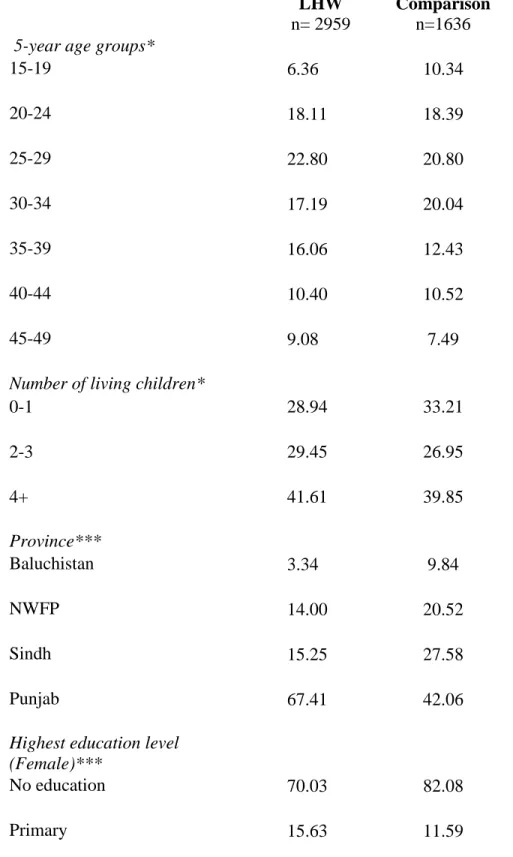
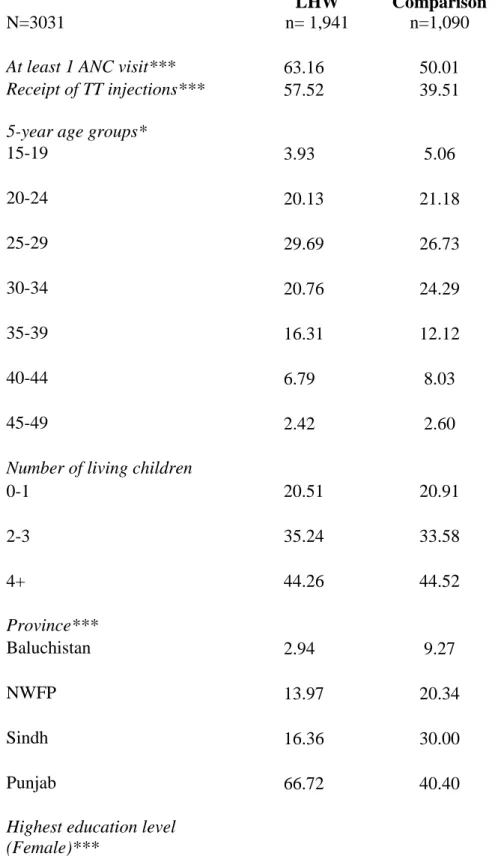
Table 1 provides weighted descriptive statistics for the population served by
LHWs and comparison areas. Overall, women who live in communities with a LHW tend
to be more educated, literate, and wealthier than those not exposed to LHW. The age
distribution of women was relatively similar between women exposed to LHW and those
who were not. There were small differences in the number of living children between
served and comparison areas for women with 0-1 living children. A greater portion of
women served by LHWs live in the most developed province of Punjab (67.4%) and have
higher levels of education compared to their counterparts. Nonetheless both populations
have very high proportions of women who have no education (70.0% vs. 82.1%).
However, women in LHW areas were significantly more literate than women in
comparison areas. In the LHW area, women’s partners are significantly more educated at
secondary and higher-levels compared to the comparison areas. Likewise, a greater
portion of women living in served areas are located closer to family planning centers,
private providers, maternal health centers and basic health units compared to comparison
areas. There are also significant differences in structural characteristics of communities in
both areas. A greater portion of populations in LHWs areas compared to comparison
34
located in the village (26.7% vs. 7.4%), telephone line service (71.6% vs. 44.8%), post
office (42.0% vs. 10.0%) and paved roads (82.0% vs. 78.3%).
Table 2 describes family planning characteristics for ever-married women who
live in program and comparison areas. Approximately 12.8% of women living in program
areas were using modern reversible conceptive methods compared to 8.0% of women in
comparison areas. A large proportion of women in both the LHW (79.4%) and
comparison (86.8%) areas are not using contraceptives. When asked if women wanted
more children about one-half of women (50.6%) in LHW areas did not want more
compared to 45.2% in comparison areas. Knowledge of modern contraceptives was
relatively high in the served (96.5%) and comparison (91.8%) populations. Finally a
significantly larger proportion of women were exposed to family planning messages on
the radio and television in LHW areas compared to comparison areas.
Factors associated with placement of LHWs
Given that women who were exposed to LHWs appear to be significantly better
off compared their counterparts, a closer examination of the determinants of program
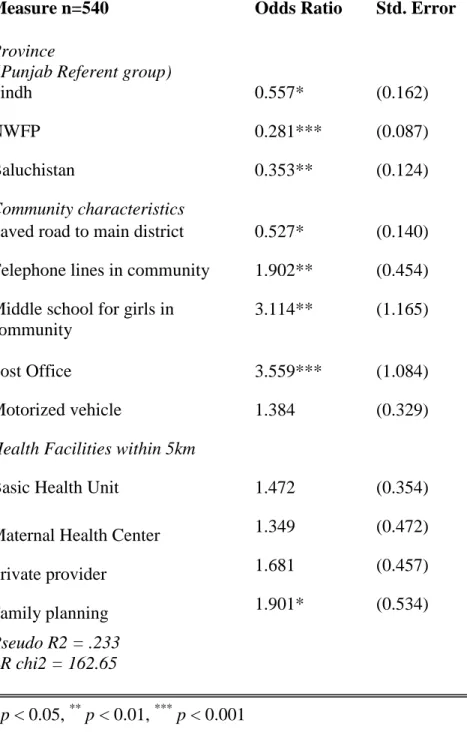
placement through a community-level regression is essential. Table 3 presents odds
ratios from the logistic regression of factors associated with the presence of a LHW in
540 communities. The dependent variable is defined as equal to 1 when a LHW is
present in a community and 0 when an LHW is not present. Data suggests that women
living in Sindh, NWFP, and Baluchistan were significantly less likely to have a LHW
present in a rural community compared to villages in Punjab province. This isn’t terribly
35
extremely remote province of Baluchistan and NWFP (National Institute of Population
2008). Areas with a relatively developed community infrastructures were significantly
more likely to have access to a LHW in their community. The availability of a basic
health unit, maternal and child health center and private provider within 5km were not
statistically significant predictors of placement of the program. However, communities
with an available family planning center within 5km were almost 2 times more likely to
have a LHW present. The most significant predictor of placement of a LHW in rural
communities were the availability of girl’s middle school (OR: 3.11) and a post office
(OR: 3.56). Villages with telephone lines were almost twice (OR: 1.90) as likely to have
access to a LHW as villages without. Although, the two instruments suggested for this
analysis, availability of telephone lines and a middle school within a community are
predictors of the placement of the program, tests for the validity of the instruments can
only be conducted using a simultaneous equation (bivariate probit model).
Testing for Non-random Program Placement
In order examine whether non-random program placement is a significant issue,
the correlation between error terms of Eq.1 and Eq.2 were tested: : E{[ 1i, 2i]}=0.
Results of this test indicated, was statistically significant, with a p=0.01, therefore we
would strongly reject the null hypothesis of exogeneity ( = 0.00) and conclude there is
endogeneity within the model. Thus, utilizing a naïve estimation procedure such as
single-equation regression model or propensity score matching estimators will produce