Outage Performance of Cognitive Radio Networks
under Outage Constraint of Multiple Primary Users
and Transmit Power Constraint of Secondary User
Hung Tran and Hans-J¨urgen Zepernick
Blekinge Institute of Technology
SE-371 41 Karlskrona, Sweden
E-mail:
{
htr, hjz
}
@bth.se
Chan Dai Truyen Thai
Univ Lille Nord de France, F-59000, Lille, IFSTTAR,
LEOST, F-59650, Villeneuve d’Ascq
E-mail: [email protected]
Abstract—In this paper, the outage performance of a cognitive radio network under the joint constraint of multiple primary users (PUs) and a secondary user (SU) is investigated. More specifically, the SU can adjust its transmit power to satisfy the outage probability constraint of multiple PUs and its own transmit power constraint for communication. The adaptive transmit power policy and closed-form expression for the outage probability are derived. On the basis of these formulas, the impact of the channel gains of the PUs and those of the interference links from the PUs to the SU on the performance of the secondary network is evaluated. Especially, our results show a relationship between the number of the active PUs on the licensed frequency bands and the outage performance of the secondary network. Also, the performance of secondary network can be improved by extending the bandwidth over a number of licensed frequency bands.
Index Terms—Outage Performance, Adaptive Transmit Power, Spectrum Underlay, Cognitive Radio Networks, Outage Proba-bility Constraint, Peak Transmit Power Constraint.
I. INTRODUCTION
Traditional wireless networks have used static allocation policies to assign licensed radio frequency bands for mobile users over a large geographical regions. As new wireless services and demands on the bandwidth have increased rapidly in a couple of decades, the frequency bands have become exhausted. It is predicted that the shortage of frequency bands may become more severe in the near future as next wireless generations with high transmission rate services will be im-plemented. Surprisingly, measurement campaigns executed by the Federal Communications Commission (FCC) have shown that most of the allocated spectrum is under-utilized [1]. Hence, cognitive radio networks (CRNs) have been proposed to enhance the spectrum utilization and to keep a sustainable development of wireless technology [2].
Recently, the underlay spectrum approach, one of the spectrum access techniques in the CRN, has obtained great attention [3]–[10]. In this approach, the secondary user (SU) uses its cognitive capability to simultaneously access the licensed frequency of the primary users (PUs) provided that the interference caused by SU does not compromise the PU quality of service (QoS). In particular, in [3]–[6], [10], mul-tiple optimal power allocation polices under peak or average interference power constraints of the PU, and peak or average
transmit power constraints of the secondary transmitter (SU-Tx) when considering fading channels have been studied. In [11], an optimal power allocation for the SU-Tx under the outage constraint of a single PU has been investigated. The results have indicated that substantial capacity gains for the SU can be obtained by using the proposed optimal power policy. Later, in [12], an optimal bandwidth and power allocation for a CRN where multiple SUs access the licensed spectrum of a single PU have been developed. In particular, a closed-form expression for the optimal allocation is derived under the peak and average power constraints imposed by both SU-Tx and primary receiver (PU-Rx). Our previous works in [13], [14], have examined the performance of CRNs under the peak interference power constraint of multiple PUs. These results show that increasing the number of PUs in the proximity of the SU leads to decrease in system performance. However, the effect of the primary links on the performance of the secondary networks has not been considered. Recently, the works of [15], [16] have analyzed the impact of the primary links and the interference from primary networks on the performance of secondary networks. Exact and asymptotic expressions for the outage probability under the peak transmit power and peak interference power constraints of a single PU have been derived. These constraints are also known as short-term interference constraint.
Communication link 1
2
N
SU-Tx
SU-Rx
PU-Tx1 PU-Rx1
PU-Tx2 PU-Rx2
PU-RxN
PU-TxN
Interference link
Fig. 1. System model of a cognitive radio network with a single SU and multiple PUs.
approach in this paper can be extended to study the system performance of cognitive cooperative radio networks (CCRNs) or multiple SUs communication.
The remainder of this paper is structured as follows. In Section II, the system and channel model are introduced. In Section III, the adaptive transmit power strategy under the outage constraint of multiple PUs is investigated. On this basis, the outage probability of the secondary system is derived. In Section IV, numerical results are presented and discussed. Finally, conclusions and future research are presented.
II. SYSTEM AND CHANNEL MODEL
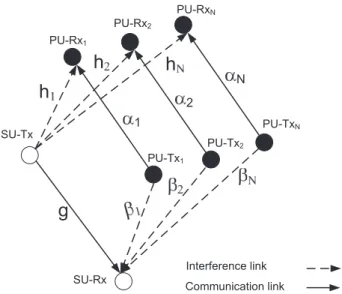
Let us consider a CRN model as shown in Fig. 1 in which the SUs utilize the licensed frequency bands allocated to a number of PUs for their communication. In particular, the
SUs useM licensed frequency bands each of which has the
same bandwidth, B, and only N of M frequency bands,
1 ≤ N ≤ M, are occupied by N pairs of PUs. It should
be noted that the SUs can simultaneously access frequency bands with the PUs as long as the negative effect to the QoS of the PUs is controlled. Fig. 2 shows an example in which the SU spreads its bandwidths over 4 licensed frequency bands while 3 licensed frequency bands are being held by the PUs. The SU-Tx transmit power must be controlled to not excess over a predefined interference threshold given by the PUs.
For mathematical modeling, we denote g and αi as the
instantaneous channel gains of the SU-Tx→SU-Rx and pri-mary transmitter (PU-Tx)i→PU-Rxi communication links, respectively. While the instantaneous channel gains of the SU-Tx→PU-Rxi and PU-Txi→SU-Rx interference links are represented, respectively, by hi and βi,i = 1,2, . . . , N. Ad-ditionally, we assume that all the point-to-point channels un-dergo independent flat Rayleigh fading, i.e., the instantaneous channel power gains are exponentially distributed random variables (RVs). The channel mean powers ofg, αi, βi, andhi
P
o
w
e
r
Frequency Interference Threshold Primary user
Secondary user
1 2 3 4
Fig. 2. The SU utilizes four frequency bands of the PUs.
are denoted byΩg,Ωα,Ωβ, andΩh, respectively. The additive white Gaussian noise (AWGN) at the receivers (SU-Rx and PU-Rx) are RVs having the common distribution CN(0, N0),
i.e., circularly symmetric complex Gaussian variables with
zero mean and variance N0. We further assume that full
channel state information (CSI) is available at the SUs. For example, the CSI of the SU-Tx→SU-Rx link may be obtained by direct feedback from the SU-Rx while the CSI of the SU-Tx→PU-Rxn interference links may be acquired from a band manager of the primary and secondary networks [17], or the secondary network and primary network can cooperate to exchange the CSI by using the approaches given in [18], [19]. Here, we note that the PUs only have the CSI of the primary communication link since the PU communication does not need to take care of the appearance of the SUs.
Subject to the interference from the SU-Tx, the channel capacity of i-th PU communication is formulated as
Ci=Blog2 (
1 + Piαi
PShi+BN0 )
(1)
wherePiandPSdenote the transmit power of the PU-Txiand SU-Tx, respectively. Similarly, the channel capacity of the SU can be expressed as
CS =BSlog2 (
1 + PSg
N
∑
i=1
Piβi+BSN0 )
(2)
whereBS =M B is the bandwidth of the secondary system. Intuitively, the channel capacity of the SU can be improved by increasing its transmit power or increasing bandwidth, i.e., increasing M. Unfortunately, the SU-Tx transmit power is restricted to not cause serious interference to the PUs. Therefore, increasing capacity by utilized bandwidths of the PUs is considered as a feasible approach to improve the performance of the secondary network.
In order to guarantee no PUs are subject to harmful in-terference from the communication of the SU, the transmit power of the SU-Tx should be maintained to satisfy the outage constraint of the PU having the worst capacity given as
PoutP = Pr
{
min
i=1,2,...,N{Ci}< rp
}
≤θth (3)
assumed to be subject to the peak transmit power constraint as
PS ≤Ppk (4)
wherePpk denotes the peak transmit power of the SU-Tx.
III. PERFORMANCE ANALYSIS
In this section, we derive the adaptive transmission power policy and the outage probability for the considered system.
A. Power Control Strategy for the SU-Tx
Assuming that the PU-Txs transmit powers are fixed and identical, i.e., Pi =PP, for i = 1,2, . . . , N, the PoutP in (3)
can be rewritten as
PoutP = Pr
{
min
i=1,2,...,N
{
PPαi
PShi+BN0 }
≤γth
}
(5)
whereγth= 2rp/B−1. Because the channel power gains,αi andβi, are independent RVs, we can apply the order statistics theory to (5) as
PoutP = 1−
N
∏
i=1
(
1−Pr
{
PPαi
PShi+BN0 ≤γth
}
| {z }
Po
)
(6)
On the other hand, the probability Po given in (6) can be derived as
Po=
∞
∫
0
Pr
{
PPαi
PSx+BN0 ≤γth
}
| {z }
P1
fhi(x)dx (7)
where
fhi(x) =
1 Ωh
exp
( − x
Ωh
)
(8)
P1= 1−exp (
−γth(PSx+BN0)
PPΩα
)
(9)
Substituting (8) and (9) into (7), we obtain
Po= 1−
PPΩα
PPΩα+γthPSΩh
exp
(
−γthBN0
PPΩα
)
(10)
Moreover, substituting (10) into (6), we can rewrite (3) as
PP out = 1−
[
PPΩα
PPΩα+γthPSΩh
exp
(
−γthBN0
PPΩα
)]N
≤θth (11)
Consequently, the maximal transmit power of the SU-Tx can be obtained from (11) as
PS =
PPΩα
γthΩh
χ (12)
whereχ= max
{
0, N√11−θ th exp
(
−γthBN0
PPΩα
) −1
}
.
Eventually, the SU-Tx transmit power policy for the con-sidered system model can be obtained by combining (12) with (4) as
P = min
{
PPΩα
γthΩg
χ, Ppk }
(13)
B. Outage Probability of the Secondary Network
On the basis of the identical transmit power of the PU-Tx and the SU-Tx transmit power strategy given by (13), we can derive the outage probability of the secondary network as
PoutS = Pr{CS< rs}= Pr
{
gP PP
N
∑
i=1
βi+BSN0 ≤µth
}
(14)
wherersis the outage threshold of the secondary network and
µth= 2rs/BS−1. Moreover, the outage probability,PoutS , can
be expressed as
PoutS = ∞
∫
0
Pr
{
g≤ µth
P (PPx+BSN0) }
fX(x)dx (15)
whereX =∑Ni=1βi. Becauseβi,i= 1,2, . . . , N are identi-cally independent distributed (i.i.d.) exponentially distributed RVs with mean value Ωβ, the probability density function (PDF) fX(x)can be formulated following [20, P. (291)] as
fX(x) =
xN−1
ΩN
βΓ(N)
exp
( − x
Ωβ
)
(16)
Also, since gis an exponential RV, we have
Pr
{
g≤ µth
P (PPx+BSN0) }
= 1−exp
{ −µth
PΩg
(PPx+BSN0) }
(17)
Substituting (16) and (17) into (15), the outage probability of the SU is eventually obtained as
PoutS = 1− 1 ΩN
βΓ(N)
exp
{
−µthBSN0 PΩg
}
× ∞
∫
0
xN−1exp
{ −x
(
µthPP
ΩgP
+ 1 Ωβ
)}
dx
= 1− 1
(1 +PPΩβ
PΩg µth)
N exp
{
−µthBSN0 PΩg
}
(18)
From (18), we reach to the following observations:
• If N is fixed and M is very large (M → ∞), then
µth = 2
rs
M B −1 → 0 and as a result PoutS → 0. This
means that the system performance will be improved if the bandwidth increases and the appearance of the PUs on the licensed radio frequency bands is limited.
• If M is fixed, i.e. BS =M B is fixed and N increases to M, then χ in (13) decreases due to N√11−θ
th
being decreased. Accordingly, the SU-Tx transmit power, P, will decrease and PS
out increases. This reveals that the
-6 -5 -4 -3 -2 -1 0 1 2 3 4 5 6 10
-3
10
-2
10
-1
10
0
Ana., P pk
= 10 dB
g =1, = =
h =2 Sim.
g =2, = =
h =2 Sim.
g =4, = =
h =2 Sim.
M=8, N=3
O
u
t
a
g
e
P
r
o
b
a
b
i
l
i
t
y
PU-Tx Transm it Power, P
P
(dB)
Ana., P pk
= 4 dB
g =1, = =
h =2 Sim.
g =2, = =
h =2 Sim.
g =4, = =
h =2 Sim.
Fig. 3. Outage probability of the secondary network with different values of channel mean powers of the primary linksΩg= 1,2,4.
IV. NUMERICAL RESULTS
To examine the system performance, let us set the system
parameters as follows: SU-Tx peak transmit power Ppk =
4,10dB, outage transmission rate for the SUrs= 0.02bit/s, outage transmission rate for the PU rp = 0.02 bit/s, outage constraint of the PUsθth= 0.2, and bandwidthB andN0are
normalized to 1.
Fig. 3 plots the outage probability of the secondary network for different values of channel mean powers of the primary links, Ωα = 1,2,4, the number of active PUs N = 3, and the number of licensed frequency bandsM = 8. The outage probability degrades as the channel mean powerΩαincreases, i.e., the channel condition of the PUs communication links is improved. This leads to an increasing of the signal-to-noise ratio (SNR) at the PU-Rxs. Hence, the capacity of the PUs is improved, i.e., the outage probability of the PUs is degraded. Accordingly, the SU-Tx can utilize the channel condition of the PUs to increase its transmit power without causing the outage probability of the PUs to exceed the given outage threshold. As a result, the performance of the secondary network is improved. Additionally, we also observe that the outage probability firstly decreases asPP increases to a specific value, e.g.3 dB, and it increases rapidly asPP >3 dB. In the view of (13), the SU-Tx can adjust its transmit power following the change of channel condition and the PU-Tx transmit power. However, if the PU-PU-Tx transmit power increases beyond a certain value, e.g.,PP >3dB, the SU-Tx cannot adapt to this change due to its limitation of the peak transmit power. As a consequence, the PU-Txs transmit power may cause severe interference to the SU, and the performance of secondary network is degraded.
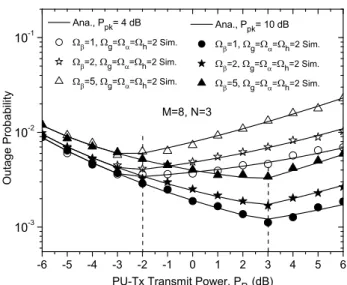
Fig. 4 shows the impact of different channel mean powers of the interference links PU-Txs→SU-Rx, i.e., Ωβ = 1,2,5, on the outage performance. As expected, when the channel
mean powers of the PU-Tx→SU-Rx interference links
in--6 -5 -4 -3 -2 -1 0 1 2 3 4 5 6
10
-3
10
-2
10
-1
Ana., P pk
= 10 dB
=1, g
= = h
=2 Sim.
=2 g
= = h
=2 Sim.
=5 g
= = h
=2 Sim.
M=8, N=3
O
u
t
a
g
e
P
r
o
b
a
b
i
l
i
t
y
PU-Tx Transm it Power, P
P
(dB)
Ana., P pk
= 4 dB
=1, g
= = h
=2 Sim.
=2 g
= = h
=2 Sim.
=5 g
= = h
=2 Sim.
Fig. 4. Outage probability of the secondary network with different values of channel mean powers of the interference link PU-Tx→SU-Rx,Ωβ= 1,2,5.
-6 -5 -4 -3 -2 -1 0 1 2 3 4 5 6
10
-2
10
-1
10
0
M=6
Ana., P
pk
=10 dB
N=2, Sim .
N=4, Sim .
N=6, Sim . Ana., P
pk
=4 dB
N=2, Sim .
N=4, Sim .
N=6, Sim .
O
u
t
a
g
e
P
r
o
b
a
b
i
l
i
t
y
PU-Tx Transm it Power, P
P
(dB)
Fig. 5. Outage probability of the secondary network with different number of active PUsN= 2,4,6on the licensed frequency bands andΩα= Ωβ=
Ωh= Ωg= 2.
creases, the outage probability increases. Because the SU-Rx is subject to more interference from the PU-Txs as Ωβ increases. Accordingly, the capacity of the secondary network is decreased, resulting in the increase in the outage probability of the secondary network.
2 4 6 8 10 12 14 16 10
-3
10
-2
10
-1
10
0
Ana., P
pk
=10 dB
P
P
=4 dB, Sim.
P
P
=8 dB, Sim.
P
P
=10 dB, Sim.
O
u
t
a
g
e
P
r
o
b
a
b
i
l
i
t
y
Num ber of Lincensed Frequency Bands, M Ana., P
pk
=4 dB
P
P
=4 dB, Sim.
P
P
=8 dB, Sim.
P
P
=10 dB, Sim.
Num ber of PUs, N=2
Fig. 6. Outage probability of the secondary network as a function of the number of licensed frequency bands withPpk= 4,10dB andΩα= Ωβ =
Ωh= Ωg= 2.
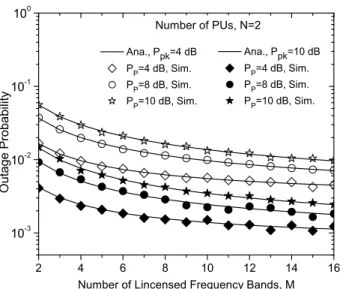
Fig. 6 displays the outage probability as a function of the number of licensed frequency bands M for different values of PU transmit powers,PP = 4,8,10 dB and the number of
active PUs being N = 2. We can observe from the figure
that the outage probability increases rapidly as the PU-Tx transmit powerPP increases. Moreover, the outage probability decreases significantly as the number of radio frequency bands increases, i.e., the bandwidth of the SU increases. Clearly, the performance of the secondary network can be improved by increasing the bandwidth. However, if the number of active PUs increases, the performance of the secondary network will be degraded.
V. CONCLUSIONS
In this paper, we have studied the performance of a CRN under the joint outage constraint of multiple PUs and peak transmit power constraint of the SU-Tx. The adaptive transmit power policy for the SU-Tx and closed-form expression for the outage probability have been derived. These formulas allow us to analyze the impact of the channel conditions of
the PU-Tx→PU-Rx and PU-Tx→SU-Rx links on the system
performance. More importantly, our results indicated that the performance of the CRN can be improved by increasing the bandwidth over a number of licensed frequency bands. However, the performance of the CRN will be degraded sig-nificantly if the number of active PUs increases. The analysis in this paper can be extended to investigate the performance of CCRNs or multiple access channels. In future research, optimal bandwidth allocation for uplink and downlink com-munication in CRN under the outage constraint of multiple PUs are interesting problems.
REFERENCES
[1] Spectrum Policy Task Force Report, TR 02-155, Federal Communications Commission (FCC), Nov. 2002.
[2] S. Haykin, “Cognitive radio: Brain-empowered wireless communica-tions,”IEEE J. Sel. Areas Commun., vol. 23, no. 2, pp. 201–220, Feb. 2005.
[3] X. Kang, Y.-C. Liang, A. Nallanathan, H. Garg, and R. Zhang, “Opti-mal power allocation for fading channels in cognitive radio networks: Ergodic capacity and outage capacity,”IEEE Trans. Wireless Commun., vol. 8, no. 2, pp. 940–950, Feb. 2009.
[4] S. Stotas and A. Nallanathan, “Enhancing the capacity of spectrum sharing cognitive radio networks,”IEEE Trans. Veh. Technol., vol. 60, no. 8, pp. 3768–3779, Oct. 2011.
[5] L. Musavian and S. Aissa, “Quality-of-service based power allocation in spectrum-sharing channels,” inProc. IEEE Global Communications Conference, New Orleans, U.S.A., Dec. 2008, pp. 1–5.
[6] A. Ghasemi and E. S. Sousa, “Fundamental limits of spectrum-sharing in fading environments,”IEEE Trans. Wireless Commun., vol. 6, no. 2, pp. 649–658, Feb. 2007.
[7] J. Hong, B. Hong, T. W. Ban, and W. Choi, “On the cooperative diversity gain in underlay cognitive radio systems,”IEEE Trans. Wireless Commun., vol. 60, no. 1, pp. 209–219, Jan. 2012.
[8] H. Suraweera, P. Smith, and M. Shafi, “Capacity limits and performance analysis of cognitive radio with imperfect channel knowledge,”IEEE Trans. Veh. Technol., vol. 59, no. 4, pp. 1811–1822, May 2010. [9] H. Wang, J. Lee, S. Kim, and D. Hong, “Capacity of secondary users
exploiting multispectrum and multiuser diversity in spectrum-sharing environments,”IEEE Trans. Veh. Technol., vol. 59, no. 2, pp. 1030– 1036, Feb. 2010.
[10] L. Musavian and S. Aissa, “Capacity and power allocation for spectrum-sharing communications in fading channels,” IEEE Trans. Wireless Commun., vol. 8, no. 1, pp. 148–156, Jan. 2009.
[11] X. Kang, R. Zhang, Y.-C. Liang, and H. K. Garg, “Optimal power allocation strategies for fading cognitive radio channels with primary user outage constraint,”IEEE J. Sel. Areas Commun., vol. 29, no. 2, pp. 374–383, Feb. 2011.
[12] X. Gong, S. Vorobyov, and C. Tellambura, “Optimal bandwidth and power allocation for sum ergodic capacity under fading channels in cognitive radio networks,”IEEE Trans. Signal Process., vol. 59, no. 4, pp. 1814–1826, Apr. 2011.
[13] H. Tran, T. Q. Duong, and H.-J. Zepernick, “Performance analysis of cognitive relay networks under power constraint of multiple pri-mary users,” inIEEE Global Telecommunications Conference, Houston, U.S.A., Dec. 2011, pp. 1–6.
[14] ——, “Delay performance of cognitive radio networks for point-to-point and point-to-multipoint communications,”EURASIP Journal on Wireless Communications and Networking, vol. 2012, no. 1, 2012.
[15] T. Q. Duong, V. Bao, H. Tran, G. Alexandropoulos, and H.-J. Zepernick, “Effect of primary network on performance of spectrum sharing AF relaying,”Elec. Lett., vol. 48, no. 1, pp. 25–27, May 2012.
[16] W. Xu, J. Zhang, P. Zhang, and C. Tellambura, “Outage probability of decode-and-forward cognitive relay in presence of primary users interference,” vol. 48, no. 1, pp. 1–4, Apr. 2012.
[17] J. Peha, “Approaches to spectrum sharing,” IEEE Personal Commun. Mag., vol. 43, no. 2, pp. 10–12, Feb. 2005.
[18] A. Jovicic and P. Viswanath, “Cognitive radio: An information-theoretic perspective,” in Proc. IEEE International Symposium on Information Theory, Seattle, U.S.A., Jul. 2006, pp. 2413–2417.