Mathematics Senior Level Capstone Course
Unit Overview
Title of Unit: Senior Trip Unit Designers:
Stephanie Brady, Michelle Rittenhouse, Marianne Veitch Hanover County Public Schools
Steve Gregorin, Lauren Noehl York County Public Schools
Editor:
Diane Leighty
UVA-SCPS Office of Mathematics Outreach
Context:
Summary of the issue, challenge, investigation, or problem.
Many students travel to exotic locations after they graduate from high school. Location, cost, and many other factors are necessary to consider when
planning a trip. Students will investigate these components for a major destination and will present their findings.
Number of Class
Hours: 7 blocks (90 minutes each)
Unit
Design: ___Task Based
_X_Project Based
Other Subject Areas/Disciplines Addressed:
Geography, tourism/vacation planning, research, personal/international finance
Driving Question: Can you make a presentation to your parents so compelling that they will be willing to pay for you to take an amazing senior trip?
Mathematics Content Addressed:
Proportions, percent, regression function, slope, volume, surface area MPE Addressed:
Area & volume, Graph interpretation and representation, Optimization, Problem solving, Data analysis Assumption of Prior
Knowledge:
Area, volume and surface area applications, calculating percentages and ratios, creating pie graphs, determining curve of best fit, converting measurements, radius, slope, arc length of circles.
College and Career
Skills to be (T) during this unit or expectation (E) for student use during this unit and assessed (A):
Communication (Oral and/or Written) – oral presentations for task and project and written work
T & A Technology – graphing calculator, internet research, PowerPoint
T & A
Critical Thinking/Decision Making – E & T Other: (Describe)
Major Products and/or Performances:
Group: Students research and answer questions about landmarks.
Presentation Audience:
X Class
School Individual: Students make a persuasive presentation
(teacher/student discretion with mode of presentation-PowerPoint, movie, etc) to their parents that explain the expenses and travel involved in a senior trip.
Expert Community
X Other: Parents/Guardian
Launch: Event or experience used to engage the students interest and inquiry:
Researching famous landmarks or architecture in the five given cities and discussing with students which they would like to visit. Video previews of the cities:
1) Cape Town “Air Jaws” flying sharks - http://www.youtube.com/watch?v=iCz4B3X_Gk0&feature=related Table Mountain Challenge 2007 - http://www.youtube.com/watch?v=JVWHpMuBvYY
or students could also run a relay outside on track or other hills in area
2) Near Tokyo, live feed from camera on Mt. Fuji: http://www.fujigoko.tv/live/camera.cgi?n=13&t=14&b= http://factsanddetails.com/japan.php?itemid=982&catid=25&subcatid=165
Visiting Tokyo, http://www.youtube.com/watch?v=Z49K6FzfptI
3) Cancun, Mayan Pyramids of Chichen Itza - http://www.youtube.com/watch?v=kyvw6G9Max0 4) Paris, Top Ten Things to Do - http://www.youtube.com/watch?v=kNB3_ovj8p8
5) Sydney, Stunning Sites - http://www.youtube.com/watch?v=nTthD9oecSk
Video clip to introduce Currency Exchange Rates:
6) Assignment Discovery: Currency Exchange - http://videos.howstuffworks.com/discovery/28735-assignment-discovery-currency-exchange-video.htm
Note: You may need to use Real Player or other software to download the videos to your computer for showing if your school district blocks access to these websites.
Preliminary
Plans/Outlines/Prototypes
Checklists X
Rough Drafts X Concept maps
Field Tests Other:
Summative Assessment (End of Project)
Written Products, with a rubric Peer Evaluation X
Oral Presentation with a rubric X Self-Evaluation X Other Product(s) or
Performance(s), with a rubric
X Other: Parent Evaluation
X
Resources Needed: On-site people, facilities: Computer lab or laptops for a few blocks.
Equipment/Technology: Computers and scientific calculators
Materials: Handouts
Community Resources: Parent or other adult to present to
Reflection Methods: Individual, Group, and/or Whole Class
Mathematicians Journal X Small/Focus Groups X Whole Class Discussions X Fishbowl Discussions
Survey Other:
Material Adapted From:
Virginia’s Senior Level Capstone Course Instructional Plan
Unit Title: Senior Trip
Driving Question: Can you make a presentation to your parents so compelling that they will be willing to pay for you to take an amazing senior trip?
Task/Project/Problem: Many students travel to exotic locations after they graduate from high school. Location, cost, and many other factors are necessary to consider when planning a trip. Students
investigate these components for a major destination and present their findings.
ENGAGE
Number of hours:
5 min introduction
25- 40 min group work 30 min presentation and discussion 5-30 min depending on how many video clips are used
Prior to unit starting, students receive HO#1A to pre-assess prior knowledge and HO#1B to refer students to appropriate resources to review these topics.
To begin the unit, teacher hands out the calendar HO#2 and discusses upcoming unit objectives with the class.
Engage #1: Architecture/Landmark Activity:
In this activity students explore the mathematics in prominent landmarks in five predetermined cities. This activity educates the students on the cities they research in the overall project, as well as reviewing several math topics.
Materials: HO#3A through HO#3E, landmark video clips
Introduction: The teacher explains the overall project and introduces the five chosen cities: Cancun, Mexico; Cape Town, South Africa; Paris, France; Sydney, Australia; and Tokyo, Japan.
The teacher can show one or more video clips before the Architecture/Landmark Activity to promote interest, or after the activity as a follow-up to the whole class discussion of the cities.
Students are divided into five groups and each group is given one of the Architecture handouts (HO#3-A through HO#3-E). If the groups are too large, students could be divided into groups of 3, with the possibility of some groups getting the same handout. Students work in groups to answer the posed questions on their handout. The teacher circulates among the groups to provide guidance as needed.
Product: Once groups are finished, the teacher asks each group to share their results with the class. Each group can verbally present their city, the landmark, the math that was required, and their solutions to the questions or they can write their information on chart paper and post the solutions around the room for each group to “visit” and ask questions. The teacher may wish to provide all students with a copy of each handout.
Mathematician Journal Prompts –
What is the farthest trip you have taken? What things did you see?
Where in the world would you like to visit? Why?
Peer Evaluation: Is your group’s work equal to your own? What part have they done?
Students and teacher use this opportunity to discuss what they already know about a particular city, what their perceptions are, and why each city would be fun to visit. Avoid asking students to choose a city to visit, because their personal travel decisions will be made in the next activity. .
Landmark Video clips:
1) Cape Town “Air Jaws” flying sharks -
http://www.youtube.com/watch?v=iCz4B3X_Gk0&feature=related or Table Mountain Challenge 2007 -
http://www.youtube.com/watch?v=JVWHpMuBvYY
or students could also run a relay outside on track or other hills in area
2) Near Tokyo, live feed from camera on Mt. Fuji: http://www.fujigoko.tv/live/camera.cgi?n=13&t=14&b=
http://factsanddetails.com/japan.php?itemid=982&catid=25&subcat id=165
or Visiting Tokyo,
http://www.youtube.com/watch?v=Z49K6FzfptI 3) Cancun, Mayan Pyramids of Chichen Itza - http://www.youtube.com/watch?v=kyvw6G9Max0 4) Paris, Top Ten Things to Do -
http://www.youtube.com/watch?v=kNB3_ovj8p8 5) Sydney, Stunning Sites -
http://www.youtube.com/watch?v=nTthD9oecSk
Engage #2: Currency Exchange Rates
Teacher may choose to show a short video about exchange rates to capture student interest. Then, discuss what students already know about different countries and their currency.
Currency Video clip:
6) Assignment Discovery: Currency Exchange -
http://videos.howstuffworks.com/discovery/28735-assignment-discovery-currency-exchange-video.htm
Move to Exploration 1: Currency Exchange Rates.
SelfEvaluation: -Are you
working equal to your peers? What part have they done? Have you offered suggestions? What are they?
EXPLORE
Number of hours:
Exploration 1: 90 minutes
Exploration 1: Currency Exchange Rates
The goal of this activity is to teach students to use the internet effectively to find data about topics of interest. Students use internet research as the basis forcreating or using mathematical models.
Materials: HO#4A, computers with internet access for students
Mathematician Journal Prompts
Exploration 1: Is one
75 minutes
Exploration 3: 45 minutes in class.
Students may need time outside of class to finish.
internet to find a website which tracks and describes currency exchange rates. Students complete the handout individually.
The teacher monitors the student use of search engines, and results, as this activity includes explicit instruction in research methods on the internet.
Once the activity is completed, the teacher engages the students in discussion about the reliability of internet sources. What types of sources are considered reliable for this kind of information? Would we rather see .com, .gov, .org, .edu, etc.? What are some reliable sources of general information? How do you know how old the information is when you see it on the internet? Does the age of the information matter in a case like this?.
Product: Students complete HO#4A individually or with a partner.
Once HO#4A and discussions are complete, continue with Explain #1: After Currency Exchange Rates.
Exploration 2: Round-trip Airfare
The goal of this activity is to allow students to use what they have learned in Exploration 1 about guided internet research to find and analyze data about airfares.
Materials: HO#4B, computers with internet access for students
Instructions: Using HO#4B, the students work in pairs to find the data and answer the questions. There are a few pieces of
information that the teacher must provide, to ensure consistency among the class results. Teacher will give the class the dates of the trip (one week in the upcoming summer) and the departing airport (closest to their current location). While the students work, teacher monitors internet activity and encourages students to check a variety of travel websites.
Once the activity is complete, teacher leads class discussion about what airfare packages they found. Who found the lowest prices? Which city cost the most to travel to? Was there a website that was consistently used to find the best airfare? Were taxes and fees included in these prices?
Product: Students complete HO#4B in pairs
Once HO#4B and discussions are complete, continue with Explain 2: After Round Trip Airfare.
Exploration 3: Choosing Your City
evenly, or can they be used to buy the same the things?
What is an exchange rate? How often does it change? Is the change predictable? Is the change constant? How can you think about, or model, how exchange rates change?
Exploration 2: What is more important to you, trip time or airfare cost? Would a long layover deter you from purchasing an airfare package?
Exploration 3: Why did we do this?
mathematical tools to make informed and logical decisions. After the teacher explains HO#5A the students are ready to complete their own decision matrix.
Materials: HO#5A, HO#5B, projector or overhead, computers with internet access for students
Instructions: Students select two additional criteria (criteria 4 and 5) upon which to evaluate the cities mathematically. The teacher can suggest sample criteria such as climate, crime rates, cost of food or entertainment, travel alerts, etc. Students independently research two criteria of their choosing and record their findings on their own paper as described in HO#5B.
Teacher monitors computer activity, but refrains from providing too much direction or guidance. This activity is designed to identify individual student preferences, and may be finished outside of class if necessary.
Product: Students complete HO#5B individually based on their work and share their conclusions with the class.
Once HO#5B and discussions are complete, continue with Explain 3: After Choosing Your City.
EXPLAIN
Number of Hours:
Explain 1: 15 min
Explain 2: 45 min
Explain 3: 10 min
Explain 1: After Currency Exchange Rates
After a follow-up discussion of HO#4A, the teacher introduces the next task for the students and prepares them to work in pairs to analyze a second type of data.
Distribute HO#4B and direct students to use the skills learned in Exploration 1 to find and analyze data about airfares.
Put students in pairs, each with a computer with internet access. Explain that in pairs, each student will be responsible for checking different websites as explained on the handout. Once the research is completed, pairs will compare the results for each city. As a pair, decide which airfare package you will choose and record the details on the handout.
Students now begin working on Exploration 2: Round-trip Airfare.
Explain 2: After Round-trip Airfare
After a follow-up discussion of HO#4B, the teacher introduces the next task for the students and prepares them to work individually to choose their city with a decision matrix.
Mathematician Journal Prompts:
Explain 3: What city did you choose and why?
What math do you anticipate using?
handout for the class. Teacher uses this handout to explain to the class how different cities can be ranked by weighting certain criteria. At teacher discretion, use as much or as little of the handout as necessary to make sure the weighting process is clear to the students.
Students now begin working on Exploration 3: Choosing Your City.
Explain 3: After Choosing Your City
The students use their chosen city for their Senior Trip Project. Students now begin working on Elaborate: Designing Your Own Senior Trip.
ELABORATE
The students are working independently with teacher consultations.
Number of Hours:
3 hours, students may need time outside of class to finish.
Designing Your Own Senior Trip
This can be done individually or with another person who had similar results thus far.
The goal of this activity is to allow students to use what they have learned in the previous Explorations to research and analyze data about their chosen city and justify their choice to their parents or to a group of adults
Materials: HO#6, HO#7, HO#8, computers with internet access for students
Instructions: Teacher distributes all three handouts and clarifies the instruction included on each. Students work individually, or with a partner, on the presentation of their chosen city.
While students work, teacher monitors internet activity and answers questions as necessary. Teacher reminds students to refer to project calendar for time management.
Product: Students may choose to present their senior trip via
PowerPoint, videos, posters, etc. at teacher discretion. Students will first present project to their parents (or a panel of adults) for
evaluation, and then to the teacher or class at teacher discretion.
Mathematician Journal Prompts:
EVALUATE
Students submit
products/make presentations
Number of Hours:
1 hour
Student media presentation of the Senior Trip Project that justifies their chosen trip.
Materials: HO#9, HO#10
Completion of:
1) Parent/Panel evaluation form
2) self-assessment and peer assessment as appropriate
Mathematician Journal Prompts
Map the Unit
What do students need to know and be able to do to complete the task/project/problem
successfully? How and when will they assess their own necessary knowledge and skills? How will they remediate their own gaps or weaknesses in knowledge and skills? Look at each major task for the unit and analyze the tasks necessary to produce a high-quality product.
Task:
KNOWLEDGE AND SKILLS NEEDED Assumed already learned
Students will self-assess
Will be taught during the unit
1. Areas/volume/surface area X X
2. Percent/ratios X X
3. Pie graphs X X
4. Curve of Best fit X X
5. Conversions X X
6. Radius/Circles X X
7. Slope X X
8. Research X
9. Oral presentation X
10. Decision making X
11.
What project tools will student’s use? Know/need to know lists Daily goal sheet
X Mathematician’s Journals Briefs/Memos
X Task lists
X Planning Calendar
□ ________________________________ □ ________________________________ □ ________________________________ □ ________________________________ □ ________________________________ □ ____________________ ___________
HO #1A
Name:______________________ Date:_____________________
Pre-Project Self-Assessment
1. A fireman places a 15 foot ladder 7 feet away from an apartment building. The other end rests against the building next to a window of scared kids. How high up is the window?
2. A matted photo frame that is 16”x20” has a matte that is 3” wide on each side. a) What size picture fits inside the matte?
b) What is the area of just the matte?
3. Convert 3.2 miles to feet.
4. Convert 2 ¼ hours to seconds.
5. Convert $15 to nickels.
6. During a football game, Joey started at the opposing team’s 20 yard line and ran the ball to the 50 yard line in 2 seconds. Joey hands off the ball to his teammate, Tony, who has 3 seconds to make a touchdown. Tony can run at a rate of 6 miles per hour.
a) How fast was Joey running?
b) Will Tony make the touchdown in time?
7. A can of soup is 2.4 inches in diameter and 4 inches tall. a) What is the volume?
b) What is the surface area?
9. A model of a house has a 6” x 3” pool. The model is a scale of 1.75 feet per inch. What is the actual length and width of the pool?
10.Ashley bought the following groceries: apples $1.65, crackers $2.10, milk $3.16, and eggs $1.98. a) What is the sub total?
b) If sales tax is 15%, what is her total with tax?
11.First, plot the points in the table on the coordinate plane below. a) Then, find the equation for the line of best fit.
b) Is it a linear or quadratic regression?
12. A pyramid has a height of 8 inches, base of 12 inches, and side angle of 20°. a) What is the area of the base?
b) What is the surface area of the pyramid?
c) What is the length of one of the edges?
13. A circle has a radius of 5 cm.
a) What is the area if the circle (don’t forget units)?
b) What is the circumference?
Name: ANSWER KEY Date:_____________________
Pre-Project Self-Assessment
1. A fireman places a 15 foot ladder 7 feet away from an apartment building. The other end rests against the building next to a window of scared kids. How high up is the window?
16.6 ft
2. A matted photo frame that is 16”x20” has a matte that is 3” wide on each side. a) What size picture fits inside the matte?
14” x 12”
b) What is the area of just the matte? 152 in2
3. Convert 3.2 miles to feet. 16,896 ft
4. Convert 2 ¼ hours to seconds. 8100 sec
5. Convert $15 to nickels. 300 nickels
6. During a football game, Joey started at the opposing team’s 20 yard line and ran the ball to the 50 yard line in 2 seconds. Joey hands off the ball to his teammate, Tony, who has 3 seconds to make a touchdown. Tony can run at a rate of 6 miles per hour.
a) How fast was Joey running? 1/15 yd per sec
b) Will Tony make the touchdown in time? no
7. A can of soup is 2.4 inches in diameter and 4 inches tall. a) What is the volume? 18.1 in3
b) What is the surface area? 39.21 in2
9. A model of a house has a 6” x 3” pool. The model is a scale of 1.75 feet per inch. What is the actual length and width of the pool? 10.5’x5.25’
10. Ashley bought the following groceries: apples $1.65, crackers $2.10, milk $3.16, and eggs $1.98. a) What is the sub total? $8.89
b) If sales tax is 15%, what is her total with tax? $10.22
11. First, plot the points in the table on the coordinate plane below. a) Then, find the equation for the line of best fit.
y = 1.1x + 9.9
b) Is it a linear or quadratic regression?
linear
12. A pyramid has a height of 8 inches, base of 12 inches, and side angle of 20°. a) What is the area of the base?
A = 144 in2
b) What is the surface area of the pyramid? SA = 384 in2
c) What is the length of one of the edges? L = 10 in
13. A circle has a radius of 5 cm.
a) What is the area if the circle (don’t forget units)? A = 78.5 cm2
b) What is the circumference? C = 31.4 cm
HO #1B
Resources and Tutorials for Students
Pythagorean Theorem:
http://www.mathsisfun.com/pythagoras.html http://www.youtube.com/watch?v=0HYHG3fuzvk
Converting:
http://www.convert-me.com/en/
http://www.khanacademy.org/video/converting-units-of-length?playlist=Developmental%20Math http://www.khanacademy.org/video/converting-yards-into-inches?playlist=Developmental%20Math
Area/Volume:
http://math.about.com/library/blmeasurement.htm
http://www.ehow.com/how_5098947_solve-volume.html http://www.youtube.com/watch?v=JijhDDJvExo
http://www.youtube.com/watch?v=-_HxRZ4keTU&feature=related
Percent:
http://en.wikipedia.org/wiki/Percentage
http://www.khanacademy.org/video/taking-percentages?playlist=Algebra
Coordinate Plane:
http://www.learningwave.com/lwonline/algebra_section2/alg_coord.html
http://www.khanacademy.org/video/the-coordinate-plane?playlist=ck12.org%20Algebra%201%20Examples
Circles:
HO #2
Name:______________________ Date:____________________
Senior Trip Project Calendar
U N I T C A L E N D A R
TITLE: Senior Trip Time Frame: 7 blocks (90 minutes each)
D a y 1 D a y 2 D a y 3 D a y 4 D a y 5
P R O J E C T W E E K O N E
Notes
Pre-assessment Discussion
Engage 1: Architecture/ Landmark Activity (90 min)
Engage 2:
Currency exchange Rates (10)
Exploration 1: Currency exchange Rates (80)
Explain 1: After Currency Exchange Rates (15)
Exploration 2:
Round-Trip Airfare (75)
Explain 2:
After Round-Trip Airfare (45)
Exploration 3:
Choosing Your City (45)
Explain 3:
After Choosing Your City (10)
Elaborate:
Designing Your Own Senior Trip (80)
D a y 6 D a y 7
P R O J E C T W E E K T W O
Notes
Elaborate:
Designing Your Own Senior Trip (90)
HO #3A
Group Names ____________________________ Date: __________________
Cancun, Mexico
Your group is considering a visit to Cancun, Mexico. In addition to the resorts and the beaches, there are many significant archaeological sites of ancient civilizations nearby. One of the most powerful cities of the Mayan civilization is Chichen Itza, established between the 9th and 12th centuries.
The Temple of Kukulkan, also known as El Castello, is at the center of Chichen Itza and is one of the most recognized and visited ancient structures in Mexico. The pyramid is made up of square terraces with staircases up each of the four sides to a temple on top. As of 2007, the city of Chichen Itza is now included as one of the new Seven Wonders of the World.
1) The base of El Castello is a square. Use the Pythagorean Theorem to find the hypotenuse of the right triangle created by the base, the altitude, and the side of the pyramid. This is called the slant height.
2) Assume El Castello is the shape of a perfect pyramid. In meters, what is the area of the base? What is the area of one of the triangular sides (remember to use the slant height)? What is the total surface area of the pyramid?
3) Each side has 91 steps. How many total steps does the pyramid have? Some historians count the temple at the top as one additional step. Now how many steps are there total? What do you think this could correspond to?
4) Why do you think the shape of a pyramid was used to elevate the temple on top?
HO #3B
Group Names ____________________________ Date: __________________
Cape Town, South Africa
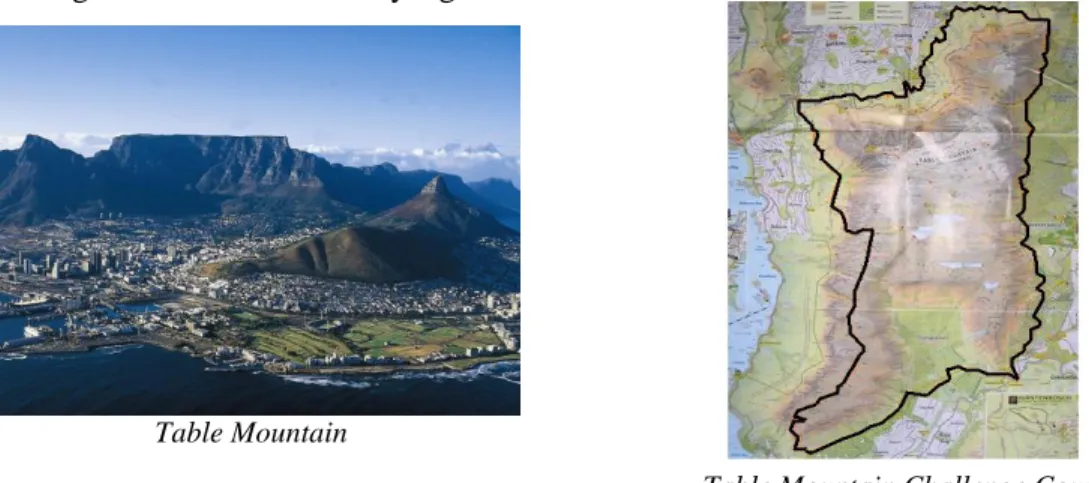
Your group is considering a visit to Cape Town, South Africa. In addition to experiencing the African culture and countryside, or diving with sharks, many visitors travel to a natural landmark in Cape Town, Table Mountain.
Every year, hundreds of runners participate in the race around the mountain known as the Table Mountain Challenge. This race is broken into three legs and can challenge serious trail runners as well as
accommodate beginners on different relay legs.
1) The first leg of the Challenge is 8.6km long. If an average competitor can run this terrain at a rate of 9 km/hr, how long would it take (in hours and in minutes) to finish the first leg?
2) The terrain on the second leg of the race is a little more difficult. The competitor must slow to a rate of 7.5 km/hr and it takes them approximately 1 hour and 15 minutes to complete this leg. How long, in kilometers, is this leg of the race?
3) The third leg is by far the most difficult. This leg includes hand over hand climbing, difficult terrain, and less running. If the competitor took 2 hours 45 minutes to complete this leg, and the leg is 17 km long, at what rate, in km/hr, is the competitor traveling now?
4) What is the total length of the Table Mountain Challenge course? In 2010, the fastest male time recorded was 3 hours and 48 seconds by Bruce Arnett, and the female time was 4 hours and 32 minutes by Katya Soggot. What is the average rate of these hikers, in km/hr, for the total challenge?
Table Mountain
HO #3C
Group Names ____________________________ Date: __________________
Paris, France
Your group is considering a visit to Paris, France. In addition to the French culture and cuisine, many visitors travel to an iconic symbol of Paris, the Eiffel Tower. The Eiffel Tower was built in 1889, is the tallest structure in Paris, and is one of the most recognized symbols in the world.
A replica of the Eiffel Tower was constructed at the amusement park, Kings Dominion, in Doswell, Virginia. The original tower in France has three observations platforms, and the replica in Virginia only has one. Despite some structural differences, both towers offer visitors the opportunity to view the surrounding area from great heights.
1) The original Eiffel Tower in France is 324 meters tall if the antenna is included. If 1 foot is equivalent to 0.3048meters, how tall is the tower in feet?
2) The replica in Virginia is about 354 feet tall. How tall is the Virginia Eiffel Tower in meters?
3) The size of the replica in Virginia is proportional to the original tower in France. If the original Eiffel Tower is 124.90 meters wide at the base, how wide is the base of the replica in meters and in feet?
4) What is the proportionality constant between the two towers?
5) What could be some reasons the observation tower at the top in Virginia appears to be so much larger than the original?
HO #3D
Group Names ____________________________ Date: __________________
Sydney, Australia
Your group is considering a visit to Sydney, Australia. In addition to the Australian culture and countryside, many visitors travel to an iconic symbol of Australia, the Sydney Opera House. Hosting more than 1,500 performances each year in the multiple venues, the Opera House is one of the busiest performing arts centers in the world.
Completed in 1973, the unique design of the Sydney Opera House is composed of a series of large precast concrete shells. These shells come from sections of a sphere and are covered with glossy white and cream colored tiles.
1) The sphere used to construct the roof has a radius of 75.2 meters. If 1 foot is equivalent to 0.3048meters, what is the radius and diameter dimensions in feet?
2) Looking at the Opera House from the side, we can see circular sections with the same radius as the overall sphere. What is the circumference, in meters, of one circle? Give the exact answer as well as the estimated answer to one decimal place.
3) Look at the largest shell. What is the arc length if the arc measure is 80˚?
4) What could be some reasons the shape of one sphere was chosen to construct the roof sections?
HO #3E
Group Names ____________________________ Date:____________________
Tokyo, Japan
Your group is considering a visit to Tokyo, Japan. In addition to the Japanese culture and history, many visitors travel to an iconic symbol of Japan, Mount Fuji. Mount Fuji is the tallest mountain in Japan at 3776 meters, or 12,389 feet, and is a surprisingly symmetrical cone shape.
More than 300,000 people have climbed Mt. Fuji, and it is it most climbed mountain in the world. Ten stations have been set up along the mountain, and visitors can drive as high as the fifth station. From there, it can take from three to eight hours to reach the summit, and two to five hours to descend.
1) Most climbers start on the fifth station, which is at an elevation of 2305 meters. What is the vertical distance from the fifth station to the summit?
2) If the average angle of elevation is roughly 27°, what is the distance in meters the hikers have to walk in order to reach the summit from the bottom? What is the distance they walk from the fifth station?
3) If your group takes 5 hours to reach the summit from the fifth station, what was the rate of your ascent in meters per hour and kilometers per hour?
4) When you reach the summit of Mt. Fuji you can peer into the 800m diameter creator that hasn’t erupted since 1707. What is the area of the creator in meters?
5) If your group takes three hours to descend from the summit back to the fifth station, what was your rate of decent in meters per hour and kilometers per hour? What factors would cause this value to be different from the rate found in #3?
Group Names ANSWER KEY Date: __________________
Cancun, Mexico
Your group is considering a visit to Cancun, Mexico. In addition to the resorts and the beaches, there are many significant archaeological sites of ancient civilizations nearby. One of the most powerful cities of the Mayan civilization is Chichen Itza, established between the 9th and 12th centuries.
The Temple of Kukulkan, also known as El Castello, is at the center of Chichen Itza and is one of the most recognized and visited ancient structures in Mexico. The pyramid is made up of square terraces with staircases up each of the four sides to a temple on top. As of 2007, the city of Chichen Itza is now included as one of the new Seven Wonders of the World.
1) The base of El Castello is a square. Use the Pythagorean Theorem to find the hypotenuse of the right triangle created by the base, the altitude, and the side of the pyramid. This is called the slant height.
2 2 230
65
.
27
c
c 40.8m
2) Assume El Castello is the shape of a perfect pyramid. In meters, what is the area of the base? What is the area of one of the triangular sides (remember to use the slant height)? What is the total surface area of the pyramid?
2 209
.
3058
3
.
55
m
A
base
A
side
21
55
.
3
40
.
8
1128
.
12
m
2
257
.
7570
09
.
3058
12
.
1128
4
m
SA
3) Each side has 91 steps. How many total steps does the pyramid have? Some historians count the temple at the top as one additional step. Now how many steps are there total? What do you think this could correspond to?
steps
364
4
91
364
1
365
steps
May represent days in a year/ calendar4) Why do you think the shape of a pyramid was used to elevate the temple on top?
Answers will vary- possible discussion of four sides (four compass points) or structural stability.
Group Names ANSWER KEY Date: __________________
Cape Town, South Africa
Your group is considering a visit to Cape Town, South Africa. In addition to experiencing the African culture and countryside, or diving with sharks, many visitors travel to a natural landmark in Cape Town, Table Mountain.
Every year, hundreds of runners participate in the race around the mountain known as the Table Mountain Challenge. This race is broken into three legs and can challenge serious trail runners as well as
accommodate beginners on different relay legs.
1) The first leg of the Challenge is 8.6km long. If an average competitor can run this terrain at a rate of 9 km/hr, how long would it take (in hours and in minutes) to finish the first leg?
min
3
.
57
min
3
1
57
1
min
60
9
1
6
.
8
or
hr
km
hr
km
2) The terrain on the second leg of the race is a little more difficult. The competitor must slow to a rate of 7.5 km/hr and it takes them approximately 1 hour and 15 minutes to complete this leg. How long, in kilometers, is this leg of the race?
km
or
km
hr
hr
km
375
.
9
8
3
9
25
.
1
1
5
.
7
3) The third leg is by far the most difficult. This leg includes hand over hand climbing, difficult terrain, and less running. If the competitor took 2 hours 45 minutes to complete this leg, and the leg is 17 km long, at what rate, in km/hr, is the competitor traveling now?
hr
km
or
hr
km
hr
km
/
18
.
6
/
11
2
6
75
.
2
17
4) What is the total length of the Table Mountain Challenge course? In 2010, the fastest male time recorded was 3 hours and 48 seconds by Bruce Arnett, and the female time was 4 hours and 32 minutes by Katya Soggot. What is the average rate of these hikers, in km/hr, for the total challenge?
km 975 . 34 17 375 . 9 6 .
8
Table Mountain
Group Names ANSWER KEY Date: __________________
Paris, France
Your group is considering a visit to Paris, France. In addition to the French culture and cuisine, many visitors travel to an iconic symbol of Paris, the Eiffel Tower. The Eiffel Tower was built in 1889, is the tallest structure in Paris, and is one of the most recognized symbols in the world.
A replica of the Eiffel Tower was constructed at the amusement park, Kings Dominion, in Doswell, Virginia. The original tower in France has three observations platforms, and the replica in Virginia only has one. Despite some structural differences, both towers offer visitors the opportunity to view the surrounding area from great heights.
1) The original Eiffel Tower in France is 324 meters tall if the antenna is included. If 1 foot is equivalent to 0.3048meters, how tall is the tower in feet?
ft
m
ft
m
1062
.
99
3048
.
0
1
324
2) The replica in Virginia is about 354 feet tall. How tall is the Virginia Eiffel Tower in meters?
m
ft
m
m
107
.
90
1
3048
.
0
354
3) The size of the replica in Virginia is proportional to the original tower in France. If the original Eiffel Tower is 124.90 meters wide at the base, how wide is the base of the replica in meters and in feet?
m
m
m
x
324
90
.
107
90
.
124
x41.59m and x136.45ft4) What is the proportionality constant between the two towers?
3
1
333
.
0
324
90
.
107
or
m
m
5) What could be some reasons the observation tower at the top in Virginia appears to be so much larger than the original?
Answers will vary- may include VA observation tower is roughly the same size in order to
Group Names ANSWER KEY Date: __________________
Sydney, Australia
Your group is considering a visit to Sydney, Australia. In addition to the Australian culture and countryside, many visitors travel to an iconic symbol of Australia, the Sydney Opera House. Hosting more than 1,500 performances each year in the multiple venues, the Opera House is one of the busiest performing arts centers in the world.
Completed in 1973, the unique design of the Sydney Opera House is composed of a series of large precast concrete shells. These shells come from sections of a sphere and are covered with glossy white and cream colored tiles.
1) The sphere used to construct the roof has a radius of 75.2 meters. If 1 foot is equivalent to 0.3048meters, what is the radius and diameter dimensions in feet?
ft
m
ft
m
r
246
.
72
3048
.
0
1
2
.
75
d2r 2(246.72ft)493.44ft2) Looking at the Opera House from the side, we can see circular sections with the same radius as the overall sphere. What is the circumference, in meters, of one circle? Give the exact answer as well as the estimated answer to one decimal place.
m m ft ft d C 5 . 472 4 . 150 2 . 1550 44 . 493
3) Look at the largest shell. What is the arc length if the arc measure is 80˚?
m m mm r S 105 45 1504 9 4 2 . 75 80 2 .
75
4) What could be some reasons the shape of one sphere was chosen to construct the roof sections? Answers will vary- may include discussion of structural stability of circle or ease of
Group Names ANSWER KEY Date: __________________
Tokyo, Japan
Your group is considering a visit to Tokyo, Japan. In addition to the Japanese culture and history, many visitors travel to an iconic symbol of Japan, Mount Fuji. Mount Fuji is the tallest mountain in Japan at 3776 meters, or 12,389 feet, and is a surprisingly symmetrical cone shape.
More than 300,000 people have climbed Mt. Fuji, and it is it most climbed mountain in the world. Ten stations have been set up along the mountain, and visitors can drive as high as the fifth station. From there, it can take from three to eight hours to reach the summit, and two to five hours to descend.
1) Most climbers start on the fifth station, which is at an elevation of 2305 meters. What is the vertical distance from the fifth station to the summit?
m m
m 2305 1471
3776
2) If the average angle of elevation is roughly 27°, what is the distance in meters the hikers have to walk in order to reach the summit from the bottom? What is the distance they walk from the fifth station?
x
m
3776
27
sin
x
m
1471
27
sin
m
x8317.35 from the bottom x3240.16m from the fifth station
3) If your group takes 5 hours to reach the summit from the fifth station, what was the rate of your ascent in meters per hour and kilometers per hour?
hr
m
hr
m
/
03
.
48
5
16
.
3240
km
hr
m
km
hr
m
/
64803
.
0
1000
1
1
03
.
648
4) When you reach the summit of Mt. Fuji you can peer into the 800m diameter creator that hasn’t erupted since 1707. What is the area of the creator in meters?
2
000
,
160
m
A
orA
502
,
654
.
82
m
25) If your group takes three hours to descend from the summit back to the fifth station, what was your rate of decent in meters per hour and kilometers per hour? What factors would cause this value to be different from the rate found in #3?
hr
m
hr
m
/
05
.
1080
3
16
.
3240
km
hr
HO #4A
Name:______________________ Date:____________________
Currency Exchange Rates
Each of the five cities we are thinking about travelling to uses a type of currency other than the US dollar. If we are going to travel there, we need to know what kind of money they use, and how it compares to our dollar.
1) Let’s begin by getting on the internet and finding out what type of currency they use. Record what you find here:
City Currency
Cancun Cape Town Paris Sydney Tokyo
Use the internet to complete the following:
2) What are each of the currencies worth RIGHT NOW compared to the US dollar?
3) What website(s) did you use to get this information, and why do you think your information is reliable?
4) How did each currency compare to the US dollar one year ago today?
5) What website(s) did you use to get this information, and why do you think your information is reliable?
6) Many reliable websites dealing with currencies exchange rates offer a lot of data and mathematical modeling about how the rates have changed over time. Look at some of the data, charts, graphs and models available and write down three websites which you think provide good, reliable data about patterns in exchange rates.
7) You need to think about what exchange rates will be next summer, when you might take your trip, so you can think about how much local spending money you will have. Maybe there are clues in the past that will help you predict what the exchange rates will be. How far into the past do you think you should look when try to spot patterns for prediction? Why do you think this?
8) Using the internet again, create a chart or graph on your own paper showing how each currency compared with the US dollar over the period of time you selected. You may make 5 separate graphs, or find a way to show them all clearly on one graph. Think about which way you will choose to do this. Does it make sense to see them all together, or should each one be thought about separately? Be sure you can explain why you made your graph/chart the way you did.
9) On your own paper, briefly describe any trends or patterns you might notice in the charts or graphs. Describe each currency separately. Using any mathematical model you choose (one already created by an internet source, or one you have created based on the data), make you best prediction about what the exchange rates might be next summer. For each currency, explain your model in mathematical terms. You may do this in words, or with the use of a formula, equation or graph.
10) Now that you know about what the exchange rates are now and what you might predict for next summer, what does that really MEAN? What does a single unit of currency buy in each of the five cities? Use the internet to find out how much, in local currency, some simple item might cost. Think about something you understand the value of, like a Big Mac, a Starbuck’s coffee, a Coke or a loaf of bread.
Item chosen: _____________________
City Cost of the item chosen Cancun
Cape Town Paris Sydney Tokyo
HO #4B
Name:______________________ Date:____________________
Round-Trip Airfare
Now that we have explored exchange rates as a group, you have many new skills that enable you to research and analyze trends. Use these skills to look at the prices for economy seat airline tickets to each of the 5 destinations on your own.
Keep track of all of your data on your own paper and be prepared to explain the trends, patterns or models that you used to predict what airline tickets might cost next summer.
1) Information to be provided by teacher:
Dates of trip: _________________________________
Departing Airport: _____________________________
2) Websites used to research airlines:
3) What did you notice about the airline prices? What factors have an effect on the price of the ticket?
4) Record your choices of flights on the table below:
City Airline(s) used for entire trip
Total Round-trip Time (hours)
Total Round-trip airfare (dollars)
Cancun
Cape Town
Paris
Sydney
HO #5A
Name:______________________ Date:____________________
Choosing Your City – Teacher Copy
Teachers can use this model on an overhead or projected to explain the mathematics behind choosing a city.
So far, we have looked at three criteria for each of our five cities. We have looked atfamous landmarks, exchange rates, and air fare. We will use these criteria to eliminate one choice from our list of cities. Use the following table to record your data and your personal feelings about the importance of the data.
Because we did different sorts of math in looking at the three criteria, and because the results are so different for each category, it might be difficult to compare the results. We will simplify the way we look at our data by using it to simply rank the 5 cities mathematically. Here is where we, as the decision makers, have to decide how our rankings will work. Do we want a bigger number to be “better,” or would we like a smaller number? For my example, I think bigger numbers are “better.” I will assign my favorite landmark a 5, and my least favorite a 1. Here is how I would fill out the first column if I thought that Paris had the best landmark, and Tokyo had the worst.
City Landmark
Importance of Landmark
Exchange Rate
Importance of Exchange
Rate
Air Fare
Importance of Air Fare
City Score
Tokyo 5
Paris 1
Cape
Town 4
Mexico
City 2
Sydney 3
Next, based on the data alone and not on my opinion, I would rank each city 1-5 for exchange rate and airfare. The most favorable exchange rate would get a 5, and the cheapest flight would get a 5, because they are the “best.”
City Landmark Importance of Landmark Exchange Rate Importance of Exchange Rate Air Fare Importance of Air Fare
City Score
Tokyo 5 10 4 1 2 2
Paris 1 10 3 1 4 2
Cape
Town 4 10 1 1 3 2
Mexico
City 2 10 2 1 5 2
Sydney 3 10 5 1 1 2
What I am going to do now is find a total score for each city by multiplying the rank for each criterion times the importance, or the weight, that I have given it.
City Landmark
Importance of Landmark Exchange Rate Importance of Exchange Rate Air Fare Importance of Air Fare
City Score
Tokyo 5x10 = 50 10 4x1= 4 1 2x3= 6 3 60
Paris 1x10 = 10 10 3x1= 3 1 4x3 =12 3 25
Cape
Town 4x10= 40 10 1x1 = 1 1 3x3= 9 3 50
Mexico
City 2x10 = 20 10 2x1= 2 1
5x3 =
15 3 37
Sydney 3x10= 30 10 5x1 = 5 1 1x3 = 3 3 38
Based in this table, I have decided to remove Sydney from my list of possible destinations. Now, use this process to eliminate one choice from the list of 5 based on YOUR data and YOUR preferences. If money is important to you, your work will be VERY different from mine.
City Landmark
Importance of Landmark Exchange Rate Importance of Exchange Rate Air Fare Importance of Air Fare
HO #5B
Name:______________________ Date:____________________
Choosing Your City
Choose two alternate criteria (4 and 5) to investigate in each city. Record your results for each criterion on a separate sheet of paper and attach. These new criteria will help you decide which city you would like to visit.
Using the weighted model demonstrated by your teacher, complete the table below to organize the
information you have learned about each city, as well as your new researched information (criteria 4, 5).
Identify your criteria 4: _________________________ and criteria 5: ____________________________
City Cancun Cape Town Paris Sydney Tokyo
Landmark
Importance of Landmark
Exchange Rate
Importance of Exchange Rate
Airfare
Importance of Airfare
Criteria 4
Importance of Criteria 4
Criteria 5
Importance of Criteria 5
Overall City Score
Is there a city you are leaning towards after finding and evaluating all of this information? Why?
HO #6
Name:______________________ Date:____________________
Designing Your Own Senior Trip
To celebrate your completion of high school, the senior class will be taking an amazing trip shortly after graduation. The school board office has approved the senior class trip to one of five different destinations. These five destinations include Cancun, Cape Town, Paris, Sydney, and Tokyo.
Now that you have chosen your city, you will create a presentation about your destination. You will give the presentation to your parents. The goal is to have a presentation that gives a convincing enough argument that your parents would allow you to go with the class. You may make a PowerPoint presentation, a video, a poster, or another media. You must discuss your chosen form of media with me before you begin. The reasons for your choice and the criteria researched must be elaborated on during the presentation.
You must include the following information about your chosen destination:
1. A comparison of the monetary system to the US dollar including conversion rates and applicable fees.
2. The cost of travel
a. Cost to get to the airport – including parking (if applicable) b. Cost of the flight (if applicable)
c. Cost of driving – including gas (if applicable)
3. Living Expenses
a. Cost of three meals a day b. Cost of overnight arrangements c. Cost of entertainment/extras
4.
Comparison of the costs - Pie or Bar graph displaying the percentages of money spenton each of the items above
5.
Information about
a.
The safety of your destination
HO #7
Name:______________________ Date:____________________
Senior Trip Project Rubric
4= Excellent Effort 3= Good Effort 2= Ok Effort 1= Insufficient Effort
Choosing a City
City was chosen from a completed difference matrix as shown in class
City was chosen mainly from the difference matrix
City was chosen without using a difference matrix
City was chosen at random
Choosing a landmark
A city landmark was chosen, a mathematical concept was clearly demonstrated, and all pertinent work shown
A city landmark was chosen and a mathematical concept was shown
A city landmark was chosen, and some possible connection was mentioned
A city landmark was/wasn’t chosen.
Researching the Monetary
System
Complete conversion rates for the chosen city and USA are discussed, current, and applicable
Complete conversion rates are discussed and current
Conversion rates are discussed
Conversion rates are not clear, not current, or not applicable
Cost of Travel
Complete detailed analysis of scenario: including any possible travel expenses
Detailed analysis of travel expenses
Cost of major travel expenses
Cost of only one part or no travel expenses given
Living Expenses
Complete detailed analysis of scenario: day trips, food, lodging etc…
Detailed analysis of living
expenses.
Cost of major living expenses only
Cost of only one or no living expenses given
Cost Comparison
Complete detailed diagram (Graphical Display) of cost
comparison including all covered categories
Graphical display created of cost comparison of all covered
categories
Graphical display of only major cost comparison
No display or a comparison of cost of living to cost of travel only
City Research
Description of city and its appeal is thorough and includes meaningful information
Description of city is appealing and includes meaningful info
Description of your city includes some interesting information
Description of your city is sparse or non-existent
Presentation
Well planned/executed, demonstrated excitement, knowledge, and creativity
Well planned and demonstrated knowledge
Demonstrated knowledge
HO #8
Student Name:______________________________________
Parent Information Form
Dear Parent/Guardian:
As you know, your child is taking a project-based math class. Our next project is the Senior Trip Project. Through this project the students will learn to: create mathematical models, make predictions, apply geometric and trigonometric formulas, calculate ratios and percents, create graphs, and create a presentation.
At the end of the project the students make a present to their parent/guardian summarizing all of the expenses and the itinerary. You will be asked to observe your child’s presentation and complete an evaluation of their presentation and understanding of the topics.
This is NOT an actual trip that we are planning and you are under no obligation to fund your child for this trip. We do not want parents to feel that they are being coerced to pay for or allow a trip outside of the country. The goal is to allow the students to learn about researching prices such as airline tickets, money conversions, hotels, etc. We want them to learn good strategies for making comparisons and predictions, as well as apply certain mathematics such as trigonometry and ratios in real situations.
If you have any questions, please contact me by phone at ____________________or by email at ____________________.
Sincerely,
HO #9
Senior Trip Project
Student Name:______________________________________
Parent Evaluation Form
Dear Parent/Guardian:
Please take a few minutes to allow your son or daughter to practice their oral presentation in front of you. Students need to learn to communicate their knowledge to others in many different forms, including public speaking. This is one area that the majority of students need practice. The exercise will also allow the students to be evaluated at no expense to them, other than their time, in a comfortable, non-threatening environment.
Your child’s task is to present you with information about a senior trip that they hope to take. They must include all of the elements of the project criteria, which are found on the back of this form. Please read through them before the presentation.
Thank you very much for your time and your continued support of your child’s education. If you have any questions, please contact me by phone at ________________or by email at ____________________.
Sincerely,
______________________ Mathematics Teacher
Project Evaluation:
Please rate each of the following from 1-10, with 10 being the highest.
Overall presentation _______
Quality of presentation medium used _______
All data, graphs, analysis included. (refer to student’s criteria sheet) _______
All graphs labeled properly. _______
(graphs should be understandable without data tables)
Student displays a clear understanding of their topic _______
Student arguments have a solid foundation _______
Project Criteria:
Please check each item that is present within the presentation. Costs to be included:
_____ Airline – flight, luggage, parking (if flying)
_____ Gas, hotels, where they will stop (if driving)
_____ Passport
_____ Three meals per day
_____ Hotel for at least 4 nights
_____ Activities while there
Other items to be included:
_____ Safety of their destination
_____ Pie or Bar graph displaying the percentages of money spent on each of the items above
_____ Information about the landmark at their destination
_____ Currency conversion information for their desired country
Comments:
Please include comments on your ratings below.
____________________________________________ ____________________
HO #10
Name:______________________ Partner:_____________________ Date:_____________
Peer Evaluation
The following is a list of statements to be answered by you about your partner. Think carefully about assigning values for each of the following statements.
Directions: Put an ‘X’ in the box that applies.
My partner… Strongly
Agree Agree Neutral Disagree
Strongly Disagree Shared information about their city/criteria
Offered suggestions for research materials Checked my math for total costs,
conversions, etc.
Helped answer my questions about research Helped answer questions about the
presentation tool used
Listened to my practice presentation and gave suggestions for improvement
Self Evaluation
The following is a list of statements to be answered by you about yourself. Think carefully about assigning values for each of the following statements.
Directions: Put an ‘X’ in the box that applies.
I ,________________ ,(insert name here)… Strongly
Agree Agree Neutral Disagree
Strongly Disagree Shared information about my city/criteria
Offered suggestions for research materials Checked my partner’s math for total costs, conversions, etc.
Helped answer my partner’s questions about research
Helped answer my partner’s questions about the presentation tool used
Listened to my partner’s practice presentation and gave suggestions for improvement