Implications of Building Information Modeling on Interior Design Education:
The Impact on Teaching Design Processes
Amy Roehl, MFA
Assistant Professor of Interior Design Texas Christian University
Department of Interior Design & Merchandising, Texas, USA E-mail: [email protected]
Gayla Jett Shannon, MArch
Assistant Professor of Professional Practice in Interior Design Texas Christian University
Department of Interior Design & Merchandising, Texas, USA ABSTRACT
Currently, major shifts occur in design processes effecting business practices for industries involved with designing and delivering the built environment. These changing conditions are a direct result of industry adoption of relatively new technologies called BIM or Building Information Modeling. This review of literature examines implications of these changing processes on interior design education.
Key words: Building Information Modeling, Design Education, Design Process. 1. Introduction
Interior design graduates enter a vastly different professional landscape than existed even ten years ago. One of the greatest challenges facing the industry is adoption and management of rapidly evolving technology required to execute complex and most often global design projects (Cramer & Gaboury, 2011). Skill sets and knowledge necessary for entry-level placement increasingly expands for young designers seeking employment with firms executing large-scale projects. The necessary disciplines for producing the built environment include architects, interior designers, engineers, contractors and a wide variety of project-specific consultants. In order for interior designers to be valued as professional, knowledgeable and capable members of the project team, interior design curricula must incorporate industry-standard technology (Crumpton & Miller, 2008). Interior design educators must consider important emerging skills as critical to the design process due to shifts occurring in practice. The focus of this review of literature is the relatively recent integration of technology called Building Information Modeling (BIM) and its potential implications on interior design education.
2. Understanding Traditional 2D Drafting Software and BIM
Designers prepare drawings throughout the design process with the goal of delivering a set of construction documents from which the contractor builds. These documents include drawing types such as floor plans, reflected ceiling/lighting plans, electrical plans, construction detailing, and others. Until the advent of BIM technologies, computer-aided drafting (CAD) replicated the processes of hand drafting, conveying the design and construction intent of a space in 2D form. Just as a designer sits at a drafting board using pencil on paper, designers over the last few decades have come to draw 2D “virtual” lines on the computer. This meant that each “sheet” or drawing within the document set had to be individually coordinated both internally and externally. BIM is not CAD and was never intended as such. CAD is a replacement for pen and paper. BIM programs produce documents that flow from and are a derivative of 3-D virtual “proto-building” processes of constructing a virtual building (Tobin, 2008). Smart technology embeds pertinent project information such as interior construction
model. This significantly reduces time previously required for drafting and coordination between disciplines (Aubin, 2011). This new ability to work with a holistic model from the start of a project is changing the way designers work.
3. Industry Adoption and Implementation of BIM
BIM software is currently almost a requisite for producing construction documents. Adoption of the technology by leading firms passed the critical tipping point in 2010 (The Greenway Group Inc., 2009). Many firms are in transition, some utilizing only certain aspects of the software. This indicates that while many projects are either instigated using BIM software or are being transferred from 2D to BIM software the full potential of BIM is not yet realized. "Firms may own the software but don't yet own the process" (Deutsch, 2011). The terms adoption and implementation regarding BIM are not, however, interchangeable and could be described as the difference between purchasing technology and incorporating the systemic industry-wide changes that BIM requires. It will take time for industry-wide implementation to become integrated practice. Some firms, particularly small ones, cannot afford the conversion while others, such as residential firms, do not require the breadth of information that the software furnishes. In terms of education, today’s interior design students must learn both software types in order to be marketable post-graduation (Crumpton & Miller, 2008).
4. Impact on Project Delivery, Design Processes, and Collaboration
Before the advent of BIM, project flow was highly linear. With the traditional system of design-bid-build project delivery, projects typically started with the architectural team focusing on the outside or “shell” of the building and interior architectural components such as basic structure, column grid, elevators and stairwells or “core” of the building. Engineers analyzed and authenticated structural feasibility and designed environmental control systems such as plumbing, heating, ventilation and air conditioning. Eventually the interior design team, among other consultants, was introduced to the project. As each discipline came on board, their information was layered over the architectural core and shell and incorporated into the construction documents. This process not only segregated the disciplines into “silos” of knowledge and expertise but required much coordination between teams commonly leading to errors, schedule delays, and unanticipated costs.
BIM is in transition, and shifts in working modalities are fueling change in project delivery methods (Deutsch, 2011). Integrated Project Delivery (IPD) involves starting the project with an integrated team that works together throughout the project lifecycle ending the project with an “integrated closeout” (AIA National | AIA California Council, 2007). While IPD involves more than the use of software, the ability of BIM software to assimilate information including detailing, specifications and material calculations early on in the project forces a move toward revamping the traditional phases of design. Because the holistic BIM model is housed in the “Cloud,” all parties may access it concurrently. Increased collaboration between disciplines earlier in the process is now possible and provides a conduit for sharing proposed designs remotely and fosters collaboration using a real-time version of the building model. “Rather than working in silos and passing paper-based snapshots of the design, all members of the design team can access the latest model changes and assess the impact of their design recommendations in the context of the overall design” (“BIM Workshop | Unit 2 – BIM Design Process,” n.d.). By utilizing an IPD approach, strategically repositioning the traditional roles of participants according to their expertise and abilities, success can be measured by the degree to which commonly established goals are achieved (AIA National | AIA California Council, 2007). With a highly project-centered focus, realignment of roles may require significant efforts toward cooperation. Team formation and team building, decision-making and communication paths may be created and developed with the goal of accomplishing the best interests of the project versus fueling egos of individuals. For the interior designer, this may mean involvement earlier in the project process. Inclusion in defining work processes and measuring common goals presents the possibility of interior designers wielding greater influence in both configuring interiors as well as impacting the overall design of the building. This could require the interior designer to be a more knowledgeable and effective contributor.
5. Implications for Changes to Interior Design Curriculum
The first and most basic challenges interior design programs face require time and money. Funds are needed to purchase and maintain BIM software as well as to train faculty. Some faculty within each department must learn the software in order to teach it. Others must be familiar with the software in order to assist students with projects in subsequent courses. Extensive time commitments are required by faculty due to the complexity of software that uses a different language and way of thinking than the former drafting software. In addition, learning a complex program designed for use in a team-based environment is challenging when learning it individually. Since the 2D software is not likely to disappear in the near future, interior design programs must teach both (Crumpton & Miller, 2008). Implications are that significantly more content must be covered within the same number of credit and contact hours.
Courses incorporating BIM must address a variety of learning outcomes. Curricula must ensure students understand the intensified collaborative nature of the design process and project delivery as a result of the industry-wide implementation of BIM. Several institutions have included the following in their course objectives in order to address the impact of BIM adoption: (i) understand principles and strategies of BIM, (ii) ability to develop and manage BIM model amongst interdisciplinary teams, (iii) understand linkages of virtual information, and (iv) understand administrative procedures in design and construction processes (Barison & Santos, 2010). While professional degree courses must reflect contemporary practice, (Franz, 2007) many educators voice concern that the essential process of learning design not be lost under the weight of technology (Crumpton & Miller, 2008).
6. Competencies Needed due to BIM Implementation
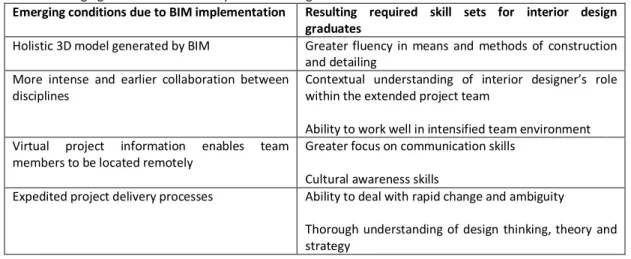
Beyond challenges faced by faculty and programs, certain skill sets become more important by virtue of BIM-influenced changes to business. Implications include new expectations for interior design graduates entering the workplace. Just as the integration of BIM software forces changes in the professional environment, changes should occur in interior design curricula to prepare students for a new way of working. Table 1 illustrates emerging conditions and resulting required skill sets for graduates.
Table 1. Emerging skill sets influenced by BIM technologies
Emerging conditions due to BIM implementation Resulting required skill sets for interior design graduates
Holistic 3D model generated by BIM Greater fluency in means and methods of construction and detailing
More intense and earlier collaboration between
disciplines Contextual understanding of interior designer’s role within the extended project team Ability to work well in intensified team environment Virtual project information enables team
members to be located remotely Greater focus on communication skills Cultural awareness skills
Expedited project delivery processes Ability to deal with rapid change and ambiguity
Thorough understanding of design thinking, theory and strategy
7. Fluency in Means and Methods of Construction and Detailing
Unlike traditional 2D drafting software that only enables a designer to create one drawing type at a time, BIM software requires viewing the design holistically at all times. This means that a comprehensive understanding of the architectural interior becomes more critical. “To use BIM effectively, interior design students must
building details in order to design effectively. When interior walls are drawn, the designer must understand how that wall connects to the ceiling, floor and possibly exterior wall conditions. Building details introduced by the architect must be taken into consideration as the interior spaces are developed.
8. Contextual Understanding of the Interior Designer’s Role
People-centered attitudes are central to the advancement of BIM and IPD due to the demand for intensified collaboration between team members. It may be true that BIM and IPD require as much social intelligence as technical competence. Strategies identifying best practices, if developed with a focus on human factors such as respect, workflow, talent management, work habits, identity, role, and personality are likely to positively impact the effectiveness of BIM and IPD implementation. Helping professionals, as well as students, cultivate an exemplar of design as a team sport verses a competition with a singular star performer is essential. People, as obvious as they are, cannot be overlooked (Deutsch, 2011). Without a trust-based and collaborative foundation and inclusion of key contributors, participants may linger in adversarial and antagonistic relations that hinder the quality of the built environment. Clarity about each discipline’s contribution and how it affects the design of the interior is imperative. This suggests that design students must have at least basic insight into how the interior designer’s role should be defined.
9. Ability to Work in an Intensified Team Environment
Considering that the expanded project team works more closely and earlier in the process, members of the design team will be evaluated for collaborative skills and leadership chemistry. Executing effective team-based and interdisciplinary project strategies and conveying the critical nature and techniques of collaboration can be hard in an academic setting. Difficulties students encounter in understanding the nature of design practice without having experienced a professional work environment is confounded when professionals themselves have yet to identify best practices from the perspective of the interior designer. Even so, during this period of transition, context and team play is most likely understood through a combination of academic preparation and “in the field” work experience, such as an internship followed by classroom discussion and reflection on student experiences (Black, 2000).
Collaboration forms of the past involved a project team located in one physical location with the ability to communicate face-to-face. Today, technology enabled sharing of information facilitates a new type of collaboration (Cohen & Mankin, 2002). Resulting challenges include overcoming geographical distances and cultural contexts with the rise of multicultural and multidisciplinary design teams (Young, 2008). While emotional intelligence and the ability to cooperate with others have always been important to productive teamwork, cultural awareness emerges as an important skill for working with teams members globally. Written proficiency and interpersonal communication skills are critical (Weko, 2011) for discussions with team mates and clients working out of disparate time zones and cultures.
10. Agility, Adaptability, and Acceptance of Ambiguous Conditions
The fast pace of technological change is cited as one of the design industry’s primary concerns (Cramer & Gaboury, 2011). As software expedites and consolidates, clients demand faster results. Technological progressions in combination with owners’ demands for more effective results drive significant and rapid change in the design industries (AIA National | AIA California Council, 2007). As a result, today’s workplace is dynamic requiring quick responses to unanticipated situations, continually subjecting designers to uncertainty. This “unprecedented rate of change” brought on by the information age (Steelcase, 2000) require skills of agility, adaptability and the ability to accept ambiguous conditions. Can these skills be taught in an academic setting? Educators must consider strategies that cultivate student capability to adapt to and effectively manage uncertainty and change.
11. Understanding of Design Thinking, Theory and Strategy
Alongside rapid change, skill sets for designers shift as a result of the virtual model. The ability to exchange data over the Internet facilitates outsourcing of 3D renderings and other drawing production services. Drawing “production” is increasingly contracted to firms internationally where fees are significantly less than US rates. Technology skill providers develop long-term relationships with Western firms (Harding, 2008). This alone could force domestic designers to adopt revised practices in order to remain relevant and add significant value to project delivery. However, as BIM matures and develops more fully into a proto-building design strategy instead of a document generator and representational tool, thorough understanding of design thinking, theory, and strategy possessed by well-educated and experienced design professionals becomes increasingly essential. Even while production skills can be bought for a fraction of the cost of a US employee, the project costs compared with measurable outcomes will likely tip the scales in favor of the educated professional.
12. Conclusion
Interior designers still struggle with both public and peer perceptions of their skills and abilities(Clemons & Waxman, 2007). Demonstration of professionalism, keeping current with industry standard technology and its associated knowledge are critical for interior designers to be perceived as informed, educated, tested professionals who generate value in project outcomes. Cultivating a current understanding of workplace practices by faculty should be considered in developing effective and relevant teaching strategies. While knowledge and skill can be imparted in the classroom, navigating the nuances of the workplace is difficult to replicate in an academic setting. Industry cannot expect students to emerge from formal education “fully formed” and ready for practice. The joining of forces between the academy and the industry is essential to effectively educate and mentor emerging designers amidst a rapidly changing environment. Each discipline is faced with similar challenges as BIM continues its evolution and best practices will likely appear over time (Deutsch, 2011).
References
AIA National | AIA California Council. (2007). Integrated Project Delivery: A Guide. American Institute of Architects. Retrieved from http://www.aia.org/groups/aia/documents/pdf/aiab083423.pdf Aubin, P. F. (2011). The Aubin Academy Master Series: Revit Architecture 2012 (1st ed.). Autodesk Press.
Barison, M. B., & Santos, E. T. (2010). Review and Analysis of Current Strategies for Planning a BIM Curriculum. In Proc., CIB W78 2010 27th International Conference, 1–10. Retrieved from http://itc.scix.net/data/works/att/w78-2010-83.pdf
BIM Workshop | Unit 2 – BIM Design Process. (n.d.). Autodesk BIM Workshop. Retrieved January 1, 2013, from http://bimcurriculum.autodesk.com/unit/unit-2-%E2%80%93-bim-design-process
Black, A. L. (2000). Stories of Co-Op: Reflections in a Professional Practice Course. Journal of Interior Design, 26(1), 74–85.
Clemons, S., & Waxman, L. K. (2007). Student perceptions: debunking television’s portrayal of interior design. Journal of Interior Design, 32(2), v–xi.
Cohen, S. G., & Mankin, D. (2002). Complex collaborations in the new global economy. Organizational Dynamics, 31(2), 117.
Cramer, J. P., & Gaboury, J. (2011). New opportunities but little recovery:25 trends transforming architecture and design. Design Intelligence, 17(1), 6–19.
Crumpton, A., & Miller, B. (2008). Building Information Modeling: State of the A&D Industry and BIM Iinto design education. In Proceedings of the Interior Design Educator’s Council Annual Conference, 1175–1188. Presented at the Interior Design Educator’s Council Annual Conference, St. Louis, Missouri.
Deutsch, R. (2011). BIM and Integrated Design: Strategies for Architectural Practice (1st ed.). Wiley.
Franz, J. M. (2007). Work Integrated Learning for Design: A scholarship of Integration. Faculty of Built Environment and Engineering; School of Design. Conference Paper. Retrieved January 1, 2013, from http://www.connected2007.com.au/
Fraser, S., & Greenhalgh, T. (2001). Coping with complexity: educating for capability | BMJ. Retrieved January 4, 2013, from http://www.bmj.com/content/323/7316/799
Greenway Group Inc. (2009). 25 Trends Transforming Architecture and Design Practice. Design Intelligence, 15(1), 14-22.
Harding, K. (2008). 10 Trends Reshaping the Talent Quest. Design Intelligence, 15, 52–59.
Steelcase Inc. (2000). Learning Environments for the Information Age, 3–17. Retrieved from http://www.oneworkplace.com/pdfs/whitepapers/LearningEnvironments.pdf
Tobin, J. (2008, May 29). Proto-Building -- To BIM is to Build: AECbytes “Building the Future” Article. Retrieved January 1, 2013, from http://www.aecbytes.com/buildingthefuture/2008/ProtoBuilding.html
Weko, A. G. (2011). Mixed Messages: Communication in Education and Practice. Design Intelligence, 17(6), 104– 111.
Young, G. N. (2008). Forum Focus: Emerging Trends for Designers with an Education and Research Focus. Perspective Journal of the IIDA, 48.