Play Online Poker
CakePoker
(110% Deposit Bonus up to $600)
WilliamHill
(100% Deposit Bonus & $120,000 RakeRace)
PrestigeCasino
($1,500 in FREE Spins No Deposit Needed)
PokerStrategy
($50usd Starting Capital FREE No Deposit Needed)
WilliamHill Bingo
($40usd FREE To Start Playing No Deposit
Table of Contents
Play to Learn ... 4 Table Selection ... 6 Bankroll Management ... 10 Math is Easy ... 18 Hand Combinations ... 19 Hand Ranges ... 22Probability and Odds ... 25
Pot Odds ... 27
Fold Equity ... 31
Odds Chart... 33
Estimating Your Equity on Flop and Turn ... 34
Expected Value ... 35
Determining How Often a Bluff/Call Has to Work to be Profitable ... 38
Memorizing Numbers ... 39
Quick Poker Facts ... 40
Preflop: The Fundamentals ... 41
The Blinds (SB & BB) ... 42
Under the Gun (UTG) ... 48
Middle Position (MP) ... 51
Cutoff (CO) ... 54
Button (BTN) ... 58
Postflop: Let’s Play Some Poker ... 62
Why We Bet ... 63
Continuation Bet ... 65
Paired Boards ... 69
Monotone Boards ... 74
Villain’s Perception of Your Range ... 75
Leading ... 77
Floating ... 86
Double Barreling ... 90
Check-Raising ... 109
3-betting ... 119
3-betting as the Aggressor ... 123
Playing the Flop ... 126
Countering 3-Bets ... 130
4-betting ... 137
Adjusting Against Different Players ... 142
Balancing Your Range ... 146
Multi-Way Pots ... 154 Scare Cards ... 158 Timing Tells ... 163 Glossary ... 167 Final Words ... 169 Recommended Readings ... 171
The Learner and the Grinder
The difference between these two mentalities is also the gap between a microstakes grinder and a high-stakes player. You should tackle poker as a competitive game and strive to become better every day. It is not a mere vehicle that provides you with a modest income. Simply changing your perception of the game will improve your skills much more and much faster.
The “learner” will try to understand difficult poker concepts and try to outplay his opponents. He questions what hands are in Villain’s ranges, what his raise on the river means, what spots are best for check-raising, and a multitude of other situations that arise in every session. He desires knowledge. He knows he can get better. He wants all the edges he can get. He enjoys playing poker. Every bad beat is simply a result of variance. The “grinder” only wishes to win money and does not care to improve his game. He is content with his marginal winnings and taking money from the occasional fish. He plays at the same stakes for months and even years. He may play 8+ tables and simply wait for the nuts. He misses out on the small edges because he does not care to fight back. He may want to fight back at times, but fails because he lacks the experience and knowledge. Every bad beat results in anxiety or anger. He loses control of himself and his game deteriorates. He is doomed to mediocrity. Poker becomes a grind.
I hope that after reading this book, you will fall into the “learner” category. If you find yourself in the “grinder” category, don’t sweat. You’ve just taken a big step in improving your game by seeking more knowledge. Keep up your momentum.
I found myself in the “grinder” category for a while without realizing it, and had to grind it out at the same stakes for months. Poker really became a grind. There was no more fun playing the game that I used to stay up all night reading books and forum posts. Once I became aware of it, I worked harder and improved tremendously within a few short months. It was a lot more enjoyable and refreshing as well.
You will get from this book what you put into it. If you read it without applying any of the strategies, then it is merely information. I cannot promise you a magic bullet, but I can assure you that if you study the materials in this book and apply them, you will become a better player—enough to beat your current game.
A Brief History
A few years ago, when online poker was full of really bad players, it was easier to win. I miss the days when bad players would open-limp all the time and had no problem stacking off 200BBs with top pair, no kicker. Unfortunately, those days are gone. However, fish are still swimming around, just in smaller groups than before. You should go out of your way to search for them. This is because table selection is the most important factor separating winning and losing players.
Player Stats
If a player plays over 35 percent of his hands, unless he is regular, he is almost always bad. If he plays over 35 percent of his hands and raises less than 10 percent of his hands, then he is almost always bad. The most profitable fish are loose and passive (aggression factor less than 1.5) who will often fail to extract value from their strong hands post-flop.
Important Note: If you don’t know what these numbers mean, I strongly recommend buying a hand history tracking program like Holdem Manager. You can set it to automatically store all the hands you play and give you useful stats about your opponents’ games (how loose they’re playing, how aggressive they are, how much they’re up or down in a session, etc.).
Stack Sizes
Anyone sitting with less than 100BB should get you salivating, especially if they are playing on just one table. This almost always means they are recreational players, and that means there is a lot of passiveness in their game.
If you find players who regularly play less than 25BB, they are likely professional short-stackers and they aren’t very good. Although they can be annoying, the best way to deal with them is to not call their shoves too light. My range for calling their shoves is 55+/ATs. This range changes with respect to our positions. If I open UTG and a short-stacker shoves, my calling range is tighter. If I open in the CO or BTN and a short-stacker shoves from the blinds, my calling range will be wider. Your calling range also depends on how loose they are. It’s your job as a player to figure out his estimated shoving range.
Player Tendencies
Although practicing this advice is hard, before sitting down, watch the game for a few minutes to see who is playing normally. Sometimes a solid regular has a losing session and can be playing his C game, which you can exploit. Some people start to play looser than
their normal game if they are on tilt. Some don’t bluff as often because they don’t want to lose more. Figure out which players fall into which categories. Once you are able to recognize tilt among regular players, playing poker will be an easy task. No money tastes sweeter than tilt money.
Seat Selections
If I have the option of having position on a really good player or having position on a really bad player, then I would instantly choose having position on the bad player. A good player can give you a lot of trouble by using his positional advantage, but you can easily counter this by folding a lot of your marginal hands and playing only with the nuts. Since he is so aggressive, you can basically win by closing your eyes and check-calling three streets with your strong hands.
If I were starting a table, then I would sit at the top left corner (10 o’clock position in a 6-max table). For some reason, the majority of fish like to sit in the lower two seats. By sitting to a fish’s immediate left, even if the table fills up with the best players at your stakes, the game is still worth playing.
Number of Fish Required
As long as there’s a fish at a table, that game is worth playing. If you are unsure on how to play against the rest of the table, you aren’t losing much value by folding all your non-premium hands. No matter how good your opponent is, it’s going to be tough for him to exploit you if you play against him with a range of TT+/AQ+. Of course, he will be stealing your blinds left and right, but the presence of the fish makes it a very high-EV situation.
Bum-hunting
Bum-hunting is when a regular sits at a heads-up table and waits for a really bad player to join and play. This practice has been frowned upon by many online poker players. But in the words of Don Corleone, “It don't *sic+ make any difference to me what a man does for a living.” I feel the same way regarding table selection. If bum-hunting is your table selection standard, go for it and don’t let anyone tell you otherwise.
Screen Names and Avatars
If a player has a screen name of an alcoholic drink or a car, then he is usually a recreational player over the age of 30. Such examples are whiskey72 or Ferrari_lover. If a player has a screen name of a famous player follow by a number, then he is usually bad. Such examples are Phil_Ivey_123 or Helmuth33.
If a player has a screen name of a sports team with the team’s logo, then he is usually bad. Such examples are Lakers2000 or Colts13424.
If a player’s screen name has the word “crazy”, “bluff” or “gamble”, then he is usually a nit.
If a player’s screen name has the word “monies” or “lol,” then he is likely a young player who posts in online forums. This generally means he’s an aggressive player.
If a player has a picture of his baby as his avatar, then he is usually over 30 and is almost always bad.
Knowing When to Move Up
(This is an excerpt taken from Tri’s upcoming poker psychology book)
Bankroll management is different for everyone. The number of buy-ins required for a stake before moving up depends on your ability to rebuild and your age. If you are young (18 years old) and have no problem moving down when you lose a few buy-ins at your shot taking, I would try to move up as quickly as possible.
In fact, if I were to start over again, I would implement the 30 buy-in (50 for PLO) rule for whatever stake I am playing and move down if I lose 5 buy-ins at that stake. I would only play 4 tables so I could focus more on both my and my opponent's play. I would take notes religiously and would try to move up as fast as possible. This is because how much you can win is highly disproportional to your poker skill. For example, a 1/2NL regular can make $100K/year and a 2/4NL regular can make $200k/year even though the 2/4NL regular isn't that much better. In some instances, their skill level is the same.
Another reason why you should try to move up as soon as possible is that as you grow older, your willingness to gamble and take risk decreases tremendously. You have worked hard to get to where you are; the risk of losing it all is disheartening and at times, scary. You don't want to deal with an enormous amount of stress anymore.
When you're young, you don't know any better, and that's a good thing. You have a lot of hope and aspiration to be the best. You have that gamble in your blood. You want to play because you truly love the game. It's exciting. The high when you win is comparable to the low when you lose. During this phase in your poker career, you should be as aggressive as you can with your bankroll. You have time and age by your side. If things go wrong, you can always rebuild. After all, it’s easier to rebuild a $1,000 bankroll than a $100,000 bankroll.
My friends and I have talked about the older generation and how nitty they are. What we don't often realize is that, compared to the 18-year-olds of today, we are the nits. Just when we think it’s tougher to be more aggressive than we already are, a new generation of poker players comes in and proves us wrong. Thus, it's not surprising that every year, a new young superstar appears who challenges the pecking order of the current poker establishment. Those who have been around kind of accept their place in the poker hierarchy. They know who they can beat and who has an edge on them. They no longer want to deal with the swings and are content where they are. Do they still want to improve? Sure. But not enough to go through enormous swings against better players. Age has caught up to them.
It's not uncommon for nosebleeders to admit their reluctance to play super under-rolled as they grow older. These are the same nosebleeders who definitely wouldn't hesitate to gamble if they were younger. In fact, they probably wouldn't think twice. But now that they are older and are content with what they have, the idea of playing stakes that can ruin them isn't appealing anymore.
So, whoever said you're only young once was right. Considering that your earnings improve exponentially relatively to your skill level, you should try to be as aggressive as possible with your bankroll.
You’re Young Only Once
Imagine for a minute that you are working at a corporate job and there are ten rankings on the company ladder. The CEO is at the top and the cashier is at the bottom. You were a cashier last quarter and got promoted to a higher position this quarter. You love your field. You are willing to work hard and hope that one day you will be at the top. It doesn’t matter why you want to be at the top (pay, status, power, etc.); the key is you want to be at the top and you will try your best to get there.
How come some people don’t have the same when it comes to poker?
Why is it that in every job when we are at the bottom, we want to get to the top? But in poker, some players are satisfied with grinding out a decent living. There’s nothing wrong with being satisfied with where you are. That’s not the problem. The problem is being satisfied with where you are without taking a shot at the top. In poker, it is extremely profitable when you are the best player at your given stake. Other regulars will stay out of your way. When you create tables, you get to play fish heads-up for a while before other regulars join. You also improve a lot because you’re playing heads-up. Most important of all, your earning potential increases dramatically.
The best strategy when becoming a poker player is to be as aggressive as you can regarding your bankroll when you are first starting out. You want to move up as soon as possible.
If you ask high-stakes players what they would do differently if they were to start again, most will likely say, “I wish I had been more aggressive with my bankroll.” This is coming from players who were playing on 15 buy-ins. Looking back, they understand that the opportunity to improve at a fast rate is very important. Few, if any, regretted putting their bankroll at risk, as they were moving up. In fact, some kind of wish they had been more aggressive. Because they understand that if their shots fail, they can always rebuild. They are still young. Of course, if you ask the same players if they would use the same bankroll management at their current age, they wouldn't. Time is no longer on their side. They wise up a little. They don't want to lose it all when they have so much to lose.
I remember when I first started playing poker. All I wanted to do was play. It was a rush to improve every time I sat down at the table. There was so much to learn. Of course, I was
young and didn't know better.
I remember playing 100NL on Paradise Poker and getting sucked out on over and over again. I had enough money and went to a local casino to play live. I played a $300 buy-in game, ran incredibly hot and won about 10 buy-ins. It felt awesome. I came back the next day with $600. At this time, I was using my two buy-ins rule. After my big win, I felt pretty dangerous inside. My confidence was sky-high. I wandered around the casino and noticed a $5-10NL game ($500 buy-in) was taking place. I sweated for a few minutes and realized I could beat this game. I did what any young kid would do. I sat down.
Over the course of the night, I won and won and finally got into a big hand for all my chips, and my hand held. I do not know what would've happened if I’d lost that pot. It was over $3,000, which was about 25 percent of my bankroll. If I have to guess, I would go on tilt and go home and sleep and come back the next day to grind the $300 games. Luckily, I won the pot and ended up playing 10NL from that point on. To my amazement, the $5-10NL ($500 buy-in) games were as easy as the $2-5 games ($300 buy-ins).
For my online bankroll story, I was playing 400NL on Party Poker for a month during my senior year in college. I remember limp-re-raising all my strong hands in 6-max games. That's the ultimate move in live poker, so I did it online. I don't know how I won, but I did. Then one day, I got bored at 400NL and played 600NL. At this point, I'm positive I had less than $15,000 to my name because I would remember if I had more than that. It's fifteen-thousand for a broke college kid. I played 600NL for less than 10 hands and for some random reason decided that I could play $5-10NL, the highest stake at this point. I ended up winning a little bit with “unorthodox” plays such as open-limping under-the-gun, limp-re-raising in the cutoff because the button kept raising pre-flop, and check-raising flops with bluff-catchers. I didn't know any better. Then I found out about rakeback and asked Party Poker to close my account because it's bad luck. They closed my account and I created the account SlowHabit. My friend transferred me $1,000 and I split that into two tables at $5-10NL. I ended up busting one table and ran the other table up to about $8,000. I was afraid I would lose it all so I left and played 4-tables. I wasn't good enough to 6-table yet. I am very bad at video games. Next thing I know, I ran that account to about 250K and closed that account when I ran bad.
Looking back, I don't think I stopped to think for a second that I might bust my account. The thought of me losing buy-ins didn't even register in my head. I had two! Of course, knowing what I know now, it was a very stupid thing to do because the probability of me losing it all was extremely high. But do I regret it? No, because even if I busted my account, I could deposit and rebuild at lower-stakes. Luckily, I ran hot and continued playing the biggest games on Party Poker until legislation passed and I can no longer play on the site. I know I wouldn't have the chance to make as much money as I could if I were to follow strict bankroll-management guidelines.
Let's pretend I can go back in time and knowing what I do know, would I still take the same risk? If I'm 20 like I was, yes. If I'm 25, no. I would definitely think it over because
time is no longer on my side. If I'm 25, I have more responsibilities. I'm likely a college graduate. I have to repay my parents for taking care of me and making me who I am, except for the gambling part.
There is always an opportunity to be better. You have to embrace the risk. After all, what's the worst thing that can happen? You lose a buy-in and move down to rebuild. Not exactly a risky situation, is it?
100 Buy-in Rule
I have never been a fan of X buy-ins rules. My philosophy is that if you are running good and playing well, you can afford a few buy-ins to take a shot at the next level. After all, with living expenses and variance in poker, your bankroll might never reach 100 buy-ins until half a year later. By that time, your game might be stagnant because you are playing against the same types of regulars over and over again without learning anything new. You might risk playing down to your opponents. Or worse, everyone is improving so you keep staying at one stake and it's tougher to move up.
Of course, when using an aggressive approach to bankroll management, you have to be honest with yourself and ask if you can grind lower games if taking shots doesn't work. If you get tilted easily by taking a shot and losing, then approach the situation cautiously. Take all the time you want. Though, like what my man Mike McDermont once said, "If you're too careful, your life can be a fucking grind."
One thing I want to be clear about is that I'm not advocating for you to go take shots in tough games full of regulars. I'm talking about the situations where you feel the timing is right and you're feeling good about your game and luck. If that is the case, go for it. You eventually have to defeat them, why not start now when everything is going your way?
Shoot, Reload, Try Again
If Phil Ivey suddenly got in contact with you and offered to play you HU at one stake higher than your regular game, would you take it? I know I would because I would learn a lot. What if a lineup of the top five nosebleed players invites you to play a game of 6-max game at your regular stakes. Would you take it? I know I would, because I would learn a lot. Or am I just being delusional, not learning that much and just wanting to play against great players for a small price?
In terms of learning a lot and also future potential earnings, you learn more by playing a tough regular HU or taking a shot at stakes higher than yours. You have the most to gain when you are playing against these players because you learn more. What Ivey or other nosebleeders do, you cannot apply to your game. They play differently. Their opponents are also different. So if you aren't afraid of losing a few buy-ins to Ivey, why are you afraid to lose a few buy-ins at one stake higher for the chance to greatly improve your game?
gives you a reality check—you might not be as good as you think. Second, you might realize that the players playing one stake higher than you aren't that good and that you can beat them. Third, you can run good and never look back again.
So, when you feel good about your game and there's a softer game at a higher level, take a shot. Give yourself three buy-ins and move down if you lose it. I don't care why you lost. Move down. Once you start to lose an amount of money that seems big to you, you will play badly. And you will play scared. You will feel that you're not. But trust me, you are and you will.
Move down. Reload. Try again.
You should also take shots to improve your game. If I ever teach a poker course at university, my final exam will be take a shot at higher stakes. Some people are afraid of losing, of getting embarrassed. But think of it as college tuition if you lose. You paid for your lessons. Go home and analyze why you lost. If you lost with AA pre-flop, then go back down and grind as fast as you can so you can take the next shot to show yourself that the last failed attempt was a fluke. You are better than that.
Just remember to move down once you lose three buy-ins, because if you continue playing, you might end up losing more than you can handle. This will make it hard for you to grind the lower games because now, you have to win a lot to just break-even over a long stretch of hands. If you can withstand long break-even stretches, more power to you. Some people cannot fathom the idea. The thought of breaking even over 100K hands can tilt people and create an enormous amount of stress that can be very tough for you to overcome. Thus, the best solution is to avoid the situation altogether. Of course, you will probably go past your loss limit the first few times around. I know I did. However, we learn. Just like the first time we touched that burning stove.
Stop-Loss
People often ask me how many buy-ins do I lose before I quit? The answer depends heavily on how good your game is compared to your opponents. If you are playing against a bunch of morons, then keep playing until you don't feel comfortable losing X amount. The cutoff for the majority of people is six buy-ins. After that, their games go downhill.
As a professional, it's always best to play your A game and quit when you no longer operate at a high level. Of course, it's difficult to be rational when you are tilting. No one can. Thus, I developed a system to help me put things in perspective.
A simple strategy I use for stop-loss is to think of my biggest winning days and average them out. If I'm having a losing session and it passes the average, I try to quit. That doesn't mean I'm constantly checking my cashier to see whether I'm up or down (I don't
do that). I usually keep track of how many all-ins I lost and once I feel I’ve had enough, I quit. Of course, it's easier said than done because we always want to get back to even. But knowing that there's no way in hell you are coming back helps you to step away from the tables. It's going to be very tough to do it upon command. I still have trouble with it to this day. However, I'm much better at quitting now. The main reason I got better at quitting is to look over my game log.
Game Log Analysis
If you look over your game log for the past year, you will notice that your total earnings for the year are almost equivalent to the sum of your 15 biggest sessions. That is the number of buy-ins for me at 10/20NL. If you play higher, then that is a little less than your total earnings. If you play lower, then the earnings are a little more than your top 15 winning sessions.
Now, look over the worst 15 losing sessions. If you somehow cut half of those sessions down, you are a much richer man. I know it's tough to quit when you are stuck but hopefully, by looking at this data, you will realize how important stop-loss is to a player's earnings. This was how I realized that minimizing losing sessions can increase your income tremendously.
Cash-Out Versus Moving Up
It's important to try to move up as quickly as possible to the stake where you can comfortably play for a decent living. This stake should be 200NL.
I think it is important to be the best poker player that you can be before you settle down and grind the games. The enthusiasm for learning the game has a relatively short span. For some people, a few downswings and they get discouraged and will be content with grinding 12 tables at small-stakes. There is nothing wrong with this. It is just not how I want to live my life.
Now, imagine yourself as a business. Any business in the real world isn't going to be very profitable in the first three years. They have to develop a system in their company. They have to improve their infrastructure. They have to incur a lot of expense to improve. A business doesn't generate a lot of profit if it isn't good at what it does. It doesn't make as much if it doesn't have a market share in its niche. Thus, as a business owner, your goal is to become the best business in your niche.
For this reason, you shouldn't be cashing out that often. I should be clearer. You shouldn't cash out to spend a lot. You can cash out and put it in the bank in case one of the poker sites collapses. But besides that, you should try to cut down your expenses and work hard to improve your craft. Spend as much money as you can to improve your game. Use it for coaching and taking shots. That's your expense.
There will be a day when your learning curve will slow down dramatically. In other words, there will be a day when your business has little growth potential. This is when you want to settle down and grind the tables to reap the profits. You have worked hard and now you can see your reward. Hopefully, the stakes that you are grinding at are bigger than 50NL.
If you keep cashing out and spending it, you are keeping yourself from moving up. What if there's a great game and you can't play in it because you are not rolled for it?
Many people think the Dang Brothers, Phil Galfond and Durrr are lucky because they have the rolls to play Guy Libierte in the ultra-nosebleeds game. Not many stop to ask how these players manage to have the roll to play Guy. They probably don't. They were willing to take a risk when it presented itself, and they prospered from that decision.
Hand Combinations
A hand combination is any two cards that you are dealt, such as JT spades. This is one of my favorite math topics in poker because learning hand combinations, or simply “combinations”, will automatically make us better hand readers. It allows us to narrow Villain’s hand range based on his actions, our cards and the community cards. With that said, let’s get some facts out of the way.
1. There are 1,326 combinations in No-Limit Holdem. 2. A set has 3 combos.
3. Two pairs have 9 combos. 4. Pocket pairs have 6 combos. 5. A pair + kicker has 12 combos. 6. Unpaired cards have 16 combos.
7. Any two specific suited cards have 4 combos. 8. Any two specific cards have 1 combo.
This may seem intimidating, but it’s really not as hard as it looks. Let’s go over a quick example to illustrate this.
100 NL – 6 max. 100BB effective stacks.
A tight player raises from UTG and you 3-bet from the Button with
He 4-bets you all in. How many combinations of AA does he have?
There are 4 aces left in the deck. Based on the list from above, there are exactly 6 combinations of AA. If we manually count them out, we have
That’s simple enough. Now let’s go over a slightly more complicated problem and see how things change when we hold one of the cards on the board.
100 NL – 6 max. 100BB effective stacks.
You raise from UTG with
and a TAG player calls from the SB. The flop is
He checks to you. You bet 2/3-pot and he check-raises to 3x your bet size. How many combinations of sets, two pairs, AA, AK and straight draws are in his range?
We’ll need to make some adjustments because we hold one of the cards on the board. 1. Sets – 7 combos: 3 combos for a set of eight, 3 combos for a set of 9 and 1
combo for a set of kings (you have one king and there’s one king on the flop). 2. 2 pairs – 2 combos: Since we don’t think he’s going to be calling our UTG raise
with 98 offsuit, we can subtract those combos from his range. There are 4 combos of 98 suited preflop. On the flop, he can only have 2 combos for 98s (98 clubs and 98 spades). We also remove K9s and K8s from his range because TAGs don’t call UTG raises from the blinds with those hands.
3. AA – 3 combos: Again, there can be 6 combos of AA, but since we have one of the aces in our hand, he can only have the following 3 combos.
4. AK – 6 combos (3 aces left x 2 kings left = 6 combos): A pair + kicker usually has 12 combos. However, we hold a king and an ace so that takes away several combinations.
5. Straight draws – 4 combos of JT suited (JT clubs, JT spades, JT diamonds, JT hearts): We can safely assume that Villain will not call an UTG raise with JT offsuit from the blinds. I left out T7s and 76s because he is less likely to call an
UTG raise with those hands from the blinds in a heads-up pot. Even if he does, he will more likely check-call.
If we know he never check-raises with a straight draw here, then that decreases the chances that he has JT and increases the chances that he holds two pair or better. Thus, the correct play is to fold. Another option is to call and see what he does on the turn. If he bets again, then we’re likely behind and can fold. If he checks, then we can check behind for a cheap showdown. If you’ve seen villain overvalue his KQ and check-raise here, you can call the flop more liberally.
As you can see, hand combinations allow us to focus on villain’s hand range to figure out how likely he is to have a certain hand. This does not replace hand reading in any way. It should be a great supplement, however, to dissect your opponent’s range.
Hand Ranges
A hand range is a group of holdings that one player is likely to have based on previous history and the actions in a hand. Let’s look at some examples.
100NL – 6 max. 100BB effective stacks.
Villian is a TAG and raises to $4 from UTG. You 3-bet to $14 from the BTN with
He 4-bets you all-in, and you call.
His hand range here is very strong, which means that a lot of his holdings include TT+ and AK. Versus that range, our AK is a 40 percent underdog. Since we know he’s a TAG, he is unlikely to be doing this with AQ/AJ or 99. So, we stand to lose money in the long run if he shows up with this range every time in this situation.
Now, let’s say a very bad, maniacal player raises $4 from UTG and you 3-bet again to $14 with
He 4-bets you all-in and you call.
His range is much weaker compared to that of our previous opponent because of his maniacal, aggressive nature. He might be the type to 5-bet all-in with AJs and 55. There are tons of mediocre hands that we either dominate or are 50/50 against. He could do this with TT+ and AK, but a larger portion of his range consists of AT+, 55+ and KQ-type hands. We have 48 percent equity against this range. With the dead money out there, we have more than enough odds to call profitably.
We did not try to put Villain on a specific hand, but rather on a range of hands he might have had. This is how you should be thinking in poker. It’s often very difficult to put a player on an exact holding, but it’s much each easier to estimate his hand range.
Hand ranges also allow us to analyze a situation in a broader perspective. For example, if our maniacal Villain from the previous example 4-bets us and shows up with AA, it doesn’t mean that we made a bad read. We know that AA is only a small part of his range.
Sometimes he will show up with a good hand, but most of his range consists of much weaker holdings. As you can see, you estimate a player’s hand range based on his image, tendencies and history.
Hand ranges are dynamic and can change after any given action. Consider the following example.
100NL – 6 max. 100BB effective stacks.
Let say our TAG player raises to $4 from UTG and we call from the button with
The flop is
He c-bets full pot. His hand range has not changed because he will c-bet this dry flop nearly 100-percent of the time. We call. The turn is a
and he checks. At this point, his hand range changes.
Unless he is going for an unlikely check-raise, we can safely assume that he rarely has KK, 99, 22, and K9+ in his range. He would have bet those hands to try to extract value from a weaker Kx, TT-QQ, or 9x. Checking allows us to control the pot size and check behind with our weak hands. So his hand range has weakened, while ours has gone up relative to his holdings.
A good generalization to keep in mind is that if you think your opponent’s range is stronger than your hand, you want to fold more often. And if you think his range is weaker than your hand, you want to call or raise more.
The Fundamentals
If you’re not good with numbers, don’t worry. You only need to understand a few basic fundamentals of poker to become a great player. Once you learn these concepts, you will no longer have to worry about the mathematical aspects of poker.
Probability and Odds
Probability is the proportion of the time that something is likely to occur or has already occurred. It is usually expressed as a percentage (e.g., 40 percent) or a ratio indicating odds (e.g., 7:1). They are one and the same. For example, an open-ended straight draw has 31.5 percent equity on the flop, which is equivalent to saying it’s a 2.2:1 dog.
Percentages are very straightforward. The higher the percentage, the more often an event is likely to occur. Now let’s go over ratios.
There are two ways to describe a ratio. You can say it in terms of being a favorite or a
dog, and there’s a significant difference between the two. The simplest thing to keep in mind is that when you’re a favorite, you’re ahead, and when you’re a dog, you’re behind. Let’s look at a few examples.
To be a 2:1 favorite means that for every two times that you win, you lose once.
To be a 3:1 dog implies that you lose three times for every one time that you win.
Now, let’s say we want to convert a 4:1 dog to a percentage. To do that, we use the equation below:
Convert 4:1 dog to a percentage.
percentage = wins/(left number + right number) = 1/(4 + 1)
= 1/5
= 20%
Let’s have some more practice.
Convert 3:1 dog to percentage
= wins/(left number + right number) = 1/(3 + 1)
= 1/4 = 25%
Convert 2:1 favorite to percentage
= wins/(left number + right number) = 2/(2 + 1)
= 2/3 = 67%
Convert 2:1 dog to percentage
= wins/(left number + right number) = 1/(2 + 1)
= 1/3 = 33%
Convert 3:1 favorite to percentage
= wins/(left number + right number) = 3/(3 + 1) = 3/4 = 75% Convert 37% to ratio = 37% = 37/100 = 37 wins, 63 losses = roughly 40/60 = 4/6 = 2/3 = 2:3 or 3:2 dog Convert 25% to ratio = 25% = 25/100 = 25 wins, 75 losses = 25/75 = 1/3 = 1:3 or 3:1 dog
Pot Odds
One of the essentials of poker, pot odds are something that every poker player should learn about. Whether you’re grinding it at a 10NL table or playing high-stakes, you have to know what pot odds are. We will cover two types of odds: immediate odds and implied odds. Knowing about odds allows us to determine if a call, bet, fold or raise is the most optimal play.
Immediate odds
Normally referred to as simply “odds”, immediate odds are how much you stand to win immediately in relation to what you have to risk, and is usually expressed as a ratio. Here are five simple steps we need to take to determine our pot odds.
1. Determine the original pot size.
2. Determine the amount we have to call.
3. Add up original size of pot and amount we have to call to get the Total Pot Size. 4. Express it as a ratio (Total Pot Size:Amount we have to call).
5. Convert it to a percentage. Let’s apply this in a few examples.
Say we get to the river with top pair and there’s $50 in a pot. Villain bets $25. Do we have enough odds to call?
In order to know if you can profitably call here, you need to know your odds. To determine this, let’s follow the steps above.
1. Original size of pot = $50 2. Amount we have to call = $25
3. Original size of pot + amount we have to call = Total Pot Size $50 + $25 = $75
4. Total Pot Size:Amount we have to call 75:25, or 3:1 odds.
5. 3:1 odds converts to 25 percent equity, which means if you are good here 25 percent of the time, you break even. If more than 25 percent, you stand to win money in the long run. With our top pair, we think we’re good here more than 25 percent of the time, so we call.
Sometimes the numbers don’t round up perfectly, so we’ll have to do some adjusting. Here’s an example:
We get to the river with top pair and the pot is $70. Villain goes all-in for $65. We think we’re good here about 50 percent of the time. Do we have enough odds to call?
We need to call $65 to win $135 ($70 + $65). That’s 135:65. This can be a hard number to work with, so let’s round it up. $135 is about twice as big as $65, so we reduce that to about 2:1. We can convert 2:1 odds to about 33 percent equity. Since we think we’re good here at least 50 percent of the time, we can profitably call.
Hopefully, that wasn’t too hard. It does take a little getting used to in the beginning, but after a bit of practice, you can easily do this in seconds. If you have trouble understanding this, I suggest you read this section again to feel more comfortable. It took me a while getting used to it myself.
Let’s go over another example for some more practice.
100NL – 6 max. 100BB effective stacks. We hold
and the flop is
Villain bets $15 into a $20 pot. Do we have the odds to call with our flush draw?
Let’s apply the steps from above: 1. Original size of pot = $20 2. Amount we have to call = $15
3. Original size of pot + amount we have to call = Total Pot Size $20 + $15 = $35
35:15, or 2.33:1 odds. To get this number, just compute 35/15 on a calculator. 5. 2.33:1 odds converts to 30 percent equity, which means if we are good here 30
percent of the time, we break even. If more than 30 percent, we stand to win money in the long run. Against a hand like AQ, we have about 37 percent chance of winning, but ONLY if we get to see BOTH the turn and river. If we plan to fold to a turn bet when we miss, then we only get to see one card. This reduces our 37 percent equity to about 20 percent. Based on this alone, we can’t call. Good thing we have implied odds.
Implied Odds
Implied odds reflect how much we expect to win in later streets if we hit our hand. In the above example, if we know that Villain is the type of player who will stack off with Ax even when the flush card comes, we can call here all day. We have a lot of money left behind to make up for it. Although our immediate odds aren’t great, our implied odds are enough to at least warrant a call.
Figuring out implied odds is very similar to determining immediate odds. You simply add what he has left (excluding his bet) to the Total Pot Size.
So after he bets the flop, he still has $75 left. So $75 + $35 (Total Pot Size) = $110. Our new odds are 110:15, which is about 7.33-to-1. Since we only need *4:1 odds to call, we can continue.
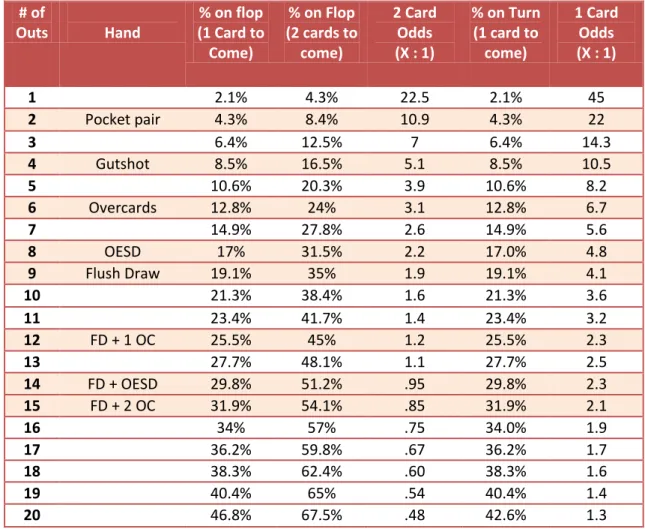
* A flush draw has 19 percent equity if you get to see only 1 card; this is the same as a 4:1 odds. Check out The Odds Chart on page 33.
Reverse Implied Odds
Reverse implied odds reflect how much you stand to lose even if you do hit your hand. The most basic example is raising with ATo from UTG. We don’t want to do this in an aggressive game because this hand has a lot of reverse implied odds. Even if we do hit an Ace on the flop, we will stand to lose a lot of money against AJ, AQ and AK when the money goes in. Furthermore, we will not be able to extract much from weaker aces that will only call one or two small bets.
You have
in the BB. For some reason, the pot is limped around and you see the flop 5-way. The flop comes out
What is your play in this situation?
You should check-fold. Because there are so many players in the pot, your hand is rarely ahead. If you are behind, you are almost drawing dead. Thus, in this situation, you should check it down unless your hand improves on the turn or the river.
Fold Equity
Fold Equity is based on how often we expect our opponents to fold to a bet or raise. Since poker is all about being aggressive at the right time, it’s a good idea to know a little something about fold equity. Often times, you will find yourself in spots where a call is perfectly okay, but with fold equity, it may be best to raise it. Allow me to demonstrate.
100NL – 6 max. 100BB effective stacks. The BTN raises to $3 and we call with
from the BB. The flop is
We check. He bets full-pot and we check-raise to 3.5x his bet.
With the nut flush draw + overcards + BDST (backdoor straight draw), we are actually ahead of a top pair hand like T9. Although we can call here, the most optimal play is to raise. This is because of fold equity. Raising will fold out medium-pair hands like 99 or 8x. With the dead money already in there and being OOP, we don’t mind that kind of result, especially since most of his range will be mediocre holdings. A ten will probably call us and that’s fine because we will be able to fire on a lot of turn cards (any spade, and J, Q, K and A). Since most of his range includes marginal hands like T9, he can’t be too thrilled about calling another big bet.
Here’s another example you may be familiar with:
We only have ace-high, and even a pair as weak as 22 is ahead of us. So why do we want to put money in when we’re behind?
Fold equity.
We will be able to fold out hands that are a favorite against us but too weak to call OOP (22-88). We can put a lot of pressure on our opponents with AK and we don’t mind getting it all in pre-flop when we get 4-bet. Three-betting with the intention of getting it in against a 4-bet is rarely our goal with AK. If he folds to our 3-bet, then we win. If he calls, then we can still flop a big hand and win. If he 4-bets us, then we have enough odds to call.
Odds Chart
# of Outs Hand % on flop (1 Card to Come) % on Flop (2 cards to come) 2 Card Odds (X : 1) % on Turn (1 card to come) 1 Card Odds (X : 1) 1 2.1% 4.3% 22.5 2.1% 45 2 Pocket pair 4.3% 8.4% 10.9 4.3% 22 3 6.4% 12.5% 7 6.4% 14.3 4 Gutshot 8.5% 16.5% 5.1 8.5% 10.5 5 10.6% 20.3% 3.9 10.6% 8.2 6 Overcards 12.8% 24% 3.1 12.8% 6.7 7 14.9% 27.8% 2.6 14.9% 5.6 8 OESD 17% 31.5% 2.2 17.0% 4.8 9 Flush Draw 19.1% 35% 1.9 19.1% 4.1 10 21.3% 38.4% 1.6 21.3% 3.6 11 23.4% 41.7% 1.4 23.4% 3.2 12 FD + 1 OC 25.5% 45% 1.2 25.5% 2.3 13 27.7% 48.1% 1.1 27.7% 2.5 14 FD + OESD 29.8% 51.2% .95 29.8% 2.3 15 FD + 2 OC 31.9% 54.1% .85 31.9% 2.1 16 34% 57% .75 34.0% 1.9 17 36.2% 59.8% .67 36.2% 1.7 18 38.3% 62.4% .60 38.3% 1.6 19 40.4% 65% .54 40.4% 1.4 20 46.8% 67.5% .48 42.6% 1.3Estimating Your Equity on the Flop and Turn
Below are two simple and easy methods to estimate your equity on the flop and/or turn. They work best when you deal with small numbers of outs. Also note that Multiples of 2 are generally more accurate than Multiples of 4; however, both give very good estimates.
Multiples of 4 – To approximate the equity you have on the flop, multiply your number of outs by 4.
o You have an open-ended draw straight on the flop. That’s 8 outs, so 8 x 4 = 32 percent to win by the river. The actual number is 31.5 percent (This is if you get to see both the turn and river cards.)
Multiples of 2 – To approximate your equity on the turn, multiply your number of outs by 2.
o You have an open-ended draw straight on the turn. That’s 8 outs, so 8 x 2 = 16 percent to win by the river. The actual number is 17 percent.
Expected Value
Expected Value (EV) is the average amount that we stand to win or lose if we see a certain situation many times.
Let’s go over a quick hand to clarify what this means.
100NL – 6 max. 100BB effective stacks.
You have
on
You bet $20 into a pot of $25. Villain raises you all-in $65 more and you think he has 98 for an open-ended straight draw. What’s the EV of your call?
First, you must determine your equity against his hand. I plugged this into Poker Stove to find out that you have 65 percent equity. This means that on average, you will win 65 percent of the time and lose 35 percent of the time. So, you need to call $65 more to win a total pot of $110 ($25 + $20 + $65). Now use the equation below to figure out your EV.
EV = (% you win)(amount you win) – (% you lose)(amount you lose)
Your EV = (.65)($110) – (.35)($65) = $71.5 – $22.75
= $48.75 (roughly half of a buy-in)
This means that on average, you will earn $48.75 for every time you call his raise in this exact scenario. Thus, it is a very +EV (positive expected value) call that you should make all day because you will win a lot in the long term.
You will also lose 35 percent of the time. When you lose, you lose the $65 you invested in the pot, but you still gain an expected value of $48.75, or Sklansky Bucks. Just know that as long as you keep winning Sklansky Bucks, you’ll be making money when variance evens out.
So, what happens when you don’t know Villain’s exact hand? You estimate his hand range
(the possible hands that he can hold).
100 NL – 6 max. 100BB effective stacks.
A TAG player raises to $4 from UTG and you 3-bet to $12 from the button with
He calls. The flop is
He checks. You bet $20 into a pot of $25.50 ($1.50 from the blinds), and he check-raises all-in for $68 more. What’s the EV of your call?
You need to call $68 to win $133.50 ($25.50 + $20 + $20 + $68). To figure out the EV of your call, let’s first determine his hand range. We can safely rule out all bluffs just because it’s such a bad flop to do it on and Villain is good enough to know that.
Made hands: He can do this with AA, AK, AQ, 77, 66, A7s, A6s and 76s. We will remove some sets and two-pair hands from his range because he will often fold 77, 66, 76s, A7s, and A6s to pre-flop 3-bets. We can also take away AK some of the time because he would want to 4-bet you and get it in pre-flop.
Draws: he could have KsQs, QsJs, JsTs, Ts9s, 9s8s, 8s6s, 6s5s. Again, we will take away some of the small suited connectors because he will usually fold them pre-flop to a 3-bet. Since it’s a two-tone board, he probably wouldn’t check-raise all-in with just an open-ended straight draw.
Against this range of hands, you have 54 percent equity to win. Now let’s determine the EV of your call.
Using the equation from above:
EV = (% you win)(amount you win) – (% you lose)(amount you lose)
= (.54)($133.50) – (.46)($68) = $72.09 – $31.28
= $40.81
As you can see, the EV of your call is $30.01 (that’s 30BB at 100NL) given your read on the player’s hand ranges. You will not be able to make these kinds of calculations at the table, and that’s fine. You should do it whenever you have time. Maybe you were stuck on a hand and didn’t know if your call was correct or not. Now you can plug in the numbers to find out. Since folding is zero or neutral EV, then calling is generally correct if your EV is greater than zero.
Determining How Often a Bluff Has to Work to be Profitable
We get to the river with a busted draw and we bet full-pot to bluff him off his hand. To determine if this is a profitable bet, we need to figure out how often he needs to fold. To accomplish this, we use the equation 0 = 100F – (size of bet)(1-F).
Determining How Often a
Call
Has to Work to be Profitable
We get to the river with top pair and villain bets full-pot into us. The pot is $50 and he bets $50. We think he’s bluffing some of the time, and so we call. In order to know if this is a profitable call, let’s do some quick math.
How often a pot-size bluff has to work to be profitable 0 = 100F – (size of bet)(1-F) 0 = 100F – 100(1-F) 0 = 100F – 100 + 100F 100 = 200F 100/200 = F .5 = F
50% of the time or more
How often a half-pot bluff has to work to be profitable 0 = 100F – (size of bet)(1-F) 0 = 100F – 50(1-F) 0 = 100F – 50 + 50F 50 = 150F 50/150 = F .33 = F
33% of the time or more
How often we must be ahead for our call to be profitable against a pot-size bet?
Pot size : Amount we have to call
($50 + $50):$50 $100:$50 2:1
= 33% of the time or more
How often we must be ahead for our call to be profitable against a half-pot bet?
Pot size : Amount we have to call
($50 + $25):$25 $75:$25
3:1
Memorizing Numbers
You get to the river with
on
The pot is $100 and the preflop raiser shoves his entire stack of $75. How often do you have to be good here for this call to be profitable?
If you don’t know the answer to this right away, you’re going to be losing valuable time and energy doing it in the middle of a game (the answer is at least 30%).
These situations happen all the time in poker. Villain may bet half-pot or full-pot, or he might even over-bet the pot and you sit there trying to figure out the odds. Learn the math now, so that when these situations come up again, you can focus your attention on his hand range instead of the odds you need to make a profitable call.
I’ve already done all the hard work for you. I plugged all the numbers into the equations and organized the answers for you (on page 40). All you have to do now is memorize it. Learning these charts is one of the easiest and fastest things you can do to immediately improve your poker game and win rate.
If I were to learn poker from the beginning again, this will certainly be one of my top priorities. Poker is all about having an edge over your opponents. Whether you know something they don’t or are capable of doing something and they’re not, you gain. Knowing these charts is certainly one of those edges.
Quick Poker Facts
(Memorizing these charts now will make your life much easier)
Bluffing Frequency on River
How often yourbluffs have to work to be
profitable
Your Bet Size
67% or more 2x the pot size
60% or more 1.5x the pot size
50% or more Pot size
43% or more of pot size
33% or more of pot size
25% or more of pot size
20% or more of pot size
17% or more of pot size
Calling Frequency on River
How often we must be ahead for our call to be
profitable
Villain’s Bet Size
40% or more 2x the pot size
37.5% or more 1.5x the pot size
33% or more Pot size
30% or more of pot size
25% or more of pot size
20% or more of pot size
17% or more of pot size
The Blinds
Look at positional stats in PokerTracker or Holdem Manager and you will find that you’re actually losing money in the blinds. The amount is probably a little more than you would like. This is the fate that most, if not all, poker player share because it’s very difficult to win money playing pots out of position. It’s difficult to extract value from your strong hands, and your range is more faced-up. You also give your opponent more information regarding the strength of your hand than vice versa.
When the decision to fold or call pre-flop is close, folding is better because a small mistake can lead to a bigger one post-flop. In the occasion that you do play and find yourself being out of position, try to keep the pots small so you won’t find yourself in many sticky situations.
Raising from the blinds
Be very conservative with your raises from the blinds. With a few limpers in the pot, don’t raise unless you’ve got a good hand like 99+, ATs+, AQo+, or KQs. Another thing to remember is that when you raise from the blinds after a few limpers, most people will put you on premium hands (AQ+, TT+). So, on a flop like AT3 rainbow, you’re not going to extract much value from weaker hands. Players will know what your range is and they have the opportunity to continue or not after you act. If you get raised here, then be very cautious against standard TAGs and especially NITs. Unless there is any history, if your c-bet gets raised, you should fold one pair in this spot. No one is going out of their way to make you fold AQ /AK on an AT3 flop.
3-betting From The Blinds
Against a UTG raise, the majority of your 3-bets should be for value. Unless I know UTG is a fish, I rarely 3-bet in this type of situation because my perceived range is so strong. An argument can be made that if my opponent thinks my range is strong, I should 3-bet with marginal holdings to make him fold his good hands. Although this reasoning is valid, I’m going to get called pre-flop a lot since Villain has position on me. If he is aggressive and good, he’s going to make my life pretty tough post-flop. My philosophy regarding poker is to put myself in situations to make simple decisions and avoid making costly one. This is one of those situations that I wish to avoid and I hope you do too.
Since we are rarely 3-betting a UTG open from the blinds, we should call with the majority, if not all our holdings. If you only 3-bet with the nuts, an observant opponent
will notice and will put a lot of pressure when you only call from the blinds. Besides, it’s not like we are giving up a lot of value by calling from the blinds. It is just one of those situations where no matter what you do, you aren’t going to get a lot of value out of it. The sooner you accept this fact, the better your game will be and subsequently, your bankroll.
It is important to note that there are a lot of players who won’t notice that you are 3-betting from the blinds with only the nuts. In such situations, I would definitely 3-bet KK+ and try to get as much money in as possible. If you find a particular player who fold to 3-bets a lot, you can start 3-betting with marginal hands such as 98s and KQo. However, I would be cautious of such an approach. There are much better situations in an orbit of hands where your edge is bigger.
Against an MP open, the same principle applies, although you can widen your 3-betting range since your opponent’s opening range is wider and your perceived range is wider as well. It is important to note that you should try to have your range as wide as possible. In this situational dynamic, you should 3-bet more often with JJ+/AK against looser opponents. If my opponent folds to 3-bets a lot, I wouldn’t 3-bet with JJ and AK and would call pre-flop to keep them in. I rarely flat call in this spot with QQ+ because it would be disastrous if I fail to stack my opponent’s premium holding. I would call with QQ+/AK only if I know the players who have yet to act is squeeze happy and will 3-bet if I call. If those players don’t exist at the current table, you lose too much value for not 3-betting pre-flop.
You shouldn’t be 3-betting with non-broadway suited connectors. They don’t play well in 3-bet pots and you won’t flop enough hands to continue after c-betting. Don’t 3-bet with weak suited Ax either. It doesn’t flop well and it is very tough to play post-flop. When you flop an ace, you rarely dominate your opponent and you only get action when you are behind.
Against opponents who rarely fold to 3-bets, tighten up your range by removing suited connectors. If they call 3-bets a lot and fold to c-bets when they miss, then go ahead and widen your 3-betting range to include suited broadway hands that are easy to play post-flop.
Against a CO/BTN open, you should 3-bet with a wider range because his stealing range is wider. The question is which range should you be 3-betting with?
In this type of situation, I would like to 3-bet with a polarized range. What this means is I would 3-bet with premium hands such as JJ+/AQ and speculative holdings such as 65s and 87s that can’t play profitably post-flop without the initiative. I would call with marginal hands such as AJ, KJ, QJ, and pocket pairs. The reason is by calling with AJ, KJ and QJ, I can keep some of the hands I dominate in the pot since worse hands are rarely calling my 3-bet. Sometimes I call from the blinds with AK/AQ as well to have some nut hands in my flatting range and for deception value. Some players like to 3-bet small pairs from the blind against the CO/BTN because it works well with their game. Since I don’t like to play out of position, I like to call with those holdings and make my decision post-flop.
Squeezing
Squeezing is when you re-raise a pre-flop raiser with another player in the pot. Unless you have a history of 3-betting a ton, this will look extremely strong and will give you a lot of respect and folds. Most of the time, the person squeezing will be from late position or from the blinds. At 50NL, a squeeze is usually a strong hand. At 600NL, ranges are wider and Villain can show up with speculative hands such as A4s, 75s, and KJo.
Here is a simple squeezing spot.
100 NL – 6 max. 100BB effective stacks.
A weak-tight UTG player limps and CO raises to $5. You have
on the Button. You 3-bet to $17.
The example above illustrates that you can 3-bet to punish a habitual isolator, whose range in this spot is likely wide. Squeezing also discourages the CO from playing more hands because he has to worry about you.
Another squeeze spot is when a loose player opens in MP or in the CO and the BTN calls. If you are in the blinds, then this is a good squeezing spot. The main reason is when a loose player opens, the BTN has a wider value range to 3-bet with. So when the BTN only calls, the majority of his calling range is marginal holdings such as small pocket pairs, QTs, and ATs. Let’s stop for a second. If you have JJ+/AQ+ on the BTN and a loose player opens in the CO, what would you do? You would 3-bet the majority of the time because your hand is so ahead of your opponent’s range and your hand dominate some of the hands he
calls a 3-bet with. This is the main reason why good players always advocate folding marginal holdings on the BTN or CO against an early position open if there is a squeeze happy player on the blinds.
While squeezing is a powerful play, it can easily be misused. Learn the guidelines below to prevent yourself from making mistakes that cost you money.
- Squeeze until they give you a reason to stop: If they don’t adjust by either 4-betting you light or start shoving flops lightly against your c-bet, then there’s no reason to stop. Keep running them over. You will be surprised to see so many players willing to let you have your way. If a player, especially a regular, has been folding to your 3-bets, suddenly 4-bets you, then fold anything worse than AK and QQ. He isn’t leveling nor adjusting against you. He has the nuts.
- Villain’s Hand Range: A good, tight-aggressive player’s hand range for calling your 3-bets consist of 88+, AQ, KQs, QJs, JTs, T9s, 98s, and 87s. On a flop like A73 rainbow, you should consider betting your entire range since you have a lot of fold equity. And because it’s a flop where you can have a lot of combinations of strong hands in your range (AT+), your betting range is easily balanced with air. For this reason, just bet one-half to three-fifth pot. There’s no reason to bet bigger since hands that are behind your made hands aren’t going to outdraw you often. Betting small also allows you to bluff cheaply on future hands.
- Ace high flops: If you 3-bet with TT-KK OOP and the flop comes Axx, you should bet-fold more often than check-call. Although you won’t often get called by worse, it makes the hand easier to play, especially if your opponent is aggressive. Of course, if your opponent is passive and let you get to showdown easily, then checking is fine. - Against NITS: Don’t squeeze a NIT when he raises from early position because his range will be too tight and strong.
- Against loose-bad players: Don’t squeeze loose, bad players with low suited connectors. They will call your 3-bets and c-bets too often that it’s just not profitable. It’s much better to just call their raise preflop and stack them when you hit something big.
- Against shortstacks: Don’t squeeze when there’s a short stack in the hand and you don’t want to call his all-in raise. He’s not going to fold often, and will just jam with
any A or any pair. AT+ or 77 are decent hands to squeeze with but stay away from medium or low suited connectors.
- Against light 4-better: Don’t squeeze against an opponent who 4-bets you back frequently. This won’t happen much at lower stakes, although it’s something to keep in mind as you move up.
After Villain calls your squeeze, never bet unless you think he will fold a lot or you are willing to get it in on the turn. It’s very exploitable to always check-fold the turn after you bet the flop. Good players will pick up on this and you will lose a lot of money. Fewer players are capable of detecting this at micro-stakes or small stakes, but be aware of it. His hand range for calling the flop mostly consists of weak-type hands or even overcards if he’s tricky. You should be betting the turn a ton of the time against players like him. Unless he’s stubborn and calls you down lightly, it’s tough for him to do anything about it. Here’s another example.
100 NL – 6 max. 100BB effective stacks.
MP opens $4. CO calls $4. You squeeze to $16 with
MP folds and CO calls. The flop is
You bet one-half pot and Villain calls. The turn is a
What is your play?
You should consider betting three-fourth pot or near pot to commit yourself. Don’t bet so small that he would take it as weakness and shove over your bet with a pair or a draw.
Most of Villain’s range will be Tx, 77-99, 98s, 87s (occasionally 6x and A4s), and cannot continue on the turn. You have tons of equity (overcards and OE) to make the best hand against a hand like ATs. If he shows up with a set, you can always suck out. On the same note, if he can show up with a set on this board, he’ll have a lot of other pocket pairs in his range that will fold to the turn bet.
Caution: Squeezing a lot will build up adrenaline and you may find yourself playing too aggressively to the point of spazzing out like a monkey. You will also find yourself more incline to fight for pots because the pots are bigger. I suggest taking a conservative approach at first by squeezing with only QQ+/ AK+ so you are comfortable playing in 3-bet pots. Once you’re more comfortable and recognize some spots where your opponents fold all the time, you can add speculative hands such as 87s, ATs, and KJs to your range. I would also practice playing in 3-bet pots against weaker players at the table first.
Under the Gun (UTG)
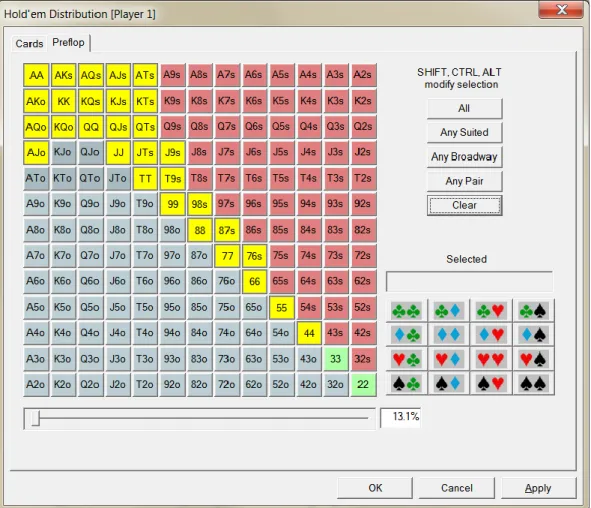
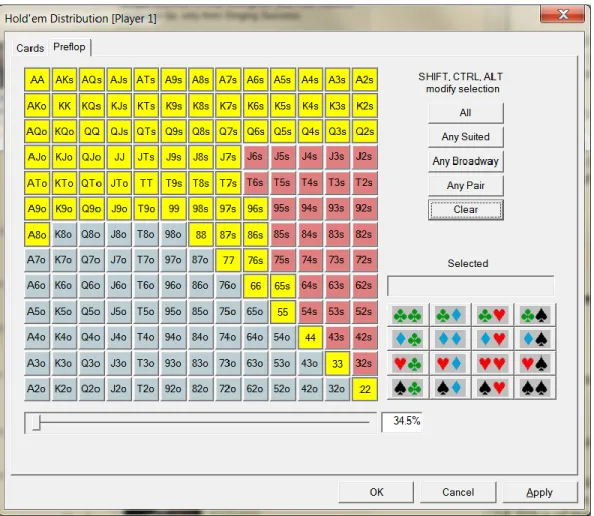
Figure 1: UTG’s Raising Range in Yellow Highlights - 13.1%
UTG is the first player to act pre-flop, with three players having position on you—middle position (MP), cut off (CO) and the button (BTN). Since you will be out of position for most hands, it’s best to play with a tighter range than all other positions.
Hand Ranges
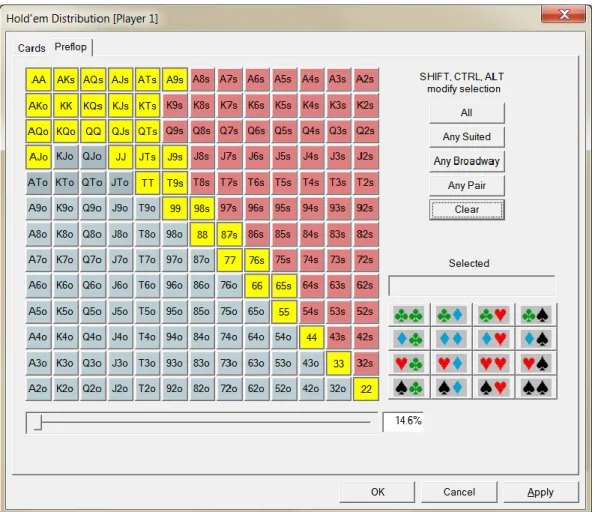
Here’s a conservative range of hands to play from UTG if you want to play at 23/18 or so. I recommend raising about 12-14% of hands.
1. All pairs 44 and higher