
Imperial College London
Department of Computing
Adaptive Response System
for Distributed Denial-of-Service Attacks
Vrizlynn Thing Ling Ling
A thesis submitted to Imperial College London for the degree of Doctor of Philosophy
Abstract
The continued prevalence and severe damaging effects of the Distributed Denial of Service (DDoS) attacks in today’s Internet raise growing security concerns and call for an immediate response to come up with better solutions to tackle DDoS attacks. The current DDoS prevention mechanisms are usually inflexible and determined attackers with knowledge of these mechanisms, could work around them. Most existing detection and response mechanisms are standalone systems which do not rely on adaptive updates to mitigate attacks. As different responses vary in their “leniency” in treating detected attack traffic, there is a need for an Adaptive Response System.
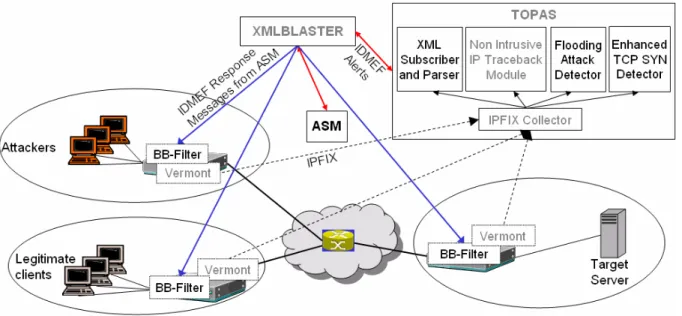
We designed and implemented our DDoS Adaptive ResponsE (DARE) System, which is a distributed DDoS mitigation system capable of executing appropriate detection and mitigation responses automatically and adaptively according to the attacks. It supports easy integrations for both signature-based and anomaly-based detection modules. Additionally, the design of DARE’s individual components takes into consideration the strengths and weaknesses of existing defence mechanisms, and the characteristics and possible future mutations of DDoS attacks. These components consist of an Enhanced TCP SYN Attack Detector and Bloom-based Filter, a DDoS Flooding Attack Detector and Flow Identifier, and a Non Intrusive IP Traceback mechanism. The components work together interactively to adapt the detections and responses in accordance to the attack types. Experiments conducted on DARE show that the attack detection and mitigation are successfully completed within seconds, with about 60% to 86% of the attack traffic being dropped, while availability for legitimate and new legitimate requests is maintained. DARE is able to detect and trigger appropriate responses in accordance to the attacks being launched with high accuracy, effectiveness and efficiency.
We also designed and implemented a Traffic Redirection Attack Protection System (TRAPS), a stand-alone DDoS attack detection and mitigation system for IPv6 networks. In TRAPS, the victim under attack verifies the authenticity of the source by performing virtual relocations to differentiate the legitimate traffic from the attack traffic. TRAPS requires minimal deployment effort and does not require modifications to the Internet infrastructure due to its incorporation of the Mobile IPv6 protocol. Experiments to test the feasibility of TRAPS were carried out in a testbed environment to verify that it would work with the existing Mobile IPv6 implementation. It was observed that the operations of each module were functioning correctly and TRAPS was able to successfully mitigate an attack launched with spoofed source IP addresses.
Acknowledgements
It is with the deepest gratitude that I thank my first supervisor and most respected mentor, Morris Sloman, for his constant support, dedication and guidance. Throughout the years of my PhD studies, Morris has been a constant source of inspiration and encouragement. His close attentiveness in reviewing my work and his critical analysis have helped me develop my research skills immensely.
I am very grateful to my second supervisor, Naranker Dulay for his guidance and advice. His insights, critical reviews and constructive comments always help me improve the quality of my work. I will always remember his valuable advice that it is often more interesting to understand why and not just how things are done, that good research always requires us to probe deeper.
I would like to thank the academic staff and researchers in our department for their guidance, technical advice as well as advice on matters of research and teaching. Special thanks go to Emil Lupu, Susan Eisenbach, Alessandra Russo, Peter Pietzuch, Julie McCann and Dong Changyu. I would also like to thank Amani El-Kholy for her constant advice on the PhD administrative matters.
I am extremely grateful to my partners in the Diadem project – Gerhard Muenz, Yannick Carlinet, Sherif Yusuf, Ali Fessi, Olivier Paul, Dusan Gabrijelcic, Raimondas Sasnauskas, Patricia Sagmeister, Gero Dittmann and Falko Dressler, who have provided me with great intellectual stimulation and advice during my involvement in such a large scale project. Special thanks also go to Emulab for providing the facility for the experiments in this thesis.
Many thanks are due to my fellow students and friends – Azher Mohammed, Keoh Sye Loong, Eva Du, Markus Huebscher, Jayshan Raghunandan, Zhang Yu, Alberto Schaeffer, Eskinder Asmare, Daniel Sykes, Leonardo Mostarda, Tamas Suto, Dalal Alrajeh, Duc Le, Paulo Maia, Giovanni Russello, Ma Jiefei, Andrew Smith, Robert Craven, Rudi Ball, Zhu Yanmin and Ana Freitas, who livened up my life in London.
I am deeply grateful to my grandmother, Tan Geok Choon, who passed away the year I came to London, for all the years of care and doting. I am also full of gratitude to my wonderful parents, Thing Sim Poo and Betty Tan, and my lovely younger sister, Zoan Thing, for their everlasting love, support and encouragement, and their companionship through all the precious moments in my life. To them, I dedicate this thesis.
The work presented in this thesis was funded by the European Union Diadem Distributed Firewall project FP6 IST-2002-002154 and through participation in the International Technology Alliance sponsored by the U.S. Army Research Laboratory and the U.K Ministry of Defence.
List of Publications
Vrizlynn L. L. Thing, Henry C. J. Lee and Morris Sloman, "Traffic Redirection Attack Protection System (TRAPS)", IFIP International Information Security Conference (SEC), May 2005, Springer-Kluwer. – Chapter 8
Gerhard Munz, Ali Fessi, Georg Carle, Oliver Paul, Dusan Gabrijelcic, Yannick Carlinet, Sherif Yusuf, Morris Sloman, Vrizlynn Thing, Jan van Lunteren, Patricia Sagmeister, Gero Dittmann, “DIADEM Firewall: Web Server Overload Attack Detection and Response”, Broadband Europe (BBEurope), Dec. 2005. – Chapter 4
Vrizlynn L. L. Thing, Morris Sloman and Naranker Dulay, "Non-Intrusive IP Traceback for DDoS Attacks", ACM Symposium on Information, Computer and Communications Security, Mar. 2007. – Chapter 7
Vrizlynn L. L. Thing, Morris Sloman and Naranker Dulay, "A Survey of Bots Used for Distributed Denial of Service Attacks", 22nd IFIP International Information Security Conference (SEC), May 2007. – Chapter 3
Vrizlynn L. L. Thing, Morris Sloman and Naranker Dulay, "Enhanced TCP SYN Attack Detection", IEEE/IST Workshop on Monitoring, Attack Detection and Mitigation (MonAM), Nov. 2007. – Chapter 5
Vrizlynn L. L. Thing, Morris Sloman and Naranker Dulay, "Network Domain Entrypoint/path Determination for DDoS Attacks", IEEE/IFIP Network Operations and Management Symposium (NOMS), Apr. 2008. – Chapter 7
Table of Contents
Abstract
iii
Acknowledgement
v
List of Publications
vii
Table of Contents
ix
List of Figures
xv
List of Tables
xvii
List of Abbreviations
xix
1.
Introduction
1
1.1
Motivation... 2
1.2
Objectives ... 7
1.3
Contributions ... 8
1.4
Publications and Awards ... 9
1.5
Outline of Thesis... 9
2.
DDoS Attacks and Defences
11
2.1
DoS and DDoS Attacks ... 11
2.1.1
DDoS Attack Models... 13
2.1.2
Types of DDoS Attacks ... 15
2.1.2.1
Attacks on resources ... 15
2.1.2.2
Attacks on routes to resources ... 19
Table of Contents
2.2.1
Attack Prevention...22
2.2.2
Attack Detection ...24
2.2.3
Attack Responses ...26
2.2.3.1
Traceback ...27
2.2.3.2
Containment ...29
2.2.3.3
Reconfiguration...30
2.2.3.4
Redirection ...32
2.2.3.5
Filtering...32
2.2.3.6
Ratelimiting...33
2.2.3.7
Resource replication...34
2.2.3.8
Legitimacy testing...34
2.2.3.9
Attackers’ resource consumption...35
2.2.4
Automated Attack Mitigation Frameworks ...35
2.3
Summary ...38
3.
DDoS Attack Bots
41
3.1
Related Work ...42
3.2
DDoS Bots ...43
3.2.1
Agobot...43
3.2.2
SDBot...45
3.2.3
RBot ...46
3.2.4
Spybot ...48
3.3
Analysis and Discussions...48
3.3.1
Bot Features ...48
3.3.2
Implications on Mitigation Techniques ...51
3.4
Design and Implementations of DDoS Attacks ...52
3.5
Summary ...53
4.
DDoS
Adaptive
Response
System
(DARE)
55
4.1
Analysis of Specific and Appropriate Responses ...55
4.2
Architecture Overview...58
Table
of
Contents
4.2.2
DARE ... 61
4.2.2.1
VERMONT... 65
4.2.2.2
TOPAS... 66
4.3
Summary... 67
5.
Enhanced SYN Flood Detector and Bloom-based Filter
69
5.1
Background... 69
5.2
Related Work ... 70
5.3
SYN-FIN/RST and SYN-SYN&ACK Analysis... 72
5.4
Enhanced TCP SYN Attack Detection ... 75
5.5
Evaluation and Analysis ... 76
5.6
Bloom-based Filtering ... 81
5.7
Experiment... 81
5.8
Summary... 83
6.
DDoS Flooding Attack Detector and Attack Flow Identifier
85
6.1
Related Work ... 85
6.2
Design of DDoS Flooding Attack Detector and Flow Identification Module ... 88
6.3
Experiments on Flooding Attack Detection... 90
6.4
Comparison with MULTOPS ... 92
6.5
Summary... 93
7.
Non-Intrusive IP Traceback
95
7.1
Design Objectives and Key Assumptions... 95
7.2
Design of Non-Intrusive IP Traceback ... 97
7.3
Network Segmentation Based (NSB) Approach ... 98
7.4
Strategic Points Based (SPB) Approach... 101
7.5
Deployment Considerations... 102
7.6
Simulations ... 103
7.7
Related Work ... 105
7.8
Summary... 106
Table of Contents
8.1.1
Mobile IPv4...110
8.1.2
Mobile IPv6...110
8.2
Design Objectives and Key Assumptions ...111
8.3
Design of TRAPS...113
8.3.1
Virtual Relocation Approach ...113
8.3.2
High-Bandwidth Traffic Selection...114
8.3.3
Traffic Congestion and Overloading Detection ...114
8.3.4
Rate Limiting at Gateways and Guard Router ...117
8.3.5
Deactivating TRAPS...117
8.4
Incorporation with Mobile IP...118
8.4.1
Redirection with Mobile IPv4...118
8.4.2
Redirection with Mobile IPv6...122
8.4.3
Gateways with HA Functionality...122
8.5
Proof of Concept ...123
8.6
Comparison with Related Work...125
8.7
Summary ...127
9.
Experimental
Evaluation
of
DARE
129
9.1
TCP SYN Attack Experiments ...134
9.1.1
TCP SYN Attack Experimental Results I ...136
9.1.2
TCP SYN Attack Experimental Results II...140
9.2
UDP Flooding Attack Experiments ...142
9.2.1
UDP Flooding Attack Experimental Results I ...144
9.2.2
UDP Flooding Attack Experimental Results II...149
9.3
Discussion on Traceback Simulations and Experimental Results ...153
9.4
Comparison with Diadem TCP SYN Attack Mitigation...154
9.5
Summary ...155
10.
System
Evaluation
and
Security
Threat
Analysis
157
10.1
DDoS Adaptive Response System (DARE) ...157
10.1.1
Limitations ...157
10.1.1.1
DDoS Flooding Attack Detection, Flow Identification and Ratelimiting158
Table
of
Contents
10.1.1.2
TCP SYN Attack Detection, Traceback and Bloom-based Filtering ... 158
10.1.2
Security Threat Analysis... 159
10.1.2.1
Adaptive System Manager (ASM) ... 159
10.1.2.2
TOPAS, Detectors and Internal Response Modules... 160
10.1.2.3
VERMONT... 162
10.1.2.4
External Response Modules: Ratelimiters and Bloom-based Filters... 163
10.2
Traffic Redirection Attack Protection System (TRAPS)... 163
10.2.1
Limitations... 163
10.2.2
Security Threat Analysis... 164
10.2.2.1
Spoofing of binding requests ... 164
10.2.2.2
Replay attacks... 165
10.2.2.3
Eavesdropping attacks ... 166
10.2.2.4
DDoS on TRAPS components... 166
10.2.2.5
Information acquisition attacks... 166
10.2.2.6
Computation of new address by attackers ... 167
10.3
Summary... 167
11.
Conclusions
169
11.1
Achievements ... 169
11.2
Future Work... 173
11.3
Closing Remarks... 174
12.
References
175
List of Figures
Figure 1.1: Attack Sophistication vs. Intruder Technical Knowledge [1] ... 1
Figure 1.2: Arbor Networks Inc.’s surveyed ISPs’ most concerning threats [16]... 5
Figure 1.3: Top 20 Threats and Vulnerabilities, January through October 2007 [17]... 6
Figure 2.1: DoS Attack ... 11
Figure 2.2: DDoS Attack ... 12
Figure 2.3: DDoS Agent-Handler Attack Model... 14
Figure 2.4: DDoS IRC-Based Attack Model... 14
Figure 2.5: Classification of DDoS Attacks ... 15
Figure 2.6: TCP 3-Way Handshake... 16
Figure 2.7: IP Addresses compromised by “Code Red” Worm ... 18
Figure 2.8: SOS Architecture [95]... 31
Figure 4.1: Architecture Overview of Diadem ... 59
Figure 4.2: Architecture Overview of DARE... 62
Figure 4.3: Functional overview of VERMONT... 65
Figure 4.4: TOPAS Architecture [143] ... 66
Figure 5.1: (a) TCP 3-way handshake (b) TCP SYN Attack... 70
Figure 5.2: Bot Buddy Attack... 74
Figure 5.3: 1 to Many Bot Buddies Attack... 74
Figure 5.4: Attack Packet’s Header ... 75
Figure 5.5: Error Rates Computation... 80
Figure 6.1: MULTOPS Data Structure [82] ... 86
Figure 6.2: C++ code defining Record and Table [82] (EMWA implements an exponentially
weighted moving average)... 86
Figure 6.3: Expansion and Contraction of MULTOPS Data Structure [82] ... 87
Figure 6.4: Example of existing Hierarchical Data Structure... 88
Figure 6.5: Adding flow 155.160.38.9 into the Hierarchical Data Structure... 89
List of Figures
Figure 6.7: Flooding Attack Detector and Flow Identification Module Experiment 1... 90
Figure 6.8: Flooding Attack Detector and Flow Identification Module Experiment 2... 91
Figure 7.1: Route Anomaly... 98
Figure 7.2: Network Segmentation Based Approach... 100
Figure 7.3: Traceback using SPB approach ... 103
Figure 8.1: Traffic Congestion and Overloading Detection Flowchart ... 115
Figure 8.2: Example of Traffic Congestion and Overloading Detection ... 116
Figure 8.3: Traffic redirection using co-located CoA in protected network... 119
Figure 8.4: Traffic redirection using FA in protected network... 119
Figure 8.5: Traffic redirection using co-located CoA in foreign network (initial binding using
co-located CoA) ... 121
Figure 8.6: Traffic redirection using co-located CoA in foreign network (initial binding using
FA as CoA) ... 121
Figure 8.7: Traffic redirection using Mobile IPv6 in protected network... 122
Figure 8.8: Gateway functioning as HA ... 123
Figure 8.9: TRAPS Testbed ... 123
Figure 9.1: Network Topology of Experiments ... 130
Figure 9.2: Topology Map with IP address allocation... 132
Figure 9.3: TCP SYN Attack Experiment Timeline ... 134
List of Tables
Table 2.1: DNS Resource Record Types... 20
Table 4.1: Usefulness of Potential Response Types ... 56
Table 4.2: Response actions taken based on characterization of attacks... 58
Table 7.1: Mismatched packets ... 104
Table 9.1: System reaction time for TCP SYN Attack Experiment I... 137
Table 9.2: TCP SYN Packets Sent and Received... 138
Table 9.3: Bloom based Filter Processing ... 139
Table 9.4: System reaction time for TCP SYN Attack Experiment II ... 140
Table 9.5: TCP SYN Packets Sent and Received... 141
Table 9.6: Bloom based Filter Processing ... 142
Table 9.7: System reaction time for UDP Flooding Attack Experiment I... 145
Table 9.8: Experiment Data for 10.1.11.0 Network ... 146
Table 9.9: Experiment Data for 10.1.4.0 Network ... 147
Table 9.10: Experiment Data for 10.1.3.0 Network ... 148
Table 9.11: Experiment Data for 10.1.5.0 Network ... 149
Table 9.12: System reaction time for UDP Flooding Attack Experiment II ... 149
Table 9.13: Experiment Data for 10.1.11.0 Network ... 150
Table 9.14: Experiment Data for 10.1.4.0 Network ... 151
Table 9.15: Experiment Data for 10.1.3.0 Network ... 152
Table 9.16: Experiment Data for 10.1.5.0 Network ... 153
List of Abbreviations
ACK Acknowledgement flag ESP Encapsulating Security Payload
AH Authentication Header FA Foreign Agent
ARTIS Artificial Immune System FIN Finish flag
AS Autonomous System FSB Front Side Bus
ASM Adaptive System Manager GR Guard Router
Back Binding Acknowledgement GRE Generic Routing Encapsulation
bps Bits per second HA Home Agent
BU Binding Update HoA Home Address
C2 Command and Control ID Identification field
CD Correspondent Database IDMEF Intrusion Detection Message Exchange Format
CN Correspondent Node IDS Intrusion Detection System
CoA Care of Address IETF Internet Engineering Task Force
co-CoA Co-located Care of Address IIS Internet Information Server COSSACK Coordinated Suppression of
Simultaneous Attacks
IPFIX IP Flow Information Export
CUSUM Cumulative Sum IPSec Internet Protocol Security
DARE DDoS Adaptive Response
System
ITrace ICMP Traceback
DCOM RPC Distributed Component Object Model Remote Procedure Call
ITrace-CP ICMP Traceback with Cumulative Path
DDR2 Double Data Rate LISYS Lightweight Intrusion Detection
System DiDDeM Distributed Denial of Service
Detection Mechanism
LSASS Local Security Authority Subsystem Service EMERALD Event Monitoring Enabling
Responses to Anomalous Live Disturbances
List of Abbreviations
MIP Mobile IP SOAP Secure Overlay Access Point
MIPL Mobile IPv6 for Linux SOS Secure Overlay Services
MIPv4 Mobile IPv4 SPADE Statistical Packet Anomaly
Detection Engine
MIPv6 Mobile IPv6 SPB Strategic Points Based
MN Mobile Node SPIE Source Path Isolation Engine
MPLS Multiprotocol Label Switching SSL Secure Sockets Layer
MSDE Microsoft Desktop Engine SYN Synchronization flag
MTU Maximum Transmission Unit TFN Tribe Flood Network MULTOPS Multi-Level-Tree for Online
Packet Statistics
TFN2k Tribe Flood Network 2000
NIMI National Internet Measurement Infrastructure
TLS Transport Layer Security
ns-2 Network Simulation version 2 TOPAS Traffic Flow and Packet Analysis System
NSB Network Segmentation Based TOS Type of Service
Pi Path identifier TRAPS Traffic Redirection Attack
Protection System
pps Packets per second TTL Time to Live
PSAMP Packet Sampling URG Urgent Pointer flag
RAND_MAX Maximum Random number URPF Unicast Reverse Path Forwarding
RIP Routing Information Protocol VERMONT Versatile Monitoring Toolkit
RR Resource Record WL White List
RST Reset flag XML Extensible Markup Language
SAVE Source Address Validity Enforcement
CHAPTER 1
INTRODUCTION
In November 1988, the first major computer security incident happened on the Internet. A computer worm, the Morris Worm, written by a student, Robert Tappan Morris, at the Cornell University, was launched from the Massachusetts Institute of Technology. It was then distributed via the Internet. The worm was to infect computers multiple times and each additional infection slowed down the machines, rendering them unusable. The incident gained significant mainstream media attention and the Government Accountability Office estimated the cost of the damage at US$10M – US$100M.
Figure 1.1: Attack Sophistication vs. Intruder Technical Knowledge [1]
Today, the Internet has grown to become an indispensable part of our life. It is widely used to perform information sharing, online learning, video streaming, and communications through means such as emails, messaging and Internet telephony, etc. More critical applications include multi-million dollar financial transactions, and military and defence communications, which could result in significant losses and serious damages unless handled in a timely manner. However, at the same time, incidents of Internet attacks and sophisticated attack tools continue to proliferate [1]. The timeliness
1. INTRODUCTION
requirement of critical applications would therefore be disrupted during attacks targeted at the end host or the network. Figure 1.1 shows that intruder tools are becoming increasingly sophisticated and easy to use by novice intruders [2].
1.1
Motivation
Availability is a broad subject addressing areas such as fault tolerance to protect against system and service failures, and access control to ensure that data is available to those authorized to access it. In the Internet world, availability has also taken on an expanded meaning. One of the most common security problems is the "Distributed Denial-of-Service" (DDoS) attack. This is a focused attempt by a network attacker to make a remote computer system and its service and data unavailable. This can be done in two ways. First, the attacker may try to damage the target system or some network component on which the system depends. Second, the attacker may simply send so many messages from attack machines to the target system or network component that it cannot possibly process them all. Other users attempting to use that system for legitimate purposes find that it has failed or is too busy to service them.
In recent years, high-profile DDoS attacks over the Internet have targeted and impacted availability. The first well-publicized attack in the public press was in February 2000 [3]. On 7th
February 2000, Yahoo was the victim of an attack during which its Internet portal was inaccessible for three hours. On 8th February 2000, Amazon, Buy.com, CNN, and eBay were all hit by attacks that
caused them to either stop functioning completely or slowed them down significantly. On 9th February
2000, E*Trade and ZDNet both suffered attacks that brought down their websites. Analysts estimated that during the three hours Yahoo was down, it suffered a loss of e-commerce and advertising revenue that amounted to about US$500,000. According to Amazon.com, its widely publicized attack resulted in a loss of US$600,000 during the 10 hours it was down. During their DDoS attacks, Buy.com went from 100% availability to 9.4%, CNN.com's users went down to below 5% of the normal volume, while Zdnet.com and E*Trade.com were virtually unreachable. Schwab.com, the online venue of the discount broker Charles Schwab, was also hit but refused to give out exact figures for losses. One can only assume that to a company that does $2 billion dollars weekly in online trades, the downtime loss was huge.
In recent years, DDoS attacks have increasingly been exploited by extortionists, business rivals and rebels on websites of banking and financial companies, online gambling firms, web retailers,
1.1
Motivation
government sectors, and even firms providing Internet security services. The following items list some high profile incidents.
• In March 2005, five Dutch hackers were arrested for carrying out DDoS attacks in the Netherlands on the government websites in a protest against cabinet proposals [4]. The websites which are the central gateways to all information on the cabinet policy in the Netherlands couldn’t be reached for 5 days.
• In April 2005, an entrepreneur was arrested for recruiting a 16 year old hacker to bring down the websites of his major competitors [5]. The attacks were launched repeatedly for 5 months by bombarding the sites with data requests. Many of the sites’ servers were overloaded and brought down for days. The attacks also brought down companies hosting the servers and at least 1000 other unrelated business. The overall damage caused was estimated to be at least US$2.5 million. • In July 2005, an email worm was seen “recruiting” computers for a coordinated DDoS attack on
Symantec’s website [6]. Email filtering vendor MessageLabs intercepted 13,717 copies of the worm and issued a medium-level warning. If activated, the attached file in the email connects the computer to a botnet1 and begins to send data to Symantec’s website, aiming to crash it.
• In January 2006, the Million Dollar homepage (a website selling advertisement spaces) was attacked by blackmailers asking for a ransom of US$50,000 [7]. The attackers tried to bring down the website by launching a DDoS attack. Third-party analysis indicated that about 23,000 hosts were attacking the site.
• In February 2007, the Internet sustained a significant DDoS attack against the 13 DNS (Domain Name System) root servers [8] (a similar attack lasting an hour was carried out in October 2002 which crippled 9 of the 13 root servers [9]). The root servers providing the translation service for domain names into their respective IP addresses, are the base on which the Internet’s naming system runs. The first attack lasted for 2.5 hours while the second attack 3.5 hours after, lasted for 5 hours. Six of the thirteen root servers that form the foundation of the Internet were affected, having to handle heavy traffic of DNS requests, while two of them suffered badly from the attack. • In March 2007, Go Daddy Group Inc, the largest registrar of Internet domain names and one of the
largest web hosting providers, was hit by a massive DDoS attack that took down many of its customers’ websites and other services for several hours [10]. It was reported that services hosted
1 Zombie computers, also known as bots, are computers in homes and offices which are infected with malicious software enabling their remote control to mount attacks or send spam emails. Zombies are assembled to form botnets that are controlled by one or more individuals or organizations, and used for an array of nefarious
1. INTRODUCTION
at one of their data centers suffered sluggish or zero response as a result. According to Go Daddy’s chief information security officer, Neil Warner, their services were seeing 70,000 DDoS SYN flood attack packets per second at the height of the attack. A SYN flood is a DDoS attack that exploits the 3-way handshake of the TCP protocol. The attacker spoofs the source IP address of the SYN packets so that acknowledgements are never responded to, therefore tying up the victim’s resources to handle the bogus sessions – explained in more details in Chapter 2).
• In April and May 2007, Estonia experienced three weeks of massive DDoS attacks, bringing down the websites of the Estonian presidency and its parliaments, the country’s government ministries, political parties, three of the country’s six big new organizations, two of its largest banks and firms specializing in communications [11-13]. ICMP ping flooding attacks and botnets were used to launch spam distribution attacks against the routers of the ISPs hosting the websites as well as their DNS servers. It was considered the first known incident of such a cyber assault on a country. According to the director of the Estonian communication and information technology department, Mikhel Tammet, 20,000 networks of compromised computers were being linked and orchestrated at the height of the attacks. The attacks brought massive disruption and financial losses to the country, where network service availability is a very important security objective in the financial sector and military defence infrastructure.
Other than the above-mentioned attacks, incidents such as router misconfiguration and flash crowds may also result in denial of network service, although without malicious intent. We discuss them further in Chapter 2.
Further studies were conducted to investigate and demonstrate the prevalence of DDoS attacks in the Internet. Results from some recent studies were presented as follow.
• In 2006, measurements using backscatter analysis, by capturing attack traffic using IP address spoofing, were collected in [14]. The paper showed the prevalence of DDoS attacks in the Internet, whereby 22 distinct traces collected over a period of 3 years from 2001 to 2004, revealed 68,700 attacks against over 34,700 distinct Internet host targets.
• In March 2007, Symantec published its Internet security threat report to provide an overview of the threat activity that took place in the Internet between 1st July and 31st December 2006 [15].
The data was collected from over 40,000 sensors monitoring network activity in over 180 countries. Analysis was also conducted on malicious code data gathered from spyware and adware
1.1
Motivation
reports from 120 million clients, servers and gateway systems deploying Symantec’s antivirus products. The report showed that Symantec was able to witness an average of 5,213 DDoS attacks per day.
• In September 2007, Arbor Networks Inc., a provider of network security and operational performance for global business networks, released its Worldwide Infrastructure Security Report [16]. For this report, Arbor Networks Inc. gathered input from 70 self-classified Tier 1, Tier 2 and other IP network operators from North America, South America, Europe and Asia. The purpose of the report covering a 12-month period from July 2006 to June 2007, was to provide useful data to network operators so that they could make informed decisions about their use of network security technology to protect their mission-critical infrastructures. The ISPs involved in the survey, ranked the millions of zombie computers across the Internet as the single largest threat facing network services availability and operational security. The surveyed ISPs reported observing an increase in the types of activities for which the botnets are employed for, such as launching DDoS attacks. They also reported significant improvements in the sophistication and coordination of zombie army attacks in DDoS attacks, with multi-gigabit “professional” efforts involving tens of thousands of zombie hosts. As shown in Figure 1.2, bots/botnets and DDoS were ranked the most concerning threats of the surveyed ISPs when asked to rank their primary and secondary concerning threats. Since a majority of today’s DDoS attacks are perpetrated by botnets, concerns about botnets largely imply concerns about DDoS attacks as well.
1. INTRODUCTION
• In December 2007, Cisco published its annual security report, which provided an overview of cybercrime trends drawn from significant amount of security information, gathered by the security intelligence in Cisco from January to October 2007 [17]. The Cisco security analysts identified numerous threat and vulnerability issues in the year 2007. The Cisco Security IntelliShield Alert Manager Service issued the most alerts for DoS, buffer overflow and arbitrary code execution threats, as shown in Figure 1.3. The Cisco Security IntelliShield Alert Manager Service’s team of expert analysts compiled the risk reports using a broad range of automated data-collection tools that continuously monitor human and electronic information sources from all regions of the world.
Number of Incidents
Figure 1.3: Top 20 Threats and Vulnerabilities, January through October 2007 [17]
From the DDoS attacks that shut down the high-profile Web sites (for example, Yahoo, Amazon) in February 2000 [18] to the above-mentioned incidents and studies in recent years, DDoS attacks have demonstrated their prevalence, severe impact and consequences of the damages, and the
1.2
Objectives
importance of and need for efficient defence mechanisms. Based on these motivations, I present the objectives of my PhD in the next section.
1.2
Objectives
In order to fully understand how DDoS attacks are mounted, we need to study the existing DDoS attack tools used by attackers. An in-depth understanding of such tools would enable us to know what types of DDoS attacks they can generate, what sort of spoofed addresses can be generated and how attack packets are formatted in order to formulate appropriate detection and response mechanisms. As such tools and their open source code are also easily available in the Internet for potential attackers, another objective is to foresee what potential mutations to the attacks are possible which would make detection and mitigation a more challenging task.
An evaluation of existing DDoS attack prevention, detection and response mechanisms is needed to determine what techniques are already available to handle DDoS attacks and how well they are able to cope with current typical DDoS attacks as well as their potential mutations, identified from analysis of possible attack tool extensions.
Finally, we aim to build a flexible Adaptive Response System, which is capable of executing appropriate detection and mitigation responses automatically according to the changing conditions of the victim and its network during an attack. The proposed system should overcome the weaknesses of existing mechanisms to handle current and future variants of DDoS attacks (for example, tweaking attack characteristics to make attack profiling difficult for defence mechanisms, spoofing of source addresses, overloading of servers with seemingly legitimate requests). The Adaptive Response System should:
• incorporate flexibility for easy integration of future components in order to evolve to cater for future changes in attack objectives and characteristics
• be distributed and scalable to handle the distributed nature of DDoS attacks • require no change to the Internet infrastructure which raise conformance issues
• constitute simple and fast modules with minimal processing overhead for detecting and responding to attacks efficiently
• be implemented as independent management components which can be implemented in protected computers to reduce the threat from attack on the Adaptive Response System itself.
1. INTRODUCTION
1.3
Contributions
The following outlines the contributions of my PhD work:
• A DDoS Bot Survey analyses the source code of the four most popular botnet tools typically used for carrying out DDoS attacks. We identify and analyse their characteristics to cater for better understanding of current DDoS attacks.
• A DDoS Adaptive ResponsE (DARE) System is designed and built to achieve the goal of establishing a tight loop of modular detection, decision making and response components. DARE is composed of a bandwidth monitoring module, a traceback module, a TCP SYN detection module, a system manager for coordination of various components, a filtering module and a ratelimiting module. DARE can work across multiple, distributed networking devices. The modular approach also allows for easy modification, tailoring and adaptation of the detection, decision making and response techniques.
• A new Enhanced TCP SYN Attack Detection and Bloom-based Filtering Mechanism to cater for the potential “mutation” of TCP SYN attacks, which would not be detected by current techniques, is designed and evaluated to determine its effectiveness.
• An enhanced DDoS Flood Attack Detector and Attack Flow Identification Mechanism is presented. This mechanism is modeled from MULTOPS with enhancements to allow for speedier attack detection and a more efficient memory allocation for the hierarchical data structure it uses.
• A novel Non Intrusive IP Traceback technique to identify actual paths taken by attack traffic by detecting route anomalies has been built and evaluated. It is used to facilitate tracing of attackers and to carry out responses (for example, filtering and ratelimiting) of attack traffic as close as possible to the source in order to limit attack traffic within intermediate networks. • A Traffic Redirection Attack Protection System (TRAPS) aimed at next generation IPv6
networks is described. TRAPS verifies the authenticity of source addresses in order to detect address spoofing during a DDoS attack. It then performs adaptive reconfigurations to differentiate legitimate clients and attackers in order to carry out mitigation by filtering out attack traffic. It is particularly useful in IPv6 networks where Mobile IPv6 and its route optimization feature is a built-in functionality.
1.5 Outline of Thesis
1.4
Publications and Awards
The DDoS Bot Survey [19] was published as a full paper and presented at the 22nd IFIP
International Information Security Conference in May 2007.
The Enhanced TCP SYN Attack Detection [20] was published as a full paper and presented at the IEEE/IST Workshop on Monitoring, Attack Detection and Mitigation in November 2007.
The preliminary research on Non Intrusive IP Traceback [21] was published as a short paper and presented at the ACM Symposium on Information, Computer and Communications Security in March 2007. An extended version of the paper [22] with details on the design, experiments and analysis was published as a full paper at the IEEE/IFIP Network Operations and Management Symposium in April 2008.
TRAPS [23] was published as a full paper and presented at the 20th IFIP International Information
Security Conference in May 2005, and was awarded the “Best Student Paper” award. Our TRAPS also won the Merit Award in the Open Section at the Tan Kah Kee Young Inventors’ Award held in Singapore in March 2006.
1.5
Outline of Thesis
The following presents an outline of the rest of this thesis.
• Chapter 2 covers the background study and literature survey on DDoS Attack types and models, as well as related work on current DDoS Defences.
• Chapter 3 presents our study and analysis on DDoS Attack Bot tools, including discussions on possible mutations and the effects they have on current defence mechanisms. In this chapter, we also explain the need to design our own attack tools, to be used in later experiments to evaluate DARE.
• Chapter 4 presents the design of our DDoS Adaptive ResponsE (DARE) System and introduces its main components. Details on the design of the individual main components are covered in Chapter 5 to 7.
• Chapter 5 describes the study on current TCP SYN detection mechanisms and analyses how well they can handle TCP SYN flood attacks. This chapter also presents new variants of TCP SYN flood attack which defeat existing detection mechanisms. We propose an enhanced
1. INTRODUCTION
detector to handle both current and new variants of TCP SYN flood attacks effectively, and a Bloom-based filter which allows differentiating between legitimate and attack TCP traffic, bringing about a more accurate and targeted filtering response to the attack flows. Experiments to test the attack detection and filtering modules are described, with the results presented in this chapter.
• Chapter 6 describes and analyses the design of a well known DDoS bandwidth flooding attack detector and flow identifier, MULTOPS. We propose a new model, overcoming the disadvantages of the former’s design. Details on the experiments to test the detection of flooding attacks and handling of traffic flows (for example, the expansion and contraction features) are presented.
• Chapter 7 presents the design of our Non-Intrusive IP Traceback mechanism. Deployment issues are considered and the implementation in ns-2 [24] for simulation tests is described. The mechanism is also implemented in C++ as a module for integration to the DARE System. • Chapter 8 presents the design of our Traffic Redirection Attack Protection System (TRAPS)
for DDoS attack detection and mitigation in the next generation networks. Simple experiments to prove the concept are presented in this chapter.
• Chapter 9 describes the details of the experiments on our DARE System. We present and discuss the experimental results on the detection and mitigation of the DDoS attacks.
• Chapter 10 provides a security threat analysis and discussion on DARE and its component modules, and TRAPS.
CHAPTER 2
DDOS ATTACKS AND DEFENCES
In this chaper, we present a background study on DDoS attack types and models, and discuss current DDoS defence mechanisms. A short discussion on flash crowds is also presented.
2.1
DoS and DDoS Attacks
Distributed Denial-of-Service (DDoS) [25] attacks are a virulent and relatively new type of Internet attack. In non-distributed DoS attacks (refer to Figure 2.1), a large number of malicious packets are sent from a single machine, with the aim of exhausting the target’s computational and networking resources, or crashing the target. The purpose of such attacks is to deprive legitimate users of access to the target’s services.
Internet Attacker
Target
Figure 2.1: DoS Attack
In the summer of 1999, a new breed of attack, the DDoS attack (refer to Figure 2.2), was developed [26]. It is a much more nefarious extension (and superset) of the DoS attack. Multiple (compromised) machines (that is, zombies) are deployed in DDoS attacks and the attack is coordinated (at the attacker’s end) to bring down the services of the target. DDoS attacks are more powerful and difficult
2. DDOS ATTACKS AND DEFENCES
to detect and mitigate compared to DoS attacks. Multiple machines can be coordinated to send small streams of attack traffic to the target but the aggregate traffic load arriving at the target would be too much for it to handle.
Zombie N Zombie 3 Zombie 2 Attacker Target ... ... Zombie 1
Figure 2.2: DDoS Attack
The first tools [27] developed to perpetrate the DDoS attack were Trinoo [28] and Tribe Flood Network (TFN) [29]. A Trinoo network of at least 227 systems was used on August 17, 1999 to flood a single system at the University of Minnessota, swamping the target network (consisting of two OC3 links, with an approximate capacity of 90 Mbps, for connecting to the Internet) and rendering it unusable for over two days. Trinoo is a master-slave attack tool. The attacker uses telnet to connect to the masters. The masters provide instructions to the daemons (attacks are launched from coordinated daemons and consist of floods of UDP packets to the target) as to when and who to attack. The masters and daemons communicate using UDP packets, whereby the commands are not encrypted. The source addresses of the attack packets are also not spoofed, so the attack sources can be easily determined.
On the other hand, TFN daemons can generate a variety of floods: ICMP, SYN, UDP and Smurf attacks (details of these classes of attacks are given in later sections). TFN daemons also include a backdoor that provides administrator access to the daemon’s host system. The masters communicate with the daemons using ICMP Echo Reply packets to make detection more difficult. The commands are in the form of numeric codes and are not encrypted.
2.1 DoS and DDoS Attacks
Trinoo and TFN spawned the next generation of tools called Tribe Flood Network 2000 (TFN2K) [30] and Stacheldraht (German for Barb Wire) [31]. TFN2K was a successor to the original TFN Trojan. Its additional features included providing encryption to the communication link and spoofing IP addresses to confuse packet sniffing tools (to prevent identifying the source of the attack). If the network uses Egress Filtering [32], TFN2K can also forge packets that appear to come from other systems in the same domain. In TFN2K, the masters do not communicate directly with the daemons. Instead, commands are sent to the network in which the daemons are running and the daemons sniff the command from the network. No responses are sent back to the masters and each command to the daemons is sent 20 times, to make sure that the daemons receive the commands.
Stacheldraht was based on the source code from TFN. It combined the features of Trinoo and TFN, and added encryption of communication between the attacker and the Stacheldraht masters (that is, nodes used by the attacker to communicate indirectly with the daemons). Another additional feature is the automated update of the daemons (masters can send a command that causes the daemons to download, install and execute an updated version of the attack code). It also supports ICMP, SYN and UDP flood, and Smurf attacks. These DDoS attack tools were designed to bring down one or more sites by flooding the victim with large amounts of network traffic originating at multiple locations, which are remotely controlled by a single client (that is, the attacker).
2.1.1 DDoS Attack Models
There are two main types of DDoS attack networks: the Agent-Handler model and the Internet Relay Chat (IRC-based) model [33]. In the DDoS Agent-Handler model (Figure 2.3), the attackers communicate with the rest of the attack network (indirectly) through the handlers. The agents are compromised systems that will eventually carry out the attack on the target/victim.
The other DDoS attack model is IRC-based (Figure 2.4). IRC is a multi-user, online chatting system. It allows users to create multi-party interconnections and transfer messages in real time to one another. The IRC network architecture consists of IRC servers located throughout the Internet allowing the users to set up communication channels. In the IRC-based attack model, the communication channel is used to connect the attackers to the agents (instead of using handlers as in the previous model). Additional benefits over the previous model include usage of “legitimate” IRC ports for sending commands to the agents (thus making tracking DDoS command packets more difficult) and large volumes of traffic at IRC servers making it easier for the attacker to hide his
2. DDOS ATTACKS AND DEFENCES
presence from a network administrator. This attack model also removes the need for the attacker to maintain a list of agents by simply allowing the attacker to log on to the IRC server to view a list of all
Handler M Handler 3 Handler 2 Attacker Target ... ... Handler 1 Attacker ... ... Agent 1 Agent N Agent N-1 Agent 5 Agent 4 Agent 3 Agent 2 ... ...
Figure 2.3: DDoS Agent-Handler Attack Model
Attacker ... ... Attacker Agent N Agent N-1 Agent 5 Agent 4 Agent 3 Agent 2 ... ... IRC Network Target Agent 1
Figure 2.4: DDoS IRC-Based Attack Model
available agents. The file sharing functionality in the IRC also allows the ease of distribution of the agent code. In both attack models, the agents are often known as the secondary victims or zombies, whereas the target/victim is known as the primary victim.
2.1 DoS and DDoS Attacks
2.1.2 Types of DDoS Attacks
Due to the wide variety of DDoS attacks, we have classified them into different classes as shown in Figure 2.5.
Figure 2.5: Classification of DDoS Attacks
“Attacks on resources” refers to the attackers launching the DDoS attacks directly towards the destined target/victim, whereas “Attacks on routes to resources” refers to attackers launching indirect attacks on the destined target/victim by bringing down the routes to the latter. Under “Attacks on resources”, we have three sub-classes of attacks. In Network layer attacks, the attacks target the design and implementation flaws of the network layer protocols. In Network link attacks, the attacks deplete the bandwidth of the network link/s to the target. In End-Host System attacks, the attacks target the victim’s resources such as CPU, memory, time and consumable resources (for example, printer paper and ink), or programming flaws in the applications (for example, buffer overflow).
2.1.2.1 Attacks on resources
In Ping of Death attacks [34], the attacker sends a packet that is much larger than the maximum IP packet size of 65535 bytes to the victim. As packets that are larger than the underlying layer’s maximum transmission unit (MTU) are fragmented into smaller packets, the packets with the illegal
2. DDOS ATTACKS AND DEFENCES
size (exceeding maximum) are sent out successfully. However, the receiver cannot process a packet until it has received all fragments of it. As a result, there is the possibility of overflow which can lead to system crashes and reboots. The solution comes in the form of patches to secure the kernel against overflow when reconstructing IP fragments.
A well known networking protocol attack is the TCP SYN attack [35]. It is an exploitation of the TCP handshaking procedure (see Figure 2.6) between the server and the client.
Client A Server B
SYNA
SYNB + ACKA
ACKB
Figure 2.6: TCP 3-Way Handshake
When a server receives a SYN request, it replies with an ACK and its own SYN request to the sender and waits for the latter to send an ACK, after which communication between them can begin. Processing and memory resources are reserved at the server for each handshaking process while waiting for the ACK packet. In TCP SYN attack, the attacker instructs the agents to send bogus TCP SYN requests to the victim to tie up its resources, therefore preventing legitimate users from accessing the victim. Mitigation schemes for TCP SYN attacks are introduced in later sections.
Teardrop [36] is an attack tool that sends IP fragments to a system to exploit an overlapping IP fragment bug present in Windows 95, Windows NT, Windows 3.1, and earlier (than 2.1.63) versions of Linux. These implementations of the TCP/IP IP fragmentation re-assembly code are unable to handle overlapping IP fragments and will cause the system to crash or reboot. There are patches available for the operating systems to prevent Teardrop attacks. For latest versions of the above-mentioned operating systems, this attack is no longer effective.
Some implementations of TCP/IP are vulnerable to packets that are crafted in a particular way. Land [37] is a widely available attack tool that exploits this vulnerability in Windows 95, Windows NT and FreeBSD systems. By sending a SYN packet in which the source address and port are the same as the destination address and port, it results in crashing the system. Like Ping of Death and
2.1 DoS and DDoS Attacks
Teardrop, patches have since been available and these attacks are no longer effective on the above-mentioned operating system. However, there have been reports [38, 39] in May 2005, that Land attacks are effective on Microsoft’s latest operating systems such as Windows Server 2003 and XP Service Pack 2. The French Security Incident Response Team issued an alert about the bug, stating that Microsoft’s patch release in April 2005, only resolve the IPv4 Land attack risk but not the IPv6 Land attack risk.
In the packet flooding attacks, large number of packets (for example, UDP [40] and ICMP [41]) are sent from the agents to the target/victim. This causes the saturation of the victim’s network bandwidth (bandwidth depletion) and prevents the victim from providing services to legitimate users. Email bombing [42] is another form of packet flooding attack where attackers repeatedly send an email message [43] to the target/victim. In most instances, these messages are large and constructed from meaningless data in an effort to consume the target/victim’s system and network resources. Another form of bandwidth depletion attack is the amplification attack (that is, Smurf attack [44] and Fraggle attack [45]). It uses the broadcast address feature to amplify and reflect the attack. In the Smurf attack, the attacker sends ICMP Echo Requests to a network amplifier with the return address spoofed to the victim’s IP address. The amplifier then forwards the requests to all the nodes within the broadcast address range, and each of them in turn sends the victim ICMP Echo Replies. In the Fraggle attack, UDP Echo packets are used instead of ICMP. A variation of the Fraggle attack [46] exists whereby the UDP Echo packets are sent to the character generation port, with the return address spoofed to the victim’s echo service, thereby creating an infinite loop. The Fraggle packets are sent to the character generator service of the nodes within the broadcast address range. These nodes each generate a character to send to the echo service of the victim, which will then resend an echo packet back to the character generator, repeating the whole process.
DoS attacks could also be carried out targeting the end-host’s resources (for example, printing garbage to waste paper or full pages of black color to waste ink) or programming flaws in the applications (for example, to cause buffer overflow). Email spamming [42] is a variant of email bombing. It refers to sending email to large number of users. System resources and users’ time would be wasted processing these emails.
Worms are exponential attacks which self-propagate across the Internet. They exploit common bugs or behaviors found in a large population of susceptible programs or users. One well-known worm is “Code Red” [47, 48]. The "Code Red" worm is malicious self-propagating code that exploits Microsoft Internet Information Server (IIS)-enabled systems susceptible to the vulnerability which
2. DDOS ATTACKS AND DEFENCES
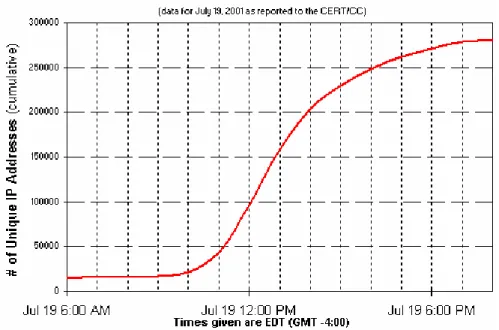
exists in the Indexing Services. Anyone who can reach a vulnerable web server can execute arbitrary code on the system. This results in the intruder gaining complete control of the system. Its activity on a compromised machine is time sensitive; different activity occurs based on the date (day of the month) of the system clock. Data reported to the CERT Coordination Center indicates that the "Code Red" worm infected more than 250,000 systems in just 9 hours. Figure 2.7 illustrates the worm’s propagation activity between 6:00 AM EDT and 8:00 PM EDT on July 19, 2001. After 8:00 PM EDT on July 19 (0:00 GMT July 20), the worm switched into flood mode (launching of a DoS flooding attack against a specific IP address embedded in the code) on most infected systems, so the number of infected systems remained fairly constant after that time. Infected systems may experience web site defacement as well as performance degradation as a result of the propagating activity of this worm. In severe cases, the degradation will cause some services to stop entirely, since it is possible for a machine to be infected with multiple copies of the worm simultaneously.
Figure 2.7: IP Addresses compromised by “Code Red” Worm
The Slammer worm [49] consists of self-propagating malicious code that exploits the vulnerability in the Resolution Service of Microsoft SQL Server 2000 and Microsoft Desktop Engine (MSDE) 2000. This vulnerability allows for the execution of arbitrary code on the SQL Server system due to a stack buffer overflow, resulting in compromise of the systems. The high volume of traffic generated by the infected systems trying to find and compromise other systems (that is, propagation of this
2.1 DoS and DDoS Attacks
malicious code to UDP port 1434 of randomly chosen IP addresses) has caused varied levels of network degradation across the Internet, resulting in DDoS conditions.
2.1.2.2 Attacks on routes to resources
The original Routing Information Protocol (RIP) [50] is not secure. It is possible to disrupt the routes to the target by injecting bogus RIP packets into a network, resulting in DoS. If the attacker’s system is closer to the target than the real source system, it will also be possible to divert traffic to the attackers. RIP version 2 [51] provides authentication support to increase the security of the routing protocol by preventing routers from accepting routing packets from unauthorized entities.
The Border Gateway Protocol (BGP) [52] is an inter-autonomous system routing protocol. An autonomous system (AS) is a network under a common administration. BGP is used to exchange routing information for the Internet and is the protocol used between Internet service providers (ISP). The nature of the BGP protocol gives autonomous systems considerable latitude in determining which routes to modify, forward, or reject. This implies that there is a class of routing attacks that cannot be avoided simply because they do not necessarily constitute malicious behavior. For instance, the AS7007 incident [53] in April 1997 was caused by a misconfigured router that flooded the Internet with incorrect advertisements, announcing AS7007 as the origin of the best route to essentially the entire Internet. As a result, that AS quickly became a major traffic sink, and it disrupted reachability to many networks for several hours. Similar events occurred in Apr. 1998, when AS8584 announced 10,000 prefixes it did not own, and in Apr. 2001, when AS15412 announced 5,000 prefixes it did not own [54]. Therefore, in the event that one or more BGP routers are compromised, it could result in DoS attacks that would have a forceful impact on the entire Internet.
Most external BGP sessions are between adjacent routers. Therefore, to protect from attackers trying to hijack a BGP session, [55] proposed setting the IP header TTL field to a value that allows those BGP packets to reach the receiving router only if the latter is exactly one hop away from the sender. To protect against spoofed messages and TCP connections hijacking, BGP sessions are often protected using the TCP MD5 signature option [56], which is a new TCP option to carry a MD5 digest in the TCP segment. The digest acts as a signature for that segment, incorporating information known only to the connection end points. Therefore, to spoof the connection, the attacker not only needs to guess the TCP sequence numbers, but would also have to obtain the password (which never appears in
2. DDOS ATTACKS AND DEFENCES
The Domain Name System (DNS) [57-60] is a distributed database system for mapping host names to IP addresses and vice versa. Hosts send UDP queries to DNS servers and get replies with either the answers to the queries or information about higher level servers (who might hold the answers).
Type Function
A IPv4 address of host
AAAA IPv6 address of host
NS Name server. Specifies a host name where DNS information can be
found about the domain name to which the NS record is attached. SOA Start of authority. Denotes start of a zone; contains cache and
configuration parameters, and gives the address of the person responsible for the zone.
MX Mail exchange. Names a host that processes incoming mail for the designated target.
CNAME Alias for the real name of the host
PTR Domain name pointer. Used to map IP addresses to host names.
HINFO Host type and operating system information
WKS Well-known services. Information about which services are available at a host.
SRV Service Location. Uses DNS to find out how to contact for access to a particular service.
SIG Signature record. Cryptographic public key signature for DNS security.
DNSKEY Public key used in DNS security
NAPTR Naming authority pointer. Used mostly for Internet telephony infrastructure.
Table 2.1: DNS Resource Record Types
Queries made via TCP are for zone transfers. Zone transfers are used by backup servers to obtain a full copy of their portion of the namespace. The different types of resource records (RRs) stored by the DNS is shown in Table 2.1. In the DDoS attack carried out against the 13 DNS root servers in October 2002 and February 2007 [8, 61], the attacker uses bogus ICMP Ping requests to flood the servers for about an hour. Several root servers were overwhelmed by the requests and were unable to provide normal services to the Internet users. Solutions to prevent this attack are for ISPs to provide DNS
2.1 DoS and DDoS Attacks
service only to their own customers, mandate source address verification for DNS servers, and limit the amount of ICMP traffic that the root servers can accept.
In systems with existing security vulnerabilities (for example, due to design or implementation flaws), the attacker will need knowledge of the security weaknesses of the victim and ability to come up with the attack tools targeting them. Such system vulnerability attacks are more difficult to launch compared with bandwidth depletion attacks, which can be accomplished by simply flooding the victim with seemingly legitimate requests. In any case, it is easier for users to detect and defend against system vulnerability attacks (if the vulnerabilities are known) by monitoring attack patterns and performing patches to fix security holes.
2.1.2.3 Flash Crowds
In this section, we explain how flash crowds are similar to DDoS in terms of the impact of congestion on a server but differ in their non-malicious intentions, as flash traffic consists of real legitimate requests. A Flash crowd is an unanticipated, massive and rapid increase in the popularity of a resource, such as a web page, that lasts for a short time. Flash crowd events such as popular webcasts like the Olympics, can be anticipated in advance and precautions can be taken (e.g. in the form of increasing resources for support). However, some flash crowds have no advance warning, such as the September 2001 terrorist attack in the United States, which saw popular news sites, for example the CNN, receiving a dramatic increase in the number of requests.
[62] studied the differences in the characteristics of flash events and DDoS attacks. In flash crowds, the client distribution is expected to follow the population distribution among ISPs and networks, and there is a significant overlap between the clusters of IP addresses a site sees before and during a flash crowd event. As a server gets slower during a flash crowd event, the per-client request rate is lower than usual. This indicates that legitimate clients are responsive to the performance of a server unlike DDoS attackers who generate requests without regards to the server’s load. In DDoS attacks, the client distribution across ISPs and networks does not follow the population distribution. The cluster overlap is also very small. In some DDoS attacks, they involve a few clients emitting very high request rates while some involve a large number of clients generating a low request rate, but in both cases, the per-client request rate is stable during the attacks and significantly deviates from
2. DDOS ATTACKS AND DEFENCES
There are several approaches to remedy the flash crowd problem. A straightforward but costly approach is to provide accessibility based on the peak demand. Another approach is the use of Content Distribution Networks (CDNs) [63-65] which are commercial solutions to help offload the request volume on Web servers by serving a subset of resources on behalf of a set of origin servers via an overlay network. Besides being used to improve routine access to Web sites, CDNs can also serve as insurance protection against flash crowd events so that Web sites can continue to function normally.
For sites such as non-profit organizations, the costly solutions stated above are not justifiable. These sites can then make use of publicly available and Internet-wide infrastructure supports such as widely distributed hierarchical Web proxies, caching networks [66], or peer caching via peer-to-peer overlays [67-69].
2.2
DDoS Defences
There are three categories of DDoS defences, namely prevention, detection and reaction/responses. Attack prevention measures attempt to protect a network or node from damage caused by an attack. Attack detection mechanisms attempt to determine the existence of an ongoing attack with low false positive and low false negative, and provide alerting signals to the response mechanisms. Response mechanisms act during an attack to mitigate it or trace down the attacker (possibly after an attack too) so as to reduce the impact of damage and to institute accountability. In the following subsections, we discuss the existing defence mechanisms. In addition, we introduce DDoS mitigation frameworks, which both detect and automatically respond to various forms of attacks.
2.2.1 Attack Prevention
Egress filtering [32] is a form of attack prevention measure. It performs filtering on outbound traffic and only allows packets with valid source addresses out from the network and into the Internet. This attempts to ensure that networks implementing egress filtering could not be exploited to being a participant in a DDoS attack. Widespread deployment will result in reduction of DDoS attack incidents where spoofed IP addresses are used. However, a way to bypass egress filtering would be to generate attack packets with spoofed IP addresses within the source network address range. D-WARD
![Figure 1.1: Attack Sophistication vs. Intruder Technical Knowledge [1]](https://thumb-us.123doks.com/thumbv2/123dok_us/9331059.2414952/21.892.209.730.555.887/figure-attack-sophistication-vs-intruder-technical-knowledge.webp)
![Figure 1.2: Arbor Networks Inc.’s surveyed ISPs’ most concerning threats [16]](https://thumb-us.123doks.com/thumbv2/123dok_us/9331059.2414952/25.892.230.723.764.1063/figure-arbor-networks-s-surveyed-isps-concerning-threats.webp)
![Figure 1.3: Top 20 Threats and Vulnerabilities, January through October 2007 [17]](https://thumb-us.123doks.com/thumbv2/123dok_us/9331059.2414952/26.892.93.749.451.971/figure-threats-vulnerabilities-january-october.webp)

![Figure 2.8: SOS Architecture [95]](https://thumb-us.123doks.com/thumbv2/123dok_us/9331059.2414952/51.892.278.656.190.496/figure-sos-architecture.webp)

![Figure 4.4: TOPAS Architecture [143]](https://thumb-us.123doks.com/thumbv2/123dok_us/9331059.2414952/86.892.88.766.292.501/figure-topas-architecture.webp)
