National Readiness for E-learning
- a comparative study of Thailand and Sweden
Master thesis, 10 credits, Programme of Systems Analysis, Lund University Presented: April 2005
Writer: Petra Nilsson Supervisor: Erik Wallin
National Readiness for E-learning
- a comparative study of Thailand and SwedenPetra Nilsson
Master thesis, presented April 2005 Pages: 74 (including appendices) Supervisor: Erik Wallin
Abstract
In this thesis a comparative study of Sweden and Thailand was conducted in order to find out why Sweden is top-ranked and Thailand low-ranked on an e-learning readiness scale. More specifically, I was focusing on the net universities in Sweden and in Thailand. The net universities and the countries were contrasted in order to find out, not only if the differences or similarities had any influence of the e-learning readiness rankings, but also to see what could be done to make Thailand more successful in e-learning.
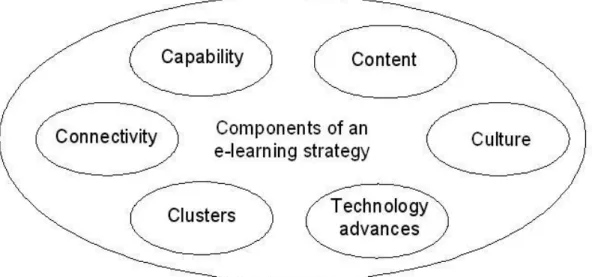
The purpose of the study was to find out how a country best succeed with net universities and e-learning on a national level. The thesis is a qualitative study with interviews and documents used as the primary methods. Based on a previous study, a framework consisting of six components of an e-learning strategy was created and used throughout the study. The components included in the framework are: connectivity, capability, content, culture, technology advances and cluster. The thesis and the framework will hopefully be applicable and useful in other countries that wish to improve e-learning on a national level.
The results of the study show that Thailand and the Thai net university need to make efforts to improve some of the learning components in order to become successful in e-learning and become higher ranked in the e-e-learning readiness scale. Since a high level of quality must be ensured within every component in order to succeed, it is necessary to consider all six components when developing an e-learning strategy.
Keywords
Table of contents
1 INTRODUCTION ... 3
1.1BACKGROUND... 3
1.2PROBLEM AREA... 4
1.3PURPOSE OF THE THESIS... 4
1.4RESEARCH QUESTIONS... 4 1.5SCOPE... 5 1.6THESIS OUTLINE... 5 2 RESEARCH METHODS... 7 2.1RESEARCH METHOD... 7 2.1.1 Qualitative study ... 7 2.1.2 Case study ... 8 2.2DATA COLLECTION... 8 2.2.1 Documentation... 8 2.2.2 Interviews... 9
2.2.3 Preparing the interviews... 10
2.2.4 Conducting the interviews... 11
2.3DATA HANDLING... 11 2.4CRITIQUE OF METHODS... 12 2.4.1 Reliability... 12 2.4.2 Validity... 13 2.5ETHICAL ASPECTS... 14 3 E-LEARNING ... 15 3.1DEFINITION OF E-LEARNING... 15 3.2POSSIBLE EFFECTS... 16 3.3E-LEARNING READINESS... 17
3.4E-LEARNING IN THE KNOWLEDGE-BASED SOCIETY... 19
3.5COMPONENTS OF AN E-LEARNING STRATEGY... 20
3.5.1 Connectivity ... 21 3.5.2 Capability... 21 3.5.3 Content... 22 3.5.4 Culture ... 23 3.5.5 Technology advances ... 24 3.5.6 Cluster... 26 4 THAILAND ... 28 4.1GENERAL INFORMATION... 28 4.1.1 Education in Thailand... 28 4.1.2 ICT in Thailand... 29
4.2THAILAND CYBER UNIVERSITY... 29
4.3CONNECTIVITY... 30 4.4CAPABILITY... 32 4.5CONTENT... 32 4.6CULTURE... 33 4.7TECHNOLOGY ADVANCES... 34 4.8CLUSTER... 34
5 SWEDEN... 36 5.1GENERAL INFORMATION... 36 5.1.1 Education in Sweden... 36 5.1.2 ICT in Sweden ... 37 5.2THE SWEDISH NET UNIVERSITY... 37 5.3CONNECTIVITY... 38 5.4CAPABILITY... 38 5.5CONTENT... 39 5.6CULTURE... 39 5.7TECHNOLOGY ADVANCES... 40 5.8CLUSTER... 42 6 COMPARISON ... 43 6.1GENERAL INFORMATION... 43 6.2CONNECTIVITY... 43 6.3CAPABILITY... 44 6.4CONTENT... 44 6.5CULTURE... 45 6.6TECHNOLOGY ADVANCES... 45 6.7CLUSTER... 45 6.8SUMMARY OF COMPARISON... 46
7 DISCUSSION ON STUDY FINDINGS... 47
7.1GENERAL INFORMATION... 47 7.2CONNECTIVITY... 47 7.3CAPABILITY... 48 7.4CONTENT... 49 7.5CULTURE... 49 7.6TECHNOLOGY ADVANCES... 50 7.7CLUSTER... 50 8 CONCLUSIONS... 52 8.1CONCLUDING REMARKS... 52
8.2RECOMMENDATIONS FOR THE FUTURE DEVELOPMENT OF TCU... 53
8.3REFLECTIONS ON THE STUDY... 54
8.4SUGGESTIONS FOR FURTHER RESEARCH... 54
9 REFERENCES ... 55 10 APPENDICES ... 60 INTERVIEW 1 ... 60 INTERVIEW 2 ... 63 INTERVIEW 3 ... 67 INTERVIEW 4 ... 69
1 Introduction
This chapter describes the basis of the thesis and gives an overview of what the thesis aims to study. A description of the background, the research questions, the purposes, as well as the scope of the study and the outline of the thesis, is presented in this chapter.
1.1 Background
Over the last few years Information and Communication Technology (ICT) has come to play a major role for organisations working for poverty reduction. Since the development of Information Technology (IT) is of different levels in different countries, there is a risk that IT strengthens the developed countries while the developing countries become weaker. It is therefore of great importance that also the poor countries will receive the benefits of ICT and avoid falling even further behind in the global development. Great efforts needs to be made to bridge the digital divide, both within and between countries, since the ICT is becoming more and more important in the social and economical development (SIDA, 2003).
One way for IT to support developing countries is by improving the education. There is a great difference between the number of people that has access to higher education in developing countries compared to developed countries. Higher education is essential for closing the gap between the industrial and the third world (Daniel, 2005b). E-learning is a way to close this gap. E-learning refers to the use of Internet technologies to provide education with advantages such as low costs and high flexibility, including accessibility any time and any where (Rosenberg, 2001). ICT has also created new opportunities for universities. Studying at a net university is a way of using e-learning, taking advantages of the technological benefits, transforming and hopefully improving the education. E-learning in schools is used to reach a broader segment of the population and to meet the needs of non-traditional students (EIU, 2003).
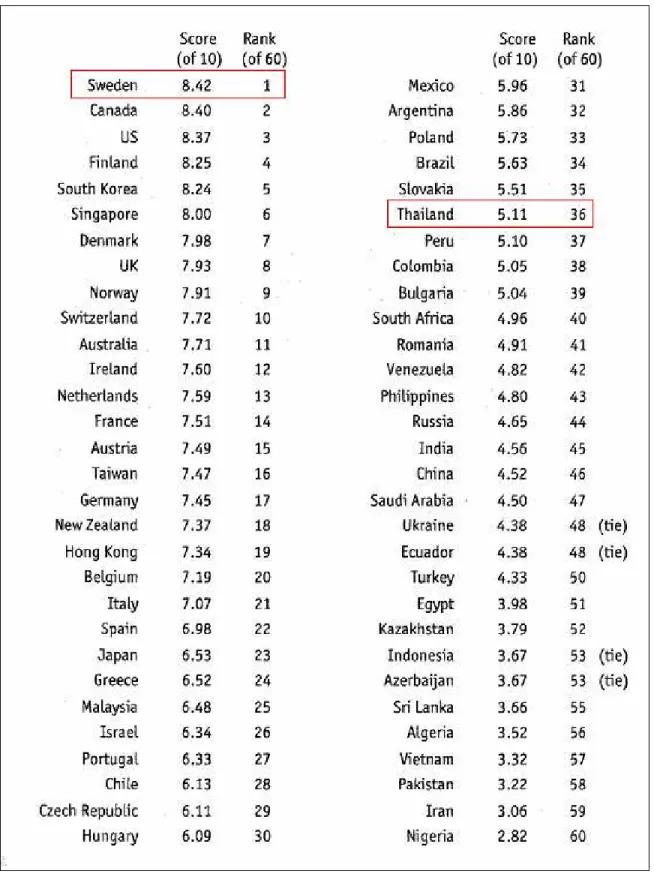
However, the success of learning differs in different countries. According to an e-learning readiness scale made by the Economist Intelligence Unit (EIU) Sweden is ranked as the top leader among 60 countries. This can be set in contrast to Thailand, which is ranked at 36th place in the same scale (ibid.) A combination of different factors influences the success of e-learning in a country and all of these factors have to be considered in order to improve the success. A relevant question to consider is why Sweden is placed in the top of the e-learning readiness ranking while Thailand is placed at 36th.
1.2 Problem area
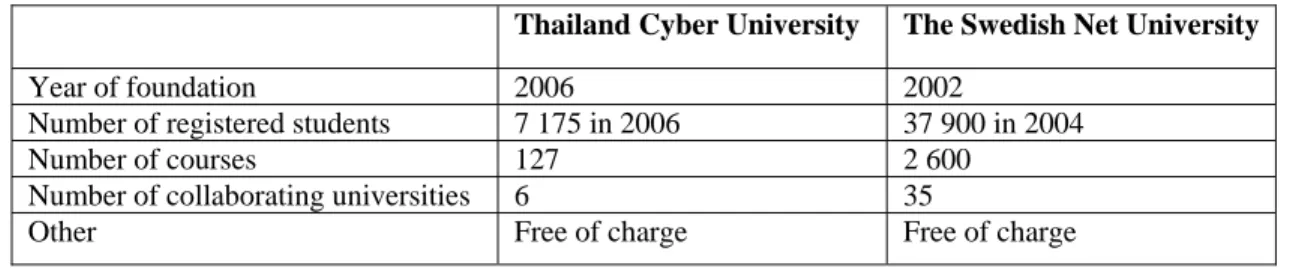
In this thesis I study the reasons why Sweden is being high-ranked and Thailand low-ranked in the e-learning readiness scale. More specifically I focus on net universities in Sweden and Thailand and compare them in order to find out, not only if the differences or similarities have any influence of the e-learning readiness rankings, but also to see what could be done to make Thailand more successful in e-learning. A recommendation of the future development of the Thai net university, called Thailand Cyber University (TCU), in accordance with current trends and theories within the field of e-learning is also articulated.
The intended target group of the thesis is primarily students and teachers at the Department of Informatics at Lund University. In addition to this I hope my findings will be of interest to institutions and universities in Thailand working with e-learning.
1.3 Purpose of the thesis
By writing this thesis I intend to provide a study that investigates what is needed for a country to improve the success of net universities and e-learning.
I hope to gain knowledge in the field of e-learning that are useful for my own and others’ understanding of the area. The study will hopefully be useful, not only for Thailand in order to improve their e-learning readiness ranking and in the development of the net university, but also in other developing or developed countries, that wish to improve e-learning.
1.4 Research questions
By conducting this study I intend to find answer to the following question: What is needed for a country to improve the success of net universities and e-learning? In order to reach an answer for this I aim to use the following questions:
• Why is Thailand low-ranked and Sweden high-ranked in the e-learning readiness ranking?
• What is needed for Thailand to get a higher ranking?
• What are the differences and similarities between the Swedish Net University and Thailand Cyber University?
• How will Thailand Cyber University develop in the future and what impact will it have on the e-learning readiness of Thailand?
• How should Thailand Cyber University develop in the future in order to succeed?
1.5 Scope
In this thesis I have chosen to focus on two specific countries, Sweden and Thailand, in order to contrast them. Although it would have been interesting to study and compare other countries in the e-learning readiness ranking this have been excluded in this thesis. I have chosen to study Thailand since my intention was to study a developing country with a relatively low ranking in the e-learning readiness scale. Since e-learning has become an important factor in order to improve the education level in Thailand, I found the country interesting to study. As a Thai exchange student made research within the field of e-learning at the Department of Informatics I also had the benefit to obtain information and contacts in Thailand. I have chosen to study the field of e-learning from an overall perspective, studying several aspects as opposed to focusing on any specific aspect. Since successful e-learning depends on several factors I would not be able to answer my research questions or reach my purpose with a deep focus on only one aspect.
1.6 Thesis outline
Chapter 1 – IntroductionIn this introductory chapter the background of the thesis is described together with the research questions, aim and purposes and the scope of the thesis.
Chapter 2 – Research methods
In this chapter the research methods used in the study are described followed by an explanation of why they are suitable in this thesis. I also provide details about the planning, preparing and conducting of the study. In the end of the chapter critique of the methods, as well as ethical aspects, are discussed.
Chapter 3 – E-learning
This theory chapter starts with a short history and an introduction to e-learning. E-learning is then described in the context of the knowledge-based society which is followed by a presentation of the e-learning readiness study. The theoretical framework that I have composed is then presented. This framework consists of six components that are used throughout the thesis.
Chapter 4 – Thailand
This chapter consists of the empirical data that have been collected about Thailand. The chapter starts with general information about Thailand in order to give the reader a brief introduction to the country. Information relating to the country as well as to Thailand Cyber University are then presented within the theoretical framework.
Chapter 5 – Sweden
This chapter has the same structure as the previous one. It starts with general information about Sweden, followed by information related to the country and the Swedish net university within the frame of the earlier presented components.
Chapter 6 – Comparison
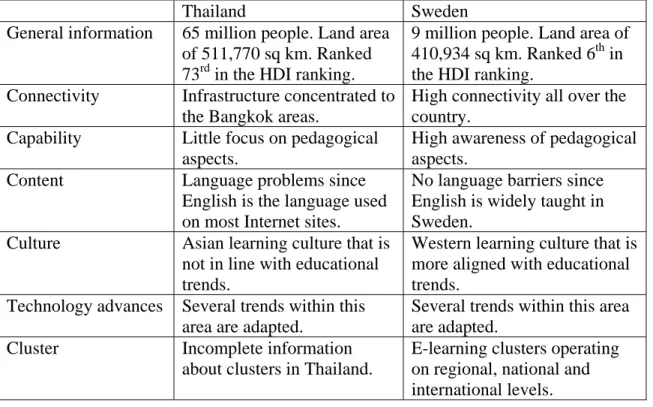
In this chapter Thailand and Sweden are contrasted. This starts with a comparison of general information about the countries followed by comparisons of information within the strategy framework. The chapter ends with a summary of the comparison in order to get a quick overview of the contrasts between the countries.
Chapter 7 – Discussion
In this chapter I discuss the comparison presented in chapter 6.
Chapter 8 – Conclusions
In this final chapter the conclusions of the discussion are presented. Recommendations for the future development of Thailand Cyber University are provided after the conclusions. This is also where I summarise the answers of my research questions. Finally I give reflections and comments on the work of the thesis as well as suggestions for further research.
As several abbreviations and concepts are used throughout the thesis, a list of these is presented in the appendices in order to facilitate for the reader.
2 Research methods
This chapter describes the process and the choices of the research method. An explanation of the method is followed by a description of how the work has been planned, conducted and analysed. As a final point critique of the methods and ethical aspects are discussed.
2.1 Research method
When planning a study the purpose must be well established as this will affect the method that is used. There are several different types of studies that in most cases differ by the amount of information that is available within a specific area. Studies that lack certain information and aim to gain as much knowledge as possible within a problem area are called explorative studies. These types of studies try to illustrate broad problem areas and are often used as a base for further studies (Patel & Davidson, 1994). As I intend to find information about e-learning and net universities in Thailand and Sweden, this study is focusing on information gathering rather than to discover peoples’ values or opinions. The purpose of the study is therefore most in line with explorative ones.
There are two methods that often are used in research; induction and deduction. The inductive method starts with data collection in order to look close at a phenomenon and is followed by more general and theoretical conclusions. There is an ambition to collect data without preconceptions in inductive work. This has however been criticized since the selection of phenomenon involves a theoretic standpoint. As opposed to induction, deductive work starts off with a theory, which is later proved empirically. The theory has an important role in deduction since it is from this the study is derived from (Wallén, 1996).
I have chosen to use a deductive method for my study. I started by examining what was written about the field of e-learning and e-learning readiness and continued to develop a theoretical framework which I used throughout the thesis. The framework was then applied to each country and its net university. This can be seen as a deductive process since the existing theories were used as a foundation for the empirical study.
2.1.1 Qualitative study
There are two different traditional approaches that can be taken in scientific research; a qualitative and a quantitative approach. Methods associated with a qualitative approach have the ambition to gain a deeper understanding of the studied objects. The aim in qualitative studies is to give a vivid and detailed view of the social reality. The qualitative researcher tries to express events, actions, norms and values from the perspective of the
studied objects in order to create a thorough understanding of their experience. The information that is collected in a qualitative study is often described as more thorough than information in a quantitative study. In quantitative studies there is generally more focus on collecting data from a large number of people in order to generalise it on a larger population. The quantative approach is often associated with studies within the area of natural science. In the qualitative approach there is a strong connection with the context since there is an attempt to understand objects in its circumstances. The overall view is emphasised within qualititative research when social entities are to be explained and understood in its totality (Bryman, 1997). By conducting this thesis I intended to get a deep understanding of the objects I studied. My intention was to focus on a few objects rather than trying to generalise a great amount of data in a larger field. The research questions and the purposes of the study are more in line with the qualitative approach.
2.1.2 Case study
What strategy to choose in a study is based upon the type of research question, the degree of control the investigator has over behavioural events and whether the study is contemporary or historical (Yin, 2003). Yin (2003) proposes five main strategies to choose among in a study; experiments, surveys, archival analyses, histories and case studies. Since each strategy means different advantages and disadvantages it is important to be aware of the differences between them in order to choose the most suitable. A case study is preferred when the study is intended to answer questions like how and why, when the investigator has little or no control of the events and when the study is contemporary (ibid.). In this thesis I will primarily focus on how and why questions in an explorative manner, which is in line with case study conditions. The study focuses on a contemporary context where I as an investigator intend to have no control over behaviours during the data collection. According to Yin’s (2003) arguments a case study is preferable for this study.
2.2 Data collection
There are several ways to collect data in order to answer research questions. A combination of several different techniques is often used to collect information for explorative studies (Patel & Davidson, 1994). I have chosen the techniques that in the best way answer my research question. The information that has been used in this study is collected from documents and interviews. The data collection has been structured by a framework of six different components included in an e-learning strategy (see section 3.5).
2.2.1 Documentation
The choice of documents should be done in order to gain a comprehensive picture of the problem. By using several sources to describe the same issue the problem is studied in more than one perspective. Documents can be used in order to answer questions about actual facts or real events, as well as answering questions about people’s experiences. In both cases it is essential to ensure that the presented facts are reliable. To ensure the
reliability of the facts there are a few relevant questions to consider. When and where the documents were published as well as why and in what purpose the creator had, are relevant questions in the critique of data. Who the creator is, what relation he had to the event, his background and possible influences are also to be considered. In order to create a reliable picture of the problem the information that is collected must not only support the researchers own ideas and opinions, but also present information that contradicts the results (Patel & Davidson, 1994). In accordance to Patel & Davidson (1994) I have collected information from many different sources in order to gain different views of the problem. Before using the sources I have studied the documents and the writers in order to prevent non reliable facts. Some of my sources have been more used than others. Reports from the Economist Intelligence Unit have been widely used to gain information about e-learning readiness. Much of the information about the net universities is collected from the web pages of TCU, the Swedish Net University and the Swedish Agency for Networks and Cooperation in Higher Education. Other central sources are the Commonwealth of Learning and UNESCO, who have given information about e-learning from a developing country’s perspective. Since e-learning is a reasonably contemporary issue I have tried to gain as much information as possible from updated Internet web pages.
2.2.2 Interviews
Interviews create more detailed information from fewer people (Kvale, 1997). In this study I have chosen to conduct three interviews via telephone and one interview via e-mail.
The degree of structure can vary depending on the purpose of the data collection. An unstructured interview has open questions, which means that the format and the content of the questions are undetermined. Structured interviews contain determined questions which require specified answers. Semi-structured interviews can be seen as a combination of unstructured and structured interviews. In this type of interviews there are basic guidelines to follow (Andersson, 1994). Explorative interviews are open and not very structured. New information with new perspectives about questions, areas or problems is often searched for in explorative interviews (Kvale, 1997).
I have chosen to use semi-structured interviews for the telephone interviews in this study. With semi-structured interviews I have the possibility to gain information about the topics I am interested in without being constrained by the questions. In this way I can follow up topics that I am more interested in and form the interview as I prefer it. The respondents have the possibility to explain the central factors in the topics in their opinion and they are allowed to talk freely during the interview. I gave the respondents this possibility but ensured that the topics were followed. In that way I ensured that I received the information I searched for without controlling the respondents during the entire interview.
One of the interviews was conducted via e-mail. In an e-mail I presented my self and my study, the purpose of the interview followed by the interview questions that was adapted
to the respondent. The respondent then wrote down the answers in a document and sent it to me via e-mail.
In quantitative research random selections are most frequently used. The selection of respondents in a qualitative study is often more intentionally done (Bryman, 1997). In the planning process of the interviews selections have to be made not only among people but also among environments, events and social processes. One way to conduct the selection is to choose persons, environments or objects that meet specific criteria (Miles & Huberman, 1994). When selecting respondents for my interviews I have considered the persons’ professions and knowledge area. I have chosen to interview persons that in some way are involved and have knowledge of the net universities in Sweden and in Thailand. Table 1 shows an overview of the persons that have participated in the study.
Table 1 Interviews Interview 1 Ann Sofie
Fredriksson
Information Officer at the Swedish Agency for Networks and Cooperation in Higher Education. Ann Sofie
Fredriksson works with the Agency’s and Net
University’s marketing and information as well as with web publishing.
Interview 2 Janerik Lundquist
Chairman of the International Committee at the Swedish Agency for Networks and Cooperation in Higher
Education Janerik Lundquist is associate professor, Linköping University and vice president of the European Association of Distance Teaching Universities.
Interview 3 Anonymous Programmer at the Chulalongkorn University which is one of the collaborating universities in TCU.
Interview 4 Nenad Cuturic
Webmaster and in charge of IT at the Swedish Agency for Networks and Cooperation in Higher Education. He works with the technical side of the web portal,
communication, and learning platforms.
2.2.3 Preparing the interviews
The interviewer needs to be well prepared and familiar with the case in point in order to conduct an interview with high quality. Awareness of what information to search for as well as knowledge within communication also increases the quality of the interview (Kvale, 1997). I prepared myself in order to gain knowledge within the field of e-learning by reading articles and study theories before the interviews were conducted. As far as possible I also tried to gain information about the respondents’ environment that could be relevant for the interviews, such as professions or background information. This was also applicable in the preparation of the interview questions.
Before conducting the interviews I prepared interview guides. Interview guides for semi-structured interviews contain an overview of what areas that will be covered as well as suggestions of questions (ibid.). I used interview guides since it would help me focusing
on the research area and the information I searched for during the interviews. I constructed one interview guide for each interview as the respondents work in different areas. Since the respondents are qualified to answer different questions the interview guides were adjusted to each respondent.
2.2.4 Conducting the interviews
Due to geographic distances it has not been possible to perform face-to-face interviews in this study. Instead I conducted the interviews via telephone and one via e-mail. By not being able to observe the respondents’ facial expressions there is a risk that states of mind or physical expressions can not be perceived (Kvale, 1997). However since the intention of my interviews was to gain information rather than explore the respondents’ personal opinions, I consider the telephone and e-mail interviews suitable for the purpose.
During the telephone interviews I used a speaker phone in order to record the interviews, as well as taking notes manually. The manual note taking was used in case of technical malfunction as well as gaining a second view of the interview. The recording allowed me as an interviewer to focus more on the interview and to adjust the questioning after my interests and objectives. However recording can also involve disadvantages; there is a risk that the respondents feel uncomfortable when their words are recorded (ibid.). In order to prevent this I chose to inform the respondents about the interview techniques and then asked them for permission to use speaker phone and a recorder. All of the respondents gave their permission.
The ability to determine the degree of structure in an interview is important in order to decide what is the most appropriate in the current context. A too structured interview can close the possibility to find new knowledge, although a too unstructured interview can lead to a loss of focus. The interviewer must therefore estimate when to follow up a question and when to follow the interview guide (Kvale, 1997). I used the interview guide as support for my interviews rather than strictly following the questions. I tried to direct the interview with my interview questions without preventing them from talking freely.
2.3 Data handling
It is common that the researcher starts to search for patterns, flows or relationships already during the data collection. In this stage and during the whole data analysis it is important to keep an openness and scepticism towards the conclusions. Usually the final conclusions cannot be drawn until the data collection is finished (Miles & Huberman, 1994). Printing the data includes an interpretation done by the person performing the transcription. There is a risk that the recorded material is transcribed differently by different persons. Breaks, giggles and sighs can be perceived differently depending on the one that interprets the data (Kvale, 1997). As mentioned earlier I recorded my telephone interviews although it involves a lot of work afterwards. I printed the interviews in order to manage the collected data.
Before the transcription is started, rules of how to print the interview have to be cleared out. The transcriber must for example determine whether the statements will be printed literally, if the transcriber will conclude parts of the interview that will be of importance for the analysis and whether breaks, sighs or emotional expressions will be described (ibid.). I have chosen to exclude breaks, laughs, and similar emotional expressions in the transcription. However, I believe that this kind of details will not provide the interviews with more information contributing to the purpose of the interviews.
An analysis of the interviews can be easier to handle by using different methods. Using a data handling method facilitates the analysis with a type of tools that is relevant for interviews. One of these methods involves categorising the interviews into categories so that a large amount of text is reduced and structured (ibid.). I find this type of data analysis method suitable in this study for both the telephone interviews and the email interview. I have chosen to use the six different components in my framework (see section 3.5) as categories for the analysis. By using this method I have structured the interviews and connected it to each category. In this way further analysis is easier to conduct. After categorising all interviews, information about every component for each country was summarised. For every component I contrasted the countries, allowing me to discover similarities and differences between them (see chapter 6). This was followed by an analysis of why there were differences or similarities between the countries, which then were related to existing theories within the field of e-learning (see chapter 7). Empirical material within every component where related to e-learning theories within every component.
2.4 Critique of methods
As a researcher it is important to reflect on the quality of the study during the data collection and the data analysis (Miles & Huberman, 1994). The two most common ways to ensure the quality of a study is by reliability and validity. I have tried to ensure the quality of this study by continuously reflecting on these concepts.
2.4.1 Reliability
The reliability is an important aspect that needs to be considered in a study. If the study is repeated by the same methods but with another researcher and shows the same results the reliability in the study is high. There is always a risk that the individual knowledge basis and preconceived ideas of a researcher can affect the study and its results (Yin, 2003). People often search for a meaning in what we see, read, discover or experience. We organise and interpret the world using our earlier experiences, knowledge and preconceived ideas. In the research it is important to ensure that these interpretations are real as well as to ensure good quality (Gilovich, 1991). I have been aware of this risk during the study when I have suspected that this can affect the result. I have been aware of how my presence and the way I ask the questions in the interviews can influence the respondents’ answers. Not only can I affect the respondents, the respondents and the
environment can have a great influence of me as a researcher, which I also have had in mind in order to prevent adjusting conclusions or theories to the current situation.
In order to ensure the reliability of the transcription it is recommended to let two persons independent of each other print the material and to note differences (Kvale, 1997). Since I conducted this study alone this has however not been possible in this study. Instead I used my manual note takings during the interview as a second view of the transcription. The transcription was also sent to the respondents in order to ensure that my interpretation of the interview was in line with the respondents. During the first interview only the manual note taking was used due to a failure of the recording. Contrary to the other interviews this interview was therefore summed up by my own words. However, since the respondent confirmed that the summary was in line with her statements, I consider this interview reliable.
In order to enhance the reliability in the study I have attached the transcription or summary of the interviews. This will give the reader the opportunity to create an opinion of their own about the respondents’ statements and make their own interpretation (Yin, 2003). One of the respondents specifically expressed a wish of not attaching the transcription in the thesis, which I of course respected. The transcriptions are written in Swedish since the respondents have answered in Swedish. Since the primary target group are students and teachers at the Department of Informatics in Lund, the transcriptions have not been translated to English.
2.4.2 Validity
Validity means that a method studies what it intends to study (Miles & Huberman, 1994). A difficulty in qualitative interviews is to ensure that I as an interviewer have understood the respondents correctly. Preconceived ideas in combination with personal, political and cultural values can affect the interpretation of the interviews (Kvale, 1997). The approval from the respondents of the transcriptions is one way of preventing this as well as strengthening the validity of the interviews. This verifies that the printing of the interviews is in line with the respondents statements. It is also a way of controlling and, if needed, questioning the information, which strengthens the validity in interviews (Kvale, 1997). If the respondents consider the transcriptions not to be in line with their opinions a new collection of data is required, followed by a repetition of the controlling procedure (Yin, 2003).
A detailed description of the work flow allows the reader to follow every step in the study (ibid.). Since qualitative studies are dependent of context, perspective and participants I have tried to explain the studied environment and the way of working in order to allow the readers to build their own opinion as well as to repeat the study if this is desired.
2.5 Ethical aspects
As important as it is to ensure the quality of a study, the consideration of ethical aspects also must be taken into account. It is necessary to reflect on what actions are right and wrong and what in the study can have an influence on people. The researcher has the responsibility to consider ethical issues in the study in order to increase the awareness and decrease the risk of arising ethical dilemmas. Before the study starts researchers should consider if their knowledge within the field is enough in order to conduct a study. Ethical aspects should be considered before, during and after the study (Kvale, 1997). It is recommended to question the respondents’ advantages and disadvantages when they participate in the study (Miles & Huberman, 1994). The participation in this study means investment in time and energy for the respondents. The interviews can allow the respondents to consider the subject and the questions and in some cases express their opinions. My hope is that this study will be useful for the respondents. I also hope that it can be usable also for people working with e-learning outside Sweden and Thailand. My hope is therefore that the respondents’ participating and investment in time in the study will bring about advantages.
Before the interviews start off an approval of participation should be finished (Miles & Huberman, 1994). I described my study, my purpose and my way of working for the respondents. I also described how the interview would be conducted and gave an overview of what topics that would be discussed. I asked the respondents for approval of using their names in the study. One of the respondents did not want me to use the respondent’s name in the thesis, which I of course respected.
There are no clear guidelines to ensure ethical quality in a study. Ethical aspects are more about considering the respondents involvement and to reflect on the effect the created knowledge can have on the society (Kvale, 1997). By reflecting on ethical dilemmas and discussing the different aspects within the field of ethics in research the ethical quality of the study can be strengthened and thereby also contribute to the overall quality of the study.
3 E-learning
In this chapter I aim to give an introduction to learning. Concepts within the field of e-learning are defined, followed by a description of possible effects. The e-e-learning readiness study is described as well as a clarification of e-learning in the context of a knowledge-based society. In the end components of an e-learning strategy are described. These are used as a framework throughout the thesis.
3.1 Definition of e-learning
There are several terms to describe the use of technology for learning and the terms tend to change rapidly. Below I explain a short history of e-learning in order to clarify some of the terms that have been used within the field of technology for learning.
As more and more personal computers were deployed in offices and homes in the seventies and eighties, the use of computer-based training (CBT) increased (Rosenberg, 2001). With CBT it is possible to learn by utilising special training programs on a computer, often equipped with CD-ROMs, which makes the education more viable (Webopedia). CBT has the benefits of interactivity, which was missing in the previous period of educational television in the fifties and sixties. Although the benefits were apparent in the early days of the CBT, several imperfections soon were discovered. CBT programs were often limited by poor graphics, slow computer speeds and small hard drives, which led to dull programs composed by text based screens. CBT neither met the needs of changing technology nor the new approaches to learning where great advances were made in order to understand how people learn (Rosenberg, 2001). This gave rise to web-based training, which refers to the use of Internet or Intranet in order to provide training or instruction using a Web browser. For instance web-based training includes audio and video, portals of information and interactive methods such as chat rooms and instant messaging (Webopedia). This is similar to online learning which refers to education in a distance education mode and only occurs through the web. In this type of learning there is no face to face contact or any physical learning materials (Nichols, 2003).
According to Rosenberg (2001) e-learning has greater possibilities than the concepts described above. Based upon three criteria he describes e-learning as follows:
1) Firstly, e-learning is connected to a network, making it possible to update, store, distribute and share instructions and information instantly. This excludes instructional CD-ROMs that lack the possibility of immediate update and deliver immediately.
2) Secondly, e-learning is delivered to the user via a computer that uses standard Internet technology.
3) And finally, e-learning focuses on a broad view of learning which differs from the traditional views of education. It goes beyond the terms CBT and web-based training as well as distance learning since it includes more than what these concepts consist of (Rosenberg, 2001).
In distance learning learners are separated from trainers and teachers mostly by time and space. Technology or media are used to make communication possible. Closely related to the term distance learning is open learning. Open learning has the ambition to describe learning with as few barriers as possible. Open learning is directed to whole populations regardless of gender, age, background or other possible barriers in the public surroundings. Students living in remote areas using distance learning are in a way also using open learning since the education is open for the students in the way it has not been before. Although separated in terms, open learning and distance learning are closely linked, which makes it hard to discuss one term without the other (Daniel, 2005a).
I will be using the term learning in this thesis. The definition below is used in the e-learning readiness study and also the definition that is most in line with my perception of e-learning:
“E-learning is defined as formal and informal education and information-sharing that uses digital technology” (EIU, 2003).
3.2 Possible effects
ICT is an essential factor in the improvement of the national performance and wealth of a country. In today’s rapid change of technologies it is important to follow the development in the IT sector (Al-Rawas, 2001). E-learning has advantages such as: low costs, consistent or customized content depending on need, and more up to date and dependable content. E-learning can be delivered anytime and anywhere; it supports universal internet protocols and browsers and it can build communities by the sharing of knowledge. It can be used in small or very large scales, and it provides an increasingly valuable customer service (Rosenberg, 2001). Digital material is cheaper to copy, distribute, adapt and share than other formats. E-learning can provide interactive components of learning, which are important to the success of many students. The quality of interaction often has great influence on the overall quality of a university (Daniel, 2005b). In developing countries literate workforces, functional infrastructures and investments in human capital are not as apparent as in developed countries. E-learning in the developing world is faced by challenges obtaining basic literacy, functional local, regional and national infrastructure, technological leadership and social, linguistic and cultural factors (Al-Rawas, 2001).
3.3 E-learning readiness
The Economist Intelligence Unit is a research and advisory firm that provide analysis in political, economic and business in different countries around the world. The Economist Intelligence Unit has published a report of e-learning readiness ranking of 60 countries. In this context e-learning refers to formal and informal education and information-sharing that uses digital technology. The e-learning readiness specifies a country’s ability to produce, use and expand e-learning at work, at school, in the government and in the society at large in order to improve the country’s economic activity.
The study has 150 criteria, categorised into four groups: government, industry, education and society, which in turn are organised into four areas, the four Cs: connectivity, capability,content and culture.
1. Connectivity refers to the infrastructure, including broadband connectivity, mobile-phone usage, and PC usage. When the quality and the extent of the infrastructure are high and Internet is available in rural areas among poor people and used throughout the society, the connectivity is fulfilled.
2.Whereas the connectivity is essential for a country to become successful in e-learning the capability is necessary. Capability is measured by how well a country delivers and consumes e-learning based upon traditions of learning, literacy rates and educational trends. Successful e-learning countries have a strong education system, support for lifelong learning, a high rate of literacy as well as a broad tradition of learning.
3. The content indicates the quality and commonness of online learning materials, such as library materials, newspapers, corporate information and government databases. It is crucial that this material is published in the country’s native language, making informal learning possible and strengthening e-learning programs at schools or companies. By keeping a low censorship and encouraging schools and libraries to increase funds for online learning material the government can support the content of the country.
4. The last area, which in combination with the other factors is necessary to succeed in e-learning, is culture. Culture is about a country’s beliefs and behaviours of e-learning. A country that respects the teaching profession, welcomes Internet improvements, values learning high and has a public acceptance of online learning has a good chance of succeeding in e-learning.
The e-learning readiness study of 2003 ranked Sweden as number one while Thailand was positioned at 36th place. Good IT infrastructure, people’s willingness to integrate the Internet into their daily lives, and a first-rate education system are the reasons why Sweden was placed number one. The Swedish government has provided online government services, at both national and local levels, which, according to the Economist Intelligence Unit, has helped Sweden to become the front-runner in the ranking (EIU, 2003).
3.4 E-learning in the knowledge-based society
Knowledge has long been an important factor in economic growth. The term
knowledge-based society refers to the role of knowledge and technology in economic growth and
great efforts are made to understand the area. The importance of production, distribution and use of knowledge are continuously growing and countries are becoming more dependent on this as the knowledge becomes a part of the whole society. Education will play a central role in the knowledge-based economy (OECD, 1996). It is now common that education systems around the world have problems to meet the needs of knowledge-intensive societies. The globalisation and the growth of information with knowledge from many more sources than before create new needs for learning. As the conception of knowledge is changing we are moving towards a more activity-based, distributed, customised, adaptive and interactive paradigm. The social changes caused by globalisation, technology developments and the information explosion is also changing the view of the universities. The traditional views of the universities have to be reconsidered and the universities need to rethink their roles. ICT is giving new possibilities for universities both in how to run the business of higher education and in the methodologies of teaching and learning (Mason, 2003). There is an increasing demand of capabilities of selecting relevant and disregarding irrelevant information as well as recognizing patterns and interpreting and decoding information. Investments oriented towards skill development of gathering and utilising information are essential in order to remain and develop the efficiency of the market economies. Learning will be a factor that influences both individual and organisational advancements. The success of national economies as a whole is also greatly dependent on the effectiveness in gathering and utilising knowledge. In order to exchange knowledge as a driving force for innovation, interactions in a community of actors within industry, government and academia are essential. Participators from every area are important since every sector has its own knowledge and plays a specific role and the knowledge acquirement is necessary in all sectors (OECD, 1996). In the increasing participation in distance and virtual education, the private sector has been a driving force. Many companies view e-learning as a strategic necessity in today’s knowledge economy recognizing the benefits of advancing the employees’ careers without training-related travel expenses and decreasing employee productivity (Farrell, 2001).
Workers will be in need of formal education as well as the capability applying the knowledge as they increasingly will be paid for their knowledge skills rather than for their manual work. In the knowledge-based society, training and learning are becoming increasingly common in non-formal settings, allowing the learner to use the knowledge in practice where new kinds of knowledge are developed (OECD, 1996). Learning is taking part of everyday life. The so called embedded learning is a social and informal activity rather than a peripheral and formal one. The current architecture of learning environments has to be reconsidered in order to adapt it to new views of learning. Reflections, sharing of knowledge and feedback from others with innovative technologies, such as blogs, are required in the learning society and knowledge economy (Verstraete, 2006).
3.5 Components of an e-learning strategy
An e-learning strategy should comprise educational sectors at all levels, benefiting all members of society including individuals that are unable to access higher education because they live in remote areas, are disabled, sick or unable to travel (Al-Rawas, 2001). Since many parties are involved in e-learning, with many different views of what learning events are and what they can be, it is vital to develop a strategy ensuring that e-learning has the best possible chance of succeeding. An e-learning strategy considers issues of technology, learning, effectiveness, culture, leadership, justification, organisation, talent, and change, and must deal with a combination of these areas (Rosenberg, 2001).
Below I have summed up components that should be considered in a strategy. These are based upon the four areas in the e-learning readiness ranking (described in section 3.3). In addition to these I have added two components that I find crucial to the success of e-learning. The components that will be used throughout this study are: connectivity, capability, content, culture, technological advances and cluster. These will be used as a framework in the comparison of the countries and the net universities in Thailand and Sweden (see figure 2). After studying several theories within the field of e-learning strategies I discovered a pattern of a few areas that where considered in the theories. The areas that were included in the theories were also included in the e-learning readiness ranking study. This was the reason why I found it suitable to use these four areas as a basis for my framework. Since technology advances and cluster also have a great impact on the success of learning I chose to add these aspects as they are not included in the e-learning readiness study. An explanation of why I have chosen to add components in my framework is presented in section 3.5.5 and 3.5.6. I have chosen to study all of these six components instead of just focusing on one or a few, since a broad overall approach is important for the success of e-learning (EIU, 2003). An explanation of every component, as well as theories about how to best deal with every one of them, is described below.
3.5.1 Connectivity
Connectivity is about the use of technological capabilities to deliver and manage e-learning (Rosenberg, 2001). The lack of connectivity is a major constraint to the use of ICT in education, and this is particularly common in developing countries (Farrell, 2001). Without capable computers, useful software and internet connections, e-learning will not be possible. New technologies, such as wireless technology, satellite spectrum and broadband allow remote areas access to e-learning (EIU, 2003). The use of mobile phones in the field of e-learning has also increased recently (UNESCO, 2005b).
To produce e-learning with high quality it is important to make sufficient bandwidth available and affordable. While many developing countries still do not have enough bandwidth, and since it will take time to expand it, it is essential to adjust the websites and the data that may be transferred making it acceptable for use with the current bandwidth (Daniel, 2005b). E-learning resources such as software and hardware may be very expensive. If the resources are not properly used they will not be cost-effective. Equipments in schools can therefore be used to support continuing education outside regular schools hours as a community resource (Al-Rawas, 2001). E-learning tends to develop fast in countries where government initiatives within the infrastructure are apparent (EIU, 2003).
3.5.2 Capability
Capability includes teaching and learning trends, literacy rates and traditions of learning. In countries where the teaching profession is respected and rewarded, where non-traditional certificates and degree programs are accepted, where national institutions support e-learning and learning is important to the general populace, there is a great chance for succeeding with e-learning (EIU, 2003). Attitudes towards learning must be changed so that the maintenance, development and the measuring will be adjusted to the new learning approach. (Rosenberg, 2001) This includes making school credits transferable, so that credits from different schools are accepted and can be combined in one degree (EIU, 2003). The learning architectures are also of importance including coordination of e-learning with the rest of the organisation’s learning approaches so that, for example, classroom training is combined with e-learning (Rosenberg, 2001). In this so called blended learning educators are not replaced by technology, but it can work as a great tool for them. A blended approach to e-learning, where classroom time supplements online material, is optional. Courses that are mainly online can use e-mail or Internet-phone features to make interaction between students and instructors possible in order to increase the feeling of community (EIU, 2003).
Teachers need to be competent in their own subject area and trained in using modern learning technology and in methodological processes. This includes support in pedagogical aspects of teaching, new technologies, coaching and training. Designing a course for the web is a considerable step away from preparing lectures. Since e-learning requires different presentation methods, content and support from traditional learning, it is of great importance that teachers are trained to use technologies that are suitable in an e-learning session (Rudd, Rickinson & Benefield, 2004). Teaching students how to learn
and to motivate them to learn, not only in school but also after school, is an important task for the educator. Lifelong learning means that learning not only occurs in school, but also before and after. The distinction between working and learning is becoming vaguer when demands of continuous up-skilling are growing (Kalantzis & Harvey).
The importance of learning, not only throughout life, but also across life, has also increased. Lifewide learning means that the classroom is just one place where learning occurs. The division between learning and working as well as learning and living is becoming more and more questioned when educational institutions will be more open and more closely connected with wider communities. Informal and social learning will be linked to our everyday life and the importance of reflection will grow. Educators will be operating in a wider and more complex environment working as collaborators with a number of broad and diverse groups throughout society (ibid.). The role of the teacher is changing and will continue to change. The teacher will play the role of a learning manager who will help the learners to structure their own learning and make it relevant to the world outside school. The learner-centred education will be emphasised and the learning will become more individualised or personalised (Rudd, Rickinson & Benefield, 2004).
3.5.3 Content
Content refers to online training, that provides courseware, and knowledge management that provides informational databases and support tools (Rosenberg, 2001). Successful e-learning countries have access to content including library materials, newspapers, corporate information, government databases etcetera, online in their native language (EIU, 2003). Developing e-learning content for a big heterogeneous group of people is a great difference from developing paper-based course material for a small group of known people. To provide courseware of high quality there are for example new communications rules that have to be considered. In order to structure the process of the development, frameworks can be helpful and useful. Instructional systems design is used to describe a systematic approach to the design of instruction (Tozman, 2004). Instructional design emphasises knowledge of educational theory in combination with practice with appropriate technologies. It is a component of a user centred development process that focuses, not only on the development of the product, but also on training and support. The increased understanding of user centred design and usability in design has lead to e-learning resources that meet the needs of the target market more sufficiently. The principles of user centred design are not new, but it has been rediscovered in the educational market (AFLF, 2003). The cost of designing, developing and modifying content is much higher in an electronic environment, which is a reason why reusability and rapid development tools have come to play a more central role in the field of e-learning (Tozman, 2004).
In the development of the content the learning experience is also an important factor to consider. The learning experience is highly influenced by the e-learning usability, which refers to the design of usable environments, that are easy to use and that provide a pleasant, enjoyable and rewarding user experience. E-learning usability is especially important since the learners need to focus on the content and the learning process rather
than the use of the webpage (E-learning site). The importance of the users’ needs has increased more and more. A wide understanding of the learner facilitates the process of adapting the content, the learning environment and the technologies to its context. The content itself is of uncertain value until it is utilised in the context of the users, the technology and the organisation. Since the importance of the modification of the content has increased, new tools that allow teachers to modify and sequence the material to customise the content to its context have become helpful. The development of e-learning is often composed by technical developers. Although the use of new technology is of importance, pedagogical innovations have more impact on the success of the learner. By including different groups of participants, such as learners, teachers, designers and ICT specialists, in the design and development process the possibility of considering all important aspects in e-learning increase (AFLF, 2003).
3.5.4 Culture
In the development of e-learning content, the context and the audience is of great importance. The environment includes learning culture and the management, who all must share the attitude of regarding learning as a valuable activity (Rosenberg, 2001). In order to be successful with e-learning in a country, government, citizens and the business sector need to have embraced technology on a cultural level (EIU, 2003).
It is becoming increasingly important to develop content for a diverse audience or in a worldwide or multicultural context. To make the content suitable for a multicultural environment, factors like graphics, colours, forms and time zones have to be taken into account. Symbols, pictures and gestures might arouse negative feelings, distract or upset as they can be interpreted differently in every different culture. Local expressions, jokes and abbreviations can be confusing to students who use a second language or live in a different culture. This is a reason why the globalisation of online teaching has to be considered in the development of e-learning (E-learning site).
It is also of importance to ask whether e-learning helps to address the challenges in higher education in the country as well as considering if the content fits the learners’ needs and respect their cultural belonging. The e-learning content must frequently be adapted to the context it will be used in (Daniel, 2005b). This is also true for teaching methods. There is for example a difference of challenging your professor’s opinions in Asia and in other cultures. Assignments in Asia, where students are to challenge their teacher, do not tend to succeed, while in Europe students would not enjoy a course where you are to be passive. The cultural differences have to be considered when course materials and teaching methods are developed (EIU, 2003). The traditional teaching models must be changed and adapted to the information age. For e-learning to succeed citizens need to search information and develop knowledge for their own curiosity. In developing countries where developed curricula are few, it is common that resources are obtained from other countries and modified or adapted for the use in developing countries. When resources and even specialists originate from a developed country there is a risk that sensitivities in the host country are not addressed, with the consequence that
the curriculum will not be following the developing plan and will therefore not be in accordance with the country’s e-learning needs and objectives (Al-Rawas, 2001).
Culture is a wide concept that includes several aspects. Culture in the context of this thesis includes the objective of reaching all kinds of groups in a population by, for example, adapting the education so that it is available for all. It also considers the cultural context that e-learning is embraced in. Finally culture includes the extent of embracement of IT and e-learning in the general population.
3.5.5 Technology advances
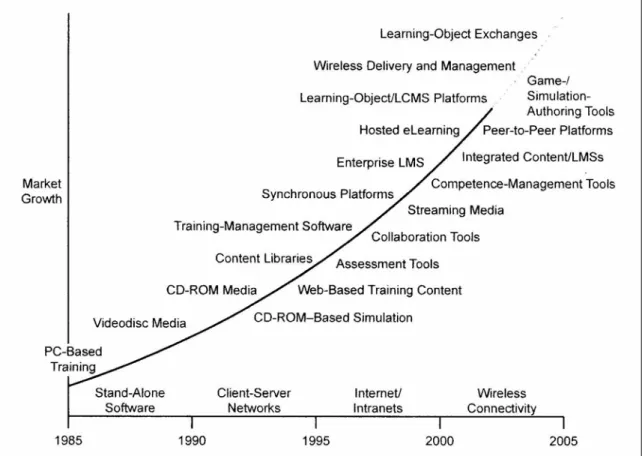
Technology advances include the latest trends within e-learning. In the field of e-learning technology innovations have expanded the area remarkably. The concept of stand-alone computer content has developed and come to include advanced management, delivery and collaboration technologies, providing improvements of the capabilities of e-learning. In the 1990s, when networking expansions and Web advances helped to increase the IT innovations, a range of new products and services in the e-learning field emerged (see figure 3). Most important of these innovations was the development of the Learning
Management Systems (LMS) (Barron, 2002). LMS is software that organises, manages
and reports on the interaction between learner and content as well as learner and instructor. For instance it manages students registrations, stores test results and measures the performance of the learners. A Content Management System (CMS) is a software application that handles version managing, workflow and publishing for the content of huge websites. A CMS, however, does not satisfy all the needs within the e-learning field (E-learning site).
The newest trend in e-learning technology innovations is Learning Content Management Systems (LCMS) which uses the benefits of learner administration capabilities from LMS and the benefits of the content creation (which is not possible in an LMS) and storage capabilities from a CMS. An LCMS creates, stores, collects and delivers e-learning content and offers the benefits of granularised learning that users can repurpose for different contexts and personalise for individual learners by using learning objects (ibid.). Learning objects are elements of computer-based instructions based on the object-orientation in computer science. The basis of object-object-orientation is to create components (objects) that can be reused in multiple contexts. Learning objects often have additional metadata, that contain information about the objects, such as the creators of the learning object, medium or format and pedagogical objective. The richer the metadata is, the easier it is to discover what learning objects can be combined successfully. Rich metadata also helps obtain a correct sequence of resources more easily. Learning objects without accurate metadata will be nearly useless outside their original application. Learning objects are prioritised since they promote a culture of reuse; more time can be spent on teaching and using the learning objects instead of creating the content (Jacobsen, 2001). As the technology develops there will be an increasing opportunity to mix and match learning modules from institutes among the world (EIU, 2003).
Figure 3: Technology evolution in e-learning (Barron, 2002)
To make it possible to collect learning objects from different sources and to ensure that people will find the right materials at the right place and time, standards are needed. Using standards to generate indexes for learning objects with consistently constructed metadata, means that the learning object and the metadata will be searchable and reusable. Standardisation is essential to the long-term success of e-learning, since the market of educational digital content will grow (ORMEE, 2003). To provide universal access to e-learning, the material must be catalogued and organised in standardised manors. The better the content conforms to standards of e-learning organisation and cataloguing the easier it is to build modular content that can be reused (EIU, 2003). Standards are helpful not only for students who are offered a consistent environment, but also for educators who might be sceptical of using computers in education, unwilling to change work practices or fearful due to unfamiliarity (Al-Rawas, 2001).
Another promising improvement in e-learning related to reusability is open educational resources (OERs). OERs refer to open course content and open source software and the principle of sharing courseware. By sharing building blocks of open course content learning objects can be reusable (Daniel, 2005b).
Mobile learning (m-learning) is another new technological innovation in the field of education. Various types of mobile devices can be used in the education sector in order to further educational opportunities in remote areas. M-learning combines two new technologies: WiMax and Pocket PC. WiMax provides wireless local area network connection with IP multimedia services such as web content, streaming video and wireless links to video projectors. The Pocket PC enables simultaneous audio and video and can use satellite or wire line connectivity, as well as a DVD to deliver content. M-learning can enable teachers and learners to overcome constraints of resources that are common in remote and developing communities. In the Asia-Pacific region common problems with some e-learning formats are high costs for desktop computers, wire line, broadband connection as well as for installation, maintenance, storage and repair. With m-learning, the WiMax bandwidth can reach rural areas, even in areas of rough terrain. Satellite technology enables data to be accessible in remote areas in which teachers do not have access to libraries or teaching material. The devices are affordable, and the cost of maintenance, storage and repair is low. M-learning can be used by persons without requiring a high level of IT literacy and training (UNESCO, 2005b).
I have chosen to use technology advances as an additional component in my framework since this includes the latest technological trends within the field of e-learning. Embracing trends is essential in order to become successful in e-learning. New concepts, such as learning objects, are determining factors in the development of e-learning as this will affect the country’s ability to cooperate internationally. Using the most recent technology gives the country a chance to act both as consumers and producers in an international market.
3.5.6 Cluster
Clusters are interconnections of companies and institutions that are geographically related to each other. For example clusters include suppliers of inputs, manufacturers of complementary products as well as governmental institutions and universities. A cluster often contains members that encourage both competition and cooperation. Rivals that compete in winning and keeping customers often coexist with co-operators since they operate in different dimensions and among different members. The quality of the local business environment strongly influences the cluster. For example there is no need for companies to invest in logistical techniques if the transportation infrastructure is of low quality (Porter, 1998). Within the field of e-learning well-developed content is for instance not useful in an environment with low bandwidth. Some companies can be strongly affected by the legal system or corporate tax rates and to compete effectively they need well-educated employees (ibid.).
Productivity, innovation and formation of new businesses are the three main ways in which the cluster strengthens competition. The innovation within a cluster is strengthened by companies’ ability to gain an overview and to be familiar of the market. Companies within a cluster can for instance in an early stage learn about evolving technology, component availability and marketing concepts. By frequent face-to-face contacts, learning about the market facilitates. The innovations within a cluster often lead to rapid acting by the companies since local suppliers and partners can ensure a good match with
the customer. Clusters often expand as soon as it has taken form, which in turn influences the government as well as public and private institutions (ibid.).
Clusters are not very common in developing countries, and a formation usually starts at the basic level when improving education and building capacity in technology. Despite the increasing globalisation of the markets, the local networks are important. E-learning is no longer merely a part of the academic field. Private industries have come to understand the importance of providing knowledge within the organisations and to utilise the benefits of e-learning. Governmental institutions realise the importance of education as they face the knowledge-based society. It has become crucial for every entity; businesses, government and institutions and they all play an important role and are dependent on each other. The lines between public and private investments become vaguer as they all play significant roles. Companies are becoming as important as the universities within the field of education as well as universities are becoming important to local businesses (ibid.). A close relationship between corporations, industries and government agencies are essential for countries to become successful in e-learning (EIU, 2003).
In order to develop successful e-learning in a country or a region clusters are essential. The reason why I have chosen to add cluster as a component in my framework is because countries that are high ranked in the e-learning readiness ranking tend to have a high degree of collaboration between government and the private sector (EIU, 2003). I believe that the concept of cluster within the field of e-learning strongly improves the overall quality of e-learning, which in turn affect the national success of e-learning.
4 Thailand
In this chapter I describe the background of Thailand, national ICT strategies and other relevant information about the country. This is followed by a description of the net university. As a final point, information related to the country, as well as to the net university, is described within the earlier presented framework.
4.1 General information
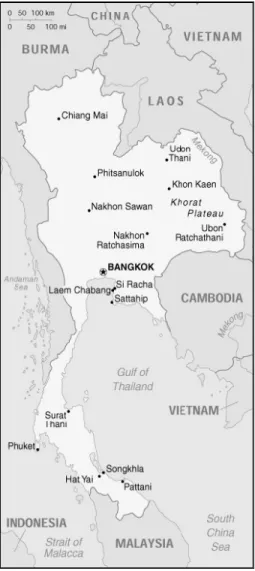
Thailand is located in the central part of South East Asia bordering to Burma, Laos, Cambodia and Malaysia with a land area of 511,770 sq km. The country is divided into 76 provinces where every province is subdivided into districts, sub-districts and villages (NECTEC, 2005). Thailand has been a monarchy since 1932. The population amounts to 65 millions of which approximately 9 millions live in the capital city of Bangkok. The official language is Thai and the secondary language is English (The World Fact Book). In the Human Development Index (HDI) presented by the United Nations Development Programme (UNDP), where life expectancy, educational attainment and adjusted real income, is measured Thailand is ranked 73rd among 177 countries (UNDP, 2005).
4.1.1 Education in Thailand
About eight percent of the Thai adult population lack basic reading and writing skills. Two thirds of these are female (UNESCO, 2005a). A new constitution, announced in 1997, states that all Thai people have equal rights to free basic education for twelve years, which will help raising the educational level of the citizens of Thailand (Makishima & Suksiriserekul, 2003). There has been an increasing improvement of the literacy rate the past few years and there is a good chance that Thailand will reduce the illiteracy rate by 50 percent in ten years (UNESCO, 2005a).
Figure 4: Map of Thailand (World Fact Book)