CHAPTER ONE INTRODUCTION 1.0 Reasons for the audit
The Public Servants Housing Loan Scheme (PSHLS) was set up by the government in 1975 to provide financial assistance to public servants to enable them put up residential accommodation of their own. Twenty years (by December 2005) since its inception, the Scheme has been able to assist 3,939 public servants out of 350,000 (figure given by Controller and Accountant General).
Many retired public servants refuse to quit government bungalows assigned to them because they do not have houses of their own to move into. In addition, many public servants lack information about the housing loan scheme.
It is because of these reasons that we conducted a performance audit into the activities of PSHLS to determine the extent of the problems in the administration of the Scheme and to offer suggestions for improvement.
Purpose and scope
The purpose of the audit was to examine the effectiveness of the Scheme. We looked at funding, loan processing, monitoring of approved projects and loan refund.
The study covered five financial years: 2001-2005. We visited eleven districts in five regions. At the central level, we interacted with ten institutions to solicit their views on issues related to the operations of the Scheme. The names of the districts, regions and institutions are recorded at Appendix “A”.
Methods and implementation We adopted the following methods:
Review of documents Interview,
Survey,
Questionnaire administration, and Projects inspection
Review of documents
The objective was to obtain and review data and other information relevant to the administration of the scheme.
We conducted interviews in five regions. We interviewed heads of departments, public servants and beneficiaries to know about the difficulties involved in accessing loans from PSHLS.
Survey
We collected data based on the questionnaire we sent to public servants in the regions and districts we visited. We also reviewed a survey conducted by Beacon Consultancy on behalf of the Office of the Head of Civil Service into Public Servants Housing Loan Scheme.
Inspection
We also inspected some of the projects being funded by the Scheme.
Structure of the audit report
Chapter 1 introduces the report while Chapter 2 gives a detailed description of the process involved in the award of loan to public servants in terms of goals and objectives, application processing, funding, monitoring, repayment of loans, key players and main activities. Chapter 3 deals with the findings of the audit. Chapter 4 presents the summary and conclusions. In Chapter 5, the report made recommendations to the Board of PSHLS in order to improve its efficiency and effectiveness.
CHAPTER TWO DESCRIPTIVE CHAPTER 2.1 Historical background
Public Servants’ (Housing Loan Scheme) Decree 319 was promulgated in March 1975 to give the legal authority to the Scheme. The basic purpose of the Decree was for government to assist public servants with housing loans to put up their residential accommodation. The Decree established a management board to administer and manage grants which government releases through the Minister of Finance and Economic Planning. Qualified public servants receive recoverable loans.
2.2 Objectives
The objectives of the Board are:
To ensure that only Public Servants benefit from this loan;
To grant and recover loans in accordance with the provisions of Decree 1975 NRCD 319; To enter into contracts and do all things necessary for or incidental or conducive to the purposes of the Decree.
The Scheme is funded from the Consolidated Fund. Funds provided are given out as loans to the applicants at annual interest rate of 2.5%. Recoveries made are also given out as loans (creating a revolving fund). From the inception of the Scheme to December 2005, ⊄22,984,866,086 had been given out as loans and ⊄18,068,292,560 recovered from borrowers (principal and interest).
Table 1:Public servants housing loan scheme Loan refund (1975-2005)
Year Government grants from
Ministry of Finance and Economic Planning
Recoveries from borrowers principal and
1.9752E+123 3,000,000.00 5,000,000.00 -8,000,000.00 -12,000,000.00 -10,000,000.00 20,000,000.00 50,000,000.00 310,000,000.00 275,000,000.00 350,000,000.00 400,000,000.00 400,000,000.00 600,000,000.00 1,100,000,000.00 1,220,000,000.00 2,000,000,000.00 2,100,000,000.00 1,500,000,000.00 -2,500,000,000.00 2,000,000,000.00 3,959,000,000.00 1,162,866,086.00 3,000,000,000.00 -8,198.95 82,120.93 170,936.94 467,531.50 929,111.63 1,827,609.07 1,163,984.77 923,410.66 1,483,702.88 1,396,269.04 2,860,158.94 3,216,179.84 7,000,000.00 15,163,932.26 24,045,542.99 54,315,364.16 84,628,585.55 106,958,220.00 108,000,000.00 261,490,000.00 399,265,465.22 643,086,082.74 850,960,627.00 1,132,059,648.00 1,495,676,758.96 2,148,249,169.04 2,631,990,306.73 4,313,773,793.76 3,777,099,847.85 Total 22984866086.00 18068292560.23 Source:PHLSC
2.4 Current Development
The Board has adopted new management initiative to improve the Scheme’s administration. These include the following:
Forms for additional loans have been introduced (2002). Since they are for sale it will generate revenue for the Board
Allocation for loans (investment) is now budgeted for instead of it falling into the Below the Account System (2001).
Government has introduced new initiatives in housing and home acquisition. E.g. mortgages. (“Ghanaian Times” of May 15, page 22)
Government establishments like Controller and Accountant General, Ministry of Health and Internal Revenue Service are in the process of setting up their own housing loan schemes and are establishing land banks for their employees.
KEY PLAYERS AND THEIR ACTIVITIES 2.5 Administrative structure of PSHLSB
PSHLSB is based in Accra the capital. It has no officers in the regions. The Board exercises its administrative activities through the Executive Secretary who is a member of the Board. He is responsible for the day-to-day management and administration of the Board. The Executive Secretary is assisted by a principal accountant, administrative officer, senior estate manager and their staff totalling twenty-two. There is also a Solicitor in the Ministry of Justice who advises the Board on legal matters.
2.6 The Board
The Board consists of a chairman, an Executive Secretary, a representative of the government and of the following organisations:
Lands Commission
Ministry of Works and Housing Ministry of Justice
Ministry of Finance and Economic Planning Architectural and Engineering Service Limited Controller and Accountant General
The Board approves applications and determines amount of loan to give each applicant based on the salary level of the applicant. In general, loans are granted for the following purposes:
To construct a new residential property
To extend or refurnish an existing residential property To pay off a loan on a residential property already acquired To purchase an existing residential property
To qualify for a loan, the applicant who must be a Ghanaian public servant must also provide the following:
Building Plan (original and photocopy) Building /Development Permit
To purchase an existing residential property, applicants must provide an offer letter from the seller of the property they intend to buy
To pay off a loan on a residential property, applicants must provide a statement of account from the existing lender
Two passport size photographs and pay-slip.
To apply for the loan, an applicant must buy an application form. The completed form must be endorsed by the head of the applicant’s organisation and then submitted with the required documents to the office of PSHLSB. The consultant (AESL) inspects and values the property. It then submits a report to the Executive Secretary who prepares a list of successful applicants, which is forwarded to the Board. The Board approves the list and the loans are granted to the beneficiaries. The Board does not finance the project that exceeds a three-bedroom house unless the applicant can undertake to self- finance up to 70% of the project. The grant of a loan depends on the individuals age, salary and the dimension (type) of the project. Loans granted by the Board attract interest of 2.5% per annum and are repayable within thirty years.
They value projects after applications have been accepted and recommend amounts that should be given as loans to applicants.
2.8 Ministry of Finance and Economic Planning (MoFEP)
The Ministry releases funds for the operation of the Scheme periodically (two to three instalments yearly).
2.9 Controller and Accountant-General
Beneficiaries of the Scheme repay the loan and interest thereon by monthly deduction. The Accountant-General deducts the loan and interest from the salaries of borrowers. The deductions are then paid to the Board. The monthly deductions in respect of the Principal Loan and Interest shall not exceed 30% of the borrower’s basic salary in the case of junior officers and 35% in the case of senior officers.
2.91 Public servants
This group is made up of civil and public servants. They are the target group for which the scheme exists. They are the borrowers who collect loans and pay back with interest.
CHAPTER THREE FINDINGS
Introduction
PSHLS was established by NRCD 319 as result of government’s efforts to provide shelter for public servants. Since its inception the scheme has continuously financed a number of dwelling houses for public servants. During the audit, we found that between 1975 and 2005, ⊄22.98 billion had been disbursed to beneficiaries as loans to acquire residential accommodation. During the same period, ⊄18.07 billion was received as refunds from beneficiaries. Over the period, 3,939 public servants had benefited from the scheme. The audit revealed however, that there were problems with the management of the scheme. These are:
Many public servants are not aware of the scheme Funding is inadequate
Loan acquisition procedures are cumbersome Approval and disbursement of loan delay Inadequate monitoring
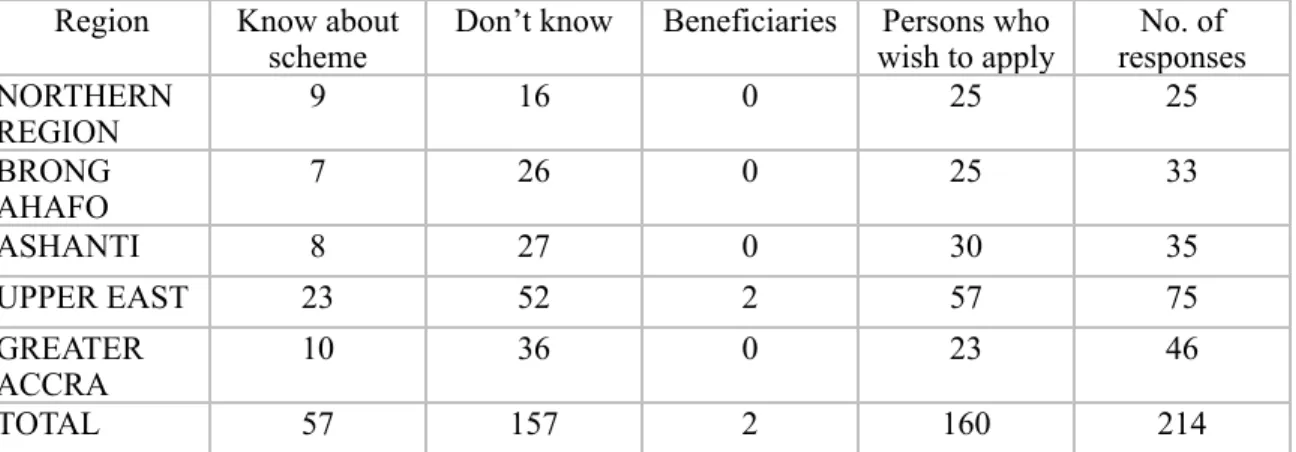
The audit showed that many public servants were not aware of the scheme. The results of the questionnaire sent to public servants in the regions visited indicated that out of 214 public servants who filled the questionnaires, 73% had not heard of the scheme, while 76% of them wished to apply for loans. Results of the questionnaire are summarised in Table 1, while the percentage of public servants who are unaware of the Scheme and those who wish to apply for loans have been shown as pie charts in Figures 1 and 2 respectively. A senior official of the Board interviewed was of the view that due to financial constraints, there was the likelihood that the scheme would come under pressure from would-be beneficiaries whom they would not be able to satisfy. Beneficiaries interviewed stated that they heard about the scheme from friends who are beneficiaries. This assertion is supported by a survey conducted by Beacon Consultancy mentioned elsewhere in the report that 85% of public servants interviewed had heard about the scheme from colleagues (page16).
Table 2:Results of questionnaire Region Know about
scheme Don’t know Beneficiaries wish to applyPersons who responsesNo. of NORTHERN REGION 9 16 0 25 25 BRONG AHAFO 7 26 0 25 33 ASHANTI 8 27 0 30 35 UPPER EAST 23 52 2 57 75 GREATER ACCRA 10 36 0 23 46 TOTAL 57 157 2 160 214
Source: GAS
Figure 1:Percentage of public servants who know about the scheme
EMBED Excel.Chart.8 \s
Source: GASFigure 2:Percentage of public servants who want to apply for loans
EMBED Excel.Chart.8 \s
Source: GASThis condition was caused by the inability of management to publicise the scheme although ¢9.0 million had been allocated in the budget for 2005 under advertisements and publicity. Public servants could have been informed through advertisements in the major newspapers and also through news letters to Ministries, Departments and Agencies (MDAs) as is normally done.
3.2 Funding is inadequate
Funding for the scheme was noted to be inadequate. Prior to 2004, PSHLS was not permitted to budget for grants from GoG. They were given specific amounts of money as grants at the discretion of the Ministry of Works and Housing. We found out that after 2004, budgets prepared had a ¢4.00 billion projection for each year. We were informed that about 1200 applications are received yearly. However, that figure was not used as a basis for the Scheme’s budgetary projections. Again, even though ¢4.00 billion is budgeted for there is no assurance that all would be released for the year. For instance in
2005, although ⊄4.00 billion was budgeted for, ¢3.00 billion out of the amount was disbursed to the scheme.
Besides, beneficiaries do not repay their loans and are regarded as defaulters. Defaulters are beneficiaries whose deductions for refund are not effected by Controller and Accountant General (CA-GD) and those who simply refuse to pay.
Refunds delay because inputs sent to CA-GD are not effected timely. For example it takes one year for pensioners’ inputs for instance to be effected. Sometimes CA-GD inputs wrong figures (on the low side), which have to be corrected and this takes time to rectify. Also, borrowers change jobs without informing their heads of departments who endorsed their loan forms making difficult to trace them. Unlike pensioners under CAP 30, whose deductions are effected and paid directly to the Scheme, Social Security Law 1991 PNDCL 247 Section 31 does not permit such deductions to be made and paid to the Scheme. Consequently, beneficiaries under the SSNIT pension scheme feel reluctant to pay cash to the Scheme. The total amount owed by pensioners under SSNIT by December 2005 amounted to ⊄874,039,209. In addition, pensioners suffer a reduction in remuneration when they retire. As a result, the Scheme is forced to review downwards the deductions from their monthly pensions, which negatively affect projected income from deductions.
The Auditor-General’s report on PSHLS for the period 1 January 2001 to 31 December 2002, noted that nine beneficiaries who were on retirement had over 30 to 56 years for their loans to be fully recovered. Table 3 refers:
Table 3:List of retirees with long loan recovery periods No Name Loan balance Monthly
deduction Expected period of recovery Expected date of recovery 1 Ernest A Obese 32589818 81944 33 years 2035 2 Samuel Yaw Akuamah 29094500 65000 37 years 2039 3 Samuel Opoku Bampoe 13313085 36406 30.5 years 2033 4 Seth Adote Acquaye 21965231 60000 30.5 years 2033 5 Robert Winst Asiedu 36576125 70000 44.5 years 2047 6 Seth Ashie Ashaley 46900431 70000 56 years 2058 7 Gilbert Asare-Bediako 37501963 10000 31 years 2033 8 Ida Fyn Thompson 33653473 50000 56 years 2058 9 Ebenezer O. Awuku 43198917 100000 36 years 2038
This condition is contrary to Section 15 (5) of Decree 319, which states that the period of repayment of the loan and interest shall not exceed a period of thirty years. The report also noted that the pensioners in question had also collected their gratuities, which could have been used to defray their loans. Clearly, PSHLS had gone against its own requirement of granting loans for a maximum period of 30 years. The beneficiaries’ expected monthly pensions and ages were not taken into account before they were granted the loans. The long period of repayment would not allow the Board to recover enough funds to make available to other applicants. The condition also weakens pensioners’ financial security because they are already receiving reduced income.
Infrequent monitoring of beneficiaries has contributed to the non-payment of loans. As part of their functions, the monitoring section is supposed to trace defaulters from time to time. However monitoring of loan defaulters is done once a year because the Scheme did not have a vehicle for the exercise. As a result, borrowers default because there is no pressure on them to repay their loans. A list of defaulters published by the Scheme in the “Daily Graphic” on 24 May 2005 indicated that 32 beneficiaries had defaultered to the tune of ⊄490,8 million. From the publication the highest defaulter owed as much as ⊄36,4million, whilst the least owed ⊄0.9million. By 31 December 2005, the figure had risen to ⊄1,31billion, owed by 108 defaulters. It is pertinent to note that the Scheme is
unwilling to take legal means to retrieve amounts owed by defaulters as required by Article 15, Section 7 of NRCD 319.
3.3 Loan acquisition procedures are cumbersome
To qualify for a loan an applicant must present the following documents: (a)
Original Title Deed Land Certificate Building Plans (original and photo copy) Building/Development Permit
To purchase an existing residential property, applicants must provide an offer letter from the seller of the property they intend to purchase.
To pay off a loan on a residential property, applicants must provide a statement of accounts from their existing lenders.
In all the cases above two recent passport photographs of the client together with current pay slips showing their staff number, grade, basic and gross salary must be added. He must buy an application form, which must be completed and endorsed by the head of the applicant’s organisation and then submitted with the required documents.
Majority of public servants interviewed on the cumbersome nature of the requirements agreed that the requirements were difficult to meet. A few of them did not start processing their applications at all after knowing about the documents they were to present and the long process involved in the acquisition of the loan. This condition has been confirmed by the Beacon report, which cites that out of 60 representatives from selected public services randomly selected and interviewed, 65% described the loan requirement as too difficult to meet and should therefore be made a bit flexible.
Besides, public servants find it difficult to acquire land. This is because salaries in the public sector are so low that public servants cannot buy land, which is the basic requirement. Records at the offices at the Scheme show that 60% of applicants are from the public sector organisations (GES, GAS, GHS) and the rest (40%) are from the Civil Service. Moreover those who own family land, especially in the rural areas, cannot acquire title deeds since these lands have not been registered.
In addition, all applicants who live outside Accra have to travel long distances to access the loan since the Scheme is based in Accra. When application forms and other requirements have been accepted by the Board, applicants still have to visit Accra regularly to follow up on their applications. Since applications take a minimum of one
year to process, applicants thus, spend a lot of money on transportation and hotel bills to their detriment. These expenditures reduce the value of the loan with regard to the insufficient amount of loan given.
The audit also revealed that approval of loans extend beyond the one year period instituted by the Board. Some of the applicants had their loans between 18 to 53 months after submission of their applications. This condition does not help the cause of the public servants because they would have to spend more years to put up their buildings (probably after retirement). In addition, they would have to spend more money to complete their buildings and their planning and projections would be thrown out of gear.
3.4 Monitoring is inadequate
The monitoring department is to make sure that loans granted to beneficiaries are used for the purpose for which they are granted. Officials from the department follow up on projects being developed all over the country. To achieve this objective, the department should be monitoring projects regularly. However, we were informed that officers visit these project sites once a year because they did not have a vehicle to take them round. They depended on their clients to carry them to the project sites. We noticed that the monitoring department did not have activity plan for monitoring the projects. Such a
plan, which is time bound, would enable the department to monitor effectively and report meaningfully on projects.
Inadequate monitoring could result in borrowers using the loan for other purposes rather than those they took the loans for. The Auditor-General’s report on the Scheme for the period January 2001- December 2002 cites two cases where borrowers used the loans for different purposes.
3.5 Incremental development approach leads to cost overruns
Incremental development is a strategy used by the Scheme to allocate funds to borrowers for project development in stages over a period. After completely exhausting a loan on the project, clients can apply for additional loan to continue with the next stage of the project. This continues till the applicant exhausts the ceiling of amount he qualifies for. At every stage, the processes of application, valuation and approval of loan are applied.
Currently, ceilings are based on salary level of applicants. Junior staff qualify for a maximum of ⊄80 million, while senior staff are entitled to ¢100 million. The period for accessing loan component is not determined while the granting of loans depends on budgetary delivery over the year.
This approach to loan delivery leads to high level of cost overruns for beneficiaries as a result of increasing cost of building materials.
CHAPTER FOUR
SUMMARY AND CONCLUSION 4.0 Introduction
The Scheme has between 1975 and 2005 disbursed ⊄22.98 billion to public servants to acquire residential accommodation. This has brought improvement in the provision of decent accommodation to public servants. Despite this achievement, there remain further
challenges in the administration of the Scheme to improve on its operations. Below, we set out our overall summary and conclusions in relation to our five main themes:
4.1 Public servants are not aware of the Scheme
The audit disclosed that 73% of public servants interviewed were not aware of the loan scheme. The condition arose because the Scheme failed to advertise and also did not inform the MDAs about its activities for onward transmission to staff. According to a senior official of PSHLS, the Scheme would come under pressure from would- be beneficiaries whom they would not be able to satisfy. We are of the view that all public servants must be made aware of government policies that affect them. The choice to access loans should be left to individual public servants and should not be predetermined by PSHLS that had been set up to administer the scheme.
4.2 Funding is inadequate
The Scheme is funded from the consolidated fund and interest on loans granted to borrowers. However, the Scheme does not prepare realistic budget and as a result few public servants benefit from loans. Besides, the Scheme does not receive the total amount budgeted for. The recovery period for loans in some cases exceeded the 30years mandatory period. SSNIT Law, PNDC Law 247, (31) prevents deductions from pensioners’ salary. Moreover, borrowers had failed to pay up their loans amounting to ⊄490.85 million by the year 2005. No legal action has ever been taken against defaulters
to retrieve the loans as required by law. These problems have resulted in a funding gap, which has further reduced the Scheme’s ability to cater for more public servants.
4.3 Loan acquisition procedures are cumbersome
Majority of public servants interviewed (65%-Beacon Report) were of the view that the loan requirements were difficult to meet. The documentation they have to provide and the long process they have to undergo (one to five years) to acquire the loan were deemed to be frustrating enough to deter applicants. They also find it very difficult to acquire land owing to low salary levels. Besides, applicants who live outside Accra spend much time and money travelling to the capital to process and monitor their applications.
4.4 Monitoring is inadequate
The monitoring department did not have an activity plan. It monitored projects and traced defaulters once a year, which did not allow them to monitor effectively and to report meaningfully. Consequently, beneficiaries could use the housing loan for different purposes.
4.5 Incremental development approach leads to cost overran
The Scheme does not give beneficiaries the total amount of money at a go to enable them put up their buildings. However, borrowers can apply for additional loans. The beneficiary thus, takes a long time to put up his building. This approach to loan delivery
leads to high cost of overruns for the borrower as a result of increasing cost of building materials.
The ineffectiveness of PSHLS has made it impossible for many public servants to acquire residential accommodation of their own. As a result, public sector organisations like Controller and Accountant General, Civil Servants Association, Ghana Audit Service, Ghana Health Service and Internal Revenue Service have put mechanisms in place to help their staff put up buildings. For example, Controller and Accountant General has sourced ⊄40.00 billion (GCB Personal Loan Facility, Letter No. CAGD/ADM/07/00 of 28 July 2006) from Ghana Commercial Bank, which attracts an interest of 14.5% a year as compared to the Scheme’s 2.5% interest (a difference of 12%). GHS, Civil Servants Association and Ghana Education Service have all gone into the establishment of land banks for their staff.
CHAPTER FIVE RECOMMENDATIONS 5.0 Making public servants aware of the scheme
Many public servants are not aware of the Scheme and could therefore not access the loan facility provided. To make public servants aware of the Scheme, PSHLS should disseminate information about their activities through the news media, brochures and letters to MDAs.
5.1 Improving funding
In the previous chapter we concluded that funding was inadequate and as a result PSHLS could not satisfy public servants who had applied. To eliminate the funding gap:
The government of Ghana should always endeavour to honour its budgetary obligations to the Scheme
PSHLS should prepare realistic budgets by taking into consideration the number of workers who apply
Loan recovery should not extend beyond the date of retirement (60 years). PSHLS should trace defaulters and take legal action to recover loans.
5.2 Improving loan acquisition procedures
To improve loan acquisition procedures we recommend that: PSHLS should include land as part of the loan facility
The monitoring unit should visit the regions regularly to disseminate the activities of the Scheme, interact with workers and to distribute and receive applications from applicants
PSHLS should endeavour to remain within the one year target they have set for the processing and disbursement of loans.
To improve monitoring, we recommend that the monitoring unit should have a work plan, which should be followed to enable the unit to be efficient in the monitoring of projects, tracking of defaulters and interaction with public servants in all the regions.
5.4 Minimizing cost overrun
The incremental development approach to loan delivery is a long term strategy which is not favourable to the public servant. To minimize cost overruns we recommend that PSHLS should consider giving applicants the full amount they are entitled to.
Appendix “A” LIST OF INSTITUTION VISITED
Ghana Educational Servant Ghana Audit Service
Ministry of Food and Agriculture
National Commission for Civic Education Ghana Immigration Service
Information Service Department Dangbe East District Assembly Dangbe West District Assembly National Fire Service
Electoral Commission Department of Co-operatives Prisons Service
Ministry of Health
Bolgatanga Regional Cordinating Council Builsa District Assembly
Bawku Municipal Assembly Tano South District Assembly Asunafo North District Assembly Forestry Department
Game and Wildlife Department
Appendix “B”
LIST OF DISTRICTS AND REGIONS VISITED
Districts Regions
Dangbe East Dangbe West
Greater Accra Atwima-Kwanwoma
Ashanti Akim North
Ashanti Bechem District Asunafo North Brong Ahafo Bolgatanga district Builsa District Bongo District Bawa District Upper East Yendi Northern
Appendix “C”
LIST OF ABBREVIATIONS PSHLS - Public Servants Housing Loan Scheme AESL - Architectural Engineering Services Limited MOFEP - Ministry of Finance and Economic Planning GAS - Ghana Audit Service
CA-GD - Controller and Accountant-General Department GOG - Government of Ghana
SSNIT - Social Security and National Insurance Trust NRCD - National Redemption Council Decree
GHS - Ghana Health Service
Appendix “D”
KEY PLAYERS INTERVIEWED Position Organisation Executive Secretary Board Member PSHLS
Principal Accountant “
Senior Estate Officer “
Valuation Consultant Board Member AESL
Rex Sumana Director Ministry of Works and Housing
Head, Human Resource Office of the Head of Civil Service
Executive Secretary Public Service
Commission
Regional Minister Upper East
Chief Accountant Controller and Accountant
General’s Department
Appendix “E”
DOCUMENTS REVIEWED
PSHLS Brochure—requirements and conditions for granting of a housing loan. Land Title Registration law 1986 (PNDCL 152).
Public Servants Housing Loan Scheme Board Regulations 1975, LI. 1020. Public Servants Housing Loan Scheme Decree 319 of 1975.
PSHLS: Years 2005 and 2006 budget statements. Proposed disbursement for first half of year 2005. Proposed disbursement for second half of 2005.
Management audit report on the accounts of PSHLS for the period January 2001 to December 2002.
Social Security Law 1991 PNDCL 247.
Report of Beneficiary Assessment of Public Servants Housing Loan Scheme.
PAGE
PAGE 13