T
ech
n
ical P
T
he combined ultraviolet (UV) and electron beam (EB) curing of flexographic printing inks was investigated. The initial UV curing produced a partially cured ink layer. The cure was effectively completed by subsequent EB irradiation without nitrogen inerting. The advantages of dual UV/EB curing include the ability to cure high-density ink layers which are challenging to cure by UV alone; the ability to dry-trap multiple ink layers using relatively low-power interstation UV curing; the assurance that all ink layers will be fully cured upon EB irradiation after the final print station; and its potential use in food packaging using low levels of migration-resistant photoinitiators.Dual UV/EB Curing of
Printing Inks
By Stephen C. Lapin, Ph.D.,
and Steve Lundahl
Table 1
Comparison of UV and EB technology in printing and packaging applications
UV EB
Equipment Size Compact—Well-suited to interstation installations.
Large—Best suited to installation after last station.
Throughput Limited—Multiple lamps needed for high speeds.
Very Fast— Typical ink cure dose easily delivered up to 1,200 ft./min.
Inerting Most systems designed to cure in air. Nitrogen inerting required for curing.
Food packaging Concerns with photoinitiator migration and uncured materials.
No photoinitiator required. High
conversion minimizes uncured materials.
Consistency Lamp output decreases with age. Decrease varies across the width and spectral output of the lamp.
Beam output is very consistent with age and over the width of the web.
Heat
Management
High heat output must be managed. Heat increases for higher power input lamps.
Relatively cool curing process.
Through-cure Challenge to cure through high-density ink layers.
Easily penetrates high-density ink layers.
Background
UV and EB curing technology is well established in several printing and packaging applications. Each technology has its own advantages and disadvantages. A comparison of some key properties of each technology is given in Table 1.
These inherent advantages and disadvantages have driven the evolution of current UV/EB printing processes. For example:
s Sheet-fed offset printing is almost exclusively UV since it is challenging to inert and shield EB sheet-fed processes
s EB is well established for web offset package printing because paste inks may be wet trapped and cured with
T
ech
n
ical P
a single EB unit at the end of the press. EB is also preferred for food safety aspects of the process. An exciting technology known as Wetflex™ has expanded the possibilities
for EB package printing. The Wetflex process involves wet trapping of flexographic inks without interstation dryers and allows curing with a single EB unit at the end of the press.1
Limitations of Wetflex include that it is limited to central impression (CI) press configurations since the wet ink must not contact idler rolls needed for in-line press configurations; it cannot wet trap over first down white opaque ink layers due to difficulty in applying subsequent colors to the heavy wet white layer; and the need to nitrogen inert the EB curing process. In spite of these limitations, strong interest is expected with this solvent-free, high-quality printing technology.
Printers may weigh the advantages and disadvantages and make a decision between using UV or EB technology. Another less common option may be to use some combination of UV and EB together. An early reference to dual UV/EB curing appeared in U.S. Patent 4,070,497 by Marco Wismer et al.2 They found that acrylate-based
ink or coating layers could be partially cured to a “gelled” state. Cure could then be completed by EB irradiation. This patent also described curing of multiple ink layers using UV to gel each layer as it is applied. This is followed by a final EB exposure to complete the cure of all layers together. They further recognized that pigmented materials could be more easily cured by EB compared to UV.
A more recent reference specifically describes the advantages of a dual UV/EB curing approach for
flexographic printing.3 The inventors
recognized challenges associated with
of photoinitiator components in food packaging application; the effect of heat from high-powered lamps on certain film substrates; and the effect of lamp heat on the CI drum. They describe a dual UV/EB flexographic printing system that uses inks
containing less than 10% photoinitiator and is cured with interstation lamps operating at less than 300 watt/inch of input power. The system again utilizes a single EB unit after the last printing or coating station to complete the cure of all the layers. They also described advantages of improved ink adhesion to film substrates resulting in EB-induced “grafting” of the ink to the substrate.
Another reference also describing dual UV/EB curing in a flexographic printing process includes the use UV light-emitting diode (LED) sources to provide interstation curing prior to final EB cure.4 This reference
also includes the possibility that some of the ink layers may not need interstation curing prior to the final EB cure. The same authors also showed that inks could be effectively EB cured after initial UV curing with as little as 3% photoinitiator.5
In summary, the advantages of dual UV/EB curing for flexographic printing may include:
1. Improved print quality compared to solvent- and water-based ink due to the low dot gain achieved with 100% solids inks.
2. Low energy usage compared to thermal drying.
3. Elimination of solvents. 4. Elimination of thermal oxidizer
equipment.
5. Limited lamp heat effects on substrates and equipment.
6. Uses ink chemistry based on stable,
process which may be more forgiving than wet trapping. 8. UV dry trapping allows in-line or CI
press configurations.
9. Final EB cure allows the use of high-optical density inks that may be difficult to cure by UV alone. 10. Higher line speeds compared to UV
curing alone.
11. Inks suited for food packaging; low levels of migration-resistant photoinitiators may be used since only partial UV cure is needed prior to the final EB cure.
12. Assurance of complete cure due to consistent EB output and penetration.
In spite of these advantages, dual UV/EB curing has only limited use in commercial applications. This may be due in part to existing patents and also the lack of available inks and press equipment for the demonstration and testing of these systems. The purpose of the paper is to demonstrate the performance of dual UV/EB curing systems in order to facilitate future growth of this technology.
Experimental
A set of cyan, magenta, yellow and black process colors flexo inks were prepared. The ink formulations are shown in Table 2. The inks utilize a photoinitiator system that is designed for low migration and also complies with a list of materials recognized by a major global consumer food product company.6
Inks were applied with a Harper flexographic hand proofer using a 900 line/inch (1.36 bcm) and also a 700 line/inch (2.27 bcm) anilox roll. This application method produces ink weights representative of commercial printing applications. An Avery
T
ech
n
ical P
The optical densities of the ink films were measured with a model 939 X-Rite densitometer. Initial UV curing was conducted using an American Ultraviolet laboratory curing unit equipped with a variable speed conveyor and a 300 w/in medium-pressure mercury arc lamp. The applied UV energy was measured with a UV Process Supply Compact Radiometer.
Following UV curing, the ink films were further cured with a Broad
Beam EP series electron beam unit operating at 125 kV. Samples were attached to a moving carrier web and exposed with an EB dose of 30 kGy. Duplicate samples were EB cured in air and also using nitrogen inerting (<200 ppm oxygen).
Ink curing was characterized after UV curing and also after subsequent EB curing. The ink was wiped with a dry cloth to check for residual surface tack after curing. Ink adhesion to the
substrate was determined using Scotch 810 tape. The approximate amount of ink remaining on the substrate after tape removal from a crosshatch area was recorded. Resistance of the cured ink films to methyl ethyl ketone (MEK) solvent was determined using four layers of cloth wrapped on the round end of a 24 oz. ball-peen hammer. The cloth was saturated with MEK and rubbed back and forth 10 times over the cured ink using only the force from the
Table 2
Flexographic inks for dual UV/EB curing
Component (Weight %) Cyan Magenta Yellow Black
Acid-Modified Epoxy Acrylate 20 20 20 20
PONPGDAa 10 10 10 11
EOTMPTAb 8 8 8 7
Yellow 14 Flexo Dispersionc — — 50 —
Red 57.1 Flexo Dispersionc — 50 — —
Blue 15.4 Flexo Dispersionc 50 — — —
Black 7 Flexo Dispersionc — — — 50
PL-LOW-Nd 12 12 12 12
a. Propoxylated neopentyl glycol diacrylate b. Ethoxylated trimethylol propane tricrylate c. Sun Chemical
d. Photoinitatior system (Palermo Lundahl—Low Migration, Nestle Compliant)
Table 3
UV-cured ink properties
Tape Adhesion (%) MEK Resistance
75 mj/cm2 100ft/min 100mj/cm2 75 ft/min 150mj/cm2 50ft/min 75 mj/cm2 100ft/min 100 mj/cm2 75ft/min 150mj/cm2 50ft/min Cyan 2.65 OD 0 0 0 0 0 0 Cyan 2.73 OD 0 0 0 0 0 0 Magenta 2.61 OD 0 10 20 0 0 2 Magenta 2.69 OD 0 0 10 0 1 4 Yellow 1.39 OD 0 0 0 0 0 0 Yellow 1.44 OD 0 0 0 0 0 1 Black 1.95 OD 70 80 90 1 3 4 Black 2.07 OD 50 50 60 2 4 4
T
ech
n
ical P
weight of the hammerhead. The relative damage to the ink layer was recorded on a scale of 0 to 5 (0 = complete ink removal, 5 = no visible ink removal).
Results and Discussion
Inks were applied at two different weights and cured at three different applied UV energy levels. The optical density of the ink films along with cured ink properties are shown in Table 3. As expected, ink adhesion and MEK resistance improved with increasing UV exposure. In many cases, inks applied at the lower weights showed better adhesion compared to the heavier weights. Tape adhesion is dependent on the curing at ink/substrate interface; therefore, the decrease in tape
adhesion was likely caused by reduced throughcure as a result of decreased light penetration through the more dense ink layer. The relatively low MEK rub resistance confirmed that, in most cases, the inks were not completely cured by UV alone. Higher apparent MEK resistance was observed for the heavier ink layers due to the fact that more ink must removed to reach the underlying substrate.
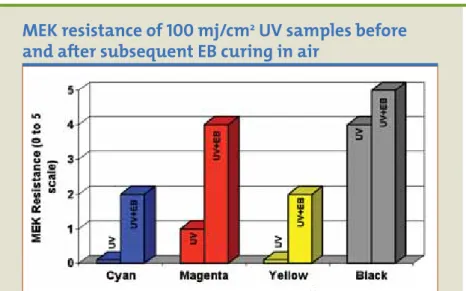
to subsequent EB curing. EB irradiation (30 kGy) was conducted both in air and with nitrogen inerting (<200 ppm) of the reaction chamber. The results for curing in air are summarized in Table 4. The results clearly show that EB is effective for completing the curing of the inks. Improved ink adhesion was observed for all samples after EB exposure. This was expected since the EB can easily penetrate the ink layer and provide curing at the ink/ substrate interface. MEK rub resistance was also improved for all samples after
EB curing. The improvement in tape adhesion and MEK resistance after EB appeared to be independent of the initial UV energy exposure. This indicates that EB effectively completes the curing to about the same degree independent of the initial level of UV cure. EB-induced changes in ink film properties for the 100 mj/cm2 UV
samples are shown in Figures 1 and 2. A photograph of representative samples is shown in Figure 3. In this case, the magenta ink shows increasing MEK resistance with increasing UV
Table 4
Ink properties after combined UV and EB cure
Tape Adhesion (%) MEK Resistance
UV 75 mj/cm2 EB 30 kGy UV 100mj/cm2 EB 30 kGy UV 150mj/cm2 EB 30 kGy UV 75 mj/cm2 EB 30 kGy UV 100 mj/cm2 EB 30 kGy UV 150 mj/cm2 EB 30 kGy Cyan 2.65 OD 30 20 40 2 2 3 Cyan 2.73 OD 60 50 40 2 2 4 Magenta 2.61 OD 60 40 90 4 4 3 Magenta 2.69 OD 70 80 60 4 4 4 Yellow 1.39 OD 10 20 20 2 3 4 Yellow 1.44 OD 20 30 20 2 2 4 Black 1.95 OD 100 100 100 3 4 4 Black 2.07 OD 100 100 100 4 5 5
Figure 1
Tape adhesion of
100
mj/cm
2UV samples before
and after subsequent EB curing in air
UV+EB UV+EB UV UV+EB UV+EB UV UV UV
T
ech
n
ical P
exposure. However, tape adhesion remains poor in all cases. The poor tape adhesion is likely due to limited UV energy reaching the ink/substrate interface with this high-density (2.69) ink layer. After EB exposure, MEK resistance is greatly improved and appears to be about the same for all
three samples. Adhesion is also greatly improved for all samples after EB exposure. This shows that the beam is effectively completing the curing at the ink/film interface.
Figure 4 provides a comparison of magenta ink samples applied at two different weights. A UV exposure of
150 mj/cm2 was used for both samples.
In this case, tape adhesion was improved at the lower ink weight. This is due to the increased UV penetration through the lower density ink layer. MEK resistance appeared to be lower with the lower weight sample because the solvent can more easily remove the lower amount of ink. Tape adhesion for both samples was greatly improved by subsequent EB exposure.
Figure 5 shows the results for magenta ink after UV curing and after subsequent EB curing. The results provide a comparison of EB exposure in air and with nitrogen inerting. No significant difference between the samples was observed. In both cases tape adhesion and MEK resistance were dramatically improved by EB exposure.
It was somewhat surprising that the results were essentially the same for EB curing in air and EB curing with nitrogen inerting. A control experiment was conducted by curing the inks with EB alone without the initial UV cure. As expected, the inks were wet after EB exposure in air and well cured after EB exposure with nitrogen inerting. When wet ink samples are EB irradiated in air, oxygen diffuses into the ink layer and effectively inhibits the curing. When inks are partially UV cured, the solid or “gelled” ink limits the diffusion of oxygen and allows EB curing without interting. This interesting synergistic effect of dual UV/EB was not previously noted in earlier references on dual UV/EB ink curing.2-5
The cost of nitrogen inerting can be significant for commercial installations. This capital and operational cost of UV lamps in dual UV/EB curing installations may be partially offset by eliminating the need for nitrogen.
Conclusions
EB curing was very effective for completing the cure of partially UV-cured flexographic inks. An
Figure 2
MEK resistance of
100
mj/cm
2UV samples before
and after subsequent EB curing in air
0 = complete ink removal, 5 = no visible effect on ink layer
Figure 3
Magenta ink samples UV cured at
75
,
100
, and
150
mj/cm
2. Tape adhesion and MEK resistance is shown
T
ech
n
ical P
Figure 4
Magenta ink samples UV cured at
150
mj/cm
2at
two different application weights. Adhesion and
MEK resistance shown before and after subsequent
EB cure.
700 lpi, 2.27 bcm application on left; 900 lpi, 1.36 bcm application on right
additional benefit of the dual UV/EB curing is the elimination of the need to inert the EB-curing process. These systems appear to offer good potential for commercial package printing installations.
Future Work
Additional work planned includes the demonstration of dual UV/EB curing on a commercial printing press. The photoinitiator package will be optimized to provide just enough UV curing for dry trapping ink prior to final EB cure. Migration testing is planned to confirm that the printed substrates are suitable for food packaging applications. ◗
References
1. M. Laksin, V. Linzer, T. Best, J. Modi, S. Chatterjee, TAPPI PLACE Division Conference, August 2004.
2. M. Wismer, G. Gerek, U.S. Patent 4,070,497, July 24, 1978. 3. J. Lovin, L. Keller, U.S. Patent
5,407,708, April 18, 1995.
4. M. Laksin, W. Wilczak, U.S. Patent Application 2007/0289459, December 20, 2007.
5. M. laksin, S. Chatterjee, RadTech 2008 Conference Proceedings, Chicago, May 2008.
6. Nestle Corporation, 2009.
—Stephen C. Lapin, Ph.D., is an applications specialist at PCT Engineered Systems LLC, in Davenport, Iowa. Steve Lundahl is a partner at Palermo Lundahl Industries in Chisago City, Minn.