Simulation-Driven Design of High-Performance
Programmable Network Interface Cards
by
Paul Willmann
A Thesis Submitted
in Partial Fulfillment of the
Requirements for the Degree
MASTER OF SCIENCE
Approved, Thesis Committee:
Vijay S. Pai , Chair
Assistant Professor of Electrical and Computer Engineering and Computer Science
Scott Rixner
Assistant Professor of Computer Science and Electrical and Computer Engineering
Bart Sinclair
Associate Dean of the George R. Brown School of Engineering
Houston, Texas
May, 2004
Simulation-Driven Design of High-Performance
Programmable Network Interface Cards
by
Paul Willmann
As network link speeds race to 10 Gigabit/sec and beyond, Internet servers will rely on programmable network interface cards (NICs) to relieve the ever increasing frame processing burdens. To meet that need, this work introduces a scalable, pro-grammable NIC architecture that saturates a full-duplex 10 Gigabit/sec Ethernet link. This proposed architecture utilizes simple parallel processors instead of a single com-plex core to satisfy its frame-processing requirements, thereby reducing core power by 63%. To exploit lower-frequency parallel resources, this work also contributes an enhanced event queue firmware mechanism that enables frame-level parallelism.
Although simulation provides a detailed, inexpensive method to evaluate architec-tures and software, no detailed architectural simulator has previously targeted NIC designs. This work therefore contributes Spinach, a new simulation toolset that ac-curately models programmable NICs in microarchitectural detail. A Spinach model
I would like to thank Dr. Vijay Pai and Dr. Scott Rixner for their motivation and guidance in this work. Also, I would like to thank Dr. Bart Sinclair for his perspectives on simulation approaches and methodology. Additionally, I want to acknowledge Mike Brogioli’s significant technical and moral support throughout the development of this project. Many coffee-sustained nights (and following days) went into this work, and Mike worked through many of them with me. Hyong-youb Kim’s expertise on all things related to the Tigon and its firmware proved invaluable toward my understanding in the development of this work. Neil Vachharajani provided extensive debugging of and improvements to the Liberty backend, for which I am very thankful. I also thank Dr. Jan Hewitt for sharing her vast wisdom regarding language and thesis semantics with me. Finally, I must thank my family, Leighann, and my friends. This work would not be possible without their steadfast support and understanding.
Abstract ii
Acknowledgments iv
List of Figures ix
List of Tables xi
1 Introduction: Designing High-Performance Programmable Network
Interfaces Using Simulation 1
1.1 Next-Generation Network Performance via a Scalable, Programmable
Ten Gigabit/sec NIC . . . 3
1.2 Spinach: A Simulator for Programmable NIC Architectures . . . 5
1.3 Introduction to Chapters . . . 8
2 Background 9 2.1 Network Interface Cards . . . 9
2.1.1 NIC Processing . . . 9
2.1.2 The Tigon-2 Architecture . . . 13
2.1.3 NIC Firmware . . . 17
2.2.1 Evaluating Simulation Approaches for Suitability in the NIC
Domain . . . 23
2.2.2 The Liberty Simulation Environment . . . 26
3 Spinach: A Simulator for Programmable NIC Architectures 33 3.1 Simulating NICs . . . 35
3.1.1 Spinach: Going Beyond LSE . . . 36
3.2 Spinach Modules . . . 41
3.2.1 Interconnect . . . 41
3.2.2 Memory . . . 43
3.2.3 Input/Output . . . 46
3.2.4 Processor . . . 49
3.3 Modeling a Real NIC using Spinach . . . 51
3.3.1 Modeling Tigon using Spinach . . . 51
3.4 Evaluating Spinach Modeling Tigon-2 . . . 56
3.5 Evaluating Modified Architectures . . . 60
3.5.1 Evaluating The Tigon-2 Bandwidth Limitation . . . 61
3.5.2 Beyond Tigon-2: Improving Small-Frame Throughput . . . 62
3.6 Concluding Remarks . . . 68
4.1 Supporting Ten Gigabit Ethernet . . . 71
4.1.1 Satisfying Processing and Memory Requirements . . . 71
4.1.2 Web Server Power Dissipation . . . 73
4.1.3 Embedded Processor Power Dissipation . . . 75
4.2 A Scalable 10 Gigabit NIC Architecture . . . 76
4.2.1 Data Memory System Design . . . 77
4.2.2 Processor Subsystem Design . . . 82
4.2.3 System Integration . . . 83
4.3 The Event Queue: Exploiting Frame-level Parallelism . . . 86
4.3.1 Defining the Event Queue . . . 87
4.3.2 Frame- vs. Task-Level Parallelism . . . 89
4.3.3 Firmware Structure . . . 91
4.4 Evaluating a Ten Gigabit NIC Architecture with Spinach . . . 93
4.5 Experimental Results . . . 96
4.5.1 Firmware Optimizations . . . 96
4.5.2 Performance . . . 103
4.5.3 Computation and Bandwidth . . . 105
4.5.4 Power versus Performance . . . 113
5 Related Work 116 5.1 Simulation . . . 116
5.2 Embedded Systems Architecture . . . 120
6 Conclusions 124
2.1 Steps for sending a frame with a NIC. . . 10
2.2 Steps for receiving a frame with a NIC. . . 12
2.3 The Tigon-2 Gigabit programmable NIC architecture. . . 15
2.4 Task-level parallelism using an event register. . . 20
2.5 Example of an LSE channel connecting two ALUs. . . 28
2.6 A hierarchical multiply-add LSE module. . . 29
3.1 A Spinach mux with LSE channels enumerated. . . 39
3.2 The Tigon-2 architecture modeled using Spinach modules. . . 52
3.3 A 5-Stage MIPS core modeled using Spinach modules. . . 55
3.4 Spinach modeling a uniprocessor Tigon-2. . . 58
3.5 Spinach modeling Tigon-2 with parallel firmware. . . 59
3.6 Spinach modeling Tigon-2 with 250 MHz SRAM. . . 61
3.7 The Tigon-2 architecture with separate descriptor memory. . . 64
3.8 Evaluating architecture modifications to increase small-frame perfor-mance. . . 65
4.1 A traditional hierarchical memory organization. . . 78
4.3 A Programmable Ten Gb/s Ethernet NIC Architecture. . . 83 4.4 Contrasting Task- and Frame-Level Parallelism. . . 90 4.5 A Scalable 10 Gigabit NIC architecture implemented with Spinach
modules. . . 94 4.6 Two DMA read allocation policies. . . 98 4.7 Evaluating firmware optimizations for enhanced transmit throughput. 102 4.8 Scaling core frequency and the number of processors. . . 103 4.9 Ethernet performance, variable frame sizes. . . 104 4.10 Execution profiles for varying frequencies and numbers of processors. 109 4.11 Relative minimum processor dissipation for configurations that achieve
3.1 Spinach interconnect modules. . . 42
3.2 Spinach memory modules. . . 44
3.3 Spinach input/output modules. . . 46
3.4 Spinach processor modules. . . 49
4.1 Average number of instructions and data accesses to send and receive one Ethernet frame on a programmable Ethernet controller. . . 72
4.2 Power dissipation of a network server streaming 1518 byte Ethernet frames. . . 74
4.3 Power dissipation of the Intel XScale processor at various operating frequencies. . . 75
4.4 Breakdown of computation bandwidth in instructions per cycle per core.105 4.5 Execution Profile. . . 107
Introduction: Designing High-Performance
Programmable Network Interfaces Using
Simulation
As computer architects strive to provide server solutions that meet the ever-growing demand for Internet services, the performance and capabilities of the server’s interface to the network are becoming increasingly critical. Physical link speeds are increasing such that the server’s host processor cannot keep up with the frame rates delivered by modern 10 Gigabit/sec links. Hence, next-generation network interface cards (NICs) will need to do more than just provide frames at the rate supported by the physical link; these NICs will also need to alleviate the frame-processing burdens currently carried by server host processors. Adding flexible computation capabilities to the NIC offers the potential to close the performance gap between the network and host processor and to improve overall server performance. However, as computer architects aim to close this gap using programmable NIC designs and specialized NIC firmware, architects will need a tool that can model their proposed NIC systems, can evaluate NIC performance, and can provide detailed information that will help improve their hardware and software designs. To meet the need for a modern, pro-grammable NIC that can fully utilize next-generation 10 Gigabit/sec Ethernet links, this thesis contributes a multiprocessor programmable NIC architecture and
paral-lelized firmware. To develop this and future NIC designs, this work also introduces Spinach, a flexible simulation toolset for modeling programmable network interface architectures.
Although the advent of 10 Gb/sec Ethernet intensifies the need for programmable NICs, several researchers previously examined improving server performance by pro-viding network services using programmable NICs. Gallatin et al. used a programmable Myrinet NIC designed for message-passing applications and developed firmware for it that improves TCP/IP performance [18]. Shivam et al. developed specialized firmware for the Tigon programmable Gigabit Ethernet NIC that improves message-passing application performance [43]. Kant estimates the web-serving benefits of offloading TCP/IP processing to an external accelerator, which could be part of a programmable NIC [23]. The 3Com corporation offers a line of programmable 100 Mbit/sec NICs that provide various offload capabilities, including IPSec firewall and cryptographic processing [1]. Intel produces a Gigabit NIC that uses an XScale processor to pro-vide iSCSI services [22]. NIC programmability is even more important in light of the performance gap between 10 Gb/s Ethernet links and server host processor ca-pabilities. This thesis extends the field of programmable NIC research by proposing a high-performance programmable NIC architecture and by introducing the Spinach toolset, which researchers can use to develop new programmable NIC designs and NIC firmware.
1.1
Next-Generation Network Performance via a Scalable,
Programmable Ten Gigabit/sec NIC
The goal of a high-performance 10 Gb/s programmable NIC is to offer an extensi-ble platform from which to provide frame processing services while ensuring that the NIC’s frame rates match those delivered by 10 Gb/s Ethernet links. However, pro-grammable NIC designs must also consider requirements beyond those defined simply by performance demands. Since a high-performance NIC is a server peripheral that typically resides in a data center, NIC designs must consider the tight power bud-get for peripheral devices operating in such an environment. While high-frequency, complex processor cores can deliver the high computation rates required to process frames at 10 Gb/s, such cores consume power roughly proportional to the square of their frequencies. Rather than relying on complex, high-frequency cores, the proposed architecture satisfies its computation requirements with several parallel, simple cores. Firmware analysis shows that a programmable 10 Gb/s NIC must support 5.79 Gb/s of sustained control data bandwidth and at least 39.5 Gb/s of sustained frame data bandwidth. Delivering this substantial aggregate bandwidth motivates a memory organization that exploits the varying access behaviors of NIC data. The frame throughput effects resulting from I/O metadata latency encourage the use of low-latency memory structures; such structures are incompatible with the requirement for high-bandwidth frame data. We propose a heterogeneous, content-specific
ap-proach to satisfy the high-bandwidth and low-latency requirements simultaneously by partitioning the memory space according to data type. The proposed 10 Gb/s NIC architecture satisfies control data requirements by using a low-latency banked scratch pad memory network and satisfies frame data requirements by using off-chip high-bandwidth GDDR SDRAMS operating at 500 MHz.
Utilizing the proposed architecture’s parallel cores requires an efficient, parallel firmware. NIC firmware interacts with the host through a series of steps that fa-cilitate the transmission and reception of Ethernet frames. Existing parallelization approaches to programmable Gigabit NICs rely on coarse-grained parallelism among the various NIC processing steps. While such a parallelization method allows multiple steps to execute concurrently, each currently executing step must be unique. For ex-ample, only one instance of the step that processes frames arriving from the Ethernet can run at a time. In contrast, this work introduces an enhanced NIC firmware that exploits parallelism among frames and enables frame processing at the high rates pro-vided by 10 Gb/s Ethernet. This frame-level parallelization permits multiple frames in the same step of NIC processing to proceed concurrently. An enhanced frame-level parallelized firmware enables a 10 Gb/s NIC with six 200 MHz parallel cores to achieve the same frame throughput performance as a single 800 MHz core while potentially using 63% less processor power than the single-core solution.
results, performance degraded as frame rates increased because of inefficiencies in-troduced by maintaining frame ordering. Maintaining frame ordering is important to avoid performance degradation associated with out-of-order TCP packet delivery. This thesis contributes firmware enhancements that led to a 213% improvement in overall frame throughput for minimum-sized frames while still maintaining frame or-dering. NIC performance when processing minimum-sized frames is correlated to overall server performance [36].
1.2
Spinach: A Simulator for Programmable NIC
Architec-tures
Analyzing the performance and runtime behaviors of a programmable NIC and its firmware requires a flexible infrastructure that permits detailed observation with-out perturbing system performance. Hardware implementations cannot provide such detailed insights, and they bear enormous manufacturing costs. However, simulation provides an inexpensive mechanism for iterative design evaluation. Simulation also provides valuable insights into hardware behaviors that are otherwise unobservable and offers more control than hardware for developing and debugging software.
Traditionally, the relevant complex systems in the computer architecture com-munity include general purpose processors and multiprocessor systems. Hence, most simulation technology targets these types of systems. However, the advent of pro-grammability in various embedded devices, including NICs, motivates a simulation
infrastructure that can accurately model the environment and input/output (I/O) interactions typical in such a device. While the applications for programmable NICs continue to grow, no simulator has yet targeted the NIC design space. This thesis contributes Spinach, a simulation toolset that accurately models programmable NICs in microarchitectural detail. Because host and network interactions arrive unsolicited with respect to the NIC’s instruction flow, NICs differ from traditional processors. This uniqueness motivated a careful search of existing simulation techniques to select an appropriate method. The Liberty Simulation Environment (LSE) is a framework that enables straightforward mappings of parallel, asynchronous hardware compo-nents to simulation constructs.
Spinach is based on the LSE, in which users compose simulators hierarchically out of base modules. The LSE enables extensive code reuse and provides the port I/O abstraction, which permits tight coupling of timing and machine state. LSE modules evaluate their ports on a cycle-by-cycle basis, which provides the ability to transfer state and to service I/O interactions asynchronously with respect to instruction flow. Spinach goes beyond traditional LSE modules, however, by eliminating reliance on a backend emulator to maintain machine state; instead, Spinach modules maintain local state. Since Spinach modules can communicate only via their cycle-accurate ports, they closely map hardware structures to simulation modules. The elimination of re-liance on an emulator means that users can freely reconfigure Spinach modules and be
certain that the reconfigured simulator will model their changes accurately. Further-more, reconfiguration consists only of reconnecting and instantiating new modules; a user does not need to know anything about how a sequentially coded emulator models the simulated hardware state, since state changes are entirely encapsulated within the reconfigured modules. Spinach’s low overall software engineering cost enables rapid and detailed examination of a wide NIC design space.
The Spinach library consists of 21 base modules from which users can build and evaluate NIC models. This work validates these Spinach modules by modeling a real hardware NIC and by comparing benchmarks. When modeling the existing Tigon-2 Gigabit NIC, Spinach predicts performance within 8.9% of hardware performance. Beyond simple validation, Spinach also enables exploration of modified architectures. Evaluating modified architectures led to the unanticipated discovery that the Tigon-2 Gigabit Ethernet NIC is both memory- and computation-bound when processing minimum-sized Ethernet frames. Adding a separate memory and bus to service I/O transfer metadata requests increases performance by almost 50% when processing miminum-sized frames.
This insight into components of frame throughput performance leads to the par-titioned, heterogeneous memory organization of the proposed 10 Gb/s NIC. Further-more, Spinach enables the firmware enhancements that improve performance rela-tive to the initial firmware implementation for the proposed 10 Gb/s NIC.
Spinach-provided data builds an efficiency profile for the proposed NIC’s parallelized firmware and provides detailed information that enables firmware optimizations that increase parallelism and decrease inefficiencies.
1.3
Introduction to Chapters
This thesis proceeds as follows: Chapter 2 gives background on programmable NIC functionality and the simulation underpinnings on which Spinach is based. Chapter 3 introduces Spinach in detail, including validation information and study of modified architectures. Chapter 4 introduces a new 10 Gb/s NIC architecture and evaluates its hardware and firmware effectiveness. Chapter 5 discusses related work, and Chapter 6 summarizes the contributions of this thesis.
Background
This chapter provides background information relevant to network interface cards and simulation. Section 2.1 deals with NICs, including the tasks they perform and the firmware that implements those tasks. This section also introduces the Tigon-2 programmable Gigabit NIC architecture, which researchers have used as a platform from which to implement network services [25, 43]. Section 2.2 then presents infor-mation relevant to simulating programmable NIC systems, including an overview of the Liberty Simulation Environment on which Spinach is built.
2.1
Network Interface Cards
2.1.1 NIC Processing
The purpose of a network interface card is to facilitate the transmission and re-ception of Ethernet frames. User software typically requests network service, and the host operating system (OS) satisfies these requests by interacting with the NIC through a series of steps. This section describes those steps.
When frames arrive from the network, the network interface notifies the OS. Anal-ogously, the OS notifies the network interface when frames are ready to be trans-mitted. After notification, the NIC and OS collaborate further to complete frame transfers.
H o s t C P U B u s B u ffe r D e s c rip to r B u f fe r F r a m e H o s t M e m o r y N IC B u ffe r D e s c rip to r F ra m e 1) C re a te B D 2) M a ilb o x 6) N o tify D o n e 3) D M A B D 4) D M A D a ta 5) Tra n s m it N e tw o rk
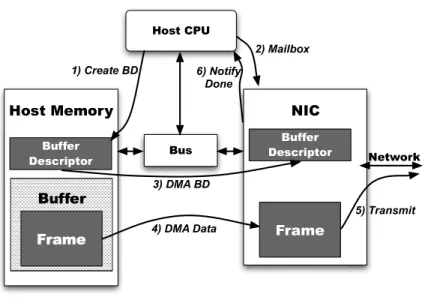
Figure 2.1 Steps for sending a frame with a NIC.
For both sending and receiving frames, the OS maintains buffers of free space that are allocated to frames. When the OS prepares to send a frame, it copies the frame contents to a series of free buffers and builds descriptors for the buffers that hold that frame. These descriptors, called buffer descriptors, contain the size and host memory address of the buffers. Likewise, the OS must preallocate free buffers so that the network interface has somewhere to copy frames as they arrive. These preallocated receive buffers also have buffer descriptors (BDs); receive BDs convey information about how much space is available in host memory for frame delivery. The OS organizes both send and receive BDs in circular rings, each of which has a producer and consumer value that indicate the amount of free BDs in each ring.
via a NIC. It is assumed that before these steps take place, the OS has copied the frame into a free buffer and is otherwise ready to send the frame. From there, the processor 1) fills in the contents of a buffer descriptor corresponding to the frame that is to be sent. The specific BD filled in is the next available in the send BD ring, indicated by the send-buffer-descriptor producer pointer. To indicate that a frame is ready for transmission, the OS2) writes the updated send-buffer-descriptor producer value into the NIC via programmed I/O. As indicated by the figure, these updates to the buffer-descriptor producer are sometimes referred to as mailbox writes. The NIC maintains its own copy of the host’s send-buffer-descriptor ring and a local producer value, and thus the NIC can determine when new BDs are available. After being notified of the updated send buffer producer value, the NIC 3) reads the host’s BD into local NIC memory via direct memory access (DMA). When the send BD arrives, the NIC analyzes the buffer and 4) fetches the associated host buffer. Once the frame data has fully arrived, the NIC 5) transmits the frame out over the network using the medium access control (MAC) unit. Once the transmit has completed, the NIC may 6) notify the OS by interrupting the host’s processor. An interrupt coalescing threshold set by the OS determines whether or not the NIC will interrupt the host. This value specifies how many frames must finish transmission before the NIC interrupts the host, which coalesces several events into one interrupt and hence reduces host interrupt overhead.
H o s t C P U B u s B u ffe r D e s c rip to r B u f fe r F r a m e H o s t M e m o r y N IC B u ffe r D e s c rip to r B u f f e r F ra m e N e tw o rk 1) R e c e ive 2) D M A D a ta 3) D M A B D 4) N o tify D rive r
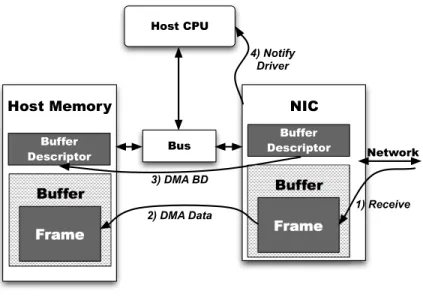
Figure 2.2 Steps for receiving a frame with a NIC.
Figure 2.2 presents the steps required to receive a frame from the NIC into host memory. The initial conditions for receiving a frame are slightly more complex than for sending one. The steps in this figure begin after the OS has already created free receive buffers and corresponding BDs in host memory. Furthermore, the host has already notified the NIC of the existence of these free buffers, and the NIC has read the corresponding BDs into NIC memory via DMA. Notification of free receive buffers is done analogously to the notification of available send buffers.
Once free buffers are available, the NIC 1) receives network data into local NIC memory. After the frame completes its arrival, the NIC2)transfers the frame contents via DMA to the host memory location pointed to by an available receive BD. After that, the NIC 3) modifies the NIC’s copy of the corresponding receive BD’s length
field in order to indicate the size of the received frame and then writes the modified BD to host memory via DMA. Finally, the NIC 4) notifies the OS that a frame has arrived. Typically this notification comes in the form of a DMA write of the newly updated receive-buffer-descriptor consumer pointer, which indicates that the NIC has consumed free buffers. However, this notification may also be an interrupt. Both forms are subject to coalescing thresholds, just as in the send case.
These steps are somewhat simplified for clarity. In practice, frames may be trans-ferred between the NIC and host in the form of several buffers and BDs, rather than just one each as depicted here. Commonly, received frames use just one buffer and descriptor pair (presuming that the allocated buffers are of large enough grain to hold the received frame), while sent frames typically use two separate buffer and descriptor pairs for a frame’s IP header and its payload data. Additionally, the operating system may or may not actually copy data between user- and kernel-space buffers. To avoid the memory overhead of copying, the OS may simply remap the virtual pages from user to kernel space or out of kernel space into user space [16]. Regardless of these differences, the NIC’s tasks and OS’s responsibilities are identical.
2.1.2 The Tigon-2 Architecture
Since the NIC processing steps presented in Section 2.1.1 are straightforward and methodical, most NICs manage these steps with high-speed application-specific in-tegrated circuits (ASICs). However, programmable architectures offer flexibility to
redefine the steps performed by the NIC and add functionality into those steps. This functionality enables offloading portions of server computation to the NIC. As men-tioned in the introduction, several researchers have perviously examined offload ca-pabilities of programmable NICs. Existing programmable NIC caca-pabilities include iSCSI offloading, IPSec firewalling and cryptography, message passing, TCP check-summing, and data caching [22, 1, 43, 28, 25]. The Tigon-2 NIC architecture is the only known user-programmable Gigabit Ethernet NIC architecture and is the basis of the AceNIC family of 3Com Gigabit NICs. When Alteon Websystems released the firmware to the Tigon-2 as open-source software, it also released the hardware and firmware manuals which describe the Tigon-2 hardware and software architec-tures [5, 6]. This section uses that information to summarize the Tigon-2.
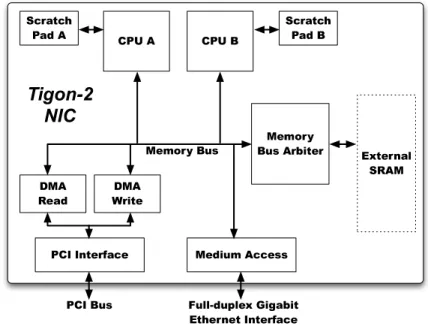
The Tigon-2 architecture has two processors running at 88 MHz, one private scratch pad memory per processor, two DMA channels that interact with a peripheral component interconnect (PCI) interface, and a MAC unit to assist in transmitting and receiving frames over the full-duplex Gigabit Ethernet interface. Figure 2.3 depicts this architecture. The processors support a subset of the MIPS R4000 instruction set and two additional instructions for priority decoding and jump-table offset control flow. The 64-bit memory bus runs at 100 MHz. The connected external SRAM operates in burst mode with an initial latency of 2 memory cycles and a burst length of 4 64-bit words, providing a maximum achievable throughput of 5.12 Gb/sec. The
S c ra tc h P a d A S c ra tc h P a d B C P U A C P U B M e m o ry B u s A rb ite r E x te rn a l S R A M D M A W rite D M A R e a d P C I In te rfa c e M e d iu m A c c e s s M e m o ry B u s P C I B u s F u lld u p le x G ig a b it E th e r n e t In t e rfa c e T ig o n ¡ 2 N I C
Figure 2.3 The Tigon-2 Gigabit programmable NIC architecture.
scratch pads provide access of up to one 32-bit word per core cycle. The processors and hardware assists also have single-cycle access to a set of memory-mapped registers.
The processors may use scratch pad memory for either instructions or data, but each scratch pad has only one port. Each processor also has a small hardware-controlled instruction cache that caches contents only from main memory (not the scratch pad.) These instruction caches each have a single 128-byte line for prefetching firmware not found in the scratch pad. The Tigon-2 uses a prioritized, burst-detecting bus arbitration scheme with timeouts to prevent starvation. Both processors share one arbiter request slot with round-robin arbitration between the processors, though the processors have the lowest prioritization among all requesting devices.
The hardware assists may be logically decomposed into four interfaces: DMA read, DMA write, MAC transmit, and MAC receive. DMA read transfers data from host memory to NIC memory, while DMA write transfers data in the opposite direc-tion. Likewise, the MAC transmit interface sends frames from NIC memory out to the network, while the MAC receive interface writes received frames into NIC mem-ory. These DMA and MAC assist units are simple nonprogrammable state machines that perform I/O services. The assists read transaction descriptors created by the processors and perform the requested operation. These transaction descriptors are in local NIC memory and are organized in circular descriptor rings, just like the buffer descriptor rings. Each ring has a producer and consumer value, and there are sep-arate rings for the four assist interfaces. When the processors request service, they create a transaction descriptor in the next free slot of the appropriate ring and update the producer value. The assists likewise poll this producer value in order to deter-mine when new requests arrive. As the assists complete transactions, they update the consumer value for their ring, indicating to the processor when the transactions have completed. The caveat to this description is that MAC receive works in reverse. The MAC receive interface produces transaction descriptors for received frames and writes the producer value, while the processors read these descriptors and update the consumer value as they process the received frames.
2.1.3 NIC Firmware
Though the hardware described in Section 2.1.2 facilitates the input and output (I/O) transactions required by a NIC, a programmable NIC’s firmware must orches-trate the hardware in an efficient manner. Efficiency ensures timely completion of the NIC’s processing steps. This section describes the Event Model abstraction of NIC processing and a mapping of event processing to hardware resources.
The Event Model
Most steps described in Section 2.1.1 correlate to actions that the NIC must take to further the processing of a frame. These actions taken are calledevents, and either hardware or software may trigger them. The firmware functions that service events are calledevent handlers. Hardware events result when the hardware completes trans-actions. For instance, when the DMA read interface finishes processing transactions, a DMA read event occurs and the DMA read handler services that event. On the other hand, software events are the result of previous events that may need further, separate service. For example, during the process of servicing a DMA read event, the DMA read handler inspects the type of data that has been read. This is done at the completion of step 3) in Figure 2.1. If the data is a group of send BDs, the DMA read handler will trigger a separate software event for the purpose of requesting the frames associated with these newly received send BDs. This requesting process is
the initialization of the read transaction represented by step 4) in Figure 2.1. Cor-rectly triggering and clearing these various events as each step proceeds requires a management mechanism.
The Tigon-2 architecture manages events via a hardware event register mecha-nism, while the Tigon-2’s specialized instructions provide efficient event dispatch. Each processor has its own event register. Event registers are bit vectors in which each bit represents a distinct event. Events are prioritized by the rank of their bit po-sition in the event registers. Processors use the specialized priority-decode instruction to determine the highest-order event currently set. The result of this priority decode feeds the specialized jump-offset instruction, which transfers control via a jump table to the event’s handler.
As hardware events complete, the Tigon-2 automatically sets a bit in the event registers associated with that type of event. For instance, the hardware controls DMA read, DMA write, MAC transmit, and MAC receive events. These hardware events are subject to a software-controlled threshold which sets how many transactions must finish before the next event should be triggered. The Tigon-2’s processors may write to the event register in order to clear events or set software events.
Task-level Parallelism
As Figures 2.1 and 2.2 show, many steps (and thus events) are involved in sending and receiving frames. To maximize frame throughput, event processing should be
overlapped in such a way as to allow multiple frames to be in various stages of processing at any given time. Alteon’s Tigon-2 firmware (version 12.4.13) processes all event handlers on one processor while executing the timer event handler on the other [6]. Kim et al. examined the data sharing patterns and load balancing among the Tigon-2 event handlers and repartitioned them such that send-related handlers ran on one processor while receive-related handlers ran on the other, resulting in a 65% performance increase [26]. While the Alteon firmware exploits very little parallelism, both approaches rely on task-level parallelism. In the programmable NIC domain, task-level parallelism refers to the concurrent execution of parallel event handlers. A task is one event handler that implements a NIC processing step.
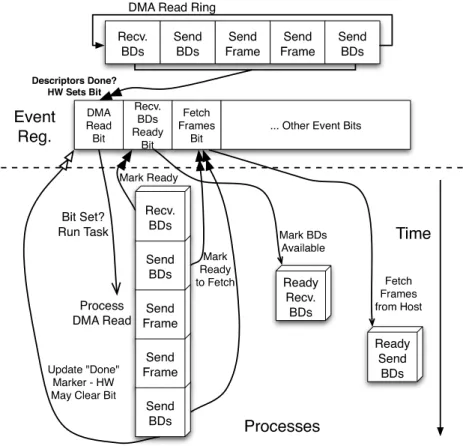
Figure 2.4 illustrates task-level parallelism using an event register; double-black arrows indicate bits being set, double-clear arrows represent bits being cleared, and single arrows represent event dispatch. In this case, the hardware sets the DMA-read event bit in the event registers. A processor assigned to this type of event then runs the DMA-read handler (labeled “Process DMA Read”), which inspects the completed DMA-read transactions. As shown in the figure, when the handler encounters receive and send BDs, the DMA-read handler turns on the respective software event bits in the event register. Assuming there are sufficient processors, each of these types of handlers (receive-BD and send-BD handlers) may run concurrently after the DMA-read handler toggles their event bits. Kim’s parallelization strategy is such that
P ro c e s s D M A R e a d T im e E v e n t R e g . D M A R e ad B it R ec v . B D s R e ad y B it F etc h F ra m es B it ... O th e r E v e nt B its S e n d B D s S e n d F ra m e S e n d F ra m e S e n d B D s R e cv . B D s De scrip to rs D o ne ? H W S ets B it B it S e t? R u n T a s k P ro c e s s e s M a rk R e ad y to F etc h M a rk R e ad y U pd ate "D o n e " M a rke r ù H W M ay C le a r B it R e cv . B D s D M A R e a d R in g S e n d B D s S e n d F ra m e S e n d F ra m e S e n d B D s R e a d y R e cv . B D s R e a d y S e n d B D s M a rk B D s A v a ila b le F etc h F ra m es fro m H o s t
Figure 2.4 Task-level parallelism using an event register.
the “Receive-BDs ready” event handler could run concurrently with the DMA-read handler, but the “Fetch Frames” handler would have to run after the DMA-read handler completes, since it is statically assigned to the same processor as the DMA-read handler.
Regardless of partitioning issues, the key observation regarding task-level paral-lelism is that event handling occurs at the granularity of per-type tasks. With an event register, there is no notion of a partial event; events are either on (some data is ready
to be processed) or off (no data available for processing at this step). For instance, the DMA-read handler in Figure 2.4 processes all currently completed DMA-read transactions. Task-level parallelism’s scalability depends upon the handlers having relatively equal computation demands and experiencing low data-sharing costs where data sharing exists. However, Kim’s profiling work shows that the Tigon-2 handlers are not equally balanced [26]. Furthermore, the Tigon-2 architecture only supports interprocessor data sharing through the main memory, for which the processors have the lowest arbitration priority. Using the task-level parallelism approach with more than two processors on an architecture similar to Tigon-2 is thus unlikely to scale efficiently.
2.2
Simulation
Programmable NIC systems, such as those described in the preceding section, represent an interesting area of research because such NICs will enable network servers to utilize the frame rates delivered by next-generation links. When developing other programmable systems, such as uniprocessors and multiprocessors, researchers utilize simulation as a mechanism to develop and enhance their designs.
Simulators are useful tools that system designers utilize in various stages of the de-sign process. However, the flexibility and accuracy of a simulator often determine its utility in design. Simulators derived from transistor-level or low-level register transfer language (RTL) descriptions are highly accurate and can yield important, physically
unobservable insights into performance behaviors and bottlenecks. The Intel IXP simulator falls in this category [7]. Such simulators result from a specification of a highly detailed design that has already progressed far beyond the point of microar-chitectural exploration. This class of simulator is useful for modeling low-level details of an existing, established design. However, they tend to be poor tools for designing new systems. For instance, if designers propose an entirely new memory hierarchy, at minimum this requires a complete rewrite of that subsystem including low-level im-plementation details. Portions of the system that interact with the memory hierarchy may also require modification.
Another approach to simulation is to model high-level architectural constructs in a modular fashion. Computer architects then organize the overall model using a combination of these high-level pieces. This simulation approach provides flexibility, but that flexibility can come at the price of accuracy. Recent trends in architectural simulation favor detailed approaches in order to reduce accuracy concerns. Pai et al. show that accurately modeling ILP mechanisms in detail significantly improves the accuracy of ILP shared-memory multiprocessors [34]. In that case, modeling the processor interconnect network and memory system in detail may prove useless and misleading if the processor models do not accurately model memory interactions.
To be useful from the beginning to end of the design process, a simulator should be flexible enough to permit rapid evaluation of a wide space of high-level design changes,
yet accurate enough to yield meaningful results. Several simulation frameworks in the domain of general-purpose processors attempt to meet these goals. Section 2.2.1 discusses existing simulator frameworks in light of the characteristics of NICs, and Section 2.2.2 discusses the LSE, on which Spinach is based. Section 5.1 further details modern multiprocessor and embedded processor simulators.
2.2.1 Evaluating Simulation Approaches for Suitability in the NIC
Do-main
The vast majority of architectural simulators are either discrete-event simulators or process-oriented simulators that result from machine descriptions. While these simulators may be modular, they are inherently sequential. Vachharajani et al. dis-cuss the difficulty of correctly mapping parallel hardware operations to sequentially programmed simulators [45]. In particular, behavior implemented by module appli-cation programming interfaces (APIs) may have very little correlation to hardware behavior. Discrete-event simulators must take special care to model parallel hardware actions with sequentially processed events. Similarly, architectural machine descrip-tion simulators require a careful mapping of potentially concurrent hardware acdescrip-tions to sequential simulator states.
While it may be straightforward to implement the functions internal to module APIs correctly, managing the method in which APIs are called complicates matters further. Module APIs can be called globally from any module to any other module,
and this can introduce correctness problems as designs evolve away from the original baseline configuration. Furthermore, a user has no guarantee that an added module will correctly affect the rest of the entire system unless that user fully understands the entire codebase. For instance, a new cache controller module may attempt to throttle bandwidth by taking more cycles to satisfy a request, but a calling module may have been written with an existing notion of what the bandwidth behavior used to be. The original calling modules may issue cache requests but then obtain the requisite values directly from global shared state after some internally set number of cycles. Subsequent calls may do the same thing. Thus the simulation proceeds using the new cache module and keeps getting correct values, but it is not readily apparent that timing is completely inaccurate. While this is completely a software engineering concern, the complications of managing such issues in large simulators with many developers are nontrivial. Consequently, taking an existing simulator codebase that functions in this way, such as SimpleScalar [10], is less than ideal because it limits flexibility and raises serious correctness and maintenance concerns.
The asynchronous interactions of a programmable NIC’s assists and multiple pro-cessors further complicate matters with traditional discrete-event simulators. Such simulators schedule events for known times; when no events are scheduled, the simu-lation proceeds “instantly” over these empty cycles. However, NICs regularly process network and host requests that arrive unsolicited and asynchronously. Correctly
modeling this unsolicited behavior is essential to correctness because the timing of instruction execution and state modifications may have an impact on the actual in-struction sequences computed [29].
Recent simulator frameworks attempt to build architectural simulators that better match the intended hardware. The Asim simulation framework models the execution of Alpha processors using a combination of a performance model that maintains tim-ing and a backend execution layer that maintains machine state [17]. As instructions proceed through the performance model, the performance model’s simulation units interact with the execution layer to update machine state. Modules within the per-formance model interact with each other and the execution layer via a set of APIs. Again, the ability to call a global API from anywhere in the code raises maintenance and correctness concerns.
While Asim better maps architectural simulation to hardware structures, it re-quires close integration with the execution layer, which is still a sequentially pro-grammed emulator. If users modify the modular timing layer to represent a radically different design, the execution layer may not model the associated state transitions correctly. Straying from the state transition steps supported by the execution layer would require modification to the execution layer, which most likely would be a non-trivial software engineering effort. Additionally, the execution layer may obscure intercycle details relevant to the correctness of the system model.
Asim’s performance model could correctly model the asynchronous, unsolicited requests from NIC traffic by having additional NIC-specific modules that call the memory modules for service. Thus, a framework such as Asim begins to address some of the concerns for flexible simulation of systems that do not closely match the timing characteristics of baseline configurations or that depend on interactions asyn-chronous to the flow of instructions, such as NICs. However, maintaining correctness with respect to the execution layer involves the same problems of traditional sequen-tially coded simulators. Specifically, the user must still call global APIs in a method consistent with timing, which necessarily implies a significant software engineering cost in large systems.
2.2.2 The Liberty Simulation Environment
Vachharajani et al. introduced the Liberty Simulation Environment (LSE) as a way to map hardware structures faithfully to simulation modules [45]. Their hierar-chical method of building simulators that can tightly couple timing and simulation state is novel and still relatively new to the architecture community. This subsection compares the LSE to Asim and explains how computer architects may use the LSE to build useful simulators. The hierarchical LSE method enables code reuse that con-tributes to Spinach’s flexibility. Spinach extends the LSE by tightly coupling machine state to each module rather than relying on the LSE’s functional emulator.
design choices rapidly. Computer architects compose LSE simulators using a set of these modules. Modules communicate with each other via ports. Users instantiate modules, connect the module ports, and compose hierarchical modules using a high-level language, the Liberty Structural Specification (LSS) [44]. The key to LSE simulators is the port construct; all communication between modules must take place between ports. The abstraction of a port-to-port connection is called achannel. Since all communication happens over channels, LSE modules have no notion of global APIs for communication. Instead, modules must convey communication via their output ports using “send” calls. However, each send call is specific to the port instance on which it is called, and a module may only call send or receive methods on local port instances. Modules cannot see a global port namespace.
Fundamentally, the modular Asim approach differs from the LSE approach in that LSE forces all communication across local module port instances, and the timing model used in LSE is directly coupled to dataflow. Forcing communication over enumerated ports ensures a close mapping of modules to hardware behavior, while the coupling of timing to dataflow enforces that data flows through the model as it would in the desired hardware. This coupling means that there is no potential disconnect between machine state timing and performance model timing which could affect correctness.
connec-tions. LSE channels support sending and receiving one unit of data per simulation cycle. Transmitting more requires more channel connections between the two com-municating modules, just as increased per-cycle bus bandwidth requires more bits on the bus. Data units transmitted via ports are typically restricted to C’s simple built-in types, but future versions of the LSE will support complex data types.
E n a b le D a ta A c k O U T I N 0 I N 1 I N 0 I N 1 O U T M U L A D D
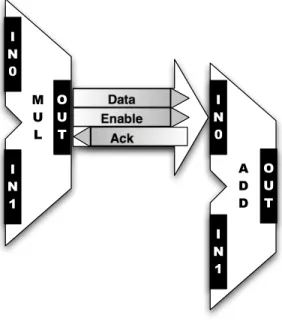
Figure 2.5 Example of an LSE channel connecting two ALUs.
LSE channels contain three parts: data, enable, and acknowledgement (Ack). Fig-ure 2.5 depicts an LSE channel connecting the “OUT” port of one hypothetical MUL module to the “IN0” port of an ADD module. (In the interest of simplicity, full port connections are not shown.) After the MUL unit has its source operands, it produces its output and sends it out via its OUT port. This sets the data portion of the
chan-E na b le D a ta O U T I N 0 I N 1 M U L I N 0 I N 1 O U T A D D I N 0 I N 1 E na b le D ata E na b le D ata A c k E na b le D a ta A c k A c k A c k O U T I N 2
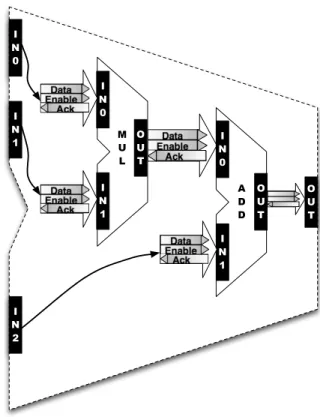
Figure 2.6 A hierarchical multiply-add LSE module.
nel. The LSE framework consequently schedules the ADD module to run, which sees the new input and may produce an output on its OUT port. The ADD module is responsible for passing back an Ack value to the MUL unit’s OUT port. Typically LSE modules pass back the Ack supplied at their output to their inputs. This back-ward flow enables source modules in a chain can determine if subsequent dependent operations have been acknowledged. In this case, the ADD unit would pass whatever Ack value is present at its OUT port back to its IN0 and IN1 ports. This, in turn, arrives via the channel at the feeding modules, including MUL. Enables flow through
the system analogously, though in the opposite direction. Notice, however, that the enable portion of an LSE channel is largely redundant because LSE channels support sending “null” data, which effectively represents a disabled signal. The modules must facilitate all data, enable, and Ack flow explicitly. However, they can control only the channels that flow through them via their ports.
Figure 2.5 could be used as a building block for a multiply add (MADD) module. The LSS standard supports building modules hierarchically. Figure 2.5 depicts two low-level modules. Low-level LSE modules are written in C and use LSE port APIs to communicate; high-level LSE modules are composed of a mixture of low-level modules and other high-level modules. For instance, a user could define a new MADD module based on the two low-level ALUs, as in Figure 2.6. The newly defined MADD unit has three input ports (IN0, IN1, and IN2) and one output port (OUT) that would be defined in its LSS file. The MADD LSS specification would instantiate two ALUs (one parameterized to multiply and the other to add). The high-level MADD specification would then connect port instances of the component low-level ALUs by using LSS connection statements. After defining MADD, a user could instantiate it and use it interchangeably with any other high- or low-level module. When connecting modules in LSS, there is no difference between the two. LSE simulators use module blocks built similarly to the MADD example in order to construct architectural models.
systems and memory organizations. Once a user creates a processor model, it is trivial to instantiate and connect multiple instances of that model. Furthermore, the LSE’s tight dataflow/timing coupling ensures reliability when dealing with requests that are unsolicited and asynchronous to instruction execution. Such interactions may be requested by special-purpose modules that plug in (via ports) to the rest of the general-purpose execution and memory systems. These requests may arrive asynchronously and unsolicited, and will be dealt with cycle-by-cycle just as “normal” interactions from the processors would. Code reuse and the straightforward, correct mapping of hardware structures to simulator modules make the LSE a good candidate framework for simulating programmable NICs.
As with most simulators, LSE modules can take ordinary values as parameters. Unlike most other simulators, modules can also take user-written functions as param-eters. These functions can preprocess input data and set the cycle-by-cycle behavior of the module accordingly. For example, bus arbiter units take an algorithmic pa-rameter that determines which requesting unit can access the bus. This papa-rameter effectively sets the cycle-by-cycle arbitration policy. Users can manipulate such algo-rithmic parameters to get very different behaviors using the same modules. Thus, key advantages of the LSE include the straightforward retargetability and reconfiguration of modules into simulators of various systems as well as the easy integration of various simulators with each other. The latter is particularly straightforward because even a
Spinach: A Simulator for Programmable NIC
Architectures
Because network interface cards can have a tremendous impact on server appli-cation performance, the design of efficient, high-performance NICs will be of critical importance as computer architects attempt to meet the increasing demands of next-generation applications. Offloading services normally provided by the server to the server’s programmable NIC can improve performance [28]. TCP protocol processing, iSCSI services, and message passing services are surfacing as future applications for programmable NICs [21, 31, 43].
Simulation provides an inexpensive design tool that can reveal an arbitrary de-gree of detail and is widely used in general-purpose processor design. However, unlike general-purpose CPUs, NICs must handle host and network interactions that arrive and complete asynchronously with respect to the flow of instructions. This char-acteristic of programmable NICs makes most general-purpose CPU simulators poor candidates for extension into the domain of NIC modeling.
This chapter contributes Spinach, a flexible simulation toolset based on the Lib-erty Simulation Environment (LSE) framework. Spinach is the first known publicly available programmable NIC simulation toolset capable of modeling NICs in microar-chitectural detail. Spinach introduces a new model of simulator computation
ab-straction that enables high degrees of configurability and requires very little software engineering overhead when using or recomposing Spinach modules. Spinach’s con-figurability is limited only by the LSE framework’s ability to produce and compile large, complex software systems that may result from complex Spinach definitions; this limitation is not inherent to Spinach.
Spinach is composed of only 21 low-level computation and state modules. Users may compose basic simulator computation and state modules into blocks; these blocks and basic modules may be composed hierarchically in any fashion the user wishes. However, existing LSE-based modules rely on an underlying emulator to maintain the architectural state of the system being simulated. An emulator backend such as this may introduce correctness problems when dealing with the asynchronous interactions prevalent in NIC processing. Furthermore, any change to the many modules which may affect the architectural state may require complementary changes to the emulator backend. Such changes may be subtle, thus increasing the likelihood of user error and the introduction of inaccuracies into the simulation model. Furthermore, correctly maintaining the backend emulator requires significant knowledge of how the backend emulator models its architectural state, which may be disjoint from the user’s desired model. Spinach obviates all of these concerns by eliminating reliance on the emulator backend and instead maintaining the architectural state locally per module. Thus, Spinach modules provide a one-to-one mapping of hardware constructs and their
associated state (e.g., arithmetic units, memory units, etc.) to software modules. The straightforward architectural organization of Spinach simulators combined with the limitless flexibility of Spinach modules enables rapid evaluation of wide design spaces. For instance, modifying a single-processor NIC architecture to support an additional processor required only 90 lines of high-level script.
Section 3.1 of this chapter discusses the design goals for Spinach and the vari-ous simulation approaches available to meet those goals. Section 3.2 introduces the modules Spinach provides. Section 3.3 presents the Tigon-2 programmable NIC ar-chitecture and examines how Spinach modules map to this arar-chitecture. Section 3.4 evaluates the accuracy of Spinach modeling Tigon-2, finding that the Spinach model is within 4.5% of hardware performance on average. Section 3.5 concludes by evaluat-ing some modified versions of the Tigon-2 architecture and discusses the importance of certain architectural parameters with respect to NIC processing. Portions of this chapter, including some figures, are based on a paper copyrighted by the Association for Computing Machinery [48] and are used in compliance with the ACM’s authorship copyright agreement.
3.1
Simulating NICs
As described in Section 2.2, a large portion of previous simulation work is unsuit-able as a basis for simulating NICs because of the unique characteristics NICs have, such as self-modifying code and I/O interactions that occur asynchronously to the
flow of instructions. Furthermore, many previous simulation frameworks present a sig-nificant software engineering challenge to computer architects because they require accurately mapping parallel hardware events to sequential simulator code. Global simulation application programming interfaces (APIs) can introduce artificial behav-iors that model physical components poorly and can detrimentally affect correctness. The Liberty Simulation Environment (LSE) attempts to address these issues. De-signers build simulators by composing LSE modules hierarchically. Unlike simulators that allow global APIs for communication, LSE modules can communicate with each other only by their ports; modules evaluate ports on a cycle-by-cycle basis. The port construct encourages a close mapping of parallel hardware structures to LSE modules. Designers instantiate modules and connect module ports using the high-level Liberty Structural Specification (LSS) language [44].
3.1.1 Spinach: Going Beyond LSE
Ideally, reconnecting the component modules in different ways should change the execution and timing characteristics of the resultant simulator in a manner exactly representative of the module reorganization that the user intended. As previously described in Section 2.2.2, this is precisely what happens. However, as alluded to in that section, the caveat to flexible LSE module reorganization is the LSE’semulator interface. Though not discussed in the paper by Vachharajani et al. [45], the emulator is a fast functional simulator that maintains the architectural state of the entire
system. Thus, existing LSE simulators use the modules only for timing. The modules may send data, but most parts of existing LSE simulators do not use the dataflow to send and receive machine state (such as register values, memory data, and so on.) These simulators use the control flow aspects of the LSE port construct to maintain timing, and the modules internally call emulator APIs to manipulate machine state as instructions and memory requests propagate.
This approach is similar to the Asim approach in that it requires the user to have confidence that the backend emulator is modeling state transitions exactly as their de-sired timing model intends. Just as with Asim, any deviation from the supported state transitions requires either addition or modification to the emulator. This necessarily implies that a simulator user who wants to be able to change the model topography radically by reconnecting modules will also need to have a firm understanding of the emulator implementation. Furthermore, the user may have to maintain and update the emulator. Some changes, such as adding multiple processors, may require nontriv-ial modification to the emulator. With regard to NIC design, the asynchronous and unsolicited memory interactions would have to interact with the emulator. Again, ensuring that these interactions happen in the order modeled by the simulator timing may require a full audit of the emulator code. In short, the emulator introduces a substantial software engineering burden that may severely limit a designer’s ability to evaluate a wide scope of designs correctly.
Spinach addresses these issues by taking advantage of the LSE’s intermodule dataflow support. Furthermore, using the emulator backend is not an LSE require-ment, and Spinach simply does not use it. Rather than using the modules for timing only and maintaining state in the emulator, Spinach modules send and receive state data via their ports. Some modules, such as Spinach memories, also maintain local state. Memory modules receive memory addresses and load or store local data via their ports, ALUs perform requisite arithmetic operations on intermediate values, processor control signals flow throughout the model via channels, and interconnect modules, steered by the values generated by control modules, route data throughout the simulator model.
Hence, the LSE provides a straightforward method for mapping hardware struc-tures to simulator modules. Spinach extends this mapping by coupling module be-havior directly to state changes and dataflow. Since LSE port dataflow happens on a cycle-by-cycle basis and Spinach ties state to timing, Spinach modules naturally support the asynchronous transactions common in NICs. Spinach’s coupling of tim-ing and state increases the amount of computation per simulated instruction because all intra-instruction operations (including control generation) must be modeled com-pletely. However, this model of simulation ensures cycle-by-cycle accuracy and cor-rectly models any asynchronous or unsolicited simulation interactions. In the Spinach model, there truly is no difference between an asynchronous, unsolicited request for
service and a “normal” instruction request. They both proceed cycle-by-cycle through the system and complete just as they would in real hardware.
E na b le Da ta A c k E na b le Da ta A c k En a b le D a t a Ac k E na b le D ata A c k D a ta 1 Pro d u ctio n Lo g ic D ata S e le ctio n L o g ic S R C D E S T S R C D a ta 0 Pro d u ctio n Lo g ic SEL D ata C o nsu m p tio n
Figure 3.1 A Spinach mux with LSE channels enumerated.
The difference between the standard LSE mux and the Spinach mux underscores the distinction between the two approaches. Figure 3.1 depicts the Spinach mux. The standard LSE mux uses an algorithmic selection parameter to choose which in-put gets passed through. That is, there is no “select” inin-put. The algorithmic selection logic makes a query to the backend emulator to determine, according to the current instruction, what selection should be made. However, this violates Spinach’s simu-lation abstraction model. In Spinach modules, decisions must be local and depend only on the inputs to the module and state maintained by the local module.
There-fore, Spinach’s mux module has a “select” input represented as a simple integer that determines which input gets passed through to the output. (The select input must be generated by another control module, which likely takes current-cycle state values as inputs to determine where to route data.) Unlike the simplified figure, inputs and outputs are uniform-sized vectors; the “select” signal chooses a vector of inputs to pass through.
It is important to notice that, under the Spinach simulation model, module state is completely independent of the rest of the system. Thus, adding new components (such as processors or memories) or reorganizing existing components does not affect the correctness of the rest of the system. The resultant simulator will faithfully model execution and memory behavior exactly as the user specifies by the LSS module connection listing. Because Spinach modules maintain a precise mapping of hardware to simulator modules, users must understand only the potential state modifications introduced by their added or changed “hardware” (module) connections. Thus, users have plenteous degrees of freedom with which to modify their configurations, all by simply adding and changing high-level LSS module connections. Furthermore, the user does not have to maintain a sequential emulator, which leads to lower software engineering costs. Spinach’s low software engineering cost enables rapid exploration of a wide architectural design space.
3.2
Spinach Modules
The vast majority of existing LSE modules do not satisfy the Spinach model of simulation. In order to build a full Spinach-based system, one must have sufficient Spinach-compliant building blocks. This section introduces the Spinach library of base modules. This library consists of 21 new modules, which may be placed into four general categories: simple interconnect, memory, input/output (I/O), and processor. Interconnect modules act as glue logic between the various other computation and memory modules. Memory modules are those that hold memory state and control timing and arbitration of general-purpose memory systems. I/O-specific modules are those that interact with the external host and network. Processor modules are those used in a processor core and may include instruction-set specific modules for decoding.
3.2.1 Interconnect
Table 3.1 presents the Spinach interconnect modules. These modules typically function as glue logic between data-generating modules and state modules. The “inputs” and “outputs” listed in this and all subsequent tables are LSE ports. Ports connect to each other via LSE channels, each of which contains data, enable, and acknowledgement subparts. Figure 3.1 illustrates how a mux might be used as glue logic between source logic and destination logic that will consume the value(s) selected by the mux. All interconnect modules that act as steering or pass-through logic pass the contents of the entire LSE channel: data, enable, and acknowledgement (Ack).
Module Name
Inputs Outputs
Ack Detector
Data Passed-through Data, “Ack
De-tected” Signal Data
Detector
Data Passed-through Data, “Data De-tected” Signal
Demux One N-wide Vector, Select M N-wide Vectors (one is valid)
Function Data Resultant Signal
Mux M N-wide Vectors, Select One N-wide Vector
Pipe* Data Time-delayed Data
Receiver Data (none)
Sender (none) Data
Tee* Data Fanned-out data
Asterisks (*) denote modules distributed with the Liberty Simulation Environment Italicsdenote algorithmically parameterized modules
Table 3.1 Spinach interconnect modules.
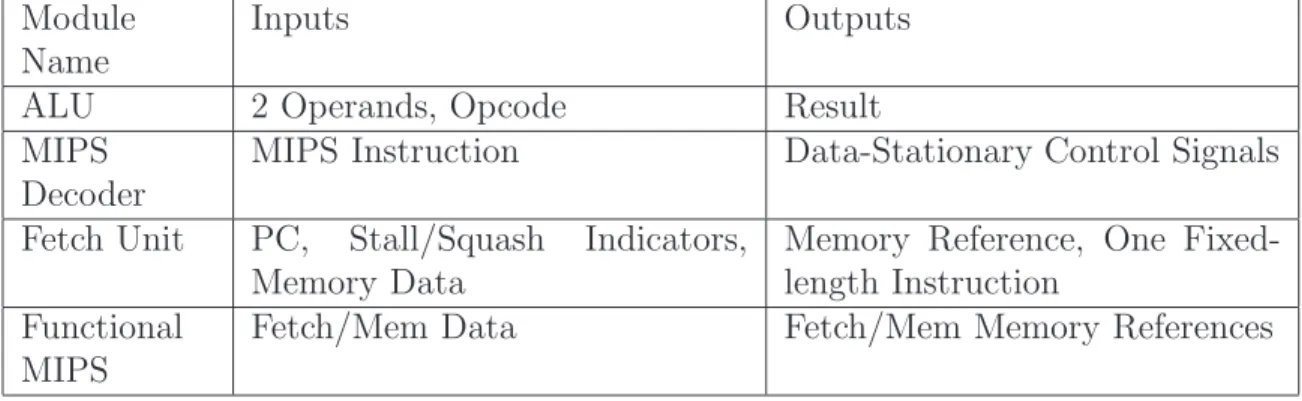
Ports that are not passed through receive a negative acknowledgement (Nack). Both the Ack and Data detectors analyze a passed-through LSE channel for the presence of positive acknowledgement and data, respectively. Such modules are use-ful in control units to analyze progress of variable-latency circuits, such as memory hierarchies. The Function takes advantage of LSE’s capability to provide algorithmic parameters; it takes several input data signals and applies the user-supplied algorithm to determine its runtime output. Notice that the Tee (which acts as a fanout, since LSE channels may not be multiply tapped) and Pipe (a pipelined delay unit) are the only LSE-supplied modules; all other modules are new.
3.2.2 Memory
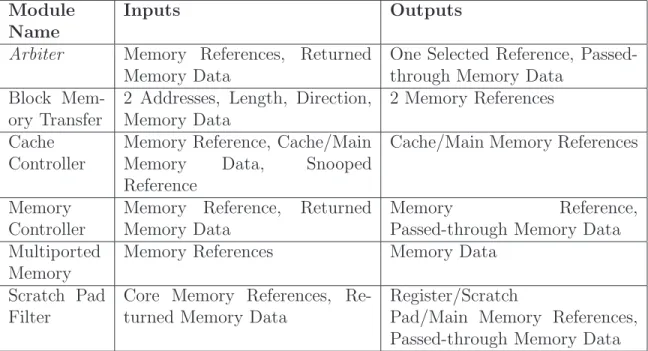
Table 3.2 enumerates the Spinach memory modules. Users compose these modules with interconnect modules to create memory organizations. Memory modules, like all other Spinach modules, are general purpose and may be used generically throughout a system model. For example, instances of Multiported Memory modules would be used both as register files and as main memory. Memory modules commonly accept and repeat memory references. Spinach memory references contain an address, an enable that indicates a load or store request, any data to be stored, and the reference’s datatype. The datatype specifies the size of the memory reference. Both data and addresses use one LSE port instance per byte of information. While modules must decode and reassemble these addresses and data, using vectors of bytes for address and data permits modeling of arbitrary address spaces and data widths that may be far beyond that which the simulator host directly supports.
The arbiter uses an algorithmically provided parameter to determine which input reference should be passed through; this effectively sets the arbitration policy. The Block Memory Transfer unit acts as a DMA engine between Spinach’s cycle-accurate, variable latency memory networks.
Both the Cache and Memory Controllers model timing policies for accessing a physical memory. A physical memory is instantiated as a Multiported Memory mod-ule, whether it is a register file, cache, SRAM, or DRAM. The Multiported Memory
Module Name
Inputs Outputs
Arbiter Memory References, Returned Memory Data
One Selected Reference, Passed-through Memory Data
Block Mem-ory Transfer
2 Addresses, Length, Direction, Memory Data
2 Memory References Cache
Controller
Memory Reference, Cache/Main Memory Data, Snooped Reference
Cache/Main Memory References
Memory Controller
Memory Reference, Returned Memory Data
Memory Reference, Passed-through Memory Data Multiported
Memory
Memory References Memory Data Scratch Pad
Filter
Core Memory References, Re-turned Memory Data
Register/Scratch
Pad/Main Memory References, Passed-through Memory Data Italicsdenote algorithmically parameterized modules
instance maintains each local memory state, but it does not model any intercycle latencies. Rather, the Multiported Memory retiresP references per simulation cycle,
where P is the number of input ports. Reads get processed before writes, thereby
enabling intracycle data forwarding.
The Cache Controller maintains tag state for all cached blocks and uses a write-through, no-read-allocate policy. Additional coherence policies may be supported by modifying this module. The Cache Controller satisfies incoming requests by forward-ing the request to a variable-latency cache unit or by loadforward-ing the correspondforward-ing cache line from main memory.
The Memory Controller maintains burst access information about the recent mem-ory patterns in order to determine when the memmem-ory bus is available. Requests that arrive during waiting cycles receive a Nack. The Memory Controller may be config-ured for either DRAM or SRAM operation. The Memory Controller issues memory references in order. Future improvements may include a memory access scheduling policy such as that discussed by Rixner et al. [40] in order to increase achievable bandwidth, but such policies require a complex split transaction bus. Such a bus architecture may not be feasible in embedded systems such as NICs. For DRAM op-eration, user-supplied row length and row activation latencies determine the latency each subsequent access experiences. SRAM operation is just a subset of DRAM oper-ation; SRAMs have a smaller burst (“row”) length and have fixed latencies between
bursts regardless of any switch between reading and writing.
A Scratch Pad Filter unit serves as a special-purpose arbiter and memory reference steering unit. Embedded systems commonly have private, low-latency scratch pad memories that may be partitioned from the global address space; the scratch pad filter detects private references and forwards them accordingly to either scratch pad memory or partitioned memory-mapped registers.
3.2.3 Input/Output
Module Name
Inputs Outputs
DMA Assist Read Host Data, Memory Data Host Reference, Memory Refer-ences, Write Host Data
MAC Assist Memory Data, Receive Network Data
Memory Reference, Transmit Network Data
NIC Feeder Host Reference, Write Host Data Memory Reference, Read Host Data
Packet Feeder
(none) Frame Data
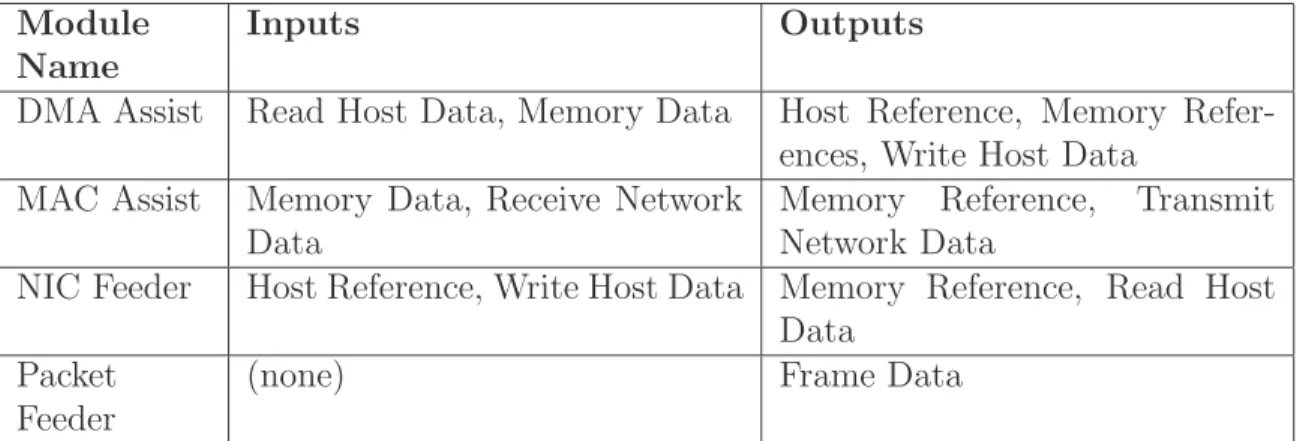
Table 3.3 Spinach input/output modules.
A network interface card must interact with a host and with an external network. The modules in Table 3.3 facilitate these interactions. The direct memory access (DMA) and medium access control (MAC) Assist units reside “onboard” the NIC. The NIC and Packet Feeders are part of the overall simulator, but they model the necessary external subsystems that drive NIC operations.